×

Morocco🇲🇦 | best citiesTop-Rated 10 cities in Morocco

Cities in Morocco split into distinct types, and picking the wrong one wastes days. The imperial cities inland (walled medinas, souks, riads) are the real draw, and they are cheap, dense and crowded. The Atlantic coast is modern, pricier and mostly skippable unless you need a transport hub or a surf town. The Atlas and desert gateways trade medina intensity for mountain access and cooler air. The north is greener, more Spanish-influenced and calmer. For backpacking or independent travel, trains make the main axis easy, while the south needs buses and shared taxis. Expect hassle in the biggest tourist medinas and quiet in the smaller ones.

By Johan Kruseman 🇳🇱 | Updated October 18, 2026
Explore the best towns in Morocco

Why go?Why These city Stand Out

Morocco suits city travel because its urban core is old, intact and still in daily use. Medinas were laid out for walking and donkeys, not cars, so they work as living neighborhoods rather than museum districts. Several dynasties made different cities their capitals over a thousand years, which is why the architecture, food and crafts vary more between cities than you would expect in a country this size. Berber, Arab, Andalusian and French colonial influences all sit on top of each other.

Geography shapes the experience too. Cities sit on plains between the Atlantic, the Atlas range and the Sahara, so heat, altitude and distance change what each place feels like. The rail network along the Atlantic corridor is fast and cheap. Beyond it, travel slows down.

Know before you choose: medina navigation … read more 👉
Morocco suits city travel because its urban core is old, intact and still in daily use. Medinas were laid out for walking and donkeys, not cars, so they work as living neighborhoods rather than museum districts. Several dynasties made different cities their capitals over a thousand years, which is why the architecture, food and crafts vary more between cities than you would expect in a country this size. Berber, Arab, Andalusian and French colonial influences all sit on top of each other.

Geography shapes the experience too. Cities sit on plains between the Atlantic, the Atlas range and the Sahara, so heat, altitude and distance change what each place feels like. The rail network along the Atlantic corridor is fast and cheap. Beyond it, travel slows down.

Know before you choose: medina navigation is confusing, and phone maps lose accuracy in alleys. Touts and unofficial guides are routine in the most visited medinas, and persistence is part of the deal. Modern ville nouvelle districts (French-built new towns) are fine for trains, banks and SIM cards but offer little to see. If you want museums, nightlife and polished sightseeing, other countries do it better. If you want working, layered old cities, Morocco is hard to beat.
Our Approach to Ranking
The list of best cities in Morocco is created based on culture, vibe, attractions, transport ease, and local charm. If you feel a city is missing in this list, please let us know.

When to go?Timing Your Visit for the Best Experience

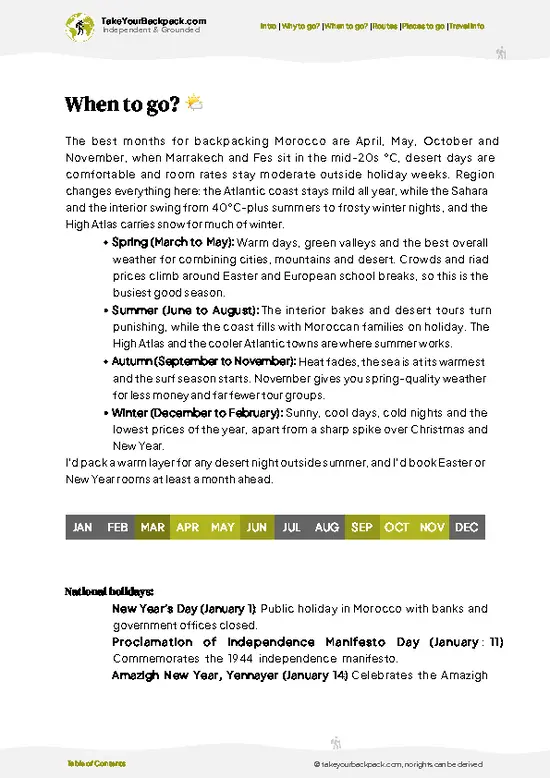
Best months: The best months for Morocco’s cities are March to May and September to November, when inland daytime highs sit around 20 to 30°C instead of the 38 to 45°C common in summer. Spring also brings green countryside and long daylight. Autumn is warm, settled and slightly cheaper than spring.

Winter and summer: Winter (December to February) is mild on the Atlantic coast, at 15 to 20°C by day, but inland and Atlas cities drop near freezing at night, and riads often have weak heating. Most of the annual rain (roughly 300 to 800 mm in the north and center) falls from November to March, so pack a shell. Snow closes some mountain passes.

Summer is not worth the time in the interior and the south. Marrakech, Fez and desert gateways regularly pass 40°C, and afternoons are unusable for walking … read more 👉
Best months: The best months for Morocco’s cities are March to May and September to November, when inland daytime highs sit around 20 to 30°C instead of the 38 to 45°C common in summer. Spring also brings green countryside and long daylight. Autumn is warm, settled and slightly cheaper than spring.

Winter and summer: Winter (December to February) is mild on the Atlantic coast, at 15 to 20°C by day, but inland and Atlas cities drop near freezing at night, and riads often have weak heating. Most of the annual rain (roughly 300 to 800 mm in the north and center) falls from November to March, so pack a shell. Snow closes some mountain passes.

Summer is not worth the time in the interior and the south. Marrakech, Fez and desert gateways regularly pass 40°C, and afternoons are unusable for walking medinas. The Atlantic and northern coasts stay at 24 to 30°C, so coastal cities work in July and August, though domestic and European holidaymakers push beach-town prices up by 30 to 50 percent.

Peaks and closures: Christmas, New Year and Easter are the crowded, expensive windows for riads. During Ramadan (dates shift about 11 days earlier each year), daytime restaurants are limited, pace slows and shops open late, though evenings are lively. Book transport ahead for Eid holidays.

city hoppingTips for Visiting Multiple Destinations

How many days: A trip linking several Moroccan cities needs 10 to 14 days, and 7 days is the minimum if you cover only two regions. Trying more in less time means living on trains and buses.

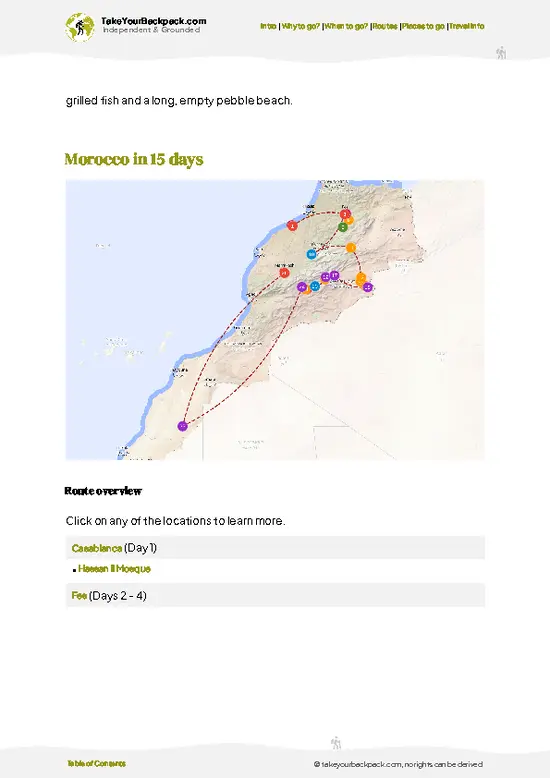
Grouping and direction: Three clusters work. The Atlantic corridor (Tangier to Casablanca) is linked by fast trains, and Tangier to Casablanca takes about 2 hours on the high-speed line. The imperial inland belt (Fez, Meknes, Rabat, Marrakech) is reached by train in 3 to 8 hours between ends. The south and Atlas side needs buses, with Marrakech to the desert gateways taking 4 to 8 hours. A loop starting in the north, heading south through Fez, then Marrakech, and finishing near an airport avoids backtracking. Flying in and out of different cities is often cheaper than doubling back.

Time per stop and … read more 👉
How many days: A trip linking several Moroccan cities needs 10 to 14 days, and 7 days is the minimum if you cover only two regions. Trying more in less time means living on trains and buses.

Grouping and direction: Three clusters work. The Atlantic corridor (Tangier to Casablanca) is linked by fast trains, and Tangier to Casablanca takes about 2 hours on the high-speed line. The imperial inland belt (Fez, Meknes, Rabat, Marrakech) is reached by train in 3 to 8 hours between ends. The south and Atlas side needs buses, with Marrakech to the desert gateways taking 4 to 8 hours. A loop starting in the north, heading south through Fez, then Marrakech, and finishing near an airport avoids backtracking. Flying in and out of different cities is often cheaper than doubling back.

Time per stop and common errors: Allow 2 to 3 nights in the big medinas to get past the first-day overwhelm, and 1 night for transit-style towns. Travel days eat half a day, so count them honestly.

Common errors: cramming the desert into a 2-day side trip from Marrakech (the drive is 9 to 10 hours round trip each way for the major dunes, so allow 3 days), booking overnight buses without checking they arrive after dawn, and assuming south-of-Atlas roads move at highway speeds. Mountain roads run 40 to 60 km/h on average. Build one buffer day, and book popular long-distance trains and CTM buses a day or two ahead in busy periods.

The ListTop cities of Morocco

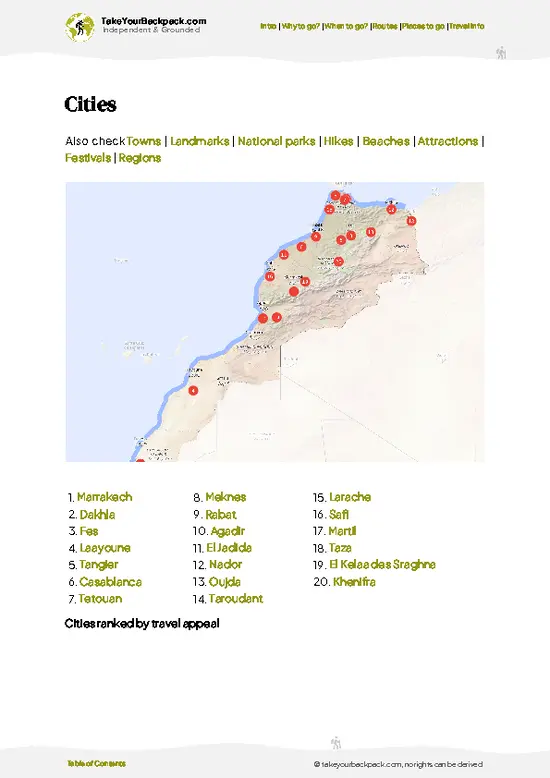
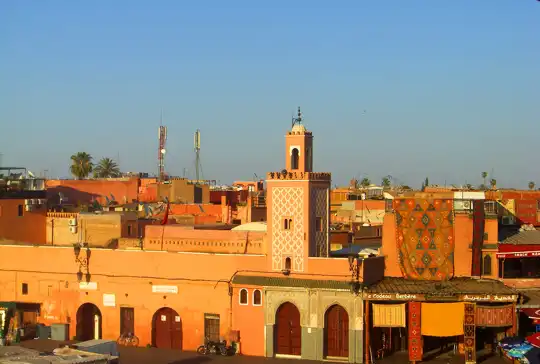
1 Marrakech

red sandstone walls, souk maze, palm groves

Absorb the sensory overload of a city where gardens, markets, and historic quarters converge under the Atlas foothills.

Morocco - Marrakech

2 Dakhla

Atlantic lagoon, windsurfing spots, Saharan coastline, seafood markets

Experience a city where desert meets ocean, with strong winds, fresh catches, and a laid-back rhythm shaped by the tides.

3 Fes

medina labyrinth, tanneries, religious schools

Lose yourself in narrow alleys lined with centuries-old craft, where tradition and scholarship still guide the city’s flow.

4 Laayoune

Spanish colonial remnants, palm-lined avenues, city squares, regional transport hub

Discover a crossroads city marked by colonial architecture, public gathering spaces, and connections to the wider Western Sahara region.

5 Tangier

Strait of Gibraltar, literary cafés, whitewashed medina

Stand at a crossroads of continents, where shifting light, layered history, and a cosmopolitan edge define the city’s character.

morocco-city-tangier
© Google |

6 Casablanca

art deco architecture, business district, Atlantic corniche

Move through a metropolis where modern commerce, urban sprawl, and oceanfront promenades create a fast-paced urban experience.

morocco-city-casablanca
© Google |

7 Tetouan

Andalusian medina, artisan quarters, mountain backdrop

Explore a city where whitewashed lanes and craft traditions reflect a blend of Mediterranean and mountain influences.

8 Meknes

imperial gates, olive groves, royal granaries

Trace the legacy of sultans through monumental architecture and quiet streets, set amid rolling countryside and olive fields.

9 Agadir

Atlantic beaches, modern boulevards, surf spots

Experience a coastal city rebuilt for leisure, where wide promenades, fresh seafood, and reliable surf attract a steady stream of visitors.

10 Rabat

Royal palace, oceanfront kasbah, medieval necropolis, modern galleries

Balance old and new as you explore royal grounds, ancient tombs, and contemporary art spaces along the breezy Atlantic coast.

11 El Jadida

Portuguese cistern, seaside ramparts, colonial quarters

Step into a coastal city where European architecture meets Moroccan daily life, with quiet lanes and a storied maritime past.

12 Nador

Marchica lagoon, Rif coast, cross-border trade

Observe daily life shaped by migration and commerce, with waterfront views and a steady flow of goods and people.

morocco-city-nador
© Google |

13 Oujda

border city, music festivals, palm-lined boulevards

Experience a crossroads of cultures, where lively events and wide avenues reflect both local and cross-border influences.

14 Taroudant

mudbrick ramparts, citrus orchards, Berber trading town

Stroll beneath ancient walls and through market squares, surrounded by the rhythms of rural commerce and mountain views.

15 Larache

Atlantic beaches, Spanish fort, fishing port

Walk between sea and river, where colonial relics and a working harbor set the pace for local life.

16 Safi

Atlantic port, pottery workshops, sardine industry

Discover a coastal city where ceramics and fishing define the landscape, and the sea air carries the scent of salt and clay.

17 Martil

Mediterranean beach, summer promenade, student life

Relax on sandy shores popular with locals, stroll the lively seafront, and notice the youthful energy from nearby universities.

18 Taza

limestone caves, mountain pass, ancient ramparts

Climb from valley to ridge in a city shaped by its strategic location, with natural wonders and old defenses close at hand.

19 El Kelaa des Sraghna

olive oil mills, Haouz plain, rural souks

Travel through a market town surrounded by olive groves, where agricultural cycles and local trade shape the landscape.

20 Khenifra

Cedar forests, Oum Er-Rbia river, Amazigh heartland

Travel through a mountain town surrounded by forests and rivers, where Amazigh culture is woven into daily routines.

Think you know Morocco?

Prove you’re a true local — uncover 10 lesser-known cities in Morocco that locals tend to keep to themselves.
Loading the map 🌍

Expert viewPro Tips for Exploring the Best

How many cities: Three to five cities is the right number for most trips of 10 to 14 days. Fewer than three wastes the variety that makes Morocco worth visiting. More than five turns the trip into logistics, because each hop costs 3 to 8 hours and each medina needs at least a full day to stop feeling like a maze.

Choosing between kinds: First-timers should choose at least two imperial medina cities, since they are the core of the country. Culture and craft seekers should pick the older, less polished medinas, which are more authentic and more confusing. Travelers who want ease and comfort should add one coastal city for air, seafood and a break from touts. Hikers should weight toward an Atlas gateway. The modern business hubs are not worth the time beyond a transfer, an airport night or a … read more 👉
How many cities: Three to five cities is the right number for most trips of 10 to 14 days. Fewer than three wastes the variety that makes Morocco worth visiting. More than five turns the trip into logistics, because each hop costs 3 to 8 hours and each medina needs at least a full day to stop feeling like a maze.

Choosing between kinds: First-timers should choose at least two imperial medina cities, since they are the core of the country. Culture and craft seekers should pick the older, less polished medinas, which are more authentic and more confusing. Travelers who want ease and comfort should add one coastal city for air, seafood and a break from touts. Hikers should weight toward an Atlas gateway. The modern business hubs are not worth the time beyond a transfer, an airport night or a bank run.

What it costs: Budget US$30 to 50 a day (roughly 300 to 500 dirhams) in dorms or simple riads, with street food and local cafes. Mid-range, with private riad rooms and sit-down meals, runs US$60 to 100. Dorm beds cost about US$8 to 15, double rooms in a decent riad US$35 to 80, and tagines or grilled meals US$3 to 8 at local places, with tourist-square restaurants charging double.

Per visit, most monuments and museums cost 70 to 120 dirhams (about US$7 to 12). An official licensed guide runs roughly 250 to 400 dirhams for half a day, which is worth paying in your first medina to learn the layout. Trains between cities cost about 50 to 250 dirhams depending on distance, and local taxis within a city are cheap if the meter is used.

Safety and culture: Morocco’s cities are generally safe, with the main problems being scams, pickpocketing and aggressive touts. Politely decline “the road is closed” helpers, and agree on a price before accepting any service. Keep valuables out of back pockets in crowded souks. Women traveling alone often get repeated attention, and calm firmness plus modest dress helps. Shoulders and knees covered is the practical standard in medinas, especially away from tourist districts.

Ask before photographing people, and expect to be refused or asked for payment. Alcohol is limited to licensed bars and some riads, and public drinking is discouraged. During Ramadan, avoid eating or smoking openly in the street in smaller towns. Learn a few words of Darija or French, since both open doors that English does not.

✈️ The backpacker research shortcutMorocco Travel Guide

An offline-friendly backpacking guide with optimized travel routes, ranked highlights, transport advice, and the best areas to stay.
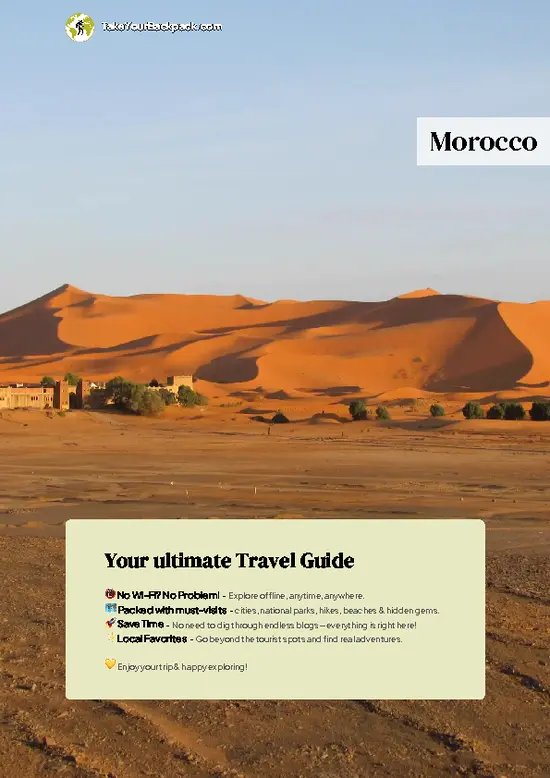
example page 0 from our offline Travel Guide for Morocco
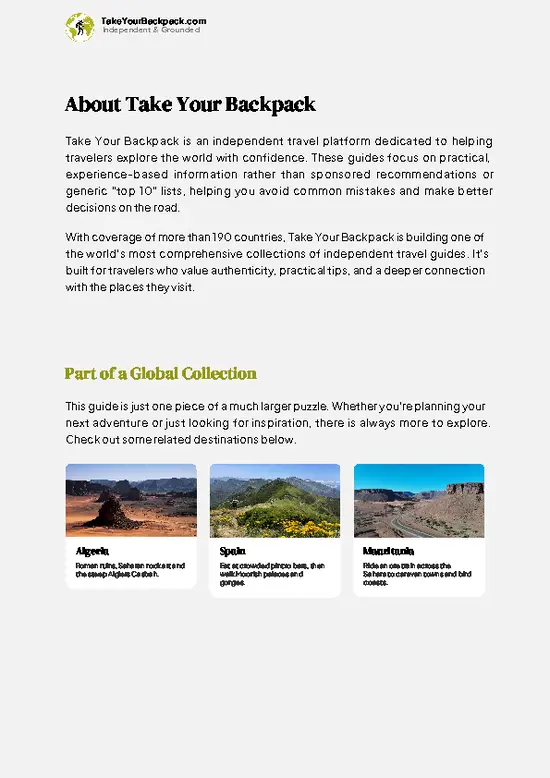
example page 1 from our offline Travel Guide for Morocco
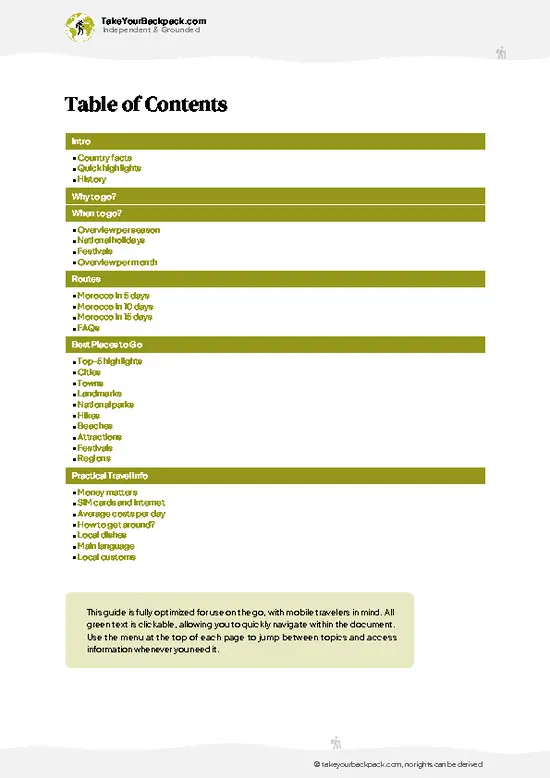
example page 2 from our offline Travel Guide for Morocco
example page 3 from our offline Travel Guide for Morocco
example page 4 from our offline Travel Guide for Morocco
example page 5 from our offline Travel Guide for Morocco
example page 6 from our offline Travel Guide for Morocco
example page 7 from our offline Travel Guide for Morocco
The digital guide (424 pages) contains:
✅ 112 highlights, ranked by travel appeal
✅ Optimized 5, 10 & 15-day travel routes
✅ Cities, national parks, landmarks, beaches
✅ How to get around
✅ Offline-friendly for travel without Wi-Fi
👉 Click to see all 30+ guide features

📅 Plan smarter in minutes, not weeks
✅ Month by month travel advice
✅ Festivals & national holidays
✅ Budget expectations

🗺️ Go to the right places, skip the overrated ones
✅ Honest pros & cons of destinations
✅ Top hikes, parks & viewpoints
✅ Lesser-known places most travelers miss
✅ Clear “worth it vs skip it” guidance

🛏️ Travel smoothly without rookie mistakes
✅ Best areas to stay
✅ Transport systems explained simply
✅ Common scams & safety advice
✅ SIM cards, money & practical tips

🌍 Understand the country, not just visit it
✅ Culture & traditions
✅ 52 Essential phrases & customs
✅ Festivals worth planning around
✅ Traveler-friendly historical context
✅ Insights that make places more meaningful

📱 Built for real travel conditions
✅ Fully downloadable PDF
✅ Works completely offline
✅ Optimized for phone use
✅ Useful in remote areas & buses
✅ Everything in one place
Stop searching, start planning
Get instant access to your full guide. 30‑day money-back guarantee.
+ Add another guide for just

By proceeding you agree to our terms.
Sent to your inbox immediately after payment • 100% Secure Checkout
Best Backpacking Travel Advisor 2025 tourism awardBest Backpacking
Travel Advisor
2025
What others say about Take Your Backpack Guides:
⭐⭐⭐⭐⭐
Fantastic, amazing amount of information!
⭐⭐⭐⭐⭐
My goodness this is amazing, it's what I've been looking for hats off too you!
⭐⭐⭐⭐⭐
I think this is absolutely BRILLIANT
⭐⭐⭐⭐
Very complete and informative. It's still missing places, but I gotta to commend you
⭐⭐⭐⭐⭐
This is truly amazing, thank you, can't wait to explore it with my kids!
⭐⭐⭐⭐⭐
Awesome resource, thank you!
⭐⭐⭐⭐⭐
This is amazing! Can't wait to explore the ones I haven't seen
⭐⭐⭐⭐
I love this! Well done, great idea.
⭐⭐⭐⭐⭐
Thanks for taking the time to make this gem!
⭐⭐⭐⭐⭐
This might be the best website I've ever seen.
⭐⭐⭐⭐⭐
Congratulations, and thank you so much for your work; it's incredibly valuable.
⭐⭐⭐⭐
In all seriousness I think you did a great job pointing out the important spots
⭐⭐⭐⭐⭐
10/10 very good
⭐⭐⭐⭐⭐
As someone who's only just starting to visit regularly this is awesome, thank you.
⭐⭐⭐⭐
Thank you very much! I'm going to visit my dad, it's going to be very useful!
⭐⭐⭐⭐⭐
This is really cool! We'll be travelling for the first time and this definitely come in handy.
⭐⭐⭐⭐⭐
You are now our minister of culture, congratulations 👨‍💼
⭐⭐⭐⭐⭐
Just wanted to tell you that this is a pearl! Going to follow your recommendations.
⭐⭐⭐⭐⭐
This is so cool. I'll definitely be using the resource for my travels soon.
⭐⭐⭐⭐⭐
This is very impressive! Good work.
⭐⭐⭐⭐⭐
This is an amazing and informative site. Very well done!

🛏️ Where to stay?Where to Base Yourself

Morocco has plenty of hostels and budget guesthouses, most set in converted riads with dorms around a tiled courtyard and a rooftop terrace where breakfast is usually included. In Marrakech, the Medina near Jemaa el-Fnaa keeps you walking distance from the souks and food stalls but comes with motorbike noise, touts and confusing alleys after dark, while Gueliz is calmer and has most of the city’s bars, at the cost of a 20 to 30 minute walk to the old town. In Fes, staying inside Fes el-Bali puts the tanneries and medersas on your doorstep (the lanes go quiet and dim at night, so note your route), whereas the medinas of Chefchaouen and Essaouira are smaller, safer-feeling and easy to find your … read more 👉
Morocco has plenty of hostels and budget guesthouses, most set in converted riads with dorms around a tiled courtyard and a rooftop terrace where breakfast is usually included. In Marrakech, the Medina near Jemaa el-Fnaa keeps you walking distance from the souks and food stalls but comes with motorbike noise, touts and confusing alleys after dark, while Gueliz is calmer and has most of the city’s bars, at the cost of a 20 to 30 minute walk to the old town. In Fes, staying inside Fes el-Bali puts the tanneries and medersas on your doorstep (the lanes go quiet and dim at night, so note your route), whereas the medinas of Chefchaouen and Essaouira are smaller, safer-feeling and easy to find your way around, and Taghazout near Agadir is packed with surf hostels that suit a social crowd more than sightseers.

If you enjoy meeting fellow travelers, consider choosing hostels with high ratings for atmosphere. On the other hand, if you prefer having your own space, a hotel might be a better option.

MoroccoExpand Your Journey

👋 Meet the founderWho’s Behind Take Your Backpack?

Johan, backpacker and founder of TakeYourBackpackHi, I’m Johan (Netherlands 🇳🇱), the creator of TakeYourBackpack. Over the past 3 decades, I’ve backpacked through 90+ countries across six continents, gaining extensive experience with independent travel, long-term trips, and overland routes.

This site is built on a combination of firsthand travel experience and carefully curated insights from other backpackers. Many guides are based on places I’ve personally visited, while others bring together tips, observations, and practical advice shared by trusted travelers I’ve met along the way.

The goal is to provide realistic, experience-driven guidance — not generic itineraries — so you can explore destinations with better context, clearer expectations, and more confidence.