×

Mozambique🇲🇿 | national parksZinave National ParkSave River, sand-track drives, riverside camping, dark skies | things to do and best time to go

Explore Chimanimani National ParkExplore Magoe National Park

Backpacking in Zinave
👌 Worth visitingnational park ranked #7
By Johan Kruseman 🇳🇱 | Updated October 22, 2026

Your tires hiss through soft sand, a kudu steps out of the mopane scrub, and the engine goes quiet because nobody wants to scare it off. That is a normal first hour in Zinave National Park, in southern Mozambique's Inhambane and Gaza provinces, roughly west of Massinga and the coast. Wildlife has been reintroduced since the park's restoration, so you will find giraffe, zebra, wildebeest and impala, with elephants and predators far less certain. Crowds are almost nonexistent, but the tracks are sandy, fuel is scarce, and walking is limited. Book ahead, carry spare fuel, and bring a high-clearance 4x4 to avoid breakdowns and turnarounds. Self-drivers who love empty bush will adore it. Anyone chasing guaranteed big-cat sightings or public transport will not.

Discover everything you want to know in the 📖 Mozambique Travel Guide.


example page 0 from our offline Travel Guide for Mozambique
example page 1 from our offline Travel Guide for Mozambique
example page 2 from our offline Travel Guide for Mozambique
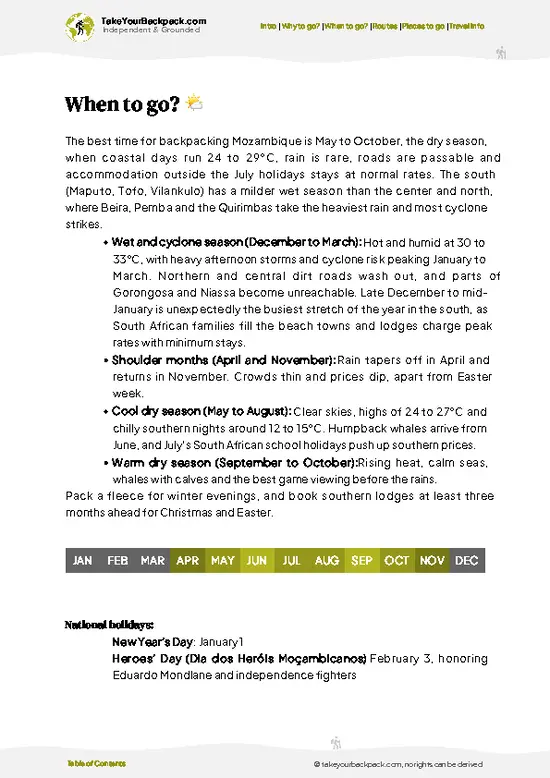
example page 3 from our offline Travel Guide for Mozambique
example page 4 from our offline Travel Guide for Mozambique
example page 5 from our offline Travel Guide for Mozambique
example page 6 from our offline Travel Guide for Mozambique
example page 7 from our offline Travel Guide for Mozambique
Loading the map 🌍
CLICK TO FILTER
cities
towns
national parks
hikes
beaches
attractions
festivals
regions
SHOW COUNTRY’S BESTSHOW ALL

✨ Why go?
Ranked #7 national park in Mozambique
What makes this national park worth exploring

Zinave National Park rewards people who like to drive their own line through empty country. The park covers roughly 4,000 square kilometers, and you can spend a whole morning without seeing another vehicle. Self-drive is allowed, which makes it far cheaper and more flexible than a guided safari circuit. The Save River forms the southern edge and gives you shaded riverbank camping among fever trees and big old figs, the best place to wake up to hippo grunts. Birders get a long list, from fish eagles to bee-eaters, in a landscape of mopane woodland, open grassland and sand forest that changes every few kilometers. Wildlife is present but not packed in, so patience matters, and sightings feel earned. If you want tours with a driver and a schedule, other parks suit you better. If you want solitude and a map, this is your place.

💡 HighlightsDon't-miss highlights and experiences

  1. Save River: The park's southern boundary, lined with fever trees and reed beds, where hippos and crocodiles share the pools and elephants sometimes come to drink.
  2. Game drives on the sand tracks: Self-drive loops through mopane and open plains where zebra, wildebeest, giraffe and kudu graze. Early mornings give the best sightings.
  3. Riverside camping: Pitching a tent under big trees near the water means hearing hippos and nightjars through the night.
  4. Birdwatching along the floodplains: African fish eagles, bee-eaters, hornbills and storks gather where the river and pans hold water.
  5. Sand forest patches: Dense, rare woodland on deep sand, home to small antelope such as suni and shy forest birds.
  6. Waterholes and pans: Quiet spots to park, switch off the engine and wait for herds to arrive, especially
… read more 👉
  1. Save River: The park's southern boundary, lined with fever trees and reed beds, where hippos and crocodiles share the pools and elephants sometimes come to drink.
  2. Game drives on the sand tracks: Self-drive loops through mopane and open plains where zebra, wildebeest, giraffe and kudu graze. Early mornings give the best sightings.
  3. Riverside camping: Pitching a tent under big trees near the water means hearing hippos and nightjars through the night.
  4. Birdwatching along the floodplains: African fish eagles, bee-eaters, hornbills and storks gather where the river and pans hold water.
  5. Sand forest patches: Dense, rare woodland on deep sand, home to small antelope such as suni and shy forest birds.
  6. Waterholes and pans: Quiet spots to park, switch off the engine and wait for herds to arrive, especially in the late afternoon.
  7. Night sky: With almost no light pollution, the Milky Way fills the horizon from camp.
Zinave National Park charges daily entry and camping fees, and campsites and lodging should be booked ahead through the park's reservation contacts.
Spotted a mistake or missing something? Contact us.

🌤️ When to go?When to go for the best experience

  • Cool Dry Season (May to August): Days reach 24 to 28°C (75 to 82°F) and nights drop to 8 to 13°C (46 to 55°F). Grass thins out, animals gather at the Save River and pans, and sightings are at their easiest. Days run roughly 11 hours.
  • Hot Dry Season (September to November): Highs climb to 32 to 38°C (90 to 100°F). Game viewing stays good around water, but midday is brutal and dust builds on the tracks.
  • Wet Season (December to March): Expect 30 to 36°C (86 to 97°F), thunderstorms and humidity. Sand tracks turn to mud, some become impassable, and lodges may close or discount. Days stretch to about 13 hours. Birding is excellent.
  • Crowds and Prices: Zinave is quiet all year. Rates peak from June to September, with South African school holidays the busiest.
Book camps or lodges early for July, and aim … read more 👉
  • Cool Dry Season (May to August): Days reach 24 to 28°C (75 to 82°F) and nights drop to 8 to 13°C (46 to 55°F). Grass thins out, animals gather at the Save River and pans, and sightings are at their easiest. Days run roughly 11 hours.
  • Hot Dry Season (September to November): Highs climb to 32 to 38°C (90 to 100°F). Game viewing stays good around water, but midday is brutal and dust builds on the tracks.
  • Wet Season (December to March): Expect 30 to 36°C (86 to 97°F), thunderstorms and humidity. Sand tracks turn to mud, some become impassable, and lodges may close or discount. Days stretch to about 13 hours. Birding is excellent.
  • Crowds and Prices: Zinave is quiet all year. Rates peak from June to September, with South African school holidays the busiest.
Book camps or lodges early for July, and aim for June or September if you want cool weather with fewer vehicles.


source: climatestotravel.comJANJanuary: fair for travelingFEBFebruary: fair for travelingMARMarch: fair for travelingAPRApril: good for travelingMAYMay: highly recommended for travelingJUNJune: excellent for travelingJULJuly: excellent for travelingAUGAugust: excellent for travelingSEPSeptember: excellent for travelingOCTOctober: highly recommended for travelingNOVNovember: fair for travelingDECDecember: fair for traveling
mozambique-national-park-zinave-national-park v1
© Google |

✈️ The backpacker research shortcutMozambique Travel Guide

An offline-friendly backpacking guide with optimized travel routes, ranked highlights, transport advice, and the best areas to stay.
example page 0 from our offline Travel Guide for Mozambique
example page 1 from our offline Travel Guide for Mozambique
example page 2 from our offline Travel Guide for Mozambique
example page 3 from our offline Travel Guide for Mozambique
example page 4 from our offline Travel Guide for Mozambique
example page 5 from our offline Travel Guide for Mozambique
example page 6 from our offline Travel Guide for Mozambique
example page 7 from our offline Travel Guide for Mozambique
The digital guide (324 pages) contains:
✅ 78 highlights, ranked by travel appeal
✅ Optimized 5, 10 & 15-day travel routes
✅ Cities, national parks, landmarks, beaches
✅ How to get around
✅ Offline-friendly for travel without Wi-Fi
👉 Click to see all 30+ guide features

📅 Plan smarter in minutes, not weeks
✅ Month by month travel advice
✅ Festivals & national holidays
✅ Budget expectations

🗺️ Go to the right places, skip the overrated ones
✅ Honest pros & cons of destinations
✅ Top hikes, parks & viewpoints
✅ Lesser-known places most travelers miss
✅ Clear “worth it vs skip it” guidance

🛏️ Travel smoothly without rookie mistakes
✅ Best areas to stay
✅ Transport systems explained simply
✅ Common scams & safety advice
✅ SIM cards, money & practical tips

🌍 Understand the country, not just visit it
✅ Culture & traditions
✅ 52 Essential phrases & customs
✅ Festivals worth planning around
✅ Traveler-friendly historical context
✅ Insights that make places more meaningful

📱 Built for real travel conditions
✅ Fully downloadable PDF
✅ Works completely offline
✅ Optimized for phone use
✅ Useful in remote areas & buses
✅ Everything in one place
Stop searching, start planning
Get instant access to your full guide. 30‑day money-back guarantee.
+ Add another guide for just

By proceeding you agree to our terms.
Sent to your inbox immediately after payment • 100% Secure Checkout
Best Backpacking Travel Advisor 2025 tourism awardBest Backpacking
Travel Advisor
2025
What others say about Take Your Backpack Guides:
⭐⭐⭐⭐⭐
Fantastic, amazing amount of information!
⭐⭐⭐⭐⭐
My goodness this is amazing, it's what I've been looking for hats off too you!
⭐⭐⭐⭐⭐
I think this is absolutely BRILLIANT
⭐⭐⭐⭐
Very complete and informative. It's still missing places, but I gotta to commend you
⭐⭐⭐⭐⭐
This is truly amazing, thank you, can't wait to explore it with my kids!
⭐⭐⭐⭐⭐
Awesome resource, thank you!
⭐⭐⭐⭐⭐
This is amazing! Can't wait to explore the ones I haven't seen
⭐⭐⭐⭐
I love this! Well done, great idea.
⭐⭐⭐⭐⭐
Thanks for taking the time to make this gem!
⭐⭐⭐⭐⭐
This might be the best website I've ever seen.
⭐⭐⭐⭐⭐
Congratulations, and thank you so much for your work; it's incredibly valuable.
⭐⭐⭐⭐
In all seriousness I think you did a great job pointing out the important spots
⭐⭐⭐⭐⭐
10/10 very good
⭐⭐⭐⭐⭐
As someone who's only just starting to visit regularly this is awesome, thank you.
⭐⭐⭐⭐
Thank you very much! I'm going to visit my dad, it's going to be very useful!
⭐⭐⭐⭐⭐
This is really cool! We'll be travelling for the first time and this definitely come in handy.
⭐⭐⭐⭐⭐
You are now our minister of culture, congratulations 👨‍💼
⭐⭐⭐⭐⭐
Just wanted to tell you that this is a pearl! Going to follow your recommendations.
⭐⭐⭐⭐⭐
This is so cool. I'll definitely be using the resource for my travels soon.
⭐⭐⭐⭐⭐
This is very impressive! Good work.
⭐⭐⭐⭐⭐
This is an amazing and informative site. Very well done!

🛏️ Where to stay?Best areas to stay in Mozambique

The best base for backpackers is inside Zinave National Park itself, because there are no towns near the entrances and the sand roads are slow after dark. Camping is the budget option. Mabalauta and Fundudzi camps (the park’s main camps near the Save River and the central area) offer pitches with basic ablutions, and some have simple chalets. Check current availability with the park operator, Peace Parks Foundation, before you go. Bring a tent, a cooler, water, and all your food, as supplies inside are limited. For a bit more comfort, the park has lodge-style chalets and tented camps at higher … read more 👉
The best base for backpackers is inside Zinave National Park itself, because there are no towns near the entrances and the sand roads are slow after dark. Camping is the budget option. Mabalauta and Fundudzi camps (the park’s main camps near the Save River and the central area) offer pitches with basic ablutions, and some have simple chalets. Check current availability with the park operator, Peace Parks Foundation, before you go. Bring a tent, a cooler, water, and all your food, as supplies inside are limited. For a bit more comfort, the park has lodge-style chalets and tented camps at higher prices.
Outside the park, the nearest towns are Mapinhane and Massinga along the EN1 highway, and Vilankulo is the main tourist hub on the coast, about 4 to 5 hours away by road. Guesthouses and hostels in Vilankulo suit travelers combining Zinave with beach time. Expect only basic lodging in Mapinhane. Arrive at the gate well before dark.

👛 Costs (as of 22 October 2026)Money, prices, and spending tips

Zinave National Park costs roughly US$100 to 125 a day for a self-drive camper, with most of it going to fuel and the vehicle. The table gives typical ranges.
CategoryBudget RangeLocal Reality
Entrance and conservation feesUS$10 to 20Charged per person per day, plus a smaller vehicle fee at the gate.
Accommodation (high season)US$20 to 35Camping pitches are the cheapest. Chalets and lodges cost far more, often US$100 or above.
Accommodation (low season)US$15 to 25Cheaper pitches in the wet season, though some tracks close.
Local transportUS$40 to 55Fuel and 4x4 rental share. The park has no public transport, and fuel is only available in towns on the EN1.
Food and suppliesUS$10 to 15Stock up in Vilankulo or Maxixe. Little is sold inside the park.
Total Daily BudgetUS$100 to 125Lower if you split vehicle costs among four people.


source: visitmozambique.net
⚠️ Prices can change and everyone travels differently, so take this as a rough guide. Hope it helps you plan your adventure!

🥾 TrailsPlan your hike in Zinave: routes, terrain, and sights

Zinave National Park has no long-distance hiking trails. Most activity happens by vehicle, with short walks around camps and with rangers where permitted.
⚠️ Hiking info can sometimes be outdated or inaccurate. Before you hit the trail, check the latest conditions with locals. If you do spot anything that's off, I'd love to hear from you, so I can update it for fellow travelers.

🛡️ SafetyTraveler Safety Guide

Zinave is a remote, fenced reserve with low crime, and the main hazards are sand tracks and heat. Four-wheel drive with decent clearance is needed, and you should carry a recovery strap, shovel, spare tire and extra fuel, since help can be hours away. Mobile signal is patchy, so tell someone your plan. Drink more water than you expect, wear a hat, and keep midday for shade.
Elephants, buffalo, lions and leopards live here, and animals are wild and unhabituated. Stay inside your vehicle on drives, keep your distance from elephants, and never walk around camp after dark without a torch. Hippos and crocodiles live in the Save River, so keep away from the banks. Malaria is present all year, so take prophylaxis, repellent and long sleeves in the evening.

FAQCommon questions from travelers

Plan on 2 to 3 days for Zinave National Park. That gives you two game drives a day along the Save River and the central pans, plus a night or two in camp. Add a third night if you want to see the northern and southern areas, since the sand tracks are slow going.
Zinave National Park is very hard to visit without a car, because there is no public transport to the gate and the roads inside are sand tracks that need four-wheel drive. Most backpackers rent a 4x4 in Vilankulo or Maputo, or join an organized safari from Vilankulo, about 4 to 5 hours away. Splitting vehicle costs among four people keeps the price reasonable.
Yes, Zinave National Park charges a daily entrance and conservation fee, typically around US$10 to 20 per person, with a smaller fee per vehicle. No separate hiking permit is needed, but you must register at the gate and book camping or lodging in advance through the park operator. Carry cash for fees if you can, as card facilities are unreliable.
⚠️ Things can change over time, so always validate details locally before you go.

Other Mozambican national parks near Zinave

Explore more nearby:


💡 Not sure where to go next?
Create a personalized itinerary for Mozambique including Zinave and the places that fit your trip.

Generate my itinerary

👉 Discover all national parks

Or checkout all Mozambique has to offer (think cities, towns, villages, national parks, hikes, beaches, festivals)
Country photo of Mozambique

We 💚 feedbackSumming up the experience

Zinave National Park deserves three nights minimum. One night barely covers the drive in and the setup, while three lets you do a dawn loop, a midday river rest and a dusk drive without rushing. I would add a fourth night if you are self-driving, and carry extra fuel and water.

✍️ Help improve this page!
The information on this page is based on in-depth research, insights shared by experienced travelers, and feedback from the local travel community in Mozambique. While every effort is made to keep the information accurate and current, conditions can change — so if you spot anything incorrect or outdated, please get in touch.


🙋‍♂️ Give feedback

👋 Meet the founderWho’s Behind Take Your Backpack?

Johan, backpacker and founder of TakeYourBackpackHi, I’m Johan (Netherlands 🇳🇱), the creator of TakeYourBackpack. Over the past 3 decades, I’ve backpacked through 90+ countries across six continents, gaining extensive experience with independent travel, long-term trips, and overland routes.

This site is built on a combination of firsthand travel experience and carefully curated insights from other backpackers. Many guides are based on places I’ve personally visited, while others bring together tips, observations, and practical advice shared by trusted travelers I’ve met along the way.

The goal is to provide realistic, experience-driven guidance — not generic itineraries — so you can explore destinations with better context, clearer expectations, and more confidence.