
×

Nauru🇳🇷 | landmarksCommand RidgeJapanese command bunker, rusted anti-aircraft guns, island high point, coral pinnacles | things to do and best time to go

Explore Nauru’s Historic Sites TrailExplore Nauru’s Lighthouse

Backpacking in Command Ridge
🏆 Top pickunique site ranked #1
By Johan Kruseman 🇳🇱 | Updated October 15, 2026

The big decision here is whether to treat Command Ridge as a quick stop or give it a proper slow hour, and the deciding factor is light and heat. Go midday and you’ll be baking on bare rock with no shade. Nauru’s highest point sits on the Topside plateau in the island’s southwest interior, and the wartime Japanese command post and rusting guns are the reason to come. Mistakes catch people out here. Rental scooters and rides get hurried, so settle the plan for your return before you leave the coast road. Phones run out of battery, so download a map first. Rough coral and broken metal chew up flip-flops, so wear closed shoes. Bring your own water, since nothing is sold on the ridge. Expect almost no one else: no rangers, no signs worth the name, and a quiet that suits wanderers. Before you go, ask your guesthouse host about the access track, because it can be rough after rain.

Discover everything you want to know in the 📖 Nauru Travel Guide.


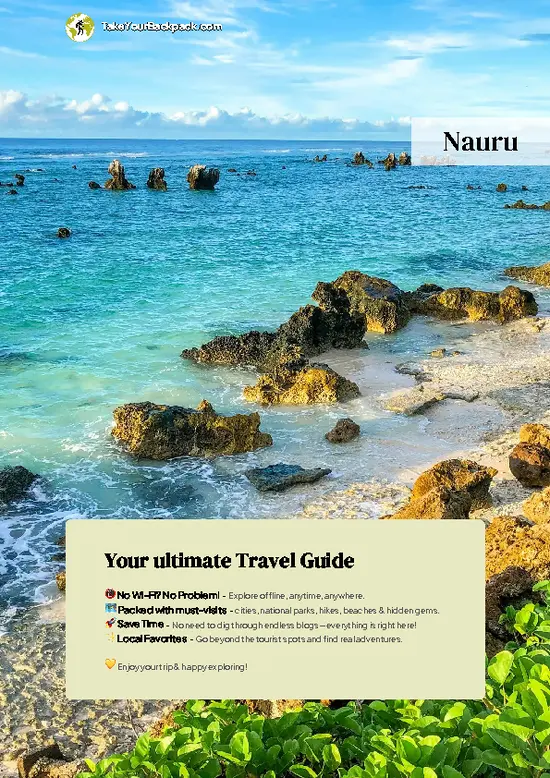
example page 0 from our offline Travel Guide for Nauru
example page 1 from our offline Travel Guide for Nauru
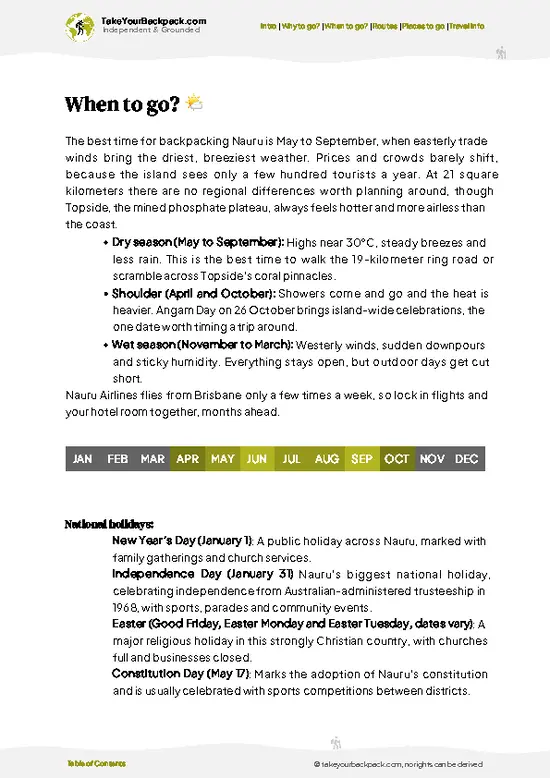
example page 2 from our offline Travel Guide for Nauru
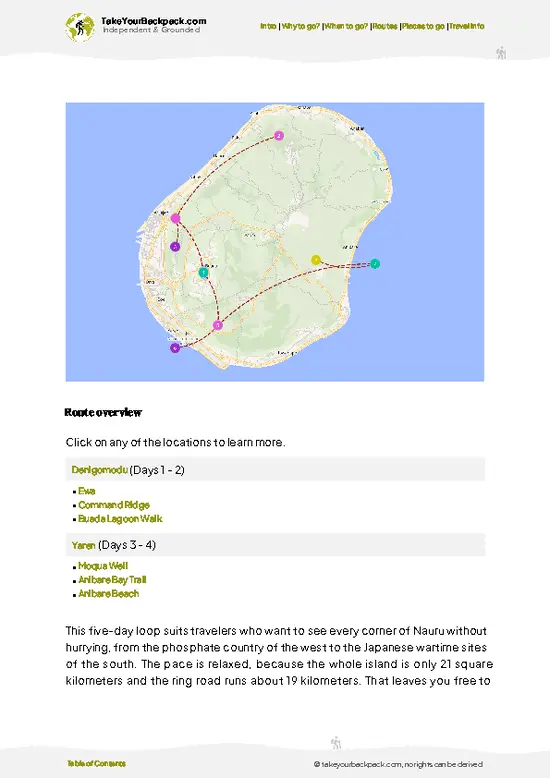
example page 3 from our offline Travel Guide for Nauru
example page 4 from our offline Travel Guide for Nauru
example page 5 from our offline Travel Guide for Nauru
example page 6 from our offline Travel Guide for Nauru
example page 7 from our offline Travel Guide for Nauru
Loading the map 🌍
CLICK TO FILTER
villages
landmarks
hikes
beaches
SHOW COUNTRY’S BESTSHOW ALL

✨ Why go?
Ranked #1 unique site in Nauru
What sets this place apart

Command Ridge suits you if you like finding things yourself. There’s no ticket booth, no guided circuit and no queue, so you set the pace. Nauru is small enough that you can ride out to the plateau, wander the ridge, and be back at the coast for lunch.

The main draw is the Japanese WWII command post, a concrete bunker that still holds its shape after decades of salt air. Around it lie rusted anti-aircraft guns pointing out over the ocean, which gives you a feel for how the Japanese garrison watched for aircraft. Standing next to the barrels, you can see the whole plan of the defense.

It also pairs well with a loose, self-directed day on Topside, where the old phosphate mining country is a landscape in its own right. A guide isn’t needed. A decent map, sturdy shoes and a bit of curiosity do the … read more 👉
Command Ridge suits you if you like finding things yourself. There’s no ticket booth, no guided circuit and no queue, so you set the pace. Nauru is small enough that you can ride out to the plateau, wander the ridge, and be back at the coast for lunch.

The main draw is the Japanese WWII command post, a concrete bunker that still holds its shape after decades of salt air. Around it lie rusted anti-aircraft guns pointing out over the ocean, which gives you a feel for how the Japanese garrison watched for aircraft. Standing next to the barrels, you can see the whole plan of the defense.

It also pairs well with a loose, self-directed day on Topside, where the old phosphate mining country is a landscape in its own right. A guide isn’t needed. A decent map, sturdy shoes and a bit of curiosity do the job, and locals you meet along the way are usually happy to point you in the right direction.

💡 HighlightsDon't-miss highlights and experiences

  1. Japanese Command Post: The concrete bunker is the best-known sight and the reason most visitors come. Thick walls, narrow openings and a position on the island’s high ground show why the Japanese garrison chose the ridge as its nerve center during WWII. Walk around the outside first, then look in.
  2. Anti-aircraft guns: Heavy Japanese guns still stand on the ridge, rusted orange and pointing toward the sky and sea. They’re the most photogenic relics here, and you can get close enough to read the scale of the barrels.
  3. The island’s highest point: At roughly 65 to 70 meters, this is the high point of Nauru. That sounds modest, but on a flat island it gives you a wide ring of horizon, with the sea visible on clear days beyond the treetops.
  4. Scattered wartime metal: Fragments of equipment, concrete footings
… read more 👉
  1. Japanese Command Post: The concrete bunker is the best-known sight and the reason most visitors come. Thick walls, narrow openings and a position on the island’s high ground show why the Japanese garrison chose the ridge as its nerve center during WWII. Walk around the outside first, then look in.
  2. Anti-aircraft guns: Heavy Japanese guns still stand on the ridge, rusted orange and pointing toward the sky and sea. They’re the most photogenic relics here, and you can get close enough to read the scale of the barrels.
  3. The island’s highest point: At roughly 65 to 70 meters, this is the high point of Nauru. That sounds modest, but on a flat island it gives you a wide ring of horizon, with the sea visible on clear days beyond the treetops.
  4. Scattered wartime metal: Fragments of equipment, concrete footings and corroded steel lie around the ridge. Poking around slowly turns up more than a first glance does, though you should keep your eyes on where you step.
  5. Topside coral pinnacles: The surrounding plateau is covered in jagged limestone pinnacles left behind by phosphate mining. They’re sharp, strange and photogenic, especially when low sun throws long shadows across them.
  6. Buada Lagoon: The island’s only inland lagoon sits in the interior depression nearby, ringed by banana, pandanus and coconut trees. It’s green and still, a soft contrast with the stark ridge.
Pair the anti-aircraft guns with Buada Lagoon in one day, doing the ridge first and the shaded lagoon edge once the heat builds.
Spotted a mistake or missing something? Contact us.

🌤️ When to go?Weather, crowds, and seasonal trade-offs

The best window for Command Ridge is roughly March to October, when rain is lighter and the climb to Nauru’s highest point (about 65 m, 213 ft) stays manageable.
  • Drier months (roughly March to October): Showers still pass through, but less often. Temperatures run about 26 to 32°C (79 to 90°F), and the concrete gun emplacements and rusted Japanese anti-aircraft guns dry quickly for photos.
  • Wetter months (roughly November to February): Westerly squalls bring heavier downpours, and the track through the Topside scrub turns slick. Temperatures stay in the same 26 to 32°C (79 to 90°F) band, but the air feels heavier.
  • Daylight: Sunrise is close to 6:00 a.m. and sunset near 6:00 p.m. all year, so plan to be off the ridge by late afternoon.
  • Crowds and prices: Visitors are very few in any month, and you
… read more 👉
The best window for Command Ridge is roughly March to October, when rain is lighter and the climb to Nauru’s highest point (about 65 m, 213 ft) stays manageable.
  • Drier months (roughly March to October): Showers still pass through, but less often. Temperatures run about 26 to 32°C (79 to 90°F), and the concrete gun emplacements and rusted Japanese anti-aircraft guns dry quickly for photos.
  • Wetter months (roughly November to February): Westerly squalls bring heavier downpours, and the track through the Topside scrub turns slick. Temperatures stay in the same 26 to 32°C (79 to 90°F) band, but the air feels heavier.
  • Daylight: Sunrise is close to 6:00 a.m. and sunset near 6:00 p.m. all year, so plan to be off the ridge by late afternoon.
  • Crowds and prices: Visitors are very few in any month, and you will often have the ridge to yourself. Flights and the handful of guesthouses are the main cost swings, with prices rising when government or mining delegations visit.
Book Nauru Airlines flights well ahead, since services run only a few times a week.


source: climatestotravel.comJANJanuary: fair for travelingFEBFebruary: fair for travelingMARMarch: highly recommended for travelingAPRApril: excellent for travelingMAYMay: excellent for travelingJUNJune: excellent for travelingJULJuly: excellent for travelingAUGAugust: excellent for travelingSEPSeptember: excellent for travelingOCTOctober: highly recommended for travelingNOVNovember: fair for travelingDECDecember: fair for traveling
when-to-go

✈️ The backpacker research shortcutNauru Travel Guide

An offline-friendly backpacking guide with optimized travel routes, ranked highlights, transport advice, and the best areas to stay.
example page 0 from our offline Travel Guide for Nauru
example page 1 from our offline Travel Guide for Nauru
example page 2 from our offline Travel Guide for Nauru
example page 3 from our offline Travel Guide for Nauru
example page 4 from our offline Travel Guide for Nauru
example page 5 from our offline Travel Guide for Nauru
example page 6 from our offline Travel Guide for Nauru
example page 7 from our offline Travel Guide for Nauru
The digital guide (57 pages) contains:
✅ 8 highlights, ranked by travel appeal
✅ Optimized 2, 3 & 5-day travel routes
✅ Cities, national parks, landmarks, beaches
✅ How to get around
✅ Offline-friendly for travel without Wi-Fi
👉 Click to see all 30+ guide features

📅 Plan smarter in minutes, not weeks
✅ Month by month travel advice
✅ Festivals & national holidays
✅ Budget expectations

🗺️ Go to the right places, skip the overrated ones
✅ Honest pros & cons of destinations
✅ Top hikes, parks & viewpoints
✅ Lesser-known places most travelers miss
✅ Clear “worth it vs skip it” guidance

🛏️ Travel smoothly without rookie mistakes
✅ Best areas to stay
✅ Transport systems explained simply
✅ Common scams & safety advice
✅ SIM cards, money & practical tips

🌍 Understand the country, not just visit it
✅ Culture & traditions
✅ 52 Essential phrases & customs
✅ Festivals worth planning around
✅ Traveler-friendly historical context
✅ Insights that make places more meaningful

📱 Built for real travel conditions
✅ Fully downloadable PDF
✅ Works completely offline
✅ Optimized for phone use
✅ Useful in remote areas & buses
✅ Everything in one place
Stop searching, start planning
Get instant access to your full guide. 30‑day money-back guarantee.
+ Add another guide for just

By proceeding you agree to our terms.
Sent to your inbox immediately after payment • 100% Secure Checkout
Best Backpacking Travel Advisor 2025 tourism awardBest Backpacking
Travel Advisor
2025
What others say about Take Your Backpack Guides:
⭐⭐⭐⭐⭐
Fantastic, amazing amount of information!
⭐⭐⭐⭐⭐
My goodness this is amazing, it's what I've been looking for hats off too you!
⭐⭐⭐⭐⭐
I think this is absolutely BRILLIANT
⭐⭐⭐⭐
Very complete and informative. It's still missing places, but I gotta to commend you
⭐⭐⭐⭐⭐
This is truly amazing, thank you, can't wait to explore it with my kids!
⭐⭐⭐⭐⭐
Awesome resource, thank you!
⭐⭐⭐⭐⭐
This is amazing! Can't wait to explore the ones I haven't seen
⭐⭐⭐⭐
I love this! Well done, great idea.
⭐⭐⭐⭐⭐
Thanks for taking the time to make this gem!
⭐⭐⭐⭐⭐
This might be the best website I've ever seen.
⭐⭐⭐⭐⭐
Congratulations, and thank you so much for your work; it's incredibly valuable.
⭐⭐⭐⭐
In all seriousness I think you did a great job pointing out the important spots
⭐⭐⭐⭐⭐
10/10 very good
⭐⭐⭐⭐⭐
As someone who's only just starting to visit regularly this is awesome, thank you.
⭐⭐⭐⭐
Thank you very much! I'm going to visit my dad, it's going to be very useful!
⭐⭐⭐⭐⭐
This is really cool! We'll be travelling for the first time and this definitely come in handy.
⭐⭐⭐⭐⭐
You are now our minister of culture, congratulations 👨‍💼
⭐⭐⭐⭐⭐
Just wanted to tell you that this is a pearl! Going to follow your recommendations.
⭐⭐⭐⭐⭐
This is so cool. I'll definitely be using the resource for my travels soon.
⭐⭐⭐⭐⭐
This is very impressive! Good work.
⭐⭐⭐⭐⭐
This is an amazing and informative site. Very well done!

🛏️ Where to stay?Where staying makes the most sense

There is nowhere to sleep at Command Ridge itself, so stay elsewhere on the island and reach the ridge by short ride, since all of Nauru is only about 21 sq km (8 sq mi).
Most visitors choose the Meneng district on the east coast, where the Menen Hotel is the island’s best-known full-service option, with a restaurant and rooms from about A$150 to 220 a night. It sits close to the airport, roughly 10 minutes from the ridge by car or scooter.
For tighter budgets, small guesthouses and lodges are scattered around the coastal ring road, notably in Aiwo, Anabar and Denigomodu. Expect simple rooms with … read more 👉
There is nowhere to sleep at Command Ridge itself, so stay elsewhere on the island and reach the ridge by short ride, since all of Nauru is only about 21 sq km (8 sq mi).
Most visitors choose the Meneng district on the east coast, where the Menen Hotel is the island’s best-known full-service option, with a restaurant and rooms from about A$150 to 220 a night. It sits close to the airport, roughly 10 minutes from the ridge by car or scooter.
For tighter budgets, small guesthouses and lodges are scattered around the coastal ring road, notably in Aiwo, Anabar and Denigomodu. Expect simple rooms with air conditioning, shared or basic private bathrooms and rates around A$70 to 120. Ewa and Anetan also have a few places, and the Aiwo area puts you near the harbor and phosphate cantilever.
Command Ridge lies on Topside, the raised coral plateau inland of the coast, west of the center. From any coastal guesthouse it is a short drive up a sealed road, then a brief walk.
Since only a few dozen rooms exist island-wide, reserve before arrival and confirm airport pickup. Many guesthouses will arrange a rental scooter or driver, which is the easiest way to reach the ridge. There is no campsite culture here, and wild camping is not realistic.

👛 Costs (as of 15 October 2026)Money, prices, and spending tips

Expect to spend about US$85 a day at Command Ridge, and most of that goes on a bed and food rather than the site itself. Command Ridge is the highest natural point on Nauru, a short ride inland from the Aiwo and Yaren side of the island, and it has no ticket booth, no ranger post and no gate.
CategoryBudget RangeLocal Reality
Entrance feeUS$0No fee or permit is charged to walk up to the old Japanese command post and its rusted guns. Nearby landowners may have views about where you park or wander, so ask first.
Accommodation (high season)US$45 to 70 a nightNauru has only a small handful of guesthouses and hotels, mostly around Anibare Bay, Meneng and the Aiwo area. Rooms are basic, rates are the same most of the year, and bookings fill up when officials or contractors are visiting.
Accommodation
… read more 👉
Expect to spend about US$85 a day at Command Ridge, and most of that goes on a bed and food rather than the site itself. Command Ridge is the highest natural point on Nauru, a short ride inland from the Aiwo and Yaren side of the island, and it has no ticket booth, no ranger post and no gate.
CategoryBudget RangeLocal Reality
Entrance feeUS$0No fee or permit is charged to walk up to the old Japanese command post and its rusted guns. Nearby landowners may have views about where you park or wander, so ask first.
Accommodation (high season)US$45 to 70 a nightNauru has only a small handful of guesthouses and hotels, mostly around Anibare Bay, Meneng and the Aiwo area. Rooms are basic, rates are the same most of the year, and bookings fill up when officials or contractors are visiting.
Accommodation (low season)US$40 to 60 a nightRates barely move. Rooms are easier to find outside the busy periods.
Local transportUS$5 to 15Scooter or car rental, or a ride arranged through your guesthouse, is the practical way to reach the ridge. Buses are infrequent. The ring road is short, so fuel costs stay low.
Food and suppliesUS$15 to 25Most food is imported, so prices run higher than in neighboring Pacific countries. Small restaurants and Chinese-run eateries serve rice and noodle plates, and supermarkets stock tinned and packaged goods. Pay in Australian dollars, the local currency.
Water and snacks for the climbUS$2 to 5The walk is short, but there is no shop on the ridge, so buy water beforehand.
Total Daily BudgetUS$67 to 115About US$85 a day with a mid-range room, a rental, and simple meals.
⚠️ Prices can change and everyone travels differently, so take this as a rough guide. Hope it helps you plan your adventure!

🛡️ SafetyStaying Safe: What Travelers Should Know

Command Ridge is a short, low-risk walk, and the main hazards are heat, slippery ground and unexploded-feeling relics you should simply leave alone.
The climb is gentle, but humidity of 70 to 80 percent makes even a 20-minute walk sweaty. Carry at least a liter of water, wear a hat, and go in the morning. After rain the coral rock and leaf litter get slick, so wear shoes with grip rather than sandals. Coral edges are sharp and cut easily.
The Japanese guns and concrete bunkers are rusted and crumbling. Do not climb on them or crawl into dark openings, where the floors can be uneven and sharp metal is exposed. Stay on the clear tracks, since the Topside is pocked with old mining pits and pinnacles that hide drops.
Wildlife is not a concern. You may meet stray dogs on the road up, which usually … read more 👉
Command Ridge is a short, low-risk walk, and the main hazards are heat, slippery ground and unexploded-feeling relics you should simply leave alone.
The climb is gentle, but humidity of 70 to 80 percent makes even a 20-minute walk sweaty. Carry at least a liter of water, wear a hat, and go in the morning. After rain the coral rock and leaf litter get slick, so wear shoes with grip rather than sandals. Coral edges are sharp and cut easily.
The Japanese guns and concrete bunkers are rusted and crumbling. Do not climb on them or crawl into dark openings, where the floors can be uneven and sharp metal is exposed. Stay on the clear tracks, since the Topside is pocked with old mining pits and pinnacles that hide drops.
Wildlife is not a concern. You may meet stray dogs on the road up, which usually ignore walkers. Mosquitoes can be active at dusk, so bring repellent. Tell your guesthouse where you are going, and carry a charged phone.

FAQCommon questions from travelers

Half a day is enough for Command Ridge itself, and most visitors fold it into a 2 to 3 day stay on Nauru. The walk takes about 30 to 60 minutes, and the rest of the island, including Anibare Bay and the Buada Lagoon, fills a second day. A third day adds the phosphate-mining Topside and the harbor area.
Yes, you can reach it without a car, though a scooter or driver makes it far easier. The ring road is only about 19 km (12 mi) around the whole island, and the ridge is a few kilometers inland from the coast. Guesthouses can arrange a driver for roughly A$20 to 40, and cycling or a long walk from Aiwo is possible in the heat.
There is no entrance fee or permit for Command Ridge, and the site is open to walk up. You do need a visa to enter Nauru, with a fee that is roughly A$100 to 150 depending on nationality and processing. Carry your passport and onward ticket, and ask your guesthouse about access if the track crosses private land.
⚠️ Things can change over time, so always validate details locally before you go.

Other Nauruan landmarks near Command Ridge

Explore more nearby:


💡 Not sure where to go next?
Create a personalized itinerary for Nauru including Command Ridge and the places that fit your trip.

Generate my itinerary

👉 Discover all landmarks

Or checkout all Nauru has to offer (think cities, towns, villages, national parks, hikes, beaches, festivals)
Country photo of Nauru

We 💚 feedbackKey takeaways before you go

Be on the ridge in the hour after sunrise, when the heat hasn’t built, the rust glows orange and the horizon is clear all around. That’s when the guns look their best and the whole island lies quiet below you. I’d skip midday entirely, and pack water and closed shoes whatever the hour. Dry months give firmer tracks, but morning light beats the calendar here.

✍️ Help improve this page!
The information on this page is based on in-depth research, insights shared by experienced travelers, and feedback from the local travel community in Nauru. While every effort is made to keep the information accurate and current, conditions can change — so if you spot anything incorrect or outdated, please get in touch.


🙋‍♂️ Give feedback

👋 Meet the founderWho’s Behind Take Your Backpack?

Johan, backpacker and founder of TakeYourBackpackHi, I’m Johan (Netherlands 🇳🇱), the creator of TakeYourBackpack. Over the past 3 decades, I’ve backpacked through 90+ countries across six continents, gaining extensive experience with independent travel, long-term trips, and overland routes.

This site is built on a combination of firsthand travel experience and carefully curated insights from other backpackers. Many guides are based on places I’ve personally visited, while others bring together tips, observations, and practical advice shared by trusted travelers I’ve met along the way.

The goal is to provide realistic, experience-driven guidance — not generic itineraries — so you can explore destinations with better context, clearer expectations, and more confidence.