×

The Netherlands🇳🇱 | national parksAmsterdamse WaterleidingduinenFallow deer, dune lakes, old waterworks, spring wildflowers | things to do and best time to go

Explore OoijpolderExplore Brunssummerheide

Backpacking in Amsterdamse Waterleidingduinen
🏆 Top picknational park ranked #5
By Johan Kruseman 🇳🇱 | Updated October 15, 2026

Most summaries call the Amsterdamse Waterleidingduinen a free dune park, but you enter through gates, and the main entrance has a small fee (roughly €2 to 4 per adult, with a lower rate or free entry in some seasons and on foot at certain gates). The reserve sits between Zandvoort and Vogelenzang, in the province of Noord-Holland, about 30 km west of Amsterdam. It supplied the city’s drinking water for over a century, which explains why the dunes are so tightly managed. The pattern is simple: flat sandy paths, almost no elevation, and little shade, so 10 to 15 km loops feel easy but exposed. I expected empty wilderness and instead rounded a bend to find fallow deer standing calmly on a path beside a cyclist. Bus and train links to Zandvoort or Overveen get you close, and the park is gentler than Zuid-Kennemerland’s steeper dunes.

Discover everything you want to know in the 📖 The Netherlands Travel Guide.


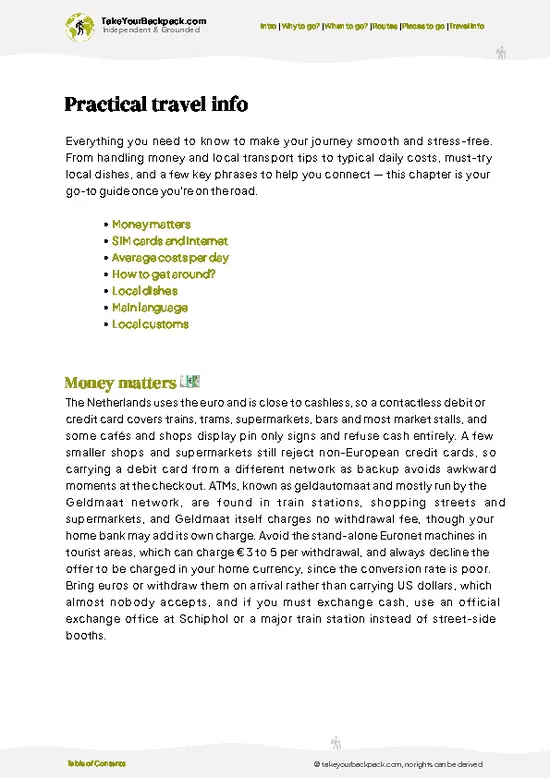
example page 0 from our offline Travel Guide for Netherlands
example page 1 from our offline Travel Guide for Netherlands
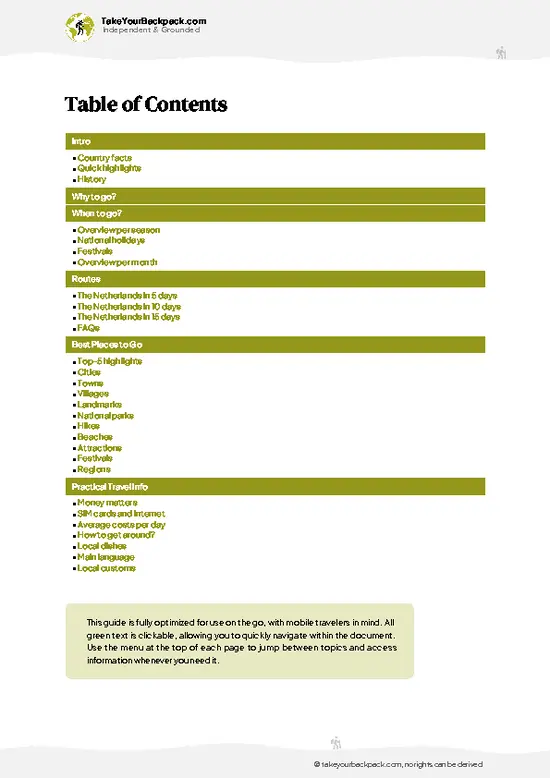
example page 2 from our offline Travel Guide for Netherlands
example page 3 from our offline Travel Guide for Netherlands
example page 4 from our offline Travel Guide for Netherlands
example page 5 from our offline Travel Guide for Netherlands
example page 6 from our offline Travel Guide for Netherlands
example page 7 from our offline Travel Guide for Netherlands
Loading the map 🌍
CLICK TO FILTER
cities
towns
villages
landmarks
national parks
hikes
beaches
attractions
festivals
regions
SHOW COUNTRY’S BESTSHOW ALL

✨ Why go?
Ranked #5 national park in The Netherlands
What sets this place apart

Backpackers come for the fallow deer herds that roam freely among the dunes, a sight you can get within an hour of Amsterdam without renting a car. The park has no mountain-style effort, so the payoff is easy: a network of marked paths lets you stitch together a 5 km stroll or a 20 km day, depending on your energy and the daylight. It also slots into a Netherlands route naturally. Combine it with a morning in Zandvoort aan Zee on the North Sea beach, or finish the day in Haarlem, a short bus ride away. Costs stay low: entry is a few euros and the paths need no gear beyond decent shoes and water. If you want a calm day between city stops, this is a reliable and varied choice.

💡 HighlightsEssential experiences to have while exploring Amsterdamse Waterleidingduinen

  1. Fallow deer: Herds of free-roaming deer graze in the open dune valleys, and early morning gives you the best chance of seeing them at close range.
  2. Dune valleys and lakes: Former infiltration channels and ponds, built to filter water, now shelter reeds, ducks and rare plants within a short walk of the paths.
  3. Old water infrastructure: Pumping stations and canals recall the park’s role supplying Amsterdam’s drinking water, and they give the landscape an unusual, engineered feel.
  4. Spring and summer wildflowers: The calcium-rich sand supports orchids and other dune flora that you rarely see in farmland nearby.
  5. Birdlife: Look for spoonbills, buzzards and waterfowl around the ponds, with many more birds passing through in migration seasons.
Fallow deer and the old water infrastructure combine well in one … read more 👉
  1. Fallow deer: Herds of free-roaming deer graze in the open dune valleys, and early morning gives you the best chance of seeing them at close range.
  2. Dune valleys and lakes: Former infiltration channels and ponds, built to filter water, now shelter reeds, ducks and rare plants within a short walk of the paths.
  3. Old water infrastructure: Pumping stations and canals recall the park’s role supplying Amsterdam’s drinking water, and they give the landscape an unusual, engineered feel.
  4. Spring and summer wildflowers: The calcium-rich sand supports orchids and other dune flora that you rarely see in farmland nearby.
  5. Birdlife: Look for spoonbills, buzzards and waterfowl around the ponds, with many more birds passing through in migration seasons.
Fallow deer and the old water infrastructure combine well in one day, since both lie along the same loop of paths.
Spotted a mistake or missing something? Contact us.

Things to do near Amsterdamse Waterleidingduinen

Ratings based on Tripadvisor reviews. When you book through this link, you support our work at no extra cost to you.

🌤️ When to go?Seasonal considerations and timing

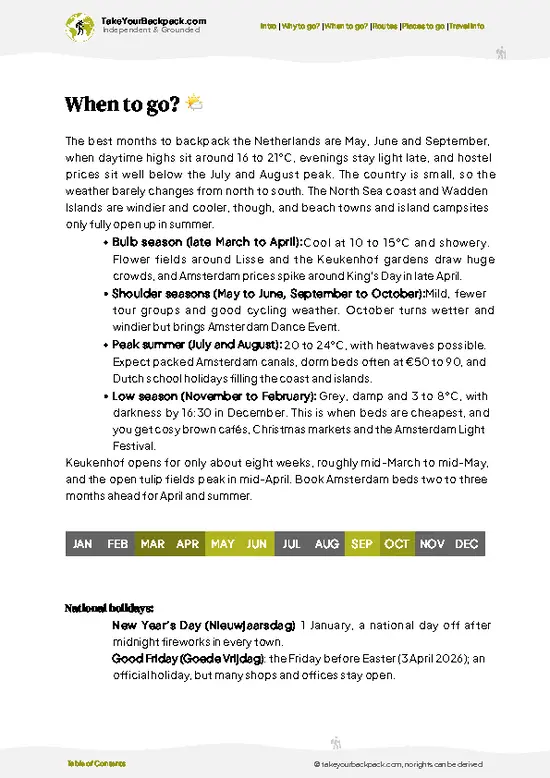
  • Spring (April to May): The best window, with 8 to 17°C (46 to 63°F) days, blossoming hawthorn and fallow deer fawns arriving in late May. Daylight stretches to about 15 hours by May. Weekends fill with local walkers.
  • Summer (June to August): Highs of 20 to 23°C (68 to 73°F) suit long days, with light until after 10 p.m. in June. Expect the most visitors, plus ticks and the occasional heavy shower.
  • Autumn (September to November): Temperatures fall from 18°C (64°F) to around 8°C (46°F). Rutting season brings deer activity in October, and the oak leaves turn rust-colored. Crowds thin out.
  • Winter (December to February): Typically 0 to 6°C (32 to 43°F), with only about 8 hours of daylight and damp, grey spells. Trails are quiet, though paths can be muddy and the park closes at dusk.
Entry is by a small … read more 👉
  • Spring (April to May): The best window, with 8 to 17°C (46 to 63°F) days, blossoming hawthorn and fallow deer fawns arriving in late May. Daylight stretches to about 15 hours by May. Weekends fill with local walkers.
  • Summer (June to August): Highs of 20 to 23°C (68 to 73°F) suit long days, with light until after 10 p.m. in June. Expect the most visitors, plus ticks and the occasional heavy shower.
  • Autumn (September to November): Temperatures fall from 18°C (64°F) to around 8°C (46°F). Rutting season brings deer activity in October, and the oak leaves turn rust-colored. Crowds thin out.
  • Winter (December to February): Typically 0 to 6°C (32 to 43°F), with only about 8 hours of daylight and damp, grey spells. Trails are quiet, though paths can be muddy and the park closes at dusk.
Entry is by a small fee or permit that stays the same all year, so timing affects weather and crowds only. Aim for a weekday morning in May or October.


source: climatestotravel.comJANJanuary: fair for travelingFEBFebruary: fair for travelingMARMarch: good for travelingAPRApril: highly recommended for travelingMAYMay: excellent for travelingJUNJune: excellent for travelingJULJuly: good for travelingAUGAugust: good for travelingSEPSeptember: highly recommended for travelingOCTOctober: highly recommended for travelingNOVNovember: good for travelingDECDecember: fair for traveling
netherlands-national-park-amsterdamse-waterleidingduinen
© Google | Cas

✈️ The backpacker research shortcutThe Netherlands Travel Guide

An offline-friendly backpacking guide with optimized travel routes, ranked highlights, transport advice, and the best areas to stay.
example page 0 from our offline Travel Guide for Netherlands
example page 1 from our offline Travel Guide for Netherlands
example page 2 from our offline Travel Guide for Netherlands
example page 3 from our offline Travel Guide for Netherlands
example page 4 from our offline Travel Guide for Netherlands
example page 5 from our offline Travel Guide for Netherlands
example page 6 from our offline Travel Guide for Netherlands
example page 7 from our offline Travel Guide for Netherlands
The digital guide (373 pages) contains:
✅ 127 highlights, ranked by travel appeal
✅ Optimized 5, 10 & 15-day travel routes
✅ Cities, national parks, landmarks, beaches
✅ How to get around
✅ Offline-friendly for travel without Wi-Fi
👉 Click to see all 30+ guide features

📅 Plan smarter in minutes, not weeks
✅ Month by month travel advice
✅ Festivals & national holidays
✅ Budget expectations

🗺️ Go to the right places, skip the overrated ones
✅ Honest pros & cons of destinations
✅ Top hikes, parks & viewpoints
✅ Lesser-known places most travelers miss
✅ Clear “worth it vs skip it” guidance

🛏️ Travel smoothly without rookie mistakes
✅ Best areas to stay
✅ Transport systems explained simply
✅ Common scams & safety advice
✅ SIM cards, money & practical tips

🌍 Understand the country, not just visit it
✅ Culture & traditions
✅ 52 Essential phrases & customs
✅ Festivals worth planning around
✅ Traveler-friendly historical context
✅ Insights that make places more meaningful

📱 Built for real travel conditions
✅ Fully downloadable PDF
✅ Works completely offline
✅ Optimized for phone use
✅ Useful in remote areas & buses
✅ Everything in one place
Stop searching, start planning
Get instant access to your full guide. 30‑day money-back guarantee.
+ Add another guide for just

By proceeding you agree to our terms.
Sent to your inbox immediately after payment • 100% Secure Checkout
Best Backpacking Travel Advisor 2025 tourism awardBest Backpacking
Travel Advisor
2025
What others say about Take Your Backpack Guides:
⭐⭐⭐⭐⭐
Fantastic, amazing amount of information!
⭐⭐⭐⭐⭐
My goodness this is amazing, it's what I've been looking for hats off too you!
⭐⭐⭐⭐⭐
I think this is absolutely BRILLIANT
⭐⭐⭐⭐
Very complete and informative. It's still missing places, but I gotta to commend you
⭐⭐⭐⭐⭐
This is truly amazing, thank you, can't wait to explore it with my kids!
⭐⭐⭐⭐⭐
Awesome resource, thank you!
⭐⭐⭐⭐⭐
This is amazing! Can't wait to explore the ones I haven't seen
⭐⭐⭐⭐
I love this! Well done, great idea.
⭐⭐⭐⭐⭐
Thanks for taking the time to make this gem!
⭐⭐⭐⭐⭐
This might be the best website I've ever seen.
⭐⭐⭐⭐⭐
Congratulations, and thank you so much for your work; it's incredibly valuable.
⭐⭐⭐⭐
In all seriousness I think you did a great job pointing out the important spots
⭐⭐⭐⭐⭐
10/10 very good
⭐⭐⭐⭐⭐
As someone who's only just starting to visit regularly this is awesome, thank you.
⭐⭐⭐⭐
Thank you very much! I'm going to visit my dad, it's going to be very useful!
⭐⭐⭐⭐⭐
This is really cool! We'll be travelling for the first time and this definitely come in handy.
⭐⭐⭐⭐⭐
You are now our minister of culture, congratulations 👨‍💼
⭐⭐⭐⭐⭐
Just wanted to tell you that this is a pearl! Going to follow your recommendations.
⭐⭐⭐⭐⭐
This is so cool. I'll definitely be using the resource for my travels soon.
⭐⭐⭐⭐⭐
This is very impressive! Good work.
⭐⭐⭐⭐⭐
This is an amazing and informative site. Very well done!

🛏️ Where to stay?How to pick the right area

If you enjoy meeting fellow travelers, consider choosing hostels with high ratings for atmosphere. On the other hand, if you prefer having your own space, a hotel might be a better option.

🥾 TrailsTrail guide for Amsterdamse Waterleidingduinen national park

Total Distance: Flexible, typically 8 to 20 km depending on the loop you choose.
Estimated Duration: 2 to 5 hours of walking, plus time for wildlife watching.
Difficulty: Easy. The terrain is flat to gently rolling with soft sand in places.
Starting Point: The main entrance is near Vogelenzang. Public transport options:
  • Train and bus: Take a train to Haarlem or Heemstede-Aerdenhout, then a local bus toward Vogelenzang or Zandvoort.
  • Walking in: Several entrances can be reached on foot or by bike from nearby villages.
Major Landmarks:
  • Dune lakes: Former water basins with reeds and birds.
  • Pumping infrastructure:
… read more 👉
Total Distance: Flexible, typically 8 to 20 km depending on the loop you choose.
Estimated Duration: 2 to 5 hours of walking, plus time for wildlife watching.
Difficulty: Easy. The terrain is flat to gently rolling with soft sand in places.
Starting Point: The main entrance is near Vogelenzang. Public transport options:
  • Train and bus: Take a train to Haarlem or Heemstede-Aerdenhout, then a local bus toward Vogelenzang or Zandvoort.
  • Walking in: Several entrances can be reached on foot or by bike from nearby villages.
Major Landmarks:
  • Dune lakes: Former water basins with reeds and birds.
  • Pumping infrastructure: Remnants of the water supply system.
  • Open dune viewpoints: Low rises with views toward the coast.
Terrain and Scenery: Sandy trails and gravel paths wind through dune hollows, scrub and open grassland. Shade is limited, so bring water and sun protection.
Vegetation: Sea buckthorn, hawthorn, dune grasses, mosses and seasonal orchids.
Wildlife: Fallow deer are the highlight, with foxes, rabbits and many waterbirds.
⚠️ Hiking info can sometimes be outdated or inaccurate. Before you hit the trail, check the latest conditions with locals. If you do spot anything that's off, I'd love to hear from you, so I can update it for fellow travelers.

🛡️ SafetyTraveler Safety Guide

This is one of the easiest and safest hikes in the Netherlands, with flat sandy paths, no real exposure and no altitude to worry about. The main practical issue is navigation. Dozens of intersecting trails look alike among the dunes, so download an offline map or pick up the park map at the entrance, and note which gate you used. Opening hours are enforced, and the gates close around sunset, so check the closing time before you set off in winter. Ticks are common in grass and bracken from spring to autumn, so wear long trousers, tuck in your socks and check your skin afterward. Fallow deer, foxes and Highland cattle live here. Keep your distance, never feed the animals and keep dogs on a leash. Bring drinking water, since refill points are scarce. Weather shifts quickly off the North Sea, … read more 👉
This is one of the easiest and safest hikes in the Netherlands, with flat sandy paths, no real exposure and no altitude to worry about. The main practical issue is navigation. Dozens of intersecting trails look alike among the dunes, so download an offline map or pick up the park map at the entrance, and note which gate you used. Opening hours are enforced, and the gates close around sunset, so check the closing time before you set off in winter. Ticks are common in grass and bracken from spring to autumn, so wear long trousers, tuck in your socks and check your skin afterward. Fallow deer, foxes and Highland cattle live here. Keep your distance, never feed the animals and keep dogs on a leash. Bring drinking water, since refill points are scarce. Weather shifts quickly off the North Sea, so pack a light rain jacket even on sunny mornings. Sandy paths tire legs more than you expect, so wear comfortable shoes.

FAQCommon questions from travelers

Most visitors spend 2 to 5 hours on the trails. A short loop near the Vogelenzang entrance is around 8 km, while longer circuits pass 15 to 20 km. Add an hour if you stop to watch the deer.
The hike is easy. The terrain is nearly flat, with some soft sand that slows you slightly, and loops of 8 to 20 km suit most fitness levels. Shade is limited, so carry water in summer.
No guide is needed, since the paths are well marked and open to independent walkers. Entry has a small fee, roughly €2 to 4 per adult, collected at the main gates. Check current opening hours before you go, as the gates close in the evening.
⚠️ Things can change over time, so always validate details locally before you go.

Other Dutch national parks near Amsterdamse Waterleidingduinen

Explore more nearby:


💡 Not sure where to go next?
Create a personalized itinerary for The Netherlands including Amsterdamse Waterleidingduinen and the places that fit your trip.

Generate my itinerary

👉 Discover all national parks

Or checkout all The Netherlands has to offer (think cities, towns, villages, national parks, hikes, beaches, festivals)
Country photo of The Netherlands

We 💚 feedbackFinal thoughts on exploring Amsterdamse Waterleidingduinen

Go early on a spring or autumn morning, when the light is soft and the deer are still out in the open valleys. Midday summer crowds and the lack of shade take some of the shine off, and it is no place for a challenging trek. As a calm half day from Amsterdam, though, it is reliable.

✈️ When did I visit The Netherlands?
Netherlands is my home base, so whenever I don’t travel, you can find me in this tiny spot on the globe. When friends from abroad visit me, it’s the time to actually explore my own country as a traveler.

✍️ Help improve this page!
The information on this page is based on my own backpacking experience in The Netherlands, supplemented with up-to-date research and feedback from other travelers. Travel details can change, so if you notice anything outdated or incomplete, feel free to let me know.


🙋‍♂️ Give feedback

👋 Meet the founderWho’s Behind Take Your Backpack?

Johan, backpacker and founder of TakeYourBackpackHi, I’m Johan (Netherlands 🇳🇱), the creator of TakeYourBackpack. Over the past 3 decades, I’ve backpacked through 90+ countries across six continents, gaining extensive experience with independent travel, long-term trips, and overland routes.

This site is built on a combination of firsthand travel experience and carefully curated insights from other backpackers. Many guides are based on places I’ve personally visited, while others bring together tips, observations, and practical advice shared by trusted travelers I’ve met along the way.

The goal is to provide realistic, experience-driven guidance — not generic itineraries — so you can explore destinations with better context, clearer expectations, and more confidence.