×

The Netherlands🇳🇱 | citiesGroningenMartinitoren, student bars, bike traffic, Groninger Museum | things to do and best time to go

Explore DeventerExplore Haarlem

Backpacking in Groningen
👍 Recommendedcity ranked #9
By Johan Kruseman 🇳🇱 | Updated October 16, 2026

Groningen suits backpackers who like student-town energy, bikes and late-night bars more than monuments. If you want mountains, big-ticket sights or a quiet retreat, you may find it less rewarding. It sits in the far north of the Netherlands, about 2 hours by train from Amsterdam, and it works as a compact university city of some 35,000 students. That pattern explains everything: cheap cafés, packed bike racks, and a social scene that thins out in summer. I arrived at the station on an evening train and wheeled out into a river of cyclists, hundreds of bells and no cars, and understood the city’s logic within minutes. Compared with Amsterdam or Utrecht, it is cheaper, less crowded and far less polished.

Discover everything you want to know in the 📖 The Netherlands Travel Guide.


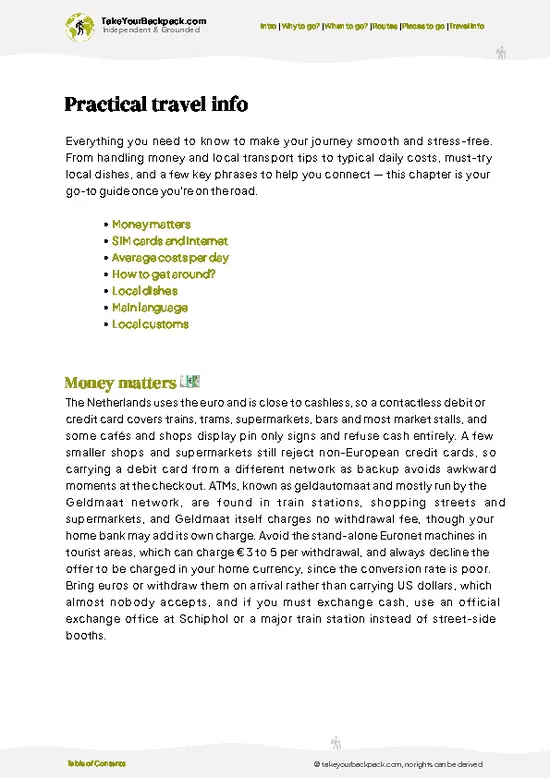
example page 0 from our offline Travel Guide for Netherlands
example page 1 from our offline Travel Guide for Netherlands
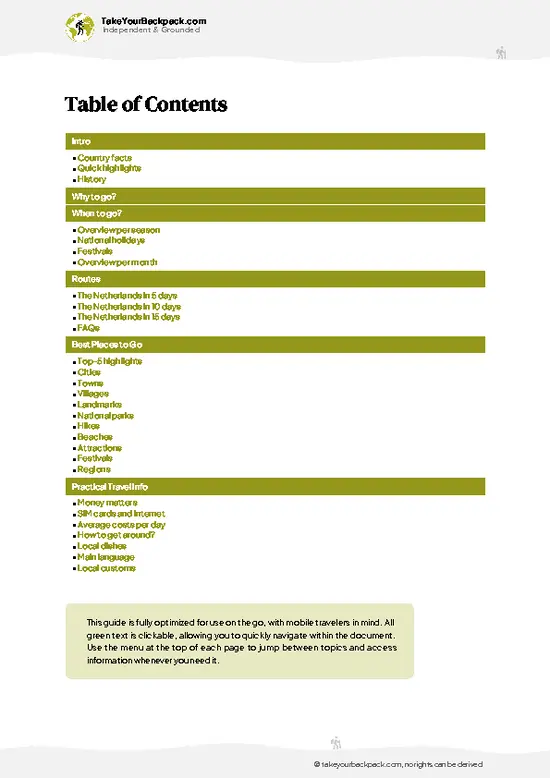
example page 2 from our offline Travel Guide for Netherlands
example page 3 from our offline Travel Guide for Netherlands
example page 4 from our offline Travel Guide for Netherlands
example page 5 from our offline Travel Guide for Netherlands
example page 6 from our offline Travel Guide for Netherlands
example page 7 from our offline Travel Guide for Netherlands
Loading the map 🌍
CLICK TO FILTER
cities
towns
villages
landmarks
national parks
hikes
beaches
attractions
festivals
regions
SHOW COUNTRY’S BESTSHOW ALL

✨ Why go?
Ranked #9 city in The Netherlands
What makes it a must-see city

Groningen earns its place on a northern Netherlands route because it is the region’s student capital, with roughly one in five residents enrolled, so nightlife runs every night of the week and prices at cafés and snack bars stay lower than in the Randstad. The center is small enough to cross on foot in 20 minutes, yet a bike rental at around €10 to 15 a day opens up the canals and parks. It is also a practical hub. Trains reach Amsterdam in about 2 hours, and regional lines head to the Wadden Sea coast and into Friesland. Hostel options are limited, so book ahead and expect hotels or rooms from private hosts to fill the gap. Plan two nights if you like bars and food, or one if you only want a stopover on the way to the islands.

💡 HighlightsWhat this place is best known for

  1. Martinitoren: The 97-meter tower dominates the Grote Markt, and the climb of about 260 steps gives the best view over flat farmland. Go on a clear morning. Around €6 to 7, 45 minutes.
  2. Groninger Museum: A colorful postmodern building on the canal, with eccentric art, design and fashion. Weekday mornings are calmer. Around €17 to 18, 2 hours. Closed Mondays.
  3. Grote Markt and Vismarkt: The main square and nearby fish market area form the social heart of town. Visit Saturday morning when stalls fill up. Free, 1 hour.
  4. Noorderplantsoen: A landscaped park north of the center with ponds, sculpture and picnic spots. Late afternoon in summer is lovely. Free, 1 hour.
  5. Prinsenhof Garden: A tucked-away courtyard garden behind the old Prinsenhof, planted in historic style. Spring and summer are best. Free, 30
… read more 👉
  1. Martinitoren: The 97-meter tower dominates the Grote Markt, and the climb of about 260 steps gives the best view over flat farmland. Go on a clear morning. Around €6 to 7, 45 minutes.
  2. Groninger Museum: A colorful postmodern building on the canal, with eccentric art, design and fashion. Weekday mornings are calmer. Around €17 to 18, 2 hours. Closed Mondays.
  3. Grote Markt and Vismarkt: The main square and nearby fish market area form the social heart of town. Visit Saturday morning when stalls fill up. Free, 1 hour.
  4. Noorderplantsoen: A landscaped park north of the center with ponds, sculpture and picnic spots. Late afternoon in summer is lovely. Free, 1 hour.
  5. Prinsenhof Garden: A tucked-away courtyard garden behind the old Prinsenhof, planted in historic style. Spring and summer are best. Free, 30 minutes.
  6. Noordelijk Scheepvaartmuseum: A small museum of northern maritime history in two old merchant houses. Good for a rainy afternoon. Around €8 to 10, 1 to 1.5 hours.
  7. Canal boat tour: A one-hour cruise through the Diepenring canals shows the old city walls and bridges. Best on dry days between April and October. Around €13 to 15.
For a first visit, start with the Martinitoren, since it explains the city’s layout in one glance. Day trips worth considering include the Wadden Sea mudflats at Pieterburen, the moated Fraeylemaborg estate in Slochteren and the island of Schiermonnikoog.
Spotted a mistake or missing something? Contact us.

Things to do in Groningen

Ratings based on Tripadvisor reviews. When you book through this link, you support our work at no extra cost to you.

🏘️ NeighborhoodsNeighborhood guide to Groningen

Groningen is compact, and its areas sort themselves by what students do with their days and nights, which makes the city easy to read once you see the pattern.
  • Binnenstad (Inner City): The medieval core around the Grote Markt and Martinitoren tower holds the shops, brown cafés and the Vismarkt and Vischmarkt squares. Everything is walkable in 20 minutes, and it is busiest on Saturdays. Eat cheap at the snack counters on the side streets rather than the square terraces.
  • Zwanestraat and Poelestraat area: Poelestraat and nearby Peperstraat form the nightlife strip, with student bars open until 4 or 5 a.m. on weekends. Drinks cost less here than on the main squares, so it gives the best value for a night out, though it gets loud.
  • Ebbingekwartier: A quieter northwest corner with the Groninger Museum
… read more 👉
Groningen is compact, and its areas sort themselves by what students do with their days and nights, which makes the city easy to read once you see the pattern.
  • Binnenstad (Inner City): The medieval core around the Grote Markt and Martinitoren tower holds the shops, brown cafés and the Vismarkt and Vischmarkt squares. Everything is walkable in 20 minutes, and it is busiest on Saturdays. Eat cheap at the snack counters on the side streets rather than the square terraces.
  • Zwanestraat and Poelestraat area: Poelestraat and nearby Peperstraat form the nightlife strip, with student bars open until 4 or 5 a.m. on weekends. Drinks cost less here than on the main squares, so it gives the best value for a night out, though it gets loud.
  • Ebbingekwartier: A quieter northwest corner with the Groninger Museum near the station and Noorderplantsoen park. It costs a little in time to reach, about 10 minutes on foot from the center, but the park is free and good for a picnic.
  • Oosterparkwijk: A residential eastern district with the Oosterpark and the Oosterpoort concert venue. Less touristy and flat, it rewards a bike ride more than a stroll.

⌛️ 1 dayHow to make the most of one day

Groningen is easy to cover in a day because the center is compact and flat, and the city mixes old brick with bold modern design.
9:00 AM, Martinitoren: Climb early for views across the roofs and the surrounding plain, then walk two minutes to the Grote Markt.
10:30 AM, Vismarkt and Prinsenhof Garden: Wander the old quarter, browse the stalls if it is a market day, and slip into the quiet garden courtyard.
12:30 PM, Lunch near Oosterstraat: Pick a student café for a sandwich or stew at modest prices, then walk or bike 15 minutes toward the station.
2:00 PM, Groninger Museum: Spend two hours in its wild interiors and rotating exhibitions.
4:30 PM, Noorderplantsoen: Stroll the park and rest by the ponds.
6:00 PM, Ebbingekwartier: Off the main tourist track, this quiet residential area has the Ebbingepoort … read more 👉
Groningen is easy to cover in a day because the center is compact and flat, and the city mixes old brick with bold modern design.
9:00 AM, Martinitoren: Climb early for views across the roofs and the surrounding plain, then walk two minutes to the Grote Markt.
10:30 AM, Vismarkt and Prinsenhof Garden: Wander the old quarter, browse the stalls if it is a market day, and slip into the quiet garden courtyard.
12:30 PM, Lunch near Oosterstraat: Pick a student café for a sandwich or stew at modest prices, then walk or bike 15 minutes toward the station.
2:00 PM, Groninger Museum: Spend two hours in its wild interiors and rotating exhibitions.
4:30 PM, Noorderplantsoen: Stroll the park and rest by the ponds.
6:00 PM, Ebbingekwartier: Off the main tourist track, this quiet residential area has the Ebbingepoort and the Ebbingekwartier’s calm streets. Walk its leafy lanes before dinner.
8:00 PM, Peperstraat area: End with a drink in the lively bars along the narrow streets near the market.

🌤️ When to go?Best time to visit Groningen

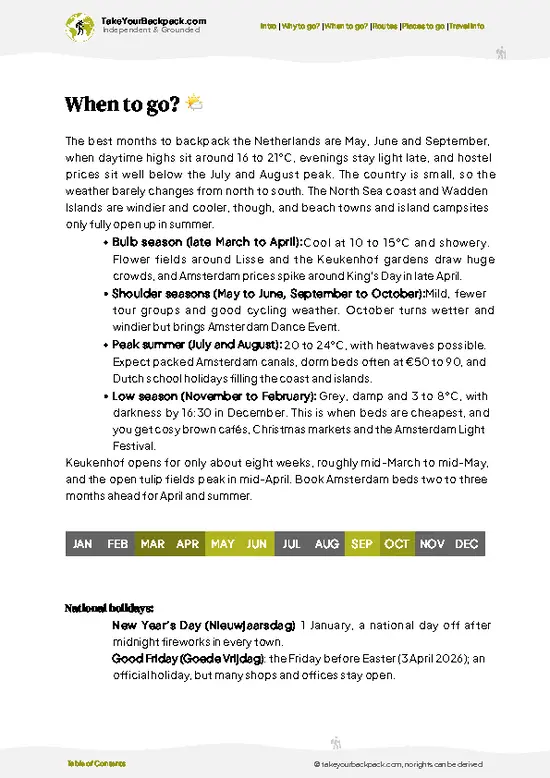
May to September is the best window, with long daylight and the city at its liveliest.
  • Summer (June to August): Highs of 20 to 23°C (68 to 73°F), daylight until about 10 p.m. in June. Terraces fill, festivals run, and hostel prices peak.
  • Spring (April and May): 10 to 17°C (50 to 63°F), tulip season nearby, and fewer crowds. Showers are frequent.
  • Autumn (September to November): 8 to 17°C (46 to 63°F), with student arrivals in late August and September filling bars and beds.
  • Winter (December to February): 0 to 6°C (32 to 43°F), only about 8 hours of daylight, damp wind and the cheapest rooms. Christmas markets add atmosphere.
Book beds early for late August, when the university term begins.

source: climatestotravel.comJANJanuary: fair for travelingFEBFebruary: fair for travelingMARMarch: good for travelingAPRApril: highly recommended for travelingMAYMay: highly recommended for travelingJUNJune: good for travelingJULJuly: good for travelingAUGAugust: good for travelingSEPSeptember: highly recommended for travelingOCTOctober: good for travelingNOVNovember: fair for travelingDECDecember: fair for traveling
netherlands-city-groningen
© Google |

✈️ The backpacker research shortcutThe Netherlands Travel Guide

An offline-friendly backpacking guide with optimized travel routes, ranked highlights, transport advice, and the best areas to stay.
example page 0 from our offline Travel Guide for Netherlands
example page 1 from our offline Travel Guide for Netherlands
example page 2 from our offline Travel Guide for Netherlands
example page 3 from our offline Travel Guide for Netherlands
example page 4 from our offline Travel Guide for Netherlands
example page 5 from our offline Travel Guide for Netherlands
example page 6 from our offline Travel Guide for Netherlands
example page 7 from our offline Travel Guide for Netherlands
The digital guide (373 pages) contains:
✅ 127 highlights, ranked by travel appeal
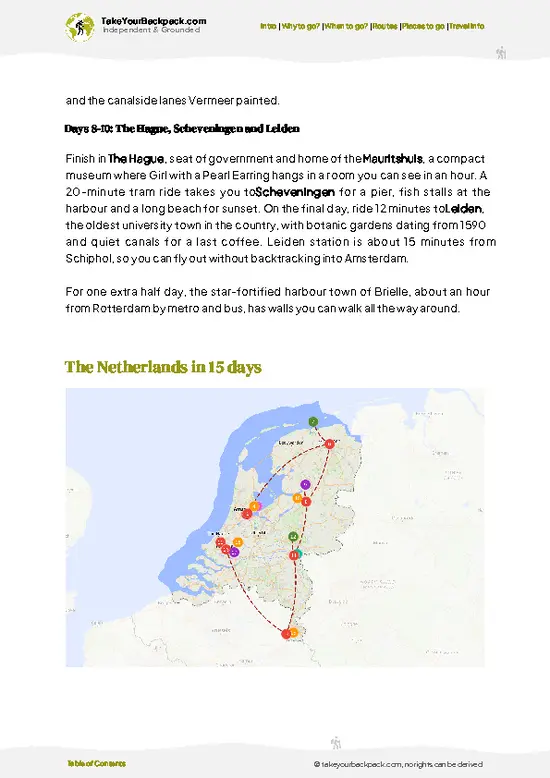
✅ Optimized 5, 10 & 15-day travel routes
✅ Cities, national parks, landmarks, beaches
✅ How to get around
✅ Offline-friendly for travel without Wi-Fi
👉 Click to see all 30+ guide features

📅 Plan smarter in minutes, not weeks
✅ Month by month travel advice
✅ Festivals & national holidays
✅ Budget expectations

🗺️ Go to the right places, skip the overrated ones
✅ Honest pros & cons of destinations
✅ Top hikes, parks & viewpoints
✅ Lesser-known places most travelers miss
✅ Clear “worth it vs skip it” guidance

🛏️ Travel smoothly without rookie mistakes
✅ Best areas to stay
✅ Transport systems explained simply
✅ Common scams & safety advice
✅ SIM cards, money & practical tips

🌍 Understand the country, not just visit it
✅ Culture & traditions
✅ 52 Essential phrases & customs
✅ Festivals worth planning around
✅ Traveler-friendly historical context
✅ Insights that make places more meaningful

📱 Built for real travel conditions
✅ Fully downloadable PDF
✅ Works completely offline
✅ Optimized for phone use
✅ Useful in remote areas & buses
✅ Everything in one place
Stop searching, start planning
Get instant access to your full guide. 30‑day money-back guarantee.
+ Add another guide for just

By proceeding you agree to our terms.
Sent to your inbox immediately after payment • 100% Secure Checkout
Best Backpacking Travel Advisor 2025 tourism awardBest Backpacking
Travel Advisor
2025
What others say about Take Your Backpack Guides:
⭐⭐⭐⭐⭐
Fantastic, amazing amount of information!
⭐⭐⭐⭐⭐
My goodness this is amazing, it's what I've been looking for hats off too you!
⭐⭐⭐⭐⭐
I think this is absolutely BRILLIANT
⭐⭐⭐⭐
Very complete and informative. It's still missing places, but I gotta to commend you
⭐⭐⭐⭐⭐
This is truly amazing, thank you, can't wait to explore it with my kids!
⭐⭐⭐⭐⭐
Awesome resource, thank you!
⭐⭐⭐⭐⭐
This is amazing! Can't wait to explore the ones I haven't seen
⭐⭐⭐⭐
I love this! Well done, great idea.
⭐⭐⭐⭐⭐
Thanks for taking the time to make this gem!
⭐⭐⭐⭐⭐
This might be the best website I've ever seen.
⭐⭐⭐⭐⭐
Congratulations, and thank you so much for your work; it's incredibly valuable.
⭐⭐⭐⭐
In all seriousness I think you did a great job pointing out the important spots
⭐⭐⭐⭐⭐
10/10 very good
⭐⭐⭐⭐⭐
As someone who's only just starting to visit regularly this is awesome, thank you.
⭐⭐⭐⭐
Thank you very much! I'm going to visit my dad, it's going to be very useful!
⭐⭐⭐⭐⭐
This is really cool! We'll be travelling for the first time and this definitely come in handy.
⭐⭐⭐⭐⭐
You are now our minister of culture, congratulations 👨‍💼
⭐⭐⭐⭐⭐
Just wanted to tell you that this is a pearl! Going to follow your recommendations.
⭐⭐⭐⭐⭐
This is so cool. I'll definitely be using the resource for my travels soon.
⭐⭐⭐⭐⭐
This is very impressive! Good work.
⭐⭐⭐⭐⭐
This is an amazing and informative site. Very well done!

🛏️ Where to stay?How to pick the right area

The inner city and the streets around the station are the best bets for a budget bed in Groningen. Hostel and budget capacity is small compared with Amsterdam, so beds fill quickly in late August and September when students return.
The inner city puts you within walking distance of bars, cafés and the market squares, and you will not need transport at all. The trade-off is noise on Thursday to Saturday nights, especially near the Poelestraat bar strip, so ask for a room facing away from the street or pack earplugs. Nights are safe, with plenty of people and bike traffic on the streets until late. … read more 👉
The inner city and the streets around the station are the best bets for a budget bed in Groningen. Hostel and budget capacity is small compared with Amsterdam, so beds fill quickly in late August and September when students return.
The inner city puts you within walking distance of bars, cafés and the market squares, and you will not need transport at all. The trade-off is noise on Thursday to Saturday nights, especially near the Poelestraat bar strip, so ask for a room facing away from the street or pack earplugs. Nights are safe, with plenty of people and bike traffic on the streets until late.
The area around the station suits early departures and late arrivals. It is 10 to 15 minutes on foot from the center, quieter at night, and has trains and most buses on your doorstep. Prices run a little lower here than in the middle of town. If dorms are full, look at rooms in the Oosterparkwijk residential district, a 10 minute bike ride away.

🚌 Getting aroundHow to get from A to B

A bicycle is the easiest way to get around Groningen, because the city is flat, compact and built around bike lanes, with more bikes than cars in the center. Most backpackers walk the old center and ride for anything farther, while buses fill the gaps and trains handle the region. Public transport is reliable, but the center is small enough that it often loses to your own legs.
  • Walking: Free, and it covers the whole inner city in about 20 minutes end to end. It gives the best value for sightseeing, but watch for bikes, which have priority and rarely slow down.
  • Rental bike: About €10 to 15 a day from rental shops, or €30 to 50 a week for longer stays. It is the fastest way to reach parks, the Oosterpoort or lakes like Paterswoldsemeer (15 minutes). Lock it twice, because theft is common.
  • City
… read more 👉
A bicycle is the easiest way to get around Groningen, because the city is flat, compact and built around bike lanes, with more bikes than cars in the center. Most backpackers walk the old center and ride for anything farther, while buses fill the gaps and trains handle the region. Public transport is reliable, but the center is small enough that it often loses to your own legs.
  • Walking: Free, and it covers the whole inner city in about 20 minutes end to end. It gives the best value for sightseeing, but watch for bikes, which have priority and rarely slow down.
  • Rental bike: About €10 to 15 a day from rental shops, or €30 to 50 a week for longer stays. It is the fastest way to reach parks, the Oosterpoort or lakes like Paterswoldsemeer (15 minutes). Lock it twice, because theft is common.
  • City bus: Operated by Qbuzz, with single tickets around €3 to 4 bought on board by card. Services run roughly 6 a.m. to midnight, with some night buses on weekends. Buses make sense for rain or reaching the outskirts, but you rarely need one downtown.
  • Train: Groningen station has direct trains to Assen, Leeuwarden, Zwolle and Amsterdam (about 2 hours 15 minutes). Fares vary with distance, so use an OV-fiets or a contactless bank card, which saves buying paper tickets.
  • OV-fiets: A rail-linked bike near the station costing about €5 per 24 hours, which suits a quick trip if you hold a Dutch OV-chipkaart.

👛 Costs (as of 16 October 2026)How expensive it really is

Backpacking in Groningen costs about €55 to 90 a day, noticeably lower than Amsterdam.
CategoryBudget RangeLocal Reality
Dorm accommodation (high season)€35 to 55Few hostels, so book ahead for summer and September.
Dorm accommodation (off-season)€25 to 40Easier to find a bed in winter.
Meals€15 to 30Takeaway snacks €3 to 7, cheap student lunches €8 to 12.
Local transport€0 to 15Walking is free, bike rental €10 to 15 per day.
City transport pass€5 to 10Day passes cost little, and few visitors need one.
Basic activities/entry fees€0 to 15Groninger Museum about €15 to 17, Martinitoren tower a few euros.
Miscellaneous€5 to 15Beer €3 to 5, laundry and lockers.
Total Daily Budget€55 to 90Lower if you cook and cycle.
Buy groceries at supermarkets and cook in the hostel kitchen to save around €10 to 15 a day.
⚠️ Prices can change and everyone travels differently, so take this as a rough guide. Hope it helps you plan your adventure!

🚌 Day tripsShort trips worth adding

Groningen sits on a flat network of trains and buses, so day trips to the coast and nearby towns are easy and cheap, usually under €25 return.Wadden Sea at Pieterburen: Take the bus and train combination (about 1 hour) to this coastal village, home to a seal sanctuary. Come between April and October for mudflat walks, and never walk the flats without a registered guide, which is the common first-timer mistake. Budget €20 to 40 including a guided walk.
Zoutkamp and Lauwersmeer: A bus ride of about 50 minutes takes you to a fishing harbor and a national park of marsh and birdlife. Rent a bike in town for about €10 to cycle quiet dikes. Late spring and autumn are best for migrating geese.
👉 Explore Lauwersmeer National ParkLeeuwarden: The Frisian capital is 40 minutes by train, with canals, leaning … read more 👉
Groningen sits on a flat network of trains and buses, so day trips to the coast and nearby towns are easy and cheap, usually under €25 return.Wadden Sea at Pieterburen: Take the bus and train combination (about 1 hour) to this coastal village, home to a seal sanctuary. Come between April and October for mudflat walks, and never walk the flats without a registered guide, which is the common first-timer mistake. Budget €20 to 40 including a guided walk.
Zoutkamp and Lauwersmeer: A bus ride of about 50 minutes takes you to a fishing harbor and a national park of marsh and birdlife. Rent a bike in town for about €10 to cycle quiet dikes. Late spring and autumn are best for migrating geese.
👉 Explore Lauwersmeer National ParkLeeuwarden: The Frisian capital is 40 minutes by train, with canals, leaning tower Oldehove and a calm pace. Return fares run around €15 to 20 off-peak. Go in summer, when the surrounding Frisian lakes and sailing add a dimension.
👉 Explore LeeuwardenBourtange: This star-shaped fortress village is about 1 hour 15 minutes away by train and bus. Entry to the grounds is free, with museums costing a few euros. Check the last bus back before you wander, since rural services thin out in the evening.
👉 Explore Bourtange

🍲 FoodWhat to Eat & Drink

Groningen eats like a student city: hearty, cheap and best with a beer. Try patatje oorlog (fries with mayonnaise, peanut sauce and onions), bitterballen with mustard, and a spicy Groninger mosterdsoep, a mustard soup found in traditional places. For the local liquor, ask for a Boswachter or a shot of Berenburg (herbal Frisian bitters), often poured with a tiny glass of beer on the side.
Cheap meals live around the Vismarkt and Grote Markt side streets, with snack bars, Turkish and Surinamese takeaways and market stalls selling stroopwafels and cheese. Brown cafés (bruine kroegen) are the social engine, with dark wood, candles and long beer menus with local brews. Afternoon borrel means drinks plus snacks.
Tipping is modest: round up or leave 5 to 10 percent. Dinner starts early, with kitchens … read more 👉
Groningen eats like a student city: hearty, cheap and best with a beer. Try patatje oorlog (fries with mayonnaise, peanut sauce and onions), bitterballen with mustard, and a spicy Groninger mosterdsoep, a mustard soup found in traditional places. For the local liquor, ask for a Boswachter or a shot of Berenburg (herbal Frisian bitters), often poured with a tiny glass of beer on the side.
Cheap meals live around the Vismarkt and Grote Markt side streets, with snack bars, Turkish and Surinamese takeaways and market stalls selling stroopwafels and cheese. Brown cafés (bruine kroegen) are the social engine, with dark wood, candles and long beer menus with local brews. Afternoon borrel means drinks plus snacks.
Tipping is modest: round up or leave 5 to 10 percent. Dinner starts early, with kitchens often closing around 9 p.m., so eat before you drink.

🛡️ SafetyTraveler Safety Guide

Groningen is very safe, and the usual problems are bikes rather than crime. Bike theft is the main issue, so use a strong lock and fasten the frame to something fixed. Never leave a bike overnight in the same spot near the station. Pickpockets occasionally work crowded bars on weekends and the Saturday market, so keep phones in a front pocket. Solo travelers, including women, walk home late through the lit center without trouble, though the Poelestraat strip gets rowdy after 2 a.m. Cyclists ignore red lights now and then, so look both ways at bike lanes, which are easy to step into. Cannabis offers on the street are rare, and buying from anyone other than a licensed coffeeshop is a bad idea. The emergency number is 112.

FAQCommon questions from travelers

Two full days is enough for most backpackers, and three works if you add a day trip. Day one covers the Grote Markt, the Martinitoren (about 97 meters tall) and the Groninger Museum, which takes 2 to 3 hours on its own. Day two suits the canal loop, a long lunch and the bars around the Peperstraat and Poelestraat. Pathum-style side trips such as Pieterburen or Haren fit into a third day, each under 30 minutes by bus or train.
Yes, Groningen is among the safer student cities in the Netherlands, and solo travelers rarely run into more than bike theft. Walking home at 2 AM through the center is normal, and the main train station area is well lit. Lock your bike with two locks, since rental or borrowed bikes disappear often, and keep your phone in a front pocket on crowded nights on Poelestraat. For emergencies, dial 112 anywhere in the country.
Groningen is known for its huge student population, with roughly 60,000 to 70,000 students at the University of Groningen and Hanze University, which gives the city a young, late-night feel. It is also famous for the Martinitoren, the Groninger Museum with its colorful postmodern design beside the station, and one of the highest bike-use rates in Europe. Food fans know it for the mustard soup and for Groninger koek (spiced cake), while the pub streets around the Grote Markt stay busy until 4 or 5 AM.
⚠️ Things can change over time, so always validate details locally before you go.

Other Dutch cities near Groningen

Explore more nearby:

  • Leeuwarden—Leaning Oldehove, Frisian signs, ceramics, Voorstreek| 51 km away
  • Zwolle—Sassenpoort gate, moat walk, Peperbus, northeast base| 85 km away
  • Deventer—Bergkwartier, IJssel bank, Brink square, mustard shop| 110 km away

💡 Not sure where to go next?
Create a personalized itinerary for The Netherlands including Groningen and the places that fit your trip.

Generate my itinerary

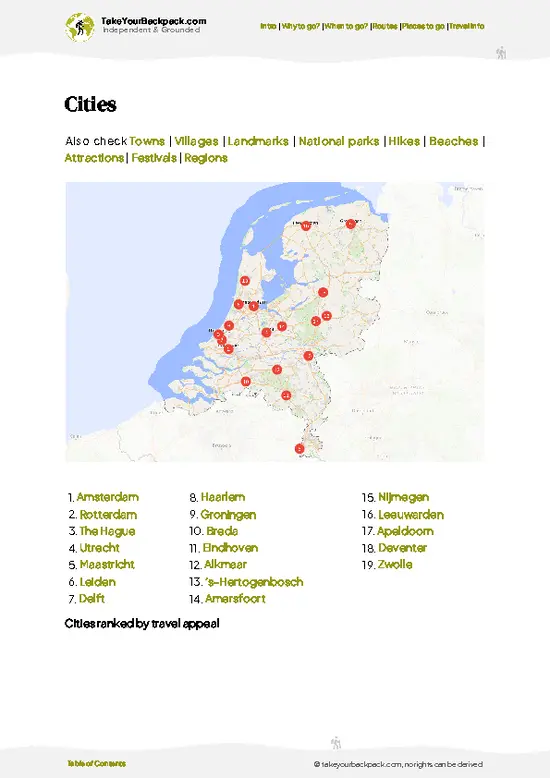
👉 Discover all cities

Or checkout all The Netherlands has to offer (think cities, towns, villages, national parks, hikes, beaches, festivals)
Country photo of The Netherlands

We 💚 feedbackWhat to keep in mind

Come in late spring, on a long evening around 7 PM, when the terraces on the Grote Markt fill and the light stays until after 9. It is a great place to people-watch with a beer. Summer thins the student crowd, and winter is dark by 5 PM. Groningen won’t wow you with sights, but it is easy to like.

✈️ When did I visit The Netherlands?
Netherlands is my home base, so whenever I don’t travel, you can find me in this tiny spot on the globe. When friends from abroad visit me, it’s the time to actually explore my own country as a traveler.

✍️ Help improve this page!
The information on this page is based on my own backpacking experience in The Netherlands, supplemented with up-to-date research and feedback from other travelers. Travel details can change, so if you notice anything outdated or incomplete, feel free to let me know.


🙋‍♂️ Give feedback

👋 Meet the founderWho’s Behind Take Your Backpack?

Johan, backpacker and founder of TakeYourBackpackHi, I’m Johan (Netherlands 🇳🇱), the creator of TakeYourBackpack. Over the past 3 decades, I’ve backpacked through 90+ countries across six continents, gaining extensive experience with independent travel, long-term trips, and overland routes.

This site is built on a combination of firsthand travel experience and carefully curated insights from other backpackers. Many guides are based on places I’ve personally visited, while others bring together tips, observations, and practical advice shared by trusted travelers I’ve met along the way.

The goal is to provide realistic, experience-driven guidance — not generic itineraries — so you can explore destinations with better context, clearer expectations, and more confidence.