×

The Netherlands🇳🇱 | national parksLauwersmeer National ParkDark Sky stargazing, goose migration, Lauwersoog harbor, Schiermonnikoog ferry | things to do and best time to go

Explore Verdronken Land van SaeftingheExplore Weerribben-Wieden National Park

Backpacking in Lauwersmeer
🌟 Highlightnational park ranked #5
By Johan Kruseman 🇳🇱 | Updated October 15, 2026

The pea soup arrived at a café near Lauwersoog harbor steaming, with a slice of rye bread and smoked sausage, and the bill was about €7.50, which tells you how the park prices things: modest, but only where there are shops. Lauwersmeer sits on the border of Groningen and Friesland in the north of the Netherlands, a former sea bay sealed off in 1969. The pattern to understand is that everything is flat, open and spread out. That gives you big skies, thousands of geese in autumn, Konik horses and red deer, plus quiet. It also means long, exposed walks and few services. Compared with Schiermonnikoog, just offshore, it is cheaper and easier but less wild. Compared with the Drents-Friese Wold, it has fewer forests and more horizon. Buses are sparse, so check timetables before you commit, and carry food and water.

Discover everything you want to know in the 📖 The Netherlands Travel Guide.


example page 0 from our offline Travel Guide for Netherlands
example page 1 from our offline Travel Guide for Netherlands
example page 2 from our offline Travel Guide for Netherlands
example page 3 from our offline Travel Guide for Netherlands
example page 4 from our offline Travel Guide for Netherlands
example page 5 from our offline Travel Guide for Netherlands
example page 6 from our offline Travel Guide for Netherlands
example page 7 from our offline Travel Guide for Netherlands
Loading the map 🌍
CLICK TO FILTER
cities
towns
villages
landmarks
national parks
hikes
beaches
attractions
festivals
regions
SHOW COUNTRY’S BESTSHOW ALL

✨ Why go?
Ranked #5 national park in The Netherlands
Reasons people choose to explore here

Backpackers choose Lauwersmeer because it rewards self-guided wandering. Marked paths and cycle routes link the harbor at Lauwersoog, the dikes and the marshes, so you never need a tour to find the good spots. The park is also one of the few places in the Netherlands officially designated a Dark Sky Park, so a clear night here gives you a proper Milky Way with only a headlamp and a thermos. Wildlife is the second draw: in autumn tens of thousands of geese use the wetlands, and the grazing herds in the Reitdiep delta area are easy to watch without a guide. Add the ferry from Lauwersoog to Schiermonnikoog, and you can stretch a weekend into something that feels like a small expedition, still with campsites and simple lodging close by.

💡 HighlightsPlaces and moments you shouldn't skip

  1. Dark Sky Park stargazing: The park has very little light pollution, and its darkness is formally recognized, so clear nights show the Milky Way.
  2. Goose migration: In autumn and winter, huge flocks of geese, including barnacle and greylag, rest on the wetlands and lift off at dawn.
  3. Lauwersoog harbor: A working fishing port with smoked fish stalls, cafés and the ferry terminal for Schiermonnikoog.
  4. Schiermonnikoog ferry: The crossing takes about 45 minutes and leads to a car-free island with beaches and dunes.
  5. Wildlife in the Reitdiep area: Konik horses, Highland cattle and red deer graze the open marshes, and spoonbills can turn up in summer.
  6. Dikes and cycle routes: Flat paths run along the old sea dike, ideal for long, easy rides with wind as the only obstacle.
  7. Kollumerwaard and the Kollumerwaard
… read more 👉
  1. Dark Sky Park stargazing: The park has very little light pollution, and its darkness is formally recognized, so clear nights show the Milky Way.
  2. Goose migration: In autumn and winter, huge flocks of geese, including barnacle and greylag, rest on the wetlands and lift off at dawn.
  3. Lauwersoog harbor: A working fishing port with smoked fish stalls, cafés and the ferry terminal for Schiermonnikoog.
  4. Schiermonnikoog ferry: The crossing takes about 45 minutes and leads to a car-free island with beaches and dunes.
  5. Wildlife in the Reitdiep area: Konik horses, Highland cattle and red deer graze the open marshes, and spoonbills can turn up in summer.
  6. Dikes and cycle routes: Flat paths run along the old sea dike, ideal for long, easy rides with wind as the only obstacle.
  7. Kollumerwaard and the Kollumerwaard viewpoints: Birdwatching spots over open water and reedbeds, good for waders and ducks.
For a first visit, start with Lauwersoog harbor, since it combines food, the ferry and easy access to walking and cycling routes.
Spotted a mistake or missing something? Contact us.

Things to do near Lauwersmeer National Park

Ratings based on Tripadvisor reviews. When you book through this link, you support our work at no extra cost to you.

🌤️ When to go?When to go for the best experience

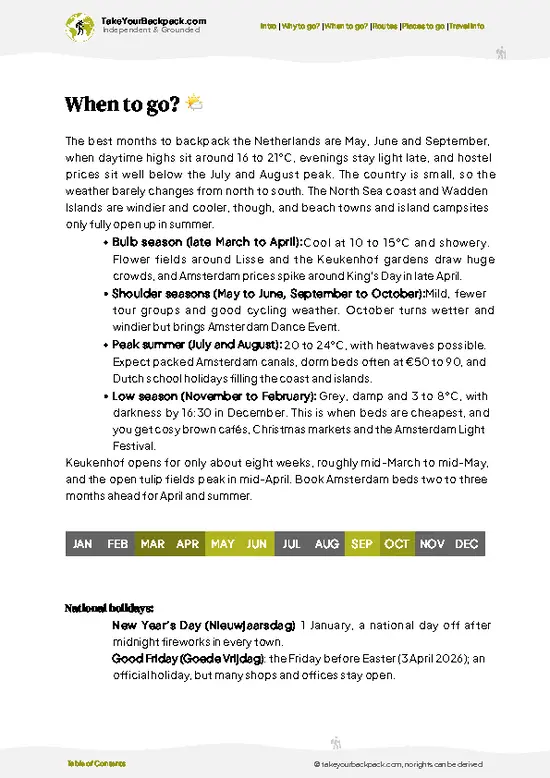
May to September is the best window for Lauwersmeer, with long days and the most reliable weather for walking and cycling.
  • Spring (April to May): Highs of 10 to 17°C (50 to 63°F), around 14 to 16 hours of daylight by May. Geese linger, birds are nesting, and crowds are thin.
  • Summer (June to August): Highs of 19 to 22°C (66 to 72°F), up to 17 hours of light. Water sports, camping and ferry-linked bike loops peak, and so do prices and campsite bookings, especially during Dutch school holidays.
  • Autumn (September to October): Highs fall from 18°C to 13°C (64 to 55°F). Tens of thousands of geese arrive from October, and the red deer rut brings dawn visitors.
  • Winter (November to March): Highs of 3 to 7°C (37 to 45°F), only 8 hours of light in December, strong wind off the sea. Quiet, cheap, and good
… read more 👉
May to September is the best window for Lauwersmeer, with long days and the most reliable weather for walking and cycling.
  • Spring (April to May): Highs of 10 to 17°C (50 to 63°F), around 14 to 16 hours of daylight by May. Geese linger, birds are nesting, and crowds are thin.
  • Summer (June to August): Highs of 19 to 22°C (66 to 72°F), up to 17 hours of light. Water sports, camping and ferry-linked bike loops peak, and so do prices and campsite bookings, especially during Dutch school holidays.
  • Autumn (September to October): Highs fall from 18°C to 13°C (64 to 55°F). Tens of thousands of geese arrive from October, and the red deer rut brings dawn visitors.
  • Winter (November to March): Highs of 3 to 7°C (37 to 45°F), only 8 hours of light in December, strong wind off the sea. Quiet, cheap, and good for geese and stargazing in the Dark Sky area.
Book summer weekends early, and visit midweek for emptier paths.


source: climatestotravel.comJANJanuary: below average for travelingFEBFebruary: below average for travelingMARMarch: fair for travelingAPRApril: good for travelingMAYMay: excellent for travelingJUNJune: excellent for travelingJULJuly: highly recommended for travelingAUGAugust: highly recommended for travelingSEPSeptember: excellent for travelingOCTOctober: good for travelingNOVNovember: fair for travelingDECDecember: below average for traveling
when-to-go

✈️ The backpacker research shortcutThe Netherlands Travel Guide

An offline-friendly backpacking guide with optimized travel routes, ranked highlights, transport advice, and the best areas to stay.
example page 0 from our offline Travel Guide for Netherlands
example page 1 from our offline Travel Guide for Netherlands
example page 2 from our offline Travel Guide for Netherlands
example page 3 from our offline Travel Guide for Netherlands
example page 4 from our offline Travel Guide for Netherlands
example page 5 from our offline Travel Guide for Netherlands
example page 6 from our offline Travel Guide for Netherlands
example page 7 from our offline Travel Guide for Netherlands
The digital guide (373 pages) contains:
✅ 127 highlights, ranked by travel appeal
✅ Optimized 5, 10 & 15-day travel routes
✅ Cities, national parks, landmarks, beaches
✅ How to get around
✅ Offline-friendly for travel without Wi-Fi
👉 Click to see all 30+ guide features

📅 Plan smarter in minutes, not weeks
✅ Month by month travel advice
✅ Festivals & national holidays
✅ Budget expectations

🗺️ Go to the right places, skip the overrated ones
✅ Honest pros & cons of destinations
✅ Top hikes, parks & viewpoints
✅ Lesser-known places most travelers miss
✅ Clear “worth it vs skip it” guidance

🛏️ Travel smoothly without rookie mistakes
✅ Best areas to stay
✅ Transport systems explained simply
✅ Common scams & safety advice
✅ SIM cards, money & practical tips

🌍 Understand the country, not just visit it
✅ Culture & traditions
✅ 52 Essential phrases & customs
✅ Festivals worth planning around
✅ Traveler-friendly historical context
✅ Insights that make places more meaningful

📱 Built for real travel conditions
✅ Fully downloadable PDF
✅ Works completely offline
✅ Optimized for phone use
✅ Useful in remote areas & buses
✅ Everything in one place
Stop searching, start planning
Get instant access to your full guide. 30‑day money-back guarantee.
+ Add another guide for just

By proceeding you agree to our terms.
Sent to your inbox immediately after payment • 100% Secure Checkout
Best Backpacking Travel Advisor 2025 tourism awardBest Backpacking
Travel Advisor
2025
What others say about Take Your Backpack Guides:
⭐⭐⭐⭐⭐
Fantastic, amazing amount of information!
⭐⭐⭐⭐⭐
My goodness this is amazing, it's what I've been looking for hats off too you!
⭐⭐⭐⭐⭐
I think this is absolutely BRILLIANT
⭐⭐⭐⭐
Very complete and informative. It's still missing places, but I gotta to commend you
⭐⭐⭐⭐⭐
This is truly amazing, thank you, can't wait to explore it with my kids!
⭐⭐⭐⭐⭐
Awesome resource, thank you!
⭐⭐⭐⭐⭐
This is amazing! Can't wait to explore the ones I haven't seen
⭐⭐⭐⭐
I love this! Well done, great idea.
⭐⭐⭐⭐⭐
Thanks for taking the time to make this gem!
⭐⭐⭐⭐⭐
This might be the best website I've ever seen.
⭐⭐⭐⭐⭐
Congratulations, and thank you so much for your work; it's incredibly valuable.
⭐⭐⭐⭐
In all seriousness I think you did a great job pointing out the important spots
⭐⭐⭐⭐⭐
10/10 very good
⭐⭐⭐⭐⭐
As someone who's only just starting to visit regularly this is awesome, thank you.
⭐⭐⭐⭐
Thank you very much! I'm going to visit my dad, it's going to be very useful!
⭐⭐⭐⭐⭐
This is really cool! We'll be travelling for the first time and this definitely come in handy.
⭐⭐⭐⭐⭐
You are now our minister of culture, congratulations 👨‍💼
⭐⭐⭐⭐⭐
Just wanted to tell you that this is a pearl! Going to follow your recommendations.
⭐⭐⭐⭐⭐
This is so cool. I'll definitely be using the resource for my travels soon.
⭐⭐⭐⭐⭐
This is very impressive! Good work.
⭐⭐⭐⭐⭐
This is an amazing and informative site. Very well done!

🛏️ Where to stay?Where staying makes the most sense

The best base for backpackers is a campsite right at the lake, because there are no hostels or hotels inside the park itself.
Campsites and holiday parks ring the shore, including Lauwersoog, Anjum, Zoutkamp and Vierhuizen. Some offer small tents plots, pitches near the water, and simple cabins. Lauwersoog is the most practical for walkers, as it has the ferry to Schiermonnikoog, shops, and a bus stop. Wild camping is not allowed in the park, but a few small nature campsites and farm camping spots (“minicampings”) sit just outside the boundary and are quiet and cheap.
For beds and kitchens, head … read more 👉
The best base for backpackers is a campsite right at the lake, because there are no hostels or hotels inside the park itself.
Campsites and holiday parks ring the shore, including Lauwersoog, Anjum, Zoutkamp and Vierhuizen. Some offer small tents plots, pitches near the water, and simple cabins. Lauwersoog is the most practical for walkers, as it has the ferry to Schiermonnikoog, shops, and a bus stop. Wild camping is not allowed in the park, but a few small nature campsites and farm camping spots (“minicampings”) sit just outside the boundary and are quiet and cheap.
For beds and kitchens, head to nearby towns. Dokkum, about 15 kilometers west, has a walled old center, B&Bs and a couple of budget hotels. Groningen, roughly 35 kilometers south, is the real hostel city, with hostels, student-style rooms and frequent bus connections via Zoutkamp or Leens. Leeuwarden is a similar distance to the west.
Book anything near the lake well ahead for July and August. Shoulder-season rates drop noticeably, and many campsites close from late October to March.

👛 Costs (as of 15 October 2026)What things cost and how to budget

A day at Lauwersmeer typically costs USD 45 to 110, and entering the park is free.
CategoryBudget RangeLocal Reality
EntranceUSD 0No gate fee. Some parking areas and the Schiermonnikoog ferry charge separately.
CampingUSD 20 to 40Per night for a small tent and one or two people, with higher rates in July and August.
Hostel or budget roomUSD 40 to 90Mostly in Groningen or Dokkum. B&Bs near the park often run USD 90 to 150 for a double.
Local transportUSD 5 to 25Buses link Groningen, Zoutkamp and Lauwersoog (about USD 5 to 10 each way). Bike rental is around USD 12 to 20 per day, or more for e-bikes.
FerryUSD 20 to 25Return passenger fare from Lauwersoog to Schiermonnikoog, with bikes at an extra charge.
Food and suppliesUSD 15 to 40Supermarket picnic meals cost USD 8 to 15. Cafés and fish stalls in
… read more 👉
A day at Lauwersmeer typically costs USD 45 to 110, and entering the park is free.
CategoryBudget RangeLocal Reality
EntranceUSD 0No gate fee. Some parking areas and the Schiermonnikoog ferry charge separately.
CampingUSD 20 to 40Per night for a small tent and one or two people, with higher rates in July and August.
Hostel or budget roomUSD 40 to 90Mostly in Groningen or Dokkum. B&Bs near the park often run USD 90 to 150 for a double.
Local transportUSD 5 to 25Buses link Groningen, Zoutkamp and Lauwersoog (about USD 5 to 10 each way). Bike rental is around USD 12 to 20 per day, or more for e-bikes.
FerryUSD 20 to 25Return passenger fare from Lauwersoog to Schiermonnikoog, with bikes at an extra charge.
Food and suppliesUSD 15 to 40Supermarket picnic meals cost USD 8 to 15. Cafés and fish stalls in Lauwersoog cost USD 10 to 25 per meal.
Guided activitiesUSD 10 to 40Ranger-led walks, boat or seal trips, and canoe rental vary by season.
Costs rise in summer school holidays and fall outside them. Self-catering and camping keep the daily figure at the low end.
⚠️ Prices can change and everyone travels differently, so take this as a rough guide. Hope it helps you plan your adventure!

🥾 TrailsDiscover Lauwersmeer's top trails and natural wonders

Lauwersmeer is flat, open and wet, so hiking here is about distance, wind and birdlife rather than climbing. Paths cross reclaimed marsh, follow dikes and loop through reedbeds. Expect almost no shade, strong gusts off the water, and mud after rain. Wildlife is the main scenic highlight, with geese, spoonbills, Konik horses and red deer. Difficulty is easy, but exposure makes longer walks tiring.

Signed routes exist, but names and exact lengths change by operator and season, so pick up a current map at a visitor center in Lauwersoog or Zoutkamp. Typical walks run from short 3 to 5 km loops to … read more 👉
Lauwersmeer is flat, open and wet, so hiking here is about distance, wind and birdlife rather than climbing. Paths cross reclaimed marsh, follow dikes and loop through reedbeds. Expect almost no shade, strong gusts off the water, and mud after rain. Wildlife is the main scenic highlight, with geese, spoonbills, Konik horses and red deer. Difficulty is easy, but exposure makes longer walks tiring.

Signed routes exist, but names and exact lengths change by operator and season, so pick up a current map at a visitor center in Lauwersoog or Zoutkamp. Typical walks run from short 3 to 5 km loops to day routes of 10 to 20 km, taking roughly one to five hours at an easy pace.

  • Terrain: Flat, with gravel, grass and packed dike paths.
  • Difficulty: Easy, though wind can make it feel harder.
  • Best season: Autumn for geese, summer for long daylight and spoonbills.
  • Key features: Open marshes, hides for birdwatching, harbor views.

Getting there without a car is possible. Buses run from Groningen toward Lauwersoog in roughly an hour, though frequency drops in the evening and on Sundays, so check timetables. Cycling from Zoutkamp or Dokkum is a popular alternative. The park is open year-round and busiest on summer weekends and holiday periods, especially around Lauwersoog. Entry to the park itself is generally free, but parking, ferries, campsites and some activities carry separate charges.
⚠️ Hiking info can sometimes be outdated or inaccurate. Before you hit the trail, check the latest conditions with locals. If you do spot anything that's off, I'd love to hear from you, so I can update it for fellow travelers.

🛡️ SafetyScams, Hazards, and Annoyances

Lauwersmeer is flat, well signed and low risk, so the main hazards are wind, weather and ticks.
The open landscape offers no shelter, so a cool breeze can feel cold within minutes. Pack a windproof layer and rain jacket even on sunny days, and bring sunscreen for exposed summer cycling. Paths are mostly paved or packed gravel, but some marshy tracks turn muddy after rain, so sturdy shoes help. Some areas, such as the Marnewaard, can close for military exercises, so check signs.
Ticks are common in long grass from spring to autumn. Wear long trousers on off-path routes and check your skin afterward. Mosquitoes can be annoying near the water at dusk.
Wildlife is easy going. Keep your distance from red deer in the rut, stay on marked paths in nesting season, and keep dogs leashed. Bring water, since cafés are scattered.

FAQCommon questions from travelers

Two days is the practical sweet spot for most backpackers. One day covers Lauwersoog harbor, a dike cycle of 20 to 30 km and a birdwatching stop. A second day allows the 45-minute ferry to Schiermonnikoog or a night of stargazing in the Dark Sky area.
Yes, but plan carefully. Buses run from Groningen toward Lauwersoog in about an hour, with fewer services on weekends and evenings. Once there, rent a bike in Lauwersoog or Zoutkamp, since distances between sights run 5 to 15 km and the terrain is flat.
The park itself has no general entrance fee, and you can walk or cycle in freely. Costs come from parking at main trailheads, ferry tickets to Schiermonnikoog, and campsite fees, which vary by operator and season. Some protected areas have seasonal access limits for wildlife, so follow posted signs.
⚠️ Things can change over time, so always validate details locally before you go.

Other Dutch national parks near Lauwersmeer

Explore more nearby:

  • Schiermonnikoog—Car-free island, Kobbeduinen, kwelders, North Sea beach| 13 km away
  • Geopark De Hondsrug—Hunebedden, Hondsrug ridge, Gasselte sand, Zuidlaren lakes| 51 km away
  • Drents-Friese Wold—Aekingerzand, Boschberg heath, brook valley, forest paths| 56 km away

💡 Not sure where to go next?
Create a personalized itinerary for The Netherlands including Lauwersmeer and the places that fit your trip.

Generate my itinerary

👉 Discover all national parks

Or checkout all The Netherlands has to offer (think cities, towns, villages, national parks, hikes, beaches, festivals)
Country photo of The Netherlands

We 💚 feedbackFinal thoughts on exploring Lauwersmeer

Give Lauwersmeer two days if you are on foot or by bike. One day covers the harbor, a dike ride and a hide at dusk. The second lets you catch sunrise geese or a Schiermonnikoog ferry. More than that and you need extra plans, because the landscape is subtle and services are limited.

✈️ When did I visit The Netherlands?
Netherlands is my home base, so whenever I don’t travel, you can find me in this tiny spot on the globe. When friends from abroad visit me, it’s the time to actually explore my own country as a traveler.

✍️ Help improve this page!
The information on this page is based on my own backpacking experience in The Netherlands, supplemented with up-to-date research and feedback from other travelers. Travel details can change, so if you notice anything outdated or incomplete, feel free to let me know.


🙋‍♂️ Give feedback

👋 Meet the founderWho’s Behind Take Your Backpack?

Johan, backpacker and founder of TakeYourBackpackHi, I’m Johan (Netherlands 🇳🇱), the creator of TakeYourBackpack. Over the past 3 decades, I’ve backpacked through 90+ countries across six continents, gaining extensive experience with independent travel, long-term trips, and overland routes.

This site is built on a combination of firsthand travel experience and carefully curated insights from other backpackers. Many guides are based on places I’ve personally visited, while others bring together tips, observations, and practical advice shared by trusted travelers I’ve met along the way.

The goal is to provide realistic, experience-driven guidance — not generic itineraries — so you can explore destinations with better context, clearer expectations, and more confidence.