×

The Netherlands🇳🇱 | citiesThe HagueBinnenhof, Peace Palace, Mauritshuis, Scheveningen pier | things to do and best time to go

Explore HaarlemExplore Leiden

Backpacking in The Hague
🏆 Top pickcity ranked #3
By Johan Kruseman 🇳🇱 | Updated October 16, 2026

The Hague draws people for the Peace Palace and the courts, the International Court of Justice and the International Criminal Court, because this is where the Netherlands seats its government while Amsterdam is capital in name. The overlooked part is a North Sea beach at Scheveningen, one tram ride away, and beds that usually run cheaper than in Amsterdam. The city sits in South Holland on the west coast, about 50 kilometers from Amsterdam. The pattern is simple: ministries fill the weekdays, the coast fills the evenings, and prices fall where crowds thin. A paper tray of kibbeling at Scheveningen harbor cost me about €9, salty and hot, eaten on a bollard beside the fishing boats. Staying here and training to Amsterdam in 45 minutes beats the reverse for budget and calm. It suits museum fans and beach people, and bores anyone chasing nightlife. Rotterdam is edgier, Delft prettier.

Discover everything you want to know in the 📖 The Netherlands Travel Guide.


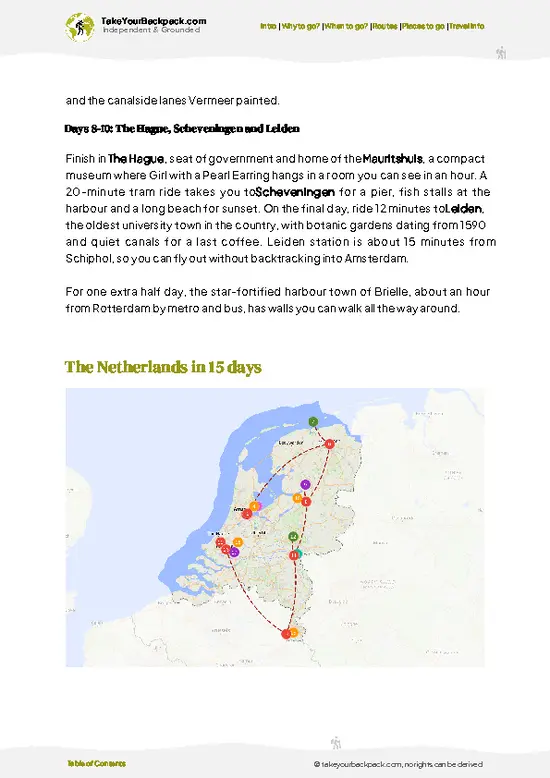
example page 0 from our offline Travel Guide for Netherlands
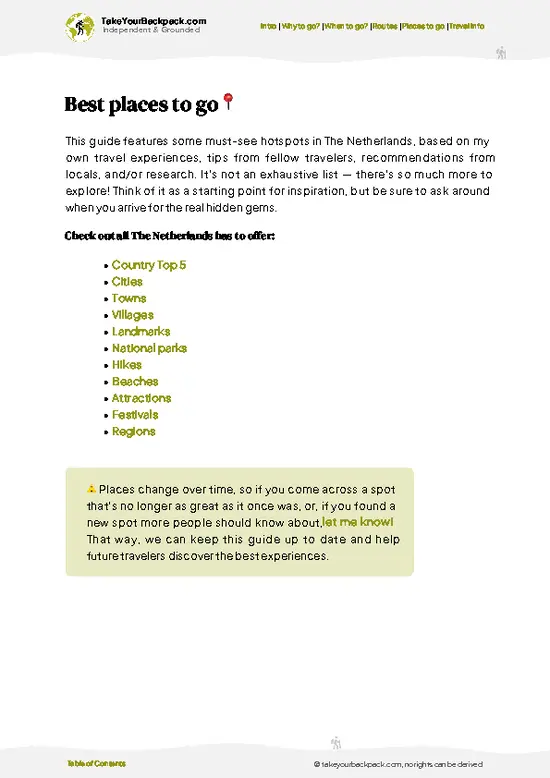
example page 1 from our offline Travel Guide for Netherlands
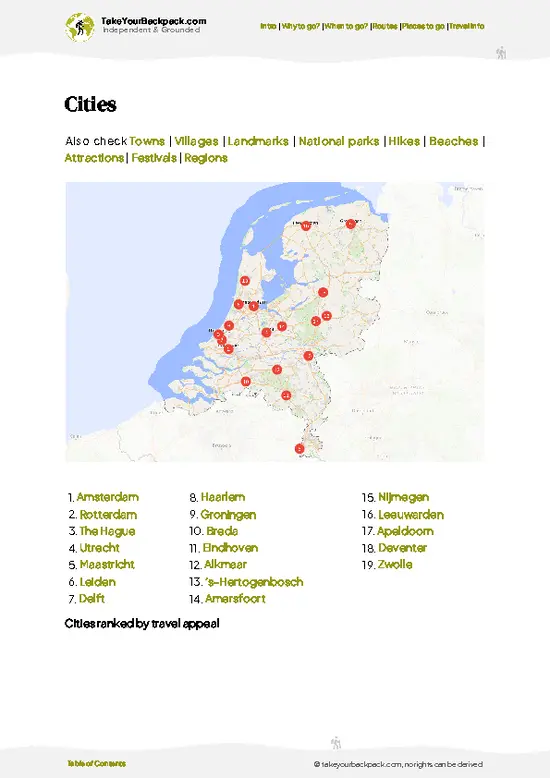
example page 2 from our offline Travel Guide for Netherlands
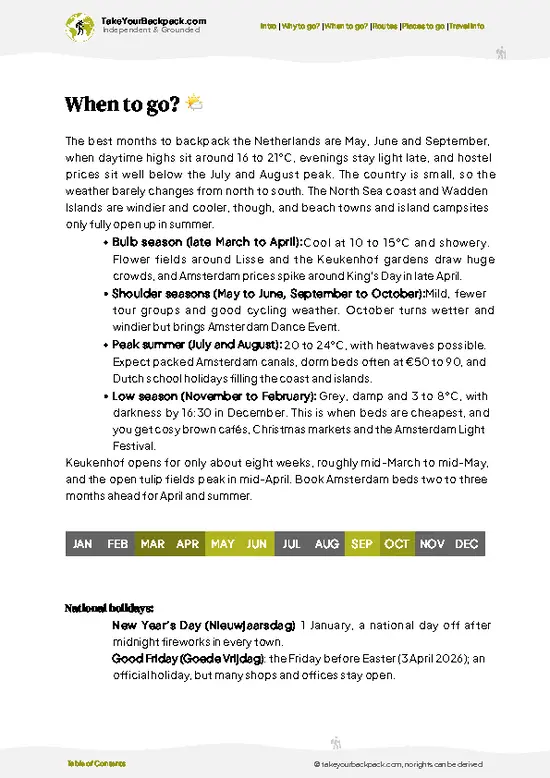
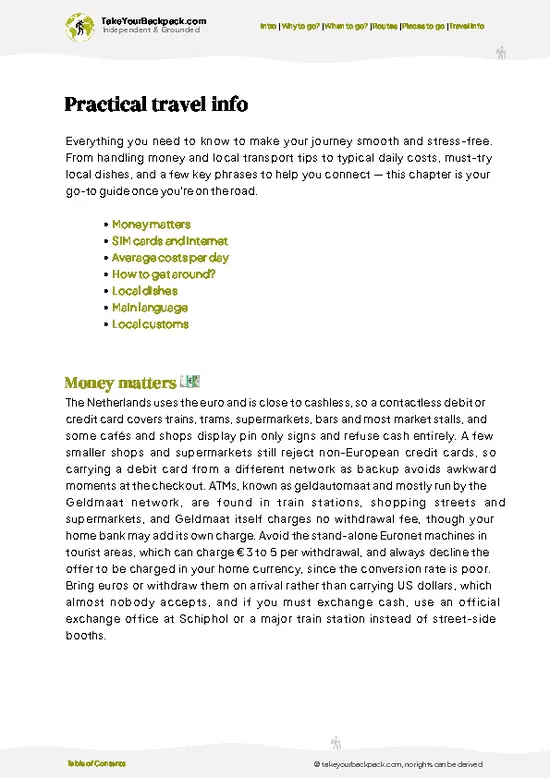
example page 3 from our offline Travel Guide for Netherlands
example page 4 from our offline Travel Guide for Netherlands
example page 5 from our offline Travel Guide for Netherlands
example page 6 from our offline Travel Guide for Netherlands
example page 7 from our offline Travel Guide for Netherlands
Loading the map 🌍
CLICK TO FILTER
cities
towns
villages
landmarks
national parks
hikes
beaches
attractions
festivals
regions
SHOW COUNTRY’S BESTSHOW ALL

✨ Why go?
Ranked #3 city in The Netherlands
Why The Hague should be on your travel list

Backpackers come for the mix: a serious museum city with a surf-and-sand resort attached. The Hague has Scheveningen beach at the end of tram lines 1 and 9, so you can spend a morning with Vermeer and an afternoon in the waves without changing hotels. Rooms and hostel beds are often a notch cheaper than in Amsterdam, and the city is calmer, which matters if you want to sleep.

The second reason is position. Trains from Den Haag Centraal and Hollands Spoor reach Delft in about 15 minutes, Rotterdam in roughly 25 and Amsterdam in about 45 to 50, so the city works as a base for a week of short hops without hauling your pack between hostels. Almost everything central, from the Binnenhof to the museums, is walkable in 10 to 20 minutes.

The limits are real. Nightlife is modest and clusters around … read more 👉
Backpackers come for the mix: a serious museum city with a surf-and-sand resort attached. The Hague has Scheveningen beach at the end of tram lines 1 and 9, so you can spend a morning with Vermeer and an afternoon in the waves without changing hotels. Rooms and hostel beds are often a notch cheaper than in Amsterdam, and the city is calmer, which matters if you want to sleep.

The second reason is position. Trains from Den Haag Centraal and Hollands Spoor reach Delft in about 15 minutes, Rotterdam in roughly 25 and Amsterdam in about 45 to 50, so the city works as a base for a week of short hops without hauling your pack between hostels. Almost everything central, from the Binnenhof to the museums, is walkable in 10 to 20 minutes.

The limits are real. Nightlife is modest and clusters around the Plein and Grote Markt, and on weekday evenings the government quarter goes quiet. Treat it as a two or three night stop, longer if you want beach days.

💡 HighlightsPlaces and moments you shouldn't skip

  1. Mauritshuis: A small royal mansion holding Vermeer’s Girl with a Pearl Earring, Rembrandt’s Anatomy Lesson and Carel Fabritius’s The Goldfinch. Rooms are compact, so the experience is intimate rather than tiring. Go on a weekday morning to beat tour groups. Tickets run about €17 to 21, and 1.5 to 2 hours is plenty.
  2. Binnenhof and Hofvijver: The medieval parliament complex with the Ridderzaal (Knights’ Hall) rising behind a small lake. The exterior and the lakeside view are free and best at golden hour, when the brick glows in the water. Allow 30 minutes outside. Interior tours are offered at times, typically around €10 to 20, depending on the renovation schedule.
  3. Peace Palace: The neo-Gothic home of the International Court of Justice, funded by Andrew Carnegie and opened in 1913. The gates and
… read more 👉
  1. Mauritshuis: A small royal mansion holding Vermeer’s Girl with a Pearl Earring, Rembrandt’s Anatomy Lesson and Carel Fabritius’s The Goldfinch. Rooms are compact, so the experience is intimate rather than tiring. Go on a weekday morning to beat tour groups. Tickets run about €17 to 21, and 1.5 to 2 hours is plenty.
  2. Binnenhof and Hofvijver: The medieval parliament complex with the Ridderzaal (Knights’ Hall) rising behind a small lake. The exterior and the lakeside view are free and best at golden hour, when the brick glows in the water. Allow 30 minutes outside. Interior tours are offered at times, typically around €10 to 20, depending on the renovation schedule.
  3. Peace Palace: The neo-Gothic home of the International Court of Justice, funded by Andrew Carnegie and opened in 1913. The gates and gardens can be viewed for free, and the visitor center next door explains the court’s work. Plan 30 to 45 minutes. Interior visits are by booked tour only, usually around €15.
  4. Panorama Mesdag: A 360-degree painting of Scheveningen in 1881, 14 meters high, viewed from a dune-top platform with real sand in the foreground. It is oddly convincing and rarely crowded. Tickets are about €10 to 12, and 30 to 45 minutes covers it. Any time of day works.
  5. Scheveningen beach and pier: A wide urban beach with surf schools, beach bars and a harbor of working fishing boats. Visit June to September for swimming, or late afternoon in any season for the light. The beach is free, kibbeling or herring costs about €5 to 10, and two to four hours is a good stretch.
  6. Escher in Het Paleis: The former winter palace of Queen Emma houses the world’s largest Escher display, with optical illusions in the upper rooms that suit rainy afternoons. Tickets are around €12 to 15, and you need about 1 to 1.5 hours.
  7. Kunstmuseum Den Haag: An Art Deco building by Berlage with the world’s largest Mondrian collection, including Victory Boogie Woogie, plus fashion and Delftware. Entry is about €17 to 20 and a visit takes 1.5 to 2 hours. Go on a weekday afternoon, when it is quiet.
  8. Museum Beelden aan Zee: A sculpture museum partly buried in the dunes along the Scheveningen boulevard, with a terrace facing the sea. It is far quieter than the pier. Tickets are about €12 to 15, and 1 to 1.5 hours is enough.
Day trips from The Hague include Delft, Leiden, Rotterdam, the Keukenhof tulip gardens in spring and the windmills of Kinderdijk. Start with the Mauritshuis right at opening, since the Vermeer room fills fast and the collection works best before the tour groups arrive.
Spotted a mistake or missing something? Contact us.

Things to do in The Hague

Ratings based on Tripadvisor reviews. When you book through this link, you support our work at no extra cost to you.

🏘️ NeighborhoodsKey areas and districts to know

The Hague spreads along the coast in loose districts, and the pattern is simple: government and money sit near the center, grit and food sit to the south and east, sand sits to the northwest. Tram or bike links them all, so pick by mood.
  • Centrum: Compact and fully walkable, with the Binnenhof, Noordeinde palace, the Plein square and a tight grid of pubs and cafés. You pay in crowds and pricier drinks, but you spend nothing on transport, so for a first afternoon it gives the most.
  • Zeeheldenkwartier and Denneweg: Antique shops, wine bars and small galleries on quiet brick streets. Walkable from the center in 10 minutes, and a better value for dinner than the Plein.
  • Chinatown and Spuistraat: A few blocks of Asian grocers and noodle spots next to the Grote Markt nightlife. Late bars cluster here,
… read more 👉
The Hague spreads along the coast in loose districts, and the pattern is simple: government and money sit near the center, grit and food sit to the south and east, sand sits to the northwest. Tram or bike links them all, so pick by mood.
  • Centrum: Compact and fully walkable, with the Binnenhof, Noordeinde palace, the Plein square and a tight grid of pubs and cafés. You pay in crowds and pricier drinks, but you spend nothing on transport, so for a first afternoon it gives the most.
  • Zeeheldenkwartier and Denneweg: Antique shops, wine bars and small galleries on quiet brick streets. Walkable from the center in 10 minutes, and a better value for dinner than the Plein.
  • Chinatown and Spuistraat: A few blocks of Asian grocers and noodle spots next to the Grote Markt nightlife. Late bars cluster here, and everything is on foot from the station.
  • Statenkwartier and Archipelbuurt: Leafy embassy streets, Art Nouveau villas and the Mesdag Panorama area. A short tram ride, calm at night, best for slow wandering.
  • Scheveningen: Beach, pier, seafood kiosks and surf schools. Tram 9 or 1 takes about 20 to 25 minutes from the center. Beach clubs are costly, but the free sand and the promenade are the best use of an afternoon.
  • Zeeheldenkwartier to Duinoord: Residential edges where cafés serve locals, not visitors, and prices drop.

⌛️ 1 daySeeing the highlights in 24 hours

The Hague works well in a day if you stay central in the morning and finish at the coast. It mixes court-and-parliament formality with a sea-air finish.

9:30 AM, Binnenhof and Hofvijver: Walk around the lake for the classic view of the parliament buildings. It is free and calm before the commuters arrive. Then stroll 5 minutes to the museum.

10:15 AM, Mauritshuis: Spend about 1.5 hours with Vermeer, Rembrandt and The Goldfinch. The galleries are small, so you will not be rushed. Book a ticket for a morning slot to skip the line.

12:15 PM, Lunch near Grote Markt: Grab a broodje or an Indonesian lunch in the nearby streets for roughly €8 to 14. Then take tram 1 or 9 from Centraal toward Scheveningen, about 20 to 25 minutes.

1:45 PM, Panorama Mesdag: Climb the stairs onto the platform and … read more 👉
The Hague works well in a day if you stay central in the morning and finish at the coast. It mixes court-and-parliament formality with a sea-air finish.

9:30 AM, Binnenhof and Hofvijver: Walk around the lake for the classic view of the parliament buildings. It is free and calm before the commuters arrive. Then stroll 5 minutes to the museum.

10:15 AM, Mauritshuis: Spend about 1.5 hours with Vermeer, Rembrandt and The Goldfinch. The galleries are small, so you will not be rushed. Book a ticket for a morning slot to skip the line.

12:15 PM, Lunch near Grote Markt: Grab a broodje or an Indonesian lunch in the nearby streets for roughly €8 to 14. Then take tram 1 or 9 from Centraal toward Scheveningen, about 20 to 25 minutes.

1:45 PM, Panorama Mesdag: Climb the stairs onto the platform and look at the 1881 painting with its sand in the foreground. It takes about 40 minutes and is a good low-key break.

3:00 PM, Museum Beelden aan Zee: Most visitors skip this sculpture museum tucked into the dunes. Spend an hour inside, then take the terrace over the sea for coffee at about €4. From here the boulevard is a short stroll.

4:30 PM, Scheveningen beach: Walk the promenade toward the pier and, in summer, swim or just sit on the sand. Watch the surfers and the beach clubs getting ready for the evening.

6:30 PM, Scheveningen harbor: Finish with kibbeling or a herring sandwich at a harbor stall, around €5 to 10, then take tram 9 back to the center.

🌤️ When to go?Best time to visit The Hague

  • Spring (April to May): 6 to 16°C (43 to 61°F), with long days reaching about 15 hours by May. Tulip fields nearby peak mid-April, and prices stay moderate.
  • Summer (June to August): 17 to 22°C (63 to 72°F) on average, with up to 17 hours of daylight. The beach is lively and festivals fill the calendar, but hostel and hotel prices peak, especially during the Parkpop and North Sea Jazz weeks.
  • Autumn (September to October): 9 to 18°C (48 to 64°F), fewer crowds and falling prices. Rain becomes frequent.
  • Winter (November to March): 1 to 7°C (34 to 45°F), with only about 8 hours of daylight in December. Wind off the sea feels colder than the numbers. Museums are quiet and beds are cheapest.
Book September for mild weather, open beaches and lower bed prices.

source: climatestotravel.comJANJanuary: fair for travelingFEBFebruary: fair for travelingMARMarch: good for travelingAPRApril: highly recommended for travelingMAYMay: highly recommended for travelingJUNJune: highly recommended for travelingJULJuly: excellent for travelingAUGAugust: excellent for travelingSEPSeptember: highly recommended for travelingOCTOctober: highly recommended for travelingNOVNovember: fair for travelingDECDecember: good for traveling
netherlands-city-the-hague
© Google | Sanjay Sharma

✈️ The backpacker research shortcutThe Netherlands Travel Guide

An offline-friendly backpacking guide with optimized travel routes, ranked highlights, transport advice, and the best areas to stay.
example page 0 from our offline Travel Guide for Netherlands
example page 1 from our offline Travel Guide for Netherlands
example page 2 from our offline Travel Guide for Netherlands
example page 3 from our offline Travel Guide for Netherlands
example page 4 from our offline Travel Guide for Netherlands
example page 5 from our offline Travel Guide for Netherlands
example page 6 from our offline Travel Guide for Netherlands
example page 7 from our offline Travel Guide for Netherlands
The digital guide (373 pages) contains:
✅ 127 highlights, ranked by travel appeal
✅ Optimized 5, 10 & 15-day travel routes
✅ Cities, national parks, landmarks, beaches
✅ How to get around
✅ Offline-friendly for travel without Wi-Fi
👉 Click to see all 30+ guide features

📅 Plan smarter in minutes, not weeks
✅ Month by month travel advice
✅ Festivals & national holidays
✅ Budget expectations

🗺️ Go to the right places, skip the overrated ones
✅ Honest pros & cons of destinations
✅ Top hikes, parks & viewpoints
✅ Lesser-known places most travelers miss
✅ Clear “worth it vs skip it” guidance

🛏️ Travel smoothly without rookie mistakes
✅ Best areas to stay
✅ Transport systems explained simply
✅ Common scams & safety advice
✅ SIM cards, money & practical tips

🌍 Understand the country, not just visit it
✅ Culture & traditions
✅ 52 Essential phrases & customs
✅ Festivals worth planning around
✅ Traveler-friendly historical context
✅ Insights that make places more meaningful

📱 Built for real travel conditions
✅ Fully downloadable PDF
✅ Works completely offline
✅ Optimized for phone use
✅ Useful in remote areas & buses
✅ Everything in one place
Stop searching, start planning
Get instant access to your full guide. 30‑day money-back guarantee.
+ Add another guide for just

By proceeding you agree to our terms.
Sent to your inbox immediately after payment • 100% Secure Checkout
Best Backpacking Travel Advisor 2025 tourism awardBest Backpacking
Travel Advisor
2025
What others say about Take Your Backpack Guides:
⭐⭐⭐⭐⭐
Fantastic, amazing amount of information!
⭐⭐⭐⭐⭐
My goodness this is amazing, it's what I've been looking for hats off too you!
⭐⭐⭐⭐⭐
I think this is absolutely BRILLIANT
⭐⭐⭐⭐
Very complete and informative. It's still missing places, but I gotta to commend you
⭐⭐⭐⭐⭐
This is truly amazing, thank you, can't wait to explore it with my kids!
⭐⭐⭐⭐⭐
Awesome resource, thank you!
⭐⭐⭐⭐⭐
This is amazing! Can't wait to explore the ones I haven't seen
⭐⭐⭐⭐
I love this! Well done, great idea.
⭐⭐⭐⭐⭐
Thanks for taking the time to make this gem!
⭐⭐⭐⭐⭐
This might be the best website I've ever seen.
⭐⭐⭐⭐⭐
Congratulations, and thank you so much for your work; it's incredibly valuable.
⭐⭐⭐⭐
In all seriousness I think you did a great job pointing out the important spots
⭐⭐⭐⭐⭐
10/10 very good
⭐⭐⭐⭐⭐
As someone who's only just starting to visit regularly this is awesome, thank you.
⭐⭐⭐⭐
Thank you very much! I'm going to visit my dad, it's going to be very useful!
⭐⭐⭐⭐⭐
This is really cool! We'll be travelling for the first time and this definitely come in handy.
⭐⭐⭐⭐⭐
You are now our minister of culture, congratulations 👨‍💼
⭐⭐⭐⭐⭐
Just wanted to tell you that this is a pearl! Going to follow your recommendations.
⭐⭐⭐⭐⭐
This is so cool. I'll definitely be using the resource for my travels soon.
⭐⭐⭐⭐⭐
This is very impressive! Good work.
⭐⭐⭐⭐⭐
This is an amazing and informative site. Very well done!

🛏️ Where to stay?Where staying makes the most sense

The best budget base is the area around the center and the streets by Den Haag Centraal and HS stations, because dorm beds and cheap rooms are most numerous there. Expect dorm beds in the range of €30 to 60 in season, with private rooms rising quickly beyond that. Both stations connect directly to trams and trains, so you reach Amsterdam, Rotterdam and the beach without a long commute.

Noise is the compromise. Streets near the Grote Markt and Spuistraat get loud on Friday and Saturday nights as bars empty out, so request a room away from the street or pack earplugs. The station side is quieter … read more 👉
The best budget base is the area around the center and the streets by Den Haag Centraal and HS stations, because dorm beds and cheap rooms are most numerous there. Expect dorm beds in the range of €30 to 60 in season, with private rooms rising quickly beyond that. Both stations connect directly to trams and trains, so you reach Amsterdam, Rotterdam and the beach without a long commute.

Noise is the compromise. Streets near the Grote Markt and Spuistraat get loud on Friday and Saturday nights as bars empty out, so request a room away from the street or pack earplugs. The station side is quieter after midnight, though a few blocks near the rail lines can feel a little empty and rough around the edges, so walk the main lit routes back late at night.

The second option is Scheveningen, which suits summer. Beds close to the beach are fewer and rise in price on sunny weekends, but you wake up near the sand and tram 9 or 1 gets you to the center in 20 to 25 minutes. In winter it is dark, windy and quiet, so the center works better then. Reserve early for July and August, and for big events such as North Sea Jazz.

🚌 Getting aroundHow to get around The Hague

The center of The Hague is walkable end to end in about 25 minutes, and walking stops making sense once you head for Scheveningen, Statenkwartier or Madurodam, which sit 4 to 6 km away. Traffic is calm in the middle and the tram network is dense and punctual, so most backpackers combine feet with trams or a bike.
  • Walking: Free and the fastest way to link the station, Binnenhof, Noordeinde and the Plein, since most of these are within 1 km of each other. Beyond that, the time cost grows quickly and trams win.
  • Tram and bus (HTM): Trams 1, 9 and 11 cover the beach and main sights. Pay by contactless bank card or phone by tapping in and out, about €1 to 1.50 start plus roughly €0.20 to 0.25 per km, so a trip to Scheveningen costs around €2.50 to 4. Services run roughly 5:30 am to midnight, and night
… read more 👉
The center of The Hague is walkable end to end in about 25 minutes, and walking stops making sense once you head for Scheveningen, Statenkwartier or Madurodam, which sit 4 to 6 km away. Traffic is calm in the middle and the tram network is dense and punctual, so most backpackers combine feet with trams or a bike.
  • Walking: Free and the fastest way to link the station, Binnenhof, Noordeinde and the Plein, since most of these are within 1 km of each other. Beyond that, the time cost grows quickly and trams win.
  • Tram and bus (HTM): Trams 1, 9 and 11 cover the beach and main sights. Pay by contactless bank card or phone by tapping in and out, about €1 to 1.50 start plus roughly €0.20 to 0.25 per km, so a trip to Scheveningen costs around €2.50 to 4. Services run roughly 5:30 am to midnight, and night buses cover the rest. This is the best balance of comfort and cost for longer hops.
  • Bicycle: Rental runs about €10 to 15 a day, and cycle lanes reach the beach in 20 to 25 minutes through the dunes. It is cheaper than trams if you ride several times a day, and the best option in dry weather. Lock it every time, with two locks if possible.
  • RandstadRail and train: Lines E and tram-trains connect the center to Rotterdam, and NS trains from Den Haag Centraal or HS reach Amsterdam in about 50 minutes to an hour for about €12 to 16 one way. Fast, comfortable, and the only practical choice for longer distances.
  • Day pass: HTM day tickets cost about €8 to 10 and pay off after about four rides. For a quick beach plus city day, contactless tapping often works out equal or cheaper.

👛 Costs (as of 16 October 2026)How expensive it really is

A backpacker in The Hague typically spends about USD 85 to 140 a day, which is higher than southern Europe but below Amsterdam.
CategoryBudget RangeLocal Reality
Dorm accommodation (high season)USD 40 to 70Summer and event weekends fill quickly, so book early.
Dorm accommodation (off-season)USD 30 to 50Winter beds drop noticeably.
MealsUSD 20 to 35Market lunches, kibbeling and Indonesian takeaways keep this low; sit-down dinners cost USD 18 to 30.
Local transportUSD 3 to 10Contactless tram rides cost USD 3 to 4.50 each, and the center is walkable.
City transport passUSD 9 to 12An HTM day ticket pays off after about four rides.
Basic activities and entry feesUSD 10 to 25Museums run USD 12 to 22, while the beach, Noordeinde and the Binnenhof exterior are free.
MiscellaneousUSD 8 to 15Beers cost USD
… read more 👉
A backpacker in The Hague typically spends about USD 85 to 140 a day, which is higher than southern Europe but below Amsterdam.
CategoryBudget RangeLocal Reality
Dorm accommodation (high season)USD 40 to 70Summer and event weekends fill quickly, so book early.
Dorm accommodation (off-season)USD 30 to 50Winter beds drop noticeably.
MealsUSD 20 to 35Market lunches, kibbeling and Indonesian takeaways keep this low; sit-down dinners cost USD 18 to 30.
Local transportUSD 3 to 10Contactless tram rides cost USD 3 to 4.50 each, and the center is walkable.
City transport passUSD 9 to 12An HTM day ticket pays off after about four rides.
Basic activities and entry feesUSD 10 to 25Museums run USD 12 to 22, while the beach, Noordeinde and the Binnenhof exterior are free.
MiscellaneousUSD 8 to 15Beers cost USD 5 to 8, plus laundry and snacks.
Total Daily BudgetUSD 85 to 140Lower end with self-catering, upper end with museums and nights out.
Shop for groceries at supermarkets and eat the biggest meal at the market at lunch to save USD 10 or more a day.


source: holland.com
⚠️ Prices can change and everyone travels differently, so take this as a rough guide. Hope it helps you plan your adventure!

🚌 Day tripsBest day trips from The Hague

The Hague sits in the middle of the Randstad, so the best day trips are short, cheap train or tram rides with no need to sleep elsewhere.Delft: A 15-minute tram (line 1) or a 10-minute train takes you to canals, the Nieuwe Kerk tower and the Royal Delft pottery. Return costs about €5 to 8 plus entries. Come on a weekday morning, since Saturday market crowds fill the center. Many first-timers only visit the pottery factory and skip the old streets, which are free.
👉 Explore Delft
Rotterdam: Trains take about 25 minutes and cost roughly €6 to 9 each way. The city offers bold architecture, the Markthal and the Kijk-Kubus houses, and it is best on dry days from April to October. Wear comfortable shoes, because the sights are spread out and first-timers often underestimate the walking.
👉 Explore Rotterdam
Keukenhof … read more 👉
The Hague sits in the middle of the Randstad, so the best day trips are short, cheap train or tram rides with no need to sleep elsewhere.Delft: A 15-minute tram (line 1) or a 10-minute train takes you to canals, the Nieuwe Kerk tower and the Royal Delft pottery. Return costs about €5 to 8 plus entries. Come on a weekday morning, since Saturday market crowds fill the center. Many first-timers only visit the pottery factory and skip the old streets, which are free.
👉 Explore Delft
Rotterdam: Trains take about 25 minutes and cost roughly €6 to 9 each way. The city offers bold architecture, the Markthal and the Kijk-Kubus houses, and it is best on dry days from April to October. Wear comfortable shoes, because the sights are spread out and first-timers often underestimate the walking.
👉 Explore Rotterdam
Keukenhof and the Bulb Fields: From late March to mid-May the gardens burst with tulips. Take a train to Leiden (about 15 minutes), then bus 854 for about 35 minutes. Budget €35 to 50 including the entry ticket, which is best booked online. Arrive early to beat coach groups, and note that the open fields outside the park are free.
👉 Explore Keukenhof
Leiden: Reached by train in about 10 to 15 minutes for roughly €5 to 7, this student town has canals, a windmill museum and the botanical garden. It works year-round and is calm even in summer, which makes it a good rainy-day option.
👉 Explore Leiden

🍲 FoodWhat to Eat & Drink

Start with haring, raw herring served with chopped onion and pickles, sold from fish stands and kiosks. Scheveningen also does excellent kibbeling, golden fried cod chunks with a garlic sauce, for about €7 to 10. Snack bars sell bitterballen, crisp little croquettes with mustard, and stroopwafels are best warm from a market stall.

The Hague has a strong Indonesian side because of colonial history. Look for rijsttafel sharing platters, nasi goreng and pisang goreng at casual warungs and takeaways, which offer big, filling meals from €10 to 15. The Haagse Markt, one of Europe’s largest, runs several days a week and is the best place for cheap lunch, Turkish bread, Surinamese roti and fresh fruit.

For drinks, a bruin café (brown pub) with dark wood and Belgian or local beer fits any night, … read more 👉
Start with haring, raw herring served with chopped onion and pickles, sold from fish stands and kiosks. Scheveningen also does excellent kibbeling, golden fried cod chunks with a garlic sauce, for about €7 to 10. Snack bars sell bitterballen, crisp little croquettes with mustard, and stroopwafels are best warm from a market stall.

The Hague has a strong Indonesian side because of colonial history. Look for rijsttafel sharing platters, nasi goreng and pisang goreng at casual warungs and takeaways, which offer big, filling meals from €10 to 15. The Haagse Markt, one of Europe’s largest, runs several days a week and is the best place for cheap lunch, Turkish bread, Surinamese roti and fresh fruit.

For drinks, a bruin café (brown pub) with dark wood and Belgian or local beer fits any night, and the Plein and Grote Markt area is the social hub. Pints cost about €5 to 7. Dutch custom is to say “proost” and make eye contact when toasting, and tipping is modest, rounding up or about 5 to 10 percent for good service. Many places take cards only, so carry one.

🛡️ SafetyStaying Safe: What Travelers Should Know

The Hague is broadly safe, and the main trouble for backpackers is bike theft and pickpocketing, not violent crime. Pickpockets work crowded trams, the Grote Markt on weekend nights, Scheveningen on hot beach days and around the stations, so keep your phone in a front pocket and bag zipped. Lock any rented bike with two locks to a fixed object, and never leave anything on the saddle or in the basket. Some streets around the rail stations and a few blocks of the Schilderswijk district feel rough after dark, so use the main lit routes and trams late at night. Solo travelers, women included, generally walk home without issue, though bars empty noisily on weekends and cyclists ignore red lights, so look before crossing bike lanes, which are easy to step into by mistake. Drug dealers sometimes … read more 👉
The Hague is broadly safe, and the main trouble for backpackers is bike theft and pickpocketing, not violent crime. Pickpockets work crowded trams, the Grote Markt on weekend nights, Scheveningen on hot beach days and around the stations, so keep your phone in a front pocket and bag zipped. Lock any rented bike with two locks to a fixed object, and never leave anything on the saddle or in the basket. Some streets around the rail stations and a few blocks of the Schilderswijk district feel rough after dark, so use the main lit routes and trams late at night. Solo travelers, women included, generally walk home without issue, though bars empty noisily on weekends and cyclists ignore red lights, so look before crossing bike lanes, which are easy to step into by mistake. Drug dealers sometimes approach people near the station, and a firm no is enough. Emergency number is 112.

FAQTraveler FAQ

Two to three days is enough for The Hague, and a fourth day helps if you want a beach day or day trips. One day covers the Binnenhof, the Mauritshuis and Scheveningen if you move briskly. Delft is 15 minutes away by train and Rotterdam about 25, so a three-night stay can include both.
Yes, The Hague is generally safe for solo backpackers, with violent crime against visitors rare. The main risks are pickpockets and bike theft, so keep bags zipped on trams 1 and 9 and at Scheveningen beach, and always lock your bike with two locks. Dial 112 for emergencies, and expect the area around Hollands Spoor station to feel rougher after dark than the center.
The Hague is known as the international city of peace and justice, home to the International Court of Justice, the International Criminal Court and the Peace Palace. It is also the seat of the Dutch government, with the Binnenhof parliament complex at its center, though Amsterdam is the official capital. Visitors know it for the Mauritshuis and Vermeer’s Girl with a Pearl Earring, and for Scheveningen beach, about 20 to 25 minutes away by tram.
⚠️ Things can change over time, so always validate details locally before you go.

Other Dutch cities near The Hague

Explore more nearby:

  • Delft—Blue pottery, Vermeer, Oude Delft canal, central position| 8 km away
  • Leiden—Student canals, Naturalis, antiquities, near Schiphol| 16 km away
  • Rotterdam—Markthal, Cube Houses, Delfshaven, harbor architecture| 21 km away

💡 Not sure where to go next?
Create a personalized itinerary for The Netherlands including The Hague and the places that fit your trip.

Generate my itinerary

👉 Discover all cities

Or checkout all The Netherlands has to offer (think cities, towns, villages, national parks, hikes, beaches, festivals)
Country photo of The Netherlands

We 💚 feedbackFinal thoughts on visiting The Hague

Go on a long evening between late May and September, when the sun sets after 9 PM and the beach bars at Scheveningen fill with locals. Winter gives you quieter museums but a grey, windy boulevard, so only brave it if you like empty beaches. The Hague is not a party city, so if you need loud nights, sleep here but go out in Rotterdam.

✈️ When did I visit The Netherlands?
Netherlands is my home base, so whenever I don’t travel, you can find me in this tiny spot on the globe. When friends from abroad visit me, it’s the time to actually explore my own country as a traveler.

✍️ Help improve this page!
The information on this page is based on my own backpacking experience in The Netherlands, supplemented with up-to-date research and feedback from other travelers. Travel details can change, so if you notice anything outdated or incomplete, feel free to let me know.


🙋‍♂️ Give feedback

👋 Meet the founderWho’s Behind Take Your Backpack?

Johan, backpacker and founder of TakeYourBackpackHi, I’m Johan (Netherlands 🇳🇱), the creator of TakeYourBackpack. Over the past 3 decades, I’ve backpacked through 90+ countries across six continents, gaining extensive experience with independent travel, long-term trips, and overland routes.

This site is built on a combination of firsthand travel experience and carefully curated insights from other backpackers. Many guides are based on places I’ve personally visited, while others bring together tips, observations, and practical advice shared by trusted travelers I’ve met along the way.

The goal is to provide realistic, experience-driven guidance — not generic itineraries — so you can explore destinations with better context, clearer expectations, and more confidence.