×

The Netherlands🇳🇱 | citiesDelftBlue pottery, Vermeer, Oude Delft canal, central position | things to do and best time to go

Explore BredaExplore Deventer

Backpacking in Delft
🌟 Highlightcity ranked #7
By Johan Kruseman 🇳🇱 | Updated October 16, 2026

Delft sits between The Hague and Rotterdam in South Holland, and that placement is the advantage most travelers find too late: you can sleep here at lower prices and calmer hours, then reach both cities by train in about 12 to 15 minutes. The pattern is simple. Visitors pour in by day, the canals empty by evening, and rooms stay quieter than in Amsterdam. When I stepped off the train, the old center was a ten-minute walk away, and the first canal appeared with bicycles stacked three deep against its railings. It suits slow travelers, art fans and anyone using the Randstad as a base. Nightlife seekers will find it thin. It is smaller and gentler than Utrecht, and far less crowded than Amsterdam.

Discover everything you want to know in the 📖 The Netherlands Travel Guide.


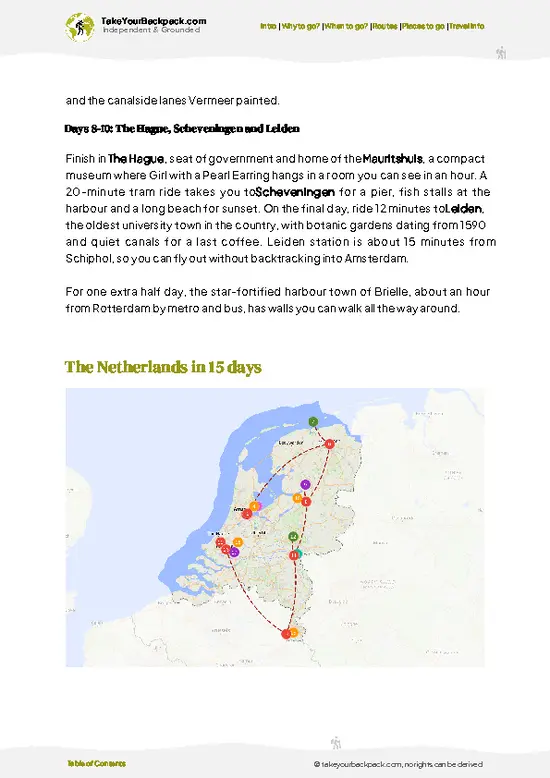
example page 0 from our offline Travel Guide for Netherlands
example page 1 from our offline Travel Guide for Netherlands
example page 2 from our offline Travel Guide for Netherlands
example page 3 from our offline Travel Guide for Netherlands
example page 4 from our offline Travel Guide for Netherlands
example page 5 from our offline Travel Guide for Netherlands
example page 6 from our offline Travel Guide for Netherlands
example page 7 from our offline Travel Guide for Netherlands
Loading the map 🌍
CLICK TO FILTER
cities
towns
villages
landmarks
national parks
hikes
beaches
attractions
festivals
regions
SHOW COUNTRY’S BESTSHOW ALL

✨ Why go?
Ranked #7 city in The Netherlands
What makes it a must-see city

Backpackers come to Delft because it solves a cost problem. Rooms in Amsterdam are expensive, while here a hostel or simple guesthouse bed typically runs about €30 to 60, and the whole center is walkable in 15 minutes. The place is compact enough that you can see the main sights in a day, yet it works as a calm base afterward. Trains to The Hague and Rotterdam run every few minutes, and Schiphol Airport is reachable in roughly 40 to 50 minutes with one change. Add the blue-and-white pottery tradition and a student population from the technical university, and you get cafes with sensible prices and an easy atmosphere. Delft is best as a one or two night stop rather than a long stay. Nightlife is modest, so pair it with a livelier city if you want late evenings, or use it as a quiet reset between bigger stops.

💡 HighlightsWhat this place is best known for

  1. Nieuwe Kerk: Gothic church holding the royal tomb of the House of Orange-Nassau. Climb the tower (about 376 steps) for views over the market square. Entry roughly €6 to 8 for church and tower combined. Allow 1 to 1.5 hours. Go in the morning.
  2. Markt Square: Delft’s main square, with the Stadhuis facing the church. Free, 30 minutes. Thursday market mornings are liveliest.
  3. Royal Delft Experience: Working factory and museum for Delftware, where painters still decorate by hand. Tickets about €16 to 20, 1.5 to 2 hours. Weekday mornings are quieter.
  4. Museum Prinsenhof: Former convent where William of Orange was shot in 1584, with bullet holes still visible on the staircase. Entry about €12 to 15, 1 to 1.5 hours.
  5. Oude Kerk: Leaning medieval tower and the grave of Johannes Vermeer. Entry around €5 to 7,
… read more 👉
  1. Nieuwe Kerk: Gothic church holding the royal tomb of the House of Orange-Nassau. Climb the tower (about 376 steps) for views over the market square. Entry roughly €6 to 8 for church and tower combined. Allow 1 to 1.5 hours. Go in the morning.
  2. Markt Square: Delft’s main square, with the Stadhuis facing the church. Free, 30 minutes. Thursday market mornings are liveliest.
  3. Royal Delft Experience: Working factory and museum for Delftware, where painters still decorate by hand. Tickets about €16 to 20, 1.5 to 2 hours. Weekday mornings are quieter.
  4. Museum Prinsenhof: Former convent where William of Orange was shot in 1584, with bullet holes still visible on the staircase. Entry about €12 to 15, 1 to 1.5 hours.
  5. Oude Kerk: Leaning medieval tower and the grave of Johannes Vermeer. Entry around €5 to 7, 45 minutes. Late morning light is good.
  6. Vermeer Centrum: Reproductions of all Vermeer’s works and explanations of his techniques, since no originals remain in town. Entry about €9 to 12, 1 hour.
  7. Canal walk along Oude Delft: Free stroll past gabled houses and bridges, 1 hour. Early evening is best for soft light.
  8. Botanical Garden of TU Delft: Small university garden with greenhouses, quiet and rarely crowded. Entry about €4 to 6, 45 minutes. Spring and summer are best.
Day trips close by include The Hague for Mauritshuis and Scheveningen beach, Rotterdam for its Markthal and Cube Houses, and Kinderdijk windmills. Start with the Nieuwe Kerk tower, since morning is calmest and the view helps you orient before wandering.
Spotted a mistake or missing something? Contact us.

Things to do around Delft

Ratings based on Tripadvisor reviews. When you book through this link, you support our work at no extra cost to you.

🏘️ NeighborhoodsHow different areas shape the experience

Delft is compact, and its districts follow the canal rings, so a few patterns explain almost everything you will do here.
  • Markt and the Old Center: The square sits between the Nieuwe Kerk and the Stadhuis, and the surrounding streets hold cafés, cheese shops and stroopwafel stalls. It is fully walkable, busiest on Thursday market days and Saturdays, and quiet after 6 pm. Plan an hour or two here, since a lot of the best value is simply wandering the canals for free.
  • Oude Delft and the Oostpoort: The canal running south from the Markt to the Oostpoort gate has the Oude Kerk, the Prinsenhof museum and brown cafés with canalside terraces. Walking from end to end takes about 20 minutes, which makes it the best use of time for the money.
  • Student Quarter (around Nieuwe Langendijk and Voorstraat): TU
… read more 👉
Delft is compact, and its districts follow the canal rings, so a few patterns explain almost everything you will do here.
  • Markt and the Old Center: The square sits between the Nieuwe Kerk and the Stadhuis, and the surrounding streets hold cafés, cheese shops and stroopwafel stalls. It is fully walkable, busiest on Thursday market days and Saturdays, and quiet after 6 pm. Plan an hour or two here, since a lot of the best value is simply wandering the canals for free.
  • Oude Delft and the Oostpoort: The canal running south from the Markt to the Oostpoort gate has the Oude Kerk, the Prinsenhof museum and brown cafés with canalside terraces. Walking from end to end takes about 20 minutes, which makes it the best use of time for the money.
  • Student Quarter (around Nieuwe Langendijk and Voorstraat): TU Delft students shape this area. Expect cheap snack bars, bike-filled streets and lively bars on weekday evenings, calmer during exams and summer. It is the best place for budget meals.
  • Station and Campus: Rail connections, supermarkets and the university buildings cluster here. It has little atmosphere, but a 10 to 15 minute walk reaches the center.
  • Delftse Hout: A wooded park with a lake and beach, a 15 minute bike ride from the center. It costs nothing and suits summer afternoons.

⌛️ 1 day1-day itinerary for Delft

Delft rewards a slow day because everything sits within a short walk and the best moments come between the sights.

9:00 AM, Markt Square: Start with coffee at a terrace and watch the square wake up. Then climb the Nieuwe Kerk tower while it is quiet, for the clearest view of the canal grid.

11:00 AM, Museum Prinsenhof: Walk five minutes along Sint Agathaplein. See the bullet holes on the staircase and the paintings that explain the Dutch Revolt.

12:45 PM, Lunch near Voldersgracht: Grab a broodje or pancake at a local cafe and eat by the water. It is cheaper than the square.

2:00 PM, Oude Kerk and Vermeer’s grave: Stroll along Oude Delft to see the leaning tower and the memorial stones inside.

3:30 PM, Botanical Garden of TU Delft: A short walk takes you to this small garden used by students, … read more 👉
Delft rewards a slow day because everything sits within a short walk and the best moments come between the sights.

9:00 AM, Markt Square: Start with coffee at a terrace and watch the square wake up. Then climb the Nieuwe Kerk tower while it is quiet, for the clearest view of the canal grid.

11:00 AM, Museum Prinsenhof: Walk five minutes along Sint Agathaplein. See the bullet holes on the staircase and the paintings that explain the Dutch Revolt.

12:45 PM, Lunch near Voldersgracht: Grab a broodje or pancake at a local cafe and eat by the water. It is cheaper than the square.

2:00 PM, Oude Kerk and Vermeer’s grave: Stroll along Oude Delft to see the leaning tower and the memorial stones inside.

3:30 PM, Botanical Garden of TU Delft: A short walk takes you to this small garden used by students, which most day visitors skip. Wander the greenhouses and rest on a bench.

5:00 PM, Royal Delft: Arrive for the final hours to watch painters at work, then browse the shop.

7:00 PM, Canal walk: Finish along Oude Delft as lamps come on and the crowds disappear.

🌤️ When to go?Best time to visit Delft

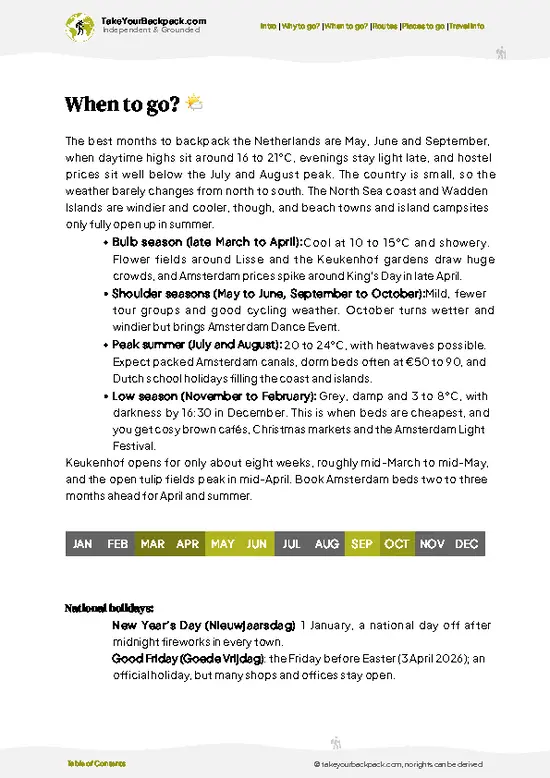
May to September is the best window, with daytime highs of 17 to 23°C (63 to 73°F) and long evenings.
  • Spring (April to May): Highs of 10 to 17°C (50 to 63°F), occasional showers and the bulb season nearby. Crowds are moderate and prices reasonable.
  • Summer (June to August): Highs of 20 to 24°C (68 to 75°F), with daylight lasting until about 10 pm in June. Terraces are full and dorm prices peak, but heat waves are rare.
  • Autumn (September to October): Highs of 12 to 19°C (54 to 66°F), thinner crowds and softer rates, though rain increases.
  • Winter (November to March): Highs of 4 to 8°C (39 to 46°F), only about 8 hours of daylight and frequent drizzle. Prices are lowest, and Christmas markets add atmosphere.
Book summer beds a few weeks ahead, and aim for weekdays to avoid the heaviest day-tripper crowds.

source: climatestotravel.comJANJanuary: fair for travelingFEBFebruary: fair for travelingMARMarch: good for travelingAPRApril: highly recommended for travelingMAYMay: excellent for travelingJUNJune: excellent for travelingJULJuly: good for travelingAUGAugust: good for travelingSEPSeptember: highly recommended for travelingOCTOctober: highly recommended for travelingNOVNovember: fair for travelingDECDecember: fair for traveling
netherlands-city-delft
© Google | Boyka Dr

✈️ The backpacker research shortcutThe Netherlands Travel Guide

An offline-friendly backpacking guide with optimized travel routes, ranked highlights, transport advice, and the best areas to stay.
example page 0 from our offline Travel Guide for Netherlands
example page 1 from our offline Travel Guide for Netherlands
example page 2 from our offline Travel Guide for Netherlands
example page 3 from our offline Travel Guide for Netherlands
example page 4 from our offline Travel Guide for Netherlands
example page 5 from our offline Travel Guide for Netherlands
example page 6 from our offline Travel Guide for Netherlands
example page 7 from our offline Travel Guide for Netherlands
The digital guide (373 pages) contains:
✅ 127 highlights, ranked by travel appeal
✅ Optimized 5, 10 & 15-day travel routes
✅ Cities, national parks, landmarks, beaches
✅ How to get around
✅ Offline-friendly for travel without Wi-Fi
👉 Click to see all 30+ guide features

📅 Plan smarter in minutes, not weeks
✅ Month by month travel advice
✅ Festivals & national holidays
✅ Budget expectations

🗺️ Go to the right places, skip the overrated ones
✅ Honest pros & cons of destinations
✅ Top hikes, parks & viewpoints
✅ Lesser-known places most travelers miss
✅ Clear “worth it vs skip it” guidance

🛏️ Travel smoothly without rookie mistakes
✅ Best areas to stay
✅ Transport systems explained simply
✅ Common scams & safety advice
✅ SIM cards, money & practical tips

🌍 Understand the country, not just visit it
✅ Culture & traditions
✅ 52 Essential phrases & customs
✅ Festivals worth planning around
✅ Traveler-friendly historical context
✅ Insights that make places more meaningful

📱 Built for real travel conditions
✅ Fully downloadable PDF
✅ Works completely offline
✅ Optimized for phone use
✅ Useful in remote areas & buses
✅ Everything in one place
Stop searching, start planning
Get instant access to your full guide. 30‑day money-back guarantee.
+ Add another guide for just

By proceeding you agree to our terms.
Sent to your inbox immediately after payment • 100% Secure Checkout
Best Backpacking Travel Advisor 2025 tourism awardBest Backpacking
Travel Advisor
2025
What others say about Take Your Backpack Guides:
⭐⭐⭐⭐⭐
Fantastic, amazing amount of information!
⭐⭐⭐⭐⭐
My goodness this is amazing, it's what I've been looking for hats off too you!
⭐⭐⭐⭐⭐
I think this is absolutely BRILLIANT
⭐⭐⭐⭐
Very complete and informative. It's still missing places, but I gotta to commend you
⭐⭐⭐⭐⭐
This is truly amazing, thank you, can't wait to explore it with my kids!
⭐⭐⭐⭐⭐
Awesome resource, thank you!
⭐⭐⭐⭐⭐
This is amazing! Can't wait to explore the ones I haven't seen
⭐⭐⭐⭐
I love this! Well done, great idea.
⭐⭐⭐⭐⭐
Thanks for taking the time to make this gem!
⭐⭐⭐⭐⭐
This might be the best website I've ever seen.
⭐⭐⭐⭐⭐
Congratulations, and thank you so much for your work; it's incredibly valuable.
⭐⭐⭐⭐
In all seriousness I think you did a great job pointing out the important spots
⭐⭐⭐⭐⭐
10/10 very good
⭐⭐⭐⭐⭐
As someone who's only just starting to visit regularly this is awesome, thank you.
⭐⭐⭐⭐
Thank you very much! I'm going to visit my dad, it's going to be very useful!
⭐⭐⭐⭐⭐
This is really cool! We'll be travelling for the first time and this definitely come in handy.
⭐⭐⭐⭐⭐
You are now our minister of culture, congratulations 👨‍💼
⭐⭐⭐⭐⭐
Just wanted to tell you that this is a pearl! Going to follow your recommendations.
⭐⭐⭐⭐⭐
This is so cool. I'll definitely be using the resource for my travels soon.
⭐⭐⭐⭐⭐
This is very impressive! Good work.
⭐⭐⭐⭐⭐
This is an amazing and informative site. Very well done!

🛏️ Where to stay?Choosing the right base

The best area for a budget stay is around the train station and the southern edge of the center, where you can reach the main sights within 10 to 15 minutes on foot.
Delft itself has very few dorm beds, so budget travelers often stay in simple guesthouses, private rooms, or in The Hague and Rotterdam, where hostel supply is far greater. Delft rooms fill quickly in summer and on weekends, so book early and expect to pay more than in the larger cities.
The station area is safe at night, lit and busy, with supermarkets and late trains nearby. Noise is light, mostly from trams and bikes. The main benefit … read more 👉
The best area for a budget stay is around the train station and the southern edge of the center, where you can reach the main sights within 10 to 15 minutes on foot.
Delft itself has very few dorm beds, so budget travelers often stay in simple guesthouses, private rooms, or in The Hague and Rotterdam, where hostel supply is far greater. Delft rooms fill quickly in summer and on weekends, so book early and expect to pay more than in the larger cities.
The station area is safe at night, lit and busy, with supermarkets and late trains nearby. Noise is light, mostly from trams and bikes. The main benefit is the transport: direct trains reach The Hague in about 10 minutes and Rotterdam in about 15, which makes a base here convenient for exploring all three cities.
The student quarter just west of the center is the second choice. It has cheaper rooms through private listings, lots of food nearby and a relaxed feel, but weekday evenings can be lively around the bars. Both areas are walkable and bike-friendly, so you rarely need a tram.

🚌 Getting aroundMoving around without the hassle

The historic center is walkable end to end in about 25 minutes, and walking stops making sense only when you head to the Delftse Hout park, TU Delft campus edges or neighboring towns. Traffic in the old core is limited, canals force routes into narrow loops, and public transport is frequent and reliable. Most backpackers combine feet, a rented bike and the occasional train or tram.
  • Walking: Free, and the fastest way through the center because streets are short and many are pedestrian-only. Cobblestones and canal edges call for decent shoes, and bikes move quickly, so watch the red cycle lanes.
  • Bicycle: Rentals run about €10 to 15 a day, and the bike is the best value for reaching the Delftse Hout or the tulip and polder routes. A bike cuts a 40 minute walk to about 12, but you must lock it with
… read more 👉
The historic center is walkable end to end in about 25 minutes, and walking stops making sense only when you head to the Delftse Hout park, TU Delft campus edges or neighboring towns. Traffic in the old core is limited, canals force routes into narrow loops, and public transport is frequent and reliable. Most backpackers combine feet, a rented bike and the occasional train or tram.
  • Walking: Free, and the fastest way through the center because streets are short and many are pedestrian-only. Cobblestones and canal edges call for decent shoes, and bikes move quickly, so watch the red cycle lanes.
  • Bicycle: Rentals run about €10 to 15 a day, and the bike is the best value for reaching the Delftse Hout or the tulip and polder routes. A bike cuts a 40 minute walk to about 12, but you must lock it with two locks and park in marked racks.
  • Tram and bus (HTM): Lines 1 and 19 connect Delft with The Hague, and tickets are paid with a contactless bank card or OV-chipkaart tap in and out at roughly €1 to 5 per trip depending on distance. Services run from about 5 am to after midnight. Trams are slower than trains but useful to reach Scheveningen and The Hague neighborhoods.
  • Train (NS): Delft station has direct services to The Hague (about 10 minutes, €3 to 4), Rotterdam (about 15 minutes, €4 to 5) and Amsterdam (about 1 hour, €15 to 18). It is the quickest and most comfortable option for longer distances, with trains every 10 to 15 minutes until after midnight. Off-peak discount cards can cut fares by 40 percent.

👛 Costs (as of 16 October 2026)Typical daily expenses

Expect to spend about €70 to 110 a day in Delft, with accommodation the biggest variable because hostel beds are scarce locally.
CategoryBudget RangeLocal Reality
Dorm accommodation (high season)€45 to 70Beds are limited, so many travelers use private rooms or stay in nearby cities
Dorm accommodation (off-season)€30 to 50Prices fall in winter and midweek
Meals€18 to 30Supermarket groceries, snack bars and market lunches keep costs low
Local transport€0 to 5Walking is free, and bike rental is about €10 to 15 a day
City transport pass€8 to 15A day ticket for HTM trams and buses suits trips to The Hague
Basic activities/entry fees€8 to 20Church tower climbs and museums cost €5 to 15 each
Miscellaneous€5 to 10Beer at €4 to 6, laundry and snacks
Total Daily Budget€70 to 110Lower if you stay in a nearby
… read more 👉
Expect to spend about €70 to 110 a day in Delft, with accommodation the biggest variable because hostel beds are scarce locally.
CategoryBudget RangeLocal Reality
Dorm accommodation (high season)€45 to 70Beds are limited, so many travelers use private rooms or stay in nearby cities
Dorm accommodation (off-season)€30 to 50Prices fall in winter and midweek
Meals€18 to 30Supermarket groceries, snack bars and market lunches keep costs low
Local transport€0 to 5Walking is free, and bike rental is about €10 to 15 a day
City transport pass€8 to 15A day ticket for HTM trams and buses suits trips to The Hague
Basic activities/entry fees€8 to 20Church tower climbs and museums cost €5 to 15 each
Miscellaneous€5 to 10Beer at €4 to 6, laundry and snacks
Total Daily Budget€70 to 110Lower if you stay in a nearby city and day trip in
Buy a museum card if you plan to see several museums, and shop at supermarkets for picnic lunches on the canals.
⚠️ Prices can change and everyone travels differently, so take this as a rough guide. Hope it helps you plan your adventure!

🚌 Day tripsExploring the surroundings

Delft sits in the middle of the Randstad, so nearly every worthwhile day trip is a short train ride with return trains until after midnight.
The Hague:
Trains take about 10 minutes and cost €3 to 4 each way, or tram line 1 takes about 25 minutes for slightly less. The Mauritshuis, the Binnenhof and the beach at Scheveningen make a full day, and you can finish on the sand in summer. A common mistake is skipping the museum booking, so reserve ahead on weekends. Budget about €25 to 35 including entry.
👉 Explore The Hague
Rotterdam:
The train takes about 15 minutes and costs around €4 to 5. The Markthal, the Cube Houses and the harbor architecture offer a bold contrast to Delft’s old brick. Allow a full day, with €20 to 30 for food and a harbor sightseeing ride. Any season works, though rain makes … read more 👉
Delft sits in the middle of the Randstad, so nearly every worthwhile day trip is a short train ride with return trains until after midnight.
The Hague:
Trains take about 10 minutes and cost €3 to 4 each way, or tram line 1 takes about 25 minutes for slightly less. The Mauritshuis, the Binnenhof and the beach at Scheveningen make a full day, and you can finish on the sand in summer. A common mistake is skipping the museum booking, so reserve ahead on weekends. Budget about €25 to 35 including entry.
👉 Explore The Hague
Rotterdam:
The train takes about 15 minutes and costs around €4 to 5. The Markthal, the Cube Houses and the harbor architecture offer a bold contrast to Delft’s old brick. Allow a full day, with €20 to 30 for food and a harbor sightseeing ride. Any season works, though rain makes the indoor Markthal particularly handy.
👉 Explore Rotterdam
Keukenhof and the Bulb Fields:
The gardens open only from late March to mid May, and the best bloom is mid April. Take a train to Leiden (about 25 minutes) then a bus for around 30 minutes. Entry costs about €20 to 25, so expect €40 to 50 for the day. Many first-timers arrive on weekends and face long queues, so go on a weekday morning.
👉 Explore Keukenhof
Kinderdijk Windmills:
Reach it by train to Rotterdam, then the Waterbus from Rotterdam (about 30 minutes). Nineteen windmills line the polder canals, and the visitor center and walking paths take about three hours. Costs run roughly €25 to 35 with entry, and late spring to early autumn brings the best light and open mills.
👉 Explore Kinderdijk

🍲 FoodLocal Cuisine & Drinks

Delft’s food is simple and satisfying, built around Dutch classics. Try stroopwafels warm from a market stall, with caramel that stretches as you pull the halves apart. Bitterballen, crisp fried balls with a molten meat ragout, arrive with mustard alongside a cold beer in almost any café. Sample aged Gouda and other cheeses at the Thursday market, where vendors cut slices for you to taste. Herring with onions is a salty, quick snack for the brave.
Backpackers eat cheaply at the student snack bars near Voorstraat, where fries with sauce, kebabs and sandwiches cost a few euros. The Thursday and Saturday markets offer fruit, fresh bread and ready-made lunches. Canalside brown cafés and terraces are the places to linger over a local beer or a glass of jenever, the Dutch juniper spirit.
Dutch habits … read more 👉
Delft’s food is simple and satisfying, built around Dutch classics. Try stroopwafels warm from a market stall, with caramel that stretches as you pull the halves apart. Bitterballen, crisp fried balls with a molten meat ragout, arrive with mustard alongside a cold beer in almost any café. Sample aged Gouda and other cheeses at the Thursday market, where vendors cut slices for you to taste. Herring with onions is a salty, quick snack for the brave.
Backpackers eat cheaply at the student snack bars near Voorstraat, where fries with sauce, kebabs and sandwiches cost a few euros. The Thursday and Saturday markets offer fruit, fresh bread and ready-made lunches. Canalside brown cafés and terraces are the places to linger over a local beer or a glass of jenever, the Dutch juniper spirit.
Dutch habits are relaxed. Tipping is small, just rounding up, and you often have to ask for the bill. Many places take cards only, and kitchens close early, often by 9 pm.

🛡️ SafetySafety Tips and Common Scams in Delft

Delft is very safe, and the main problem you will encounter is bicycle theft rather than violence. Lock your bike with two locks to a fixed object and never leave it overnight on the street in the station area. Pickpockets occasionally work crowded market days on the Markt and on trains, so keep your phone and wallet in a front pocket or zipped bag. Solo travelers, including women, usually walk the center at night without issue, as streets stay lit and student life keeps them active. The red cycle lanes are the everyday hazard, because fast cyclists will not stop for you. Look both ways before crossing, and do not stand in the lane to take photos. Drug dealing in the nearby cities is better ignored, and the emergency number is 112.

FAQTraveler FAQ

Two nights is ideal, and one full day is the minimum. The main sights, including Nieuwe Kerk, Prinsenhof and Royal Delft, fit into about 6 to 8 hours on foot. A second day lets you take a 12 to 15 minute train to The Hague or Rotterdam and return for the evening.
Yes, Delft is very safe for solo backpackers, with low violent crime and well-lit streets even at night. The main risk is bike theft, so use two locks and avoid leaving a bicycle on the street overnight. Keep an eye on bags around the train station and on market days, when pickpockets sometimes operate. Emergency services can be reached on 112.
Delft is known for Delftware, the blue-and-white pottery produced here since the 1600s, and for painter Johannes Vermeer, who lived and is buried in the city. It is also the burial place of the Dutch royal family at the Nieuwe Kerk and home to TU Delft. The canal-lined old center is compact and can be crossed on foot in about 15 minutes.
⚠️ Things can change over time, so always validate details locally before you go.

Other Dutch cities near Delft

Explore more nearby:

  • The Hague—Binnenhof, Peace Palace, Mauritshuis, Scheveningen pier| 8 km away
  • Rotterdam—Markthal, Cube Houses, Delfshaven, harbor architecture| 13 km away
  • Leiden—Student canals, Naturalis, antiquities, near Schiphol| 19 km away

💡 Not sure where to go next?
Create a personalized itinerary for The Netherlands including Delft and the places that fit your trip.

Generate my itinerary

👉 Discover all cities

Or checkout all The Netherlands has to offer (think cities, towns, villages, national parks, hikes, beaches, festivals)
Country photo of The Netherlands

We 💚 feedbackSumming up the experience

Two nights is the right length for Delft. One full day covers the churches, the museums and the pottery, and a second lets you ride to The Hague or Rotterdam and come back to quiet streets. Stay longer and the calm turns into slowness, unless you want a rest from bigger cities. As a base, it works well.

✈️ When did I visit The Netherlands?
Netherlands is my home base, so whenever I don’t travel, you can find me in this tiny spot on the globe. When friends from abroad visit me, it’s the time to actually explore my own country as a traveler.

✍️ Help improve this page!
The information on this page is based on my own backpacking experience in The Netherlands, supplemented with up-to-date research and feedback from other travelers. Travel details can change, so if you notice anything outdated or incomplete, feel free to let me know.


🙋‍♂️ Give feedback

👋 Meet the founderWho’s Behind Take Your Backpack?

Johan, backpacker and founder of TakeYourBackpackHi, I’m Johan (Netherlands 🇳🇱), the creator of TakeYourBackpack. Over the past 3 decades, I’ve backpacked through 90+ countries across six continents, gaining extensive experience with independent travel, long-term trips, and overland routes.

This site is built on a combination of firsthand travel experience and carefully curated insights from other backpackers. Many guides are based on places I’ve personally visited, while others bring together tips, observations, and practical advice shared by trusted travelers I’ve met along the way.

The goal is to provide realistic, experience-driven guidance — not generic itineraries — so you can explore destinations with better context, clearer expectations, and more confidence.