×

New Caledonia🇳🇨 | national parksBlue River Provincial ParkGiant kauri, drowned forest, cagou calls, river crossings | things to do and best time to go

Explore Parc des Grandes FougèresExplore Monts Koghis

Backpacking in Blue River Provincial Park
🏆 Top picknational park ranked #2
By Johan Kruseman 🇳🇱 | Updated October 15, 2026

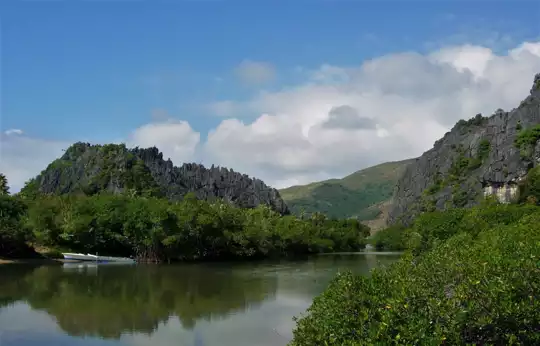
Cold, tea-colored water slides over your boots at a river crossing, and somewhere in the canopy a cagou lets out a bark that sounds more like a dog than a bird. That is Blue River Provincial Park, southeast of Nouméa in New Caledonia, and it hits you through your nose and ears before your eyes: wet earth, resin, the iron-red dust of the old nickel soil. The trails are easy to follow, mostly flat, and cut through maquis shrubland and rainforest where giant kauri trees stand. The forest is thin on big mammals, but the birdlife and the chance of seeing the flightless cagou keep you scanning the undergrowth. Rain turns tracks to red paste and the park is hard to reach without a car, so you plan around that. Crowds stay thin on weekdays and the mood is hushed. Near the lake, bleached trunks of drowned trees poke from the water like pale masts.

Discover everything you want to know in the 📖 New Caledonia Travel Guide.


example page 0 from our offline Travel Guide for New Caledonia
example page 1 from our offline Travel Guide for New Caledonia
example page 2 from our offline Travel Guide for New Caledonia
example page 3 from our offline Travel Guide for New Caledonia
example page 4 from our offline Travel Guide for New Caledonia
example page 5 from our offline Travel Guide for New Caledonia
example page 6 from our offline Travel Guide for New Caledonia
example page 7 from our offline Travel Guide for New Caledonia
Loading the map 🌍
CLICK TO FILTER
cities
towns
villages
landmarks
national parks
hikes
beaches
attractions
festivals
regions
SHOW COUNTRY’S BESTSHOW ALL

✨ Why go?
Ranked #2 national park in New Caledonia
The unique appeal for travelers

Backpackers pick this park because it rewards a self-guided day more than a tour bus ever could. Trails are signposted, you set your own pace, and nobody herds you past the good bits. You can spend an hour with the Grand Kaori, a kauri thought to be well over a thousand years old, then wander off without a schedule to keep. Cycling is allowed on the park’s internal tracks, so renting a mountain bike at the entrance turns the long, flat valley roads into a loop of your own making. The second draw is the wildlife. This is one of the most reliable places to hear and perhaps see the cagou, New Caledonia’s national bird, which lives nowhere else on earth. Early starts raise your odds, and quiet walking helps more than a guide would. Finally, the water is the other pull. The Forêt Noyée, a stand … read more 👉
Backpackers pick this park because it rewards a self-guided day more than a tour bus ever could. Trails are signposted, you set your own pace, and nobody herds you past the good bits. You can spend an hour with the Grand Kaori, a kauri thought to be well over a thousand years old, then wander off without a schedule to keep. Cycling is allowed on the park’s internal tracks, so renting a mountain bike at the entrance turns the long, flat valley roads into a loop of your own making. The second draw is the wildlife. This is one of the most reliable places to hear and perhaps see the cagou, New Caledonia’s national bird, which lives nowhere else on earth. Early starts raise your odds, and quiet walking helps more than a guide would. Finally, the water is the other pull. The Forêt Noyée, a stand of dead trees rising from the artificial lake, gives you a photograph you will not find in most Pacific parks.

💡 HighlightsTop highlights of Blue River Provincial Park

  1. Grand Kaori (Kaori Géant): The park’s best-known sight is a colossal kauri with a trunk several people could not circle with their arms. It stands in rainforest hush, and the short walk to reach it passes ferns and smaller kauris that make its scale obvious.
  2. Forêt Noyée (Drowned Forest): When the valley was dammed, the trees stayed put and died standing. Their gray trunks rise from still water, and the view is eerie at dawn when mist hangs low.
  3. Cagou spotting: The flightless, gray-plumed cagou is shy but vocal, and its crest, red bill and dawn chorus are unmistakable. Walk slowly in the quieter forest sections early in the day.
  4. Rivière Blanche and Rivière Bleue crossings: The water runs clear and stained, with pale pebbles and rust-colored banks. Several crossings give you cold feet and good
… read more 👉
  1. Grand Kaori (Kaori Géant): The park’s best-known sight is a colossal kauri with a trunk several people could not circle with their arms. It stands in rainforest hush, and the short walk to reach it passes ferns and smaller kauris that make its scale obvious.
  2. Forêt Noyée (Drowned Forest): When the valley was dammed, the trees stayed put and died standing. Their gray trunks rise from still water, and the view is eerie at dawn when mist hangs low.
  3. Cagou spotting: The flightless, gray-plumed cagou is shy but vocal, and its crest, red bill and dawn chorus are unmistakable. Walk slowly in the quieter forest sections early in the day.
  4. Rivière Blanche and Rivière Bleue crossings: The water runs clear and stained, with pale pebbles and rust-colored banks. Several crossings give you cold feet and good photos.
  5. Lac en Huit: A figure-eight lake reached on a gentle walk through maquis shrubland. Its odd shape reads best from the higher viewpoints, where you also see the red earth around it.
  6. Pont Pérignon: An old wooden bridge over an arm of the lake that makes a pleasant first stop. It sits in the park’s open valley and is easy to reach from the entrance.
Start with the Grand Kaori, because it is the park’s signature and the forest is quietest and coolest early, when the light filters through the canopy and birds are active.
Spotted a mistake or missing something? Contact us.

Things to do near Blue River Provincial Park

Ratings based on Tripadvisor reviews. When you book through this link, you support our work at no extra cost to you.

🌤️ When to go?Best time to explore Blue River Provincial Park

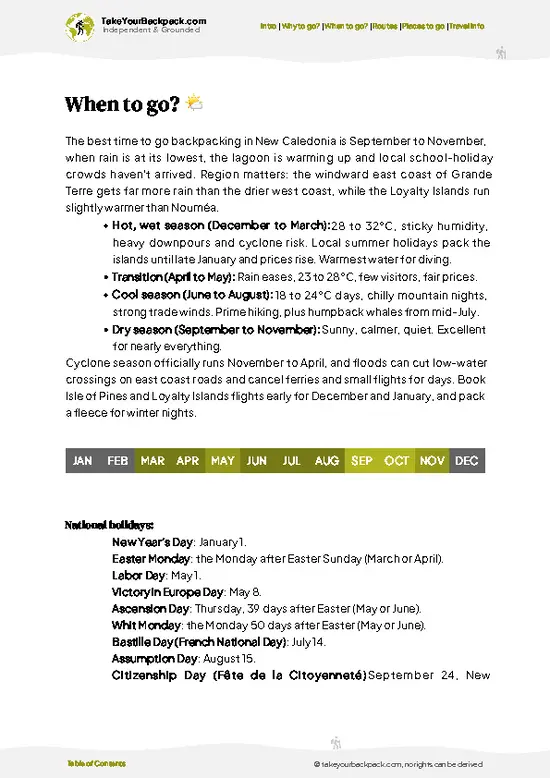
  • Cool dry season (May to September): Days run 20 to 25°C (68 to 77°F) and nights can drop to 14 to 17°C (57 to 63°F), which suits the long loop trails around Lac de Yaté. Sunrise is near 6:30 and sunset around 17:30, so start early. Rain still falls here, since the south is the wettest part of the main island.
  • Hot wet season (December to March): Expect 27 to 32°C (81 to 90°F), heavy humidity and downpours that turn red clay trails into slides. Cyclones occasionally close the park. Daylight stretches to nearly 19:00. Accommodation in Nouméa and Yaté is cheapest, though a lot of the water you came to see is brown.
  • Warm transition months (October to November and April): Temperatures sit at 23 to 28°C (73 to 82°F) with less rain than midsummer and clear water for swimming among the drowned trees
… read more 👉
  • Cool dry season (May to September): Days run 20 to 25°C (68 to 77°F) and nights can drop to 14 to 17°C (57 to 63°F), which suits the long loop trails around Lac de Yaté. Sunrise is near 6:30 and sunset around 17:30, so start early. Rain still falls here, since the south is the wettest part of the main island.
  • Hot wet season (December to March): Expect 27 to 32°C (81 to 90°F), heavy humidity and downpours that turn red clay trails into slides. Cyclones occasionally close the park. Daylight stretches to nearly 19:00. Accommodation in Nouméa and Yaté is cheapest, though a lot of the water you came to see is brown.
  • Warm transition months (October to November and April): Temperatures sit at 23 to 28°C (73 to 82°F) with less rain than midsummer and clear water for swimming among the drowned trees of the Rivière Bleue. Local school holidays in July and December fill gîtes and the park’s few cabins, and prices rise.
Book weekday visits outside July and December, and arrive at the gate before 8:00 for the quietest trails.


source: climatestotravel.comJANJanuary: fair for travelingFEBFebruary: fair for travelingMARMarch: fair for travelingAPRApril: fair for travelingMAYMay: highly recommended for travelingJUNJune: highly recommended for travelingJULJuly: excellent for travelingAUGAugust: excellent for travelingSEPSeptember: highly recommended for travelingOCTOctober: highly recommended for travelingNOVNovember: fair for travelingDECDecember: fair for traveling
new-caledonia-national-park-blue-river-provincial-park
© Google |

✈️ The backpacker research shortcutNew Caledonia Travel Guide

An offline-friendly backpacking guide with optimized travel routes, ranked highlights, transport advice, and the best areas to stay.
example page 0 from our offline Travel Guide for New Caledonia
example page 1 from our offline Travel Guide for New Caledonia
example page 2 from our offline Travel Guide for New Caledonia
example page 3 from our offline Travel Guide for New Caledonia
example page 4 from our offline Travel Guide for New Caledonia
example page 5 from our offline Travel Guide for New Caledonia
example page 6 from our offline Travel Guide for New Caledonia
example page 7 from our offline Travel Guide for New Caledonia
The digital guide (158 pages) contains:
✅ 42 highlights, ranked by travel appeal
✅ Optimized 2, 3 & 5-day travel routes
✅ Cities, national parks, landmarks, beaches
✅ How to get around
✅ Offline-friendly for travel without Wi-Fi
👉 Click to see all 30+ guide features

📅 Plan smarter in minutes, not weeks
✅ Month by month travel advice
✅ Festivals & national holidays
✅ Budget expectations

🗺️ Go to the right places, skip the overrated ones
✅ Honest pros & cons of destinations
✅ Top hikes, parks & viewpoints
✅ Lesser-known places most travelers miss
✅ Clear “worth it vs skip it” guidance

🛏️ Travel smoothly without rookie mistakes
✅ Best areas to stay
✅ Transport systems explained simply
✅ Common scams & safety advice
✅ SIM cards, money & practical tips

🌍 Understand the country, not just visit it
✅ Culture & traditions
✅ 52 Essential phrases & customs
✅ Festivals worth planning around
✅ Traveler-friendly historical context
✅ Insights that make places more meaningful

📱 Built for real travel conditions
✅ Fully downloadable PDF
✅ Works completely offline
✅ Optimized for phone use
✅ Useful in remote areas & buses
✅ Everything in one place
Stop searching, start planning
Get instant access to your full guide. 30‑day money-back guarantee.
+ Add another guide for just

By proceeding you agree to our terms.
Sent to your inbox immediately after payment • 100% Secure Checkout
Best Backpacking Travel Advisor 2025 tourism awardBest Backpacking
Travel Advisor
2025
What others say about Take Your Backpack Guides:
⭐⭐⭐⭐⭐
Fantastic, amazing amount of information!
⭐⭐⭐⭐⭐
My goodness this is amazing, it's what I've been looking for hats off too you!
⭐⭐⭐⭐⭐
I think this is absolutely BRILLIANT
⭐⭐⭐⭐
Very complete and informative. It's still missing places, but I gotta to commend you
⭐⭐⭐⭐⭐
This is truly amazing, thank you, can't wait to explore it with my kids!
⭐⭐⭐⭐⭐
Awesome resource, thank you!
⭐⭐⭐⭐⭐
This is amazing! Can't wait to explore the ones I haven't seen
⭐⭐⭐⭐
I love this! Well done, great idea.
⭐⭐⭐⭐⭐
Thanks for taking the time to make this gem!
⭐⭐⭐⭐⭐
This might be the best website I've ever seen.
⭐⭐⭐⭐⭐
Congratulations, and thank you so much for your work; it's incredibly valuable.
⭐⭐⭐⭐
In all seriousness I think you did a great job pointing out the important spots
⭐⭐⭐⭐⭐
10/10 very good
⭐⭐⭐⭐⭐
As someone who's only just starting to visit regularly this is awesome, thank you.
⭐⭐⭐⭐
Thank you very much! I'm going to visit my dad, it's going to be very useful!
⭐⭐⭐⭐⭐
This is really cool! We'll be travelling for the first time and this definitely come in handy.
⭐⭐⭐⭐⭐
You are now our minister of culture, congratulations 👨‍💼
⭐⭐⭐⭐⭐
Just wanted to tell you that this is a pearl! Going to follow your recommendations.
⭐⭐⭐⭐⭐
This is so cool. I'll definitely be using the resource for my travels soon.
⭐⭐⭐⭐⭐
This is very impressive! Good work.
⭐⭐⭐⭐⭐
This is an amazing and informative site. Very well done!

🛏️ Where to stay?How to pick the right area

Stay in Nouméa or in the small village of Yaté, because only a handful of options sit right at the park. Inside the park, you can camp or rent basic cabins (gîtes) near the Rivière Bleue entrance and the Pont Pérignon area. Camping there runs about 1,500 to 2,500 XPF (US$14 to 23) per person, and cabins cost more. Book through the park’s own reservation contacts, because capacity is small and it fills during school holidays. Camping is also possible at Prony Bay.
Yaté, roughly 45 minutes by road from the park gate, has family-run guesthouses and bungalows near Lac de Yaté, usually 6,000 to 12,000 … read more 👉
Stay in Nouméa or in the small village of Yaté, because only a handful of options sit right at the park. Inside the park, you can camp or rent basic cabins (gîtes) near the Rivière Bleue entrance and the Pont Pérignon area. Camping there runs about 1,500 to 2,500 XPF (US$14 to 23) per person, and cabins cost more. Book through the park’s own reservation contacts, because capacity is small and it fills during school holidays. Camping is also possible at Prony Bay.
Yaté, roughly 45 minutes by road from the park gate, has family-run guesthouses and bungalows near Lac de Yaté, usually 6,000 to 12,000 XPF (US$55 to 110) a room. It is the closest settlement with a small shop and a restaurant, which makes it the practical choice if you want an early start without staying in the bush.
Nouméa has the real backpacker choice: hostels with dorm beds at around 3,000 to 5,500 XPF (US$28 to 50), plus budget hotels and apartments. Staying there means a rental car or a booked shuttle to reach the park. Pack your own food, as nothing is sold inside the park.

👛 Costs (as of 15 October 2026)Travel costs and budget guide for Blue River Provincial Park

A day at Blue River Provincial Park runs about €57 to 107 per person if you camp, cook some of your own food and drive in yourself. Everything is paid in Pacific francs, and card machines are not something to count on inside the park, so carry cash from Nouméa.
CategoryBudget RangeLocal Reality
Entrance fee€4 to 5Charged per adult at the gate, with lower rates for children. Pay on arrival, ideally in cash.
Accommodation/camping€8 to 12 (high season)Basic camping is the backpacker option. Gîte rooms cost more, roughly €50 to 80 for a private room, and fill up on weekends and school holidays. Prices dip slightly in the cooler months.
Local transport€30 to 50No public bus reaches the park. Most visitors rent a small car in Nouméa (about €35 to 60 a day plus fuel) and split the cost. A taxi from Nouméa
… read more 👉
A day at Blue River Provincial Park runs about €57 to 107 per person if you camp, cook some of your own food and drive in yourself. Everything is paid in Pacific francs, and card machines are not something to count on inside the park, so carry cash from Nouméa.
CategoryBudget RangeLocal Reality
Entrance fee€4 to 5Charged per adult at the gate, with lower rates for children. Pay on arrival, ideally in cash.
Accommodation/camping€8 to 12 (high season)Basic camping is the backpacker option. Gîte rooms cost more, roughly €50 to 80 for a private room, and fill up on weekends and school holidays. Prices dip slightly in the cooler months.
Local transport€30 to 50No public bus reaches the park. Most visitors rent a small car in Nouméa (about €35 to 60 a day plus fuel) and split the cost. A taxi from Nouméa is far pricier.
Food/supplies€15 to 25Buy groceries, bread and stove fuel in Nouméa or at a supermarket on the way south, since choices near the park are limited. Eating out in the area costs more than self-catering.
Activities/rentals€0 to 15Walking trails to the giant kauri and around the Kaori lake area are covered by the entrance fee. Bike or kayak rental on the lake adds a modest charge.
Total Daily Budget€57 to 107Per person, per day, in high season.


source: nouvellecaledonie.travel
⚠️ Prices can change and everyone travels differently, so take this as a rough guide. Hope it helps you plan your adventure!

🥾 TrailsScenic routes and wildlife spotting in Blue River Provincial Park

The park’s walks are mostly gentle, on well-trodden dirt and gravel tracks across red nickel-rich soil, with forest shade and open maquis sections where the sun bites. Mud after rain is the main difficulty, not gradients.
  • Sentier du Kaori Géant: A short, easy forest walk of roughly an hour or less return to the huge kauri. Terrain is flat, with roots and some damp patches. Good for families and anyone nervous about hiking.
  • Sentier de la Forêt Noyée: An easy to moderate lakeside route, around one to two hours, that follows the shore through shrubs to the drowned trees. Open sections are exposed to
… read more 👉
The park’s walks are mostly gentle, on well-trodden dirt and gravel tracks across red nickel-rich soil, with forest shade and open maquis sections where the sun bites. Mud after rain is the main difficulty, not gradients.
  • Sentier du Kaori Géant: A short, easy forest walk of roughly an hour or less return to the huge kauri. Terrain is flat, with roots and some damp patches. Good for families and anyone nervous about hiking.
  • Sentier de la Forêt Noyée: An easy to moderate lakeside route, around one to two hours, that follows the shore through shrubs to the drowned trees. Open sections are exposed to sun.
  • Sentier du Lac en Huit: A moderate walk, around two hours return, through maquis with some gentle climbing and views over the lake’s two lobes.
  • Wildlife: The cagou is the star, along with parrots, pigeons and the odd rusa deer track. Moving slowly and quietly raises your chances.
Public transport does not run to the park, so most visitors come by rental car or organized shuttle from Nouméa. The final stretch of road is partly unpaved, and heavy rain can make it slick. A modest entrance fee is collected at the gate, and the park has a visitor point with maps. Weekdays feel nearly empty, while weekends bring local families, especially around the picnic areas. Bring water, insect repellent and shoes you do not mind turning red.
⚠️ Hiking info can sometimes be outdated or inaccurate. Before you hit the trail, check the latest conditions with locals. If you do spot anything that's off, I'd love to hear from you, so I can update it for fellow travelers.

🛡️ SafetyStaying Safe: What Travelers Should Know

Blue River is a well-managed park where the main risks are heat, slippery trails and underestimating distances. The paths are mostly flat to rolling, marked and maintained, with some steeper stretches to the viewpoints and the Grand Kaori, a giant tree that stands among the park’s old kauri forest. After rain, the laterite clay turns slick and orange, so shoes with grip matter more than poles. Water crossings happen mainly via bridges and low fords, though the river can rise quickly after storms, and the rangers will tell you which loops are closed.
Bring at least 2 liters of water per person, since taps are scarce, plus sun protection, because exposed shrubland gives little shade. Mosquitoes are active at dawn and dusk, but dengue is the real concern, so use repellent. There are no dangerous … read more 👉
Blue River is a well-managed park where the main risks are heat, slippery trails and underestimating distances. The paths are mostly flat to rolling, marked and maintained, with some steeper stretches to the viewpoints and the Grand Kaori, a giant tree that stands among the park’s old kauri forest. After rain, the laterite clay turns slick and orange, so shoes with grip matter more than poles. Water crossings happen mainly via bridges and low fords, though the river can rise quickly after storms, and the rangers will tell you which loops are closed.
Bring at least 2 liters of water per person, since taps are scarce, plus sun protection, because exposed shrubland gives little shade. Mosquitoes are active at dawn and dusk, but dengue is the real concern, so use repellent. There are no dangerous large mammals. Keep to the trails to protect rare endemic plants, and watch for introduced feral pigs and deer, which are shy. Tell someone your route, as phone reception is patchy, and set off early to finish before dusk.

FAQFrequently asked questions about Blue River Provincial Park

One full day covers the main Blue River loops, and two days let you add the Grand Kaori walk and the Lac de Yaté area. The Grand Kaori trail takes around 2 to 3 hours return and the shorter forest loops about 1 to 2 hours. If you camp inside the park, a second day is easy to fill.
It is difficult without a car, as there is no public bus to the park gate. From Nouméa the drive takes roughly 1 hour 15 minutes to 1 hour 30 minutes, and some tour operators offer day trips for about 8,000 to 14,000 XPF (US$75 to 130). Hitching is slow, so renting a car is the best option for flexibility.
Yes, a small entrance fee is charged at the park gate, typically 500 to 1,000 XPF (US$5 to 9) per adult, plus a vehicle fee. No separate hiking permit is needed for the day trails. Camping and cabin stays are booked in advance and cost extra.
⚠️ Things can change over time, so always validate details locally before you go.

Other New Caledonian national parks near Blue River Provincial Park

Explore more nearby:


💡 Not sure where to go next?
Create a personalized itinerary for New Caledonia including Blue River Provincial Park and the places that fit your trip.

Generate my itinerary

👉 Discover all national parks

Or checkout all New Caledonia has to offer (think cities, towns, villages, national parks, hikes, beaches, festivals)
Country photo of New Caledonia

We 💚 feedbackFinal thoughts on exploring Blue River Provincial Park

The classic mistake is arriving at midday, ticking off the big tree and leaving in a hurry. Get there at opening, walk the forest first while birds are calling, and save the lake for later light. Bring spare socks for the river crossings.

✍️ Help improve this page!
The information on this page is based on in-depth research, insights shared by experienced travelers, and feedback from the local travel community in New Caledonia. While every effort is made to keep the information accurate and current, conditions can change — so if you spot anything incorrect or outdated, please get in touch.


🙋‍♂️ Give feedback

👋 Meet the founderWho’s Behind Take Your Backpack?

Johan, backpacker and founder of TakeYourBackpackHi, I’m Johan (Netherlands 🇳🇱), the creator of TakeYourBackpack. Over the past 3 decades, I’ve backpacked through 90+ countries across six continents, gaining extensive experience with independent travel, long-term trips, and overland routes.

This site is built on a combination of firsthand travel experience and carefully curated insights from other backpackers. Many guides are based on places I’ve personally visited, while others bring together tips, observations, and practical advice shared by trusted travelers I’ve met along the way.

The goal is to provide realistic, experience-driven guidance — not generic itineraries — so you can explore destinations with better context, clearer expectations, and more confidence.