×

New Caledonia🇳🇨 | national parksParc des Grandes FougèresTree ferns, kagu calls, short loops | things to do and best time to go

Explore Parc provincial de la DumbéaExplore Blue River Provincial Park

Backpacking in Parc des Grandes Fougères
🏆 Top picknational park ranked #1
By Johan Kruseman 🇳🇱 | Updated October 15, 2026

The first thing you notice is the drip. Water falls off fronds the size of canoe paddles, and the air tastes of wet bark and rotting leaves. Then a shrill, dog-like bark rings out from the undergrowth, and you stand still hoping it is a kagu. Parc des Grandes Fougères sits in the mountain forest above Farino and Sarraméa, in the west-central part of New Caledonia’s main island, Grande Terre. Its tree ferns arch overhead so densely that midday light turns green and soft, which makes the trails feel cool even on a hot day. The good: dense rainforest, birds found nowhere else, and short loops that suit sneakers or boots. The bad: roots and mud are constant, rain is quick to arrive, and the walking is more shuffle than stride. No public bus reaches the park, so plan on a rental car from Nouméa.

Discover everything you want to know in the 📖 New Caledonia Travel Guide.
Best time to go: May - October
Daily cost: €55 to €100
Duration: 4 hours
Distance: 12 kilometers
Total ascent: 300 meters


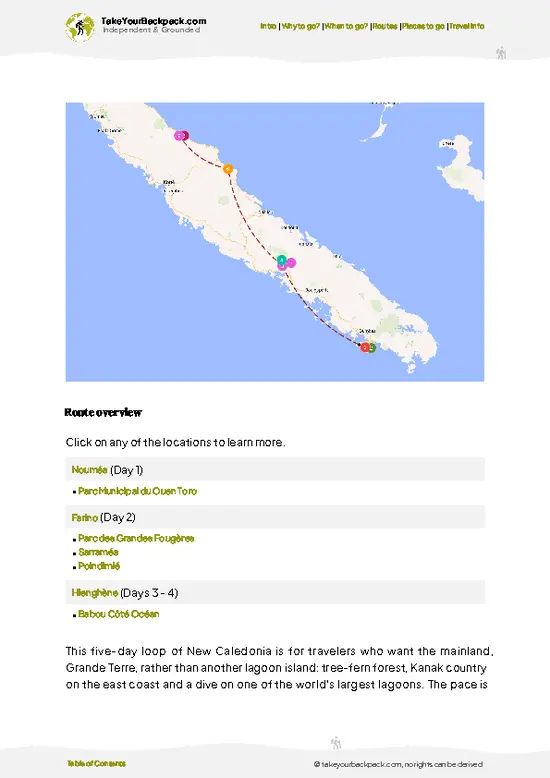
example page 0 from our offline Travel Guide for New Caledonia
example page 1 from our offline Travel Guide for New Caledonia
example page 2 from our offline Travel Guide for New Caledonia
example page 3 from our offline Travel Guide for New Caledonia
example page 4 from our offline Travel Guide for New Caledonia
example page 5 from our offline Travel Guide for New Caledonia
example page 6 from our offline Travel Guide for New Caledonia
example page 7 from our offline Travel Guide for New Caledonia
Loading the map 🌍
CLICK TO FILTER
cities
towns
villages
landmarks
national parks
hikes
beaches
attractions
festivals
regions
SHOW COUNTRY’S BESTSHOW ALL

✨ Why go?
Ranked #1 national park in New Caledonia
What sets this place apart

Backpackers on Grande Terre usually spend their days on beaches and reefs, so this forest is the contrast that rounds out a trip. You get the giant tree ferns that give the park its name without committing to a multi-day trek, and the loops can be stitched together or cut short depending on your legs and the weather. That flexibility matters on an island where daily plans bend around rain.

The second pull is wildlife. The kagu, a flightless gray bird that exists only in New Caledonia, is the animal everyone hopes to hear, and this humid mountain forest is the kind of habitat it needs. Even if it stays hidden, the forest holds other endemic birds and a plant community that feels older than anything on the coast.

It also fits a road route. The park lies on the way between the west coast and … read more 👉
Backpackers on Grande Terre usually spend their days on beaches and reefs, so this forest is the contrast that rounds out a trip. You get the giant tree ferns that give the park its name without committing to a multi-day trek, and the loops can be stitched together or cut short depending on your legs and the weather. That flexibility matters on an island where daily plans bend around rain.

The second pull is wildlife. The kagu, a flightless gray bird that exists only in New Caledonia, is the animal everyone hopes to hear, and this humid mountain forest is the kind of habitat it needs. Even if it stays hidden, the forest holds other endemic birds and a plant community that feels older than anything on the coast.

It also fits a road route. The park lies on the way between the west coast and the mountain road across to the east, so you can walk a morning and still reach your next stop by evening.

💡 HighlightsDon't-miss highlights and experiences

  1. Kagu (cagou) habitat: New Caledonia’s national bird is a flightless, pale gray heron-like creature with a crest and red eyes. It is famous for a bark-like dawn chorus, and the damp forest here is the type of terrain it needs. Walk quietly in the early morning and listen before you look.
  2. Tree fern forest: Cyathea tree ferns rise several meters on shaggy trunks and spread canopies that filter the sun into green light. Underneath, smaller ferns, moss and orchids cover every surface, and the air is noticeably cooler than on the coast.
  3. Notou pigeon: This huge fruit pigeon, among the largest in the world, gives a deep, booming call from the high canopy. Spotting one means looking up into fruiting trees, ideally at first light, and it is a bird you will hear before you ever see.
  4. Picnic area and forest
… read more 👉
  1. Kagu (cagou) habitat: New Caledonia’s national bird is a flightless, pale gray heron-like creature with a crest and red eyes. It is famous for a bark-like dawn chorus, and the damp forest here is the type of terrain it needs. Walk quietly in the early morning and listen before you look.
  2. Tree fern forest: Cyathea tree ferns rise several meters on shaggy trunks and spread canopies that filter the sun into green light. Underneath, smaller ferns, moss and orchids cover every surface, and the air is noticeably cooler than on the coast.
  3. Notou pigeon: This huge fruit pigeon, among the largest in the world, gives a deep, booming call from the high canopy. Spotting one means looking up into fruiting trees, ideally at first light, and it is a bird you will hear before you ever see.
  4. Picnic area and forest edge: At the start of the trails, a shaded picnic spot lets you eat lunch to a soundtrack of birds and dripping leaves. It is the easiest place to appreciate the forest without committing to a full loop, and a good spot to wait out a shower.
Start with the kagu listening at dawn, because the birds are most active and vocal in the first hours of light, and by midday the forest goes quiet.
Spotted a mistake or missing something? Contact us.

Things to do near Parc des Grandes Fougères

Ratings based on Tripadvisor reviews. When you book through this link, you support our work at no extra cost to you.

🌤️ When to go?Choosing the right time of year

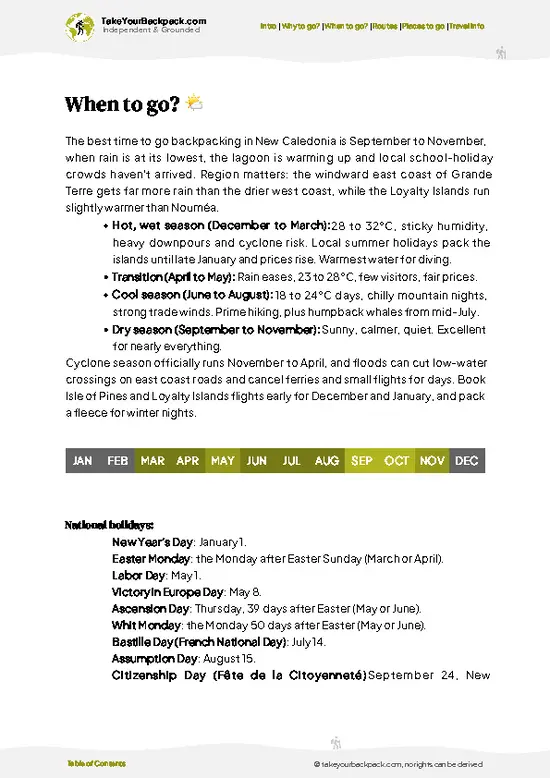
  • Cool Dry Season (June to August): Inland forest at roughly 300 to 600 m runs about 10 to 22°C (50 to 72°F), with crisp mornings and clear air. Trails drain well and mud is minimal. Daylight is short, about 11 hours, with sunset near 5:20 pm. The July school holidays bring local families on weekends.
  • Late Dry Season (September to November): Temperatures climb to 14 to 27°C (57 to 81°F), rain is sparse, and daylight stretches past 12 hours. Weekdays are quiet, and this is the easiest window for longer circuits.
  • Hot Wet Season (December to April): Expect 22 to 32°C (72 to 90°F), heavy humidity and sudden downpours, heaviest from January to March. Cyclones occasionally close the park and swell the creeks. Days run 13 hours, but you will sweat through long climbs. December and January holidays bring
… read more 👉
  • Cool Dry Season (June to August): Inland forest at roughly 300 to 600 m runs about 10 to 22°C (50 to 72°F), with crisp mornings and clear air. Trails drain well and mud is minimal. Daylight is short, about 11 hours, with sunset near 5:20 pm. The July school holidays bring local families on weekends.
  • Late Dry Season (September to November): Temperatures climb to 14 to 27°C (57 to 81°F), rain is sparse, and daylight stretches past 12 hours. Weekdays are quiet, and this is the easiest window for longer circuits.
  • Hot Wet Season (December to April): Expect 22 to 32°C (72 to 90°F), heavy humidity and sudden downpours, heaviest from January to March. Cyclones occasionally close the park and swell the creeks. Days run 13 hours, but you will sweat through long climbs. December and January holidays bring picnickers.
  • May: Rain eases, temperatures settle around 15 to 25°C (59 to 77°F), and the forest is still lush.
Start walking by 8 am year-round, since afternoon cloud often rolls in and the forest darkens early under the tree ferns.


source: climatestotravel.comJANJanuary: fair for travelingFEBFebruary: fair for travelingMARMarch: fair for travelingAPRApril: fair for travelingMAYMay: highly recommended for travelingJUNJune: excellent for travelingJULJuly: excellent for travelingAUGAugust: excellent for travelingSEPSeptember: excellent for travelingOCTOctober: highly recommended for travelingNOVNovember: fair for travelingDECDecember: fair for traveling
new-caledonia-national-park-parc-des-grandes-fougeres
© Google | Jean Paul Beaudeau

✈️ The backpacker research shortcutNew Caledonia Travel Guide

An offline-friendly backpacking guide with optimized travel routes, ranked highlights, transport advice, and the best areas to stay.
example page 0 from our offline Travel Guide for New Caledonia
example page 1 from our offline Travel Guide for New Caledonia
example page 2 from our offline Travel Guide for New Caledonia
example page 3 from our offline Travel Guide for New Caledonia
example page 4 from our offline Travel Guide for New Caledonia
example page 5 from our offline Travel Guide for New Caledonia
example page 6 from our offline Travel Guide for New Caledonia
example page 7 from our offline Travel Guide for New Caledonia
The digital guide (158 pages) contains:
✅ 42 highlights, ranked by travel appeal
✅ Optimized 2, 3 & 5-day travel routes
✅ Cities, national parks, landmarks, beaches
✅ How to get around
✅ Offline-friendly for travel without Wi-Fi
👉 Click to see all 30+ guide features

📅 Plan smarter in minutes, not weeks
✅ Month by month travel advice
✅ Festivals & national holidays
✅ Budget expectations

🗺️ Go to the right places, skip the overrated ones
✅ Honest pros & cons of destinations
✅ Top hikes, parks & viewpoints
✅ Lesser-known places most travelers miss
✅ Clear “worth it vs skip it” guidance

🛏️ Travel smoothly without rookie mistakes
✅ Best areas to stay
✅ Transport systems explained simply
✅ Common scams & safety advice
✅ SIM cards, money & practical tips

🌍 Understand the country, not just visit it
✅ Culture & traditions
✅ 52 Essential phrases & customs
✅ Festivals worth planning around
✅ Traveler-friendly historical context
✅ Insights that make places more meaningful

📱 Built for real travel conditions
✅ Fully downloadable PDF
✅ Works completely offline
✅ Optimized for phone use
✅ Useful in remote areas & buses
✅ Everything in one place
Stop searching, start planning
Get instant access to your full guide. 30‑day money-back guarantee.
+ Add another guide for just

By proceeding you agree to our terms.
Sent to your inbox immediately after payment • 100% Secure Checkout
Best Backpacking Travel Advisor 2025 tourism awardBest Backpacking
Travel Advisor
2025
What others say about Take Your Backpack Guides:
⭐⭐⭐⭐⭐
Fantastic, amazing amount of information!
⭐⭐⭐⭐⭐
My goodness this is amazing, it's what I've been looking for hats off too you!
⭐⭐⭐⭐⭐
I think this is absolutely BRILLIANT
⭐⭐⭐⭐
Very complete and informative. It's still missing places, but I gotta to commend you
⭐⭐⭐⭐⭐
This is truly amazing, thank you, can't wait to explore it with my kids!
⭐⭐⭐⭐⭐
Awesome resource, thank you!
⭐⭐⭐⭐⭐
This is amazing! Can't wait to explore the ones I haven't seen
⭐⭐⭐⭐
I love this! Well done, great idea.
⭐⭐⭐⭐⭐
Thanks for taking the time to make this gem!
⭐⭐⭐⭐⭐
This might be the best website I've ever seen.
⭐⭐⭐⭐⭐
Congratulations, and thank you so much for your work; it's incredibly valuable.
⭐⭐⭐⭐
In all seriousness I think you did a great job pointing out the important spots
⭐⭐⭐⭐⭐
10/10 very good
⭐⭐⭐⭐⭐
As someone who's only just starting to visit regularly this is awesome, thank you.
⭐⭐⭐⭐
Thank you very much! I'm going to visit my dad, it's going to be very useful!
⭐⭐⭐⭐⭐
This is really cool! We'll be travelling for the first time and this definitely come in handy.
⭐⭐⭐⭐⭐
You are now our minister of culture, congratulations 👨‍💼
⭐⭐⭐⭐⭐
Just wanted to tell you that this is a pearl! Going to follow your recommendations.
⭐⭐⭐⭐⭐
This is so cool. I'll definitely be using the resource for my travels soon.
⭐⭐⭐⭐⭐
This is very impressive! Good work.
⭐⭐⭐⭐⭐
This is an amazing and informative site. Very well done!

🛏️ Where to stay?Where staying makes the most sense

The best bases are the villages of Farino and Sarraméa on the park’s edge, with La Foa as the larger town for hotels and shops.

Farino is the most convenient for walkers. It sits close to the park entrance, has small gîtes and guesthouses, and its Saturday-morning village market is a good place to stock up on bread and fruit. Sarraméa lies on the other side of the Col de Farino road and suits you if you want the Thy valley, the Pic Ouin side and a quieter evening. Expect family-run lodgings and a few simple campsites where you pitch a tent or rent a basic cabin.

Inside the park, accommodation is … read more 👉
The best bases are the villages of Farino and Sarraméa on the park’s edge, with La Foa as the larger town for hotels and shops.

Farino is the most convenient for walkers. It sits close to the park entrance, has small gîtes and guesthouses, and its Saturday-morning village market is a good place to stock up on bread and fruit. Sarraméa lies on the other side of the Col de Farino road and suits you if you want the Thy valley, the Pic Ouin side and a quieter evening. Expect family-run lodgings and a few simple campsites where you pitch a tent or rent a basic cabin.

Inside the park, accommodation is limited. Day-use areas have picnic tables and shelters, and the Province Sud manages the grounds, so plan on sleeping in the villages and driving or walking in each morning. Treat any camping inside the boundary as something to confirm with the park office first.

La Foa, around 15 to 25 minutes from the villages by car, has the widest choice, including mid-range hotels, a supermarket, a pharmacy and a bank machine. Nouméa is roughly 100 km south and works for a single overnight at the start or end of a trip, though you lose time on the road.

Book ahead for weekends and school holidays, when New Caledonian families fill the small gîtes. You pay in local currency, and many guesthouses prefer cash.

👛 Costs (as of 15 October 2026)Money, prices, and spending tips

A day around Parc des Grandes Fougères costs roughly €55 to 100 per person in high season, mostly for lodging, food and a car.
CategoryBudget RangeLocal Reality
Entrance fee€0Entry to the park grounds and walking trails is free. Parking is free.
Accommodation€12 to 25A campsite pitch or simple village bed in Farino or Sarraméa. Private gîte rooms in high season run about €45 to 80 and are not counted here.
Food and supplies€18 to 30Self-catering from the La Foa supermarket or Farino market is cheapest. A village restaurant lunch costs about €12 to 18, and prices are high compared with mainland Europe.
Local transport€25 to 45No public bus reaches the trailheads, so a rental car (about €45 to 70 a day) split between two or three people, plus fuel, is the practical way in.
Total Daily Budget€55 to
… read more 👉
A day around Parc des Grandes Fougères costs roughly €55 to 100 per person in high season, mostly for lodging, food and a car.
CategoryBudget RangeLocal Reality
Entrance fee€0Entry to the park grounds and walking trails is free. Parking is free.
Accommodation€12 to 25A campsite pitch or simple village bed in Farino or Sarraméa. Private gîte rooms in high season run about €45 to 80 and are not counted here.
Food and supplies€18 to 30Self-catering from the La Foa supermarket or Farino market is cheapest. A village restaurant lunch costs about €12 to 18, and prices are high compared with mainland Europe.
Local transport€25 to 45No public bus reaches the trailheads, so a rental car (about €45 to 70 a day) split between two or three people, plus fuel, is the practical way in.
Total Daily Budget€55 to 100Lower end for camping, shared car and self-catering. Upper end for a village bed, restaurant meals and a car shared by two.
⚠️ Prices can change and everyone travels differently, so take this as a rough guide. Hope it helps you plan your adventure!

🥾 TrailsHiking Parc des Grandes Fougères national park: highlights and difficulty

Total Distance: Several marked loops of varying length, from short forest strolls to longer circuits. No single set route covers the whole park, so you can pick by time and energy.
Estimated Duration: Roughly 1 to 4 hours depending on the loop, with more time if you stop to listen for birds.
Difficulty: Easy to moderate. Grades are gentle, but mud, wet roots and slippery rock make the footing slow after rain.
Starting Point: The park entrance and picnic area in the hills above Farino and Sarraméa. No regular bus serves the gate, so most visitors arrive by rental car from Nouméa, and hitchhiking is
… read more 👉
Total Distance: Several marked loops of varying length, from short forest strolls to longer circuits. No single set route covers the whole park, so you can pick by time and energy.
Estimated Duration: Roughly 1 to 4 hours depending on the loop, with more time if you stop to listen for birds.
Difficulty: Easy to moderate. Grades are gentle, but mud, wet roots and slippery rock make the footing slow after rain.
Starting Point: The park entrance and picnic area in the hills above Farino and Sarraméa. No regular bus serves the gate, so most visitors arrive by rental car from Nouméa, and hitchhiking is the fallback for those without one.
Major Landmarks:
  • Picnic area: Shaded tables near the trailheads, useful as a base and a rain shelter.
  • Tree fern groves: The densest stands of giant ferns line the main loops.
  • Stream crossings: Small creeks cut through the forest and keep the trail damp underfoot.
Terrain and Scenery: Narrow forest paths over roots, leaf litter and wet clay, with the canopy closing out most of the sky. Views are mostly of the forest itself rather than far horizons, and the mood is green, quiet and dripping.
Vegetation: Humid mountain rainforest with giant tree ferns, mosses, epiphytic orchids, lianas and tall hardwoods. Plant life here includes many species found only in New Caledonia.
Wildlife:
  • Kagu: The flightless national bird, best heard at dawn.
  • Notou pigeon: A huge fruit pigeon calling from high branches.
  • Other birds and insects: Small forest birds, geckos and plenty of mosquitoes near water.
Practical Notes: Wear shoes with grip, carry a rain jacket and bring water and snacks, as there are no shops along the trails. Bring insect repellent and start early for the best light and birdlife.
⚠️ Hiking info can sometimes be outdated or inaccurate. Before you hit the trail, check the latest conditions with locals. If you do spot anything that's off, I'd love to hear from you, so I can update it for fellow travelers.

🛡️ SafetySafety Tips and Common Scams in Parc des Grandes Fougères

The trails here are well maintained and low-risk, but the forest floor punishes careless footing. Roots, wet clay and mossy rocks get slick fast after rain, so wear shoes with real tread rather than sandals, and slow down on descents. Creek crossings are usually shallow, though they rise quickly after heavy rain, particularly from January to March. If the water turns brown and loud, wait it out or turn back. Cyclone warnings are taken seriously on Grande Terre, so check the forecast before driving in. The canopy blocks mobile signal in places, so tell someone your plan and carry a downloaded offline map. Bring more water than you expect (at least 1.5 liters per person for a half-day) and insect repellent, as mosquitoes carry dengue in the warm months. Wildlife is not a concern for hikers. … read more 👉
The trails here are well maintained and low-risk, but the forest floor punishes careless footing. Roots, wet clay and mossy rocks get slick fast after rain, so wear shoes with real tread rather than sandals, and slow down on descents. Creek crossings are usually shallow, though they rise quickly after heavy rain, particularly from January to March. If the water turns brown and loud, wait it out or turn back. Cyclone warnings are taken seriously on Grande Terre, so check the forecast before driving in. The canopy blocks mobile signal in places, so tell someone your plan and carry a downloaded offline map. Bring more water than you expect (at least 1.5 liters per person for a half-day) and insect repellent, as mosquitoes carry dengue in the warm months. Wildlife is not a concern for hikers. There are no dangerous large animals, and the main courtesy is staying on the track, which protects the fragile fern roots and nesting birds. Pack out all rubbish, and start early to finish before dusk.

FAQCommon questions from travelers

Most visitors spend 1 to 2 hours on the shorter loops and 3 to 5 hours on the longer circuits through the tree-fern forest. The park sits near Farino, about two hours by road from Nouméa, so a day trip works if you leave by 7 am. Add time for photos, as the giant ferns and canopy bridges slow almost everyone down.
Easy to moderate overall. The shorter loops are gentle with modest elevation gain, while the longer circuits involve steady climbs, root-tangled sections and creek crossings that turn slippery after rain. Fit beginners can handle most of it with sturdy shoes and 1.5 liters of water. Allow extra effort in the hot, humid months from December to March.
No guide is required, and the marked trails are easy to follow without one. Day visits generally do not need a permit, though you should check current access and any fees with Province Sud or the Farino area information before you go, especially after cyclones. If you want overnight stays, arrange accommodation in nearby Farino or Sarraméa, which are a short drive away.
⚠️ Things can change over time, so always validate details locally before you go.

Other New Caledonian national parks near Parc des Grandes Fougères

Explore more nearby:


💡 Not sure where to go next?
Create a personalized itinerary for New Caledonia including Parc des Grandes Fougères and the places that fit your trip.

Generate my itinerary

👉 Discover all national parks

Or checkout all New Caledonia has to offer (think cities, towns, villages, national parks, hikes, beaches, festivals)
Country photo of New Caledonia

We 💚 feedbackSumming up the experience

Give it a full morning, and an afternoon if the forest has you hooked. One loop is a pleasant walk, but staying for two or three hours lets the birds forget you are there. I would arrive at first light, carry a rain shell even under blue skies, and skip the midday heat on the coast for this cool green detour.

✍️ Help improve this page!
The information on this page is based on in-depth research, insights shared by experienced travelers, and feedback from the local travel community in New Caledonia. While every effort is made to keep the information accurate and current, conditions can change — so if you spot anything incorrect or outdated, please get in touch.


🙋‍♂️ Give feedback

👋 Meet the founderWho’s Behind Take Your Backpack?

Johan, backpacker and founder of TakeYourBackpackHi, I’m Johan (Netherlands 🇳🇱), the creator of TakeYourBackpack. Over the past 3 decades, I’ve backpacked through 90+ countries across six continents, gaining extensive experience with independent travel, long-term trips, and overland routes.

This site is built on a combination of firsthand travel experience and carefully curated insights from other backpackers. Many guides are based on places I’ve personally visited, while others bring together tips, observations, and practical advice shared by trusted travelers I’ve met along the way.

The goal is to provide realistic, experience-driven guidance — not generic itineraries — so you can explore destinations with better context, clearer expectations, and more confidence.