×

Niger🇳🇪 | attractionsGrand Marché de NiameyCovered hall, pagne fabric, Tuareg silver, spice rows, tailors’ lanes | things to do and best time to go

Explore FachiExplore Musée National Boubou Hama

Backpacking in Grand Marché de Niamey
🌟 Highlightattraction ranked #5
By Johan Kruseman 🇳🇱 | Updated October 22, 2026

Grand Marché de Niamey is the reason to come: a sprawling, loud, hours-long tangle of fabric, spice, leather, calabashes and metalwork that sells nearly everything Nigeriens use. What gets overlooked is that it also works as the best free orientation to the country, because you see which ethnic groups trade what and what things cost. It sits in Niger’s capital, in the central district not far from the Niger River. Prices are never posted, so bargain, starting around half of the first ask, and carry small notes, since vendors rarely have change. The main hall is partly covered and hot, so shop the outer stalls first and drink water often. Skip the souvenir-heavy rows that only sell mass-made trinkets; the textile and leather sections repay your time. Spend a first day wandering the fabric lanes, eating grilled meat at the edge, then returning with a plan.

Discover everything you want to know in the 📖 Niger Travel Guide.
Safety warning

The current risk level for Niger is high. Check the advice before going.


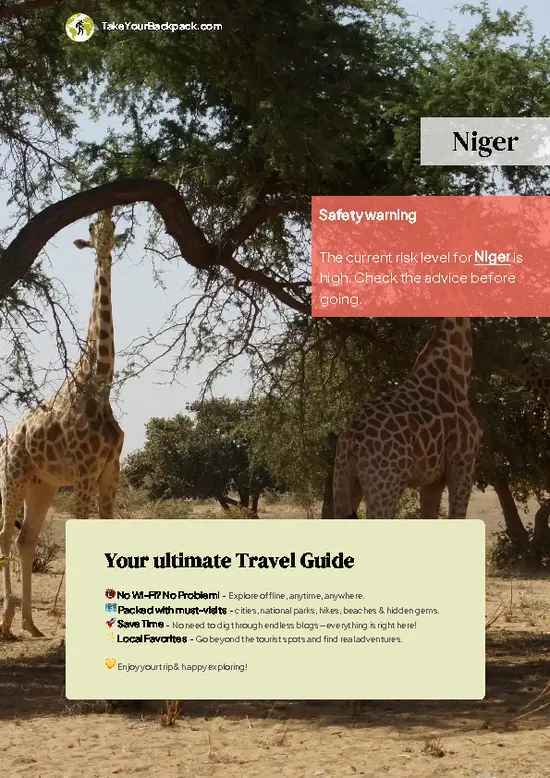
example page 0 from our offline Travel Guide for Niger
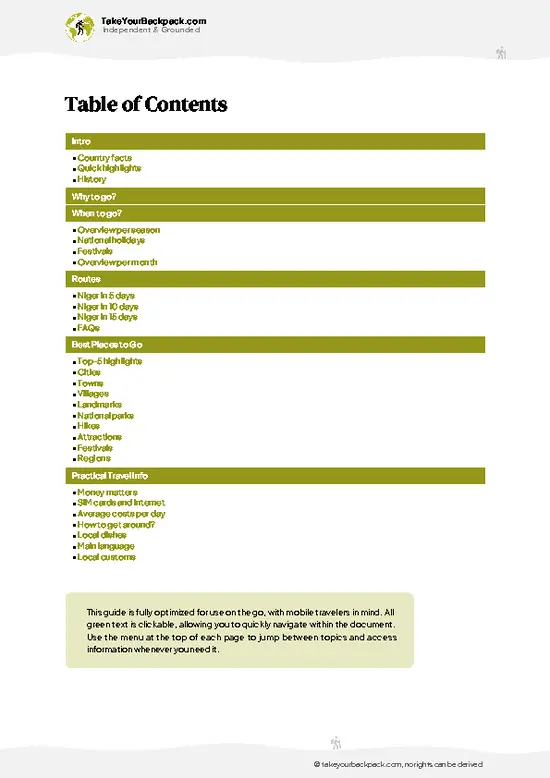
example page 1 from our offline Travel Guide for Niger
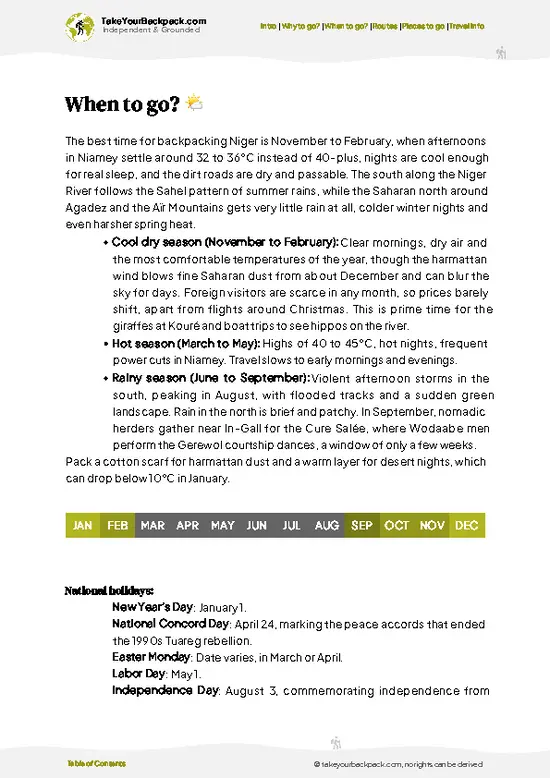
example page 2 from our offline Travel Guide for Niger
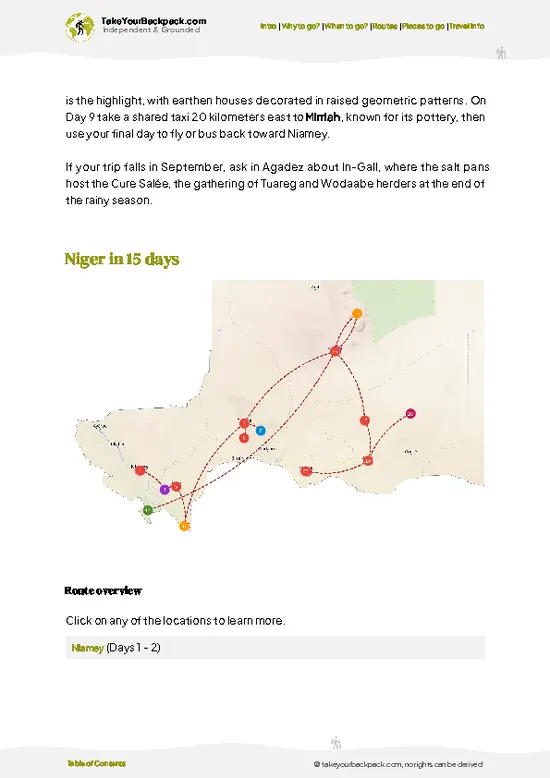
example page 3 from our offline Travel Guide for Niger
example page 4 from our offline Travel Guide for Niger
example page 5 from our offline Travel Guide for Niger
example page 6 from our offline Travel Guide for Niger
example page 7 from our offline Travel Guide for Niger
Loading the map 🌍
CLICK TO FILTER
cities
towns
villages
landmarks
national parks
hikes
attractions
festivals
regions
SHOW COUNTRY’S BESTSHOW ALL

✨ Why go?
Ranked #5 attraction in Niger
The unique appeal for travelers

Grand Marché de Niamey gives you Niger’s commercial life in one place, and that is the main reason to go. Nowhere else in the country packs so many trades into so few blocks: Hausa wax-print cloth, Tuareg silver and leather goods, dried hibiscus and baobab fruit, and tailors who stitch an outfit while you wait. Because the capital is the usual arrival point, the market also makes a practical milestone early in a route. You can buy a cheche scarf for desert travel, a SIM card nearby and local snacks before heading out. The haggling is firm but usually good-humored, and a few words of Hausa or Zarma change the mood quickly. If you only see one place to understand how Niamey earns its living, make it the main market hall and its alleys, where sellers, porters and tea-brewers all work shoulder to shoulder.

💡 HighlightsKey sights and experiences for travelers

  1. Main market hall: the central covered building, where stalls of cloth, household goods and food are packed tightly and the noise bounces off the roof.
  2. Fabric and wax-print section: bolts of bright cotton in West African patterns, sold by the pagne, ready for a tailor nearby.
  3. Tuareg jewelry and leather stalls: silver crosses of Agadez style, leather pouches and sandals, mostly handmade and open to bargaining.
  4. Spice and dried goods rows: hibiscus flowers, dried okra, baobab powder, peppers and smoked fish, sorted in sacks and bowls.
  5. Tailors’ lanes: rows of sewing machines where outfits are cut and sewn in a day or two.
  6. Metalwork and calabash corner: pots, lamps and decorated gourds made by local artisans.
  7. Grilled meat and tea stands: skewers of beef and sweet, strong green tea served in tiny glasses
… read more 👉
  1. Main market hall: the central covered building, where stalls of cloth, household goods and food are packed tightly and the noise bounces off the roof.
  2. Fabric and wax-print section: bolts of bright cotton in West African patterns, sold by the pagne, ready for a tailor nearby.
  3. Tuareg jewelry and leather stalls: silver crosses of Agadez style, leather pouches and sandals, mostly handmade and open to bargaining.
  4. Spice and dried goods rows: hibiscus flowers, dried okra, baobab powder, peppers and smoked fish, sorted in sacks and bowls.
  5. Tailors’ lanes: rows of sewing machines where outfits are cut and sewn in a day or two.
  6. Metalwork and calabash corner: pots, lamps and decorated gourds made by local artisans.
  7. Grilled meat and tea stands: skewers of beef and sweet, strong green tea served in tiny glasses at the market’s edge.
Grand Marché de Niamey is best handled by pairing the fabric section with the tailors’ lanes, so you can buy cloth and have it sewn in the same day.
Spotted a mistake or missing something? Contact us.

🌤️ When to go?Seasonal considerations and timing

  • Cool Dry Season (November to February): Mornings sit around 16 to 20°C (61 to 68°F) and afternoons reach 32 to 35°C (90 to 95°F), so walking the stalls is comfortable. Harmattan dust can haze the sky. Daylight runs roughly 11 to 12 hours.
  • Hot Season (March to June): Afternoons climb to 40 to 44°C (104 to 111°F), and the covered lanes trap heat by midday. Shop between 7 and 10 am, then retreat. Crowds thin out at noon.
  • Rainy Season (July to September): Highs of 32 to 36°C (90 to 97°F) come with downpours that turn the surrounding lanes to mud and slow vendors. Humidity rises, but produce is plentiful.
  • Festive Periods: Before Eid and Tabaski, the market gets packed. Cloth, sheep, and spices rise in price, and bargaining takes longer.
Aim for a Friday morning outside Ramadan midday hours, when stalls are open and the heat is manageable.

source: climatestotravel.comJANJanuary: highly recommended for travelingFEBFebruary: excellent for travelingMARMarch: good for travelingAPRApril: fair for travelingMAYMay: fair for travelingJUNJune: below average for travelingJULJuly: below average for travelingAUGAugust: below average for travelingSEPSeptember: below average for travelingOCTOctober: good for travelingNOVNovember: excellent for travelingDECDecember: highly recommended for traveling
when-to-go

✈️ The backpacker research shortcutNiger Travel Guide

An offline-friendly backpacking guide with optimized travel routes, ranked highlights, transport advice, and the best areas to stay.
example page 0 from our offline Travel Guide for Niger
example page 1 from our offline Travel Guide for Niger
example page 2 from our offline Travel Guide for Niger
example page 3 from our offline Travel Guide for Niger
example page 4 from our offline Travel Guide for Niger
example page 5 from our offline Travel Guide for Niger
example page 6 from our offline Travel Guide for Niger
example page 7 from our offline Travel Guide for Niger
The digital guide (254 pages) contains:
✅ 57 highlights, ranked by travel appeal
✅ Optimized 5, 10 & 15-day travel routes
✅ Cities, national parks, landmarks, beaches
✅ How to get around
✅ Offline-friendly for travel without Wi-Fi
👉 Click to see all 30+ guide features

📅 Plan smarter in minutes, not weeks
✅ Month by month travel advice
✅ Festivals & national holidays
✅ Budget expectations

🗺️ Go to the right places, skip the overrated ones
✅ Honest pros & cons of destinations
✅ Top hikes, parks & viewpoints
✅ Lesser-known places most travelers miss
✅ Clear “worth it vs skip it” guidance

🛏️ Travel smoothly without rookie mistakes
✅ Best areas to stay
✅ Transport systems explained simply
✅ Common scams & safety advice
✅ SIM cards, money & practical tips

🌍 Understand the country, not just visit it
✅ Culture & traditions
✅ 52 Essential phrases & customs
✅ Festivals worth planning around
✅ Traveler-friendly historical context
✅ Insights that make places more meaningful

📱 Built for real travel conditions
✅ Fully downloadable PDF
✅ Works completely offline
✅ Optimized for phone use
✅ Useful in remote areas & buses
✅ Everything in one place
Stop searching, start planning
Get instant access to your full guide. 30‑day money-back guarantee.
+ Add another guide for just

By proceeding you agree to our terms.
Sent to your inbox immediately after payment • 100% Secure Checkout
Best Backpacking Travel Advisor 2025 tourism awardBest Backpacking
Travel Advisor
2025
What others say about Take Your Backpack Guides:
⭐⭐⭐⭐⭐
Fantastic, amazing amount of information!
⭐⭐⭐⭐⭐
My goodness this is amazing, it's what I've been looking for hats off too you!
⭐⭐⭐⭐⭐
I think this is absolutely BRILLIANT
⭐⭐⭐⭐
Very complete and informative. It's still missing places, but I gotta to commend you
⭐⭐⭐⭐⭐
This is truly amazing, thank you, can't wait to explore it with my kids!
⭐⭐⭐⭐⭐
Awesome resource, thank you!
⭐⭐⭐⭐⭐
This is amazing! Can't wait to explore the ones I haven't seen
⭐⭐⭐⭐
I love this! Well done, great idea.
⭐⭐⭐⭐⭐
Thanks for taking the time to make this gem!
⭐⭐⭐⭐⭐
This might be the best website I've ever seen.
⭐⭐⭐⭐⭐
Congratulations, and thank you so much for your work; it's incredibly valuable.
⭐⭐⭐⭐
In all seriousness I think you did a great job pointing out the important spots
⭐⭐⭐⭐⭐
10/10 very good
⭐⭐⭐⭐⭐
As someone who's only just starting to visit regularly this is awesome, thank you.
⭐⭐⭐⭐
Thank you very much! I'm going to visit my dad, it's going to be very useful!
⭐⭐⭐⭐⭐
This is really cool! We'll be travelling for the first time and this definitely come in handy.
⭐⭐⭐⭐⭐
You are now our minister of culture, congratulations 👨‍💼
⭐⭐⭐⭐⭐
Just wanted to tell you that this is a pearl! Going to follow your recommendations.
⭐⭐⭐⭐⭐
This is so cool. I'll definitely be using the resource for my travels soon.
⭐⭐⭐⭐⭐
This is very impressive! Good work.
⭐⭐⭐⭐⭐
This is an amazing and informative site. Very well done!

🛏️ Where to stay?Where staying makes the most sense

The Plateau and Gaweye districts are the most practical bases, since both sit within a short taxi or moto ride of the market and have the best-run guesthouses in Niamey. Niger has few true backpacker hostels, so budget travelers usually end up in small guesthouses and mid-range hotels with shared or simple rooms.

The Plateau area, north of the river bend and close to the center, has the most restaurants, ATMs, and transport links. It is the safest place for walking after dark, though still keep evening trips short and use taxis. Expect the highest prices here.

Around Rue du Grand Marché and … read more 👉
The Plateau and Gaweye districts are the most practical bases, since both sit within a short taxi or moto ride of the market and have the best-run guesthouses in Niamey. Niger has few true backpacker hostels, so budget travelers usually end up in small guesthouses and mid-range hotels with shared or simple rooms.

The Plateau area, north of the river bend and close to the center, has the most restaurants, ATMs, and transport links. It is the safest place for walking after dark, though still keep evening trips short and use taxis. Expect the highest prices here.

Around Rue du Grand Marché and the nearby central streets, you are within walking distance of the stalls. These blocks are loud from dawn, with traffic and calls to prayer, and lodging is basic. They suit those who want to start shopping early.

The Koira Kano and Terminus areas cost less and put you near bus stations, handy if you are leaving for Dosso, Tahoua, or Zinder. Facilities are plainer. Wherever you stay, ask the owner to arrange a trusted driver, and confirm current security advice before booking, as conditions change.

👛 Costs (as of 22 October 2026)Money, prices, and spending tips

Grand Marché de Niamey costs next to nothing to enter, and a realistic day of backpacking around it runs about €22 to 40, with the total below at €32. Entry is free, so spending depends on what you buy, eat, and how you move. Pay in cash, since stalls do not take cards.
CategoryBudget RangeLocal Reality
Entry€0No ticket. Small tips to informal guides run about €1 to 2.
Accommodation (low season)€15 to 28Simple guesthouses with fan or air conditioning.
Accommodation (high season)€18 to 32Rates rise around holidays and event periods; counted here at €18.
Food€3 to 6Grilled meat, rice dishes, and fresh bread from stalls and small eateries.
Local transport€1 to 4Shared taxis cost less than a private cab. Agree on a fare before getting in.
Shopping€3 to 15Fabric, leather goods, and spices. Bargain hard,
… read more 👉
Grand Marché de Niamey costs next to nothing to enter, and a realistic day of backpacking around it runs about €22 to 40, with the total below at €32. Entry is free, so spending depends on what you buy, eat, and how you move. Pay in cash, since stalls do not take cards.
CategoryBudget RangeLocal Reality
Entry€0No ticket. Small tips to informal guides run about €1 to 2.
Accommodation (low season)€15 to 28Simple guesthouses with fan or air conditioning.
Accommodation (high season)€18 to 32Rates rise around holidays and event periods; counted here at €18.
Food€3 to 6Grilled meat, rice dishes, and fresh bread from stalls and small eateries.
Local transport€1 to 4Shared taxis cost less than a private cab. Agree on a fare before getting in.
Shopping€3 to 15Fabric, leather goods, and spices. Bargain hard, and expect to pay about half the first price.
Total Daily Budget€32Based on high season lodging and moderate shopping.
⚠️ Prices can change and everyone travels differently, so take this as a rough guide. Hope it helps you plan your adventure!

FAQFrequently asked questions about Grand Marché de Niamey

Half a day is enough for Grand Marché de Niamey, and most visitors spend 2 to 4 hours. Start around 8 am before the heat builds, work through the cloth, spice, and leather sections, and finish with lunch at a nearby stall. Add another hour if you plan to bargain for fabric or crafts.
Grand Marché de Niamey has no entrance fee, so the main question is whether the time and spending suit you. Entry costs €0, and you can eat well for €3 to 6 while watching traders sell cloth, livestock goods, and spices. It is one of the best places in the capital to see everyday Nigerien commerce.
Grand Marché de Niamey sits in central Niamey, and a taxi from most central hotels takes 5 to 20 minutes depending on traffic. Expect €1 to 4 by shared or private taxi, and agree on the fare first. From Niamey’s international airport, the ride is roughly 20 to 30 minutes and costs about €5 to 10.
⚠️ Things can change over time, so always validate details locally before you go.

Other Nigerien attractions near Grand Marché de Niamey

Explore more nearby:


💡 Not sure where to go next?
Create a personalized itinerary for Niger including Grand Marché de Niamey and the places that fit your trip.

Generate my itinerary

👉 Discover all attractions

Or checkout all Niger has to offer (think cities, towns, villages, national parks, hikes, beaches, festivals)
Country photo of Niger

We 💚 feedbackWhat to keep in mind

Grand Marché de Niamey suits curious shoppers, textile lovers and anyone who learns a country by watching its trade. If you hate haggling or crowds, you will tire fast. I would bring small notes, a light scarf and a patient mood, and hire a tailor before you buy anything ready-made.

✍️ Help improve this page!
The information on this page is based on in-depth research, insights shared by experienced travelers, and feedback from the local travel community in Niger. While every effort is made to keep the information accurate and current, conditions can change — so if you spot anything incorrect or outdated, please get in touch.


🙋‍♂️ Give feedback

👋 Meet the founderWho’s Behind Take Your Backpack?

Johan, backpacker and founder of TakeYourBackpackHi, I’m Johan (Netherlands 🇳🇱), the creator of TakeYourBackpack. Over the past 3 decades, I’ve backpacked through 90+ countries across six continents, gaining extensive experience with independent travel, long-term trips, and overland routes.

This site is built on a combination of firsthand travel experience and carefully curated insights from other backpackers. Many guides are based on places I’ve personally visited, while others bring together tips, observations, and practical advice shared by trusted travelers I’ve met along the way.

The goal is to provide realistic, experience-driven guidance — not generic itineraries — so you can explore destinations with better context, clearer expectations, and more confidence.