×

North Korea🇰🇵 | attractionsArch of Triumphgranite monument, national symbolism, city gateway | things to do and best time to go

Explore Juche TowerExplore Mansudae Art Studio

Backpacking in Arch of Triumph
🌟 Highlightattraction ranked #6
By Johan Kruseman 🇳🇱 | Updated June 5, 2026

Here’s what nobody tells you: the Arch of Triumph is one of the rare places in Pyongyang where you can actually get a panoramic city view—if you know to ask your guide to take you inside and up the elevator. Most visitors only snap a photo from the base and miss the real payoff. The Arch itself sits in the heart of Pyongyang, looming over a busy intersection like a marble-clad exclamation point. On paper, it’s North Korea’s answer to Paris, but in reality, it’s more about scale and spectacle than subtlety. Backpackers will clock the sheer size first—bigger than the French original, because of course it is—but the crowds are almost always limited to a handful of tour groups, so you get space to breathe. The vibe is surreal: part Cold War movie set, part nationalistic showpiece. Entry is usually bundled into your tour, so you’re not bleeding extra cash, but don’t expect spontaneous exploration—everything here is tightly choreographed. Compared to the DMZ or the Mansudae Grand Monument, the Arch is less emotionally charged but more accessible, and the cityscape from the top is a genuine, unscripted thrill.

Discover everything you want to know in the 📖 North Korea Travel Guide.
Safety warning

The current risk level for North Korea is high. Check the advice before going.


Get your North Korea guide
74 ranked highlights, routes & tips, works offline (296 pages)
Loading the map 🌍
CLICK TO FILTER
cities
towns
landmarks
national parks
hikes
beaches
attractions
festivals
regions
SHOW COUNTRY’S BESTSHOW ALL

✨ Why go?
Ranked #6 attraction in North Korea
What makes this attraction worth visiting

The Arch of Triumph in North Korea isn’t just another photo op—it’s a hard-to-ignore symbol of the country’s identity and history. Sure, it’s crowded with tourists on tightly controlled tours, and yes, the costs to get here aren’t exactly backpacker-budget-friendly. But that’s where the real story begins. This monument isn’t about flashy aesthetics; it’s about raw, political muscle flexed in stone, commemorating Korea’s resistance against Japanese occupation. Standing beneath it, you feel the weight of decades of struggle and pride, a visceral reminder of a narrative rarely told outside these borders. For backpackers threading through North Korea’s strict itinerary, the Arch is a milestone—an adrenaline spike in a journey defined by rare access and intense regulation. It’s a checkpoint where … read more 👉
The Arch of Triumph in North Korea isn’t just another photo op—it’s a hard-to-ignore symbol of the country’s identity and history. Sure, it’s crowded with tourists on tightly controlled tours, and yes, the costs to get here aren’t exactly backpacker-budget-friendly. But that’s where the real story begins. This monument isn’t about flashy aesthetics; it’s about raw, political muscle flexed in stone, commemorating Korea’s resistance against Japanese occupation. Standing beneath it, you feel the weight of decades of struggle and pride, a visceral reminder of a narrative rarely told outside these borders. For backpackers threading through North Korea’s strict itinerary, the Arch is a milestone—an adrenaline spike in a journey defined by rare access and intense regulation. It’s a checkpoint where history, politics, and sheer human will collide, making the effort to get here more than worth it. This isn’t just sightseeing; it’s stepping into a living, breathing chapter of a nation’s soul.
Want to include Arch of Triumph in your North Korea route?
Create a personalized North Korea itinerary that includes Arch of Triumph and the places that fit your trip — based on your travel style, budget, and available time. Get your route in seconds.

Generate my trip

💡 HighlightsPlaces and moments you shouldn't skip

1. The Sheer Scale—And the Reason Behind It
Let’s get this out of the way: the Arch of Triumph in Pyongyang is not just big, it’s calculatedly colossal. At 60 meters tall, it’s taller than Paris’s Arc de Triomphe, and that’s no accident. This is North Korean pageantry at its most literal—built to commemorate Kim Il Sung’s role in resisting Japanese occupation. The size isn’t just for show; it’s a flex, a statement of national pride, and a lesson in how architecture can be weaponized for myth-making. You’ll feel small, and that’s the point.


2. The Marble Reliefs—Propaganda in Stone
Look closer at the base. The marble reliefs aren’t just decorative; they’re a storyboard of North Korea’s official history. Soldiers, workers, and peasants are carved in heroic poses, all eyes forward, all energy … read more 👉
1. The Sheer Scale—And the Reason Behind It
Let’s get this out of the way: the Arch of Triumph in Pyongyang is not just big, it’s calculatedly colossal. At 60 meters tall, it’s taller than Paris’s Arc de Triomphe, and that’s no accident. This is North Korean pageantry at its most literal—built to commemorate Kim Il Sung’s role in resisting Japanese occupation. The size isn’t just for show; it’s a flex, a statement of national pride, and a lesson in how architecture can be weaponized for myth-making. You’ll feel small, and that’s the point.


2. The Marble Reliefs—Propaganda in Stone
Look closer at the base. The marble reliefs aren’t just decorative; they’re a storyboard of North Korea’s official history. Soldiers, workers, and peasants are carved in heroic poses, all eyes forward, all energy focused. It’s not subtle, but it’s fascinating. This is storytelling with a chisel, and it’s as much about what’s left out as what’s included. If you want to understand how a regime shapes its narrative, start here.


3. The Inscribed Dates—A Crash Course in North Korean Calendar
You’ll see two dates: 1925 and 1945. These aren’t random. 1925 marks the year Kim Il Sung allegedly set out to liberate Korea, and 1945 is the end of Japanese rule. The arch is basically a stone time capsule of North Korean mythology. It’s a crash course in how history is curated, and if you’re paying attention, you’ll see how every detail is loaded with meaning.


4. The Observation Deck—A View with Layers
If you’re lucky enough to get access (not always guaranteed), the observation deck inside the arch is the best seat in Pyongyang for people-watching and city-gazing. You get a panoramic sweep of Kim Il Sung Stadium, the Taedong River, and the city’s grid-like streets. It’s not just about the view; it’s about seeing the city as the regime wants you to see it—orderly, monumental, and under watchful eyes. This one’s my personal favorite. There’s something surreal about standing inside a propaganda monument, looking out over a city that’s both real and curated.


5. The Nighttime Illumination—A Stage Set for Power
Stick around after sunset. The arch lights up in a way that’s less about beauty and more about spectacle. The lighting is stark, almost theatrical, casting long shadows and turning the monument into a glowing exclamation point. It’s a reminder that in Pyongyang, even the night is choreographed. The effect is eerie, impressive, and—if you’re honest with yourself—a little mesmerizing.
Spotted a mistake or missing something? Contact us.

🌤️ When to go?Best time to visit Arch of Triumph


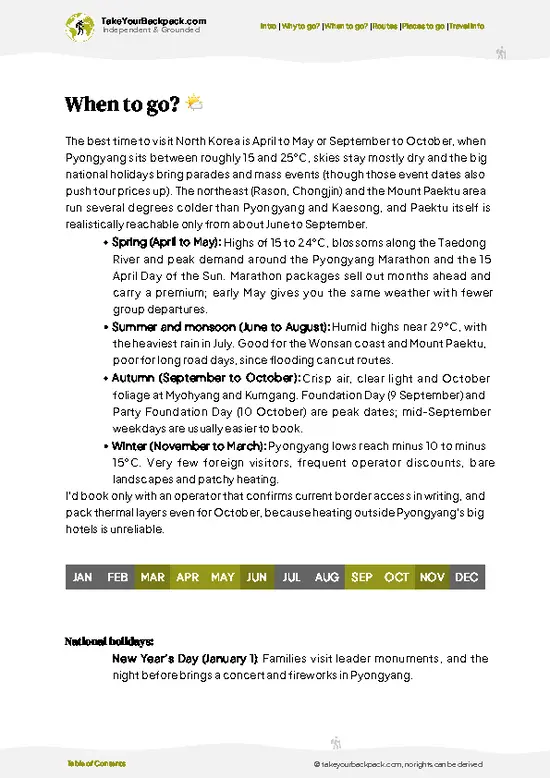
  • Weather: The best weather hits between May and September. Spring (April-May) brings mild temps and blooming trees, but April can still be chilly. Summer (June-August) is warm, sometimes hot, with highs around 25-30°C (77-86°F), but humidity can be sticky.

  • Temperature: Winters (December-February) are brutally cold, often below freezing (-5 to -15°C / 23 to 5°F), making sightseeing miserable. Late spring and early autumn offer the most comfortable temps, hovering around 15-22°C (59-72°F).

  • Daylight Hours: Longest days are June and July, with up to 15 hours of daylight—perfect for squeezing in extra exploration. Winter days shrink to about 9 hours, limiting your window for outdoor activities.

  • Crowds: Peak tourist season aligns with summer holidays, especially July and August, when groups
read more 👉

  • Weather: The best weather hits between May and September. Spring (April-May) brings mild temps and blooming trees, but April can still be chilly. Summer (June-August) is warm, sometimes hot, with highs around 25-30°C (77-86°F), but humidity can be sticky.

  • Temperature: Winters (December-February) are brutally cold, often below freezing (-5 to -15°C / 23 to 5°F), making sightseeing miserable. Late spring and early autumn offer the most comfortable temps, hovering around 15-22°C (59-72°F).

  • Daylight Hours: Longest days are June and July, with up to 15 hours of daylight—perfect for squeezing in extra exploration. Winter days shrink to about 9 hours, limiting your window for outdoor activities.

  • Crowds: Peak tourist season aligns with summer holidays, especially July and August, when groups flood the site. Spring and autumn see fewer visitors, giving you more breathing room and better photo ops.

  • Seasonal Activities: National holidays like the Day of the Sun (April 15) bring massive crowds and parades, which can be fascinating but overwhelming. Avoid these if you want a quieter visit focused on the monument itself.

  • Price Fluctuations: Tours and accommodations spike in summer and during major holidays. Booking in shoulder seasons like May or September can save you money and hassle.


Pro-tip: Aim for late spring or early autumn—cooler temps, manageable crowds, and better prices make the Arch of Triumph feel less like a tourist checkpoint and more like a place with real weight and history.


source: climatestotravel.comJANJanuary: below average for travelingFEBFebruary: below average for travelingMARMarch: fair for travelingAPRApril: good for travelingMAYMay: excellent for travelingJUNJune: highly recommended for travelingJULJuly: good for travelingAUGAugust: good for travelingSEPSeptember: excellent for travelingOCTOctober: highly recommended for travelingNOVNovember: fair for travelingDECDecember: below average for traveling
when-to-go

✈️ The backpacker research shortcutNorth Korea Travel Guide

An offline-friendly backpacking guide with optimized travel routes, ranked highlights, transport advice, and the best areas to stay.
example page 0 from our offline Travel Guide for North Korea
example page 1 from our offline Travel Guide for North Korea
example page 2 from our offline Travel Guide for North Korea
example page 3 from our offline Travel Guide for North Korea
example page 4 from our offline Travel Guide for North Korea
example page 5 from our offline Travel Guide for North Korea
example page 6 from our offline Travel Guide for North Korea
example page 7 from our offline Travel Guide for North Korea
The digital guide (296 pages) contains:
74 highlights, ranked by travel appeal
Optimized 5, 10 & 15-day travel routes
Cities, national parks, landmarks, beaches
How to get around
Offline-friendly for travel without Wi-Fi
👉 Click to see all 30+ guide features

📅 Plan smarter in minutes, not weeks
Month by month travel advice
Festivals & national holidays
Budget expectations

🗺️ Go to the right places, skip the overrated ones
Honest pros & cons of destinations
Top hikes, parks & viewpoints
Lesser-known places most travelers miss
Clear “worth it vs skip it” guidance

🛏️ Travel smoothly without rookie mistakes
Best areas to stay
Transport systems explained simply
Common scams & safety advice
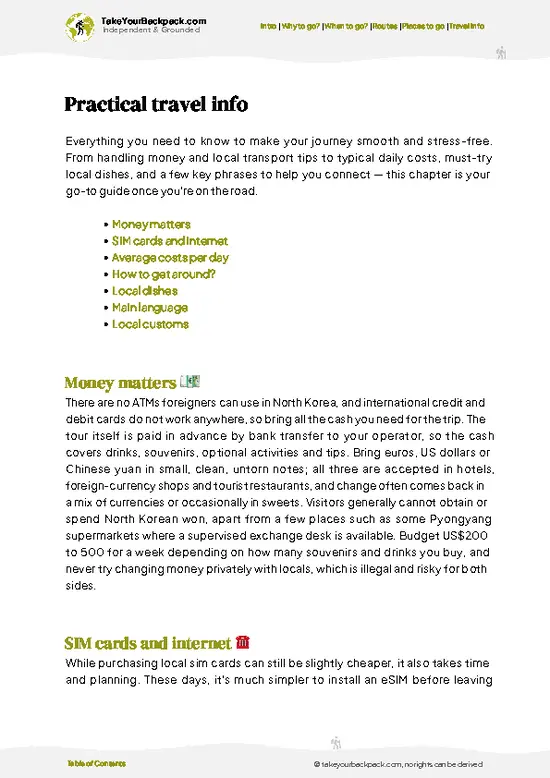
SIM cards, money & practical tips

🌍 Understand the country, not just visit it
Culture & traditions
52 Essential phrases & customs
Festivals worth planning around
Traveler-friendly historical context
Insights that make places more meaningful

📱 Built for real travel conditions
Fully downloadable PDF
Works completely offline
Optimized for phone use
Useful in remote areas & buses
Everything in one place
Save weeks of stressful planning
Get instant access to your full guide. 30‑day money-back guarantee.


By proceeding you agree to our terms.
Sent to your inbox immediately after payment • 100% Secure Checkout
Best Backpacking Travel Advisor 2025 tourism awardBest Backpacking
Travel Advisor
2025
What others say about Take Your Backpack Guides:
⭐⭐⭐⭐⭐
Fantastic, amazing amount of information!
⭐⭐⭐⭐⭐
My goodness this is amazing, it's what I've been looking for hats off too you!
⭐⭐⭐⭐⭐
I think this is absolutely BRILLIANT
⭐⭐⭐⭐
Very complete and informative. It's still missing places, but I gotta to commend you
⭐⭐⭐⭐⭐
This is truly amazing, thank you, can't wait to explore it with my kids!
⭐⭐⭐⭐⭐
Awesome resource, thank you!
⭐⭐⭐⭐⭐
This is amazing! Can't wait to explore the ones I haven't seen
⭐⭐⭐⭐
I love this! Well done, great idea.
⭐⭐⭐⭐⭐
Thanks for taking the time to make this gem!
⭐⭐⭐⭐⭐
This might be the best website I've ever seen.
⭐⭐⭐⭐⭐
Congratulations, and thank you so much for your work; it's incredibly valuable.
⭐⭐⭐⭐
In all seriousness I think you did a great job pointing out the important spots
⭐⭐⭐⭐⭐
10/10 very good
⭐⭐⭐⭐⭐
As someone who's only just starting to visit regularly this is awesome, thank you.
⭐⭐⭐⭐
Thank you very much! I'm going to visit my dad, it's going to be very useful!
⭐⭐⭐⭐⭐
This is really cool! We'll be travelling for the first time and this definitely come in handy.
⭐⭐⭐⭐⭐
You are now our minister of culture, congratulations 👨‍💼
⭐⭐⭐⭐⭐
Just wanted to tell you that this is a pearl! Going to follow your recommendations.
⭐⭐⭐⭐⭐
This is so cool. I'll definitely be using the resource for my travels soon.
⭐⭐⭐⭐⭐
This is very impressive! Good work.
⭐⭐⭐⭐⭐
This is an amazing and informative site. Very well done!

🛏️ Where to stay?Best areas to stay in North Korea

The Arch of Triumph in Pyongyang isn’t your typical backpacker hotspot. Let’s cut through the hype: this isn’t a place where you’ll find bustling hostels filled with fellow travelers swapping stories over cheap beer. North Korea’s strict controls mean solo backpackers won’t stumble into the usual social scenes or budget-friendly nooks like in Southeast Asia or Europe. Instead, your best bet is to stay in central Pyongyang districts close to the Arch, where most foreign visitors are funneled. These areas are safe—understandably so, given the tight surveillance—but they’re also where you’ll find … read more 👉
The Arch of Triumph in Pyongyang isn’t your typical backpacker hotspot. Let’s cut through the hype: this isn’t a place where you’ll find bustling hostels filled with fellow travelers swapping stories over cheap beer. North Korea’s strict controls mean solo backpackers won’t stumble into the usual social scenes or budget-friendly nooks like in Southeast Asia or Europe. Instead, your best bet is to stay in central Pyongyang districts close to the Arch, where most foreign visitors are funneled. These areas are safe—understandably so, given the tight surveillance—but they’re also where you’ll find the limited guesthouses and hotels approved for foreigners.

Don’t expect a party vibe or backpacker hangouts; the social scene is more subdued and structured, often revolving around guided tours and official events. But here’s the real magic: staying near the Arch of Triumph puts you in the heart of a city that feels frozen in time, with monumental architecture and a surreal atmosphere that’s unlike anywhere else on earth. If you’re after raw, unfiltered history and a glimpse into a world few outsiders see, this is where you want to be—even if it means trading the usual backpacker comforts for something far more intense.

👛 Costs (as of 2 April 2026)Money, prices, and spending tips

The Arch of Triumph in Pyongyang offers an elevator ride to its observation platform for €5. ([uritours.com](https://www.uritours.com/sights/arch-of-triumph/?utm_source=openai)) This fee is typically paid on-site and is not included in standard tour packages. The elevator ride provides access to the top of the arch, offering panoramic views of the city. Please note that this fee is subject to change, and it's advisable to confirm the current price with your tour operator before your visit.

source: uritours.com
⚠️ Prices can change and everyone travels differently, so take this as a rough guide. Hope it helps you plan your adventure!

Other North Korean attractions near Arch of Triumph

Explore more nearby:


💡 Not sure where to go next?
Create a personalized itinerary for North Korea including Arch of Triumph and the places that fit your trip.

Generate my itinerary

👉 Discover all attractions

Or checkout all North Korea has to offer (think cities, towns, villages, national parks, hikes, beaches, festivals)
Country photo of North Korea

We 💚 feedbackSumming up the experience

The Arch of Triumph in North Korea isn’t just a giant monument—it’s a statement carved in stone, reflecting a very specific political pride that’s hard to ignore. Sure, it’s crowded with official tours and tightly controlled, which can feel like watching history through a glass wall. But standing beneath it, you get a raw sense of how monuments shape national identity—something you won’t find in any guidebook spin.

✈️ When did I visit North Korea?
As part of my 1.5 year travel around the world trip, I visited North Korea in August 2015. I had never expected I was able to get in.

✍️ Help improve this page!
The information on this page is based on my own backpacking experience in North Korea, supplemented with up-to-date research and feedback from other travelers. Travel details can change, so if you notice anything outdated or incomplete, feel free to let me know.


🙋‍♂️ Give feedback

👋 Meet the founderWho’s Behind Take Your Backpack?

Johan, backpacker and founder of TakeYourBackpackHi, I’m Johan (Netherlands 🇳🇱), the creator of TakeYourBackpack. Over the past decade, I’ve backpacked through 80+ countries across six continents, gaining extensive experience with independent travel, long-term trips, and overland routes.

This site is built on a combination of firsthand travel experience and carefully curated insights from other backpackers. Many guides are based on places I’ve personally visited, while others bring together tips, observations, and practical advice shared by trusted travelers I’ve met along the way.

The goal is to provide realistic, experience-driven guidance — not generic itineraries — so you can explore destinations with better context, clearer expectations, and more confidence.

Get full country guide •
Instant download • 74 highlights • Full Offline guide