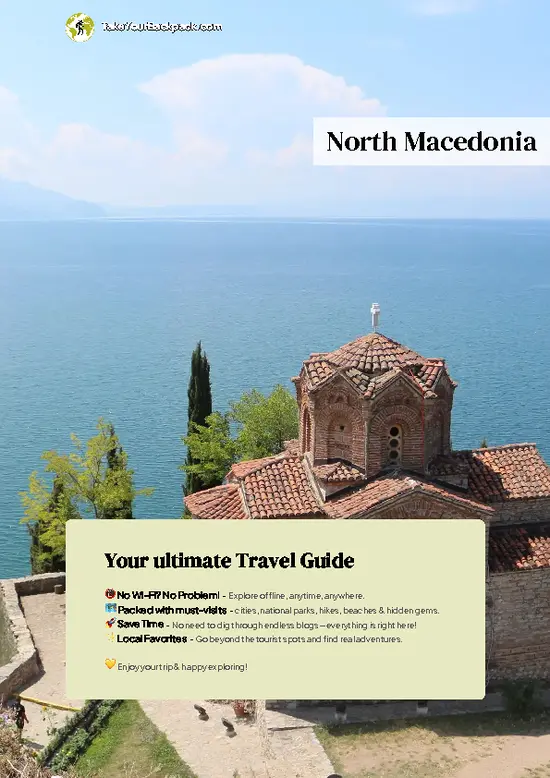
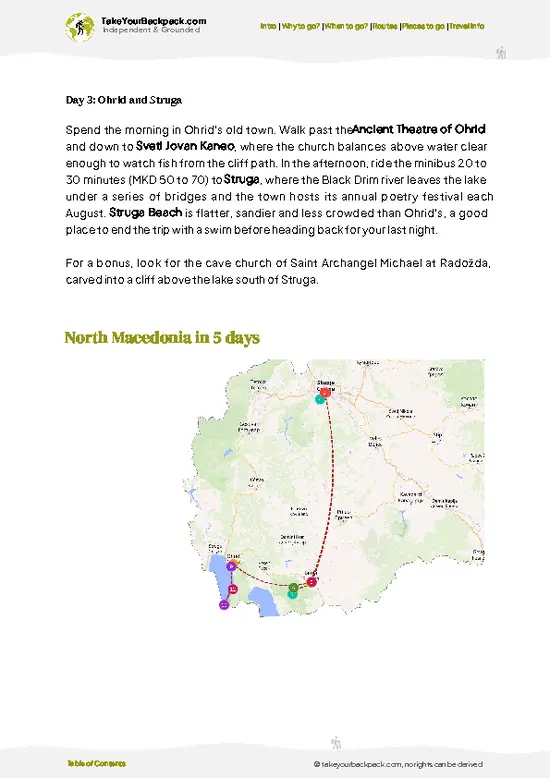
This five-night route is for travelers who want the full spread of North Macedonia in under a week: a capital with a hilltop cross, an Ottoman-era bazaar and a museum of revolutionaries, a long mountain hike to a glacial lake, and two days on the shore of Lake Ohrid. The pace is moderate, with one transfer every second day and none longer than 3.5 hours. You need intercity buses (Skopje to Bitola, Bitola to Ohrid), Ohrid’s local bus along the eastern shore, and one taxi to the trailhead on Pelister.
Day 1: Skopje, From the Bazaar to Vodno
Start in
Skopje by crossing the Stone Bridge into the
Old Bazaar, where coppersmiths, tailors and kebapči grills share lanes with mosques and caravanserais like Kapan An. A plate of ten kebapi with bread and onions runs MKD 250 to 350 (US$4.50 to 6). From there it is a short walk back across the river to the
Museum of the Macedonian Struggle, a guided tour through wax figures and paintings that explains the 1903 Ilinden Uprising and the long fight for independence. …
read more 👉This five-night route is for travelers who want the full spread of North Macedonia in under a week: a capital with a hilltop cross, an Ottoman-era bazaar and a museum of revolutionaries, a long mountain hike to a glacial lake, and two days on the shore of Lake Ohrid. The pace is moderate, with one transfer every second day and none longer than 3.5 hours. You need intercity buses (Skopje to Bitola, Bitola to Ohrid), Ohrid’s local bus along the eastern shore, and one taxi to the trailhead on Pelister.
Day 1: Skopje, From the Bazaar to Vodno
Start in Skopje by crossing the Stone Bridge into the Old Bazaar, where coppersmiths, tailors and kebapči grills share lanes with mosques and caravanserais like Kapan An. A plate of ten kebapi with bread and onions runs MKD 250 to 350 (US$4.50 to 6). From there it is a short walk back across the river to the Museum of the Macedonian Struggle, a guided tour through wax figures and paintings that explains the 1903 Ilinden Uprising and the long fight for independence. It makes the rest of the country’s statues and street names suddenly readable.
In the late afternoon, take a city bus to the lower station of the cable car on Vodno Mountain and ride up to the Millennium Cross, a 66-meter steel cross on the 1,066-meter summit. On a clear evening you can pick out the whole Skopje valley and the snow line of Shar Planina to the west. Fit hikers can walk down through beech forest in about 2 hours instead of riding.Days 2-3: Bitola and Pelister
The bus south to Bitola takes 3 to 3.5 hours and costs about MKD 550 to 650 (US$10 to 12). It is the country’s most elegant town: consulate-era facades along Širok Sokak, the pedestrian street where the whole town seems to walk at dusk, and cafés that fill with students until late. Arriving around midday leaves you the afternoon for the old bazaar and the clock tower.
Day 3 is the reason you came. Pelister National Park, the oldest national park in the country (protected since 1948), rises right behind the town, and its endemic Molika pines cover the lower slopes. Take a taxi to the Kopanki mountain hut (roughly MKD 800 to 1,200, US$14 to 21) and start the Pelister Great Lake Trail early. The climb to the lake, sitting at about 2,200 meters below the main ridge, takes about 3 hours, and the round trip 6 to 7. It is mostly snow-free from June to October. Pack water and a windproof layer, since there is nothing to buy above the hut.Days 4-5: Ohrid and the Eastern Shore
Bitola to Ohrid is 1 hour 15 minutes to 1.5 hours by bus through Resen and over the pass, MKD 250 to 350. Spend the afternoon on the cobbled lanes of the old town and finish at Sveti Jovan Kaneo, the small 13th-century church on a rock above the water, timed for sunset when the lake goes copper and the swimmers below head home.
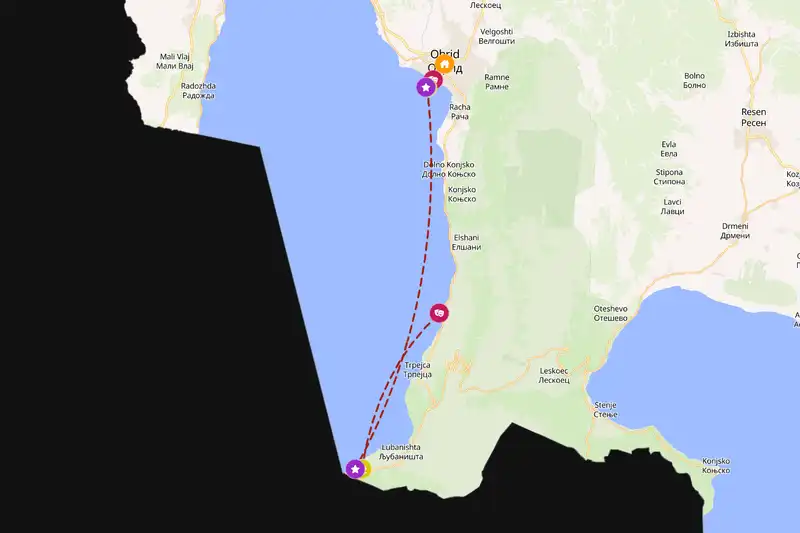
On Day 5, ride the local bus about 45 minutes south to St. Naum Monastery, founded by Saint Naum in the early 10th century. Peacocks wander the courtyard, and rowboats take you through the springs that feed the lake, water so clear and cold it looks blue-green even in shade. Swim at Sveti Naum Beach afterward, then stop on the ride back at the Bay of Bones Museum, a reconstructed Bronze Age pile-dwelling village on stilts over the bay. It is the best spot on the shore to understand how long people have lived on this lake.
For a bonus few travelers reach, hire a boat from Konjsko or Stenje on Lake Prespa to Golem Grad, an uninhabited island of ruined churches, juniper and tortoises.




 Best Backpacking