×

Palau🇵🇼 | best national parksWhere to Find the Best national parks in Palau

Palau doesn’t run its protected land like a classic national park system, so expect state-managed conservation areas, marine sanctuaries and war-history sites instead of ranger stations and trail passes. Most sit within a short boat ride or drive of Koror, so access is easy but costs add up through permits, boats and guides. Backpackers do best pairing the quiet Babeldaob interior with a few days on the Rock Islands.

By Johan Kruseman 🇳🇱 | Updated October 18, 2026
Explore the best hikes in Palau

Why go?Key Factors That Shape the Experience

Palau’s protected places exist because of local ownership. Land and reef belong to states and clans, and the traditional bul, a harvest ban declared by chiefs, is where today’s conservation rules grew from. That is why protection comes through state-run areas, a national marine sanctuary covering about 80 percent of Palau’s waters, and a UNESCO-listed lagoon rather than one park agency. Geography helps too: a compact island chain of limestone islets, mangroves and rainforest, with nearly everything within an hour or two of Koror. Before booking, know that fees are layered. A US$100 environmental fee is built into your airfare, the Rock Islands need a separate permit (around US$50), and special sites cost extra. Nearly every site needs a boat or a guide, and Palau is not a cheap country.
Our Approach to Ranking
The list of best national parks in Palau is created based on landscapes, wildlife, adventure opportunities, facilities, and overall experience. If you feel a national park is missing in this list, please let us know.

When to go?Best Time to Visit Palau for national parks

Best months: February to April: The best months are February to April, when rain eases and the seas are at their calmest, which matters because almost every site here is reached by boat. Palau stays 27 to 31°C (80 to 88°F) all year, with roughly 3,500 to 4,000 mm of rain annually, so the real question is how wet and how choppy it will be.
Shoulder and wet seasons: November to January and May are the shoulder months. Expect passing showers, but boats still run most days and visibility stays good. June to October is the wet season, with heavier downpours, muddier trails on Babeldaob and more cancelled boat trips. The upside is fewer people and softer prices. Typhoons usually pass north of Palau, though rough weather can still shut the lagoon for a day. Flights and rooms tighten from December … read more 👉
Best months: February to April: The best months are February to April, when rain eases and the seas are at their calmest, which matters because almost every site here is reached by boat. Palau stays 27 to 31°C (80 to 88°F) all year, with roughly 3,500 to 4,000 mm of rain annually, so the real question is how wet and how choppy it will be.
Shoulder and wet seasons: November to January and May are the shoulder months. Expect passing showers, but boats still run most days and visibility stays good. June to October is the wet season, with heavier downpours, muddier trails on Babeldaob and more cancelled boat trips. The upside is fewer people and softer prices. Typhoons usually pass north of Palau, though rough weather can still shut the lagoon for a day. Flights and rooms tighten from December to March, so book permits and boat spots early then. Mornings are the calm window, so leave early.

national park hoppingPlanning Your Route Efficiently

How many days to plan: A trip combining several parks in Palau needs 5 to 8 days, and Koror works as the base for almost all of it. Babeldaob sits just across the bridge, 30 to 90 minutes by road depending on how far north you go, while the Rock Islands are 30 to 60 minutes by boat from Koror. Peleliu is farther south, roughly 1 to 2 hours by boat each way.
Direction and pacing: Start with Babeldaob by rental car or taxi while you shake off jet lag, then move to the Rock Islands, and save Peleliu for last because it depends most on sea conditions. Give each stop a full day and Peleliu a full day plus a buffer. The common mistakes are squeezing Peleliu into a Rock Islands day, stacking boat days back to back, and leaving no spare day for weather. Keep one flexible day and your plan survives a rough sea.

The ListThe Best national parks of Palau

1 Ngerukewid Islands Wildlife Preserve

Seabird nesting islets, no-landing preserve, undercut limestone, Ulong Channel drifts

Cruise past uninhabited limestone islets where noddies and terns nest, then snorkel nearby channels and lagoon stops with manta rays, reef sharks and coral gardens.

palau-national-park-ngerukewid-islands-wildlife-preserve
© Google | Kd Philippines
Loading the map 🌍

Expert viewWhat You Should Know

How many to visit: I recommend three or four sites in total, mixing at least one marine area, one land site and, if history interests you, one war site. Palau’s boat logistics eat time, so every extra stop costs a half day and about US$100 or more, and the fourth rarely adds as much as the first three.
Which kind for which traveler: On a tight budget, land-based sites on Babeldaob give the most. Entry runs about US$5 to 15, a rental car costs around US$50 to 70 a day (split it with others), and you stay dry and flexible. If you can spend more, the Rock Islands are the best use of money, because a guided day boat at roughly US$110 to 180 with lunch covers more ground than anything else and the US$50 permit lasts several days. Divers add US$150 to 200 for a two-tank day. Peleliu is worth the … read more 👉
How many to visit: I recommend three or four sites in total, mixing at least one marine area, one land site and, if history interests you, one war site. Palau’s boat logistics eat time, so every extra stop costs a half day and about US$100 or more, and the fourth rarely adds as much as the first three.
Which kind for which traveler: On a tight budget, land-based sites on Babeldaob give the most. Entry runs about US$5 to 15, a rental car costs around US$50 to 70 a day (split it with others), and you stay dry and flexible. If you can spend more, the Rock Islands are the best use of money, because a guided day boat at roughly US$110 to 180 with lunch covers more ground than anything else and the US$50 permit lasts several days. Divers add US$150 to 200 for a two-tank day. Peleliu is worth the splurge only if you want history, since the boat adds comfort and cost.
Daily budget: Plan on US$120 to 200 a day for guesthouse, food, transport and one tour, and about US$250 or more on boat days. Add the US$100 jellyfish lake permit only if you want it.
Safety and respect: Sun and sea are the main risks. Use reef-safe sunscreen (Palau restricts harmful ingredients), wear a rash guard, and respect currents at channels. Trails get slippery after rain, so wear shoes with grip. On war sites, stay on marked paths, as unexploded ordnance is still found. Culturally, land and reef belong to families and states, so pay fees, hire local guides and ask before entering villages or photographing a bai meeting house. Never take shells, coral or relics, and do not touch marine life.

✈️ The backpacker research shortcutPalau Travel Guide

An offline-friendly backpacking guide with optimized travel routes, ranked highlights, transport advice, and the best areas to stay.
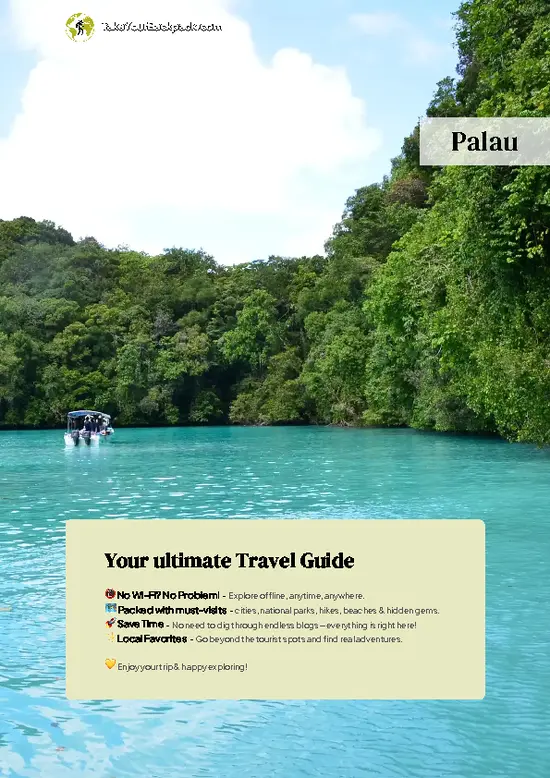
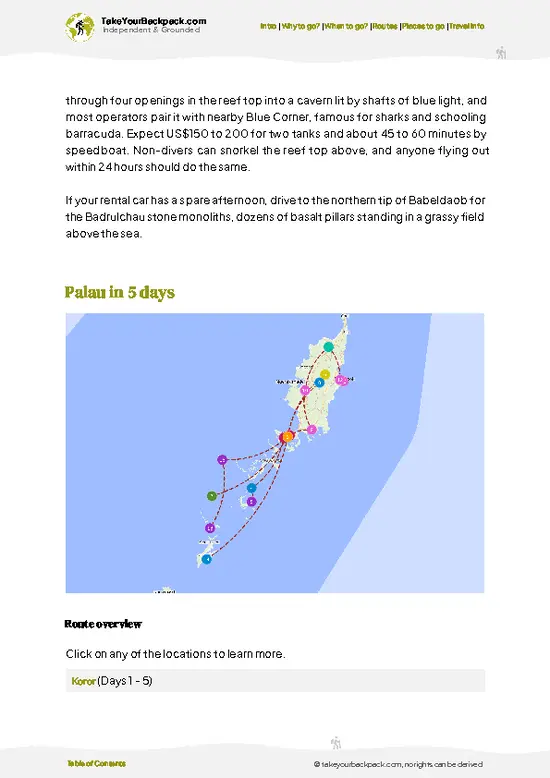
example page 0 from our offline Travel Guide for Palau
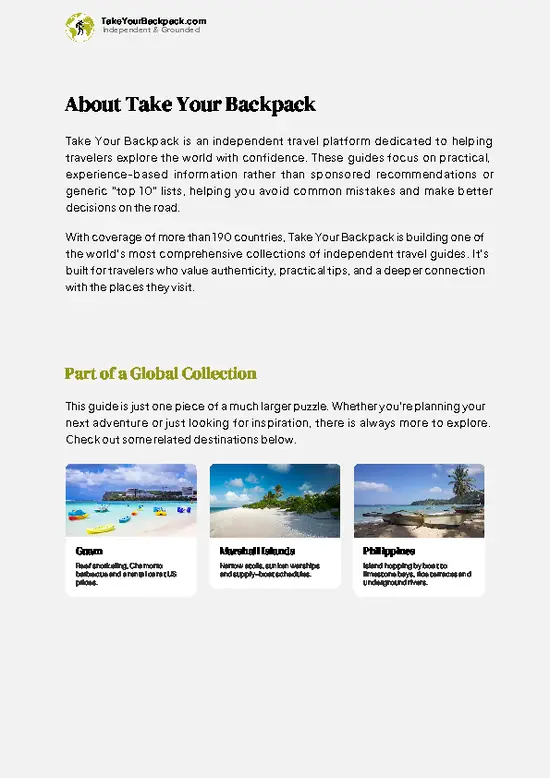
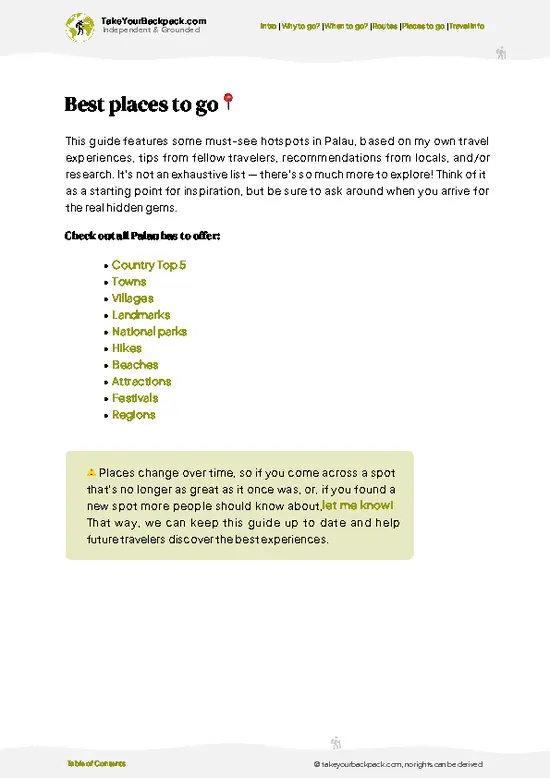
example page 1 from our offline Travel Guide for Palau
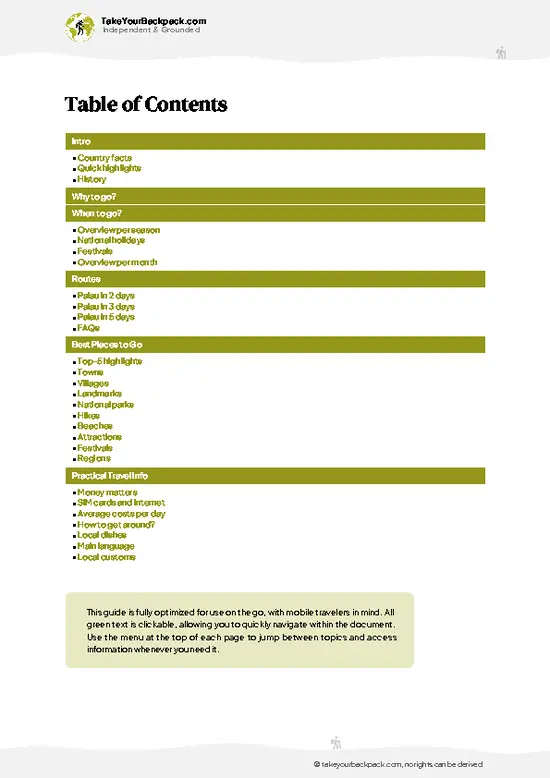
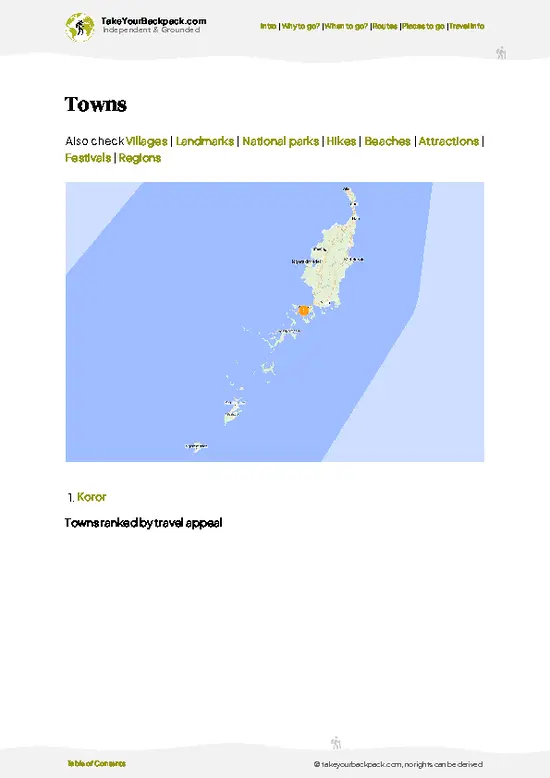
example page 2 from our offline Travel Guide for Palau
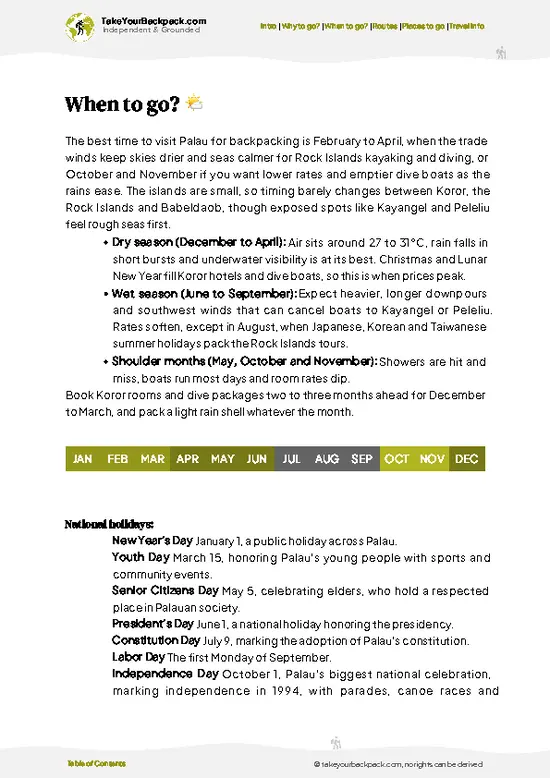
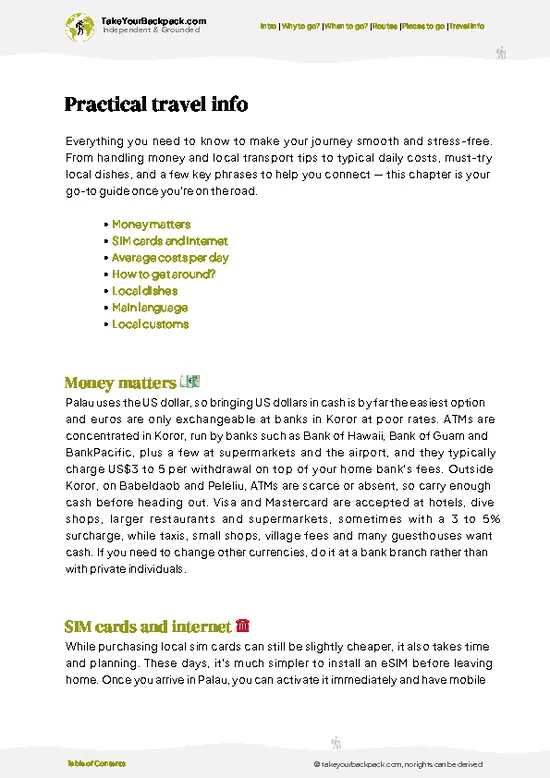
example page 3 from our offline Travel Guide for Palau
example page 4 from our offline Travel Guide for Palau
example page 5 from our offline Travel Guide for Palau
example page 6 from our offline Travel Guide for Palau
example page 7 from our offline Travel Guide for Palau
The digital guide (99 pages) contains:
✅ 22 highlights, ranked by travel appeal
✅ Optimized 2, 3 & 5-day travel routes
✅ Cities, national parks, landmarks, beaches
✅ How to get around
✅ Offline-friendly for travel without Wi-Fi
👉 Click to see all 30+ guide features

📅 Plan smarter in minutes, not weeks
✅ Month by month travel advice
✅ Festivals & national holidays
✅ Budget expectations

🗺️ Go to the right places, skip the overrated ones
✅ Honest pros & cons of destinations
✅ Top hikes, parks & viewpoints
✅ Lesser-known places most travelers miss
✅ Clear “worth it vs skip it” guidance

🛏️ Travel smoothly without rookie mistakes
✅ Best areas to stay
✅ Transport systems explained simply
✅ Common scams & safety advice
✅ SIM cards, money & practical tips

🌍 Understand the country, not just visit it
✅ Culture & traditions
✅ 52 Essential phrases & customs
✅ Festivals worth planning around
✅ Traveler-friendly historical context
✅ Insights that make places more meaningful

📱 Built for real travel conditions
✅ Fully downloadable PDF
✅ Works completely offline
✅ Optimized for phone use
✅ Useful in remote areas & buses
✅ Everything in one place
Stop searching, start planning
Get instant access to your full guide. 30‑day money-back guarantee.
+ Add another guide for just

By proceeding you agree to our terms.
Sent to your inbox immediately after payment • 100% Secure Checkout
Best Backpacking Travel Advisor 2025 tourism awardBest Backpacking
Travel Advisor
2025
What others say about Take Your Backpack Guides:
⭐⭐⭐⭐⭐
Fantastic, amazing amount of information!
⭐⭐⭐⭐⭐
My goodness this is amazing, it's what I've been looking for hats off too you!
⭐⭐⭐⭐⭐
I think this is absolutely BRILLIANT
⭐⭐⭐⭐
Very complete and informative. It's still missing places, but I gotta to commend you
⭐⭐⭐⭐⭐
This is truly amazing, thank you, can't wait to explore it with my kids!
⭐⭐⭐⭐⭐
Awesome resource, thank you!
⭐⭐⭐⭐⭐
This is amazing! Can't wait to explore the ones I haven't seen
⭐⭐⭐⭐
I love this! Well done, great idea.
⭐⭐⭐⭐⭐
Thanks for taking the time to make this gem!
⭐⭐⭐⭐⭐
This might be the best website I've ever seen.
⭐⭐⭐⭐⭐
Congratulations, and thank you so much for your work; it's incredibly valuable.
⭐⭐⭐⭐
In all seriousness I think you did a great job pointing out the important spots
⭐⭐⭐⭐⭐
10/10 very good
⭐⭐⭐⭐⭐
As someone who's only just starting to visit regularly this is awesome, thank you.
⭐⭐⭐⭐
Thank you very much! I'm going to visit my dad, it's going to be very useful!
⭐⭐⭐⭐⭐
This is really cool! We'll be travelling for the first time and this definitely come in handy.
⭐⭐⭐⭐⭐
You are now our minister of culture, congratulations 👨‍💼
⭐⭐⭐⭐⭐
Just wanted to tell you that this is a pearl! Going to follow your recommendations.
⭐⭐⭐⭐⭐
This is so cool. I'll definitely be using the resource for my travels soon.
⭐⭐⭐⭐⭐
This is very impressive! Good work.
⭐⭐⭐⭐⭐
This is an amazing and informative site. Very well done!

🛏️ Where to stay?Where to Stay in Palau

Palau has very few true hostels, so budget travelers mostly stay in small guesthouses, motels and apartment rentals, with simple private rooms typically running US$50 to 100 a night. Downtown Koror puts you on the main road within walking distance of restaurants, supermarkets, dive shops and the country’s modest bar scene, while Malakal sits closer to the docks where many dive and Rock Islands boats leave and is quieter at night, though you’ll need a taxi for dinner. Arakebesang is calm and leafy with good water views but spread out, and staying on Babeldaob gives you rural silence at the cost of a 30 to 60 minute drive to the Koror boat departures; all four areas are low-crime and relaxed after … read more 👉
Palau has very few true hostels, so budget travelers mostly stay in small guesthouses, motels and apartment rentals, with simple private rooms typically running US$50 to 100 a night. Downtown Koror puts you on the main road within walking distance of restaurants, supermarkets, dive shops and the country’s modest bar scene, while Malakal sits closer to the docks where many dive and Rock Islands boats leave and is quieter at night, though you’ll need a taxi for dinner. Arakebesang is calm and leafy with good water views but spread out, and staying on Babeldaob gives you rural silence at the cost of a 30 to 60 minute drive to the Koror boat departures; all four areas are low-crime and relaxed after dark.

If you enjoy meeting fellow travelers, consider choosing hostels with high ratings for atmosphere. On the other hand, if you prefer having your own space, a hotel might be a better option.

PalauMore of Palau

👋 Meet the founderWho’s Behind Take Your Backpack?

Johan, backpacker and founder of TakeYourBackpackHi, I’m Johan (Netherlands 🇳🇱), the creator of TakeYourBackpack. Over the past 3 decades, I’ve backpacked through 90+ countries across six continents, gaining extensive experience with independent travel, long-term trips, and overland routes.

This site is built on a combination of firsthand travel experience and carefully curated insights from other backpackers. Many guides are based on places I’ve personally visited, while others bring together tips, observations, and practical advice shared by trusted travelers I’ve met along the way.

The goal is to provide realistic, experience-driven guidance — not generic itineraries — so you can explore destinations with better context, clearer expectations, and more confidence.