×

Palau🇵🇼 | best attractionsWhere to Find the 2 Best attractions in Palau

Palau’s attractions are mostly water-based, and that shapes everything: cost, access and crowds. Koror, the hub, has the cheapest beds and the most dive and boat operators. Babeldaob offers quiet land stops reachable by rental car. The Rock Islands and southern atolls need a boat. If you’re backpacking, book boats in Koror a day ahead, and join group trips to split the bill.

By Johan Kruseman 🇳🇱 | Updated October 18, 2026
Explore the best festivals in Palau

Why go?Key Factors That Shape the Experience

Palau suits attractions built around ocean and island ecology. The country is a scatter of limestone and volcanic islands, with shallow lagoons, deep channels and clear water, so the best things happen offshore. That also means boat access sets your budget. Tours, permits and fuel cost more than in mainland Southeast Asia, and there’s no public transport between sites. Palau is also strict about conservation, so expect a Rock Islands permit and a Pristine Paradise Environmental Fee on top of tour prices. Tradition counts here too. Clan-owned sites, village customs and old stone paths all carry local rules, and guides are how you get in. Plan on paying a bit more than you’d like, then enjoy the payoff: far fewer crowds than Palau’s Pacific neighbors with similar water.
Behind the Scenes of Selection
The list of best attractions in Palau is created based on cultural significance or entertainment value. If you feel a attraction is missing in this list, please let us know.

When to go?Best Time to Visit Palau for attractions

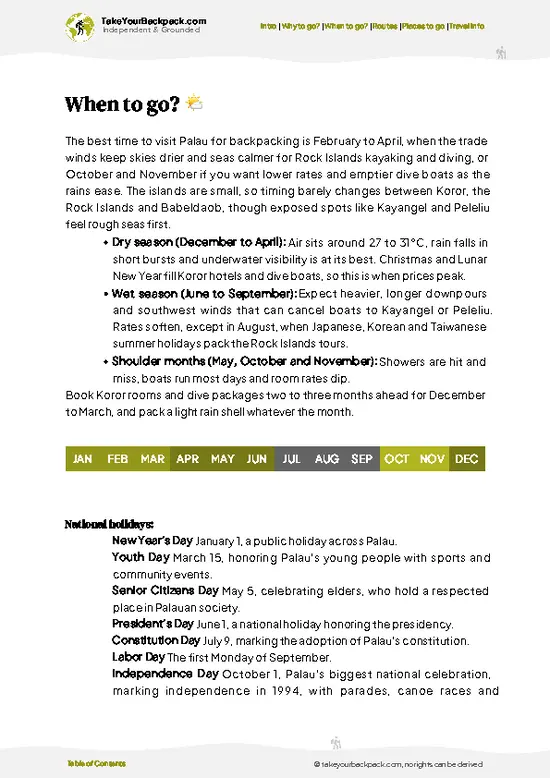
Best months and weather: The best months are November to April, when the dry season brings calmer seas, better visibility and less rain. Temperatures stay around 27 to 31°C (80 to 88°F) all year, and water sits near 28 to 30°C. Shoulder and wet months: May and June are a decent shoulder season, with showers but fewer visitors. July to October is wetter, with typhoon risk and sometimes rougher boat days, though rain often arrives in short bursts, and mornings can stay clear. Annual rainfall is high, roughly 3,500 to 4,000 mm. Crowds and prices: Peak pressure falls around December to March, plus holiday weeks, when flights and boats fill earlier. Book those months ahead. Off-peak, tour operators are more flexible on seats and sometimes prices.

attraction hoppingPlanning Your Route Efficiently

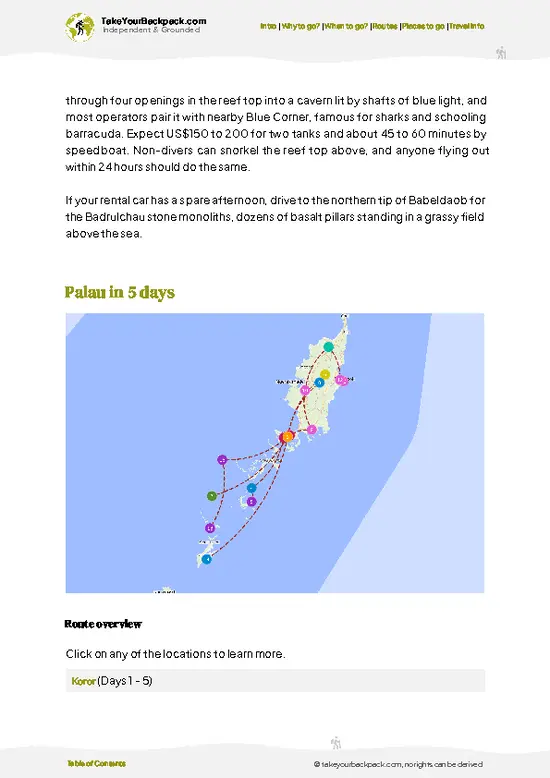
How many days to plan: A trip linking several areas needs 5 to 8 days. Grouping and direction: Base yourself in Koror, where most boats leave, then handle Babeldaob by rental car or driver, about 30 to 60 minutes each way by road from Koror. Do water days first while weather is calm, and leave land days as flexible fillers for rain. Far-flung southern islands like Peleliu and Angaur need a full day each, with boat transfers of roughly 1 to 2 hours. Allow 3 to 6 hours per boat stop or half-day, and a full day for long lagoon runs. Planning mistakes: The usual error is stacking too much into one day, so keep one buffer day for weather. Another is skipping permits and tour bookings until you arrive. Arrange these a day or two ahead, and build rest after dives, since flying within 24 hours is unsafe.

The ListThe Best attractions of Palau

1 Palau International Coral Reef Center

Living reef tanks, giant clams, jellyfish, Malakal harbor

Watch live corals, patterned giant clams and drifting jellies up close, then learn how bleaching and fishing rules shape the reefs you will dive.

palau-attraction-palau-international-coral-reef-center
© Google |

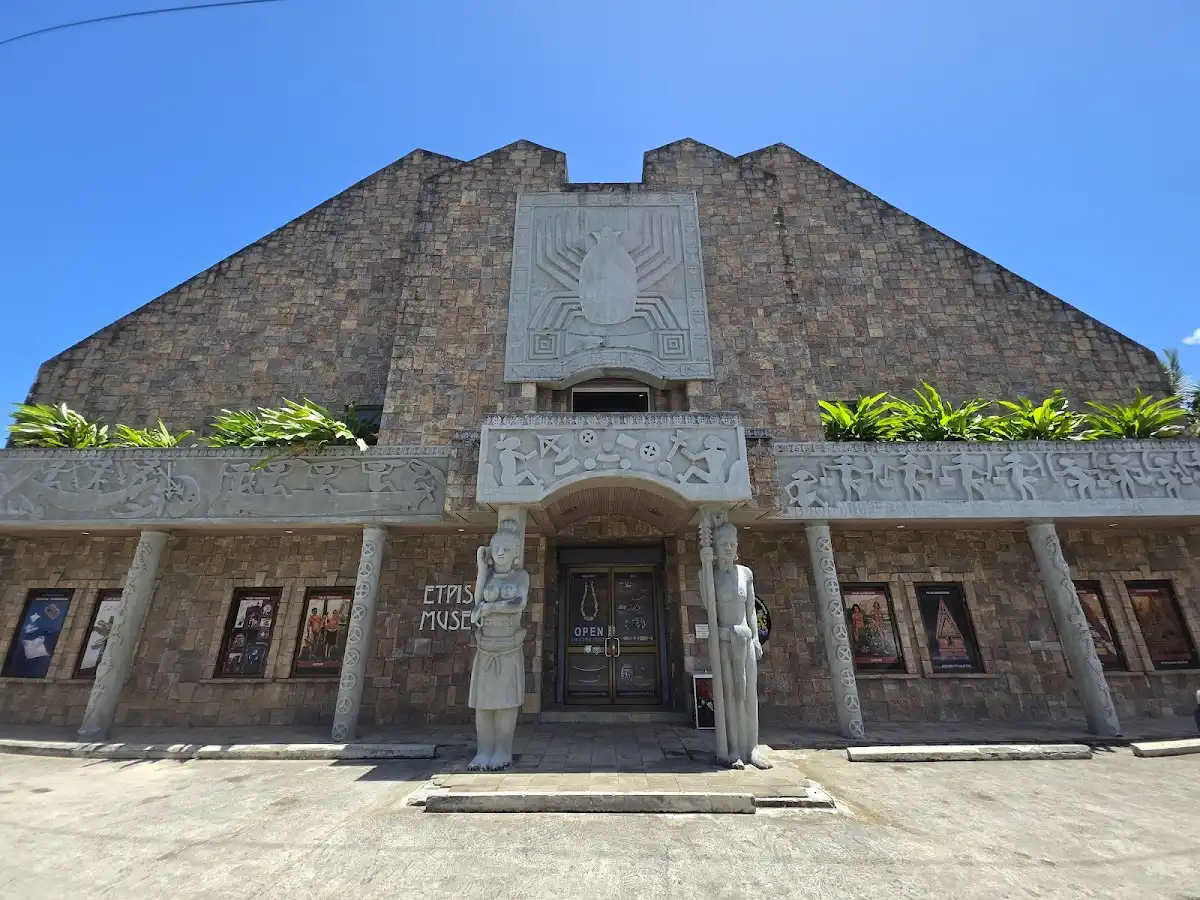
2 Etpison Museum

Palauan bead money, carved storyboards, Japanese-era photos, family-run collection

Read carved storyboards, study old bead valuables and trace the Japanese and wartime years through a small, private collection that gives Koror useful context before boat trips.

palau-attraction-etpison-museum
© Google |
Loading the map 🌍

Expert viewWhat You Should Know

How many to visit: I’d advise 4 to 6 attractions over a week. Palau’s sites mean boats, guides and time, so each one costs a half or full day. More than that becomes rushed and expensive, while fewer wastes the trip. Prioritizing by style: Divers get the most from dive days, usually US$100 to 180 for a two-tank trip with gear extra. Snorkelers should pick shared boat tours at about US$100 to 150 a day, which give you the lagoon without private-boat prices. Land-focused travelers can save on culture and history stops, where entry and guide costs often fall around US$10 to 50. Group tours cost more in cash than doing it alone but save hours of logistics, so for a backpacker they’re usually the better value on water days. Rental cars run about US$50 to 80 a day, and taxis are expensive. Budget: … read more 👉
How many to visit: I’d advise 4 to 6 attractions over a week. Palau’s sites mean boats, guides and time, so each one costs a half or full day. More than that becomes rushed and expensive, while fewer wastes the trip. Prioritizing by style: Divers get the most from dive days, usually US$100 to 180 for a two-tank trip with gear extra. Snorkelers should pick shared boat tours at about US$100 to 150 a day, which give you the lagoon without private-boat prices. Land-focused travelers can save on culture and history stops, where entry and guide costs often fall around US$10 to 50. Group tours cost more in cash than doing it alone but save hours of logistics, so for a backpacker they’re usually the better value on water days. Rental cars run about US$50 to 80 a day, and taxis are expensive. Budget: Plan on US$100 to 200 a day if you’re doing attractions daily, or about US$60 to 90 on rest days. Add the Rock Islands permit (around US$50 for 10 days) and the Pristine Paradise Environmental Fee (US$100, paid with your ticket). Safety and culture: Currents in channels can be strong, so dive with certified operators and check conditions daily. Respect reef rules: no touching coral, no feeding fish, no taking shells. Ask before entering village or clan land, dress modestly away from beaches, and hire a local guide for sensitive sites. Sunscreen should be reef-safe, as many chemical ones are banned. Bring cash for small fees, since some remote places don’t take cards.

✈️ The backpacker research shortcutPalau Travel Guide

An offline-friendly backpacking guide with optimized travel routes, ranked highlights, transport advice, and the best areas to stay.
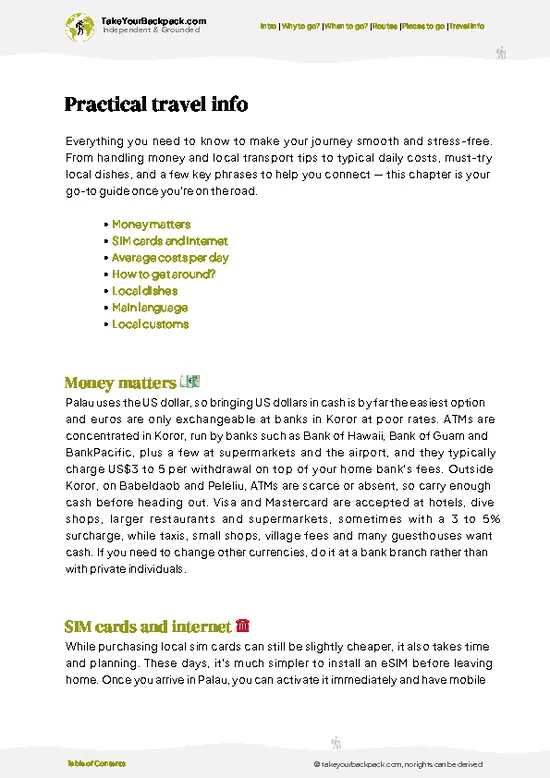
example page 0 from our offline Travel Guide for Palau
example page 1 from our offline Travel Guide for Palau
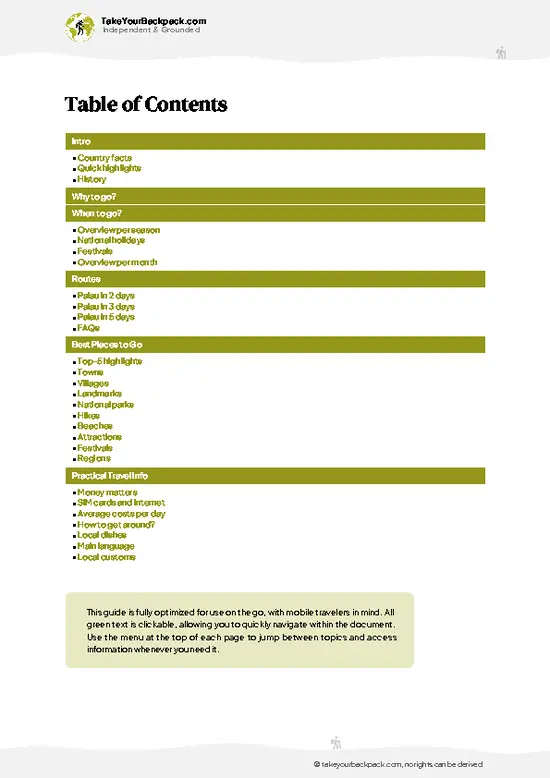
example page 2 from our offline Travel Guide for Palau
example page 3 from our offline Travel Guide for Palau
example page 4 from our offline Travel Guide for Palau
example page 5 from our offline Travel Guide for Palau
example page 6 from our offline Travel Guide for Palau
example page 7 from our offline Travel Guide for Palau
The digital guide (99 pages) contains:
✅ 22 highlights, ranked by travel appeal
✅ Optimized 2, 3 & 5-day travel routes
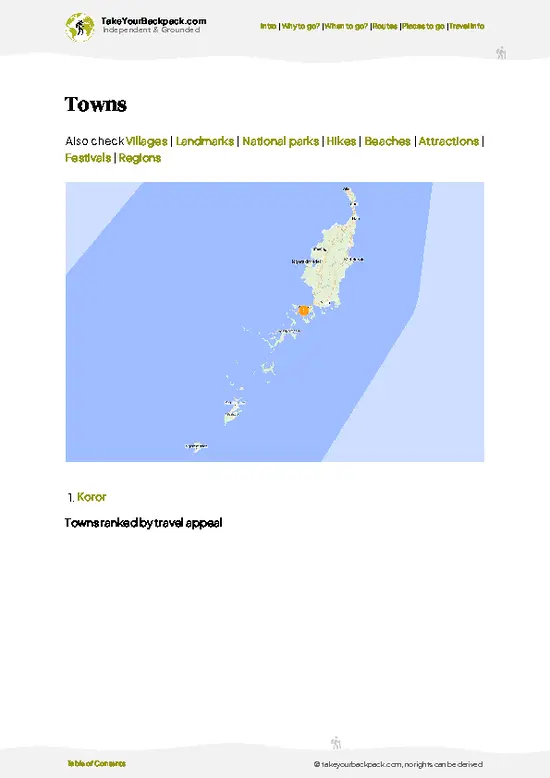
✅ Cities, national parks, landmarks, beaches
✅ How to get around
✅ Offline-friendly for travel without Wi-Fi
👉 Click to see all 30+ guide features

📅 Plan smarter in minutes, not weeks
✅ Month by month travel advice
✅ Festivals & national holidays
✅ Budget expectations

🗺️ Go to the right places, skip the overrated ones
✅ Honest pros & cons of destinations
✅ Top hikes, parks & viewpoints
✅ Lesser-known places most travelers miss
✅ Clear “worth it vs skip it” guidance

🛏️ Travel smoothly without rookie mistakes
✅ Best areas to stay
✅ Transport systems explained simply
✅ Common scams & safety advice
✅ SIM cards, money & practical tips

🌍 Understand the country, not just visit it
✅ Culture & traditions
✅ 52 Essential phrases & customs
✅ Festivals worth planning around
✅ Traveler-friendly historical context
✅ Insights that make places more meaningful

📱 Built for real travel conditions
✅ Fully downloadable PDF
✅ Works completely offline
✅ Optimized for phone use
✅ Useful in remote areas & buses
✅ Everything in one place
Stop searching, start planning
Get instant access to your full guide. 30‑day money-back guarantee.
+ Add another guide for just

By proceeding you agree to our terms.
Sent to your inbox immediately after payment • 100% Secure Checkout
Best Backpacking Travel Advisor 2025 tourism awardBest Backpacking
Travel Advisor
2025
What others say about Take Your Backpack Guides:
⭐⭐⭐⭐⭐
Fantastic, amazing amount of information!
⭐⭐⭐⭐⭐
My goodness this is amazing, it's what I've been looking for hats off too you!
⭐⭐⭐⭐⭐
I think this is absolutely BRILLIANT
⭐⭐⭐⭐
Very complete and informative. It's still missing places, but I gotta to commend you
⭐⭐⭐⭐⭐
This is truly amazing, thank you, can't wait to explore it with my kids!
⭐⭐⭐⭐⭐
Awesome resource, thank you!
⭐⭐⭐⭐⭐
This is amazing! Can't wait to explore the ones I haven't seen
⭐⭐⭐⭐
I love this! Well done, great idea.
⭐⭐⭐⭐⭐
Thanks for taking the time to make this gem!
⭐⭐⭐⭐⭐
This might be the best website I've ever seen.
⭐⭐⭐⭐⭐
Congratulations, and thank you so much for your work; it's incredibly valuable.
⭐⭐⭐⭐
In all seriousness I think you did a great job pointing out the important spots
⭐⭐⭐⭐⭐
10/10 very good
⭐⭐⭐⭐⭐
As someone who's only just starting to visit regularly this is awesome, thank you.
⭐⭐⭐⭐
Thank you very much! I'm going to visit my dad, it's going to be very useful!
⭐⭐⭐⭐⭐
This is really cool! We'll be travelling for the first time and this definitely come in handy.
⭐⭐⭐⭐⭐
You are now our minister of culture, congratulations 👨‍💼
⭐⭐⭐⭐⭐
Just wanted to tell you that this is a pearl! Going to follow your recommendations.
⭐⭐⭐⭐⭐
This is so cool. I'll definitely be using the resource for my travels soon.
⭐⭐⭐⭐⭐
This is very impressive! Good work.
⭐⭐⭐⭐⭐
This is an amazing and informative site. Very well done!

🛏️ Where to stay?Where to Stay: Palau Edition

Palau has very few true hostels, so budget travelers mostly stay in small guesthouses, motels and apartment rentals, with simple private rooms typically running US$50 to 100 a night. Downtown Koror puts you on the main road within walking distance of restaurants, supermarkets, dive shops and the country’s modest bar scene, while Malakal sits closer to the docks where many dive and Rock Islands boats leave and is quieter at night, though you’ll need a taxi for dinner. Arakebesang is calm and leafy with good water views but spread out, and staying on Babeldaob gives you rural silence at the cost of a 30 to 60 minute drive to the Koror boat departures; all four areas are low-crime and relaxed after … read more 👉
Palau has very few true hostels, so budget travelers mostly stay in small guesthouses, motels and apartment rentals, with simple private rooms typically running US$50 to 100 a night. Downtown Koror puts you on the main road within walking distance of restaurants, supermarkets, dive shops and the country’s modest bar scene, while Malakal sits closer to the docks where many dive and Rock Islands boats leave and is quieter at night, though you’ll need a taxi for dinner. Arakebesang is calm and leafy with good water views but spread out, and staying on Babeldaob gives you rural silence at the cost of a 30 to 60 minute drive to the Koror boat departures; all four areas are low-crime and relaxed after dark.

If you enjoy meeting fellow travelers, consider choosing hostels with high ratings for atmosphere. On the other hand, if you prefer having your own space, a hotel might be a better option.

PalauExplore Beyond This Category

👋 Meet the founderWho’s Behind Take Your Backpack?

Johan, backpacker and founder of TakeYourBackpackHi, I’m Johan (Netherlands 🇳🇱), the creator of TakeYourBackpack. Over the past 3 decades, I’ve backpacked through 90+ countries across six continents, gaining extensive experience with independent travel, long-term trips, and overland routes.

This site is built on a combination of firsthand travel experience and carefully curated insights from other backpackers. Many guides are based on places I’ve personally visited, while others bring together tips, observations, and practical advice shared by trusted travelers I’ve met along the way.

The goal is to provide realistic, experience-driven guidance — not generic itineraries — so you can explore destinations with better context, clearer expectations, and more confidence.