×

Palau🇵🇼 | regionsKayangel AtollSingle village, lagoon sandbars, reef-edge snorkeling, taro gardens | things to do and best time to go

Explore BabeldaobExplore Koror

Backpacking in Kayangel Atoll
👌 Worth visitingregion ranked #4
By Johan Kruseman 🇳🇱 | Updated October 15, 2026

Kayangel was once a place you reached only by a rough, wet boat ride and a bit of luck, with no guesthouse to speak of. Today a state-run ferry and a few simple lodgings make it doable, though it still feels cut off. It sits at Palau’s northern tip, above Babeldaob, and is the country’s northernmost state, with one village on Kayangel islet and a ring of empty sandbars. Expect white sand, a calm lagoon, hermit crabs and a village where everyone waves. Expect no nightlife, few shops and thin menus. Bring cash and snacks, since the shop stock runs low, and arrange your boat and bed ahead through a local contact rather than turning up and hoping. Leave early in the morning when the sea is calmest. It suits slow travelers who like snorkeling, fishing and quiet. If you need restaurants, Wi-Fi or a packed schedule, skip it.

Discover everything you want to know in the 📖 Palau Travel Guide.


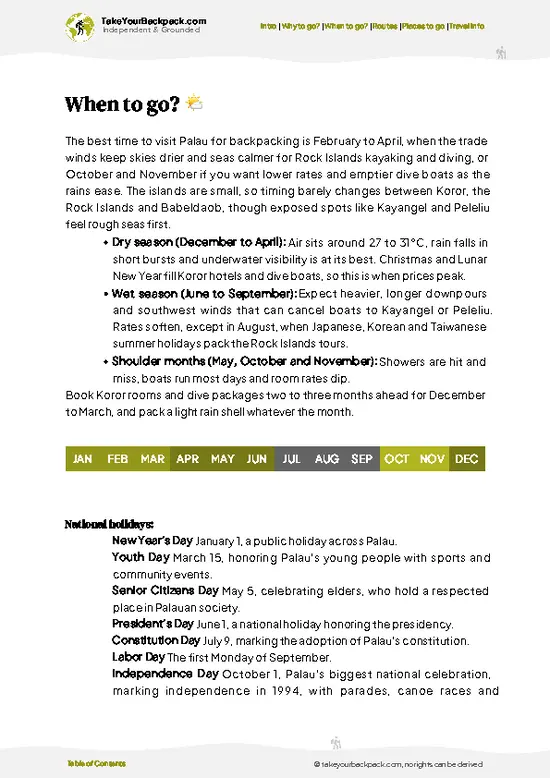
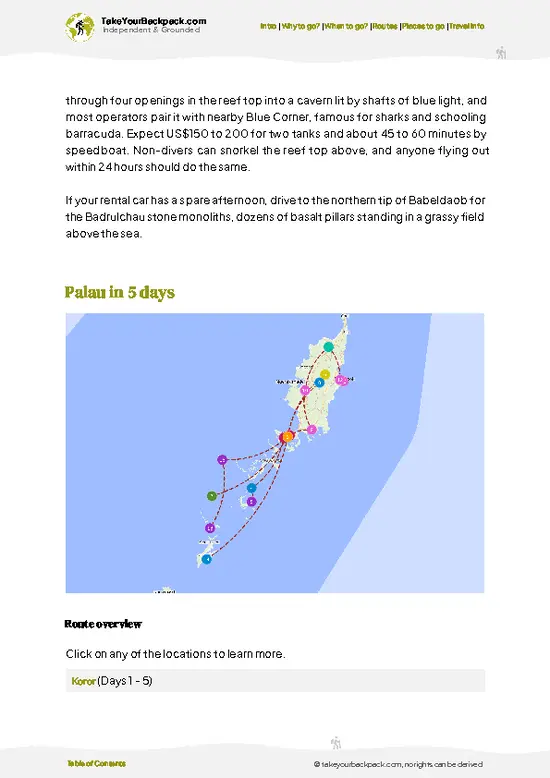
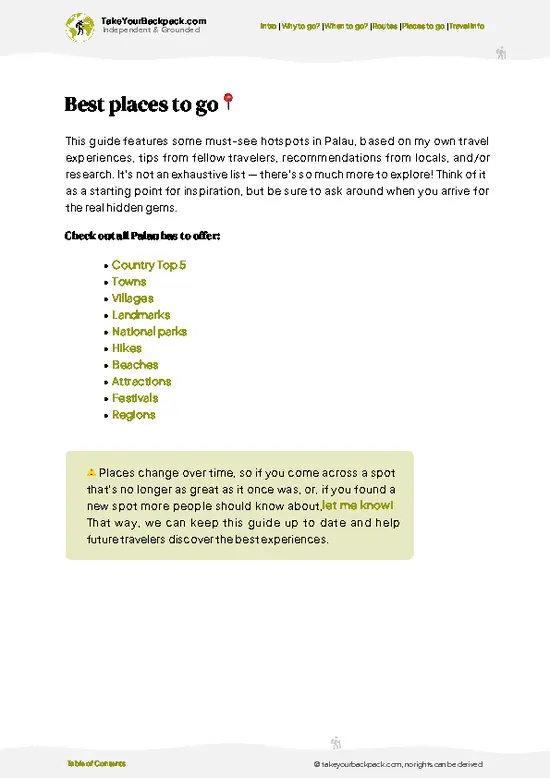
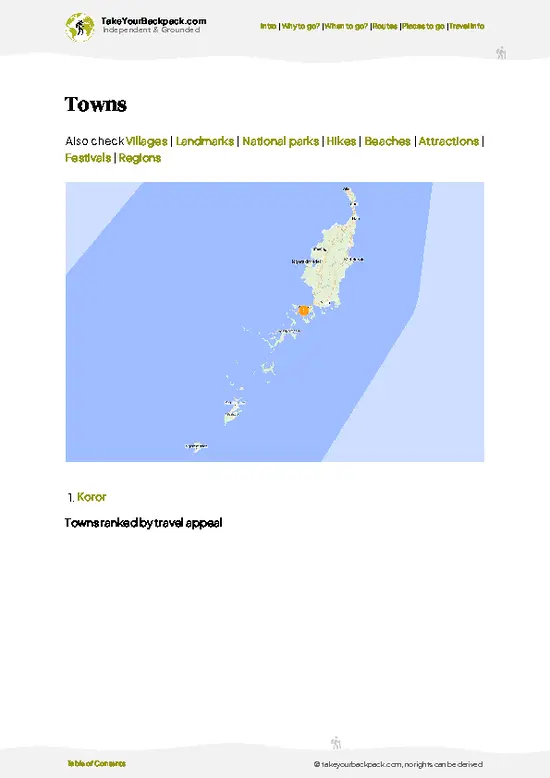
example page 0 from our offline Travel Guide for Palau
example page 1 from our offline Travel Guide for Palau
example page 2 from our offline Travel Guide for Palau
example page 3 from our offline Travel Guide for Palau
example page 4 from our offline Travel Guide for Palau
example page 5 from our offline Travel Guide for Palau
example page 6 from our offline Travel Guide for Palau
example page 7 from our offline Travel Guide for Palau
Loading the map 🌍
CLICK TO FILTER
towns
villages
landmarks
national parks
hikes
beaches
attractions
festivals
regions
SHOW COUNTRY’S BESTSHOW ALL

✨ Why go?
Ranked #4 region in Palau
Why visitors keep coming back

Backpackers come for the chance to see a Palau that hasn’t been built around tour buses. Ngeriungs, the uninhabited islet just south of the village, gives you a place to camp or picnic with nobody else in sight, and the lagoon around it is shallow enough to wade and snorkel from the beach. The village itself is the second draw. With only a small resident population, you will meet most people within a day, and fishing, taro patches and church life set the rhythm. You can spend a morning in a kayak, an afternoon walking the one road and an evening talking with your hosts. Another reason is contrast. After the dive-boat crowds around Koror and the Rock Islands, the single-village atoll shows how island life runs when the visitor economy stays small. It also fits well as a two or three night stop … read more 👉
Backpackers come for the chance to see a Palau that hasn’t been built around tour buses. Ngeriungs, the uninhabited islet just south of the village, gives you a place to camp or picnic with nobody else in sight, and the lagoon around it is shallow enough to wade and snorkel from the beach. The village itself is the second draw. With only a small resident population, you will meet most people within a day, and fishing, taro patches and church life set the rhythm. You can spend a morning in a kayak, an afternoon walking the one road and an evening talking with your hosts. Another reason is contrast. After the dive-boat crowds around Koror and the Rock Islands, the single-village atoll shows how island life runs when the visitor economy stays small. It also fits well as a two or three night stop before or after a Babeldaob road trip, so you add depth without a big detour.

💡 HighlightsPlaces and moments you shouldn't skip

  1. Kayangel Village: the atoll’s only settlement, with tidy lanes, a church, gardens and neighbors who greet every visitor.
  2. Ngeriungs: an uninhabited islet south of the village with soft sand, coconut palms and snorkeling right off the shore. Best for a day of doing nothing.
  3. Kayangel Lagoon: calm, shallow water that is good for kayaking and drifting over coral heads.
  4. Kayangel Channel Reef Edge: the outer reef drop where sharks, reef fish and the occasional turtle pass. Go with a local boatman who knows the currents.
  5. Village Taro Patches: wet gardens behind the houses where residents still grow taro by hand. Lesser known, and a quick way to see daily work.
  6. Western Beach Walk: a loop along the sand at low tide, with hermit crabs, shells and sunset views. Locals use it as their evening stroll.
  7. Sunrise
… read more 👉
  1. Kayangel Village: the atoll’s only settlement, with tidy lanes, a church, gardens and neighbors who greet every visitor.
  2. Ngeriungs: an uninhabited islet south of the village with soft sand, coconut palms and snorkeling right off the shore. Best for a day of doing nothing.
  3. Kayangel Lagoon: calm, shallow water that is good for kayaking and drifting over coral heads.
  4. Kayangel Channel Reef Edge: the outer reef drop where sharks, reef fish and the occasional turtle pass. Go with a local boatman who knows the currents.
  5. Village Taro Patches: wet gardens behind the houses where residents still grow taro by hand. Lesser known, and a quick way to see daily work.
  6. Western Beach Walk: a loop along the sand at low tide, with hermit crabs, shells and sunset views. Locals use it as their evening stroll.
  7. Sunrise Point: the eastern shore, quiet and empty before breakfast, with the sun coming up over open ocean.
  8. Local Fishing Outing: join a villager on a boat or on foot at the reef flats to learn how the day’s catch is taken. Ask your host to arrange it.
  9. Sandbar Picnic Spots: small unnamed sandbars around the lagoon that appear at low tide. Locals know which ones, and few visitors do.
  10. Village Church Service: on Sundays the community gathers, and singing carries across the island. Visitors are welcome if they dress modestly.
For a first visit, Ngeriungs gives you the atoll’s best beach and lagoon in a single easy day.
Spotted a mistake or missing something? Contact us.

Things to do near Kayangel Atoll

Ratings based on Tripadvisor reviews. When you book through this link, you support our work at no extra cost to you.

⌛️ 5 daysHow to make the most of Kayangel Atoll

Day 1: Kayangel Village: Take the morning boat, since the lagoon is flat early and the crossing is gentler. Drop your bag at your lodging, then walk the single road to learn the layout. The village is small enough that a loop takes under an hour, and your host will point out the taro patches and the church. Eat what is cooked for you, as options are limited. Spend the evening on the western beach for sunset.
Day 2 to 3: Ngeriungs and the Lagoon: Use day two for Ngeriungs, the islet south of the village. A local boatman can run you out and collect you later, which beats trying to arrange it yourself. Snorkel the shallows, then walk the sand at low tide. On day three, paddle the lagoon or ask for a fishing outing, so the island’s rhythm shapes your pace rather than a timetable. Boat transport … read more 👉
Day 1: Kayangel Village: Take the morning boat, since the lagoon is flat early and the crossing is gentler. Drop your bag at your lodging, then walk the single road to learn the layout. The village is small enough that a loop takes under an hour, and your host will point out the taro patches and the church. Eat what is cooked for you, as options are limited. Spend the evening on the western beach for sunset.
Day 2 to 3: Ngeriungs and the Lagoon: Use day two for Ngeriungs, the islet south of the village. A local boatman can run you out and collect you later, which beats trying to arrange it yourself. Snorkel the shallows, then walk the sand at low tide. On day three, paddle the lagoon or ask for a fishing outing, so the island’s rhythm shapes your pace rather than a timetable. Boat transport is the only link to the mainland, so weather and tide decide when you move, and flexibility matters more than planning.
Day 4 to 5: Reef Edge and Departure: Go to the outer reef with a boatman on day four, when the sea is calm. This is your detour off the village routine, and it adds sharks, big fish and open ocean without changing where you sleep. Keep day five loose for the morning boat out, with a final walk at sunrise on the east shore.
If you only get one day to justify the trip, make it day two on Ngeriungs, with empty sand, clear water and no one else around.

🌤️ When to go?Weather, crowds, and seasonal trade-offs

February to April is the driest stretch for Kayangel, with calm seas that make the boat run from Koror smooth and the lagoon clear for snorkeling.
  • Dry Season (December to April): Days run 27 to 31°C (81 to 88°F) with light trade winds and the flattest crossings. Sunrise is around 6:00 and sunset around 18:00. Expect the most visitors, though Kayangel stays quiet by any standard.
  • Wet Season (June to October): Heavy showers come in bursts, humidity sits high, and temperatures stay near 27 to 30°C (81 to 86°F). The channel can turn rough, so boat trips are sometimes cancelled. Rooms and tours can cost less.
  • Typhoon Risk (July to November): Palau is south of the main typhoon belt, but storms passing north can stir up swell and close the channel for days.
  • Shoulder (May and November): Mixed sun and
… read more 👉
February to April is the driest stretch for Kayangel, with calm seas that make the boat run from Koror smooth and the lagoon clear for snorkeling.
  • Dry Season (December to April): Days run 27 to 31°C (81 to 88°F) with light trade winds and the flattest crossings. Sunrise is around 6:00 and sunset around 18:00. Expect the most visitors, though Kayangel stays quiet by any standard.
  • Wet Season (June to October): Heavy showers come in bursts, humidity sits high, and temperatures stay near 27 to 30°C (81 to 86°F). The channel can turn rough, so boat trips are sometimes cancelled. Rooms and tours can cost less.
  • Typhoon Risk (July to November): Palau is south of the main typhoon belt, but storms passing north can stir up swell and close the channel for days.
  • Shoulder (May and November): Mixed sun and showers, thin crowds, and good dive and snorkel visibility on calm days.
Check the sea forecast the evening before you travel, since swell matters more than rain here.


source: climatestotravel.comJANJanuary: excellent for travelingFEBFebruary: excellent for travelingMARMarch: excellent for travelingAPRApril: highly recommended for travelingMAYMay: good for travelingJUNJune: fair for travelingJULJuly: below average for travelingAUGAugust: below average for travelingSEPSeptember: fair for travelingOCTOctober: fair for travelingNOVNovember: highly recommended for travelingDECDecember: excellent for traveling
palau-region-kayangel-atoll
© Google |

✈️ The backpacker research shortcutPalau Travel Guide

An offline-friendly backpacking guide with optimized travel routes, ranked highlights, transport advice, and the best areas to stay.
example page 0 from our offline Travel Guide for Palau
example page 1 from our offline Travel Guide for Palau
example page 2 from our offline Travel Guide for Palau
example page 3 from our offline Travel Guide for Palau
example page 4 from our offline Travel Guide for Palau
example page 5 from our offline Travel Guide for Palau
example page 6 from our offline Travel Guide for Palau
example page 7 from our offline Travel Guide for Palau
The digital guide (99 pages) contains:
✅ 22 highlights, ranked by travel appeal
✅ Optimized 2, 3 & 5-day travel routes
✅ Cities, national parks, landmarks, beaches
✅ How to get around
✅ Offline-friendly for travel without Wi-Fi
👉 Click to see all 30+ guide features

📅 Plan smarter in minutes, not weeks
✅ Month by month travel advice
✅ Festivals & national holidays
✅ Budget expectations

🗺️ Go to the right places, skip the overrated ones
✅ Honest pros & cons of destinations
✅ Top hikes, parks & viewpoints
✅ Lesser-known places most travelers miss
✅ Clear “worth it vs skip it” guidance

🛏️ Travel smoothly without rookie mistakes
✅ Best areas to stay
✅ Transport systems explained simply
✅ Common scams & safety advice
✅ SIM cards, money & practical tips

🌍 Understand the country, not just visit it
✅ Culture & traditions
✅ 52 Essential phrases & customs
✅ Festivals worth planning around
✅ Traveler-friendly historical context
✅ Insights that make places more meaningful

📱 Built for real travel conditions
✅ Fully downloadable PDF
✅ Works completely offline
✅ Optimized for phone use
✅ Useful in remote areas & buses
✅ Everything in one place
Stop searching, start planning
Get instant access to your full guide. 30‑day money-back guarantee.
+ Add another guide for just

By proceeding you agree to our terms.
Sent to your inbox immediately after payment • 100% Secure Checkout
Best Backpacking Travel Advisor 2025 tourism awardBest Backpacking
Travel Advisor
2025
What others say about Take Your Backpack Guides:
⭐⭐⭐⭐⭐
Fantastic, amazing amount of information!
⭐⭐⭐⭐⭐
My goodness this is amazing, it's what I've been looking for hats off too you!
⭐⭐⭐⭐⭐
I think this is absolutely BRILLIANT
⭐⭐⭐⭐
Very complete and informative. It's still missing places, but I gotta to commend you
⭐⭐⭐⭐⭐
This is truly amazing, thank you, can't wait to explore it with my kids!
⭐⭐⭐⭐⭐
Awesome resource, thank you!
⭐⭐⭐⭐⭐
This is amazing! Can't wait to explore the ones I haven't seen
⭐⭐⭐⭐
I love this! Well done, great idea.
⭐⭐⭐⭐⭐
Thanks for taking the time to make this gem!
⭐⭐⭐⭐⭐
This might be the best website I've ever seen.
⭐⭐⭐⭐⭐
Congratulations, and thank you so much for your work; it's incredibly valuable.
⭐⭐⭐⭐
In all seriousness I think you did a great job pointing out the important spots
⭐⭐⭐⭐⭐
10/10 very good
⭐⭐⭐⭐⭐
As someone who's only just starting to visit regularly this is awesome, thank you.
⭐⭐⭐⭐
Thank you very much! I'm going to visit my dad, it's going to be very useful!
⭐⭐⭐⭐⭐
This is really cool! We'll be travelling for the first time and this definitely come in handy.
⭐⭐⭐⭐⭐
You are now our minister of culture, congratulations 👨‍💼
⭐⭐⭐⭐⭐
Just wanted to tell you that this is a pearl! Going to follow your recommendations.
⭐⭐⭐⭐⭐
This is so cool. I'll definitely be using the resource for my travels soon.
⭐⭐⭐⭐⭐
This is very impressive! Good work.
⭐⭐⭐⭐⭐
This is an amazing and informative site. Very well done!

🛏️ Where to stay?Where staying makes the most sense

Stay on Kayangel itself if you want the atoll, and on Koror if you need a social base before or after.
Kayangel has only a single village, with a handful of guesthouses and simple bungalows, so there is nothing to choose between neighborhoods. Rooms run roughly US$50 to 100 a night, and the setting is the draw: sand lanes, a lagoon at your door and a night sky with almost no light pollution. It is very safe, and everyone knows everyone. You will meet other travelers over shared meals rather than in bars, since the atoll has no nightlife. Bring cash and enough supplies for your stay, as the one … read more 👉
Stay on Kayangel itself if you want the atoll, and on Koror if you need a social base before or after.
Kayangel has only a single village, with a handful of guesthouses and simple bungalows, so there is nothing to choose between neighborhoods. Rooms run roughly US$50 to 100 a night, and the setting is the draw: sand lanes, a lagoon at your door and a night sky with almost no light pollution. It is very safe, and everyone knows everyone. You will meet other travelers over shared meals rather than in bars, since the atoll has no nightlife. Bring cash and enough supplies for your stay, as the one or two small stores have limited stock.
For a social scene, Koror is the place. It has the widest range of dorms and budget rooms in Palau (roughly US$25 to 45 a night), plus dive shops, tour desks and restaurants, and it is where you will meet people to share a rental car north. Ngarchelong, on the mainland, has a few homestays and suits those who want to cross early in the morning, though it is quiet and has little else.

🚌 Getting aroundHow to get around Kayangel Atoll

A seat on the Kayangel ferry or a shared boat costs roughly US$10 to 25 each way, and you pay in US dollars cash to the operator or your host, as there are no card machines on the atoll. Palau uses the US dollar, so bring small bills, because change for a US$50 is hard to find on the island.
The trip starts at Ngarchelong in the far north of Babeldaob. Most backpackers reach that port by road from Koror, then cross the channel to the atoll. Roads on Babeldaob are sealed and easy, but public buses are scarce, so a little planning matters. Once you arrive, the island is tiny and everything is within walking distance.
  • Boat from Ngarchelong: Boats run on a loose schedule, usually tied to tide and demand, so ask your host to book your seat and confirm the time the day before. Mornings are calmer
… read more 👉
A seat on the Kayangel ferry or a shared boat costs roughly US$10 to 25 each way, and you pay in US dollars cash to the operator or your host, as there are no card machines on the atoll. Palau uses the US dollar, so bring small bills, because change for a US$50 is hard to find on the island.
The trip starts at Ngarchelong in the far north of Babeldaob. Most backpackers reach that port by road from Koror, then cross the channel to the atoll. Roads on Babeldaob are sealed and easy, but public buses are scarce, so a little planning matters. Once you arrive, the island is tiny and everything is within walking distance.
  • Boat from Ngarchelong: Boats run on a loose schedule, usually tied to tide and demand, so ask your host to book your seat and confirm the time the day before. Mornings are calmer and drier than afternoons.
  • Rental car or van from Koror: Expect US$50 to 80 a day. The drive to Ngarchelong takes about 1 to 1.5 hours. Split it with others and it becomes the cheapest option per person, and you can stop at the Ngardmau waterfall or Badrulchau on the way.
  • Taxi or arranged transfer: A private ride from Koror costs around US$80 to 120 each way. Taxis are the simple choice for solo travelers, but ask your lodging about a shared ride with other guests first.
  • Walking and bicycles: The atoll has a single sandy track and a loop of only a few kilometers. Walking is the way to go. Some hosts lend bikes, though sand slows them down, so you will often be quicker on foot.
Arrange the return boat when you arrive, not on departure morning, so your seat is secured and you can match it to your flight or onward ride.

🍲 FoodEating & Drinking in Kayangel Atoll

Eating on Kayangel means fresh reef fish, grilled over coals or served raw with soy sauce and lime. You will taste coconut crab in season, and sweet, smoky taro and tapioca served alongside, often with coconut milk poured over everything. Fruit includes papaya and bananas picked from nearby trees.
There are no restaurants as you would picture them. Most meals come from your guesthouse, cooked by the family, and served at a shared table, usually for about US$10 to 20 a plate. Order ahead, because the cook buys what the boat brings or catches what the lagoon offers that day. A couple of small stores sell instant noodles, canned goods and snacks, so carry in anything you crave.
For drinks, the fresh green coconut cracked open on the beach is the one to try, sweet and slightly salty, and far cheaper … read more 👉
Eating on Kayangel means fresh reef fish, grilled over coals or served raw with soy sauce and lime. You will taste coconut crab in season, and sweet, smoky taro and tapioca served alongside, often with coconut milk poured over everything. Fruit includes papaya and bananas picked from nearby trees.
There are no restaurants as you would picture them. Most meals come from your guesthouse, cooked by the family, and served at a shared table, usually for about US$10 to 20 a plate. Order ahead, because the cook buys what the boat brings or catches what the lagoon offers that day. A couple of small stores sell instant noodles, canned goods and snacks, so carry in anything you crave.
For drinks, the fresh green coconut cracked open on the beach is the one to try, sweet and slightly salty, and far cheaper than anything bottled. Bring bottled water and ask your host about the safe drinking supply.
To be polite, wait to be invited before taking food, and take only what you can finish. Alcohol is not widely sold, so bring your own and drink discreetly in respect of village customs. Fishing is part of daily life, so ask before taking photos of a catch.

FAQFrequently asked questions about Kayangel Atoll

Two days and one night is enough for most backpackers to see Kayangel Atoll, though three days lets you slow down. The boat leaves from Ngarchelong, roughly 1 to 1.5 hours by road from Koror. Spend the time snorkeling the lagoon, walking the sandy lanes, and watching the sunset from the beach.
Without a car, you can book a taxi or arranged transfer from Koror to Ngarchelong for about US$80 to 120 each way, then take the boat to the atoll for roughly US$10 to 25. Public buses to the north are limited, so ask your guesthouse or a tour operator about shared rides. On the atoll, walking is all you need, as the island is only a few kilometers around.
Kayangel Atoll is known for its quiet sandy village, a protected lagoon with clear water, and some of the calmest, least developed beaches in Palau. It is the northernmost state in the country, with only a few dozen residents. Visitors come for snorkeling, birdwatching, fresh seafood and star-filled nights, usually staying one to three days.
⚠️ Things can change over time, so always validate details locally before you go.

Other Palauan regions near Kayangel Atoll

Explore more nearby:

  • Babeldaob—Compact Road loop, waterfall trail, basalt monoliths, mangrove kayaking| 66 km away
  • Rock Islands Southern Lagoon—Limestone islets, jellyfish lake, manta channel, boat-only access| 104 km away
  • Peleliu Island—1944 landing beaches, rusted tanks, bunkers and caves, golf-cart touring| 129 km away

💡 Not sure where to go next?
Create a personalized itinerary for Palau including Kayangel Atoll and the places that fit your trip.

Generate my itinerary

👉 Discover all regions

Or checkout all Palau has to offer (think cities, towns, villages, national parks, hikes, beaches, festivals)
Country photo of Palau

We 💚 feedbackParting advice and final tips

Most first-timers rush the village and miss the evening, when families gather outside, kids play on the sand and the whole island slows down. Stay for it. I would bring snacks, small bills and a headlamp, then say yes when someone invites you to sit down. Plan one buffer day for weather, because the boat sets the schedule.

✍️ Help improve this page!
The information on this page is based on in-depth research, insights shared by experienced travelers, and feedback from the local travel community in Palau. While every effort is made to keep the information accurate and current, conditions can change — so if you spot anything incorrect or outdated, please get in touch.


🙋‍♂️ Give feedback

👋 Meet the founderWho’s Behind Take Your Backpack?

Johan, backpacker and founder of TakeYourBackpackHi, I’m Johan (Netherlands 🇳🇱), the creator of TakeYourBackpack. Over the past 3 decades, I’ve backpacked through 90+ countries across six continents, gaining extensive experience with independent travel, long-term trips, and overland routes.

This site is built on a combination of firsthand travel experience and carefully curated insights from other backpackers. Many guides are based on places I’ve personally visited, while others bring together tips, observations, and practical advice shared by trusted travelers I’ve met along the way.

The goal is to provide realistic, experience-driven guidance — not generic itineraries — so you can explore destinations with better context, clearer expectations, and more confidence.