×

Panama🇵🇦 | national parksDarién National ParkCerro Pirre climb, Rancho Frío, harpy eagle, road’s end at Yaviza | things to do and best time to go

Explore Isla Bastimentos National Marine ParkExplore Camino de Cruces National Park

Backpacking in Darién
🏆 Top picknational park ranked #2
By Johan Kruseman 🇳🇱 | Updated October 23, 2026

Darién National Park is Panama’s largest protected area, a block of lowland rainforest, swamp and cloud-covered ridges of roughly 5,790 square kilometers that runs to the Colombian border in the east of Panama, well east of Panama City. The reason it works for backpackers is also the reason it is hard: no tourist infrastructure means no crowds, and the Pirre range holds birds found nowhere else in the country. The hiking is a muddy, root-tangled climb with real wilderness at the top. I arrived at the Rancho Frío ranger station, and before I had shouldered my pack the howler monkeys opened up overhead, a roar like wind through a tunnel. That sound told me how far from anything I was. The cost is logistics: permits, guides and long approaches. Unlike Soberanía National Park, an easy day trip from the capital, Darién rewards several committed days.

Discover everything you want to know in the 📖 Panama Travel Guide.


example page 0 from our offline Travel Guide for Panama
example page 1 from our offline Travel Guide for Panama
example page 2 from our offline Travel Guide for Panama
example page 3 from our offline Travel Guide for Panama
example page 4 from our offline Travel Guide for Panama
example page 5 from our offline Travel Guide for Panama
example page 6 from our offline Travel Guide for Panama
example page 7 from our offline Travel Guide for Panama
Loading the map 🌍
CLICK TO FILTER
cities
towns
villages
landmarks
national parks
hikes
beaches
attractions
festivals
regions
SHOW COUNTRY’S BESTSHOW ALL

✨ Why go?
Ranked #2 national park in Panama
Why visitors keep coming back

Darién National Park suits backpackers who want to build their own trip rather than follow a bus-tour loop, because nothing here is packaged. You arrange the permit, the guide and the carrying yourself, and that effort filters out almost everyone else. The trails are quiet, so what you hear is birds and your own boots.

The main draw is Cerro Pirre, where the forest changes from steamy lowland to mossy cloud forest as you climb. Birders come for species restricted to this range, including the Pirre hummingbird, and the area still shelters harpy eagles, jaguars and Baird’s tapirs. Seeing any of them is luck, but the odds here are better than anywhere else in Panama.

Camping is simple. Rancho Frío gives you a base for the first night, and higher up you sleep at basic trail camps. You carry … read more 👉
Darién National Park suits backpackers who want to build their own trip rather than follow a bus-tour loop, because nothing here is packaged. You arrange the permit, the guide and the carrying yourself, and that effort filters out almost everyone else. The trails are quiet, so what you hear is birds and your own boots.

The main draw is Cerro Pirre, where the forest changes from steamy lowland to mossy cloud forest as you climb. Birders come for species restricted to this range, including the Pirre hummingbird, and the area still shelters harpy eagles, jaguars and Baird’s tapirs. Seeing any of them is luck, but the odds here are better than anywhere else in Panama.

Camping is simple. Rancho Frío gives you a base for the first night, and higher up you sleep at basic trail camps. You carry food, a sleeping bag and a water filter, and you accept that there is no cell signal. For hikers who already like multi-day walking, the Rancho Frío to Pirre ridge route is a chance to do a true jungle trek, with local guides who know every stream crossing, without a crowd.

💡 HighlightsKey sights and experiences for travelers

  1. Cerro Pirre: The park’s signature climb, to a ridge around 1,500 meters where lowland forest gives way to dripping cloud forest, thick with moss, ferns and orchids. It is a multi-day effort with a camp on the way.
  2. Rancho Frío ranger station: The trailhead and gateway near El Real. Wooden buildings sit at the forest edge, and short loops start right behind them, so you can hear howler monkeys and see toucans before you commit to the climb.
  3. Pirre endemic birds: The ridge holds the Pirre hummingbird and the Pirre warbler, species restricted to this mountain range. Mornings along the upper trail are the best time for them.
  4. Lowland rainforest trails: The walk between Rancho Frío and the foot of the range goes under huge buttressed trees, past army ants and stream crossings. Expect peccary tracks in
… read more 👉
  1. Cerro Pirre: The park’s signature climb, to a ridge around 1,500 meters where lowland forest gives way to dripping cloud forest, thick with moss, ferns and orchids. It is a multi-day effort with a camp on the way.
  2. Rancho Frío ranger station: The trailhead and gateway near El Real. Wooden buildings sit at the forest edge, and short loops start right behind them, so you can hear howler monkeys and see toucans before you commit to the climb.
  3. Pirre endemic birds: The ridge holds the Pirre hummingbird and the Pirre warbler, species restricted to this mountain range. Mornings along the upper trail are the best time for them.
  4. Lowland rainforest trails: The walk between Rancho Frío and the foot of the range goes under huge buttressed trees, past army ants and stream crossings. Expect peccary tracks in the mud and white-faced capuchins in the canopy.
  5. Harpy eagle country: Darién is one of the places in Panama where the harpy eagle still nests. Sightings are rare and depend on a guide who knows active territories, but a single sighting of this enormous raptor is worth the trip.
  6. Baird’s tapir and jaguar tracks: Fresh footprints in river mud and along trails are the usual evidence of these animals, which stay hidden. Guides read the signs and point out where the animals have passed.
  7. Yaviza and the Tuira River: The small river town where the Pan-American Highway stops, the access point for the park. Boats and pickups leave from here, and the end-of-the-road feeling is part of the experience.
For a first visit, the walk from Rancho Frío into the forest toward Cerro Pirre gives you the best of Darién National Park in the time most people have.
Spotted a mistake or missing something? Contact us.

🌤️ When to go?When to go for the best experience

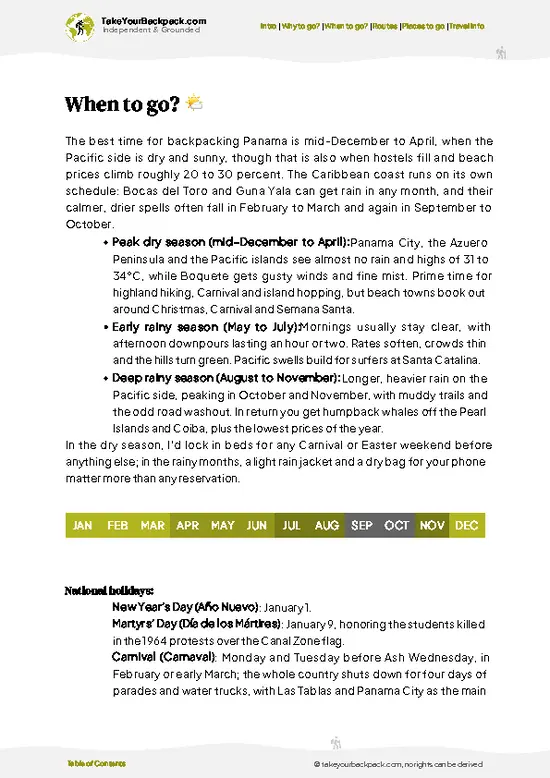
  • Dry Season (late December to April): The best window for trekking Darién National Park, with the least mud and lower rivers. Days reach 30 to 33°C (86 to 91°F), nights 22 to 24°C (72 to 75°F). Roads to Yaviza are most reliable, and local guides and lodges are booked most heavily.
  • Early Wet Season (May to July): Afternoon downpours start, trails turn to slick clay, and river levels rise. Humidity is heavy, and you get fewer visitors and more flexible guide rates.
  • Peak Rains (August to November): Expect near-daily storms, with highs of 28 to 31°C (82 to 88°F). Streams can swell within hours, and boat transfers and trails may be cut off. Guides are cheapest but often scarce.
  • Birding and Wildlife: Dry months make forest birds easier to spot near water, and harpy eagle activity is best tracked with
… read more 👉
  • Dry Season (late December to April): The best window for trekking Darién National Park, with the least mud and lower rivers. Days reach 30 to 33°C (86 to 91°F), nights 22 to 24°C (72 to 75°F). Roads to Yaviza are most reliable, and local guides and lodges are booked most heavily.
  • Early Wet Season (May to July): Afternoon downpours start, trails turn to slick clay, and river levels rise. Humidity is heavy, and you get fewer visitors and more flexible guide rates.
  • Peak Rains (August to November): Expect near-daily storms, with highs of 28 to 31°C (82 to 88°F). Streams can swell within hours, and boat transfers and trails may be cut off. Guides are cheapest but often scarce.
  • Birding and Wildlife: Dry months make forest birds easier to spot near water, and harpy eagle activity is best tracked with a local guide.
Daylight is about 11 to 12.5 hours year-round, so start hikes early. Book guides and permits a few weeks ahead for February and March.


source: climatestotravel.comJANJanuary: highly recommended for travelingFEBFebruary: excellent for travelingMARMarch: excellent for travelingAPRApril: fair for travelingMAYMay: fair for travelingJUNJune: fair for travelingJULJuly: fair for travelingAUGAugust: fair for travelingSEPSeptember: fair for travelingOCTOctober: fair for travelingNOVNovember: fair for travelingDECDecember: fair for traveling
panama-national-park-darien-national-park
© Google |

✈️ The backpacker research shortcutPanama Travel Guide

An offline-friendly backpacking guide with optimized travel routes, ranked highlights, transport advice, and the best areas to stay.
example page 0 from our offline Travel Guide for Panama
example page 1 from our offline Travel Guide for Panama
example page 2 from our offline Travel Guide for Panama
example page 3 from our offline Travel Guide for Panama
example page 4 from our offline Travel Guide for Panama
example page 5 from our offline Travel Guide for Panama
example page 6 from our offline Travel Guide for Panama
example page 7 from our offline Travel Guide for Panama
The digital guide (272 pages) contains:
✅ 89 highlights, ranked by travel appeal
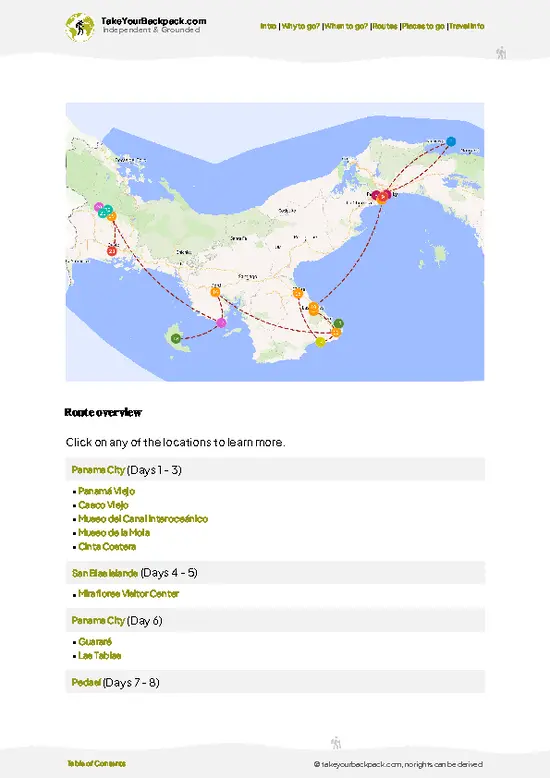
✅ Optimized 5, 10 & 15-day travel routes
✅ Cities, national parks, landmarks, beaches
✅ How to get around
✅ Offline-friendly for travel without Wi-Fi
👉 Click to see all 30+ guide features

📅 Plan smarter in minutes, not weeks
✅ Month by month travel advice
✅ Festivals & national holidays
✅ Budget expectations

🗺️ Go to the right places, skip the overrated ones
✅ Honest pros & cons of destinations
✅ Top hikes, parks & viewpoints
✅ Lesser-known places most travelers miss
✅ Clear “worth it vs skip it” guidance

🛏️ Travel smoothly without rookie mistakes
✅ Best areas to stay
✅ Transport systems explained simply
✅ Common scams & safety advice
✅ SIM cards, money & practical tips

🌍 Understand the country, not just visit it
✅ Culture & traditions
✅ 52 Essential phrases & customs
✅ Festivals worth planning around
✅ Traveler-friendly historical context
✅ Insights that make places more meaningful

📱 Built for real travel conditions
✅ Fully downloadable PDF
✅ Works completely offline
✅ Optimized for phone use
✅ Useful in remote areas & buses
✅ Everything in one place
Stop searching, start planning
Get instant access to your full guide. 30‑day money-back guarantee.
+ Add another guide for just

By proceeding you agree to our terms.
Sent to your inbox immediately after payment • 100% Secure Checkout
Best Backpacking Travel Advisor 2025 tourism awardBest Backpacking
Travel Advisor
2025
What others say about Take Your Backpack Guides:
⭐⭐⭐⭐⭐
Fantastic, amazing amount of information!
⭐⭐⭐⭐⭐
My goodness this is amazing, it's what I've been looking for hats off too you!
⭐⭐⭐⭐⭐
I think this is absolutely BRILLIANT
⭐⭐⭐⭐
Very complete and informative. It's still missing places, but I gotta to commend you
⭐⭐⭐⭐⭐
This is truly amazing, thank you, can't wait to explore it with my kids!
⭐⭐⭐⭐⭐
Awesome resource, thank you!
⭐⭐⭐⭐⭐
This is amazing! Can't wait to explore the ones I haven't seen
⭐⭐⭐⭐
I love this! Well done, great idea.
⭐⭐⭐⭐⭐
Thanks for taking the time to make this gem!
⭐⭐⭐⭐⭐
This might be the best website I've ever seen.
⭐⭐⭐⭐⭐
Congratulations, and thank you so much for your work; it's incredibly valuable.
⭐⭐⭐⭐
In all seriousness I think you did a great job pointing out the important spots
⭐⭐⭐⭐⭐
10/10 very good
⭐⭐⭐⭐⭐
As someone who's only just starting to visit regularly this is awesome, thank you.
⭐⭐⭐⭐
Thank you very much! I'm going to visit my dad, it's going to be very useful!
⭐⭐⭐⭐⭐
This is really cool! We'll be travelling for the first time and this definitely come in handy.
⭐⭐⭐⭐⭐
You are now our minister of culture, congratulations 👨‍💼
⭐⭐⭐⭐⭐
Just wanted to tell you that this is a pearl! Going to follow your recommendations.
⭐⭐⭐⭐⭐
This is so cool. I'll definitely be using the resource for my travels soon.
⭐⭐⭐⭐⭐
This is very impressive! Good work.
⭐⭐⭐⭐⭐
This is an amazing and informative site. Very well done!

🛏️ Where to stay?Choosing the right base

The best option for most backpackers is Panama City for supplies, then a few simple stops on the road toward the park. No hotels sit inside Darién National Park itself; the main accommodation is basic ranger-station lodging and camping at Rancho Frío (Pirre) near El Real, where you sleep in bunks or hang a hammock for roughly US$10 to 25 a night, depending on the service. Bring your own food and a water filter, and arrange this through MiAmbiente or a guide in advance.
Most travelers overnight in Metetí, a roadside town with a few modest hotels at about US$25 to 50 a night. Yaviza, at the end of … read more 👉
The best option for most backpackers is Panama City for supplies, then a few simple stops on the road toward the park. No hotels sit inside Darién National Park itself; the main accommodation is basic ranger-station lodging and camping at Rancho Frío (Pirre) near El Real, where you sleep in bunks or hang a hammock for roughly US$10 to 25 a night, depending on the service. Bring your own food and a water filter, and arrange this through MiAmbiente or a guide in advance.
Most travelers overnight in Metetí, a roadside town with a few modest hotels at about US$25 to 50 a night. Yaviza, at the end of the Pan-American Highway, has very basic guesthouses for about US$15 to 30, and it is the jumping-off point for the road to El Real. La Palma, the provincial capital on the Gulf of San Miguel, has small hotels and is the starting point for boat trips to remote lodges and Emberá communities. Some Emberá and Wounaan villages offer homestays with a bed and meals for around US$30 to 60 per person. Book ahead for the dry season, and carry cash because card machines are rare.

👛 Costs (as of 23 October 2026)Typical daily expenses

Darién National Park costs a backpacker about US$85 a day when you hire a guide and stay in basic lodging during the dry season. Most of the budget goes to guides, transport, and carrying your own food, since there are few shops beyond Metetí and Yaviza.
CategoryBudget RangeLocal Reality
Entrance feeUS$5 to 15Paid at the ranger station or via MiAmbiente; rates are higher for foreigners and cover the station only.
Accommodation (high season)US$10 to 30Bunks or hammock space at Rancho Frío, or a basic room in Yaviza or Metetí; hotels in Metetí reach US$50.
Accommodation (low season)US$8 to 25Prices barely fall, but rooms are easier to find.
GuideUS$30 to 60Often required for Cerro Pirre; the cost drops per person in groups of three or four.
Local transportUS$10 to 25Buses from Panama City to Metetí
… read more 👉
Darién National Park costs a backpacker about US$85 a day when you hire a guide and stay in basic lodging during the dry season. Most of the budget goes to guides, transport, and carrying your own food, since there are few shops beyond Metetí and Yaviza.
CategoryBudget RangeLocal Reality
Entrance feeUS$5 to 15Paid at the ranger station or via MiAmbiente; rates are higher for foreigners and cover the station only.
Accommodation (high season)US$10 to 30Bunks or hammock space at Rancho Frío, or a basic room in Yaviza or Metetí; hotels in Metetí reach US$50.
Accommodation (low season)US$8 to 25Prices barely fall, but rooms are easier to find.
GuideUS$30 to 60Often required for Cerro Pirre; the cost drops per person in groups of three or four.
Local transportUS$10 to 25Buses from Panama City to Metetí and Yaviza cost roughly US$12 to 20; 4x4 or shared rides to El Real add a few dollars.
Food and suppliesUS$10 to 20Fondas in Metetí and Yaviza serve rice and chicken for US$3 to 6; stock trail food in advance.
Total Daily BudgetUS$85Roughly US$65 to 150 depending on group size and transfers.
⚠️ Prices can change and everyone travels differently, so take this as a rough guide. Hope it helps you plan your adventure!

🥾 TrailsPlan your hike in Darién: routes, terrain, and sights

Darién National Park is a trekking destination, and the hiking centers on the Pirre range reached from the Rancho Frío (Pirre) ranger station near El Real. The terrain is steep and muddy, with slippery roots, frequent stream crossings and dense humidity.

  • Rancho Frío to Cerro Pirre: The main route. Plan about two days up and one down, camping at a basic site on the way. Hard. The path climbs from lowland forest through ever damper, mossier cloud forest to the ridge, with birds and monkeys all the way.
  • Rancho Frío forest loops: Short walks of about one to three hours from the ranger station through
… read more 👉
Darién National Park is a trekking destination, and the hiking centers on the Pirre range reached from the Rancho Frío (Pirre) ranger station near El Real. The terrain is steep and muddy, with slippery roots, frequent stream crossings and dense humidity.

  • Rancho Frío to Cerro Pirre: The main route. Plan about two days up and one down, camping at a basic site on the way. Hard. The path climbs from lowland forest through ever damper, mossier cloud forest to the ridge, with birds and monkeys all the way.
  • Rancho Frío forest loops: Short walks of about one to three hours from the ranger station through lowland forest. Easy to moderate, flat to gently rolling, good for first-time jungle walkers and for birding at dawn.
  • Wildlife: Howler and capuchin monkeys are common, as are toucans and aracaris. Harpy eagles, tapirs and jaguars are present but seldom seen.
  • Difficulty: The ridge climb needs fitness, trail experience and a guide. The forest loops need only sturdy shoes and rain protection.

Access is the real challenge. Buses run from Panama City toward Metetí and Yaviza, and from there you continue by pickup or hired transport to El Real and the station. It is a long day by road. The Cana field station and its airstrip are closed to visitors, so the Pirre route is the way in.

A permit from Panama’s environment ministry is required and a local guide is the norm, so arrange both before you leave the capital. The park sees very few visitors, and you may have the trails to yourself. Bring a stove, a water filter, all food, and waterproof bags, because rain is frequent and nothing is sold on the trail.
⚠️ Hiking info can sometimes be outdated or inaccurate. Before you hit the trail, check the latest conditions with locals. If you do spot anything that's off, I'd love to hear from you, so I can update it for fellow travelers.

🛡️ SafetySafety Tips and Common Scams in Darién

Darién National Park demands more preparation than most Panamanian parks, and a licensed local guide is the sensible way to go. Trails to Cerro Pirre from Rancho Frío are steep, muddy, and easy to lose in dense forest, with several stream crossings that rise fast after rain. Start early, pace yourself in the heat and humidity, and carry at least 3 liters of water plus a filter. Waterproof your gear, wear boots with aggressive tread, and pack a headlamp.
Wildlife is mostly shy. Watch your step for snakes such as the fer-de-lance, shake out boots, and keep food sealed from ants and rodents. Peccary herds and jaguars are rarely a problem if you stay quiet and keep your group together.
The larger concern is the wider region. Armed groups and smuggling operate in remote border areas, so stay on approved … read more 👉
Darién National Park demands more preparation than most Panamanian parks, and a licensed local guide is the sensible way to go. Trails to Cerro Pirre from Rancho Frío are steep, muddy, and easy to lose in dense forest, with several stream crossings that rise fast after rain. Start early, pace yourself in the heat and humidity, and carry at least 3 liters of water plus a filter. Waterproof your gear, wear boots with aggressive tread, and pack a headlamp.
Wildlife is mostly shy. Watch your step for snakes such as the fer-de-lance, shake out boots, and keep food sealed from ants and rodents. Peccary herds and jaguars are rarely a problem if you stay quiet and keep your group together.
The larger concern is the wider region. Armed groups and smuggling operate in remote border areas, so stay on approved routes, register with rangers, and never enter the park toward the Colombian border. Check conditions with MiAmbiente before leaving Yaviza.

FAQTraveler FAQ

Plan on 3 to 5 days for Darién National Park, including a full day of travel each way from Panama City. The Cerro Pirre hike from Rancho Frío takes 2 to 3 days with a night at the high camp, and a quick visit to the lower trails near El Real can be done in one. Allow an extra day in the wet season for river delays.
Public transport reaches the edge of Darién National Park but not the trails, so a car is not required. Buses run from Panama City to Metetí and Yaviza in about 5 to 6 hours for roughly US$12 to 20. From Yaviza, shared 4x4s or pickups cover the rough road to El Real and Rancho Frío for a few dollars each, and a guide can arrange this.
Yes, Darién National Park charges an entrance fee, typically around US$5 to 15 for foreign visitors, paid at the ranger station. Permits and guide arrangements go through MiAmbiente, and a registered guide is usually required for Cerro Pirre, costing about US$30 to 60 a day. Arrange it a few weeks ahead in the dry season from January to April.
⚠️ Things can change over time, so always validate details locally before you go.

Other Panamanian national parks near Darién

Explore more nearby:


💡 Not sure where to go next?
Create a personalized itinerary for Panama including Darién and the places that fit your trip.

Generate my itinerary

👉 Discover all national parks

Or checkout all Panama has to offer (think cities, towns, villages, national parks, hikes, beaches, festivals)
Country photo of Panama

We 💚 feedbackSumming up the experience

Darién National Park deserves at least four days: one to reach the station, two for the Pirre climb and one to walk out. A single night only gets you to the trailhead. I would bring a guide-approved packing list, spare dry socks and patience for the road, then give the ridge the time it needs.

✈️ When did I visit Panama?
Panama I visited during my half year trip through South and Central America back in 2003

✍️ Help improve this page!
The information on this page is based on my own backpacking experience in Panama, supplemented with up-to-date research and feedback from other travelers. Travel details can change, so if you notice anything outdated or incomplete, feel free to let me know.


🙋‍♂️ Give feedback

👋 Meet the founderWho’s Behind Take Your Backpack?

Johan, backpacker and founder of TakeYourBackpackHi, I’m Johan (Netherlands 🇳🇱), the creator of TakeYourBackpack. Over the past 3 decades, I’ve backpacked through 90+ countries across six continents, gaining extensive experience with independent travel, long-term trips, and overland routes.

This site is built on a combination of firsthand travel experience and carefully curated insights from other backpackers. Many guides are based on places I’ve personally visited, while others bring together tips, observations, and practical advice shared by trusted travelers I’ve met along the way.

The goal is to provide realistic, experience-driven guidance — not generic itineraries — so you can explore destinations with better context, clearer expectations, and more confidence.