×

Paraguay🇵🇾 | citiesAsunciónRiverfront palace, national pantheon, colonial house museums, railway station | things to do and best time to go

Explore Playa de la CostaneraExplore Encarnación

Backpacking in Asunción
🏆 Top pickcity ranked #1
By Johan Kruseman 🇳🇱 | Updated October 19, 2026

Asunción suits travelers who like a capital that has not been rearranged for visitors: history readers, slow walkers and anyone linking Argentina, Brazil and the Chaco. Beach seekers and people who want a polished old town will find it thin, and parts of the riverfront look worn. This is Paraguay’s capital, on the east bank of the Río Paraguay, facing Argentina across the water. City buses have no route maps at stops and run on numbered lines, so you learn your line from the driver or your hostel instead of reading a sign. I once boarded the first bus marked Centro and ended up at a depot, because several lines share that word and only the number tells you the path. Now I get the number first and sit near the front. Most lines take only the rechargeable Jaha or Más cards, not cash, so buy and top up a card before you ride. The old center ends at the water, where wooden fishing boats rest below the Palacio de los López.

Part of Backpacking in Paraguay: all 65 places on one map, with routes and the best time to go.
Discover everything you want to know in the 📖 Paraguay Travel Guide.


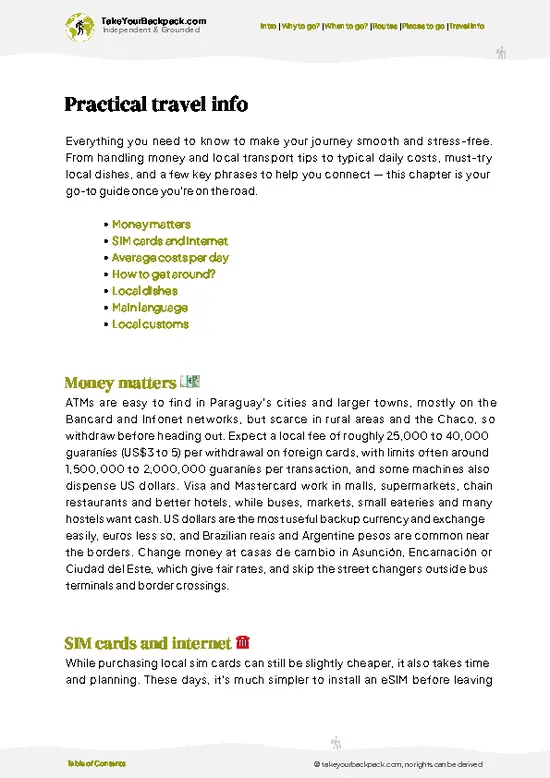
example page 0 from our offline Travel Guide for Paraguay
example page 1 from our offline Travel Guide for Paraguay
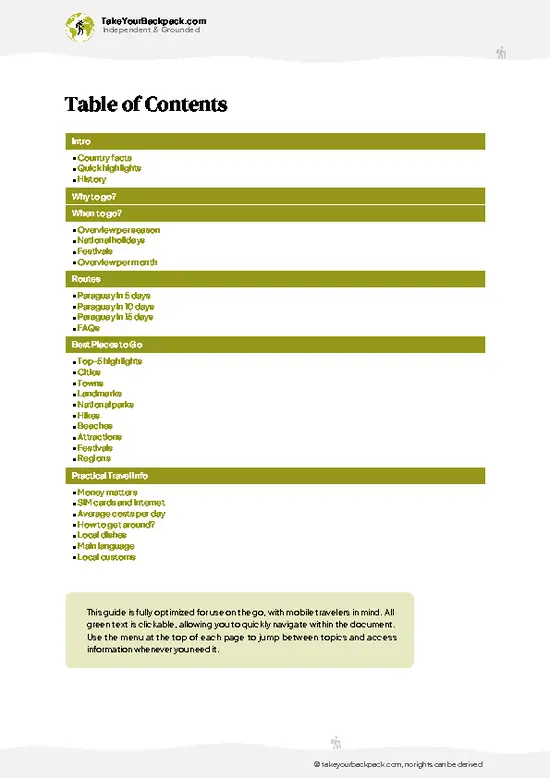
example page 2 from our offline Travel Guide for Paraguay
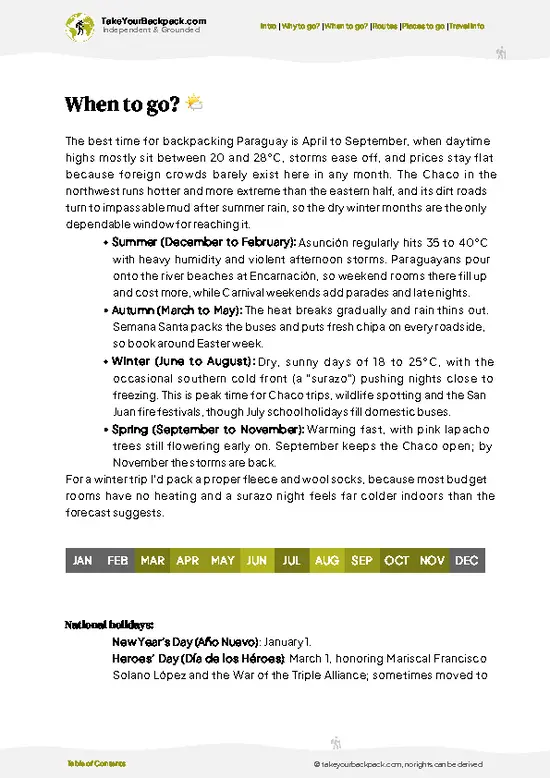
example page 3 from our offline Travel Guide for Paraguay
example page 4 from our offline Travel Guide for Paraguay
example page 5 from our offline Travel Guide for Paraguay
example page 6 from our offline Travel Guide for Paraguay
example page 7 from our offline Travel Guide for Paraguay
Loading the map 🌍
CLICK TO FILTER
cities
towns
landmarks
national parks
hikes
beaches
attractions
festivals
regions
SHOW COUNTRY’S BESTSHOW ALL

✨ Why go?
Ranked #1 city in Paraguay
Reasons people choose to visit here

Asunción works as a backpacking stop because the historic core is compact enough to cover on foot, and the main sights sit within a handful of streets around Plaza de los Héroes. That keeps your days simple and your transport needs low. Hostels cluster in the central barrios, so you can walk to dinner, a market or a bus line without planning. The second reason is routing. The city is the hub of Paraguay’s road network, and the Terminal de Ómnibus sends long-distance coaches toward Encarnación and the Jesuit missions, Ciudad del Este and the Iguazú border, and the Chaco. That makes it the natural place to rest between big overland legs. It also serves as a base for towns around Lake Ypacaraí, which are easier to reach from here than from anywhere else. Be honest with yourself about expectations: … read more 👉
Asunción works as a backpacking stop because the historic core is compact enough to cover on foot, and the main sights sit within a handful of streets around Plaza de los Héroes. That keeps your days simple and your transport needs low. Hostels cluster in the central barrios, so you can walk to dinner, a market or a bus line without planning. The second reason is routing. The city is the hub of Paraguay’s road network, and the Terminal de Ómnibus sends long-distance coaches toward Encarnación and the Jesuit missions, Ciudad del Este and the Iguazú border, and the Chaco. That makes it the natural place to rest between big overland legs. It also serves as a base for towns around Lake Ypacaraí, which are easier to reach from here than from anywhere else. Be honest with yourself about expectations: nightlife is modest outside a few districts, and the sights are quiet and historical. Two nights gives you the center and a museum or two. Add a third if you want to see how daily life runs in the markets and the cafés.

💡 HighlightsEssential experiences to have while visiting Asunción

  1. Palacio de los López: The neoclassical government palace on the riverfront, begun under Carlos Antonio López and finished in the 1860s. Guided visits are free, last about 45 minutes, and require ID, so bring your passport. The exterior is lit after dark, which is when the white facade looks best from the Costanera.
  2. Panteón Nacional de los Héroes: A small domed mausoleum holding the remains of national military figures, including Francisco Solano López and Chaco War dead, with an honor guard at the door. Entry is free and 20 to 30 minutes is enough. Morning is quieter.
  3. Casa de la Independencia: One of the oldest houses in the city, where the plotting for the 1811 independence movement took place. The rooms hold period furniture and documents. Entry is free or a token fee, and 30 to 45 minutes
… read more 👉
  1. Palacio de los López: The neoclassical government palace on the riverfront, begun under Carlos Antonio López and finished in the 1860s. Guided visits are free, last about 45 minutes, and require ID, so bring your passport. The exterior is lit after dark, which is when the white facade looks best from the Costanera.
  2. Panteón Nacional de los Héroes: A small domed mausoleum holding the remains of national military figures, including Francisco Solano López and Chaco War dead, with an honor guard at the door. Entry is free and 20 to 30 minutes is enough. Morning is quieter.
  3. Casa de la Independencia: One of the oldest houses in the city, where the plotting for the 1811 independence movement took place. The rooms hold period furniture and documents. Entry is free or a token fee, and 30 to 45 minutes covers it.
  4. Manzana de la Rivera: A block of restored colonial houses, including Casa Viola, used for exhibitions and photography shows. Expect to spend 1 hour, with entry between free and US$2. Weekday mornings are calm.
  5. Estación Central del Ferrocarril: The 19th-century station and railway museum, tied to what was one of South America’s earliest railways. Old wood-burning locomotives sit in the yard. Entry is about US$1 to 2, and 45 minutes is plenty.
  6. Museo del Barro: Contemporary art, popular crafts and Indigenous work under one roof, in a space outside the old center. Plan 1.5 to 2 hours and US$2 to 4. Take a taxi or ride-hailing car there, since it is not walkable from the center.
  7. Jardín Botánico y Zoológico: Shaded grounds on a former López family estate, with old trees, a small zoo and a modest natural history museum. Entry is about US$1 to 3, and 2 hours suits a slow wander. Go on a weekday for fewer school groups.
Beyond the city, easy day trips include the lakeside town of Areguá, the lace-making town of Itauguá, the pilgrimage basilica at Caacupé and San Bernardino on Lake Ypacaraí. The Panteón and the Palacio de los López sit close enough to see in one short morning.
Spotted a mistake or missing something? Contact us.

Things to do in Asunción

Ratings based on Tripadvisor reviews. When you book through this link, you support our work at no extra cost to you.

🏘️ NeighborhoodsNeighborhood guide to Asunción

Asunción is compact, but its districts differ sharply in pace, and the heat decides how much of it you will cover on foot.
  • Centro Histórico: The old core sits on the river, with the Palacio de López, the Panteón de los Héroes, the cathedral and Plaza de los Héroes within a few blocks. It is walkable, but the streets empty after office hours and on Sundays because the area is mostly government and commerce, so see it on a weekday morning, before the heat builds. Street vendors sell chipa and tereré supplies around the plazas.
  • Mercado 4 and surroundings: The big working market lies east of the center, along Avenida Silvio Pettirossi, with produce, herbs, clothing and cheap comedores. It is crowded and loud. Go in daylight with only a little cash and a bag worn in front; locals do the same.
  • Villa
… read more 👉
Asunción is compact, but its districts differ sharply in pace, and the heat decides how much of it you will cover on foot.
  • Centro Histórico: The old core sits on the river, with the Palacio de López, the Panteón de los Héroes, the cathedral and Plaza de los Héroes within a few blocks. It is walkable, but the streets empty after office hours and on Sundays because the area is mostly government and commerce, so see it on a weekday morning, before the heat builds. Street vendors sell chipa and tereré supplies around the plazas.
  • Mercado 4 and surroundings: The big working market lies east of the center, along Avenida Silvio Pettirossi, with produce, herbs, clothing and cheap comedores. It is crowded and loud. Go in daylight with only a little cash and a bag worn in front; locals do the same.
  • Villa Morra and Carmelitas: Residential-commercial districts east of the center, with the main malls, cafés, restaurants and most nightlife. Distances between places are longer, so experienced travelers take a short ride rather than walking in the midday sun. This is where you eat well after dark.
  • Recoleta: A leafy, calmer district with the cemetery, small cafés and some galleries. It is good for an unhurried afternoon, and shade makes walking tolerable.
  • Costanera and Bañado Sur edge: The riverfront promenade is pleasant in the evening when residents come out for tereré. The adjacent flood-prone Bañado neighborhoods are poor, and visitors have little reason to wander there.
  • Sajonia and Las Mercedes: Quiet, mostly residential areas near the river, with cheap local eateries. They suit travelers who want ordinary city life.

⌛️ 1 dayA smart one-day plan

8:00 AM, Plaza de los Héroes and Panteón Nacional: Start at the domed Panteón while the guard is fresh and the square is quiet. Ten to twenty minutes inside is enough to see the tombs, then walk a few blocks toward the river.

9:00 AM, Palacio de los López: Join a free guided visit with your passport. The route through the halls gives you the clearest picture of the López era. Afterward, stroll along the nearby riverfront to see the fishing boats below the palace.

10:30 AM, Casa de la Independencia: Short walk away. The rooms are small and the story is direct: this is where the 1811 plot was hatched. Pair it with a coffee at a nearby café.

12:00 PM, Manzana de la Rivera: Walk the restored colonial block and check which exhibitions are on in Casa Viola. The patios give a break from the street. … read more 👉
8:00 AM, Plaza de los Héroes and Panteón Nacional: Start at the domed Panteón while the guard is fresh and the square is quiet. Ten to twenty minutes inside is enough to see the tombs, then walk a few blocks toward the river.

9:00 AM, Palacio de los López: Join a free guided visit with your passport. The route through the halls gives you the clearest picture of the López era. Afterward, stroll along the nearby riverfront to see the fishing boats below the palace.

10:30 AM, Casa de la Independencia: Short walk away. The rooms are small and the story is direct: this is where the 1811 plot was hatched. Pair it with a coffee at a nearby café.

12:00 PM, Manzana de la Rivera: Walk the restored colonial block and check which exhibitions are on in Casa Viola. The patios give a break from the street.

1:30 PM, Lunch near the center: Order sopa paraguaya, mbejú or a milanesa at a local comedor. Locals eat early and fast, so go before the lunch queue builds.

3:00 PM, Estación Central del Ferrocarril: Walk or take a short taxi ride to the old station. The locomotives in the yard are the draw, and the building itself shows how ambitious the 19th-century state was.

4:30 PM, Cementerio de la Recoleta: Skip the standard circuit and take a short taxi to this old cemetery. The ornate mausoleums read like a tour of the city’s elite families, and it is quiet and rarely on any list. Go with respect, stay on the main paths and keep your voice down.

6:30 PM, Costanera: Finish along the riverfront, where families drink tereré on the benches. Ride back to the center by taxi or ride-hailing car for dinner.

🌤️ When to go?Weather, crowds, and seasonal trade-offs

March to May and September to November are the most comfortable stretches, with daytime highs around 24 to 30°C (75 to 86°F).
  • Summer (December to February): Hot and humid, with highs of 33 to 38°C (91 to 100°F) and heavy thunderstorms. Days are long, with about 14 hours of light. Local holidays around Christmas and New Year raise some prices.
  • Autumn (March to May): Warm days of 25 to 30°C (77 to 86°F), cooler nights and fewer storms. Crowds are minimal and walking is pleasant.
  • Winter (June to August): Mild afternoons of 20 to 25°C (68 to 77°F), but cold fronts can drop nights to 8 to 12°C (46 to 54°F). Light lasts about 10.5 hours. Rooms are often cheapest.
  • Spring (September to November): Warming from 26 to 33°C (79 to 91°F), with jacaranda and lapacho trees blooming.
Book transport early around Semana Santa, when many Asunceños travel home.

source: climatestotravel.comJANJanuary: good for travelingFEBFebruary: fair for travelingMARMarch: fair for travelingAPRApril: excellent for travelingMAYMay: highly recommended for travelingJUNJune: highly recommended for travelingJULJuly: highly recommended for travelingAUGAugust: highly recommended for travelingSEPSeptember: excellent for travelingOCTOctober: highly recommended for travelingNOVNovember: good for travelingDECDecember: good for traveling

✈️ The backpacker research shortcutParaguay Travel Guide

What the free pages can't give you: ready-made routes, every place ranked, and it works offline. All in 1 guide.
example page 0 from our offline Travel Guide for Paraguay
example page 1 from our offline Travel Guide for Paraguay
example page 2 from our offline Travel Guide for Paraguay
example page 3 from our offline Travel Guide for Paraguay
example page 4 from our offline Travel Guide for Paraguay
example page 5 from our offline Travel Guide for Paraguay
example page 6 from our offline Travel Guide for Paraguay
example page 7 from our offline Travel Guide for Paraguay
The digital guide (226 pages) contains:-page digital guide:
✅ Ready-made 5, 10 & 15-day routes
✅ All 65 places ranked, so you skip the overrated ones
✅ Works offline, all in 1 guide
✅ Cities, national parks, landmarks, beaches
✅ How to get around
👉 Click to see all 30+ guide features

📅 Plan smarter in minutes, not weeks
✅ Month by month travel advice
✅ Festivals & national holidays
✅ Budget expectations

🗺️ Go to the right places, skip the overrated ones
✅ Honest pros & cons of destinations
✅ Top hikes, parks & viewpoints
✅ Lesser-known places most travelers miss
✅ Clear “worth it vs skip it” guidance

🛏️ Travel smoothly without rookie mistakes
✅ Best areas to stay
✅ Transport systems explained simply
✅ Common scams & safety advice
✅ SIM cards, money & practical tips

🌍 Understand the country, not just visit it
✅ Culture & traditions
✅ 52 Essential phrases & customs
✅ Festivals worth planning around
✅ Traveler-friendly historical context
✅ Insights that make places more meaningful

📱 Built for real travel conditions
✅ Fully downloadable PDF
✅ Works completely offline
✅ Optimized for phone use
✅ Useful in remote areas & buses
✅ All in 1 guide
Stop searching, start planning
Get instant access to your full guide. 30‑day money-back guarantee.


By proceeding you agree to our terms.
Sent to your inbox immediately after payment • 100% Secure Checkout
Best Backpacking Travel Advisor 2025 tourism awardBest Backpacking
Travel Advisor
2025
What others say about Take Your Backpack Guides:
⭐⭐⭐⭐⭐
Fantastic, amazing amount of information!
⭐⭐⭐⭐⭐
My goodness this is amazing, it's what I've been looking for hats off too you!
⭐⭐⭐⭐⭐
I think this is absolutely BRILLIANT
⭐⭐⭐⭐
Very complete and informative. It's still missing places, but I gotta to commend you
⭐⭐⭐⭐⭐
This is truly amazing, thank you, can't wait to explore it with my kids!
⭐⭐⭐⭐⭐
Awesome resource, thank you!
⭐⭐⭐⭐⭐
This is amazing! Can't wait to explore the ones I haven't seen
⭐⭐⭐⭐
I love this! Well done, great idea.
⭐⭐⭐⭐⭐
Thanks for taking the time to make this gem!
⭐⭐⭐⭐⭐
This might be the best website I've ever seen.
⭐⭐⭐⭐⭐
Congratulations, and thank you so much for your work; it's incredibly valuable.
⭐⭐⭐⭐
In all seriousness I think you did a great job pointing out the important spots
⭐⭐⭐⭐⭐
10/10 very good
⭐⭐⭐⭐⭐
As someone who's only just starting to visit regularly this is awesome, thank you.
⭐⭐⭐⭐
Thank you very much! I'm going to visit my dad, it's going to be very useful!
⭐⭐⭐⭐⭐
This is really cool! We'll be travelling for the first time and this definitely come in handy.
⭐⭐⭐⭐⭐
You are now our minister of culture, congratulations 👨‍💼
⭐⭐⭐⭐⭐
Just wanted to tell you that this is a pearl! Going to follow your recommendations.
⭐⭐⭐⭐⭐
This is so cool. I'll definitely be using the resource for my travels soon.
⭐⭐⭐⭐⭐
This is very impressive! Good work.
⭐⭐⭐⭐⭐
This is an amazing and informative site. Very well done!

🛏️ Where to stay?Best areas to stay in Paraguay

Villa Morra and Carmelitas are the best bases for budget travelers, with Centro as a cheaper fallback for short stays.
Villa Morra and neighboring Carmelitas hold most of the city’s hostels and budget guesthouses, with dorm beds typically US$10 to 18. Streets are lit and busy into the evening, restaurants and supermarkets are close, and app rides to the center cost only a few dollars. Noise comes mainly from weekend nightlife, so ask for a room away from the street. Air conditioning is worth paying slightly more for in summer, since nights stay warm and humid.
Centro has a few cheaper hotels and … read more 👉
Villa Morra and Carmelitas are the best bases for budget travelers, with Centro as a cheaper fallback for short stays.
Villa Morra and neighboring Carmelitas hold most of the city’s hostels and budget guesthouses, with dorm beds typically US$10 to 18. Streets are lit and busy into the evening, restaurants and supermarkets are close, and app rides to the center cost only a few dollars. Noise comes mainly from weekend nightlife, so ask for a room away from the street. Air conditioning is worth paying slightly more for in summer, since nights stay warm and humid.
Centro has a few cheaper hotels and basic hostels, often US$8 to 15 for a bed or US$20 to 30 for a private room. It is convenient for early walks and close to bus lines, but it is quiet and poorly lit after dark, so getting back late means taking a ride rather than walking. The main bus terminal is in the south, and staying in either area means a 20 to 40 minute ride, depending on traffic. Book ahead in January and around Semana Santa.

🚌 Getting aroundHow to get from A to B

A city bus ride costs about US$0.50 to 0.60, paid with a rechargeable Jaha or Más card, since most lines no longer take cash. Asunción is spread out along the river, so the center is walkable but the malls and eateries of Villa Morra are not. Traffic is heavy at rush hour, and buses are frequent but crowded and slow.
  • Walking: Free and fine in the historic center in the morning. Heat and a lack of shade make afternoon walks tiring, so experienced travelers cover sights early and ride later.
  • City buses: Cheap and extensive, running roughly from 5 am to 11 pm, with reduced service late and on Sundays. Routes are hard to read because there is little signage, so use a maps app and ask the driver. Keep your bag in front on packed buses.
  • Ride-hailing apps: Bolt and Uber work and cost about US$2 to 5
… read more 👉
A city bus ride costs about US$0.50 to 0.60, paid with a rechargeable Jaha or Más card, since most lines no longer take cash. Asunción is spread out along the river, so the center is walkable but the malls and eateries of Villa Morra are not. Traffic is heavy at rush hour, and buses are frequent but crowded and slow.
  • Walking: Free and fine in the historic center in the morning. Heat and a lack of shade make afternoon walks tiring, so experienced travelers cover sights early and ride later.
  • City buses: Cheap and extensive, running roughly from 5 am to 11 pm, with reduced service late and on Sundays. Routes are hard to read because there is little signage, so use a maps app and ask the driver. Keep your bag in front on packed buses.
  • Ride-hailing apps: Bolt and Uber work and cost about US$2 to 5 for most trips in town. They are the smarter choice at night because the price is fixed and the route is tracked, instead of negotiating with street taxis.
  • Taxis: Metered or negotiated, typically US$3 to 7 across the city. Agree on the fare first if there is no meter, or call one by phone or app.
  • Intercity buses: The main terminal in the south runs services to Ciudad del Este (about 4.5 to 5 hours, US$10 to 15), Encarnación (about 5 to 6 hours, US$12 to 18) and nearer towns like Areguá and Itauguá. Buy tickets at the counter and arrive early for popular departures.

👛 Costs (as of 19 October 2026)Travel costs and budget guide for Asunción

Expect to spend about US$43 a day backpacking in Asunción, including a dorm bed in high season.
CategoryBudget RangeLocal Reality
Dorm accommodation (high season)US$12 to 18Dec to Feb, air conditioning is worth it; budget US$15 here
Dorm accommodation (off-season)US$9 to 14Winter beds are cheaper, though some include no heating
MealsUS$10 to 16Market comedores and lunch specials are US$2 to 5, restaurant dinners US$6 to 10; budget US$12
Local transportUS$2 to 6Buses are about US$0.50 to 0.60 a ride, short app rides US$2 to 5; budget US$4
City transport passUS$0 to 3No tourist pass; a rechargeable Jaha or Más bus card is needed on most lines; budget US$1
Basic activities and entry feesUS$2 to 10Many museums and churches cost under US$3 or are free; budget US$5
MiscellaneousUS$4 to 8Water, SIM data,
… read more 👉
Expect to spend about US$43 a day backpacking in Asunción, including a dorm bed in high season.
CategoryBudget RangeLocal Reality
Dorm accommodation (high season)US$12 to 18Dec to Feb, air conditioning is worth it; budget US$15 here
Dorm accommodation (off-season)US$9 to 14Winter beds are cheaper, though some include no heating
MealsUS$10 to 16Market comedores and lunch specials are US$2 to 5, restaurant dinners US$6 to 10; budget US$12
Local transportUS$2 to 6Buses are about US$0.50 to 0.60 a ride, short app rides US$2 to 5; budget US$4
City transport passUS$0 to 3No tourist pass; a rechargeable Jaha or Más bus card is needed on most lines; budget US$1
Basic activities and entry feesUS$2 to 10Many museums and churches cost under US$3 or are free; budget US$5
MiscellaneousUS$4 to 8Water, SIM data, laundry, snacks; budget US$6
Total Daily BudgetUS$43Per person, per day, in high season.
For savings, eat the set-lunch menu at local comedores and keep dinner light, since midday meals are the cheapest of the day.


source: senatur.gov.py
⚠️ Prices can change and everyone travels differently, so take this as a rough guide. Hope it helps you plan your adventure!

🚌 Day tripsShort trips worth adding

Asunción works well as a base for day trips, since several towns lie within one to two hours by bus and cost little.
Areguá:
A hillside town on Lake Ypacaraí known for ceramics, strawberries and colonial houses. Buses leave from the center or terminal and take about 45 minutes to 1 hour, with a budget of US$5 to 12 including lunch. Go on a weekday to avoid weekend crowds.
👉 Explore Areguá
San Bernardino:
A lakeside resort town founded by German settlers, about 1 to 1.5 hours by bus. It is lively in summer, when Paraguayans swim and party, and quiet in winter. Budget US$8 to 15. First-timers often arrive on a winter weekday and find most places closed.
👉 Explore San Bernardino
Itauguá:
Home of ñandutí lace, a spiderweb-style craft sold in shops around the plaza and the small museum. It is about … read more 👉
Asunción works well as a base for day trips, since several towns lie within one to two hours by bus and cost little.
Areguá:
A hillside town on Lake Ypacaraí known for ceramics, strawberries and colonial houses. Buses leave from the center or terminal and take about 45 minutes to 1 hour, with a budget of US$5 to 12 including lunch. Go on a weekday to avoid weekend crowds.
👉 Explore Areguá
San Bernardino:
A lakeside resort town founded by German settlers, about 1 to 1.5 hours by bus. It is lively in summer, when Paraguayans swim and party, and quiet in winter. Budget US$8 to 15. First-timers often arrive on a winter weekday and find most places closed.
👉 Explore San Bernardino
Itauguá:
Home of ñandutí lace, a spiderweb-style craft sold in shops around the plaza and the small museum. It is about 40 minutes by bus for under US$3 each way. A morning visit leaves time to combine it with Areguá.
👉 Explore Itauguá
Caacupé:
The country’s main pilgrimage site, with a large basilica, about 1 to 1.5 hours away by bus for US$2 to 4 each way. December 8 draws huge crowds, so avoid that date unless you want to see the pilgrimage.
👉 Explore Caacupé
Yaguarón and Paraguarí:
A Franciscan church with painted wooden interiors sits in Yaguarón, about 1 hour south. Buses cost US$2 to 4 each way, and a half day is enough.

🍲 FoodEating & Drinking in Asunción

Asunción’s table is built on mandioca (cassava), corn and cheese. Look for sopa paraguaya, a dense cornbread, chipa, cheesy rings sold warm by street vendors around the plazas, and mbejú, a starchy cassava pancake. Bori bori, a chicken soup with corn dumplings, shows up at lunch counters on cooler days. Barbecue (asado) and river fish like surubí appear on menus along the Costanera and in casual parrillas.
For cheap meals, try the comedores inside Mercado 4, where a plate costs around US$2 to 4, and the lunch specials in downtown cafés. Villa Morra and Carmelitas have the broader range of casual restaurants and bars, with mains typically US$5 to 10.
The drink that matters is tereré: cold yerba mate sipped from a shared horn cup (guampa) with herbs (yuyos) often added. Offices and plazas fill … read more 👉
Asunción’s table is built on mandioca (cassava), corn and cheese. Look for sopa paraguaya, a dense cornbread, chipa, cheesy rings sold warm by street vendors around the plazas, and mbejú, a starchy cassava pancake. Bori bori, a chicken soup with corn dumplings, shows up at lunch counters on cooler days. Barbecue (asado) and river fish like surubí appear on menus along the Costanera and in casual parrillas.
For cheap meals, try the comedores inside Mercado 4, where a plate costs around US$2 to 4, and the lunch specials in downtown cafés. Villa Morra and Carmelitas have the broader range of casual restaurants and bars, with mains typically US$5 to 10.
The drink that matters is tereré: cold yerba mate sipped from a shared horn cup (guampa) with herbs (yuyos) often added. Offices and plazas fill with people carrying thermoses, and if you are offered a turn, drink it all and hand it back without saying thanks until you are done. Local beer and caña (sugarcane spirit) are cheap.

🛡️ SafetyTraveler Safety Guide

Asunción is manageable for backpackers if you apply ordinary city habits. The most common problems are phone snatching and bag theft, especially around Mercado 4, crowded buses and the center when streets empty. Keep your phone out of sight near the curb, since motorbike thieves grab devices from pedestrians, and carry only the cash you need. After dark, avoid walking in Centro and the riverside slums near Bañado; a ride-hailing app costs a few dollars and is simple. Solo travelers, including women, generally report few issues in Villa Morra and Carmelitas, though catcalling happens. Taxi drivers may inflate fares for foreigners, so use apps or agree on a price first. At ATMs, prefer those inside malls or banks. Summer heat and sudden storms cause more trouble than crime, so carry water and expect flooded streets.

FAQFrequently asked questions about Asunción

Two to three days covers Asunción well. One day handles the historic center, including the Palacio de López and the Panteón de los Héroes, and a second adds Recoleta, Villa Morra and the Costanera. A third day suits a trip to Areguá or Itauguá, each about 40 minutes to 1 hour away by bus for under US$5.
Asunción is reasonably safe for solo backpackers who use common sense. Phone and bag snatching around Mercado 4, crowded buses and the empty center after dark are the main risks, so take a ride app (US$2 to 5) at night rather than walking. Villa Morra and Carmelitas are the easiest areas for solo travelers to stay and eat.
Asunción is known for its riverside colonial-era center, the Palacio de López and the Panteón de los Héroes, plus the national drink tereré, chipa and ñandutí lace from nearby Itauguá. It sits on the Paraguay River, and it is one of the cheapest capitals in South America, with a dorm bed around US$9 to 18. It also serves as the gateway to Lake Ypacaraí towns such as Areguá and San Bernardino.
⚠️ Things can change over time, so always validate details locally before you go.

Other Paraguayan cities near Asunción

Explore more nearby:

  • Itauguá—Ñandutí lace, Virgin of Candelaria, roadside stalls, home workshops| 30 km away
  • Pilar—River costanera, textile outlets, chipa market, old port| 188 km away
  • Encarnación—Riverside promenade, man-made beach, Carnival parade ground, lower town| 288 km away

💡 Not sure where to go next?
Create a personalized itinerary for Paraguay including Asunción and the places that fit your trip.

Generate my itinerary

👉 Discover all cities

Or checkout all Paraguay has to offer (think cities, towns, villages, national parks, hikes, beaches, festivals)
Country photo of Paraguay

We 💚 feedbackSumming up the experience

Asunción will please travelers who enjoy history, markets and slow, unscripted afternoons, and who treat it as a calm pause between bigger overland legs. Thrill seekers and anyone wanting a polished old town should keep it to a night or two. I would stay in a central barrio near Plaza de los Héroes and spend the rest of the time moving between the museums and the riverfront.

✈️ When did I visit Paraguay?
Before visiting Argentina in September 2012, I crossed through Paraguay, ending up at the magical Iguazu Falls.

✍️ Help improve this page!
The information on this page is based on my own backpacking experience in Paraguay, supplemented with up-to-date research and feedback from other travelers. Travel details can change, so if you notice anything outdated or incomplete, feel free to let me know.


🙋‍♂️ Give feedback

👋 Meet the founderWho’s Behind Take Your Backpack?

Johan, backpacker and founder of TakeYourBackpackHi, I’m Johan (Netherlands 🇳🇱), the creator of TakeYourBackpack. Over the past 30 years, I’ve backpacked through 88 countries across six continents, gaining extensive experience with independent travel, long-term trips, and overland routes.

This site is built on a combination of firsthand travel experience and carefully curated insights from other backpackers. Many guides are based on places I’ve personally visited, while others bring together tips, observations, and practical advice shared by trusted travelers I’ve met along the way.

The goal is to provide realistic, experience-driven guidance — not generic itineraries — so you can explore destinations with better context, clearer expectations, and more confidence.