×

Paraguay🇵🇾 | citiesCiudad del EsteDuty-free arcades, Friendship Bridge, Itaipú Dam, forest refuge | things to do and best time to go

Explore EncarnaciónExplore Pedro Juan Caballero

Backpacking in Ciudad del Este
🌟 Highlightcity ranked #3
By Johan Kruseman 🇳🇱 | Updated October 19, 2026

Most people come to Ciudad del Este for the duty-free shopping: electronics, perfume and liquor sold along the crowded streets near the Friendship Bridge. What gets overlooked is that it works as the practical gateway to Itaipú Dam and the Iguazú Falls region, with three countries within easy reach. The city sits in the east of Paraguay, on the Paraná River across from Brazil. My mistake was buying a gadget from the first stall I saw, then finding the same model a block away for less and with a proper warranty. Prices are negotiable here, so an experienced traveler compares at three shops, pays in cash and tests the item before leaving. Bring small bills, because change is often short. The city is loud, chaotic and unpolished, with little in the way of old-town charm. It suits bargain hunters, border-crossers and curious travelers who like working-city energy, and it won’t suit anyone wanting quiet streets or relaxed sightseeing.

Part of Backpacking in Paraguay: all 65 places on one map, with routes and the best time to go.
Discover everything you want to know in the 📖 Paraguay Travel Guide.


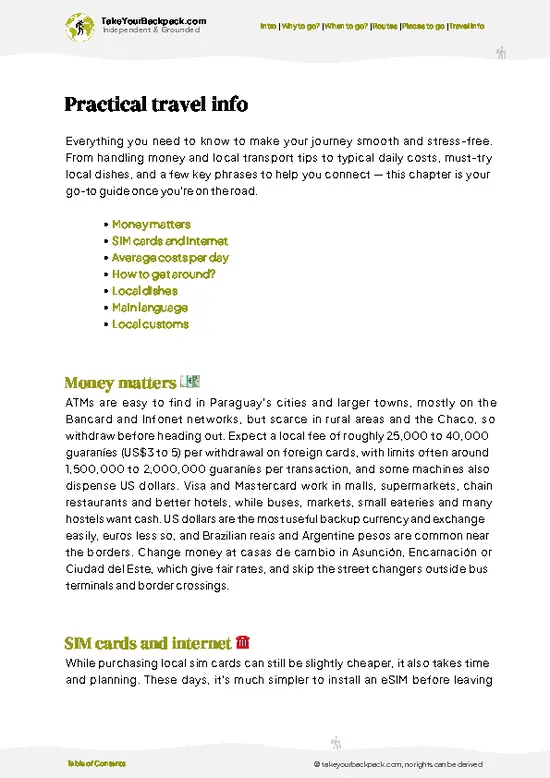
example page 0 from our offline Travel Guide for Paraguay
example page 1 from our offline Travel Guide for Paraguay
example page 2 from our offline Travel Guide for Paraguay
example page 3 from our offline Travel Guide for Paraguay
example page 4 from our offline Travel Guide for Paraguay
example page 5 from our offline Travel Guide for Paraguay
example page 6 from our offline Travel Guide for Paraguay
example page 7 from our offline Travel Guide for Paraguay
Loading the map 🌍
CLICK TO FILTER
cities
towns
landmarks
national parks
hikes
beaches
attractions
festivals
regions
SHOW COUNTRY’S BESTSHOW ALL

✨ Why go?
Ranked #3 city in Paraguay
What makes this city worth visiting

Ciudad del Este earns its place on a route as a hinge between countries, not as a place to linger. It sits at the meeting point of Paraguay, Brazil and Argentina, so travelers heading to the falls on either side often pass through, and the border crossing is a short hop from the center. The second reason is the engineering on its doorstep: the Itaipú Dam, one of the largest hydroelectric plants on Earth, is close enough for a half-day outing. Shopping is the third, and it is a real activity rather than a punchline: the Monday to Saturday commercial zone draws buyers from across South America, and sharp bargaining is part of the fun. Walking the center is manageable, though sidewalks are crowded with vendors and heat adds up. Nightlife is modest and hostels are limited, so most backpackers … read more 👉
Ciudad del Este earns its place on a route as a hinge between countries, not as a place to linger. It sits at the meeting point of Paraguay, Brazil and Argentina, so travelers heading to the falls on either side often pass through, and the border crossing is a short hop from the center. The second reason is the engineering on its doorstep: the Itaipú Dam, one of the largest hydroelectric plants on Earth, is close enough for a half-day outing. Shopping is the third, and it is a real activity rather than a punchline: the Monday to Saturday commercial zone draws buyers from across South America, and sharp bargaining is part of the fun. Walking the center is manageable, though sidewalks are crowded with vendors and heat adds up. Nightlife is modest and hostels are limited, so most backpackers treat the city as one or two nights, long enough to shop, see the dam and move on. If you want pretty streets and cafés, stay across the border instead.

💡 HighlightsThe experiences that define the visit

  1. Itaipú Dam (visitor complex, Hernandarias): The binational hydroelectric plant on the Paraná River is the reason many people stop here at all. Visits on the Paraguayan side, including the panoramic bus tour, are free but need a reservation. Go on a weekday morning, when groups are small. Allow 2 to 3 hours including the film.
  2. Friendship Bridge (Puente de la Amistad): The 552 meter span to Foz do Iguaçu in Brazil is the artery of the whole city. Watch the crossing from the Paraguayan side to see motorbike taxis, porters and trucks squeeze through. Free, 20 to 30 minutes. Mornings are busiest.
  3. Monday Market and shopping galleries (Avenida San Blas and Avenida Monseñor Rodríguez): Electronics, perfume, liquor and sportswear fill the arcades, and prices drop if you bargain politely and pay in cash.
… read more 👉
  1. Itaipú Dam (visitor complex, Hernandarias): The binational hydroelectric plant on the Paraná River is the reason many people stop here at all. Visits on the Paraguayan side, including the panoramic bus tour, are free but need a reservation. Go on a weekday morning, when groups are small. Allow 2 to 3 hours including the film.
  2. Friendship Bridge (Puente de la Amistad): The 552 meter span to Foz do Iguaçu in Brazil is the artery of the whole city. Watch the crossing from the Paraguayan side to see motorbike taxis, porters and trucks squeeze through. Free, 20 to 30 minutes. Mornings are busiest.
  3. Monday Market and shopping galleries (Avenida San Blas and Avenida Monseñor Rodríguez): Electronics, perfume, liquor and sportswear fill the arcades, and prices drop if you bargain politely and pay in cash. Weekday mornings are calmer than Saturdays. Entry is free; budget 2 to 3 hours and carry your passport copy.
  4. Monday Falls (Saltos del Monday): A broad 45 meter waterfall on the Monday River, a short ride from the center, with a small park and viewing platforms. Entry is about US$6 for foreigners. Visit after rain for full flow. Plan 1 to 2 hours.
  5. Museo de la Tierra Guaraní (Itaipú Biological Refuge area): Exhibits cover Guaraní history, local archaeology and the flooding of the reservoir lands. Entry is free. Allow 1 to 2 hours, best on a weekday.
  6. Catedral San Blas: The city’s main church sits amid the commercial grid and offers a quiet pause from the shopping noise. Free, 15 to 20 minutes. Morning light is gentle, and services are the best time to see it in use.
  7. Itaipú Ecological Refuge Tatí Yupí: A forest reserve with trails, wildlife and a small education center, run by the dam company. Entry is typically free or very cheap, and guided visits cost a few dollars. Go early for cooler walking and more birds. Plan 2 to 3 hours.
Day trips include Iguazú Falls on the Argentine and Brazilian sides, Foz do Iguaçu’s Bird Park, and the Jesuit ruins of Trinidad and Jesús to the south. The reserve at Tatí Yupí gets far fewer visitors than the dam, yet its forest trails show the Atlantic Forest that once covered this whole region.
Spotted a mistake or missing something? Contact us.

🏘️ NeighborhoodsNeighborhood guide to Ciudad del Este

Ciudad del Este is a commercial border city, and its areas are easiest to understand by what each one is for. Distances are short, but the heat and traffic make some walks poor value.
  • Microcentro and the Avenida San Blas / Monseñor Rodríguez shopping streets: This is the duty-free zone, packed with electronics, perfume and clothing stalls and arcades, mostly busy from early morning until mid-afternoon. Shops cater to Brazilian day shoppers, so they pack up early in the evening. Go on a weekday morning, compare prices at three stalls before buying, and expect to bargain. It is walkable, but crowded and hot.
  • Around the Puente de la Amistad: The border crossing to Foz do Iguaçu in Brazil is chaotic, with motorbike taxis, porters and pedestrians in constant flow. Immigration stamps matter here,
… read more 👉
Ciudad del Este is a commercial border city, and its areas are easiest to understand by what each one is for. Distances are short, but the heat and traffic make some walks poor value.
  • Microcentro and the Avenida San Blas / Monseñor Rodríguez shopping streets: This is the duty-free zone, packed with electronics, perfume and clothing stalls and arcades, mostly busy from early morning until mid-afternoon. Shops cater to Brazilian day shoppers, so they pack up early in the evening. Go on a weekday morning, compare prices at three stalls before buying, and expect to bargain. It is walkable, but crowded and hot.
  • Around the Puente de la Amistad: The border crossing to Foz do Iguaçu in Brazil is chaotic, with motorbike taxis, porters and pedestrians in constant flow. Immigration stamps matter here, and experienced travelers get them on both sides rather than trusting the crowd to wave them through. Walking the bridge takes about 15 to 20 minutes in good conditions.
  • Area Uno and the Avenida Alejo García corridor: A calmer, more residential zone with modern cafés, supermarkets, banks and restaurants where locals eat. You will want a short taxi or app ride to reach it from the microcentro, since the stretch between is loud and shadeless.
  • Avenida Boquerón and Ruta 7 edge: Wider roads with bus offices, car dealers and a few budget eateries. Little to see, but useful for onward transport.
  • Monday Falls and Itaipú side: A few kilometers out, with the Salto Monday waterfall and the Itaipú viewpoint. Go by taxi or local bus rather than walking along the highway.

⌛️ 1 dayWhat you can realistically do in a day

8:00 AM, Itaipú Dam: Start with the dam’s panoramic tour, since this is the one stop not to skip. The scale of the wall and the spillway make sense only in person, and the morning is quieter. Take a taxi or ride-hailing car back into town afterward.
11:30 AM, Museo de la Tierra Guaraní: Stop at the nearby museum and refuge for a shaded walk and a look at Indigenous history and local wildlife. It adds the context the dam skips, and few visitors bother. Return to the center by taxi.
1:00 PM, Lunch at Mercado Municipal: Eat Paraguayan staples such as chipa, sopa paraguaya or grilled meat from a market stall. Prices are low and the crowd is mostly local. Keep small bills ready.
2:30 PM, Commercial center: Walk the shopping streets around Avenida San Blas. Compare prices at several shops, bargain … read more 👉
8:00 AM, Itaipú Dam: Start with the dam’s panoramic tour, since this is the one stop not to skip. The scale of the wall and the spillway make sense only in person, and the morning is quieter. Take a taxi or ride-hailing car back into town afterward.
11:30 AM, Museo de la Tierra Guaraní: Stop at the nearby museum and refuge for a shaded walk and a look at Indigenous history and local wildlife. It adds the context the dam skips, and few visitors bother. Return to the center by taxi.
1:00 PM, Lunch at Mercado Municipal: Eat Paraguayan staples such as chipa, sopa paraguaya or grilled meat from a market stall. Prices are low and the crowd is mostly local. Keep small bills ready.
2:30 PM, Commercial center: Walk the shopping streets around Avenida San Blas. Compare prices at several shops, bargain firmly and test electronics before paying. Keep valuables in a front pocket and avoid carrying more cash than needed.
5:00 PM, Friendship Bridge: Walk toward the bridge to watch the late afternoon traffic and the river beyond. It is a lively, slightly chaotic sight and a fitting end to a day in a border city. Do not cross unless your documents are in order.
6:30 PM, Dinner: Settle in at a restaurant near the center for Asian or Lebanese dishes that reflect the city’s trading communities, then head back to your hostel before the streets empty.

🌤️ When to go?Choosing the right time of year

March to May and September to November give the most comfortable conditions for walking Ciudad del Este's shopping streets and the nearby falls.
  • Summer (December to February): Hot and humid, highs of 32 to 38°C (90 to 100°F), with heavy afternoon storms. Daylight stretches to around 14 hours. Brazilian holiday shoppers swell the crowds, especially in January, and the streets feel punishing by midday.
  • Autumn (March to May): Highs of 25 to 30°C (77 to 86°F), cooling steadily, with fewer downpours and good conditions at the waterfalls.
  • Winter (June to August): Mild days of 18 to 24°C (64 to 75°F), nights that can drop to 5 to 10°C (41 to 50°F), and about 10 hours of daylight. Shopping is comfortable and quieter.
  • Spring (September to November): Warming from 24 to 33°C (75 to 91°F), with scattered
… read more 👉
March to May and September to November give the most comfortable conditions for walking Ciudad del Este's shopping streets and the nearby falls.
  • Summer (December to February): Hot and humid, highs of 32 to 38°C (90 to 100°F), with heavy afternoon storms. Daylight stretches to around 14 hours. Brazilian holiday shoppers swell the crowds, especially in January, and the streets feel punishing by midday.
  • Autumn (March to May): Highs of 25 to 30°C (77 to 86°F), cooling steadily, with fewer downpours and good conditions at the waterfalls.
  • Winter (June to August): Mild days of 18 to 24°C (64 to 75°F), nights that can drop to 5 to 10°C (41 to 50°F), and about 10 hours of daylight. Shopping is comfortable and quieter.
  • Spring (September to November): Warming from 24 to 33°C (75 to 91°F), with scattered storms and good light for the falls.
Aim for a weekday outside Brazilian holidays, when the shopping streets and bridge are far less congested.


source: climatestotravel.comJANJanuary: fair for travelingFEBFebruary: fair for travelingMARMarch: highly recommended for travelingAPRApril: highly recommended for travelingMAYMay: highly recommended for travelingJUNJune: excellent for travelingJULJuly: excellent for travelingAUGAugust: excellent for travelingSEPSeptember: highly recommended for travelingOCTOctober: highly recommended for travelingNOVNovember: highly recommended for travelingDECDecember: fair for traveling
when-to-go

✈️ The backpacker research shortcutParaguay Travel Guide

What the free pages can't give you: ready-made routes, every place ranked, and it works offline. All in 1 guide.
example page 0 from our offline Travel Guide for Paraguay
example page 1 from our offline Travel Guide for Paraguay
example page 2 from our offline Travel Guide for Paraguay
example page 3 from our offline Travel Guide for Paraguay
example page 4 from our offline Travel Guide for Paraguay
example page 5 from our offline Travel Guide for Paraguay
example page 6 from our offline Travel Guide for Paraguay
example page 7 from our offline Travel Guide for Paraguay
The digital guide (226 pages) contains:-page digital guide:
✅ Ready-made 5, 10 & 15-day routes
✅ All 65 places ranked, so you skip the overrated ones
✅ Works offline, all in 1 guide
✅ Cities, national parks, landmarks, beaches
✅ How to get around
👉 Click to see all 30+ guide features

📅 Plan smarter in minutes, not weeks
✅ Month by month travel advice
✅ Festivals & national holidays
✅ Budget expectations

🗺️ Go to the right places, skip the overrated ones
✅ Honest pros & cons of destinations
✅ Top hikes, parks & viewpoints
✅ Lesser-known places most travelers miss
✅ Clear “worth it vs skip it” guidance

🛏️ Travel smoothly without rookie mistakes
✅ Best areas to stay
✅ Transport systems explained simply
✅ Common scams & safety advice
✅ SIM cards, money & practical tips

🌍 Understand the country, not just visit it
✅ Culture & traditions
✅ 52 Essential phrases & customs
✅ Festivals worth planning around
✅ Traveler-friendly historical context
✅ Insights that make places more meaningful

📱 Built for real travel conditions
✅ Fully downloadable PDF
✅ Works completely offline
✅ Optimized for phone use
✅ Useful in remote areas & buses
✅ All in 1 guide
Stop searching, start planning
Get instant access to your full guide. 30‑day money-back guarantee.


By proceeding you agree to our terms.
Sent to your inbox immediately after payment • 100% Secure Checkout
Best Backpacking Travel Advisor 2025 tourism awardBest Backpacking
Travel Advisor
2025
What others say about Take Your Backpack Guides:
⭐⭐⭐⭐⭐
Fantastic, amazing amount of information!
⭐⭐⭐⭐⭐
My goodness this is amazing, it's what I've been looking for hats off too you!
⭐⭐⭐⭐⭐
I think this is absolutely BRILLIANT
⭐⭐⭐⭐
Very complete and informative. It's still missing places, but I gotta to commend you
⭐⭐⭐⭐⭐
This is truly amazing, thank you, can't wait to explore it with my kids!
⭐⭐⭐⭐⭐
Awesome resource, thank you!
⭐⭐⭐⭐⭐
This is amazing! Can't wait to explore the ones I haven't seen
⭐⭐⭐⭐
I love this! Well done, great idea.
⭐⭐⭐⭐⭐
Thanks for taking the time to make this gem!
⭐⭐⭐⭐⭐
This might be the best website I've ever seen.
⭐⭐⭐⭐⭐
Congratulations, and thank you so much for your work; it's incredibly valuable.
⭐⭐⭐⭐
In all seriousness I think you did a great job pointing out the important spots
⭐⭐⭐⭐⭐
10/10 very good
⭐⭐⭐⭐⭐
As someone who's only just starting to visit regularly this is awesome, thank you.
⭐⭐⭐⭐
Thank you very much! I'm going to visit my dad, it's going to be very useful!
⭐⭐⭐⭐⭐
This is really cool! We'll be travelling for the first time and this definitely come in handy.
⭐⭐⭐⭐⭐
You are now our minister of culture, congratulations 👨‍💼
⭐⭐⭐⭐⭐
Just wanted to tell you that this is a pearl! Going to follow your recommendations.
⭐⭐⭐⭐⭐
This is so cool. I'll definitely be using the resource for my travels soon.
⭐⭐⭐⭐⭐
This is very impressive! Good work.
⭐⭐⭐⭐⭐
This is an amazing and informative site. Very well done!

🛏️ Where to stay?Choosing the right base

Area Uno and the streets near Avenida Alejo García are the best bet for a budget bed in Ciudad del Este, with basic guesthouses and a handful of hostel-style rooms at roughly US$12 to 25 for a dorm or simple private room.
The reason is practical. These blocks stay quieter at night than the shopping zone, have cafés, supermarkets and ATMs within a few minutes on foot, and feel safer to return to after dark. Taxis and ride apps reach the bus terminal and the bridge in 10 to 15 minutes.
The microcentro is the second option, and it suits travelers who want to be steps from the stalls and the border … read more 👉
Area Uno and the streets near Avenida Alejo García are the best bet for a budget bed in Ciudad del Este, with basic guesthouses and a handful of hostel-style rooms at roughly US$12 to 25 for a dorm or simple private room.
The reason is practical. These blocks stay quieter at night than the shopping zone, have cafés, supermarkets and ATMs within a few minutes on foot, and feel safer to return to after dark. Taxis and ride apps reach the bus terminal and the bridge in 10 to 15 minutes.
The microcentro is the second option, and it suits travelers who want to be steps from the stalls and the border crossing at dawn. Rooms are cheaper and more plentiful, but the area empties after the stores close, street lighting is uneven, and you will be woken by early deliveries and loudspeakers. Choose a place with a locked entrance and a staffed front desk.
Many backpackers skip Ciudad del Este as an overnight base entirely and sleep in Foz do Iguaçu in Brazil or Puerto Iguazú in Argentina, where hostels are more numerous. If you do stay, book ahead on Brazilian holiday weekends, when prices rise and rooms fill.

🚌 Getting aroundHow to get around Ciudad del Este

Most long-distance buses arrive at the terminal on the edge of town, and a taxi or app ride to the center takes 10 to 15 minutes for roughly US$3 to 5, while city buses cost under US$1 but wind through slow routes. Experienced travelers agree on a taxi price before getting in, since meters are rare, or use a ride app for a fixed fare.
The center is flat and compact, but the heat, pavement vendors and constant traffic make long walks tiring. Public transport exists but is informal and crowded, so most backpackers combine walking with short rides.
  • Walking: Fine inside the microcentro and across the Friendship Bridge, which takes about 15 to 20 minutes. Keep to the shaded side, carry water, and stay alert on narrow, crowded sidewalks where motorbikes cut through.
  • Local buses: Fares run about US$0.
… read more 👉
Most long-distance buses arrive at the terminal on the edge of town, and a taxi or app ride to the center takes 10 to 15 minutes for roughly US$3 to 5, while city buses cost under US$1 but wind through slow routes. Experienced travelers agree on a taxi price before getting in, since meters are rare, or use a ride app for a fixed fare.
The center is flat and compact, but the heat, pavement vendors and constant traffic make long walks tiring. Public transport exists but is informal and crowded, so most backpackers combine walking with short rides.
  • Walking: Fine inside the microcentro and across the Friendship Bridge, which takes about 15 to 20 minutes. Keep to the shaded side, carry water, and stay alert on narrow, crowded sidewalks where motorbikes cut through.
  • Local buses: Fares run about US$0.50 to 0.80, paid in cash on board. Routes are marked on the windshield rather than at stops, so ask the driver or conductor. They run from early morning until around 9 or 10 pm, less often late.
  • Taxis and ride apps: Short trips in town cost US$2 to 5, with the Itaipú or Monday Falls side at US$5 to 10. Apps give a fixed price and a record of the ride, which is why many travelers prefer them to street hails.
  • Motorbike taxis: Quick through jammed streets and around the bridge, about US$1 to 3 per ride. Helmets are not always provided, so a taxi is the sounder choice if you carry a big pack.
  • Cross-border buses: Brazilian city buses cross the bridge toward Foz do Iguaçu for about US$1 to 2, but they do not always wait at immigration. Get your stamps first, then board the next one rather than staying on without them.

👛 Costs (as of 19 October 2026)How expensive it really is

Ciudad del Este costs a backpacker about US$40 to 55 a day, and the total below of US$49 uses high-season dorm prices. Prices are quoted in US dollars, though you pay in guaraníes (cash dollars are also widely accepted in the shopping district).
CategoryBudget RangeLocal Reality
Dorm bed (high season)US$12 to 16Beds fill up around holidays and on shopping weekends, so book ahead. Figure US$14 for the total.
Dorm bed (off-season)US$9 to 13Quieter months bring lower rates and easier haggling for longer stays.
MealsUS$10 to 18A set lunch (menú del día) or a plate of chipa and empanadas is cheap. Sit-down dinners and Brazilian-style grill buffets by weight cost more. Figure US$14.
Local transportUS$1 to 4City buses cost well under US$1 a ride. Short taxi hops or app rides run US$2 to 5. Figure US$3.
… read more 👉
Ciudad del Este costs a backpacker about US$40 to 55 a day, and the total below of US$49 uses high-season dorm prices. Prices are quoted in US dollars, though you pay in guaraníes (cash dollars are also widely accepted in the shopping district).
CategoryBudget RangeLocal Reality
Dorm bed (high season)US$12 to 16Beds fill up around holidays and on shopping weekends, so book ahead. Figure US$14 for the total.
Dorm bed (off-season)US$9 to 13Quieter months bring lower rates and easier haggling for longer stays.
MealsUS$10 to 18A set lunch (menú del día) or a plate of chipa and empanadas is cheap. Sit-down dinners and Brazilian-style grill buffets by weight cost more. Figure US$14.
Local transportUS$1 to 4City buses cost well under US$1 a ride. Short taxi hops or app rides run US$2 to 5. Figure US$3.
City transport passNot availableNo pass exists, so you pay per ride in cash.
Basic activities and entry feesUS$0 to 8Itaipú visits on the Paraguayan side, the Museo de la Tierra Guaraní and the Tati Yupi reserve are free with a reservation. Saltos del Monday costs about US$6 for foreigners. Figure US$8 for a day with one paid entry.
MiscellaneousUS$4 to 10Water, SIM data, laundry, and the walk or ride across the Friendship Bridge to Brazil. Figure US$5.
Total Daily BudgetUS$49Per person, per day, in high season.
Buy a few items only after comparing prices at two or three shops on Avenida San Blas, and pay in cash dollars, since vendors often give a better rate than for cards.


source: senatur.gov.py
⚠️ Prices can change and everyone travels differently, so take this as a rough guide. Hope it helps you plan your adventure!

🚌 Day tripsWhere to go beyond the main area

Ciudad del Este works well as a day-trip base thanks to its position on the Paraná, with Brazil and Argentina within an hour and the Paraguayan interior reachable by bus along Ruta 7.
Foz do Iguaçu and the Brazilian Falls:
The Brazilian side of Iguazú Falls gives broad panoramic views and a walkway over the water. From the city, allow 45 minutes to 1 hour each way via the bridge, with US$1 to 2 for the bus and an entry fee of about US$25 to 30. First-timers often forget to carry passports and miss the immigration stamp at the bridge. Best from March to November.

Itaipú Dam:
One of the largest hydroelectric plants in the world sits 15 to 25 minutes from the center. Visitor tours on the Paraguayan side are free with a reservation and include a bus ride, a film and viewpoints. Arrive in the morning, … read more 👉
Ciudad del Este works well as a day-trip base thanks to its position on the Paraná, with Brazil and Argentina within an hour and the Paraguayan interior reachable by bus along Ruta 7.
Foz do Iguaçu and the Brazilian Falls:
The Brazilian side of Iguazú Falls gives broad panoramic views and a walkway over the water. From the city, allow 45 minutes to 1 hour each way via the bridge, with US$1 to 2 for the bus and an entry fee of about US$25 to 30. First-timers often forget to carry passports and miss the immigration stamp at the bridge. Best from March to November.

Itaipú Dam:
One of the largest hydroelectric plants in the world sits 15 to 25 minutes from the center. Visitor tours on the Paraguayan side are free with a reservation and include a bus ride, a film and viewpoints. Arrive in the morning, since the lines grow by midday, and bring ID.

Salto Monday:
A 40 meter waterfall in a small park just outside town, reached in 10 to 15 minutes by taxi for about US$3 to 6. Entry is about US$6 for foreigners. Go after rain for the full flow, but not during a storm when paths turn slick.

Puerto Iguazú and the Argentine Falls:
The Argentine side offers the longest trails and the Devil’s Throat. Plan 1.5 to 2 hours each way including two border checks, and about US$35 to 50 total with entry. Many first-timers underestimate crossing delays, so start before 8 am.

🍲 FoodLocal Flavors for Backpackers

Eating in Ciudad del Este reflects the border: Paraguayan staples sit beside Brazilian churrascarias, Lebanese snacks and Asian food, because Arab, Chinese, Korean and Taiwanese merchants have long shaped the city’s commerce. That mix is what sets it apart from the rest of the country.
For a quick lunch, look for kibbeh, shawarma and esfiha at small shops near the microcentro, usually US$2 to 5. Heavy parrillada grills serve beef by weight and suit groups, with a meal around US$8 to 15. Along the Paraná, river fish such as surubí or dorado appear grilled or in a milanesa, a regional touch you will not see everywhere.
Snack stalls sell chipa and sopa paraguaya by the bus offices, and people sip tereré, the iced herbal mate, from thermoses at nearly every corner. Sharing is the custom here, so … read more 👉
Eating in Ciudad del Este reflects the border: Paraguayan staples sit beside Brazilian churrascarias, Lebanese snacks and Asian food, because Arab, Chinese, Korean and Taiwanese merchants have long shaped the city’s commerce. That mix is what sets it apart from the rest of the country.
For a quick lunch, look for kibbeh, shawarma and esfiha at small shops near the microcentro, usually US$2 to 5. Heavy parrillada grills serve beef by weight and suit groups, with a meal around US$8 to 15. Along the Paraná, river fish such as surubí or dorado appear grilled or in a milanesa, a regional touch you will not see everywhere.
Snack stalls sell chipa and sopa paraguaya by the bus offices, and people sip tereré, the iced herbal mate, from thermoses at nearly every corner. Sharing is the custom here, so accept the guampa and return it when done.
For sit-down meals with air conditioning, head to Area Uno, where cafés and casual restaurants cater to locals. Evenings are quiet, with beers at small bars rather than a nightlife scene.

🛡️ SafetyTraveler Safety Guide

Ciudad del Este is manageable for backpackers who keep to daytime and stay alert in the crowds. The main nuisance is petty theft in the shopping streets and near the bridge, where pickpockets and bag-slashers work the crush. Carry a small cross-body bag in front, leave your passport copy handy and the original locked up, and avoid showing a phone on the street. Street touts and unofficial money changers can offer poor rates or short-change you, so use banks or established exchange houses instead. Fake or poorly made electronics are common, and test items before paying. After dark, the commercial zone empties and becomes poorly lit, so take a taxi or ride app rather than walking, especially alone. Solo travelers, including women, generally cope well by sticking to busy, well-lit streets and … read more 👉
Ciudad del Este is manageable for backpackers who keep to daytime and stay alert in the crowds. The main nuisance is petty theft in the shopping streets and near the bridge, where pickpockets and bag-slashers work the crush. Carry a small cross-body bag in front, leave your passport copy handy and the original locked up, and avoid showing a phone on the street. Street touts and unofficial money changers can offer poor rates or short-change you, so use banks or established exchange houses instead. Fake or poorly made electronics are common, and test items before paying. After dark, the commercial zone empties and becomes poorly lit, so take a taxi or ride app rather than walking, especially alone. Solo travelers, including women, generally cope well by sticking to busy, well-lit streets and areas like Area Uno. Watch your belongings on the bridge and in buses.

FAQCommon questions from travelers

One to two days covers Ciudad del Este itself, with a half day for the shopping streets and Salto Monday and another for the Itaipú Dam. Add a third day if you want to cross to the Brazilian or Argentine falls, each about 1 to 2 hours away. Many backpackers use it only as a stopover of one night.
Ciudad del Este is workable for solo backpackers who stay alert, mainly because of pickpocketing in the crowded shopping streets and near the Friendship Bridge. Stick to daytime for the microcentro, use taxis or ride apps after dark, which cost about US$2 to 5 for short trips, and stay in Area Uno for a calmer night. Keep your passport secured and your phone out of sight.
Ciudad del Este is known for its huge duty-free shopping district, where electronics, perfume and clothing draw Brazilian and Argentine buyers across the Friendship Bridge. It also sits near the Itaipú Dam, one of the world’s largest hydroelectric plants, with free tours on the Paraguayan side. Salto Monday waterfall, a short taxi ride away, and the Triple Frontier with Brazil and Argentina complete its profile.
⚠️ Things can change over time, so always validate details locally before you go.

Other Paraguayan cities near Ciudad del Este

Explore more nearby:

  • Encarnación—Riverside promenade, man-made beach, Carnival parade ground, lower town| 236 km away
  • Itauguá—Ñandutí lace, Virgin of Candelaria, roadside stalls, home workshops| 272 km away
  • Asunción—Riverfront palace, national pantheon, colonial house museums, railway station| 299 km away

💡 Not sure where to go next?
Create a personalized itinerary for Paraguay including Ciudad del Este and the places that fit your trip.

Generate my itinerary

👉 Discover all cities

Or checkout all Paraguay has to offer (think cities, towns, villages, national parks, hikes, beaches, festivals)
Country photo of Paraguay

We 💚 feedbackKey takeaways before you go

Ciudad del Este works best when you plan it, and the usual mistake is arriving without a shopping list or a border plan. I would decide what to buy, compare three shops, and carry cash and passport copies. Give the dam a morning, then move on to the falls instead of lingering.

✈️ When did I visit Paraguay?
Before visiting Argentina in September 2012, I crossed through Paraguay, ending up at the magical Iguazu Falls.

✍️ Help improve this page!
The information on this page is based on my own backpacking experience in Paraguay, supplemented with up-to-date research and feedback from other travelers. Travel details can change, so if you notice anything outdated or incomplete, feel free to let me know.


🙋‍♂️ Give feedback

👋 Meet the founderWho’s Behind Take Your Backpack?

Johan, backpacker and founder of TakeYourBackpackHi, I’m Johan (Netherlands 🇳🇱), the creator of TakeYourBackpack. Over the past 30 years, I’ve backpacked through 88 countries across six continents, gaining extensive experience with independent travel, long-term trips, and overland routes.

This site is built on a combination of firsthand travel experience and carefully curated insights from other backpackers. Many guides are based on places I’ve personally visited, while others bring together tips, observations, and practical advice shared by trusted travelers I’ve met along the way.

The goal is to provide realistic, experience-driven guidance — not generic itineraries — so you can explore destinations with better context, clearer expectations, and more confidence.