×

Paraguay🇵🇾 | best citiesTop-Rated 6 cities in Paraguay

Cities in Paraguay are small by South American standards. Even the capital feels like a river town that grew outward, and most others are market and agricultural centers of 50,000 to 300,000 people. The capital region holds the museums, nightlife and most hostels. The southeast along the Paraná River is calmer, with easy bus links and Jesuit-era ruins nearby. The eastern border is loud, commercial and cross-border by nature. The Chaco in the west is sparse and hot, with long distances between towns. Prices are among the lowest on the continent, crowds are almost absent, and independent backpacking works well if you accept slow buses and little English.

By Johan Kruseman 🇳🇱 | Updated November 18, 2026
Explore the best towns in Paraguay

Why go?Key Factors That Shape the Experience

Paraguay urbanized late and unevenly. The country is landlocked, and its river system, the Paraguay and Paraná, decided where settlements formed. Spanish colonial founding, Jesuit mission settlements in the southeast and the aftermath of the 1860s war with the Triple Alliance left a country of small, low-rise towns rather than grand colonial showpieces. Roughly two thirds of the population lives in cities, but a large share of that is concentrated in and around the capital.

Culture is bilingual. Spanish and Guaraní are both official, and Guaraní is what many people speak at home, so the street soundtrack differs from neighboring countries. Tereré, the iced yerba mate shared from a single guampa, structures the day more than any attraction does.

Travelers should know what Paraguay is not. … read more 👉
Paraguay urbanized late and unevenly. The country is landlocked, and its river system, the Paraguay and Paraná, decided where settlements formed. Spanish colonial founding, Jesuit mission settlements in the southeast and the aftermath of the 1860s war with the Triple Alliance left a country of small, low-rise towns rather than grand colonial showpieces. Roughly two thirds of the population lives in cities, but a large share of that is concentrated in and around the capital.

Culture is bilingual. Spanish and Guaraní are both official, and Guaraní is what many people speak at home, so the street soundtrack differs from neighboring countries. Tereré, the iced yerba mate shared from a single guampa, structures the day more than any attraction does.

Travelers should know what Paraguay is not. It has few headline monuments, patchy pavement outside the main roads, and public transport that runs on old buses with no fixed timetable. Summer heat can pass 35°C and slows everything down. Sightseeing is lighter than in Peru or Colombia, while daily costs are lower and the welcome is unhurried. Paraguay suits travelers who prefer ordinary urban life, local food and uncrowded streets over a checklist of famous sights.
Why These Made the Cut
The list of best cities in Paraguay is created based on culture, vibe, attractions, transport ease, and local charm. If you feel a city is missing in this list, please let us know.

When to go?Seasonal Guide to Visiting

Best months: The best months for cities in Paraguay are April to May and September to October, when daytime highs sit around 22 to 29°C and the summer humidity and heat have eased. Walking around town, taking buses without air conditioning and sitting at outdoor tables are all comfortable in these periods.
Summer and winter: December to February is hot and humid, with highs of 32 to 38°C in the east and up to 42°C or more in the Chaco. Afternoon storms are common, and heavy downpours can flood unpaved streets and delay buses. Annual rainfall runs from roughly 1,300 to 1,700 mm in the east, and drops to around 500 to 800 mm in the western Chaco, where the wettest months are also the hottest.

June to August is mild and dry, with daytime highs of 18 to 25°C. Cold fronts from Patagonia can push … read more 👉
Best months: The best months for cities in Paraguay are April to May and September to October, when daytime highs sit around 22 to 29°C and the summer humidity and heat have eased. Walking around town, taking buses without air conditioning and sitting at outdoor tables are all comfortable in these periods.
Summer and winter: December to February is hot and humid, with highs of 32 to 38°C in the east and up to 42°C or more in the Chaco. Afternoon storms are common, and heavy downpours can flood unpaved streets and delay buses. Annual rainfall runs from roughly 1,300 to 1,700 mm in the east, and drops to around 500 to 800 mm in the western Chaco, where the wettest months are also the hottest.

June to August is mild and dry, with daytime highs of 18 to 25°C. Cold fronts from Patagonia can push nights near 5°C or lower for a few days, and most budget rooms have no heating.
Peaks and closures: Prices barely move with the seasons. The exceptions are Christmas to New Year, the Carnival weekends of January and February in the southeast, and Holy Week, when river-town hotels can cost 20 to 40 percent more and book out. During Holy Week many shops and some restaurants close from Thursday through Sunday, and intercity buses run reduced schedules. Smaller cities also close from about noon to 3 pm all year.

city hoppingOptimizing Your Multi-Stop Itinerary

How many days to allow: A trip combining several cities in Paraguay needs 7 to 12 days, and the Chaco adds 2 to 3 more because of its distances. The country is compact, but buses are slow and the road network is essentially a few main arteries radiating from the capital.
Grouping regions and direction: The cleanest loop starts in the capital region, runs southeast on Ruta 1 to the Paraná River corridor, then turns northeast on Ruta 6 to the eastern border and returns west on Ruta 2 and 7. Going in this direction means the longest hauls come when you have fresh energy. Reversing it works equally well. Stops in the north, along the Paraguay River, cluster separately and fit better as an add-on of 2 to 3 days.
Time per stop and between regions: Allow 2 to 3 nights in the capital and 1 to 2 nights … read more 👉
How many days to allow: A trip combining several cities in Paraguay needs 7 to 12 days, and the Chaco adds 2 to 3 more because of its distances. The country is compact, but buses are slow and the road network is essentially a few main arteries radiating from the capital.
Grouping regions and direction: The cleanest loop starts in the capital region, runs southeast on Ruta 1 to the Paraná River corridor, then turns northeast on Ruta 6 to the eastern border and returns west on Ruta 2 and 7. Going in this direction means the longest hauls come when you have fresh energy. Reversing it works equally well. Stops in the north, along the Paraguay River, cluster separately and fit better as an add-on of 2 to 3 days.
Time per stop and between regions: Allow 2 to 3 nights in the capital and 1 to 2 nights elsewhere. Bus rides run about 4.5 to 6 hours between the capital and either the southeast or the eastern border, and 4 to 5 hours between those two. Chaco and northern runs take 5 to 8 hours, and fares generally land between US$8 and 18 (roughly 60,000 to 140,000 guaraníes).
Common planning mistakes: Travelers often plan three cities in two days, forgetting that a 5-hour bus plus terminal waits eats the afternoon. Leave a half day around each long transfer. Another error is traveling on Sundays and holidays, when frequencies drop sharply. Book the most distant legs for weekdays and buy tickets at the terminal a day ahead.

The ListMust-Visit cities in Paraguay

1 Asunción

Riverfront palace, national pantheon, colonial house museums, railway station

Walk from the lit Palacio de los López to the Panteón, colonial houses and the old railway yard in a capital that stays unpolished.

2 Encarnación

Riverside promenade, man-made beach, Carnival parade ground, lower town

Stroll the Costanera at dusk, swim at Playa San José in summer, and see the Zona Baja streets left behind by the reservoir.

3 Ciudad del Este

Duty-free arcades, Friendship Bridge, Itaipú Dam, forest refuge

Compare prices in the electronics galleries, watch traffic funnel across the bridge to Brazil, then take a panoramic tour of the Itaipú hydroelectric plant.

4 Pedro Juan Caballero

Open border avenue, perfume and liquor shops, Ponta Porã, churrascarias

Cross the median strip on foot into Brazil, browse the duty-free shops, and finish with an all-you-can-eat grill lunch near the line.

5 Pilar

River costanera, textile outlets, chipa market, old port

Follow the river at late afternoon, shop hand-woven cotton and embroidery, and eat chipa and fried fish at the municipal market.

paraguay-city-pilar
© Google |

6 Itauguá

Ñandutí lace, Virgin of Candelaria, roadside stalls, home workshops

Compare spiderweb lace along the main road, watch artisans stitch in their homes, and visit the museum and basilica in a single morning.

Loading the map 🌍

Expert viewWhat You Should Know

How many cities to visit: Three to four cities is the number I advise for a trip of one to two weeks. Paraguay’s urban life is low-key, and cities rarely need more than a day or two each. Beyond four, you spend most of the trip in bus terminals rather than in towns, and the differences between stops start to blur. Three gives you the capital plus two contrasting places, and you still have time for a long tereré session in a plaza, which is where conversations with locals actually happen.
Choosing between kinds: Pick by travel style. If you want museums, live music, a wider range of food and the best hostel social scene, the capital is the base, and its cafés and riverfront give you a clear first read on Paraguayan life. If you prefer quiet streets, river views and easy access to Jesuit ruins, … read more 👉
How many cities to visit: Three to four cities is the number I advise for a trip of one to two weeks. Paraguay’s urban life is low-key, and cities rarely need more than a day or two each. Beyond four, you spend most of the trip in bus terminals rather than in towns, and the differences between stops start to blur. Three gives you the capital plus two contrasting places, and you still have time for a long tereré session in a plaza, which is where conversations with locals actually happen.
Choosing between kinds: Pick by travel style. If you want museums, live music, a wider range of food and the best hostel social scene, the capital is the base, and its cafés and riverfront give you a clear first read on Paraguayan life. If you prefer quiet streets, river views and easy access to Jesuit ruins, choose the southeast, where mornings at the ruins end with a sunset along the Paraná. If you are curious about trade, cross-border commerce and Brazilian influence, the eastern border delivers the noisiest, most chaotic day of the trip, with electronics stalls and a packed waterfront. The Chaco suits travelers who want Mennonite farm culture, long straight roads and wildlife, and you should expect heat and few services.
What it costs: Budget US$30 to 50 a day (about 230,000 to 380,000 guaraníes) for dorms, local meals, buses and a few entries. Dorm beds cost US$10 to 18 and private rooms US$25 to 45. A set lunch runs US$3 to 6 and a full restaurant dinner US$8 to 15. City buses cost under US$1, and short taxi or app rides US$2 to 6. Ruins and museums charge about US$2 to 8 each, and a local guide for a half day costs US$20 to 40. Each intercity bus leg adds US$8 to 18, so budget for those separately.
Safety on the ground: Paraguay is generally relaxed, but petty theft is the main risk. In busy centers and around bus terminals, moped snatch thefts of phones and bags happen, so keep your phone away from curbs and avoid walking with it in hand after dark. Stick to ride apps at night. Border areas call for extra attention: keep documents on you and use official crossing posts. Mosquitoes carry dengue, so repellent matters, especially in summer.
Cultural habits: If someone hands you a guampa of tereré, drink it all and return it, and a simple “gracias” closes your turn. Greet shopkeepers before asking anything. Many places shut from midday to mid-afternoon, and Sundays are quiet, so plan meals and cash around them. Learn a few Guaraní greetings, because locals notice the effort and the conversation that follows is often the best part of a stop.

✈️ The backpacker research shortcutParaguay Travel Guide

What the free pages can't give you: ready-made routes, every place ranked, and it works offline. All in 1 guide.
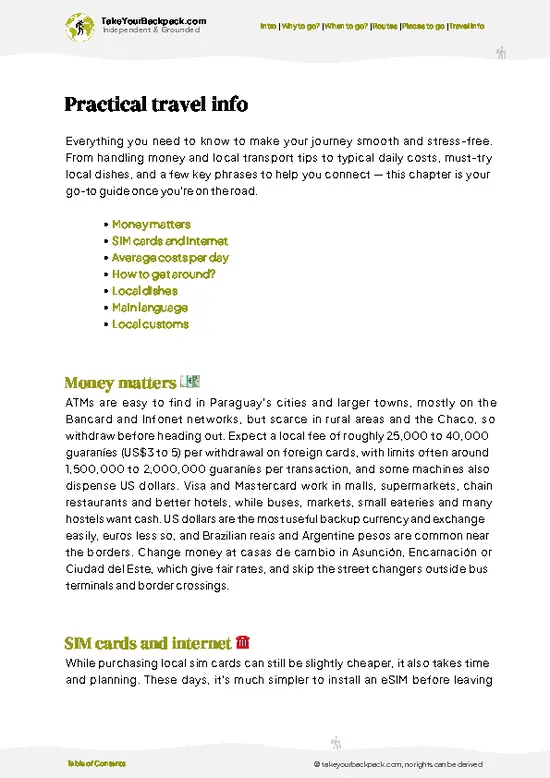
example page 0 from our offline Travel Guide for Paraguay
example page 1 from our offline Travel Guide for Paraguay
example page 2 from our offline Travel Guide for Paraguay
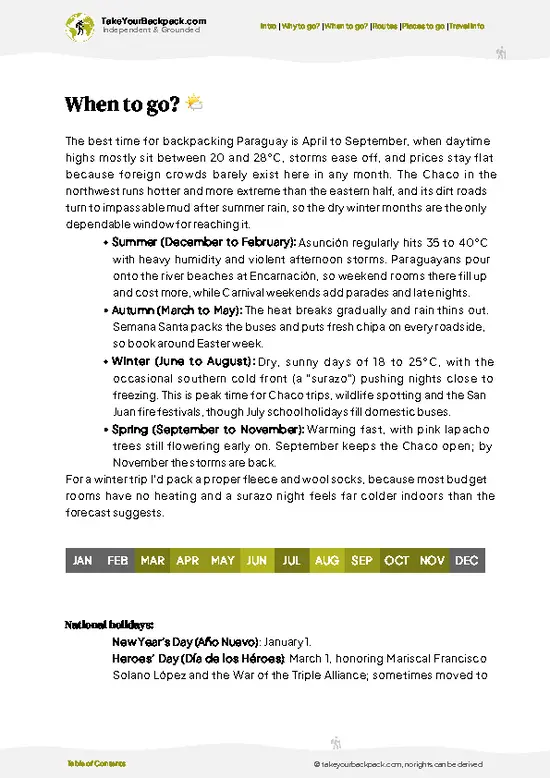
example page 3 from our offline Travel Guide for Paraguay
example page 4 from our offline Travel Guide for Paraguay
example page 5 from our offline Travel Guide for Paraguay
example page 6 from our offline Travel Guide for Paraguay
example page 7 from our offline Travel Guide for Paraguay
The digital guide (226 pages) contains:-page digital guide:
✅ Ready-made 5, 10 & 15-day routes
✅ All 65 places ranked, so you skip the overrated ones
✅ Works offline, all in 1 guide
✅ Cities, national parks, landmarks, beaches
✅ How to get around
👉 Click to see all 30+ guide features

📅 Plan smarter in minutes, not weeks
✅ Month by month travel advice
✅ Festivals & national holidays
✅ Budget expectations

🗺️ Go to the right places, skip the overrated ones
✅ Honest pros & cons of destinations
✅ Top hikes, parks & viewpoints
✅ Lesser-known places most travelers miss
✅ Clear “worth it vs skip it” guidance

🛏️ Travel smoothly without rookie mistakes
✅ Best areas to stay
✅ Transport systems explained simply
✅ Common scams & safety advice
✅ SIM cards, money & practical tips

🌍 Understand the country, not just visit it
✅ Culture & traditions
✅ 52 Essential phrases & customs
✅ Festivals worth planning around
✅ Traveler-friendly historical context
✅ Insights that make places more meaningful

📱 Built for real travel conditions
✅ Fully downloadable PDF
✅ Works completely offline
✅ Optimized for phone use
✅ Useful in remote areas & buses
✅ All in 1 guide
Stop searching, start planning
Get instant access to your full guide. 30‑day money-back guarantee.


By proceeding you agree to our terms.
Sent to your inbox immediately after payment • 100% Secure Checkout
Best Backpacking Travel Advisor 2025 tourism awardBest Backpacking
Travel Advisor
2025
What others say about Take Your Backpack Guides:
⭐⭐⭐⭐⭐
Fantastic, amazing amount of information!
⭐⭐⭐⭐⭐
My goodness this is amazing, it's what I've been looking for hats off too you!
⭐⭐⭐⭐⭐
I think this is absolutely BRILLIANT
⭐⭐⭐⭐
Very complete and informative. It's still missing places, but I gotta to commend you
⭐⭐⭐⭐⭐
This is truly amazing, thank you, can't wait to explore it with my kids!
⭐⭐⭐⭐⭐
Awesome resource, thank you!
⭐⭐⭐⭐⭐
This is amazing! Can't wait to explore the ones I haven't seen
⭐⭐⭐⭐
I love this! Well done, great idea.
⭐⭐⭐⭐⭐
Thanks for taking the time to make this gem!
⭐⭐⭐⭐⭐
This might be the best website I've ever seen.
⭐⭐⭐⭐⭐
Congratulations, and thank you so much for your work; it's incredibly valuable.
⭐⭐⭐⭐
In all seriousness I think you did a great job pointing out the important spots
⭐⭐⭐⭐⭐
10/10 very good
⭐⭐⭐⭐⭐
As someone who's only just starting to visit regularly this is awesome, thank you.
⭐⭐⭐⭐
Thank you very much! I'm going to visit my dad, it's going to be very useful!
⭐⭐⭐⭐⭐
This is really cool! We'll be travelling for the first time and this definitely come in handy.
⭐⭐⭐⭐⭐
You are now our minister of culture, congratulations 👨‍💼
⭐⭐⭐⭐⭐
Just wanted to tell you that this is a pearl! Going to follow your recommendations.
⭐⭐⭐⭐⭐
This is so cool. I'll definitely be using the resource for my travels soon.
⭐⭐⭐⭐⭐
This is very impressive! Good work.
⭐⭐⭐⭐⭐
This is an amazing and informative site. Very well done!

🛏️ Where to stay?Top Places to Consider Staying

Paraguay has a small but growing hostel scene, with dorm beds mostly in the US$10 to 18 range and simple guesthouses and budget hotels filling the gaps, though private hostels cluster mainly in Asunción and Encarnación. In Asunción, the Centro puts you within walking distance of the Palacio de los López, the Panteón and the riverfront for the lowest prices, but its streets empty out after dark and on weekends, while Villa Morra and Recoleta cost a bit more and sit a 15 to 25 minute bus ride from the old town, in exchange for safer sidewalks, shopping malls and the city’s best bars and restaurants. In Encarnación, the blocks between the center and the Costanera beachfront are the easiest base, … read more 👉
Paraguay has a small but growing hostel scene, with dorm beds mostly in the US$10 to 18 range and simple guesthouses and budget hotels filling the gaps, though private hostels cluster mainly in Asunción and Encarnación. In Asunción, the Centro puts you within walking distance of the Palacio de los López, the Panteón and the riverfront for the lowest prices, but its streets empty out after dark and on weekends, while Villa Morra and Recoleta cost a bit more and sit a 15 to 25 minute bus ride from the old town, in exchange for safer sidewalks, shopping malls and the city’s best bars and restaurants. In Encarnación, the blocks between the center and the Costanera beachfront are the easiest base, close to the riverside nightlife in summer and an easy hop to the Jesuit ruins at Trinidad.

If you enjoy meeting fellow travelers, consider choosing hostels with high ratings for atmosphere. On the other hand, if you prefer having your own space, a hotel might be a better option.

ParaguayMore Places Across Paraguay

👋 Meet the founderWho’s Behind Take Your Backpack?

Johan, backpacker and founder of TakeYourBackpackHi, I’m Johan (Netherlands 🇳🇱), the creator of TakeYourBackpack. Over the past 30 years, I’ve backpacked through 88 countries across six continents, gaining extensive experience with independent travel, long-term trips, and overland routes.

This site is built on a combination of firsthand travel experience and carefully curated insights from other backpackers. Many guides are based on places I’ve personally visited, while others bring together tips, observations, and practical advice shared by trusted travelers I’ve met along the way.

The goal is to provide realistic, experience-driven guidance — not generic itineraries — so you can explore destinations with better context, clearer expectations, and more confidence.