×

Paraguay🇵🇾 | national parksCerro Corá National ParkLopez Memorial, red sandstone ridges, petroglyph shelters, cerrado trails | things to do and best time to go

Explore the ChacoExplore Defensores del Chaco National Park

Backpacking in Cerro Corá
🏆 Top picknational park ranked #1
By Johan Kruseman 🇳🇱 | Updated October 19, 2026

Cerro Corá is a park of red sandstone outcrops, cerrado scrub and patches of forest, and most people arrive expecting flat Chaco. It sits in the Amambay department in the north of Paraguay, west of Pedro Juan Caballero. The good side is quiet. Trails are short, rock walls rise straight out of grassland, and you may share a hillside with rheas, seriemas and toucans rather than other hikers. The bad side is size and logistics: the park is small, the trail network is modest, and without your own wheels you depend on the highway and some walking. The historical weight is real, since this is where Marshal López died in 1870. At a stall near the entrance, a chipa still warm from the oven and a cup of tereré cost me about US$1, and I ate them looking at the Cerro Muralla wall. A first day works well as a morning walk to the monument and caves, then a climb once the rock has cooled.

Part of Backpacking in Paraguay: all 65 places on one map, with routes and the best time to go.
Discover everything you want to know in the 📖 Paraguay Travel Guide.


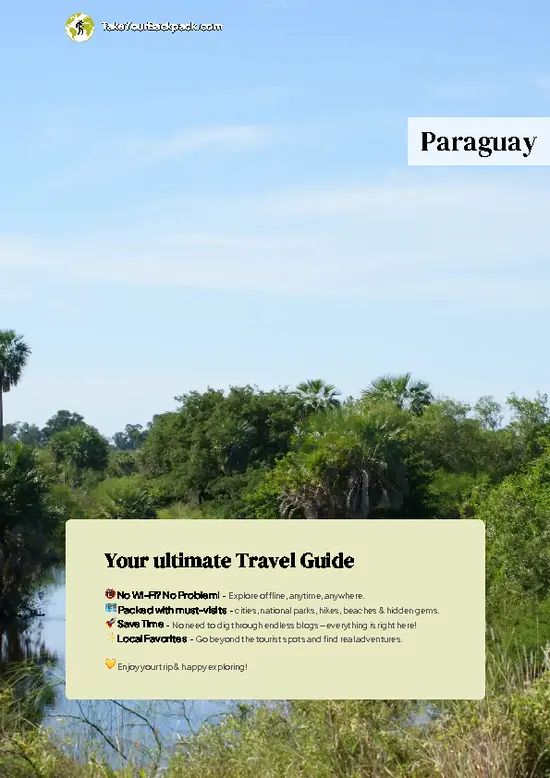
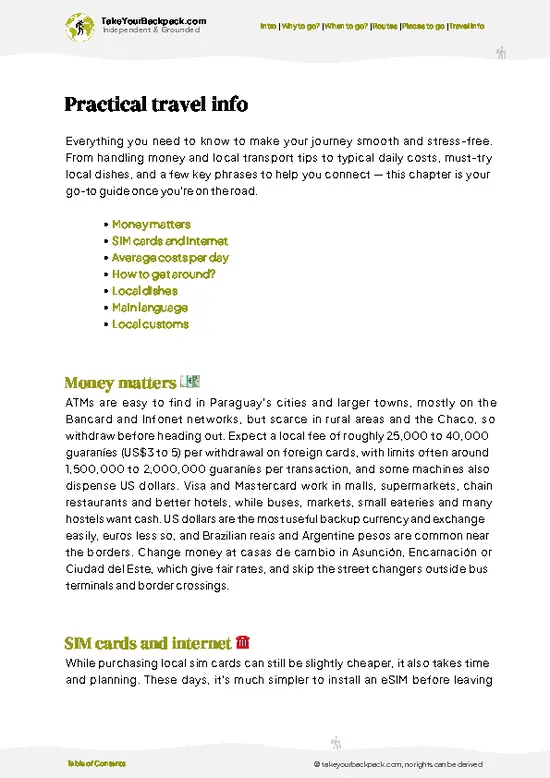
example page 0 from our offline Travel Guide for Paraguay
example page 1 from our offline Travel Guide for Paraguay
example page 2 from our offline Travel Guide for Paraguay
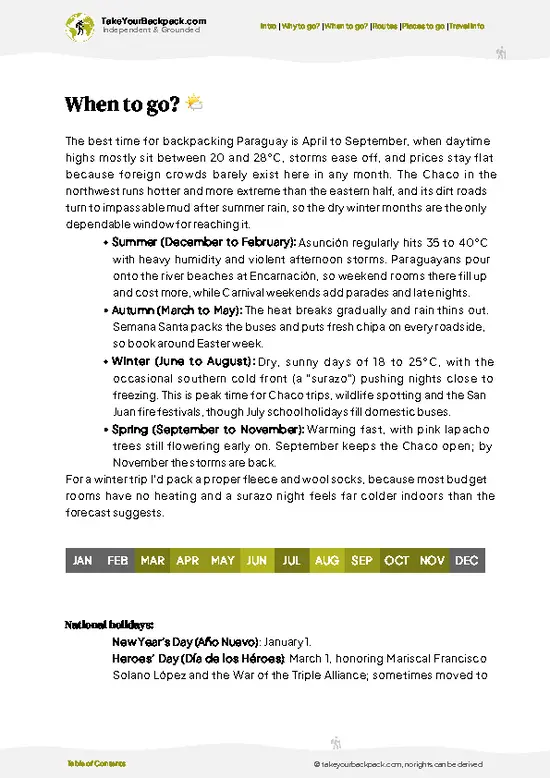
example page 3 from our offline Travel Guide for Paraguay
example page 4 from our offline Travel Guide for Paraguay
example page 5 from our offline Travel Guide for Paraguay
example page 6 from our offline Travel Guide for Paraguay
example page 7 from our offline Travel Guide for Paraguay
Loading the map 🌍
CLICK TO FILTER
cities
towns
landmarks
national parks
hikes
beaches
attractions
festivals
regions
SHOW COUNTRY’S BESTSHOW ALL

✨ Why go?
Ranked #1 national park in Paraguay
What sets this place apart

Cerro Corá National Park suits backpackers who like to move on their own schedule, because the hills are close together and nothing requires a guide to find. You can walk from the visitor area to the rock faces and the memorial site in one loop, then stretch the day with a climb. The park also ties a landscape to a moment in Paraguayan history. The spot on the Aquidabán-niguí stream where Francisco Solano López was killed in 1870 is marked with a monument, and it ended the War of the Triple Alliance. Few places let you stand where a national story closes. The other draw is the terrain itself. Cerro Muralla and the neighboring sandstone hills give you a short, steep scramble with views over cerrado that you won’t get in the flatter parts of the country. Camping on site keeps costs low and puts … read more 👉
Cerro Corá National Park suits backpackers who like to move on their own schedule, because the hills are close together and nothing requires a guide to find. You can walk from the visitor area to the rock faces and the memorial site in one loop, then stretch the day with a climb. The park also ties a landscape to a moment in Paraguayan history. The spot on the Aquidabán-niguí stream where Francisco Solano López was killed in 1870 is marked with a monument, and it ended the War of the Triple Alliance. Few places let you stand where a national story closes. The other draw is the terrain itself. Cerro Muralla and the neighboring sandstone hills give you a short, steep scramble with views over cerrado that you won’t get in the flatter parts of the country. Camping on site keeps costs low and puts you under a very dark sky. Tours exist, but this is a place to wander alone, ask the rangers where the paths are best, and stay as long as the light holds.

💡 HighlightsThe experiences that define the visit

  1. Lopez Memorial at the Aquidabán-niguí: This is what most people come for. On 1 March 1870 Marshal Francisco Solano López was killed beside this small stream, which ended the Paraguayan War. A cross and monument mark the spot, and Paraguayan school groups and history buffs arrive with real reverence. Go even if you know nothing about the war, because the quiet clearing explains why the story still carries weight here.
  2. Museo de Sitio and the park’s historical area: The on-site museum covers the final campaign and the last days of the war, with period objects, maps and portraits. It is small and takes under an hour, but it gives the memorial its context and is the best place to ask rangers about current trail conditions.
  3. Rock shelters with petroglyphs: Sandstone overhangs in the park hold carved
… read more 👉
  1. Lopez Memorial at the Aquidabán-niguí: This is what most people come for. On 1 March 1870 Marshal Francisco Solano López was killed beside this small stream, which ended the Paraguayan War. A cross and monument mark the spot, and Paraguayan school groups and history buffs arrive with real reverence. Go even if you know nothing about the war, because the quiet clearing explains why the story still carries weight here.
  2. Museo de Sitio and the park’s historical area: The on-site museum covers the final campaign and the last days of the war, with period objects, maps and portraits. It is small and takes under an hour, but it gives the memorial its context and is the best place to ask rangers about current trail conditions.
  3. Rock shelters with petroglyphs: Sandstone overhangs in the park hold carved and painted markings left by earlier inhabitants. They are on Paraguay’s UNESCO tentative list. The shelters are modest in scale, so go for the sense of deep human presence rather than for spectacle, and keep your hands off the walls.
  4. Cerro Muralla: A long, wall-like ridge of red rock rising abruptly above the surrounding grassland. It is one of the park’s signature profiles, and the climb to its top gives wide views over the rolling cerrado toward the Brazilian border country. The footing is rocky and exposed, so start early before the sun gets heavy.
  5. Cerro Chiriguelo: This hill has a cave-like rock formation and a lookout over the park’s forested valleys. It suits walkers who want a short, steady ascent with a clear payoff at the top, and the rock faces make good photographs in late afternoon light.
  6. Cerrado and dry-forest landscapes: Cerro Corá is a transition zone, with open grassland, scrub, gallery forest and sandstone outcrops sitting side by side. Walking between them in one morning changes the air, the birdsong and the soil color. Wildflowers appear after rain, and the hills hold a distinctly different feel from Paraguay’s flat Chaco and eastern farmland.
  7. Wildlife watching: The park shelters maned wolf, giant anteater, tapir, brocket deer and a good variety of birds, among them rheas and toucans. Sightings of the larger mammals are rare and luck-dependent, but anteaters and birds are realistic goals if you walk quietly at dawn or dusk. Binoculars matter more here than a long lens.
Start with the Lopez Memorial and the museum at Cerro Corá National Park, because knowing what happened on that stream turns the hills you climb afterward from pretty rock into a battlefield you understand.
Spotted a mistake or missing something? Contact us.

🌤️ When to go?Choosing the right time of year

  • Cool Season (May to August): Cerro Corá National Park is at its most comfortable for hiking. Days run 20 to 28°C (68 to 82°F), nights can drop to 5 to 10°C (41 to 50°F), and occasional cold fronts bring frost. Daylight lasts roughly 10.5 to 11 hours, so start walks early.
  • Hot Season (November to March): Afternoons reach 33 to 40°C (91 to 104°F) with heavy humidity and sudden thunderstorms. Red dirt tracks turn slick, and ticks and mosquitoes multiply. Days stretch to about 13.5 hours, but midday walking is punishing.
  • Shoulder Months (April, September, October): Highs of 25 to 32°C (77 to 90°F) and lower humidity make these my favorite window for the Cerro Muralla and Aquidabán river trails.
  • Crowds and Prices: The park is quiet all year. Paraguayan school groups and holiday visitors appear around
… read more 👉
  • Cool Season (May to August): Cerro Corá National Park is at its most comfortable for hiking. Days run 20 to 28°C (68 to 82°F), nights can drop to 5 to 10°C (41 to 50°F), and occasional cold fronts bring frost. Daylight lasts roughly 10.5 to 11 hours, so start walks early.
  • Hot Season (November to March): Afternoons reach 33 to 40°C (91 to 104°F) with heavy humidity and sudden thunderstorms. Red dirt tracks turn slick, and ticks and mosquitoes multiply. Days stretch to about 13.5 hours, but midday walking is punishing.
  • Shoulder Months (April, September, October): Highs of 25 to 32°C (77 to 90°F) and lower humidity make these my favorite window for the Cerro Muralla and Aquidabán river trails.
  • Crowds and Prices: The park is quiet all year. Paraguayan school groups and holiday visitors appear around Easter and on March 1, Heroes’ Day, when the Cerro Corá battle is commemorated. Lodging in Pedro Juan Caballero barely changes by season.
Check the forecast for rain before heading in, since the unpaved access roads become sticky after storms.


source: climatestotravel.comJANJanuary: below average for travelingFEBFebruary: below average for travelingMARMarch: below average for travelingAPRApril: fair for travelingMAYMay: highly recommended for travelingJUNJune: excellent for travelingJULJuly: excellent for travelingAUGAugust: excellent for travelingSEPSeptember: highly recommended for travelingOCTOctober: fair for travelingNOVNovember: below average for travelingDECDecember: below average for traveling
when-to-go

✈️ The backpacker research shortcutParaguay Travel Guide

What the free pages can't give you: ready-made routes, every place ranked, and it works offline. All in 1 guide.
example page 0 from our offline Travel Guide for Paraguay
example page 1 from our offline Travel Guide for Paraguay
example page 2 from our offline Travel Guide for Paraguay
example page 3 from our offline Travel Guide for Paraguay
example page 4 from our offline Travel Guide for Paraguay
example page 5 from our offline Travel Guide for Paraguay
example page 6 from our offline Travel Guide for Paraguay
example page 7 from our offline Travel Guide for Paraguay
The digital guide (226 pages) contains:-page digital guide:
✅ Ready-made 5, 10 & 15-day routes
✅ All 65 places ranked, so you skip the overrated ones
✅ Works offline, all in 1 guide
✅ Cities, national parks, landmarks, beaches
✅ How to get around
👉 Click to see all 30+ guide features

📅 Plan smarter in minutes, not weeks
✅ Month by month travel advice
✅ Festivals & national holidays
✅ Budget expectations

🗺️ Go to the right places, skip the overrated ones
✅ Honest pros & cons of destinations
✅ Top hikes, parks & viewpoints
✅ Lesser-known places most travelers miss
✅ Clear “worth it vs skip it” guidance

🛏️ Travel smoothly without rookie mistakes
✅ Best areas to stay
✅ Transport systems explained simply
✅ Common scams & safety advice
✅ SIM cards, money & practical tips

🌍 Understand the country, not just visit it
✅ Culture & traditions
✅ 52 Essential phrases & customs
✅ Festivals worth planning around
✅ Traveler-friendly historical context
✅ Insights that make places more meaningful

📱 Built for real travel conditions
✅ Fully downloadable PDF
✅ Works completely offline
✅ Optimized for phone use
✅ Useful in remote areas & buses
✅ All in 1 guide
Stop searching, start planning
Get instant access to your full guide. 30‑day money-back guarantee.


By proceeding you agree to our terms.
Sent to your inbox immediately after payment • 100% Secure Checkout
Best Backpacking Travel Advisor 2025 tourism awardBest Backpacking
Travel Advisor
2025
What others say about Take Your Backpack Guides:
⭐⭐⭐⭐⭐
Fantastic, amazing amount of information!
⭐⭐⭐⭐⭐
My goodness this is amazing, it's what I've been looking for hats off too you!
⭐⭐⭐⭐⭐
I think this is absolutely BRILLIANT
⭐⭐⭐⭐
Very complete and informative. It's still missing places, but I gotta to commend you
⭐⭐⭐⭐⭐
This is truly amazing, thank you, can't wait to explore it with my kids!
⭐⭐⭐⭐⭐
Awesome resource, thank you!
⭐⭐⭐⭐⭐
This is amazing! Can't wait to explore the ones I haven't seen
⭐⭐⭐⭐
I love this! Well done, great idea.
⭐⭐⭐⭐⭐
Thanks for taking the time to make this gem!
⭐⭐⭐⭐⭐
This might be the best website I've ever seen.
⭐⭐⭐⭐⭐
Congratulations, and thank you so much for your work; it's incredibly valuable.
⭐⭐⭐⭐
In all seriousness I think you did a great job pointing out the important spots
⭐⭐⭐⭐⭐
10/10 very good
⭐⭐⭐⭐⭐
As someone who's only just starting to visit regularly this is awesome, thank you.
⭐⭐⭐⭐
Thank you very much! I'm going to visit my dad, it's going to be very useful!
⭐⭐⭐⭐⭐
This is really cool! We'll be travelling for the first time and this definitely come in handy.
⭐⭐⭐⭐⭐
You are now our minister of culture, congratulations 👨‍💼
⭐⭐⭐⭐⭐
Just wanted to tell you that this is a pearl! Going to follow your recommendations.
⭐⭐⭐⭐⭐
This is so cool. I'll definitely be using the resource for my travels soon.
⭐⭐⭐⭐⭐
This is very impressive! Good work.
⭐⭐⭐⭐⭐
This is an amazing and informative site. Very well done!

🛏️ Where to stay?Best areas to stay in Paraguay

The most practical base for Cerro Corá National Park is Pedro Juan Caballero, about 45 km east on the Brazilian border, though a few simple options exist right at the park.
Inside the park, the administration area offers basic camping near the visitor center and museum, and rangers may also arrange modest cabin-style rooms. Expect cold water showers and limited facilities. Camping costs roughly US$3 to 8 per person, and you should bring your own food and a good water supply since shops are far.
Pedro Juan Caballero has the widest selection. Simple hotels and hostel-style rooms run US$15 to 35 a … read more 👉
The most practical base for Cerro Corá National Park is Pedro Juan Caballero, about 45 km east on the Brazilian border, though a few simple options exist right at the park.
Inside the park, the administration area offers basic camping near the visitor center and museum, and rangers may also arrange modest cabin-style rooms. Expect cold water showers and limited facilities. Camping costs roughly US$3 to 8 per person, and you should bring your own food and a good water supply since shops are far.
Pedro Juan Caballero has the widest selection. Simple hotels and hostel-style rooms run US$15 to 35 a night for a double with air conditioning and breakfast, while mid-range hotels with a pool go for US$40 to 70. The city is lively and commercial, with a duty-free shopping scene and easy access to Ponta Porã in Brazil across the street-width border. Restaurants are plentiful and ATMs are reliable.
The small town of Capitán Bado lies farther south and has a couple of basic guesthouses, but it is less convenient. Most backpackers sleep in Pedro Juan Caballero and take a taxi or bus to the park for the day, or camp inside for an early start on the trails.

👛 Costs (as of 19 October 2026)How expensive it really is

A realistic budget for Cerro Corá National Park is about US$30 to 74 per day, counting a mid-priced room in Pedro Juan Caballero.
CategoryBudget RangeLocal Reality
Entrance FeeUS$1 to 4A small fee is paid in guaraníes at the park office; foreigners pay more than locals.
Accommodation (High Season)US$15 to 35Simple hotel in Pedro Juan Caballero; camping in the park costs US$3 to 8.
Accommodation (Low Season)US$12 to 30Little seasonal change, with small discounts midweek.
Local TransportUS$6 to 15Taxi or bus from Pedro Juan Caballero to the park; rides back may need to be arranged in advance.
Food and SuppliesUS$8 to 15Set lunches and grilled meat in town; bring snacks and water for the park.
Guide (Optional)US$0 to 5Rangers may accompany walks for a tip or small fee.
Total Daily BudgetUS$30 to 74Roughly
… read more 👉
A realistic budget for Cerro Corá National Park is about US$30 to 74 per day, counting a mid-priced room in Pedro Juan Caballero.
CategoryBudget RangeLocal Reality
Entrance FeeUS$1 to 4A small fee is paid in guaraníes at the park office; foreigners pay more than locals.
Accommodation (High Season)US$15 to 35Simple hotel in Pedro Juan Caballero; camping in the park costs US$3 to 8.
Accommodation (Low Season)US$12 to 30Little seasonal change, with small discounts midweek.
Local TransportUS$6 to 15Taxi or bus from Pedro Juan Caballero to the park; rides back may need to be arranged in advance.
Food and SuppliesUS$8 to 15Set lunches and grilled meat in town; bring snacks and water for the park.
Guide (Optional)US$0 to 5Rangers may accompany walks for a tip or small fee.
Total Daily BudgetUS$30 to 74Roughly US$50 for a typical day using a hotel in town.


source: senatur.gov.py
⚠️ Prices can change and everyone travels differently, so take this as a rough guide. Hope it helps you plan your adventure!

🥾 TrailsHiking Cerro Corá national park: highlights and difficulty

Cerro Corá National Park is a compact park, so walks here are short and are best strung together into a day. Terrain is a mix of grassland, loose sandstone, scrubby cerrado and shaded stream forest. Paths are less signed than in bigger parks, so ask the rangers at the entrance for the current routes.
  • Monument walk: Starts at the visitor area and follows an easy, flat path to the López memorial by the stream. Allow 30 to 45 minutes with a stop at the small museum. Suitable for anyone.
  • Cerro Muralla: The most demanding outing, a steep climb over loose rock and ledges to the top of the wall. Allow
… read more 👉
Cerro Corá National Park is a compact park, so walks here are short and are best strung together into a day. Terrain is a mix of grassland, loose sandstone, scrubby cerrado and shaded stream forest. Paths are less signed than in bigger parks, so ask the rangers at the entrance for the current routes.
  • Monument walk: Starts at the visitor area and follows an easy, flat path to the López memorial by the stream. Allow 30 to 45 minutes with a stop at the small museum. Suitable for anyone.
  • Cerro Muralla: The most demanding outing, a steep climb over loose rock and ledges to the top of the wall. Allow roughly 1.5 to 2 hours round trip. Moderate difficulty, with good views at the top.
  • Cerro Corá hill: A gentler climb through grass and scrub, usually 1 to 1.5 hours round trip. Easier underfoot than Cerro Muralla.
  • Rock shelter: A short side walk to the rock shelter, about 45 minutes round trip from the nearest road. Easy, with some uneven ground.
  • Stream and forest edge: A flat, shaded stroll along the Aquidabán-niguí, good for birds and for cooling off between climbs. About an hour.
Wildlife is easiest to see on open ground, where rheas and seriemas walk through the grass. Toucans favor the tree lines. Wear boots with grip, since the sandstone is slippery when wet, and carry plenty of water because shade is limited on the hills.
Cerro Corá National Park lies beside the main road from Pedro Juan Caballero, so intercity buses toward Concepción can drop you at the entrance. Getting back depends on flagging a passing bus, so plan your return in daylight. The park is quiet on weekdays and busier on holidays and around the anniversary of López’s death. Foreign visitors pay a small entrance fee, roughly US$2 to 4, in local currency.
⚠️ Hiking info can sometimes be outdated or inaccurate. Before you hit the trail, check the latest conditions with locals. If you do spot anything that's off, I'd love to hear from you, so I can update it for fellow travelers.

🛡️ SafetyStaying Safe: What Travelers Should Know

Cerro Corá National Park is generally straightforward and low-risk for hikers, with the main challenges being heat, ticks and slippery tracks. In summer, carry at least 3 liters of water per person, wear a hat, and finish longer walks before midday, because shade is patchy on the open hillsides. Trails to Cerro Muralla and the rocky outcrops are short but include loose stone and steep sections, so sturdy shoes matter more than trekking gear. After rain, red clay turns slippery and access roads can become impassable for ordinary cars.
Wildlife is present but rarely a problem. Expect birds, capuchin monkeys and occasional foxes, and keep your distance from any snakes, which stay clear if left alone. Use repellent and check your legs and socks for ticks after walking through grass. Trails are … read more 👉
Cerro Corá National Park is generally straightforward and low-risk for hikers, with the main challenges being heat, ticks and slippery tracks. In summer, carry at least 3 liters of water per person, wear a hat, and finish longer walks before midday, because shade is patchy on the open hillsides. Trails to Cerro Muralla and the rocky outcrops are short but include loose stone and steep sections, so sturdy shoes matter more than trekking gear. After rain, red clay turns slippery and access roads can become impassable for ordinary cars.
Wildlife is present but rarely a problem. Expect birds, capuchin monkeys and occasional foxes, and keep your distance from any snakes, which stay clear if left alone. Use repellent and check your legs and socks for ticks after walking through grass. Trails are not heavily marked, so hiring or asking a ranger as a guide is smart. Mobile signal fades in places, so tell someone your plan. The surrounding border region calls for ordinary city caution in Pedro Juan Caballero, especially at night.

FAQTraveler FAQ

One full day covers the main sights at Cerro Corá National Park, while two days let you add slower trails and a night camping. The visitor center and museum take about an hour, and the Cerro Muralla and Aquidabán river walks fill most of a day. Many travelers base themselves in Pedro Juan Caballero, about 45 km away.
Yes, but it takes planning. Cerro Corá National Park lies about 45 km from Pedro Juan Caballero, which you can reach by long-distance bus from Asunción in around 6 to 8 hours. From there, use a taxi (roughly US$15 to 30 each way) or ask at the bus terminal about local buses toward the park. Hitching back is unreliable, so arrange your return ride in advance.
Yes, Cerro Corá National Park charges a small entrance fee, usually around US$1 to 4 and higher for foreigners than for Paraguayans. You pay at the park administration in local currency, so carry some cash. No special hiking permit is normally required, though camping costs about US$3 to 8 per person and you should register with the rangers.
⚠️ Things can change over time, so always validate details locally before you go.

Other Paraguayan national parks near Cerro Corá

Explore more nearby:


💡 Not sure where to go next?
Create a personalized itinerary for Paraguay including Cerro Corá and the places that fit your trip.

Generate my itinerary

👉 Discover all national parks

Or checkout all Paraguay has to offer (think cities, towns, villages, national parks, hikes, beaches, festivals)
Country photo of Paraguay

We 💚 feedbackKey takeaways before you go

Many travelers treat Cerro Corá National Park as a quick roadside stop to photograph the monument and keep going. That misses the hills. I would arrive with a full morning free, see the memorial first, then climb Cerro Muralla while the rock is cool. If you plan to camp, bring water and cash for the fee.

✈️ When did I visit Paraguay?
Before visiting Argentina in September 2012, I crossed through Paraguay, ending up at the magical Iguazu Falls.

✍️ Help improve this page!
The information on this page is based on my own backpacking experience in Paraguay, supplemented with up-to-date research and feedback from other travelers. Travel details can change, so if you notice anything outdated or incomplete, feel free to let me know.


🙋‍♂️ Give feedback

👋 Meet the founderWho’s Behind Take Your Backpack?

Johan, backpacker and founder of TakeYourBackpackHi, I’m Johan (Netherlands 🇳🇱), the creator of TakeYourBackpack. Over the past 30 years, I’ve backpacked through 88 countries across six continents, gaining extensive experience with independent travel, long-term trips, and overland routes.

This site is built on a combination of firsthand travel experience and carefully curated insights from other backpackers. Many guides are based on places I’ve personally visited, while others bring together tips, observations, and practical advice shared by trusted travelers I’ve met along the way.

The goal is to provide realistic, experience-driven guidance — not generic itineraries — so you can explore destinations with better context, clearer expectations, and more confidence.