×

Paraguay🇵🇾 | national parksMbaracayú Forest ReserveGuided forest trails, Aché cultural center, night walks, tapir prints | things to do and best time to go

Explore Defensores del Chaco National ParkExplore Reserva para Parque Nacional San Rafael

Backpacking in Mbaracayú Forest Reserve
🏆 Top picknational park ranked #3
By Johan Kruseman 🇳🇱 | Updated October 19, 2026

Mbaracayú is a private-run reserve of Atlantic Forest, not a national park with a ranger gate and a bus stop, and that changes how you plan. It sits in Canindeyú department in the northeast of Paraguay, near the Brazilian border, and the Fundación Moisés Bertoni manages it. Trails are good, but you hike with a guide on most routes, because the forest is dense and the trail network is not designed for wandering solo. That is also why advance booking matters: staff arrange guides, vehicles and bunks, and turning up unannounced often means waiting. Wildlife is the draw, with tapirs, peccaries, howler monkeys and a long bird list, though sightings are never promised. Crowds are close to nil. I expected silence, yet the first hour at dawn was loud with cicadas and birds, almost like a machine running. Unlike Ybycuí National Park, which is small and easy to reach, Mbaracayú is remote and demands a full commitment.

Part of Backpacking in Paraguay: all 65 places on one map, with routes and the best time to go.
Discover everything you want to know in the 📖 Paraguay Travel Guide.


example page 0 from our offline Travel Guide for Paraguay
example page 1 from our offline Travel Guide for Paraguay
example page 2 from our offline Travel Guide for Paraguay
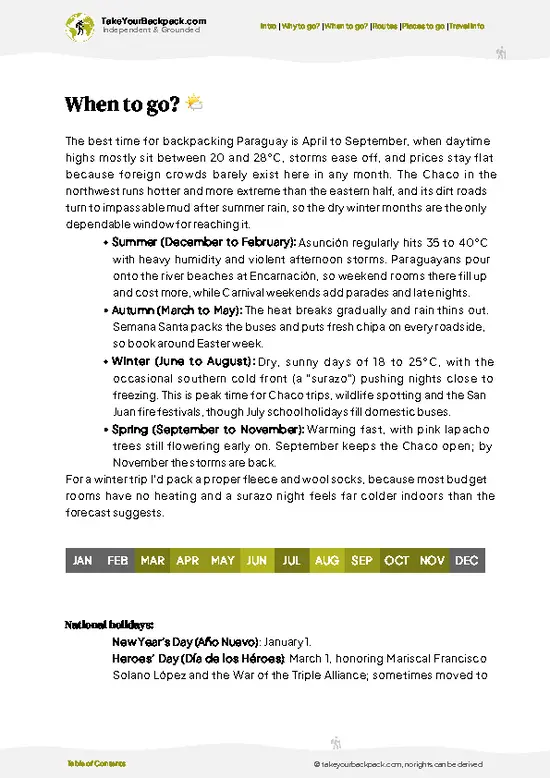
example page 3 from our offline Travel Guide for Paraguay
example page 4 from our offline Travel Guide for Paraguay
example page 5 from our offline Travel Guide for Paraguay
example page 6 from our offline Travel Guide for Paraguay
example page 7 from our offline Travel Guide for Paraguay
Loading the map 🌍
CLICK TO FILTER
cities
towns
landmarks
national parks
hikes
beaches
attractions
festivals
regions
SHOW COUNTRY’S BESTSHOW ALL

✨ Why go?
Ranked #3 national park in Paraguay
The unique appeal for travelers

Mbaracayú Forest Reserve suits backpackers who want real forest rather than a day of ticking off viewpoints. The reserve protects around 64,000 hectares of the Atlantic Forest, one of the last big blocks of this ecosystem in Paraguay, and you can feel the difference in the canopy height and the density of the undergrowth. Independent travelers will like the fact that you plan directly with the reserve rather than through a tour company, which keeps costs sensible and lets you shape the length of your stay. The Jejui-mi trail and the Aguara-ñu routes give a solid sense of the place within a day, and longer walks reach deeper forest. The Ache community connection adds a human dimension, since the Aché people have lived in and around this forest for generations, and there is a cultural center … read more 👉
Mbaracayú Forest Reserve suits backpackers who want real forest rather than a day of ticking off viewpoints. The reserve protects around 64,000 hectares of the Atlantic Forest, one of the last big blocks of this ecosystem in Paraguay, and you can feel the difference in the canopy height and the density of the undergrowth. Independent travelers will like the fact that you plan directly with the reserve rather than through a tour company, which keeps costs sensible and lets you shape the length of your stay. The Jejui-mi trail and the Aguara-ñu routes give a solid sense of the place within a day, and longer walks reach deeper forest. The Ache community connection adds a human dimension, since the Aché people have lived in and around this forest for generations, and there is a cultural center close to the visitor area. If you prefer guided, self-contained logistics, with simple lodging on site and forest at the door, this is a good fit. If you need frequent buses and spontaneous trail choices, it is not.

💡 HighlightsDon't-miss highlights and experiences

  1. Jejui-mi Trail: The classic short walk through tall Atlantic Forest, with palms, lianas and mixed canopy. It is the easiest way to understand the reserve and a good place to spot birds and butterflies.
  2. Aguara-ñu Trail: A route into Aguara Ñu, the reserve’s open cerrado savanna, where larger mammal tracks appear on soft ground. Maned wolf is the namesake, though you are more likely to find tapir prints.
  3. Lagunas and wetland edges: Small lagoons within the reserve draw waterbirds, caiman and capybara, and offer open sky after hours under canopy.
  4. Night walks: Guided after-dark outings turn up frogs, owls, nightjars and sometimes nocturnal mammals. The forest sounds change completely, and a good headlamp matters.
  5. Aché cultural center: A small center presenting the history and traditions of the Aché
… read more 👉
  1. Jejui-mi Trail: The classic short walk through tall Atlantic Forest, with palms, lianas and mixed canopy. It is the easiest way to understand the reserve and a good place to spot birds and butterflies.
  2. Aguara-ñu Trail: A route into Aguara Ñu, the reserve’s open cerrado savanna, where larger mammal tracks appear on soft ground. Maned wolf is the namesake, though you are more likely to find tapir prints.
  3. Lagunas and wetland edges: Small lagoons within the reserve draw waterbirds, caiman and capybara, and offer open sky after hours under canopy.
  4. Night walks: Guided after-dark outings turn up frogs, owls, nightjars and sometimes nocturnal mammals. The forest sounds change completely, and a good headlamp matters.
  5. Aché cultural center: A small center presenting the history and traditions of the Aché people, who are closely tied to this forest. It adds context to what you walk through.
  6. Visitor center and interpretive displays: A useful stop to see maps, species lists and the story of the reserve’s creation and conservation work.
  7. Birdwatching at the forest edge: Toucans, trogons, woodpeckers and many understory species can be found along clearings and trail margins. Dawn is the best period.
Allow two full days to cover all of this at an unhurried pace, or one long day if you prioritize the two main trails.
Spotted a mistake or missing something? Contact us.

🌤️ When to go?Choosing the right time of year

  • Cool Dry Season (May to August): Best hiking window. Days run 20 to 27°C (68 to 81°F), nights can dip to 5 to 10°C (41 to 50°F), and trails are firmer with fewer mosquitoes. Days are shorter, roughly 11 hours of light.
  • Hot Season (November to March): Highs of 32 to 38°C (90 to 100°F), heavy humidity and violent afternoon storms. Ticks, biting flies and mud are at their peak, but birdlife is active and days stretch to about 14 hours of light.
  • Shoulder Months (April, September, October): Typically 18 to 32°C (64 to 90°F). Rain is patchy, the forest is green, and you get the best mix of comfort and flowering trees.
  • Crowds and Prices: Mbaracayú sees few visitors in any month. Paraguayan school holidays in July and the Easter week bring more groups to the lodging, so rates and availability tighten
… read more 👉
  • Cool Dry Season (May to August): Best hiking window. Days run 20 to 27°C (68 to 81°F), nights can dip to 5 to 10°C (41 to 50°F), and trails are firmer with fewer mosquitoes. Days are shorter, roughly 11 hours of light.
  • Hot Season (November to March): Highs of 32 to 38°C (90 to 100°F), heavy humidity and violent afternoon storms. Ticks, biting flies and mud are at their peak, but birdlife is active and days stretch to about 14 hours of light.
  • Shoulder Months (April, September, October): Typically 18 to 32°C (64 to 90°F). Rain is patchy, the forest is green, and you get the best mix of comfort and flowering trees.
  • Crowds and Prices: Mbaracayú sees few visitors in any month. Paraguayan school holidays in July and the Easter week bring more groups to the lodging, so rates and availability tighten then.
Book the Jejui or Lagunita visitor center beds ahead for July, and expect rain to close dirt access roads for a day or two after any heavy storm.


source: climatestotravel.comJANJanuary: fair for travelingFEBFebruary: fair for travelingMARMarch: fair for travelingAPRApril: fair for travelingMAYMay: excellent for travelingJUNJune: excellent for travelingJULJuly: excellent for travelingAUGAugust: excellent for travelingSEPSeptember: excellent for travelingOCTOctober: fair for travelingNOVNovember: fair for travelingDECDecember: fair for traveling

✈️ The backpacker research shortcutParaguay Travel Guide

What the free pages can't give you: ready-made routes, every place ranked, and it works offline. All in 1 guide.
example page 0 from our offline Travel Guide for Paraguay
example page 1 from our offline Travel Guide for Paraguay
example page 2 from our offline Travel Guide for Paraguay
example page 3 from our offline Travel Guide for Paraguay
example page 4 from our offline Travel Guide for Paraguay
example page 5 from our offline Travel Guide for Paraguay
example page 6 from our offline Travel Guide for Paraguay
example page 7 from our offline Travel Guide for Paraguay
The digital guide (226 pages) contains:-page digital guide:
✅ Ready-made 5, 10 & 15-day routes
✅ All 65 places ranked, so you skip the overrated ones
✅ Works offline, all in 1 guide
✅ Cities, national parks, landmarks, beaches
✅ How to get around
👉 Click to see all 30+ guide features

📅 Plan smarter in minutes, not weeks
✅ Month by month travel advice
✅ Festivals & national holidays
✅ Budget expectations

🗺️ Go to the right places, skip the overrated ones
✅ Honest pros & cons of destinations
✅ Top hikes, parks & viewpoints
✅ Lesser-known places most travelers miss
✅ Clear “worth it vs skip it” guidance

🛏️ Travel smoothly without rookie mistakes
✅ Best areas to stay
✅ Transport systems explained simply
✅ Common scams & safety advice
✅ SIM cards, money & practical tips

🌍 Understand the country, not just visit it
✅ Culture & traditions
✅ 52 Essential phrases & customs
✅ Festivals worth planning around
✅ Traveler-friendly historical context
✅ Insights that make places more meaningful

📱 Built for real travel conditions
✅ Fully downloadable PDF
✅ Works completely offline
✅ Optimized for phone use
✅ Useful in remote areas & buses
✅ All in 1 guide
Stop searching, start planning
Get instant access to your full guide. 30‑day money-back guarantee.


By proceeding you agree to our terms.
Sent to your inbox immediately after payment • 100% Secure Checkout
Best Backpacking Travel Advisor 2025 tourism awardBest Backpacking
Travel Advisor
2025
What others say about Take Your Backpack Guides:
⭐⭐⭐⭐⭐
Fantastic, amazing amount of information!
⭐⭐⭐⭐⭐
My goodness this is amazing, it's what I've been looking for hats off too you!
⭐⭐⭐⭐⭐
I think this is absolutely BRILLIANT
⭐⭐⭐⭐
Very complete and informative. It's still missing places, but I gotta to commend you
⭐⭐⭐⭐⭐
This is truly amazing, thank you, can't wait to explore it with my kids!
⭐⭐⭐⭐⭐
Awesome resource, thank you!
⭐⭐⭐⭐⭐
This is amazing! Can't wait to explore the ones I haven't seen
⭐⭐⭐⭐
I love this! Well done, great idea.
⭐⭐⭐⭐⭐
Thanks for taking the time to make this gem!
⭐⭐⭐⭐⭐
This might be the best website I've ever seen.
⭐⭐⭐⭐⭐
Congratulations, and thank you so much for your work; it's incredibly valuable.
⭐⭐⭐⭐
In all seriousness I think you did a great job pointing out the important spots
⭐⭐⭐⭐⭐
10/10 very good
⭐⭐⭐⭐⭐
As someone who's only just starting to visit regularly this is awesome, thank you.
⭐⭐⭐⭐
Thank you very much! I'm going to visit my dad, it's going to be very useful!
⭐⭐⭐⭐⭐
This is really cool! We'll be travelling for the first time and this definitely come in handy.
⭐⭐⭐⭐⭐
You are now our minister of culture, congratulations 👨‍💼
⭐⭐⭐⭐⭐
Just wanted to tell you that this is a pearl! Going to follow your recommendations.
⭐⭐⭐⭐⭐
This is so cool. I'll definitely be using the resource for my travels soon.
⭐⭐⭐⭐⭐
This is very impressive! Good work.
⭐⭐⭐⭐⭐
This is an amazing and informative site. Very well done!

🛏️ Where to stay?Best areas to stay in Paraguay

The most practical base is inside the reserve itself, at the Jejuí Visitor Center run by Fundación Moisés Bertoni, which has simple rooms and dorm-style beds close to the forest trails. Staying here puts you on the trailhead for the main nature walks and guided night outings, and meals can be arranged on site if you book ahead. A second option is the Lagunita ranger area, which suits those wanting a quieter, more remote stay with basic facilities. Camping is possible at designated areas, but bring your own gear and water treatment. Contact the foundation before turning up, since the reserve is … read more 👉
The most practical base is inside the reserve itself, at the Jejuí Visitor Center run by Fundación Moisés Bertoni, which has simple rooms and dorm-style beds close to the forest trails. Staying here puts you on the trailhead for the main nature walks and guided night outings, and meals can be arranged on site if you book ahead. A second option is the Lagunita ranger area, which suits those wanting a quieter, more remote stay with basic facilities. Camping is possible at designated areas, but bring your own gear and water treatment. Contact the foundation before turning up, since the reserve is remote and lodging is limited.
Outside the gates, the nearest towns are Villa Ygatimí and Curuguaty, both with small hostels and family-run hospedajes at roughly US$10 to 25 a night. Salto del Guairá, farther northeast on the Brazilian border, has more hotels and a wider choice of restaurants. Most people arrange transport from these towns because public buses do not reach the visitor centers. If you want a bed in a proper town the night before or after, Curuguaty is the easiest stopover, with shops, a fuel station and a few simple eateries.

👛 Costs (as of 19 October 2026)How expensive it really is

Budget about US$51 to 106 a day for Mbaracayú Forest Reserve, with most of the money going to lodging, meals and transport from nearby towns. Travelers pay in Paraguayan guaraníes, and cards are rarely accepted at the reserve, so carry cash.
CategoryBudget RangeLocal Reality
Entrance FeeUS$3 to 8Charged at the visitor center, with lower rates for Paraguayan residents; confirm current rates when booking.
Accommodation (High Season)US$15 to 30Simple rooms or dorm beds at the visitor centers; town hospedajes in Curuguaty or Villa Ygatimí cost US$10 to 25.
CampingUS$3 to 8Designated sites only, with basic facilities and your own gear needed.
FoodUS$10 to 20Meals at the visitor center need advance booking; town meals of grilled meat, chipa and soup are cheaper.
Local TransportUS$10 to 20Buses reach Curuguaty
… read more 👉
Budget about US$51 to 106 a day for Mbaracayú Forest Reserve, with most of the money going to lodging, meals and transport from nearby towns. Travelers pay in Paraguayan guaraníes, and cards are rarely accepted at the reserve, so carry cash.
CategoryBudget RangeLocal Reality
Entrance FeeUS$3 to 8Charged at the visitor center, with lower rates for Paraguayan residents; confirm current rates when booking.
Accommodation (High Season)US$15 to 30Simple rooms or dorm beds at the visitor centers; town hospedajes in Curuguaty or Villa Ygatimí cost US$10 to 25.
CampingUS$3 to 8Designated sites only, with basic facilities and your own gear needed.
FoodUS$10 to 20Meals at the visitor center need advance booking; town meals of grilled meat, chipa and soup are cheaper.
Local TransportUS$10 to 20Buses reach Curuguaty and Villa Ygatimí, but the last leg to the reserve often needs a hired car or arranged pickup.
Guided WalksUS$10 to 20Ranger-led day or night walks; recommended since trails are lightly marked.
Total Daily BudgetUS$51 to 106Roughly US$55 to 75 for most backpackers sharing transport and using dorm beds.


source: senatur.gov.py
⚠️ Prices can change and everyone travels differently, so take this as a rough guide. Hope it helps you plan your adventure!

🥾 TrailsDiscover Mbaracayú Forest Reserve's top trails and natural wonders

Mbaracayú Forest Reserve offers forest walking that is mostly flat to gently rolling, over packed earth that turns slick and muddy after rain. Most routes need a guide, which the reserve arranges, so expect to book ahead.
  • Jejui-mi: A short interpretive loop of roughly 2 to 3 km, taking about 1.5 to 2 hours at a slow pace. Easy, with tall trees, palms and good bird chances.
  • Aguara-ñu: A longer route into the cerrado grassland, often around 5 to 8 km and 3 to 4 hours. Easy to moderate, with humid, shaded terrain and a better chance of mammal signs.
  • Lagoon walks: Short outings of about 1 to 2 hours
… read more 👉
Mbaracayú Forest Reserve offers forest walking that is mostly flat to gently rolling, over packed earth that turns slick and muddy after rain. Most routes need a guide, which the reserve arranges, so expect to book ahead.
  • Jejui-mi: A short interpretive loop of roughly 2 to 3 km, taking about 1.5 to 2 hours at a slow pace. Easy, with tall trees, palms and good bird chances.
  • Aguara-ñu: A longer route into the cerrado grassland, often around 5 to 8 km and 3 to 4 hours. Easy to moderate, with humid, shaded terrain and a better chance of mammal signs.
  • Lagoon walks: Short outings of about 1 to 2 hours to wetland edges. Easy, flat, and best for waterbirds, caiman and capybara.
  • Night walk: A guided 1.5 to 2 hour walk on the main trails after dusk. Easy, with frogs, insects and owls the usual rewards.
Wildlife includes tapir, peccary, brocket deer, howler and capuchin monkeys, coatis and a very large bird list. Sightings depend on luck and quiet walking, and the dense forest hides most animals, so patience helps. Ticks, mosquitoes and mud are standard, so long sleeves, repellent and waterproof boots are worth packing.
Reaching the reserve by public transport is slow. Buses run toward Villa Ygatimí and Curuguaty in the region, and the final stretch usually needs a pre-arranged pickup or a private vehicle over dirt roads that can become impassable in heavy rain. Many travelers hire a car or arrange transfers with the reserve. Crowds are minimal, and you may share the forest with only a handful of other visitors. An entrance or visitor fee applies, typically a few dollars, plus charges for guides and any lodging, and payment is made in local currency. Contact the Fundación Moisés Bertoni before you go to confirm access conditions.
⚠️ Hiking info can sometimes be outdated or inaccurate. Before you hit the trail, check the latest conditions with locals. If you do spot anything that's off, I'd love to hear from you, so I can update it for fellow travelers.

🛡️ SafetyStaying Safe: What Travelers Should Know

Mbaracayú is a well-managed reserve and the main hazards are heat, mud and insects rather than crime or dangerous terrain. Trails are mostly flat to gently rolling, but they can turn slick after rain, and dirt access roads may be impassable for a day or more, so build slack into your schedule. In summer, carry at least 3 liters of water per person, wear a hat, and expect high humidity. Ticks, chiggers and mosquitoes are common, so long light clothing, repellent and a nightly body check make a real difference. Wildlife includes pumas, tapirs, peccaries and snakes, but encounters are rare and animals avoid people. Stay on marked paths, make some noise on quiet stretches, watch where you step and place your hands, and never approach or feed anything. Ranger-led walks are the norm and worth taking, … read more 👉
Mbaracayú is a well-managed reserve and the main hazards are heat, mud and insects rather than crime or dangerous terrain. Trails are mostly flat to gently rolling, but they can turn slick after rain, and dirt access roads may be impassable for a day or more, so build slack into your schedule. In summer, carry at least 3 liters of water per person, wear a hat, and expect high humidity. Ticks, chiggers and mosquitoes are common, so long light clothing, repellent and a nightly body check make a real difference. Wildlife includes pumas, tapirs, peccaries and snakes, but encounters are rare and animals avoid people. Stay on marked paths, make some noise on quiet stretches, watch where you step and place your hands, and never approach or feed anything. Ranger-led walks are the norm and worth taking, since trail markings are limited. Cell signal is patchy, so tell staff your plan and bring a downloaded offline map.

FAQTraveler FAQ

Two to three days is the right amount for Mbaracayú Forest Reserve, given how far it sits from the main roads. One full day covers the main trails around the Jejuí Visitor Center, and a second adds the night walk and the longer routes toward the Lagunita area. Add a travel day each way, since reaching the reserve from Asunción takes roughly 5 to 7 hours by road.
Reaching Mbaracayú Forest Reserve without a car is possible but slow. Buses run from Asunción to Curuguaty in about 4 to 5 hours, and from there you need a local taxi, a pickup arranged with the reserve, or a ride from Villa Ygatimí for the last stretch of dirt road. Arrange this in advance with the Fundación Moisés Bertoni, because there is no regular public service to the visitor centers.
Yes, Mbaracayú Forest Reserve charges a small entrance fee, generally around US$3 to 8 for foreign visitors, paid in cash at the visitor center. A separate permit is not usually required, but visits are best arranged in advance with the Fundación Moisés Bertoni, which manages the reserve and its lodging. Guided walks add roughly US$10 to 20 and are strongly recommended.
⚠️ Things can change over time, so always validate details locally before you go.

Other Paraguayan national parks near Mbaracayú Forest Reserve

Explore more nearby:


💡 Not sure where to go next?
Create a personalized itinerary for Paraguay including Mbaracayú Forest Reserve and the places that fit your trip.

Generate my itinerary

👉 Discover all national parks

Or checkout all Paraguay has to offer (think cities, towns, villages, national parks, hikes, beaches, festivals)
Country photo of Paraguay

We 💚 feedbackSumming up the experience

Give Mbaracayú Forest Reserve two nights, not a rushed day. One full day covers the main trails, but the second gives you a dawn walk and a night outing, which is when the forest feels most alive. I would book guides ahead, bring boots that tolerate mud, and skip the idea of squeezing it in between other stops.

✈️ When did I visit Paraguay?
Before visiting Argentina in September 2012, I crossed through Paraguay, ending up at the magical Iguazu Falls.

✍️ Help improve this page!
The information on this page is based on my own backpacking experience in Paraguay, supplemented with up-to-date research and feedback from other travelers. Travel details can change, so if you notice anything outdated or incomplete, feel free to let me know.


🙋‍♂️ Give feedback

👋 Meet the founderWho’s Behind Take Your Backpack?

Johan, backpacker and founder of TakeYourBackpackHi, I’m Johan (Netherlands 🇳🇱), the creator of TakeYourBackpack. Over the past 30 years, I’ve backpacked through 88 countries across six continents, gaining extensive experience with independent travel, long-term trips, and overland routes.

This site is built on a combination of firsthand travel experience and carefully curated insights from other backpackers. Many guides are based on places I’ve personally visited, while others bring together tips, observations, and practical advice shared by trusted travelers I’ve met along the way.

The goal is to provide realistic, experience-driven guidance — not generic itineraries — so you can explore destinations with better context, clearer expectations, and more confidence.