×

Paraguay🇵🇾 | festivalsFestival del TereréShared guampa, yuyo herbs, late February, Itakyry | things to do and best time to go

Explore AsunciónicoExplore Fiesta de San Juan

Backpacking in del Tereré
👍 Recommendedfestival ranked #5

📅 Next: February 2027
By Johan Kruseman 🇳🇱 | Updated November 10, 2026

The Festival del Tereré is held in Itakyry, in the Alto Paraná department in eastern Paraguay, and has been since 1998. It is not a movable event: it runs about three days in late February, around the Día Nacional del Tereré on the last Saturday of the month, at the Polideportivo Municipal. Expect a rural town crowd of families, Paraguayan visitors and a few foreigners, with polca, guarania and country-style music, folk dance and plenty of cold herbal drink. Entry is modest and the pace is relaxed. I brought my own guampa and bombilla and asked a stall to fill the thermos with ice and yuyos, which got me into a dozen conversations fast. You can do the same. Itakyry is far from any big city, so arrange your ride and a bed in advance.

Part of Backpacking in Paraguay: all 65 places on one map, with routes and the best time to go.
Discover everything you want to know in the 📖 Paraguay Travel Guide.


example page 0 from our offline Travel Guide for Paraguay
example page 1 from our offline Travel Guide for Paraguay
example page 2 from our offline Travel Guide for Paraguay
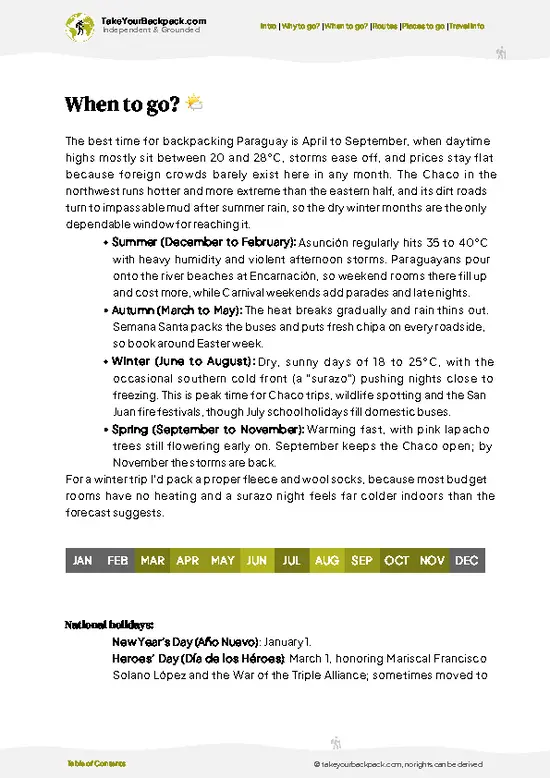
example page 3 from our offline Travel Guide for Paraguay
example page 4 from our offline Travel Guide for Paraguay
example page 5 from our offline Travel Guide for Paraguay
example page 6 from our offline Travel Guide for Paraguay
example page 7 from our offline Travel Guide for Paraguay
Loading the map 🌍
CLICK TO FILTER
cities
towns
landmarks
national parks
hikes
beaches
attractions
festivals
regions
SHOW COUNTRY’S BESTSHOW ALL

✨ Why go?
Ranked #5 festival in Paraguay
Why visitors keep coming back

Festival del Tereré gives you Paraguay’s national drink in the place where it is celebrated by locals, not staged for tour groups. Backpackers plan around it because the town is small enough that you end up sharing a table, a thermos and a round of tereré with strangers within the first hour. The custom is a circle: one person serves, everyone drinks from the same bombilla in turn, and you say “gracias” only when you want to stop. That ritual does more for cultural understanding than any museum in Asunción. It also fits an eastern route nicely. The festival sits in the Alto Paraná department, so you can pair it with the Brazilian border region, the falls at Iguazú, or the Día Nacional del Tereré on the last Saturday of February, which is the day to be there. The crowd is overwhelmingly local, … read more 👉
Festival del Tereré gives you Paraguay’s national drink in the place where it is celebrated by locals, not staged for tour groups. Backpackers plan around it because the town is small enough that you end up sharing a table, a thermos and a round of tereré with strangers within the first hour. The custom is a circle: one person serves, everyone drinks from the same bombilla in turn, and you say “gracias” only when you want to stop. That ritual does more for cultural understanding than any museum in Asunción. It also fits an eastern route nicely. The festival sits in the Alto Paraná department, so you can pair it with the Brazilian border region, the falls at Iguazú, or the Día Nacional del Tereré on the last Saturday of February, which is the day to be there. The crowd is overwhelmingly local, polca and guarania carry the evenings, and prices stay far below what comparable music events in neighboring countries charge.

💡 HighlightsWhat this place is best known for

  1. The tereré circle: the heart of the festival is the shared round of cold yerba mate with crushed medicinal herbs (yuyos). Accept the guampa when it is handed to you and hand it back empty.
  2. Día Nacional del Tereré: the last Saturday of February is the festival’s focal day, with the biggest crowds, formal celebration of the drink and the busiest stages.
  3. Polideportivo Municipal de Itakyry: the sports hall and grounds are the festival’s home. Stages, food stalls and dancing cluster here, so everything is walkable in minutes.
  4. Live polca and guarania: local and regional bands play Paraguayan folk music late into the night, with harp and guitar, and couples dance the traditional bottle dance in some sets.
  5. Yuyo and guampa stalls: vendors sell fresh medicinal herbs, carved guampas (cow-horn or wooden cups)
… read more 👉
  1. The tereré circle: the heart of the festival is the shared round of cold yerba mate with crushed medicinal herbs (yuyos). Accept the guampa when it is handed to you and hand it back empty.
  2. Día Nacional del Tereré: the last Saturday of February is the festival’s focal day, with the biggest crowds, formal celebration of the drink and the busiest stages.
  3. Polideportivo Municipal de Itakyry: the sports hall and grounds are the festival’s home. Stages, food stalls and dancing cluster here, so everything is walkable in minutes.
  4. Live polca and guarania: local and regional bands play Paraguayan folk music late into the night, with harp and guitar, and couples dance the traditional bottle dance in some sets.
  5. Yuyo and guampa stalls: vendors sell fresh medicinal herbs, carved guampas (cow-horn or wooden cups) and bombillas. These make good, cheap and packable souvenirs, and the sellers will explain which herb does what.
Festival del Tereré does not require a ticket for most of the program, but lodging in Itakyry is limited and should be booked ahead.
Spotted a mistake or missing something? Contact us.

🌤️ When to go?When is the celebration of Festival del Tereré?

Festival del Tereré runs for about three days in late February, around the Día Nacional del Tereré (the last Saturday of the month), at the Polideportivo Municipal de Itakyry in Alto Paraná.
  • Best day: Saturday is the main day, when the national day is marked and the grounds are fullest. Friday evening is calmer and easier for finding a spot near the stage.
  • Weather: Expect summer heat of 30 to 36°C (86 to 97°F), thunderstorms that arrive fast, and long daylight. Bring a hat, sunscreen, a light rain shell and shoes you can get muddy.
  • Booking: Itakyry has few beds, so reserve lodging two to three months ahead. Rates in town can rise 30 to 50 percent that weekend.
  • Roads: Rural roads can turn to slippery red mud after rain. Arrive by Friday midday and leave Sunday morning, before the departing traffic
… read more 👉
Festival del Tereré runs for about three days in late February, around the Día Nacional del Tereré (the last Saturday of the month), at the Polideportivo Municipal de Itakyry in Alto Paraná.
  • Best day: Saturday is the main day, when the national day is marked and the grounds are fullest. Friday evening is calmer and easier for finding a spot near the stage.
  • Weather: Expect summer heat of 30 to 36°C (86 to 97°F), thunderstorms that arrive fast, and long daylight. Bring a hat, sunscreen, a light rain shell and shoes you can get muddy.
  • Booking: Itakyry has few beds, so reserve lodging two to three months ahead. Rates in town can rise 30 to 50 percent that weekend.
  • Roads: Rural roads can turn to slippery red mud after rain. Arrive by Friday midday and leave Sunday morning, before the departing traffic builds.
Arrange your ride back before the Saturday night program ends, because transport thins out late.


source: climatestotravel.comJANJanuary: not recommended for travelingFEBFebruary: excellent for travelingMARMarch: not recommended for travelingAPRApril: not recommended for travelingMAYMay: not recommended for travelingJUNJune: not recommended for travelingJULJuly: not recommended for travelingAUGAugust: not recommended for travelingSEPSeptember: not recommended for travelingOCTOctober: not recommended for travelingNOVNovember: not recommended for travelingDECDecember: not recommended for traveling

✈️ The backpacker research shortcutParaguay Travel Guide

What the free pages can't give you: ready-made routes, every place ranked, and it works offline. All in 1 guide.
example page 0 from our offline Travel Guide for Paraguay
example page 1 from our offline Travel Guide for Paraguay
example page 2 from our offline Travel Guide for Paraguay
example page 3 from our offline Travel Guide for Paraguay
example page 4 from our offline Travel Guide for Paraguay
example page 5 from our offline Travel Guide for Paraguay
example page 6 from our offline Travel Guide for Paraguay
example page 7 from our offline Travel Guide for Paraguay
The digital guide (226 pages) contains:-page digital guide:
✅ Ready-made 5, 10 & 15-day routes
✅ All 65 places ranked, so you skip the overrated ones
✅ Works offline, all in 1 guide
✅ Cities, national parks, landmarks, beaches
✅ How to get around
👉 Click to see all 30+ guide features

📅 Plan smarter in minutes, not weeks
✅ Month by month travel advice
✅ Festivals & national holidays
✅ Budget expectations

🗺️ Go to the right places, skip the overrated ones
✅ Honest pros & cons of destinations
✅ Top hikes, parks & viewpoints
✅ Lesser-known places most travelers miss
✅ Clear “worth it vs skip it” guidance

🛏️ Travel smoothly without rookie mistakes
✅ Best areas to stay
✅ Transport systems explained simply
✅ Common scams & safety advice
✅ SIM cards, money & practical tips

🌍 Understand the country, not just visit it
✅ Culture & traditions
✅ 52 Essential phrases & customs
✅ Festivals worth planning around
✅ Traveler-friendly historical context
✅ Insights that make places more meaningful

📱 Built for real travel conditions
✅ Fully downloadable PDF
✅ Works completely offline
✅ Optimized for phone use
✅ Useful in remote areas & buses
✅ All in 1 guide
Stop searching, start planning
Get instant access to your full guide. 30‑day money-back guarantee.


By proceeding you agree to our terms.
Sent to your inbox immediately after payment • 100% Secure Checkout
Best Backpacking Travel Advisor 2025 tourism awardBest Backpacking
Travel Advisor
2025
What others say about Take Your Backpack Guides:
⭐⭐⭐⭐⭐
Fantastic, amazing amount of information!
⭐⭐⭐⭐⭐
My goodness this is amazing, it's what I've been looking for hats off too you!
⭐⭐⭐⭐⭐
I think this is absolutely BRILLIANT
⭐⭐⭐⭐
Very complete and informative. It's still missing places, but I gotta to commend you
⭐⭐⭐⭐⭐
This is truly amazing, thank you, can't wait to explore it with my kids!
⭐⭐⭐⭐⭐
Awesome resource, thank you!
⭐⭐⭐⭐⭐
This is amazing! Can't wait to explore the ones I haven't seen
⭐⭐⭐⭐
I love this! Well done, great idea.
⭐⭐⭐⭐⭐
Thanks for taking the time to make this gem!
⭐⭐⭐⭐⭐
This might be the best website I've ever seen.
⭐⭐⭐⭐⭐
Congratulations, and thank you so much for your work; it's incredibly valuable.
⭐⭐⭐⭐
In all seriousness I think you did a great job pointing out the important spots
⭐⭐⭐⭐⭐
10/10 very good
⭐⭐⭐⭐⭐
As someone who's only just starting to visit regularly this is awesome, thank you.
⭐⭐⭐⭐
Thank you very much! I'm going to visit my dad, it's going to be very useful!
⭐⭐⭐⭐⭐
This is really cool! We'll be travelling for the first time and this definitely come in handy.
⭐⭐⭐⭐⭐
You are now our minister of culture, congratulations 👨‍💼
⭐⭐⭐⭐⭐
Just wanted to tell you that this is a pearl! Going to follow your recommendations.
⭐⭐⭐⭐⭐
This is so cool. I'll definitely be using the resource for my travels soon.
⭐⭐⭐⭐⭐
This is very impressive! Good work.
⭐⭐⭐⭐⭐
This is an amazing and informative site. Very well done!

🛏️ Where to stay?Best areas and accommodation options

Itakyry itself is the best place to sleep, because the Polideportivo Municipal is in the small town and you can walk to the grounds and back at night. Beds are limited and mostly simple family-run guesthouses and basic inns, so the social side comes from the festival crowd rather than a hostel scene. Staying central, near the main plaza, puts you close to the grounds, the few shops and the evening gathering spots, and it keeps the walk lit and short.

Solo backpackers who arrive late in the planning window should look at Ciudad del Este or Hernandarias as a fallback. Ciudad del Este has the widest … read more 👉
Itakyry itself is the best place to sleep, because the Polideportivo Municipal is in the small town and you can walk to the grounds and back at night. Beds are limited and mostly simple family-run guesthouses and basic inns, so the social side comes from the festival crowd rather than a hostel scene. Staying central, near the main plaza, puts you close to the grounds, the few shops and the evening gathering spots, and it keeps the walk lit and short.

Solo backpackers who arrive late in the planning window should look at Ciudad del Este or Hernandarias as a fallback. Ciudad del Este has the widest choice of budget hostels, plenty of other travelers to meet and frequent buses, but the ride to Itakyry is long on rural roads and you will need to sort out return transport after dark. Staying there suits you only if Itakyry is full.

Local families sometimes rent rooms during the festival, and asking at the municipal office or your first guesthouse can turn one up. Arrive in daylight, keep your phone charged and agree on your ride out before heading to the evening program.

👛 Costs (as of 10 November 2026)How expensive it really is

Festival del Tereré costs roughly US$45 to 75 a day for an independent traveler, including a bed, food, local rides and entry. Prices are quoted in US dollars here, but you pay in Paraguayan guaraníes, mostly in cash, since Itakyry is a small rural town with few card machines.
CategoryBudget RangeLocal Reality
Festival ticketsUS$0 to 8Entry to the Polideportivo Municipal de Itakyry is often free or a small fee, and headline concerts at night can cost extra. Budget for the higher figure on the Saturday.
AccommodationUS$12 to 35 a nightBasic guesthouses and family rooms in Itakyry fill up early. Many travelers sleep in Ciudad del Este or Santa Rita and commute, where beds are easier to find. Expect a rise of 30 to 50 percent on festival nights.
Local transportUS$5 to 20Long-distance buses to the
… read more 👉
Festival del Tereré costs roughly US$45 to 75 a day for an independent traveler, including a bed, food, local rides and entry. Prices are quoted in US dollars here, but you pay in Paraguayan guaraníes, mostly in cash, since Itakyry is a small rural town with few card machines.
CategoryBudget RangeLocal Reality
Festival ticketsUS$0 to 8Entry to the Polideportivo Municipal de Itakyry is often free or a small fee, and headline concerts at night can cost extra. Budget for the higher figure on the Saturday.
AccommodationUS$12 to 35 a nightBasic guesthouses and family rooms in Itakyry fill up early. Many travelers sleep in Ciudad del Este or Santa Rita and commute, where beds are easier to find. Expect a rise of 30 to 50 percent on festival nights.
Local transportUS$5 to 20Long-distance buses to the area cost US$8 to 15 each way, and a motorbike taxi or shared ride around town runs US$1 to 4. Extra rides are needed if you sleep outside Itakyry.
Food & drinksUS$8 to 15Stalls sell grilled meat, chipa, sopa paraguaya and mandioca for US$1.50 to 5 a portion. A bag of ice and yerba for your own tereré is under US$3.
Miscellaneous expensesUS$3 to 10Guampa cups, bombillas, sunscreen, a rain layer and small tips. Handcrafts at festival stands are cheap, and ATM withdrawals may need to be made before arrival.
Total Daily BudgetUS$45 to 75Lower end if you share rooms and eat at stalls, higher if you stay in town on the main night.


source: senatur.gov.py
⚠️ Prices can change and everyone travels differently, so take this as a rough guide. Hope it helps you plan your adventure!

🍲 FoodLocal Cuisine & Drinks

Expect the festival to run on tereré, the cold herbal infusion Paraguayans sip from a shared guampa (horn or cup) through a metal bombilla straw. Stalls and families sell it with yuyos, medicinal herbs such as mint and lemongrass crushed into the water. Ice is the whole point, so find a stall with a cooler that is topped up regularly.

For food, go for the Paraguayan staples. Chipa, a cheesy cassava bread, is best warm from a clay oven. Sopa paraguaya is a dense cornbread with cheese and onion, and mbejú is a starchy cassava and cheese cake. Grilled asado and sausages (chorizo) turn up in hearty portions. Try mandi’o chyryry, fried cassava with egg, if someone is making it.

The etiquette is the fun part. One person, the cebador, pours for the group and each drinker finishes the cup before … read more 👉
Expect the festival to run on tereré, the cold herbal infusion Paraguayans sip from a shared guampa (horn or cup) through a metal bombilla straw. Stalls and families sell it with yuyos, medicinal herbs such as mint and lemongrass crushed into the water. Ice is the whole point, so find a stall with a cooler that is topped up regularly.

For food, go for the Paraguayan staples. Chipa, a cheesy cassava bread, is best warm from a clay oven. Sopa paraguaya is a dense cornbread with cheese and onion, and mbejú is a starchy cassava and cheese cake. Grilled asado and sausages (chorizo) turn up in hearty portions. Try mandi’o chyryry, fried cassava with egg, if someone is making it.

The etiquette is the fun part. One person, the cebador, pours for the group and each drinker finishes the cup before passing it back. Say “gracias” only when you want to stop, because thanking means you are done. Do not stir the bombilla. Bring cash in guaraníes, since small stalls rarely take cards, and carry small notes for change.

FAQFrequently asked questions about del Tereré

Festival del Tereré takes place over about three days in late February, around the Día Nacional del Tereré on the last Saturday of the month. It is held at the Polideportivo Municipal de Itakyry in Alto Paraná, where it has been hosted since 1998. Saturday is the busiest day, so plan to arrive by Friday.
Attending Festival del Tereré costs roughly US$55 to 100 per day for independent travelers. Entry to much of the program is free or about US$0 to 5, while a basic room in Itakyry runs about US$20 to 40 that weekend. Food at stalls adds around US$10 to 20 a day.
Festival del Tereré does not require advance tickets for most of the program, which is free or sold cheaply at the gate of the Polideportivo Municipal in Itakyry. Book your room two to three months ahead instead, since town beds are few and fill up. Bring cash in guaraníes for entry fees and stalls.
⚠️ Things can change over time, so always validate details locally before you go.

Other Paraguayan festivals near del Tereré

Explore more nearby:


💡 Not sure where to go next?
Create a personalized itinerary for Paraguay including del Tereré and the places that fit your trip.

Generate my itinerary

👉 Discover all festivals

Or checkout all Paraguay has to offer (think cities, towns, villages, national parks, hikes, beaches, festivals)
Country photo of Paraguay

We 💚 feedbackParting advice and final tips

Many travelers arrive on the Saturday itself without a bed or a ride out, then scramble in a town with few options. Festival del Tereré works best if you reserve lodging early and stay the full three days. I would bring a guampa and bombilla of your own, and learn the serving etiquette before you sit down.

✈️ When did I visit Paraguay?
Before visiting Argentina in September 2012, I crossed through Paraguay, ending up at the magical Iguazu Falls.

✍️ Help improve this page!
The information on this page is based on my own backpacking experience in Paraguay, supplemented with up-to-date research and feedback from other travelers. Travel details can change, so if you notice anything outdated or incomplete, feel free to let me know.


🙋‍♂️ Give feedback

👋 Meet the founderWho’s Behind Take Your Backpack?

Johan, backpacker and founder of TakeYourBackpackHi, I’m Johan (Netherlands 🇳🇱), the creator of TakeYourBackpack. Over the past 30 years, I’ve backpacked through 88 countries across six continents, gaining extensive experience with independent travel, long-term trips, and overland routes.

This site is built on a combination of firsthand travel experience and carefully curated insights from other backpackers. Many guides are based on places I’ve personally visited, while others bring together tips, observations, and practical advice shared by trusted travelers I’ve met along the way.

The goal is to provide realistic, experience-driven guidance — not generic itineraries — so you can explore destinations with better context, clearer expectations, and more confidence.