×

Paraguay🇵🇾 | best festivalsTop-Rated 5 festivals in Paraguay

Festivals in Paraguay are mostly local, devout and inexpensive, with few of the ticketed spectacles found elsewhere in South America. Most are tied to the Catholic calendar and to Guaraní and Jesuit-era heritage, and the best are held in small towns an hour or two from Asunción. The central region has the easiest access and the largest pilgrim crowds. The south around Encarnación adds a more organized Carnival scene with grandstands. The Chaco is sparse and hard to reach. For backpacking and independent travel, the central and southern festivals suit best: entry is usually free, and dates matter more than tickets.

By Johan Kruseman 🇳🇱 | Updated November 18, 2026
Explore the best regions in Paraguay

Why go?Key Factors That Shape the Experience

Paraguay’s festivals come from a rare blend. Guaraní is spoken by most of the population alongside Spanish, and Jesuit missions in the southeast left a tradition of music, carving and religious processions that outlasted the missions themselves. The result is a festival calendar built around community and faith rather than tourism, so what you see is mostly what locals attend for their own reasons.

The country is small, and most of its people live in the eastern half, within a few hours of Asunción. That makes the main gatherings reachable by public bus without a car. The Chaco in the west, by contrast, is thinly populated, with long distances and limited transport, and its events are harder to visit.

Infrastructure is modest. Expect few English signs, limited accommodation in small towns on … read more 👉
Paraguay’s festivals come from a rare blend. Guaraní is spoken by most of the population alongside Spanish, and Jesuit missions in the southeast left a tradition of music, carving and religious processions that outlasted the missions themselves. The result is a festival calendar built around community and faith rather than tourism, so what you see is mostly what locals attend for their own reasons.

The country is small, and most of its people live in the eastern half, within a few hours of Asunción. That makes the main gatherings reachable by public bus without a car. The Chaco in the west, by contrast, is thinly populated, with long distances and limited transport, and its events are harder to visit.

Infrastructure is modest. Expect few English signs, limited accommodation in small towns on peak dates, and cash-only stalls. Tourism offices exist but publish little in advance, so exact dates and schedules are often confirmed only days beforehand through local channels. Some events move by a day or a weekend.

A traveler should also know that festivals here are quiet by regional standards. There is music, food and ritual, but not the scale of Brazil or Peru. The appeal is proximity: you stand close to the ceremony, not behind a barrier.
Evaluating the Top Choices
The list of best festivals in Paraguay is created based on energy, traditions, crowd experience, activities, and overall excitement. If you feel a festival is missing in this list, please let us know.

When to go?Seasonal Guide to Visiting

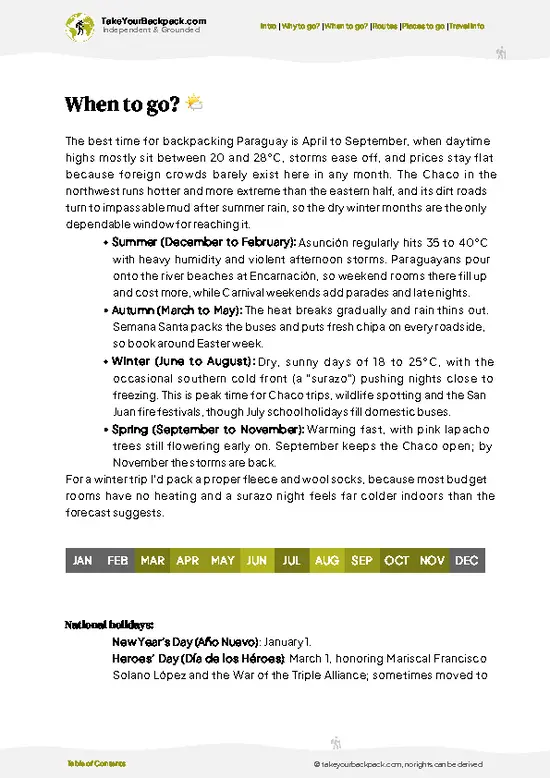
Best months and weather: The best months for festivals in Paraguay are June to September, when daytime highs run 18 to 25°C in the east, the humidity drops and the long outdoor processions and evening gatherings are comfortable. Summer (December to February) brings 30 to 38°C, high humidity and heavy afternoon storms, and many of the largest events fall in this season anyway, so plan around the heat.Shoulder seasons and regions: April to May and October to November are the shoulder months, with highs of 24 to 30°C and rain that arrives in short, intense downpours. Eastern Paraguay near Encarnación and Ciudad del Este receives roughly 1,500 to 1,800 mm a year, Asunción about 1,300 mm, and the western Chaco considerably less, though its summers are the hottest in the country, often above 40°C. … read more 👉
Best months and weather: The best months for festivals in Paraguay are June to September, when daytime highs run 18 to 25°C in the east, the humidity drops and the long outdoor processions and evening gatherings are comfortable. Summer (December to February) brings 30 to 38°C, high humidity and heavy afternoon storms, and many of the largest events fall in this season anyway, so plan around the heat.Shoulder seasons and regions: April to May and October to November are the shoulder months, with highs of 24 to 30°C and rain that arrives in short, intense downpours. Eastern Paraguay near Encarnación and Ciudad del Este receives roughly 1,500 to 1,800 mm a year, Asunción about 1,300 mm, and the western Chaco considerably less, though its summers are the hottest in the country, often above 40°C. Winter nights can drop to 5°C or lower in the south, and cold fronts bring a few damp, cool days.Peaks and prices: Peak periods that change decisions are Holy Week, the Carnival weekends of late January to February, and early December, when pilgrims fill small towns. Outside these dates, dorm beds cost about 60,000 to 120,000 PYG (US$8 to 15). During them, rooms in small towns sell out, prices rise 20 to 50 percent and buses fill, so book a week or more ahead, or stay in Asunción or Encarnación and travel in by day.

festival hoppingOptimizing Your Multi-Stop Itinerary

Time and structure: A trip combining several festivals in Paraguay needs 7 to 12 days, because dates are fixed and the distances are short but the buses are slow. Two clusters work well. The central cluster around Asunción, with Itauguá, Caacupé and the Lake Ypacaraí towns, is reached in 40 minutes to 1.5 hours by city or regional bus. The southern cluster around Encarnación, San Ignacio and the Jesuit sites lies 5 to 6 hours away by bus, at roughly 100,000 to 150,000 PYG (US$13 to 20).Direction and pacing: Travel from north to south: start in Asunción, use it as a base for the central events, then head to Encarnación and exit toward Posadas in Argentina or return north. Allow 2 to 3 nights per cluster, or a full day for a single event plus travel. Ciudad del Este is about 4.5 to 5 hours from … read more 👉
Time and structure: A trip combining several festivals in Paraguay needs 7 to 12 days, because dates are fixed and the distances are short but the buses are slow. Two clusters work well. The central cluster around Asunción, with Itauguá, Caacupé and the Lake Ypacaraí towns, is reached in 40 minutes to 1.5 hours by city or regional bus. The southern cluster around Encarnación, San Ignacio and the Jesuit sites lies 5 to 6 hours away by bus, at roughly 100,000 to 150,000 PYG (US$13 to 20).Direction and pacing: Travel from north to south: start in Asunción, use it as a base for the central events, then head to Encarnación and exit toward Posadas in Argentina or return north. Allow 2 to 3 nights per cluster, or a full day for a single event plus travel. Ciudad del Este is about 4.5 to 5 hours from Asunción and fits only as a separate leg. The Chaco, at 6 to 8 hours of bus from the capital to Filadelfia, needs its own 3 to 4 days and is better left for another trip.Common mistakes: The most frequent mistake is stacking dates too tightly. Festivals often end late, buses thin out after dark, and a 5-hour transfer the next morning leaves no margin. Leave a buffer day between clusters. Another is arriving on the day itself without a bed, which in small towns often means sleeping elsewhere and commuting. Book ahead, or base in a larger hub and make day trips. Finally, confirm dates locally a week before, since schedules shift.

The ListMust-Visit festivals in Paraguay

1 Festival del Lago Ypacaraí

Central folk night, free entry, jazz and rock evenings, artisan stalls

Join a free, two-week town anniversary program in Ypacaraí, where guarania ballads, poetry, theater and handmade crafts fill the evenings in early autumn.

2 Asunciónico

Foreign headliners, racetrack grounds, March nights, online tickets

Catch international rock and pop acts over three March nights at the Jockey Club Paraguayo, with chipa and iced tereré between sets.

3 Festival del Tereré

Shared guampa, yuyo herbs, late February, Itakyry

Pass the cold herbal mate around a circle of locals, then dance to polca and guarania around the sports hall until late.

4 Fiesta de San Juan

Judas Kái effigy, fire balls, hot coals, June 23 to 24

Gather at night around a burning straw Judas, watch kids kick flaming rag balls, and warm up with chipa and mosto from neighborhood stalls.

5 Fiesta de la Tradición Misionera

Colt taming, gaucho riders, January heats, Misiones grill

Watch riders from four countries stay on half-wild colts and race through the dust, then eat grilled meat and chipa at open-fire stalls.

Loading the map 🌍

Expert viewWhat You Should Know

How many to attend: Two or three festivals is the right number for most backpackers in Paraguay. Each one takes a full day with transport, and the country’s slow buses and fixed dates make a fourth hard to fit without rushing. Two gives you contrast, one religious and one secular, for example, and a third only makes sense if it falls on your route anyway. Spread across a trip of 10 days or so, that leaves time for tereré on a plaza bench, which you will spend more hours on than you expect.Which kind to prioritize: If you travel for culture and photography, pick a religious or heritage event in the central towns: streets lined with food stalls, brass bands, pilgrims on foot and the smell of wood smoke and frying chipa. You come away with a real sense of local devotion. If you want a party and … read more 👉
How many to attend: Two or three festivals is the right number for most backpackers in Paraguay. Each one takes a full day with transport, and the country’s slow buses and fixed dates make a fourth hard to fit without rushing. Two gives you contrast, one religious and one secular, for example, and a third only makes sense if it falls on your route anyway. Spread across a trip of 10 days or so, that leaves time for tereré on a plaza bench, which you will spend more hours on than you expect.Which kind to prioritize: If you travel for culture and photography, pick a religious or heritage event in the central towns: streets lined with food stalls, brass bands, pilgrims on foot and the smell of wood smoke and frying chipa. You come away with a real sense of local devotion. If you want a party and a social crowd, choose the Carnival season in the south, where grandstands, costumed groups and drumming run late into the night. If you prefer quiet, a craft or folk fair in a small town gives you conversation with the makers and a handmade souvenir.What it costs: Budget about US$30 to 50 a day (225,000 to 375,000 PYG) including a dorm bed of US$8 to 15, street food meals of US$2 to 5 and local buses. Entry to most religious and street events is free. Grandstand seats at Carnival run roughly 30,000 to 100,000 PYG (US$4 to 13). Day trips by bus from Asunción to nearby towns cost 15,000 to 40,000 PYG (US$2 to 5) each way, and a guide for a cultural or mission site is about US$15 to 30 for a half day. A typical visit adds US$10 to 25 for food, drinks and a craft purchase, and the reward is eating what the locals eat, such as sopa paraguaya and mbeju.Safety and etiquette: Crowds attract pickpockets, so carry a small amount of cash in a front pocket, since most stalls do not take cards and ATMs in small towns run dry on peak weekends. At Carnival, expect foam, water and flour thrown at passersby, and keep phones in waterproof pouches. Fire and pyrotechnic events, with sparks and crowd surges, call for distance and closed shoes. Dress modestly for religious ceremonies, and ask before photographing people at prayer or in procession. If offered tereré, accept it, drink the whole round, and say gracias when you are done; passing the cup back is the polite end of the exchange. Drink bottled water, carry sunscreen, and plan the last bus home before dark, because rural roads are poorly lit.

✈️ The backpacker research shortcutParaguay Travel Guide

What the free pages can't give you: ready-made routes, every place ranked, and it works offline. All in 1 guide.
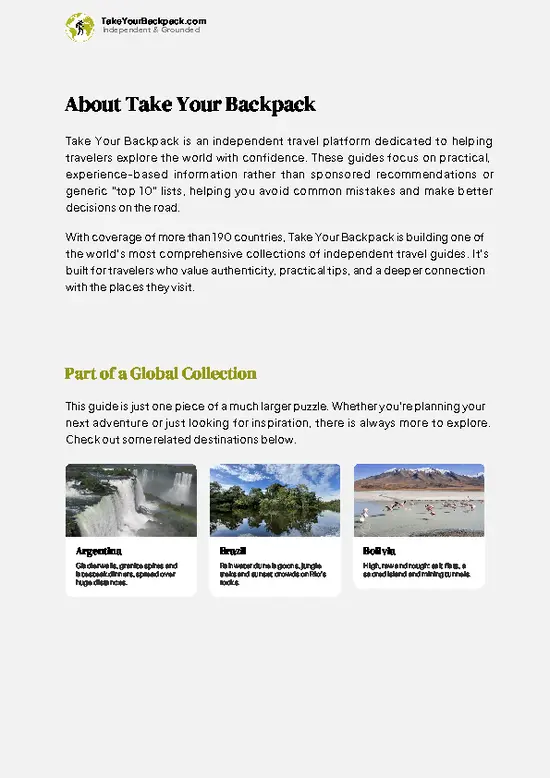
example page 0 from our offline Travel Guide for Paraguay
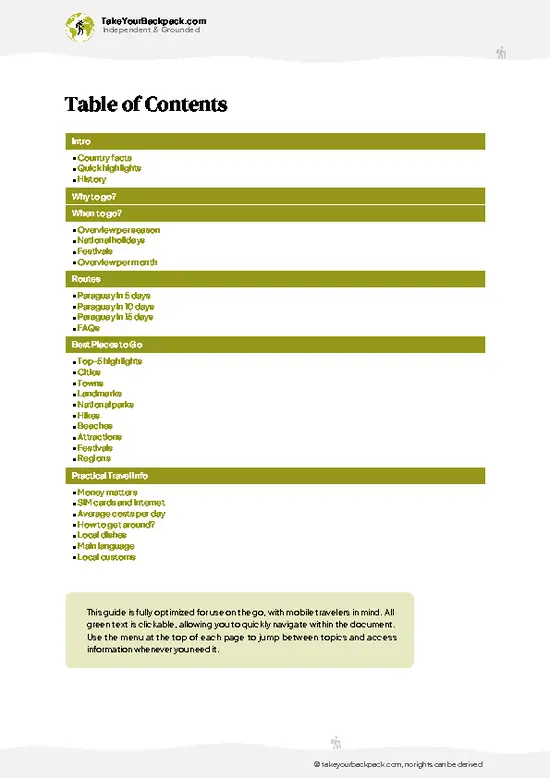
example page 1 from our offline Travel Guide for Paraguay
example page 2 from our offline Travel Guide for Paraguay
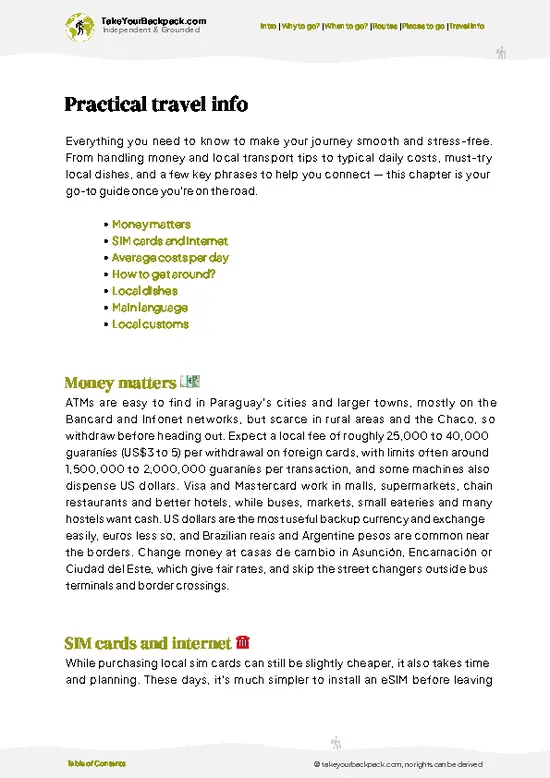
example page 3 from our offline Travel Guide for Paraguay
example page 4 from our offline Travel Guide for Paraguay
example page 5 from our offline Travel Guide for Paraguay
example page 6 from our offline Travel Guide for Paraguay
example page 7 from our offline Travel Guide for Paraguay
The digital guide (226 pages) contains:-page digital guide:
✅ Ready-made 5, 10 & 15-day routes
✅ All 65 places ranked, so you skip the overrated ones
✅ Works offline, all in 1 guide
✅ Cities, national parks, landmarks, beaches
✅ How to get around
👉 Click to see all 30+ guide features

📅 Plan smarter in minutes, not weeks
✅ Month by month travel advice
✅ Festivals & national holidays
✅ Budget expectations

🗺️ Go to the right places, skip the overrated ones
✅ Honest pros & cons of destinations
✅ Top hikes, parks & viewpoints
✅ Lesser-known places most travelers miss
✅ Clear “worth it vs skip it” guidance

🛏️ Travel smoothly without rookie mistakes
✅ Best areas to stay
✅ Transport systems explained simply
✅ Common scams & safety advice
✅ SIM cards, money & practical tips

🌍 Understand the country, not just visit it
✅ Culture & traditions
✅ 52 Essential phrases & customs
✅ Festivals worth planning around
✅ Traveler-friendly historical context
✅ Insights that make places more meaningful

📱 Built for real travel conditions
✅ Fully downloadable PDF
✅ Works completely offline
✅ Optimized for phone use
✅ Useful in remote areas & buses
✅ All in 1 guide
Stop searching, start planning
Get instant access to your full guide. 30‑day money-back guarantee.


By proceeding you agree to our terms.
Sent to your inbox immediately after payment • 100% Secure Checkout
Best Backpacking Travel Advisor 2025 tourism awardBest Backpacking
Travel Advisor
2025
What others say about Take Your Backpack Guides:
⭐⭐⭐⭐⭐
Fantastic, amazing amount of information!
⭐⭐⭐⭐⭐
My goodness this is amazing, it's what I've been looking for hats off too you!
⭐⭐⭐⭐⭐
I think this is absolutely BRILLIANT
⭐⭐⭐⭐
Very complete and informative. It's still missing places, but I gotta to commend you
⭐⭐⭐⭐⭐
This is truly amazing, thank you, can't wait to explore it with my kids!
⭐⭐⭐⭐⭐
Awesome resource, thank you!
⭐⭐⭐⭐⭐
This is amazing! Can't wait to explore the ones I haven't seen
⭐⭐⭐⭐
I love this! Well done, great idea.
⭐⭐⭐⭐⭐
Thanks for taking the time to make this gem!
⭐⭐⭐⭐⭐
This might be the best website I've ever seen.
⭐⭐⭐⭐⭐
Congratulations, and thank you so much for your work; it's incredibly valuable.
⭐⭐⭐⭐
In all seriousness I think you did a great job pointing out the important spots
⭐⭐⭐⭐⭐
10/10 very good
⭐⭐⭐⭐⭐
As someone who's only just starting to visit regularly this is awesome, thank you.
⭐⭐⭐⭐
Thank you very much! I'm going to visit my dad, it's going to be very useful!
⭐⭐⭐⭐⭐
This is really cool! We'll be travelling for the first time and this definitely come in handy.
⭐⭐⭐⭐⭐
You are now our minister of culture, congratulations 👨‍💼
⭐⭐⭐⭐⭐
Just wanted to tell you that this is a pearl! Going to follow your recommendations.
⭐⭐⭐⭐⭐
This is so cool. I'll definitely be using the resource for my travels soon.
⭐⭐⭐⭐⭐
This is very impressive! Good work.
⭐⭐⭐⭐⭐
This is an amazing and informative site. Very well done!

🛏️ Where to stay?Where to Stay: Paraguay Edition

Paraguay has a small but growing hostel scene, with dorm beds mostly in the US$10 to 18 range and simple guesthouses and budget hotels filling the gaps, though private hostels cluster mainly in Asunción and Encarnación. In Asunción, the Centro puts you within walking distance of the Palacio de los López, the Panteón and the riverfront for the lowest prices, but its streets empty out after dark and on weekends, while Villa Morra and Recoleta cost a bit more and sit a 15 to 25 minute bus ride from the old town, in exchange for safer sidewalks, shopping malls and the city’s best bars and restaurants. In Encarnación, the blocks between the center and the Costanera beachfront are the easiest base, … read more 👉
Paraguay has a small but growing hostel scene, with dorm beds mostly in the US$10 to 18 range and simple guesthouses and budget hotels filling the gaps, though private hostels cluster mainly in Asunción and Encarnación. In Asunción, the Centro puts you within walking distance of the Palacio de los López, the Panteón and the riverfront for the lowest prices, but its streets empty out after dark and on weekends, while Villa Morra and Recoleta cost a bit more and sit a 15 to 25 minute bus ride from the old town, in exchange for safer sidewalks, shopping malls and the city’s best bars and restaurants. In Encarnación, the blocks between the center and the Costanera beachfront are the easiest base, close to the riverside nightlife in summer and an easy hop to the Jesuit ruins at Trinidad.

If you enjoy meeting fellow travelers, consider choosing hostels with high ratings for atmosphere. On the other hand, if you prefer having your own space, a hotel might be a better option.

ParaguayExplore Beyond This Category

👋 Meet the founderWho’s Behind Take Your Backpack?

Johan, backpacker and founder of TakeYourBackpackHi, I’m Johan (Netherlands 🇳🇱), the creator of TakeYourBackpack. Over the past 30 years, I’ve backpacked through 88 countries across six continents, gaining extensive experience with independent travel, long-term trips, and overland routes.

This site is built on a combination of firsthand travel experience and carefully curated insights from other backpackers. Many guides are based on places I’ve personally visited, while others bring together tips, observations, and practical advice shared by trusted travelers I’ve met along the way.

The goal is to provide realistic, experience-driven guidance — not generic itineraries — so you can explore destinations with better context, clearer expectations, and more confidence.