×

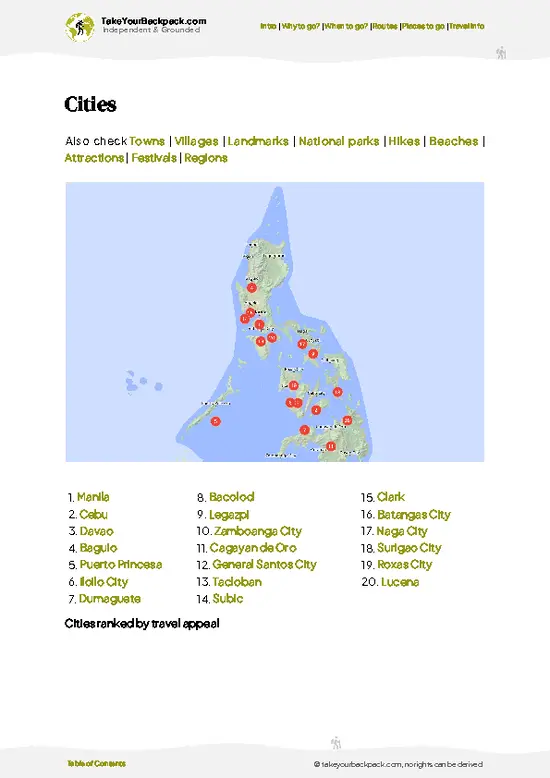
Philippines🇵🇭 | citiesCagayan de Orowhitewater river, adventure parks, city plazas | things to do and best time to go

Explore Batangas CityExplore Angeles City

Backpacking in Cagayan de Oro
🌟 Highlightcity ranked #10
By Johan Kruseman 🇳🇱 | Updated May 28, 2026

You land in Cagayan de Oro and the first big fork hits: do you burn cash on a quick whitewater rafting package and a private van to Dahilayan or Bukidnon, or slow down, ride cramped jeepneys, and stretch your budget but sacrifice comfort and time. That trade-off matters here because most of the good stuff is outside the city. CDO sits in Northern Mindanao, on the north coast of Mindanao island, and it’s a classic “hub city” for backpackers: decent malls, riverside bars, cheap eats, and adventure agencies, but not a postcard beauty. I like it as a launchpad—rafting the Cagayan River, day trips to Bukidnon’s cool highlands—less as a linger-for-a-week place. It’s cheaper and rougher than Cebu, friendlier and more energetic than Iligan, and generally safe if you stick to normal city sense and avoid sketchy late-night alleys. Meeting other travelers is hit-or-miss; you’ll find them around rafting outfitters and a few hostels, not on every corner. The vibe is workaday Filipino city with a streak of adrenaline tourism, more “base camp” than bucket-list icon.

Discover everything you want to know in the 📖 Philippines Travel Guide.
Loading the map 🌍
CLICK TO FILTER
cities
towns
landmarks
national parks
hikes
beaches
attractions
festivals
regions
SHOW COUNTRY’S BESTSHOW ALL

✨ Why go?
Ranked #10 city in Philippines
Why Cagayan de Oro should be on your travel list

Cagayan de Oro is a strategic basecamp for backpackers, balancing time, money, and comfort. It’s not just a stopover; it’s a launchpad for day trips to nearby adventures. The hostels here are budget-friendly, fostering a community vibe that makes it easy to connect with fellow travelers. You’ll find affordable food options that fuel your explorations without breaking the bank. The city is walkable, allowing you to soak in the local culture without the hassle of transport. When the sun sets, the nightlife offers a mix of chill bars and lively spots, perfect for unwinding after a day of adventure. Plus, it’s well-connected for easy onward travel, making it a smart choice for those weaving through the Philippines.
Want to include Cagayan de Oro in your Philippines route?
Create a personalized Philippines itinerary that includes Cagayan de Oro and the places that fit your trip — based on your travel style, budget, and available time. Get your route in seconds.

Generate my trip

💡 HighlightsWhat this place is best known for

  • White-water rafting on the Cagayan de Oro River — The city’s signature adrenaline rush: commercial outfitters run multi-rapids trips starting inside the city limits. It’s equal parts fun and a way to see riverside neighborhoods from a very different angle.
  • Macahambus Cave & Suspension Bridge Park — A compact, leafy park with a cave you can walk into and a small suspension bridge; the site also has Civil War-era history and good vantage points over a scenic ravine. Easy to visit and off the usual mall circuit.
  • Gaston Park / Plaza Divisoria — The old Spanish-era town square beside the river. It’s a good primer on the city’s colonial layer, and a favorite local hangout for evening strolls and street food.
  • St. Augustine Metropolitan Cathedral (Cagayan de Oro Cathedral) — The city’s main church:
read more 👉
  • White-water rafting on the Cagayan de Oro River — The city’s signature adrenaline rush: commercial outfitters run multi-rapids trips starting inside the city limits. It’s equal parts fun and a way to see riverside neighborhoods from a very different angle.
  • Macahambus Cave & Suspension Bridge Park — A compact, leafy park with a cave you can walk into and a small suspension bridge; the site also has Civil War-era history and good vantage points over a scenic ravine. Easy to visit and off the usual mall circuit.
  • Gaston Park / Plaza Divisoria — The old Spanish-era town square beside the river. It’s a good primer on the city’s colonial layer, and a favorite local hangout for evening strolls and street food.
  • St. Augustine Metropolitan Cathedral (Cagayan de Oro Cathedral) — The city’s main church: architecturally simple but important to local history and daily life. Attend a mass or just sit inside for a quiet, human slice of the city.
  • Limketkai / Centrio Riverwalk area — The urban hub where malls, markets and a pleasant riverfront meet. Good for practical stuff (SIM cards, cheap eats), people-watching, and catching weekend events without leaving the city.
  • Xavier University (Ateneo de Cagayan) campus — A leafy campus with striking architecture, tranquil courtyards and a small museum/collection that highlights Jesuit history and Mindanaoan culture; nice for a slow, local cultural walk.
  • Cogon / Divisoria Public Market — Raw, colorful, and noisy in the best way. If you want to see real daily life, sample local produce, bargain for dried fish or street eats, this market gives an authentic snapshot of the city.
  • Cagayan de Oro City Museum (Museo de Oro) — A modest but useful city museum that houses artifacts, photos and displays about the area’s indigenous groups, colonial past and everyday history—good context after walking historic spots.
  • Paseo del Río / Riverside promenades — Short riverfront stretches and small parks that reveal how the river shaped the city; you’ll find joggers, vendors and evening food stalls—great for a relaxed, local evening.
  • Street-food lanes and night markets (e.g., Pelaez Boulevard / selected pop-up night markets) — Not a single monument, but essential: trying local grilled seafood, satti, or puso (hanging rice) from nighttime vendors is one of the best ways to meet the city itself.
For nearby day trips: Dahilayan Adventure Park (Bukidnon) for ziplines and cooler mountain air, Mapawa Nature Park for waterfalls and short hikes, and Iligan’s Tinago / Maria Cristina Falls are all doable from CDO — Dahilayan is my personal favorite for a full-on adventure day outside the city.
Spotted a mistake or missing something? Contact us.

🏘️ NeighborhoodsHow different areas shape the experience

Cagayan de Oro offers a blend of urban energy and natural beauty, making it a strategic stop for backpackers. Here’s how the neighborhoods stack up:

Divisoria: This is the heart of the city, buzzing with local markets and street food. It’s wallet-friendly, perfect for short stays. Walkability is high, and you’ll find plenty of budget accommodations. Nightlife is lively but not overwhelming, making it a great base for exploring.

Macahambus: Known for its adventure activities, this area is ideal for thrill-seekers. It’s a bit quieter, with fewer tourists, and offers easy access to nature. Expect to spend more on activities, but accommodations are still reasonable. Perfect for longer stays if you want to dive into local adventures.

Balulang: A residential area that feels more laid-back. It’s … read more 👉
Cagayan de Oro offers a blend of urban energy and natural beauty, making it a strategic stop for backpackers. Here’s how the neighborhoods stack up:

Divisoria: This is the heart of the city, buzzing with local markets and street food. It’s wallet-friendly, perfect for short stays. Walkability is high, and you’ll find plenty of budget accommodations. Nightlife is lively but not overwhelming, making it a great base for exploring.

Macahambus: Known for its adventure activities, this area is ideal for thrill-seekers. It’s a bit quieter, with fewer tourists, and offers easy access to nature. Expect to spend more on activities, but accommodations are still reasonable. Perfect for longer stays if you want to dive into local adventures.

Balulang: A residential area that feels more laid-back. It’s less touristy, which means lower prices and a genuine local vibe. Transport options are decent, but you may need to rely on tricycles. Great for those looking to escape the hustle for a bit.

Pueblo de Oro: A modern development with shopping and dining options. It’s pricier, but the comfort level is higher. Walkability is decent, and it’s a good spot for longer stays if you want a mix of urban and suburban life.

⌛️ 1 day1-day itinerary for Cagayan de Oro

Cagayan de Oro, often called the ”City of Golden Friendship,” is a vibrant hub in the Philippines, known for its warm locals and thrilling white-water rafting. It’s a place where adventure meets culture, making it a perfect one-day stop.

Start your morning in the bustling district of Divisoria. Grab a hearty breakfast at a local eatery like *Kumbira*, where you can savor silog dishes—rice paired with eggs and your choice of meat. After fueling up, stroll through the nearby *Cagayan de Oro Cathedral*, a stunning piece of architecture that offers a moment of peace amidst the city’s hustle.

In the afternoon, head to the *Macahambus Cave and Gorge*. This spot is often overlooked by tourists but offers a unique glimpse into the region’s natural beauty. The hike down to the gorge is invigorating, … read more 👉
Cagayan de Oro, often called the ”City of Golden Friendship,” is a vibrant hub in the Philippines, known for its warm locals and thrilling white-water rafting. It’s a place where adventure meets culture, making it a perfect one-day stop.

Start your morning in the bustling district of Divisoria. Grab a hearty breakfast at a local eatery like *Kumbira*, where you can savor silog dishes—rice paired with eggs and your choice of meat. After fueling up, stroll through the nearby *Cagayan de Oro Cathedral*, a stunning piece of architecture that offers a moment of peace amidst the city’s hustle.

In the afternoon, head to the *Macahambus Cave and Gorge*. This spot is often overlooked by tourists but offers a unique glimpse into the region’s natural beauty. The hike down to the gorge is invigorating, and the views are worth every step. You’ll feel the thrill of being off the beaten path while soaking in the lush surroundings.

As evening approaches, make your way to the *Pueblo de Oro* area for dinner. Try *The Goodness** for some local dishes with a twist. Afterward, unwind at *Limketkai Center*, where you can enjoy a mix of shopping and entertainment.

Cagayan de Oro is a city that invites exploration, and with just one day, you can experience its heart and soul without feeling rushed. Embrace the adventure!
Turn your Cagayan de Oro visit into an Philippines adventure
Build a complete Philippines route with Cagayan de Oro, hidden gems, must-see destinations, and realistic travel times included.

Generate my trip

🌤️ When to go?Seasonal considerations and timing


  • Weather: The dry season from November to May is your best bet. Expect less rain, which means fewer muddy trails and more reliable river crossings. The wet season (June to October) brings heavy downpours that can disrupt plans and make outdoor activities risky.

  • Temperature: Temperatures hover between 24°C and 32°C (75°F to 90°F) year-round, but the dry months feel more comfortable with lower humidity. The wet season’s humidity can make the heat feel oppressive, draining your energy faster.

  • Daylight Hours: Roughly 11 to 12 hours of daylight throughout the year. The difference is minimal, so plan your hikes and river adventures around early mornings and late afternoons to avoid the midday heat.

  • Crowds: Peak tourist season aligns with the dry months, especially December to February. You’ll
read more 👉

  • Weather: The dry season from November to May is your best bet. Expect less rain, which means fewer muddy trails and more reliable river crossings. The wet season (June to October) brings heavy downpours that can disrupt plans and make outdoor activities risky.

  • Temperature: Temperatures hover between 24°C and 32°C (75°F to 90°F) year-round, but the dry months feel more comfortable with lower humidity. The wet season’s humidity can make the heat feel oppressive, draining your energy faster.

  • Daylight Hours: Roughly 11 to 12 hours of daylight throughout the year. The difference is minimal, so plan your hikes and river adventures around early mornings and late afternoons to avoid the midday heat.

  • Crowds: Peak tourist season aligns with the dry months, especially December to February. You’ll find more travelers, which means busier hostels and higher prices but also more social opportunities and events.

  • Seasonal Activities: Whitewater rafting is prime from December to May when river levels are ideal—not too low, not dangerously high. Festivals like the Higalaay Festival in August offer cultural immersion but come with crowds and price hikes.

  • Price Fluctuations: Accommodation and tours spike during the dry season and holidays. Booking early can save you money. The wet season offers lower prices but comes with the trade-off of unpredictable weather and limited activities.


Pro-tip: Aim for the shoulder months—November or May—when you dodge the worst rains and crowds but still catch good weather and decent prices. It’s the sweet spot for savvy backpackers.


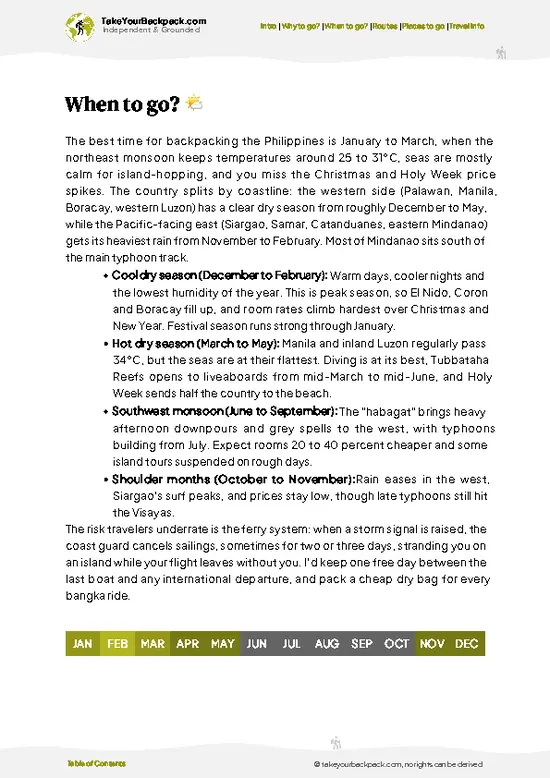
source: climatestotravel.comJANJanuary: excellent for travelingFEBFebruary: excellent for travelingMARMarch: excellent for travelingAPRApril: excellent for travelingMAYMay: highly recommended for travelingJUNJune: fair for travelingJULJuly: fair for travelingAUGAugust: good for travelingSEPSeptember: fair for travelingOCTOctober: fair for travelingNOVNovember: highly recommended for travelingDECDecember: excellent for traveling
when-to-go

✈️ The backpacker research shortcutPhilippines Travel Guide

An offline-friendly backpacking guide with optimized travel routes, ranked highlights, transport advice, and the best areas to stay.
example page 0 from our offline Travel Guide for Philippines
example page 1 from our offline Travel Guide for Philippines
example page 2 from our offline Travel Guide for Philippines
example page 3 from our offline Travel Guide for Philippines
example page 4 from our offline Travel Guide for Philippines
example page 5 from our offline Travel Guide for Philippines
example page 6 from our offline Travel Guide for Philippines
example page 7 from our offline Travel Guide for Philippines
The digital guide (505 pages) contains:
144 highlights, ranked by travel appeal
Optimized 7, 14 & 21-day travel routes
Cities, national parks, landmarks, beaches
How to get around
Offline-friendly for travel without Wi-Fi
👉 Click to see all 30+ guide features

📅 Plan smarter in minutes, not weeks
Month by month travel advice
Festivals & national holidays
Budget expectations

🗺️ Go to the right places, skip the overrated ones
Honest pros & cons of destinations
Top hikes, parks & viewpoints
Lesser-known places most travelers miss
Clear “worth it vs skip it” guidance

🛏️ Travel smoothly without rookie mistakes
Best areas to stay
Transport systems explained simply
Common scams & safety advice
SIM cards, money & practical tips

🌍 Understand the country, not just visit it
Culture & traditions
52 Essential phrases & customs
Festivals worth planning around
Traveler-friendly historical context
Insights that make places more meaningful

📱 Built for real travel conditions
Fully downloadable PDF
Works completely offline
Optimized for phone use
Useful in remote areas & buses
Everything in one place
Save weeks of stressful planning
Get instant access to your full guide. 30‑day money-back guarantee.


By proceeding you agree to our terms.
Sent to your inbox immediately after payment • 100% Secure Checkout
Best Backpacking Travel Advisor 2025 tourism awardBest Backpacking
Travel Advisor
2025
What others say about Take Your Backpack Guides:
⭐⭐⭐⭐⭐
Fantastic, amazing amount of information!
⭐⭐⭐⭐⭐
My goodness this is amazing, it's what I've been looking for hats off too you!
⭐⭐⭐⭐⭐
I think this is absolutely BRILLIANT
⭐⭐⭐⭐
Very complete and informative. It's still missing places, but I gotta to commend you
⭐⭐⭐⭐⭐
This is truly amazing, thank you, can't wait to explore it with my kids!
⭐⭐⭐⭐⭐
Awesome resource, thank you!
⭐⭐⭐⭐⭐
This is amazing! Can't wait to explore the ones I haven't seen
⭐⭐⭐⭐
I love this! Well done, great idea.
⭐⭐⭐⭐⭐
Thanks for taking the time to make this gem!
⭐⭐⭐⭐⭐
This might be the best website I've ever seen.
⭐⭐⭐⭐⭐
Congratulations, and thank you so much for your work; it's incredibly valuable.
⭐⭐⭐⭐
In all seriousness I think you did a great job pointing out the important spots
⭐⭐⭐⭐⭐
10/10 very good
⭐⭐⭐⭐⭐
As someone who's only just starting to visit regularly this is awesome, thank you.
⭐⭐⭐⭐
Thank you very much! I'm going to visit my dad, it's going to be very useful!
⭐⭐⭐⭐⭐
This is really cool! We'll be travelling for the first time and this definitely come in handy.
⭐⭐⭐⭐⭐
You are now our minister of culture, congratulations 👨‍💼
⭐⭐⭐⭐⭐
Just wanted to tell you that this is a pearl! Going to follow your recommendations.
⭐⭐⭐⭐⭐
This is so cool. I'll definitely be using the resource for my travels soon.
⭐⭐⭐⭐⭐
This is very impressive! Good work.
⭐⭐⭐⭐⭐
This is an amazing and informative site. Very well done!

🛏️ Where to stay?Best areas and accommodation options

In Cagayan de Oro, the sweet spot for backpackers is the area around Divisoria and the nearby city center. This zone strikes a smart balance between safety, social buzz, and budget-friendly options. It’s where you’ll find a cluster of hostels catering to solo travelers and groups alike, making it easy to plug into the local scene without overspending. The streets here hum with a mix of street food stalls, cafes, and small markets, offering a genuine slice of city life without the touristy gloss.

Compared to the quieter, more residential neighborhoods, Divisoria delivers on convenience—public … read more 👉
In Cagayan de Oro, the sweet spot for backpackers is the area around Divisoria and the nearby city center. This zone strikes a smart balance between safety, social buzz, and budget-friendly options. It’s where you’ll find a cluster of hostels catering to solo travelers and groups alike, making it easy to plug into the local scene without overspending. The streets here hum with a mix of street food stalls, cafes, and small markets, offering a genuine slice of city life without the touristy gloss.

Compared to the quieter, more residential neighborhoods, Divisoria delivers on convenience—public transport hubs are close, and you’re never far from the action. The vibe is casual but lively, perfect for meeting fellow backpackers or locals who aren’t just passing through. If you stray too far into the outskirts, you’ll gain quiet but lose the pulse of the city and the easy access to budget amenities. So, for a backpacker, this area is the logical choice: it’s safe enough to relax, social enough to connect, and wallet-friendly enough to keep your trip rolling.

🚌 Getting aroundHow to get around Cagayan de Oro

Cagayan de Oro moves at its own rhythm—partly dictated by the clock, partly by the pulse of the street vendors and jeepney drivers who know every shortcut and every pothole. It’s a city where schedules exist but bend, where the flow is a dance between order and improvisation. You’ll find that time here isn’t just about sticking to a timetable; it’s about reading the mood of the city and choosing your battles wisely. This is where your trade-offs between time, money, and comfort become a strategic game. The faster you want to get around, the more you pay or sacrifice ease. The cheaper the ride, the more you might wait or squeeze in with locals. Understanding this flow means you’re not just a tourist—you’re a player in the city’s transit ecosystem.


  • Jeepney: The backbone of local travel,
read more 👉
Cagayan de Oro moves at its own rhythm—partly dictated by the clock, partly by the pulse of the street vendors and jeepney drivers who know every shortcut and every pothole. It’s a city where schedules exist but bend, where the flow is a dance between order and improvisation. You’ll find that time here isn’t just about sticking to a timetable; it’s about reading the mood of the city and choosing your battles wisely. This is where your trade-offs between time, money, and comfort become a strategic game. The faster you want to get around, the more you pay or sacrifice ease. The cheaper the ride, the more you might wait or squeeze in with locals. Understanding this flow means you’re not just a tourist—you’re a player in the city’s transit ecosystem.


  • Jeepney: The backbone of local travel, jeepneys run from early morning around 5:30 AM until about 9 PM. Fares hover around 8 to 15 PHP depending on distance. They’re slow and packed, but unbeatable for budget travelers who want to experience local life and cover short to medium distances without breaking the bank.


  • Multicab: Slightly more comfortable and faster than jeepneys, multicabs operate on fixed routes with fares around 10 to 20 PHP. They start early, roughly 6 AM, and wind down by 8 PM. Ideal if you want a bit more space but still keep costs low. They’re less frequent, so timing can be a gamble.


  • Tricycle: Perfect for short hops or areas not served by jeepneys or multicabs. Prices start at about 20 PHP and can go up depending on distance. They run all day and night but comfort is minimal—think open-air, bumpy rides. Great for saving time when you’re in a hurry and don’t mind paying a bit more.


  • Walking: The ultimate zero-cost option. Cagayan de Oro’s downtown is compact enough for walking, especially if you’re not hauling heavy gear. Walking lets you absorb the city’s vibe at your own pace, but it’s a time investment and not ideal under the midday sun or for longer distances.


  • Taxi: Less common and pricier, taxis start at around 40 PHP with additional charges per kilometer. They offer comfort and speed but are rarely the budget traveler’s first choice unless you’re splitting the fare or running late. Availability can be spotty, especially outside peak hours.

👛 Costs (as of 11 October 2025)Typical daily expenses

Backpacking in Cagayan de Oro offers a clear trade-off between cost and convenience, and knowing the numbers upfront lets you play the system smartly.
  • Dorm Accommodation (High Season): Expect to pay around $8 to $12 per night. High season pushes prices up due to demand, especially near the city center or popular backpacker hubs.
  • Dorm Accommodation (Off-Season): Prices drop to about $5 to $8 per night. Off-season means fewer tourists, so you can snag better deals without sacrificing safety or cleanliness.
  • Meals: Street food and local eateries will run you about $2 to $5 per meal. If you stick to carinderias (small local restaurants), you get hearty Filipino dishes without the tourist markup.
  • Local Transport: Jeepneys and tricycles are the go-to, costing roughly $0.20 to $0.50 per ride depending
read more 👉
Backpacking in Cagayan de Oro offers a clear trade-off between cost and convenience, and knowing the numbers upfront lets you play the system smartly.
  • Dorm Accommodation (High Season): Expect to pay around $8 to $12 per night. High season pushes prices up due to demand, especially near the city center or popular backpacker hubs.
  • Dorm Accommodation (Off-Season): Prices drop to about $5 to $8 per night. Off-season means fewer tourists, so you can snag better deals without sacrificing safety or cleanliness.
  • Meals: Street food and local eateries will run you about $2 to $5 per meal. If you stick to carinderias (small local restaurants), you get hearty Filipino dishes without the tourist markup.
  • Local Transport: Jeepneys and tricycles are the go-to, costing roughly $0.20 to $0.50 per ride depending on distance. It’s cheap but expect a bit of a squeeze during rush hours.
  • City Transport Pass: There isn’t a widely used city transport pass system here, so budgeting for individual rides is more practical than upfront passes.
  • Basic Activities/Entry Fees: Most city attractions and parks charge between $1 to $3. Adventure activities like white-water rafting start around $30 but are optional and outside the daily budget baseline.
  • Miscellaneous Expenses: Budget about $1 to $3 for bottled water, snacks, or small essentials. Internet cafes or SIM cards are affordable, with SIM cards costing around $2 to $5 with data plans.

Total daily costs for a budget-conscious backpacker in Cagayan de Oro typically range from $15 to $25. This balance lets you experience the city without cutting corners on comfort or missing out on local flavor. The key is timing your stay for off-season dorm deals and embracing local transport to keep your wallet happy.
⚠️ Prices can change and everyone travels differently, so take this as a rough guide. Hope it helps you plan your adventure!

🚌 Day tripsEasy escapes and nearby places

Cagayan de Oro is a fantastic launchpad for day trips that blend adventure and culture, all while keeping your budget in check.

**White Water Rafting on the Cagayan de Oro River**
This is a must-do for thrill-seekers. Just a short 30-minute ride from the city, you’ll find yourself navigating Class III and IV rapids. The adrenaline rush is worth every peso, with costs around PHP 1,500 for a guided trip, including gear. Best from June to December, when the river swells with rainwater. A common rookie mistake? Forgetting to wear quick-dry clothes; cotton gets heavy and uncomfortable.


**Dahilayan Adventure Park**
About an hour’s drive from Cagayan de Oro, this park offers zip-lining, horseback riding, and a cool escape into the cool mountain air. Expect to spend around PHP 1,000 for activities … read more 👉
Cagayan de Oro is a fantastic launchpad for day trips that blend adventure and culture, all while keeping your budget in check.

**White Water Rafting on the Cagayan de Oro River**
This is a must-do for thrill-seekers. Just a short 30-minute ride from the city, you’ll find yourself navigating Class III and IV rapids. The adrenaline rush is worth every peso, with costs around PHP 1,500 for a guided trip, including gear. Best from June to December, when the river swells with rainwater. A common rookie mistake? Forgetting to wear quick-dry clothes; cotton gets heavy and uncomfortable.


**Dahilayan Adventure Park**
About an hour’s drive from Cagayan de Oro, this park offers zip-lining, horseback riding, and a cool escape into the cool mountain air. Expect to spend around PHP 1,000 for activities and meals. The best time to visit is during the dry season, from November to May. Many first-timers underestimate the park’s elevation; it can get chilly, so pack a light jacket.


**Malasag Eco-Tourism Village**
Just 30 minutes away, this village showcases indigenous culture and stunning views of the city. Entrance fees are minimal, around PHP 100, and you can enjoy local crafts and food. The dry season is ideal for clear skies and vibrant colors. A common oversight is rushing through; take your time to engage with the locals and soak in the atmosphere.


**Mapawa Nature Park**
A hidden treasure, this park is about 45 minutes from the city. It offers hiking trails, waterfalls, and swimming spots, all for around PHP 300. Visit during the cooler months from December to February for the best experience. First-timers often miss the trail markers; keep your eyes peeled to avoid getting lost in the lush greenery.
Want to know what more Philippines offers?
The Philippines Travel Guide describes 144 highlights, from cities to national parks, from beaches to hikes

Get the Travel Guide -

🍲 FoodLocal Flavors for Backpackers

Cagayan de Oro is a **food lover’s playground**. Dive into the local staple, **chicken inasal**, a grilled chicken marinated in a zesty mix of vinegar and spices. The smoky aroma wafts through the air, drawing you to street vendors where you can savor it fresh off the grill.

Don’t miss **kinilaw**, a refreshing ceviche made with local fish, lime, and chili. It’s a tangy burst of flavor that perfectly complements the tropical heat.

Markets are buzzing with life, offering a chance to sample **street food** like **isaw** (grilled chicken intestines) and **balut** (fertilized duck egg). Eating here is a communal experience; locals gather, sharing stories and laughter over their meals.

When it comes to drinks, try the local **tuba**, a fermented coconut drink that’s both sweet and slightly … read more 👉
Cagayan de Oro is a **food lover’s playground**. Dive into the local staple, **chicken inasal**, a grilled chicken marinated in a zesty mix of vinegar and spices. The smoky aroma wafts through the air, drawing you to street vendors where you can savor it fresh off the grill.

Don’t miss **kinilaw**, a refreshing ceviche made with local fish, lime, and chili. It’s a tangy burst of flavor that perfectly complements the tropical heat.

Markets are buzzing with life, offering a chance to sample **street food** like **isaw** (grilled chicken intestines) and **balut** (fertilized duck egg). Eating here is a communal experience; locals gather, sharing stories and laughter over their meals.

When it comes to drinks, try the local **tuba**, a fermented coconut drink that’s both sweet and slightly sour. Remember, sharing food is a sign of friendship, so don’t hesitate to offer a taste to your new friends.

🛡️ SafetySafety Tips and Common Scams in Cagayan de Oro

Cagayan de Oro is generally safe, but like any city, it has its quirks. Stay aware in crowded areas like the market or bus terminals; petty theft can happen. If you’re solo, avoid wandering too far after dark, especially in less populated spots.

Common scams include overly friendly locals offering unsolicited help, which can lead to inflated prices. Politely decline and keep your wits about you.

When using public transport, opt for registered taxis or rideshare apps to avoid confusion. Carry your belongings close and maintain a confident posture. This city thrives on genuine interactions, so engage with locals, but stay grounded in your instincts.

Other Filipino cities near Cagayan de Oro

Explore more nearby:

  • Marawi—lake city, Maranao culture, mosque domes| 63 km away
  • Ozamiz—coastal fort, city wharf, mountain backdrop| 95 km away
  • Butuan—archaeological sites, Agusan River, city museum| 111 km away

💡 Not sure where to go next?
Create a personalized itinerary for Philippines including Cagayan de Oro and the places that fit your trip.

Generate my itinerary

👉 Discover all cities

Or checkout all Philippines has to offer (think cities, towns, villages, national parks, hikes, beaches, festivals)
Country photo of Philippines

We 💚 feedbackSumming up the experience

Cagayan de Oro offers an exhilarating mix of adventure and culture, especially if you’re into white-water rafting. The thrill of navigating those rapids is unmatched. But be ready for the heat and humidity; it can be intense. Embrace the sweat, and you’ll find the city’s vibrant spirit worth every drop.

✈️ When did I visit Philippines?
Philippines being one of my favorites, due to the people and their mentality. I visited it first in 2010 and came back in January 2016 as part of my 1.5 year world trip.

✍️ Help improve this page!
The information on this page is based on my own backpacking experience in Philippines, supplemented with up-to-date research and feedback from other travelers. Travel details can change, so if you notice anything outdated or incomplete, feel free to let me know.


🙋‍♂️ Give feedback

👋 Meet the founderWho’s Behind Take Your Backpack?

Johan, backpacker and founder of TakeYourBackpackHi, I’m Johan (Netherlands 🇳🇱), the creator of TakeYourBackpack. Over the past decade, I’ve backpacked through 80+ countries across six continents, gaining extensive experience with independent travel, long-term trips, and overland routes.

This site is built on a combination of firsthand travel experience and carefully curated insights from other backpackers. Many guides are based on places I’ve personally visited, while others bring together tips, observations, and practical advice shared by trusted travelers I’ve met along the way.

The goal is to provide realistic, experience-driven guidance — not generic itineraries — so you can explore destinations with better context, clearer expectations, and more confidence.

Get full country guide •
Instant download • 144 highlights • Full Offline guide