×

Puerto Rico🇵🇷 | national parksGuánica State ForestCactus scrub, divi-divi trees, cliffside sea lookouts | things to do and best time to go

Explore El Yunque National ForestExplore Las Cabezas de San Juan Nature Reserve

Backpacking in Guánica State Forest
🏆 Top picknational park ranked #3
By Johan Kruseman 🇳🇱 | Updated October 22, 2026

The Guánica State Forest is one of the best-preserved tropical dry forests in the world, and the first thing you notice is the sound: dry leaves crackling underfoot and cuckoos calling from the thorny scrub. It sits in the southwest of Puerto Rico, on the Caribbean coast, and was made a UNESCO Biosphere Reserve. Walking here is easy and the trail network is large, with more than 12 named routes, though the shade is thin and the scenery is cactus and stunted trees rather than jungle. Birders come for endemic species like the Puerto Rican nightjar and the Puerto Rican tody. Crowds stay small on weekdays. Bring more water than you think you need, since a shop stop mid-hike is not possible. Start early, because midday heat and biting insects ruin afternoon walks. Cell signal drops, so download a trail map first. Spend your first day on a morning loop to the Fuerte Caprón lookout, then cool off at a nearby beach.

Discover everything you want to know in the 📖 Puerto Rico Travel Guide.


example page 0 from our offline Travel Guide for Puerto Rico
example page 1 from our offline Travel Guide for Puerto Rico
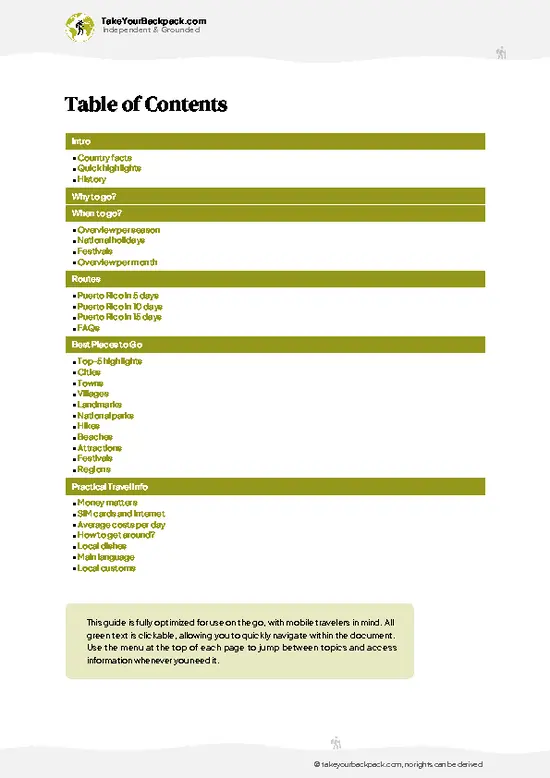
example page 2 from our offline Travel Guide for Puerto Rico
example page 3 from our offline Travel Guide for Puerto Rico
example page 4 from our offline Travel Guide for Puerto Rico
example page 5 from our offline Travel Guide for Puerto Rico
example page 6 from our offline Travel Guide for Puerto Rico
example page 7 from our offline Travel Guide for Puerto Rico
Loading the map 🌍
CLICK TO FILTER
cities
towns
villages
landmarks
national parks
hikes
beaches
attractions
festivals
regions
SHOW COUNTRY’S BESTSHOW ALL

✨ Why go?
Ranked #3 national park in Puerto Rico
What makes this national park worth exploring

Guánica State Forest rewards independent hikers because the trails are marked, short and loop-friendly, so you need no guide and no booking. Roughly 9,000 acres hold more than 700 plant species, 48 of them are rare or endangered and 16 grow nowhere else, so even a plain stroll turns into a botany lesson. Birders can tick off endemics in a single morning, and the forest is one of the best spots on the island to find the Puerto Rican nightjar at dusk.

The second reason is how neatly the forest pairs with the coast. After a sweaty morning among gumbo-limbo trees and giant prickly pear cactus, you can walk or ride to the beaches of Playa Ballena and nearby Caña Gorda for a swim. Nearby guesthouses and campsites keep costs low for anyone watching their budget. The terrain is mostly gentle, so … read more 👉
Guánica State Forest rewards independent hikers because the trails are marked, short and loop-friendly, so you need no guide and no booking. Roughly 9,000 acres hold more than 700 plant species, 48 of them are rare or endangered and 16 grow nowhere else, so even a plain stroll turns into a botany lesson. Birders can tick off endemics in a single morning, and the forest is one of the best spots on the island to find the Puerto Rican nightjar at dusk.

The second reason is how neatly the forest pairs with the coast. After a sweaty morning among gumbo-limbo trees and giant prickly pear cactus, you can walk or ride to the beaches of Playa Ballena and nearby Caña Gorda for a swim. Nearby guesthouses and campsites keep costs low for anyone watching their budget. The terrain is mostly gentle, so first-timers can handle it, while veterans get quiet back routes with no one else around. Self-guided travelers get the most from this place.

💡 HighlightsDon't-miss highlights and experiences

  1. Fuerte Caprón: A small stone lookout tower on a hilltop, rebuilt by the Civilian Conservation Corps in the 1930s, reached by a short climb. It is the most photographed man-made spot in the forest and gives a wide view across the dry scrub toward the sea.
  2. Ballena Beach Access: A quiet cove at the edge of the reserve with calm water and little development, good for a swim after hiking.
  3. Guayacán Centenario: An ancient guayacán tree, estimated to be many centuries old, with a twisted trunk. It is a short detour from the main trail and one of the forest’s signature trees.
  4. Bat cave: A cave reached by a short walk where bats shelter and the rock walls feel noticeably cooler than the scrub outside.
  5. Dry Forest Bird Watching: The forest is home to endemics such as the Puerto Rican tody and the Puerto Rican
… read more 👉
  1. Fuerte Caprón: A small stone lookout tower on a hilltop, rebuilt by the Civilian Conservation Corps in the 1930s, reached by a short climb. It is the most photographed man-made spot in the forest and gives a wide view across the dry scrub toward the sea.
  2. Ballena Beach Access: A quiet cove at the edge of the reserve with calm water and little development, good for a swim after hiking.
  3. Guayacán Centenario: An ancient guayacán tree, estimated to be many centuries old, with a twisted trunk. It is a short detour from the main trail and one of the forest’s signature trees.
  4. Bat cave: A cave reached by a short walk where bats shelter and the rock walls feel noticeably cooler than the scrub outside.
  5. Dry Forest Bird Watching: The forest is home to endemics such as the Puerto Rican tody and the Puerto Rican woodpecker. Early morning along the main roads gives the best sightings.
  6. Cactus and Gumbo-Limbo Groves: Walk beneath tall tree cactus and the red peeling bark of gumbo-limbo trees. These plants define the landscape here and look nothing like the rainforest in the island’s east.
  7. Visitor Center and Ranger Station: A good place to pick up a trail map and ask about current conditions before you set off.
Guánica State Forest needs no ticket or advance booking for any of these sights.
Spotted a mistake or missing something? Contact us.

Things to do near Guánica State Forest

Ratings based on Tripadvisor reviews. When you book through this link, you support our work at no extra cost to you.

🌤️ When to go?Seasonal considerations and timing

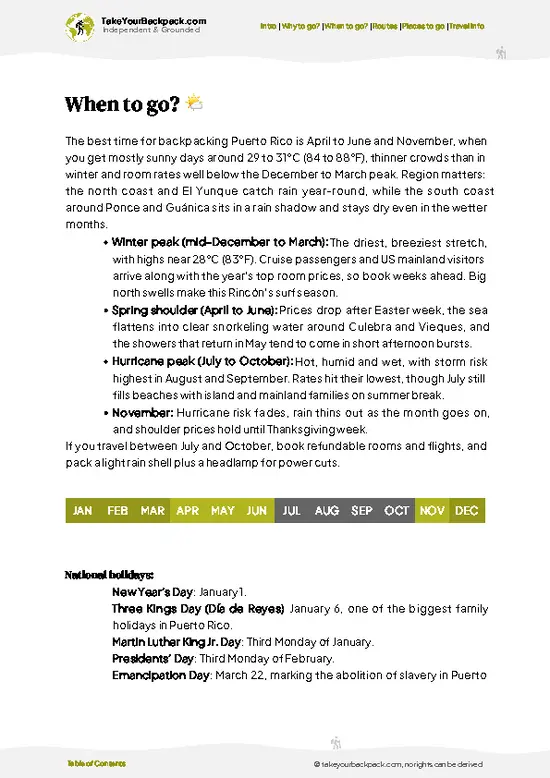
The dry months from December through April are the best window for hiking Guánica State Forest, with daytime highs of 29 to 32°C (84 to 90°F) and very little rain.
  • Winter and Spring (December to April): Driest stretch, lows of 21 to 23°C (70 to 73°F), about 11 to 12 hours of daylight. Weekends and holidays bring local crowds to Playa Santa and the coast, and lodging in Guánica town runs higher.
  • Summer (May to August): Hot and dry inland, with highs of 32 to 35°C (90 to 95°F). The dry forest stays thin on shade, so start hikes at dawn. Bioluminescence tours from La Parguera are good in dark-moon weeks. Daylight stretches to about 13 hours.
  • Hurricane Season (August to October): Heaviest rain, humidity and storm risk, though Guánica sits in a rain shadow and stays drier than the rest of the island.
… read more 👉
The dry months from December through April are the best window for hiking Guánica State Forest, with daytime highs of 29 to 32°C (84 to 90°F) and very little rain.
  • Winter and Spring (December to April): Driest stretch, lows of 21 to 23°C (70 to 73°F), about 11 to 12 hours of daylight. Weekends and holidays bring local crowds to Playa Santa and the coast, and lodging in Guánica town runs higher.
  • Summer (May to August): Hot and dry inland, with highs of 32 to 35°C (90 to 95°F). The dry forest stays thin on shade, so start hikes at dawn. Bioluminescence tours from La Parguera are good in dark-moon weeks. Daylight stretches to about 13 hours.
  • Hurricane Season (August to October): Heaviest rain, humidity and storm risk, though Guánica sits in a rain shadow and stays drier than the rest of the island. Lodging is cheapest and trails are nearly empty, but cancellations happen.
  • Bird Migration (September to April): Migrants join resident species such as the Puerto Rican nightjar and the Puerto Rican tody, which makes early mornings productive.
Book a Saturday or holiday stay at least a few weeks ahead, and hike on weekdays.


source: climatestotravel.comJANJanuary: excellent for travelingFEBFebruary: excellent for travelingMARMarch: highly recommended for travelingAPRApril: fair for travelingMAYMay: fair for travelingJUNJune: fair for travelingJULJuly: fair for travelingAUGAugust: fair for travelingSEPSeptember: fair for travelingOCTOctober: fair for travelingNOVNovember: good for travelingDECDecember: excellent for traveling
puerto-rico-national-park-guanica-state-forest
© Google | Raul M-c

✈️ The backpacker research shortcutPuerto Rico Travel Guide

An offline-friendly backpacking guide with optimized travel routes, ranked highlights, transport advice, and the best areas to stay.
example page 0 from our offline Travel Guide for Puerto Rico
example page 1 from our offline Travel Guide for Puerto Rico
example page 2 from our offline Travel Guide for Puerto Rico
example page 3 from our offline Travel Guide for Puerto Rico
example page 4 from our offline Travel Guide for Puerto Rico
example page 5 from our offline Travel Guide for Puerto Rico
example page 6 from our offline Travel Guide for Puerto Rico
example page 7 from our offline Travel Guide for Puerto Rico
The digital guide (310 pages) contains:
✅ 81 highlights, ranked by travel appeal
✅ Optimized 5, 10 & 15-day travel routes
✅ Cities, national parks, landmarks, beaches
✅ How to get around
✅ Offline-friendly for travel without Wi-Fi
👉 Click to see all 30+ guide features

📅 Plan smarter in minutes, not weeks
✅ Month by month travel advice
✅ Festivals & national holidays
✅ Budget expectations

🗺️ Go to the right places, skip the overrated ones
✅ Honest pros & cons of destinations
✅ Top hikes, parks & viewpoints
✅ Lesser-known places most travelers miss
✅ Clear “worth it vs skip it” guidance

🛏️ Travel smoothly without rookie mistakes
✅ Best areas to stay
✅ Transport systems explained simply
✅ Common scams & safety advice
✅ SIM cards, money & practical tips

🌍 Understand the country, not just visit it
✅ Culture & traditions
✅ 52 Essential phrases & customs
✅ Festivals worth planning around
✅ Traveler-friendly historical context
✅ Insights that make places more meaningful

📱 Built for real travel conditions
✅ Fully downloadable PDF
✅ Works completely offline
✅ Optimized for phone use
✅ Useful in remote areas & buses
✅ Everything in one place
Stop searching, start planning
Get instant access to your full guide. 30‑day money-back guarantee.
+ Add another guide for just

By proceeding you agree to our terms.
Sent to your inbox immediately after payment • 100% Secure Checkout
Best Backpacking Travel Advisor 2025 tourism awardBest Backpacking
Travel Advisor
2025
What others say about Take Your Backpack Guides:
⭐⭐⭐⭐⭐
Fantastic, amazing amount of information!
⭐⭐⭐⭐⭐
My goodness this is amazing, it's what I've been looking for hats off too you!
⭐⭐⭐⭐⭐
I think this is absolutely BRILLIANT
⭐⭐⭐⭐
Very complete and informative. It's still missing places, but I gotta to commend you
⭐⭐⭐⭐⭐
This is truly amazing, thank you, can't wait to explore it with my kids!
⭐⭐⭐⭐⭐
Awesome resource, thank you!
⭐⭐⭐⭐⭐
This is amazing! Can't wait to explore the ones I haven't seen
⭐⭐⭐⭐
I love this! Well done, great idea.
⭐⭐⭐⭐⭐
Thanks for taking the time to make this gem!
⭐⭐⭐⭐⭐
This might be the best website I've ever seen.
⭐⭐⭐⭐⭐
Congratulations, and thank you so much for your work; it's incredibly valuable.
⭐⭐⭐⭐
In all seriousness I think you did a great job pointing out the important spots
⭐⭐⭐⭐⭐
10/10 very good
⭐⭐⭐⭐⭐
As someone who's only just starting to visit regularly this is awesome, thank you.
⭐⭐⭐⭐
Thank you very much! I'm going to visit my dad, it's going to be very useful!
⭐⭐⭐⭐⭐
This is really cool! We'll be travelling for the first time and this definitely come in handy.
⭐⭐⭐⭐⭐
You are now our minister of culture, congratulations 👨‍💼
⭐⭐⭐⭐⭐
Just wanted to tell you that this is a pearl! Going to follow your recommendations.
⭐⭐⭐⭐⭐
This is so cool. I'll definitely be using the resource for my travels soon.
⭐⭐⭐⭐⭐
This is very impressive! Good work.
⭐⭐⭐⭐⭐
This is an amazing and informative site. Very well done!

🛏️ Where to stay?How to pick the right area

Most backpackers sleep in Guánica town, a 5 to 10 minute drive from the main forest entrances, because there is no lodging inside Guánica State Forest. Camping within the reserve is not offered as a routine option, so plan on a base outside the boundary.
Guánica town has the best value: small guesthouses and simple hotels near the waterfront and the Malecón, typically US$70 to 130 a night, plus a handful of restaurants serving fried fish and tostones. It is the easiest base if you rely on rides, since the main road lies close to the forest’s Ballena and Fuerte trailheads.
La Parguera, about 25 to … read more 👉
Most backpackers sleep in Guánica town, a 5 to 10 minute drive from the main forest entrances, because there is no lodging inside Guánica State Forest. Camping within the reserve is not offered as a routine option, so plan on a base outside the boundary.
Guánica town has the best value: small guesthouses and simple hotels near the waterfront and the Malecón, typically US$70 to 130 a night, plus a handful of restaurants serving fried fish and tostones. It is the easiest base if you rely on rides, since the main road lies close to the forest’s Ballena and Fuerte trailheads.
La Parguera, about 25 to 30 minutes west in Lajas, is the lively alternative. Guesthouses and small hotels cost roughly US$90 to 160, and it is the departure point for bioluminescent bay boat trips and cays with snorkeling. Evenings here are noisy on weekends.
Gilligan’s Island and Caña Gorda beach areas have beachside apartments and small inns, many with kitchens, around US$100 to 180. Splitting a rental among three or four people brings the per-person cost near hostel levels, and Puerto Rico has few true hostels in this corner. Ponce, roughly 45 minutes away, offers more choice and larger hotels if Guánica is full.

👛 Costs (as of 22 October 2026)Typical daily expenses

Plan on roughly US$95 to 205 per person per day for Guánica State Forest and its surroundings when you rent a car and split lodging.
CategoryBudget RangeLocal Reality
Entrance feeUS$0Entry to the forest is free, and no permit is required for day hiking.
Accommodation (high season)US$50 to 90A guesthouse or rental in Guánica town or Caña Gorda, per person when two people share a room. Drops 15 to 30 percent in the hurricane months.
Local transportUS$25 to 50A share of a rental car at US$45 to 80 a day plus fuel. Rides from Ponce or San Juan cost far more, and taxis are scarce.
Food and suppliesUS$15 to 35Fried fish plates and mofongo run US$10 to 20. Stock up on water and snacks at supermarkets in Guánica or Yauco.
ActivitiesUS$5 to 30Bioluminescent bay tours in La Parguera cost about US$35 to 55,
… read more 👉
Plan on roughly US$95 to 205 per person per day for Guánica State Forest and its surroundings when you rent a car and split lodging.
CategoryBudget RangeLocal Reality
Entrance feeUS$0Entry to the forest is free, and no permit is required for day hiking.
Accommodation (high season)US$50 to 90A guesthouse or rental in Guánica town or Caña Gorda, per person when two people share a room. Drops 15 to 30 percent in the hurricane months.
Local transportUS$25 to 50A share of a rental car at US$45 to 80 a day plus fuel. Rides from Ponce or San Juan cost far more, and taxis are scarce.
Food and suppliesUS$15 to 35Fried fish plates and mofongo run US$10 to 20. Stock up on water and snacks at supermarkets in Guánica or Yauco.
ActivitiesUS$5 to 30Bioluminescent bay tours in La Parguera cost about US$35 to 55, but the trails are free. Boat rides to Gilligan’s Island are a few dollars.
Total Daily BudgetUS$95 to 205Per person, per day, in high season.
⚠️ Prices can change and everyone travels differently, so take this as a rough guide. Hope it helps you plan your adventure!

🥾 TrailsPlan your hike in Guánica State Forest: routes, terrain, and sights

Guánica State Forest offers a large network of trails over flat to rolling limestone terrain, with dry forest, cactus thickets and coastal bluffs. Shade is limited and the heat builds quickly by late morning.
  • Camino Fortin: About 1.5 km one way, roughly 45 minutes, easy. The route climbs gently to the Fuerte Caprón lookout through thorny scrub, with good chances to spot birds.
  • Ballena Trail: About 3 km, 1 to 1.5 hours, easy to moderate. It runs through dense dry forest and ends near the coast.
  • Guayacán Centenario Trail: Short and easy, around 20 to 30 minutes, leading to a very old guayacán tree
… read more 👉
Guánica State Forest offers a large network of trails over flat to rolling limestone terrain, with dry forest, cactus thickets and coastal bluffs. Shade is limited and the heat builds quickly by late morning.
  • Camino Fortin: About 1.5 km one way, roughly 45 minutes, easy. The route climbs gently to the Fuerte Caprón lookout through thorny scrub, with good chances to spot birds.
  • Ballena Trail: About 3 km, 1 to 1.5 hours, easy to moderate. It runs through dense dry forest and ends near the coast.
  • Guayacán Centenario Trail: Short and easy, around 20 to 30 minutes, leading to a very old guayacán tree with a gnarled trunk.
  • Cueva Trail: A short moderate walk with some rocky footing, leading to a cave with bats.
  • Wildlife: Look for the Puerto Rican tody, the Puerto Rican woodpecker, lizards, and the occasional mongoose crossing the path. The nightjar is best found near dusk.
Most routes are well signed, but some paths branch confusingly, so take a photo of the trail map at the ranger station. Wear closed shoes, long light clothing, insect repellent and plenty of water. Getting to Guánica State Forest by public transport is awkward, since buses stop short of the entrance and a car or taxi from town makes the trip far simpler. The forest is generally quiet, with a few families and birders on weekends. Entry is free, though parking areas near the visitor center are limited.
⚠️ Hiking info can sometimes be outdated or inaccurate. Before you hit the trail, check the latest conditions with locals. If you do spot anything that's off, I'd love to hear from you, so I can update it for fellow travelers.

🛡️ SafetySafety Tips and Common Scams in Guánica State Forest

Guánica State Forest is a straightforward park, and heat is the main hazard, not wildlife or terrain. Most trails run through low, dry forest with thin shade, and temperatures regularly top 32°C (90°F), so hike early, carry at least 2 to 3 liters of water per person, and wear a hat. Cell service and water points are limited deep in the forest.
Trails such as the road to Fuerte Caprón and Ballena are mostly flat and well marked, but the limestone is rough and loose in places, so wear closed shoes. Some trail junctions are confusing, so download an offline map or photograph the trailhead signboard. After heavy rain, dirt roads soften and become slick.
There are no dangerous large animals. Expect mosquitoes, ticks and thorny cacti and acacia scrub, so pack repellent and long, light pants. Stay … read more 👉
Guánica State Forest is a straightforward park, and heat is the main hazard, not wildlife or terrain. Most trails run through low, dry forest with thin shade, and temperatures regularly top 32°C (90°F), so hike early, carry at least 2 to 3 liters of water per person, and wear a hat. Cell service and water points are limited deep in the forest.
Trails such as the road to Fuerte Caprón and Ballena are mostly flat and well marked, but the limestone is rough and loose in places, so wear closed shoes. Some trail junctions are confusing, so download an offline map or photograph the trailhead signboard. After heavy rain, dirt roads soften and become slick.
There are no dangerous large animals. Expect mosquitoes, ticks and thorny cacti and acacia scrub, so pack repellent and long, light pants. Stay on trails, and leave the mongoose, lizards and nesting birds alone. Lock valuables out of sight in your car at trailheads, since break-ins occur at some pull-offs.

FAQCommon questions from travelers

Two days is a good fit for Guánica State Forest: one for the dry-forest trails to Fuerte Caprón and the Ballena area, the other for beaches and Gilligan’s Island. A single early morning covers the main hikes, which take roughly 2 to 4 hours each. Add a third day if you want the La Parguera bioluminescent bay tour.
Reaching Guánica State Forest without a car is difficult, since the trailheads sit several kilometers from town and public buses are rare. Shared públicos run to Guánica from Ponce (about 45 minutes) and Yauco, but they do not reach the trails. Staying in Guánica town and taking taxis or rideshare, which can be hard to find, is the usual workaround. Renting a car at San Juan airport, about 2 hours away, is the most practical option.
Guánica State Forest has no entrance fee, and day hikers need no permit. Trails and the visitor center near the Ballena entrance are free to use, although the office keeps limited hours. Camping and group activities require advance authorization from Puerto Rico’s Department of Natural and Environmental Resources, which has its own fees.
⚠️ Things can change over time, so always validate details locally before you go.

Other Puerto Rican national parks near Guánica State Forest

Explore more nearby:


💡 Not sure where to go next?
Create a personalized itinerary for Puerto Rico including Guánica State Forest and the places that fit your trip.

Generate my itinerary

👉 Discover all national parks

Or checkout all Puerto Rico has to offer (think cities, towns, villages, national parks, hikes, beaches, festivals)
Country photo of Puerto Rico

We 💚 feedbackParting advice and final tips

Guánica State Forest deserves a full day, and two if you like birding at dawn and dusk. One morning hike plus an afternoon at the beach is the ideal rhythm. I would bring twice the water you expect and leave by early afternoon. Stay overnight nearby if you want the nightjar at dusk.

✍️ Help improve this page!
The information on this page is based on in-depth research, insights shared by experienced travelers, and feedback from the local travel community in Puerto Rico. While every effort is made to keep the information accurate and current, conditions can change — so if you spot anything incorrect or outdated, please get in touch.


🙋‍♂️ Give feedback

👋 Meet the founderWho’s Behind Take Your Backpack?

Johan, backpacker and founder of TakeYourBackpackHi, I’m Johan (Netherlands 🇳🇱), the creator of TakeYourBackpack. Over the past 3 decades, I’ve backpacked through 90+ countries across six continents, gaining extensive experience with independent travel, long-term trips, and overland routes.

This site is built on a combination of firsthand travel experience and carefully curated insights from other backpackers. Many guides are based on places I’ve personally visited, while others bring together tips, observations, and practical advice shared by trusted travelers I’ve met along the way.

The goal is to provide realistic, experience-driven guidance — not generic itineraries — so you can explore destinations with better context, clearer expectations, and more confidence.