×

Congo🇨🇬 | hikesLango Bai TrailGuided bai walk, forest elephants, camp viewpoint, wet clearing | things to do and best time to go

Explore Pointe-Noire CarnivalExplore Mbeli Bai Trail

Backpacking in Lango Bai Trail
🏆 Top pickhike ranked #1
By Johan Kruseman 🇳🇱 | Updated October 22, 2026

Lango Bai Trail is not a self-guided hike you can pick up from a village. It sits inside Odzala-Kokoua National Park in the north of the Republic of the Congo, and you walk it only with a park guide, usually arranged through the lodge at Lango Camp. No public transport reaches the start, so you arrive on a light aircraft to an airstrip and finish with a short vehicle transfer. The route is flat and short, a few hours of soft sand, root tangles and ankle-deep seeps under a closed canopy that hums with insects and drips after rain. The air smells of crushed leaves and elephant dung. Then the trees open onto the bai, a wide, wet clearing, and the light changes. Difficulty is low, but heat and humidity make it sticky work. It suits wildlife watchers, photographers and anyone happy to walk slowly and whisper. It will frustrate those wanting a long, solo, summit-style trek.

Discover everything you want to know in the 📖 Congo Travel Guide.
Best time to go: June - September
Duration: 3 hours
Distance: 6 kilometers
Total ascent: 50 meters
Safety warning

The current risk level for Congo is high. Check the advice before going.


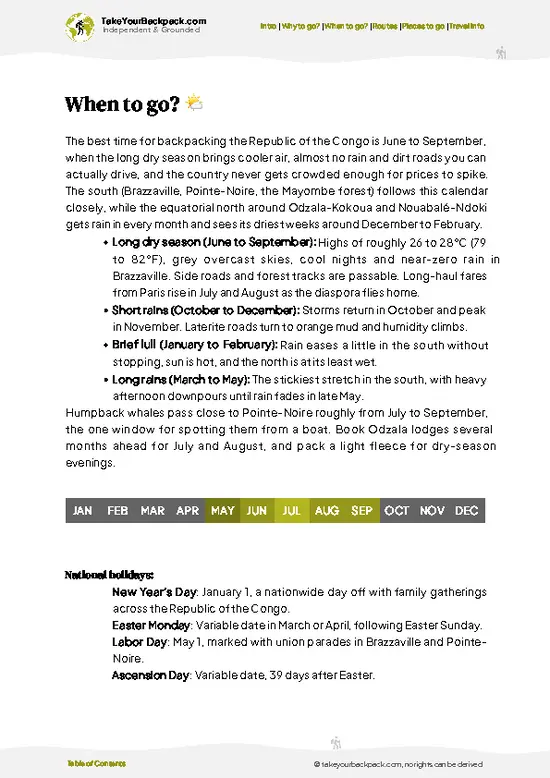
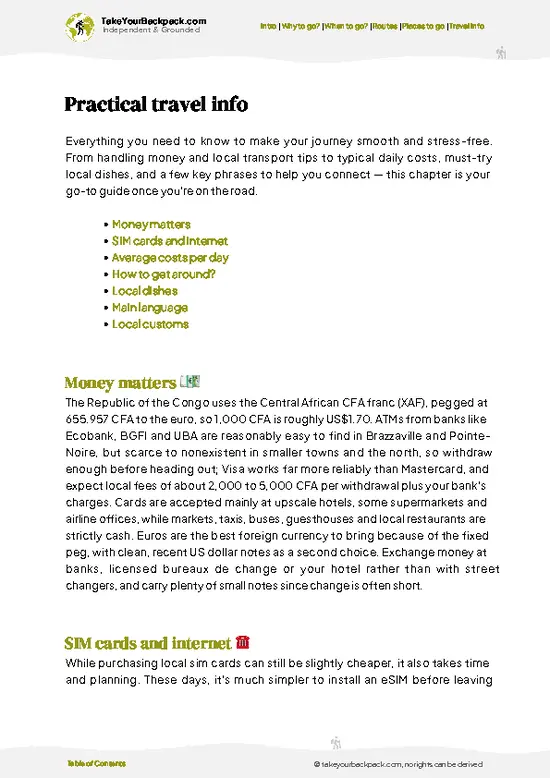
example page 0 from our offline Travel Guide for Republic of the Congo
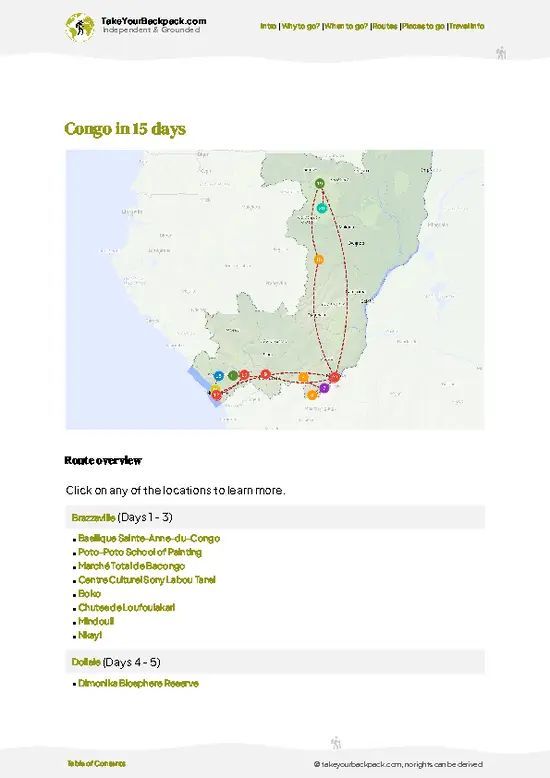
example page 1 from our offline Travel Guide for Republic of the Congo
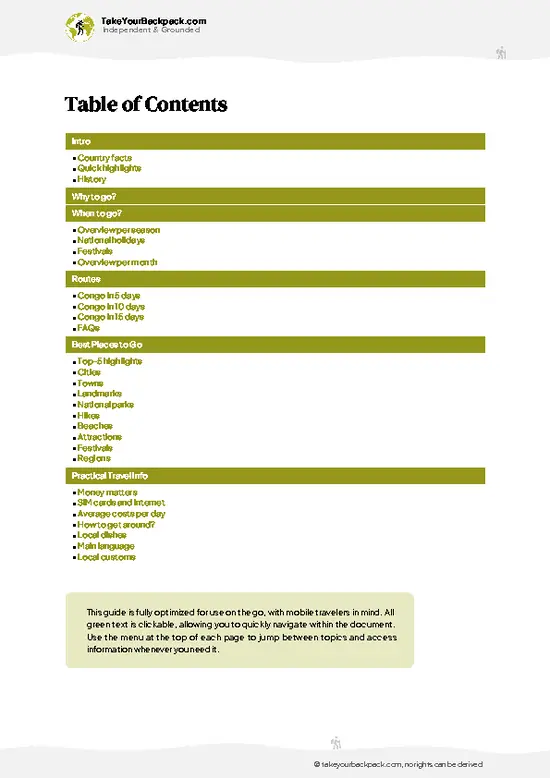
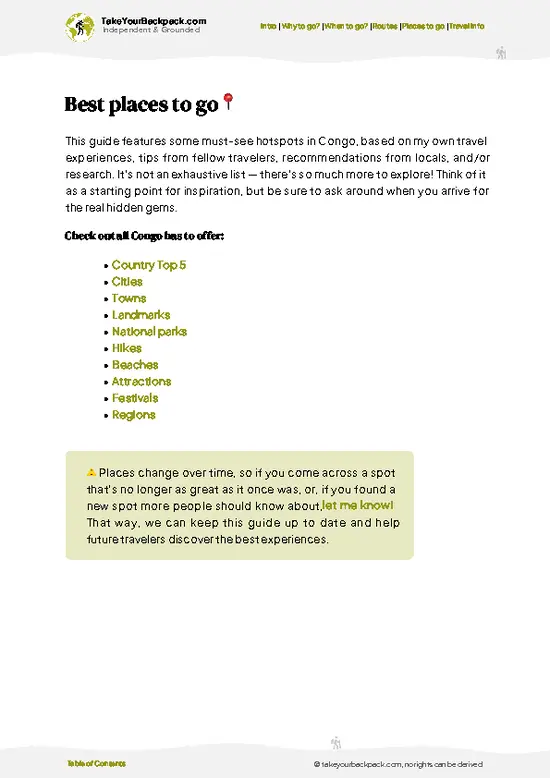
example page 2 from our offline Travel Guide for Republic of the Congo
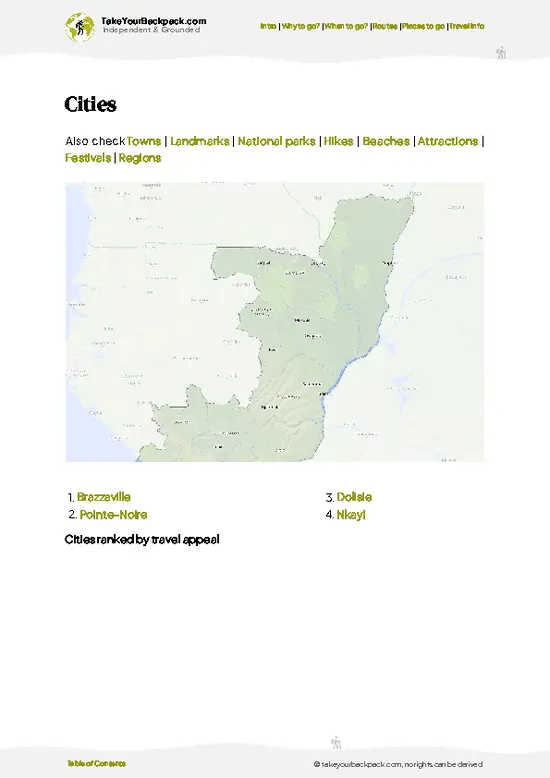
example page 3 from our offline Travel Guide for Republic of the Congo
example page 4 from our offline Travel Guide for Republic of the Congo
example page 5 from our offline Travel Guide for Republic of the Congo
example page 6 from our offline Travel Guide for Republic of the Congo
example page 7 from our offline Travel Guide for Republic of the Congo
Loading the map 🌍
CLICK TO FILTER
cities
towns
landmarks
national parks
hikes
beaches
attractions
festivals
regions
SHOW COUNTRY’S BESTSHOW ALL

✨ Why go?
Ranked #1 hike in Congo
Why Lango Bai Trail should be on your travel list

Lango Bai Trail gives you a rare thing in Central Africa: a walk on foot through lowland rainforest that ends at a clearing where wild animals actually gather. Backpackers who have done Africa's savanna circuits come for the contrast. Here the visibility is a few meters of green wall, then suddenly an open bai with elephants, buffalo and sometimes gorillas feeding on mineral-rich mud and aquatic plants.
The effort is modest. You do not need peak fitness, a tent or days of food, and the terrain is flat enough that the main challenge is sweat and patience. What you gain is proximity to western lowland gorillas in a place where few travelers have ever stood, which is the main reason it appeals to people collecting rare experiences.
It also fits well into a longer Congo route. Odzala-Kokoua is one … read more 👉
Lango Bai Trail gives you a rare thing in Central Africa: a walk on foot through lowland rainforest that ends at a clearing where wild animals actually gather. Backpackers who have done Africa's savanna circuits come for the contrast. Here the visibility is a few meters of green wall, then suddenly an open bai with elephants, buffalo and sometimes gorillas feeding on mineral-rich mud and aquatic plants.
The effort is modest. You do not need peak fitness, a tent or days of food, and the terrain is flat enough that the main challenge is sweat and patience. What you gain is proximity to western lowland gorillas in a place where few travelers have ever stood, which is the main reason it appeals to people collecting rare experiences.
It also fits well into a longer Congo route. Odzala-Kokoua is one of the country's anchor destinations, and a few nights at Lango Camp pair naturally with the park's other bais and forest walks, then with a return toward Brazzaville and the Congo River side of the country. It is a splurge destination, but you pay for access, not for a hard hike.

💡 HighlightsDon't-miss highlights and experiences

  1. Lango Bai clearing: The trail's whole point. The forest ends abruptly and a broad, marshy opening spreads out, with a small stream winding through grass and mud. Animals use it for minerals and open sightlines, so the view changes from hour to hour.
  2. Forest elephants: The elephants here are smaller and straighter-tusked than savanna elephants, and they walk quietly. They often appear at the edge of the bai, sometimes in family groups, and you watch from a distance set by your guide.
  3. Western lowland gorillas: Gorillas are one of the main draws of this part of Odzala-Kokoua. Sightings at the bai are never guaranteed, but when a silverback and his group come out to feed, it is a quiet, close and memorable scene.
  4. Lango Camp viewpoint: The camp looks over the bai, so you can scan the clearing from
… read more 👉
  1. Lango Bai clearing: The trail's whole point. The forest ends abruptly and a broad, marshy opening spreads out, with a small stream winding through grass and mud. Animals use it for minerals and open sightlines, so the view changes from hour to hour.
  2. Forest elephants: The elephants here are smaller and straighter-tusked than savanna elephants, and they walk quietly. They often appear at the edge of the bai, sometimes in family groups, and you watch from a distance set by your guide.
  3. Western lowland gorillas: Gorillas are one of the main draws of this part of Odzala-Kokoua. Sightings at the bai are never guaranteed, but when a silverback and his group come out to feed, it is a quiet, close and memorable scene.
  4. Lango Camp viewpoint: The camp looks over the bai, so you can scan the clearing from an elevated, shaded position between walks. Binoculars matter more here than a long lens, because animals move in and out of cover constantly.
  5. The forest approach walk: The route to the clearing passes through dense lowland rainforest, with thick herbs, fallen trunks, mud patches and loud birdsong. Look for fresh elephant trails, monkeys in the canopy and the small antelope that slip off the path. Sitatunga and buffalo can show up near the wetter edges.
Start with the bai itself in the cooler, quieter hours, because that is when activity is most likely and the other four items often unfold from that same vantage point.
Spotted a mistake or missing something? Contact us.

🌤️ When to go?Seasonal considerations and timing

  • Long Dry Season (December to February): Firm trails, the fewest mud days and the best odds of a clear view across the clearing. Days run 28 to 31°C (82 to 88°F), nights 20 to 22°C (68 to 72°F). This is the busiest stretch, and camp rates peak.
  • Short Dry Season (June to August): Slightly cooler at 26 to 29°C (79 to 84°F), with cloud often hanging over the canopy. Forest elephants and buffalo gather at the clearing's mineral-rich mud, and this is a strong second choice for lower rates.
  • Wet Months (March to May, September to November): Expect heavy downpours, humidity above 80 percent and boggy tracks. Highs stay 27 to 30°C (81 to 86°F). Camps cut prices and crowds thin, but rubber boots become mandatory and some paths can close.
  • Daylight: Day length barely shifts, close to 12 hours all year, so
… read more 👉
  • Long Dry Season (December to February): Firm trails, the fewest mud days and the best odds of a clear view across the clearing. Days run 28 to 31°C (82 to 88°F), nights 20 to 22°C (68 to 72°F). This is the busiest stretch, and camp rates peak.
  • Short Dry Season (June to August): Slightly cooler at 26 to 29°C (79 to 84°F), with cloud often hanging over the canopy. Forest elephants and buffalo gather at the clearing's mineral-rich mud, and this is a strong second choice for lower rates.
  • Wet Months (March to May, September to November): Expect heavy downpours, humidity above 80 percent and boggy tracks. Highs stay 27 to 30°C (81 to 86°F). Camps cut prices and crowds thin, but rubber boots become mandatory and some paths can close.
  • Daylight: Day length barely shifts, close to 12 hours all year, so plan walks early before the forest heats up.
Book the camp early for December to February, since there are only a handful of rooms in the park.


source: climatestotravel.comJANJanuary: fair for travelingFEBFebruary: fair for travelingMARMarch: fair for travelingAPRApril: fair for travelingMAYMay: fair for travelingJUNJune: highly recommended for travelingJULJuly: excellent for travelingAUGAugust: excellent for travelingSEPSeptember: highly recommended for travelingOCTOctober: fair for travelingNOVNovember: fair for travelingDECDecember: fair for traveling
when-to-go

✈️ The backpacker research shortcutCongo Travel Guide

An offline-friendly backpacking guide with optimized travel routes, ranked highlights, transport advice, and the best areas to stay.
example page 0 from our offline Travel Guide for Republic of the Congo
example page 1 from our offline Travel Guide for Republic of the Congo
example page 2 from our offline Travel Guide for Republic of the Congo
example page 3 from our offline Travel Guide for Republic of the Congo
example page 4 from our offline Travel Guide for Republic of the Congo
example page 5 from our offline Travel Guide for Republic of the Congo
example page 6 from our offline Travel Guide for Republic of the Congo
example page 7 from our offline Travel Guide for Republic of the Congo
The digital guide (205 pages) contains:
✅ 46 highlights, ranked by travel appeal
✅ Optimized 5, 10 & 15-day travel routes
✅ Cities, national parks, landmarks, beaches
✅ How to get around
✅ Offline-friendly for travel without Wi-Fi
👉 Click to see all 30+ guide features

📅 Plan smarter in minutes, not weeks
✅ Month by month travel advice
✅ Festivals & national holidays
✅ Budget expectations

🗺️ Go to the right places, skip the overrated ones
✅ Honest pros & cons of destinations
✅ Top hikes, parks & viewpoints
✅ Lesser-known places most travelers miss
✅ Clear “worth it vs skip it” guidance

🛏️ Travel smoothly without rookie mistakes
✅ Best areas to stay
✅ Transport systems explained simply
✅ Common scams & safety advice
✅ SIM cards, money & practical tips

🌍 Understand the country, not just visit it
✅ Culture & traditions
✅ 52 Essential phrases & customs
✅ Festivals worth planning around
✅ Traveler-friendly historical context
✅ Insights that make places more meaningful

📱 Built for real travel conditions
✅ Fully downloadable PDF
✅ Works completely offline
✅ Optimized for phone use
✅ Useful in remote areas & buses
✅ Everything in one place
Stop searching, start planning
Get instant access to your full guide. 30‑day money-back guarantee.
+ Add another guide for just

By proceeding you agree to our terms.
Sent to your inbox immediately after payment • 100% Secure Checkout
Best Backpacking Travel Advisor 2025 tourism awardBest Backpacking
Travel Advisor
2025
What others say about Take Your Backpack Guides:
⭐⭐⭐⭐⭐
Fantastic, amazing amount of information!
⭐⭐⭐⭐⭐
My goodness this is amazing, it's what I've been looking for hats off too you!
⭐⭐⭐⭐⭐
I think this is absolutely BRILLIANT
⭐⭐⭐⭐
Very complete and informative. It's still missing places, but I gotta to commend you
⭐⭐⭐⭐⭐
This is truly amazing, thank you, can't wait to explore it with my kids!
⭐⭐⭐⭐⭐
Awesome resource, thank you!
⭐⭐⭐⭐⭐
This is amazing! Can't wait to explore the ones I haven't seen
⭐⭐⭐⭐
I love this! Well done, great idea.
⭐⭐⭐⭐⭐
Thanks for taking the time to make this gem!
⭐⭐⭐⭐⭐
This might be the best website I've ever seen.
⭐⭐⭐⭐⭐
Congratulations, and thank you so much for your work; it's incredibly valuable.
⭐⭐⭐⭐
In all seriousness I think you did a great job pointing out the important spots
⭐⭐⭐⭐⭐
10/10 very good
⭐⭐⭐⭐⭐
As someone who's only just starting to visit regularly this is awesome, thank you.
⭐⭐⭐⭐
Thank you very much! I'm going to visit my dad, it's going to be very useful!
⭐⭐⭐⭐⭐
This is really cool! We'll be travelling for the first time and this definitely come in handy.
⭐⭐⭐⭐⭐
You are now our minister of culture, congratulations 👨‍💼
⭐⭐⭐⭐⭐
Just wanted to tell you that this is a pearl! Going to follow your recommendations.
⭐⭐⭐⭐⭐
This is so cool. I'll definitely be using the resource for my travels soon.
⭐⭐⭐⭐⭐
This is very impressive! Good work.
⭐⭐⭐⭐⭐
This is an amazing and informative site. Very well done!

🛏️ Where to stay?How to pick the right area

If you enjoy meeting fellow travelers, consider choosing hostels with high ratings for atmosphere. On the other hand, if you prefer having your own space, a hotel might be a better option.

🥾 Hike detailsHike details: route, duration, and difficulty of Lango Bai Trail

Total Distance: Roughly 6 kilometers return, depending on the route your guide chooses and where animals are being seen.
Estimated Duration: About 3 hours at a slow pace, plus extra time sitting at the clearing.
Difficulty: Easy. The terrain is flat, but heat, humidity and wet ground make it more tiring than the distance suggests.
Starting Point: Lango Camp inside Odzala-Kokoua National Park, in the north of the Republic of the Congo. There is no public transport to the trailhead. Visitors arrive by light aircraft to a park airstrip and continue by vehicle.
Major Landmarks:
  • Lango Camp: The base and
… read more 👉
Total Distance: Roughly 6 kilometers return, depending on the route your guide chooses and where animals are being seen.
Estimated Duration: About 3 hours at a slow pace, plus extra time sitting at the clearing.
Difficulty: Easy. The terrain is flat, but heat, humidity and wet ground make it more tiring than the distance suggests.
Starting Point: Lango Camp inside Odzala-Kokoua National Park, in the north of the Republic of the Congo. There is no public transport to the trailhead. Visitors arrive by light aircraft to a park airstrip and continue by vehicle.
Major Landmarks:
  • Lango Camp: The base and the usual starting point for guided walks.
  • Forest track: A narrow path through mature lowland forest, often muddy.
  • Lango Bai: The open, marshy clearing where wildlife gathers, and the end point of the walk.
Terrain and Scenery: Sandy and clay soils, exposed roots, shallow wet patches and low stream crossings. Under the canopy it is dim and green, then the bai opens into bright, wide marsh with grasses and water channels.
Vegetation: Dense tropical rainforest with tall hardwoods, vines, ferns and thick herbaceous undergrowth. The bai itself is dominated by sedges, grasses and aquatic plants.
Wildlife: Forest elephants, western lowland gorillas, forest buffalo, sitatunga, monkeys and many bird species. Insects, including tsetse flies and sweat bees, are constant companions.
Practical Notes:
  • Guides: A park guide is required, and you follow their instructions on distance from animals.
  • What to wear: Long, light, neutral-colored clothing, closed shoes that can get wet, and a rain jacket.
  • What to carry: Water, insect repellent, binoculars and a camera with a fast shutter, since the forest is dim.
⚠️ Hiking info can sometimes be outdated or inaccurate. Before you hit the trail, check the latest conditions with locals. If you do spot anything that's off, I'd love to hear from you, so I can update it for fellow travelers.

🛡️ SafetyStaying Safe: What Travelers Should Know

Lango Bai Trail is a guided forest walk, and the main hazards are mud, heat and close wildlife rather than anything technical. Paths are mostly flat but slick, with roots and shallow stream crossings, so wear waterproof boots with grip and carry a rain shell even in dry months. Humidity drains you fast, so drink steadily and walk at the guide’s pace. Forest elephants and buffalo use the clearing, and western lowland gorillas live in the surrounding forest. Stay behind your guide, keep your voice low, never block an animal’s route and hold at least the distance you are told. Never walk off alone, because the canopy hides landmarks and trails blur together. Mosquitoes and sweat bees are constant, so wear long, light sleeves and use repellent. Malaria prophylaxis and a yellow fever certificate … read more 👉
Lango Bai Trail is a guided forest walk, and the main hazards are mud, heat and close wildlife rather than anything technical. Paths are mostly flat but slick, with roots and shallow stream crossings, so wear waterproof boots with grip and carry a rain shell even in dry months. Humidity drains you fast, so drink steadily and walk at the guide’s pace. Forest elephants and buffalo use the clearing, and western lowland gorillas live in the surrounding forest. Stay behind your guide, keep your voice low, never block an animal’s route and hold at least the distance you are told. Never walk off alone, because the canopy hides landmarks and trails blur together. Mosquitoes and sweat bees are constant, so wear long, light sleeves and use repellent. Malaria prophylaxis and a yellow fever certificate are the preparation gaps that catch first-timers. Remote medical care means any injury becomes an evacuation by air, so carry travel insurance that covers it.

FAQFrequently asked questions about Lango Bai Trail

The walk to the clearing and back takes roughly 2 to 3 hours, including time sitting quietly at the viewing spot. Lango Bai Trail is usually done as part of a 3 to 5 night stay in Odzala-Kokoua National Park, with other forest walks and gorilla tracking on separate mornings. Most guests fly from Brazzaville to the park airstrip near Mbomo, then drive to camp.
Easy to moderate describes Lango Bai Trail, which covers a few kilometers on flat to gently rolling forest ground. Mud, roots and heat are what tire people, not climbing, and wet months from March to May and September to November slow the pace. Anyone with average fitness manages it, and waterproof boots matter more than stamina.
Yes, you walk Lango Bai Trail with a park-trained guide, and access is arranged through the lodges inside Odzala-Kokoua National Park, which is managed by African Parks. Park fees are normally bundled into lodge packages that typically run about €900 to 1,500 per person per night, full board with guided activities. Independent walking is not offered, so book through a camp or operator that also arranges the charter flight from Brazzaville.
⚠️ Things can change over time, so always validate details locally before you go.

Other Congolese hikes near Lango Bai Trail

Explore more nearby:


💡 Not sure where to go next?
Create a personalized itinerary for Congo including Lango Bai Trail and the places that fit your trip.

Generate my itinerary

👉 Discover all hikes

Or checkout all Congo has to offer (think cities, towns, villages, national parks, hikes, beaches, festivals)
Country photo of Congo

We 💚 feedbackFinal thoughts on hiking the Lango Bai Trail

Lango Bai Trail is easy to underestimate because it is short, and the common mistake is arriving in loud, bright clothes and rushing the clearing for photos. Wear muted colors, move slowly, and let the guide set the pace. Then sit still at the edge of the bai longer than feels necessary. The best sightings tend to arrive after you stop expecting them.

✍️ Help improve this page!
The information on this page is based on in-depth research, insights shared by experienced travelers, and feedback from the local travel community in Congo. While every effort is made to keep the information accurate and current, conditions can change — so if you spot anything incorrect or outdated, please get in touch.


🙋‍♂️ Give feedback

👋 Meet the founderWho’s Behind Take Your Backpack?

Johan, backpacker and founder of TakeYourBackpackHi, I’m Johan (Netherlands 🇳🇱), the creator of TakeYourBackpack. Over the past 3 decades, I’ve backpacked through 90+ countries across six continents, gaining extensive experience with independent travel, long-term trips, and overland routes.

This site is built on a combination of firsthand travel experience and carefully curated insights from other backpackers. Many guides are based on places I’ve personally visited, while others bring together tips, observations, and practical advice shared by trusted travelers I’ve met along the way.

The goal is to provide realistic, experience-driven guidance — not generic itineraries — so you can explore destinations with better context, clearer expectations, and more confidence.