×

Republic of the Congo🇨🇬 | best hikesThe 4 Top hikes in Congo

Hiking in Congo (the Republic of the Congo, also known as Congo-Brazzaville) means rainforest walking, not summit-bagging. Trails here are mostly muddy footpaths under a canopy that drips even when the sky is clear, with the whine of cicadas, the smell of wet leaf litter and heat that settles on your shoulders by 9 a.m. The north holds remote national park forest reached by long, costly logistics, while the south offers savanna ridges, plateaus and river gorges within a day of Brazzaville or Pointe-Noire. Independent travel is possible but slow. Expect few other hikers, guides arranged ahead, and prices that climb steeply the deeper you go.

By Johan Kruseman 🇳🇱 | Updated October 23, 2026
Explore the best beaches in Congo

Why go?Why These hike Stand Out

Congo suits hikers who want intact tropical forest without a crowd. Roughly two thirds of the country is covered by forest, and the north sits inside the Congo Basin, one of the largest rainforest blocks on earth. Western lowland gorillas, forest elephants and chimpanzees live in protected areas that see only a few thousand visitors a year, so a trail can stay silent except for hornbill wingbeats and distant primate calls.

The flip side is infrastructure. There are almost no marked trails, no printed maps and no hostels along the way. Reaching the big parks usually means a flight, a long 4x4 transfer or a river leg by pirogue, and guides and permits are mandatory in most protected areas, which pushes costs far above those of East African trekking. The south is easier, with open grassland, … read more 👉
Congo suits hikers who want intact tropical forest without a crowd. Roughly two thirds of the country is covered by forest, and the north sits inside the Congo Basin, one of the largest rainforest blocks on earth. Western lowland gorillas, forest elephants and chimpanzees live in protected areas that see only a few thousand visitors a year, so a trail can stay silent except for hornbill wingbeats and distant primate calls.

The flip side is infrastructure. There are almost no marked trails, no printed maps and no hostels along the way. Reaching the big parks usually means a flight, a long 4x4 transfer or a river leg by pirogue, and guides and permits are mandatory in most protected areas, which pushes costs far above those of East African trekking. The south is easier, with open grassland, red laterite tracks and broad views, but still needs a driver or local contact.

Before choosing Congo, expect humidity near 80 to 90 percent, insects, mud to the ankle and patchy mobile coverage. Bring a yellow fever certificate, malaria prophylaxis, and the patience to let plans shift by a day or two. In return you get a wild, uncurated forest experience that few countries still offer.
Behind the Scenes of Selection
The list of best hikes in Congo is created based on scenery, challenge, trail quality, landmarks, and overall enjoyment. If you feel a hike is missing in this list, please let us know.

When to go?Optimal Periods for Travel

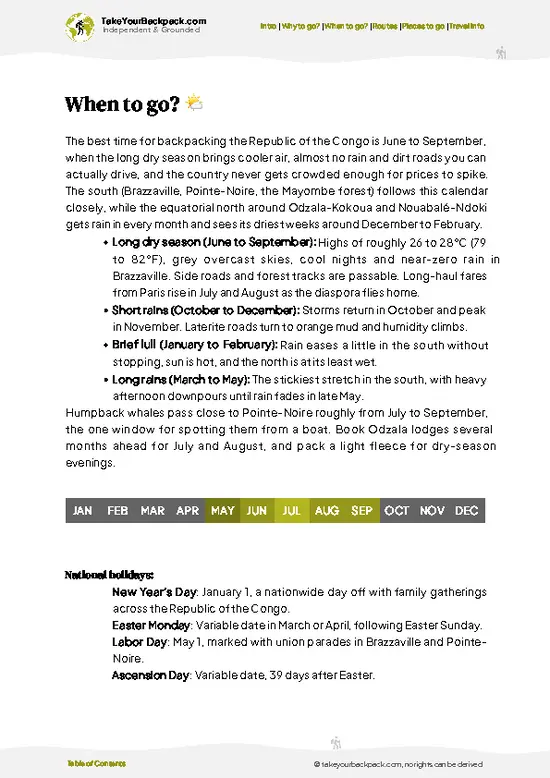
Best months for hiking: The best months are June to August, the long dry season, when rainfall drops to almost nothing in much of the country and trails firm up from soup to packed earth. Across most of Congo, daytime temperatures hold at 25 to 31°C with high humidity, and nights in the south can dip to around 18°C in July, with a cool, hazy, gray-white sky over Brazzaville and the plateaus.

Shoulder seasons and the rains: There are two rainy seasons, roughly March to May and October to December, with the heaviest downpours often in October and November. Annual rainfall runs from about 1,200 mm on the southern plateaus to 1,600 mm or more in the northern forest. In the wet months, rivers rise, tracks turn to slick red clay, and trucks stall. A short dry spell in January and February is workable, … read more 👉
Best months for hiking: The best months are June to August, the long dry season, when rainfall drops to almost nothing in much of the country and trails firm up from soup to packed earth. Across most of Congo, daytime temperatures hold at 25 to 31°C with high humidity, and nights in the south can dip to around 18°C in July, with a cool, hazy, gray-white sky over Brazzaville and the plateaus.

Shoulder seasons and the rains: There are two rainy seasons, roughly March to May and October to December, with the heaviest downpours often in October and November. Annual rainfall runs from about 1,200 mm on the southern plateaus to 1,600 mm or more in the northern forest. In the wet months, rivers rise, tracks turn to slick red clay, and trucks stall. A short dry spell in January and February is workable, especially in the south, though forest paths stay muddy.

Regional differences and prices: The north, with its equatorial climate, never fully dries out, so even July can bring afternoon showers. Wildlife viewing there often peaks in the drier months, when forest clearings draw animals. The south around Brazzaville and the Bateke plateau has the clearest dry season. Congo has no major tourist peak, so prices barely shift by season, but flight and transfer availability tightens in the dry months, so book early.

hike hoppingOptimizing Your Multi-Stop Itinerary

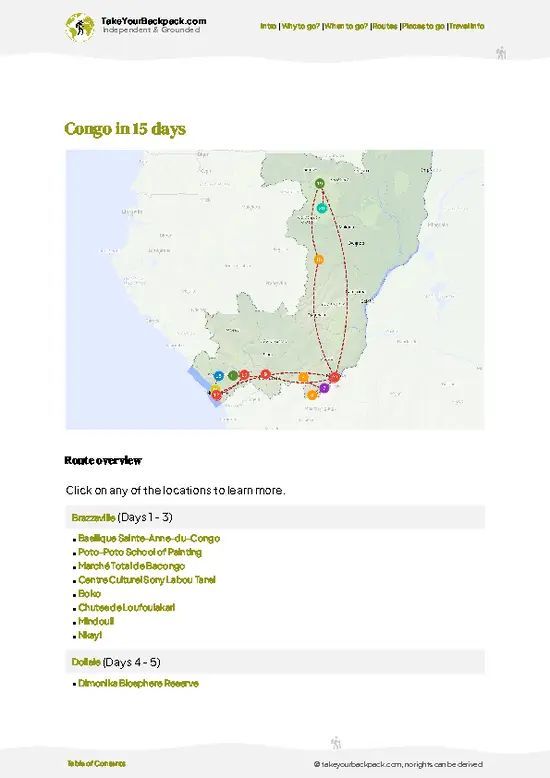
How long to allow: A trip combining several hikes in Congo needs 10 to 16 days, because transfers eat more time than walking. The country splits into a south cluster around Brazzaville, Pointe-Noire and the plateaus, and a north cluster in the forest belt around Ouesso, so treat them as two separate trips rather than one smooth loop.

Direction and transit: Start in the south, where the red-earth roads, grassland wind and shorter distances help you adjust to the heat. Brazzaville is the natural hub, with international flights and domestic connections. Pointe-Noire on the coast links to the interior by the Congo-Océan road and rail corridor, and the drive between the two cities takes roughly 8 to 12 hours depending on road conditions. Getting north usually means a flight to Ouesso, about 1. … read more 👉
How long to allow: A trip combining several hikes in Congo needs 10 to 16 days, because transfers eat more time than walking. The country splits into a south cluster around Brazzaville, Pointe-Noire and the plateaus, and a north cluster in the forest belt around Ouesso, so treat them as two separate trips rather than one smooth loop.

Direction and transit: Start in the south, where the red-earth roads, grassland wind and shorter distances help you adjust to the heat. Brazzaville is the natural hub, with international flights and domestic connections. Pointe-Noire on the coast links to the interior by the Congo-Océan road and rail corridor, and the drive between the two cities takes roughly 8 to 12 hours depending on road conditions. Getting north usually means a flight to Ouesso, about 1.5 to 2 hours, followed by 4x4 or boat transfers of 3 to 8 hours to reach park gateways.

Time per stop and common errors: Give each forest stop 3 to 5 days, since permits, briefings and slow trekking take time, and 1 to 2 days for southern hikes. The usual mistake is booking tight connections. Flights get delayed or canceled, rains close tracks, and a single missed boat can cost two days. Build in a buffer day before any international departure, confirm guides and vehicles by phone a few days ahead, and avoid cramming both clusters into a week.

The ListTop hikes of Congo

1 Lango Bai Trail

Guided bai walk, forest elephants, camp viewpoint, wet clearing

Follow a park guide through flat lowland rainforest to a marshy clearing where elephants and gorillas feed, then scan it from the camp viewpoint.

2 Mbeli Bai Trail

Research platform, thigh-deep channels, gorilla families, Nouabalé-Ndoki

Wade through tea-colored swamp channels to a raised deck where researchers log gorillas, elephants and sitatunga across an open, mineral-rich clearing.

3 Ngaga Camp Forest Trail

Habituated gorillas, chimp tracking, marantaceae thickets, charter flight access

Push through shoulder-high herbs with trackers to spend about an hour near a gorilla family, with chimpanzee tracking also available from camp.

4 Mboko Camp Forest Trail

Old-growth canopy, Lekoli River bank, grey parrots, animal signs

Walk a root-laced path beneath buttressed trunks, reading elephant trails and gorilla nests, then cool off beside the slow, dark Lekoli River.

Loading the map 🌍

Expert viewWhat You Should Know

How many hikes to plan: Plan for three or four hikes in total. Forest treks here are slow, hot and logistically heavy, and each one swallows several days with permits, transfers and recovery. Fewer, longer stays give you more time under the canopy, where the light turns green-gold and the only sound is insects and the occasional crash of a distant primate. Cramming in more means more hours in a vehicle than on foot.

Which kind to prioritize: If you want wildlife and true wilderness, put the northern rainforest first and accept the cost. If you have a smaller budget or less time, choose southern grassland, plateau and gorge walks, which are cheaper and reachable by road, with open views and cooler breezes. A balanced trip might pair one deep-forest trek with two southern day hikes. Fit hikers … read more 👉
How many hikes to plan: Plan for three or four hikes in total. Forest treks here are slow, hot and logistically heavy, and each one swallows several days with permits, transfers and recovery. Fewer, longer stays give you more time under the canopy, where the light turns green-gold and the only sound is insects and the occasional crash of a distant primate. Cramming in more means more hours in a vehicle than on foot.

Which kind to prioritize: If you want wildlife and true wilderness, put the northern rainforest first and accept the cost. If you have a smaller budget or less time, choose southern grassland, plateau and gorge walks, which are cheaper and reachable by road, with open views and cooler breezes. A balanced trip might pair one deep-forest trek with two southern day hikes. Fit hikers who like rough conditions will love the forest, while anyone who dislikes humidity and bugs will be happier on the plateaus.

What it costs: Budget US$60 to 120 a day for southern hikes, covering basic lodging, local food, a driver or moto and a guide. Remote northern forest trips run US$150 to 300 a day once park fees, mandatory guides, trackers, boat and 4x4 transfers are included. Park entry and permits typically add roughly US$30 to 100 per person, and guide fees run US$15 to 40 a day. A full multi-hike trip often totals US$1,200 to 3,000, with flights to the north the biggest single cost. Carry cash in CFA francs, because cards and ATMs are unreliable outside Brazzaville and Pointe-Noire. Your reward is trails with almost no one else on them.

Safety and cultural considerations: Hire local guides every time. They know the paths, the wildlife and the river crossings, and they keep you out of trouble in dense forest where a wrong turn is easy. Take malaria prophylaxis, a yellow fever certificate, water purification and strong insect repellent, and keep clear of elephants and any gorilla group you meet, following your guide’s distance rules. Carry copies of your passport and visa, since police checks on roads are common and polite patience helps. Ask before photographing people or villages, greet elders first with a handshake, and dress modestly in rural communities. Hiring local trackers and buying food in villages directly supports the people who protect these forests.

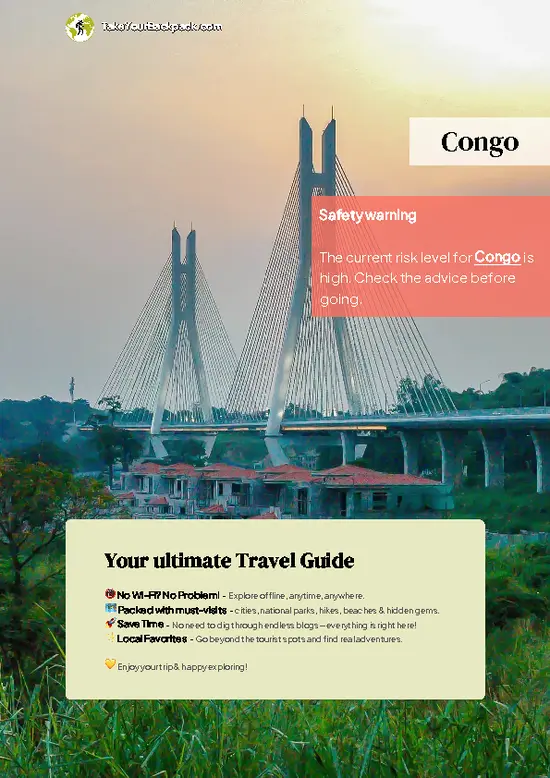
✈️ The backpacker research shortcutCongo Travel Guide

An offline-friendly backpacking guide with optimized travel routes, ranked highlights, transport advice, and the best areas to stay.
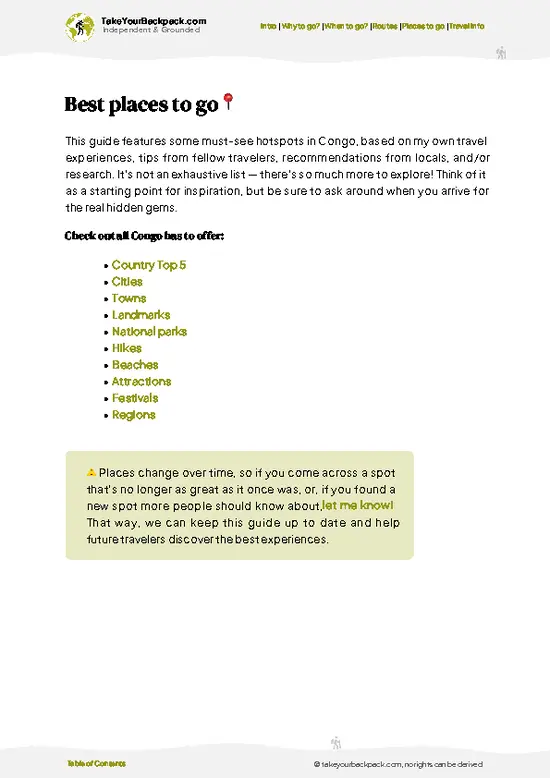
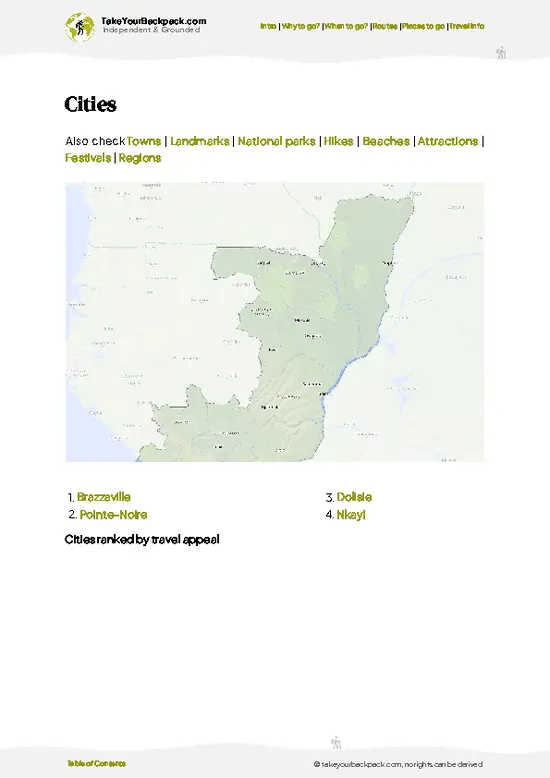
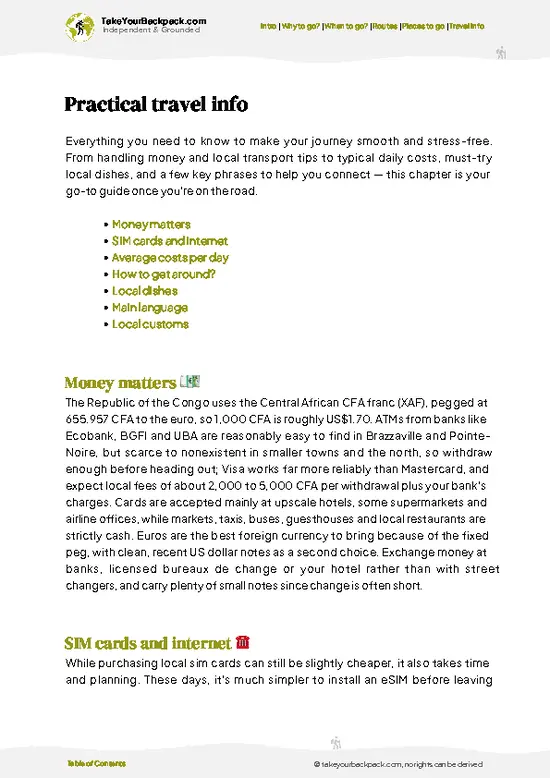
example page 0 from our offline Travel Guide for Republic of the Congo
example page 1 from our offline Travel Guide for Republic of the Congo
example page 2 from our offline Travel Guide for Republic of the Congo
example page 3 from our offline Travel Guide for Republic of the Congo
example page 4 from our offline Travel Guide for Republic of the Congo
example page 5 from our offline Travel Guide for Republic of the Congo
example page 6 from our offline Travel Guide for Republic of the Congo
example page 7 from our offline Travel Guide for Republic of the Congo
The digital guide (205 pages) contains:
✅ 46 highlights, ranked by travel appeal
✅ Optimized 5, 10 & 15-day travel routes
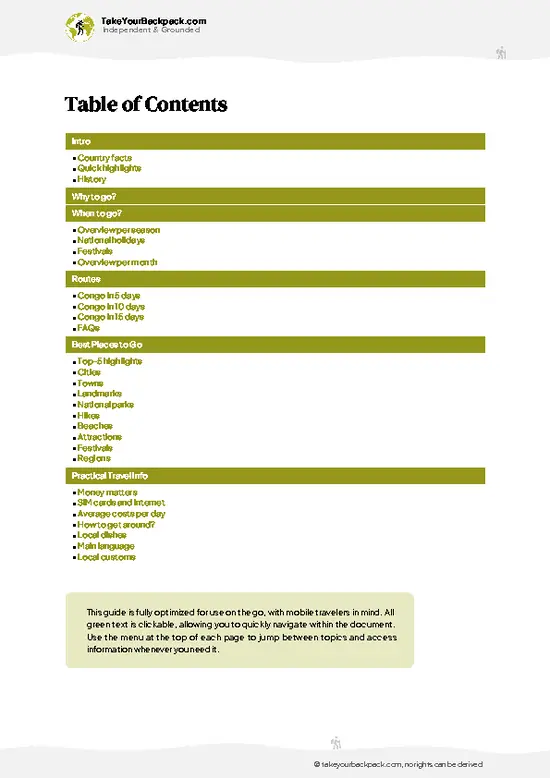
✅ Cities, national parks, landmarks, beaches
✅ How to get around
✅ Offline-friendly for travel without Wi-Fi
👉 Click to see all 30+ guide features

📅 Plan smarter in minutes, not weeks
✅ Month by month travel advice
✅ Festivals & national holidays
✅ Budget expectations

🗺️ Go to the right places, skip the overrated ones
✅ Honest pros & cons of destinations
✅ Top hikes, parks & viewpoints
✅ Lesser-known places most travelers miss
✅ Clear “worth it vs skip it” guidance

🛏️ Travel smoothly without rookie mistakes
✅ Best areas to stay
✅ Transport systems explained simply
✅ Common scams & safety advice
✅ SIM cards, money & practical tips

🌍 Understand the country, not just visit it
✅ Culture & traditions
✅ 52 Essential phrases & customs
✅ Festivals worth planning around
✅ Traveler-friendly historical context
✅ Insights that make places more meaningful

📱 Built for real travel conditions
✅ Fully downloadable PDF
✅ Works completely offline
✅ Optimized for phone use
✅ Useful in remote areas & buses
✅ Everything in one place
Stop searching, start planning
Get instant access to your full guide. 30‑day money-back guarantee.
+ Add another guide for just

By proceeding you agree to our terms.
Sent to your inbox immediately after payment • 100% Secure Checkout
Best Backpacking Travel Advisor 2025 tourism awardBest Backpacking
Travel Advisor
2025
What others say about Take Your Backpack Guides:
⭐⭐⭐⭐⭐
Fantastic, amazing amount of information!
⭐⭐⭐⭐⭐
My goodness this is amazing, it's what I've been looking for hats off too you!
⭐⭐⭐⭐⭐
I think this is absolutely BRILLIANT
⭐⭐⭐⭐
Very complete and informative. It's still missing places, but I gotta to commend you
⭐⭐⭐⭐⭐
This is truly amazing, thank you, can't wait to explore it with my kids!
⭐⭐⭐⭐⭐
Awesome resource, thank you!
⭐⭐⭐⭐⭐
This is amazing! Can't wait to explore the ones I haven't seen
⭐⭐⭐⭐
I love this! Well done, great idea.
⭐⭐⭐⭐⭐
Thanks for taking the time to make this gem!
⭐⭐⭐⭐⭐
This might be the best website I've ever seen.
⭐⭐⭐⭐⭐
Congratulations, and thank you so much for your work; it's incredibly valuable.
⭐⭐⭐⭐
In all seriousness I think you did a great job pointing out the important spots
⭐⭐⭐⭐⭐
10/10 very good
⭐⭐⭐⭐⭐
As someone who's only just starting to visit regularly this is awesome, thank you.
⭐⭐⭐⭐
Thank you very much! I'm going to visit my dad, it's going to be very useful!
⭐⭐⭐⭐⭐
This is really cool! We'll be travelling for the first time and this definitely come in handy.
⭐⭐⭐⭐⭐
You are now our minister of culture, congratulations 👨‍💼
⭐⭐⭐⭐⭐
Just wanted to tell you that this is a pearl! Going to follow your recommendations.
⭐⭐⭐⭐⭐
This is so cool. I'll definitely be using the resource for my travels soon.
⭐⭐⭐⭐⭐
This is very impressive! Good work.
⭐⭐⭐⭐⭐
This is an amazing and informative site. Very well done!

🛏️ Where to stay?Where to Stay in Congo

Backpacking the Republic of the Congo means guesthouses (“auberges”) and simple hotels rather than dorm hostels, with fan or air-con rooms typically running 15,000 to 30,000 XAF (US$25 to 50) a night. In Brazzaville, Poto-Poto has the most cheap options and puts you near markets, street food and live-music bars, at the cost of noise and pickpocket risk after dark. Centre-ville and Plateau are calmer and feel safer for walking but cost more, while Bacongo has good nightlife and cheaper rooms but quieter, poorly lit streets late at night; in Pointe-Noire, the Centre-ville near the beach and the Côte Sauvage is easiest, with cheaper rooms in Tié-Tié further from the sea.

If you enjoy meeting fellow … read more 👉
Backpacking the Republic of the Congo means guesthouses (“auberges”) and simple hotels rather than dorm hostels, with fan or air-con rooms typically running 15,000 to 30,000 XAF (US$25 to 50) a night. In Brazzaville, Poto-Poto has the most cheap options and puts you near markets, street food and live-music bars, at the cost of noise and pickpocket risk after dark. Centre-ville and Plateau are calmer and feel safer for walking but cost more, while Bacongo has good nightlife and cheaper rooms but quieter, poorly lit streets late at night; in Pointe-Noire, the Centre-ville near the beach and the Côte Sauvage is easiest, with cheaper rooms in Tié-Tié further from the sea.

If you enjoy meeting fellow travelers, consider choosing hostels with high ratings for atmosphere. On the other hand, if you prefer having your own space, a hotel might be a better option.

CongoMore of Congo

👋 Meet the founderWho’s Behind Take Your Backpack?

Johan, backpacker and founder of TakeYourBackpackHi, I’m Johan (Netherlands 🇳🇱), the creator of TakeYourBackpack. Over the past 3 decades, I’ve backpacked through 90+ countries across six continents, gaining extensive experience with independent travel, long-term trips, and overland routes.

This site is built on a combination of firsthand travel experience and carefully curated insights from other backpackers. Many guides are based on places I’ve personally visited, while others bring together tips, observations, and practical advice shared by trusted travelers I’ve met along the way.

The goal is to provide realistic, experience-driven guidance — not generic itineraries — so you can explore destinations with better context, clearer expectations, and more confidence.