×

Republic of the Congo🇨🇬 | best regionsThe Top regions in Congo

In Congo (the Republic of the Congo, also known as Congo-Brazzaville), the landscape shifts dramatically from dense rainforests to savannahs, each region offering a unique flavor of adventure. The climate varies widely; the north experiences heavy rains, while the south basks in a drier season, influencing your backpacking plans.

Choosing the right region shapes your travel experience—from the vibrant markets of Brazzaville to the remote trails of Odzala-Kokoua National Park. Each area presents distinct cultural nuances, safety considerations, and budget implications. Understanding these differences is crucial for independent travelers seeking authentic immersion in Congo’s rich tapestry.

By Johan Kruseman 🇳🇱 | Updated September 4, 2026
Explore the best cities in Congo

Why go?Why These region Stand Out

Congo is a land of contrasts, where climatic diversity shapes not just the landscape but the very culture of its people. From the humid, dense tropical rainforests of the north to the drier savannas in the south, each region offers a unique experience. This variety means travelers can immerse themselves in rich ecosystems, but it also requires navigating significant travel distances. The roads can be rough, and public transport is often limited, making some areas feel remote.

Congo’s cultural character is equally compelling. The country is home to over 200 ethnic groups, each with distinct traditions and languages. This cultural mosaic enriches the travel experience but can also present challenges in communication and understanding local customs.

The infrastructure varies widely. While … read more 👉
Congo is a land of contrasts, where climatic diversity shapes not just the landscape but the very culture of its people. From the humid, dense tropical rainforests of the north to the drier savannas in the south, each region offers a unique experience. This variety means travelers can immerse themselves in rich ecosystems, but it also requires navigating significant travel distances. The roads can be rough, and public transport is often limited, making some areas feel remote.

Congo’s cultural character is equally compelling. The country is home to over 200 ethnic groups, each with distinct traditions and languages. This cultural mosaic enriches the travel experience but can also present challenges in communication and understanding local customs.

The infrastructure varies widely. While major cities may have basic amenities, rural areas often lack reliable services. This disparity can lead to a trade-off between accessibility and immersive experiences. Travelers seeking depth may find themselves on long journeys, but the payoff is often a profound connection to the land and its people.

In summary, Congo offers a unique blend of geographic and cultural richness, but it demands patience and adaptability. Understanding these dynamics is crucial for anyone looking to explore this vibrant country.
Evaluating the Top Choices
The list of best regions in Congo is created based on landscapes, local culture, attractions, vibes, and overall appeal. If you feel a region is missing in this list, please let us know.

When to go?Optimal Periods for Travel

Climate Variation
Congo experiences a tropical climate, characterized by distinct wet and dry seasons. The wet season typically runs from October to May, bringing heavy rains that can make travel challenging. Trails become muddy, and some areas may be inaccessible. However, this season also brings lush landscapes and vibrant wildlife activity, making it a rewarding time for those willing to brave the elements.

Optimal Months
The dry season, from June to September, offers the best conditions for exploration. Expect clearer skies and more manageable trails. Wildlife is often easier to spot as animals congregate around water sources. This period is ideal for those seeking comfort and accessibility, but it can also attract larger crowds, particularly in popular areas.

Shoulder Seasons
Visiting … read more 👉
Climate Variation
Congo experiences a tropical climate, characterized by distinct wet and dry seasons. The wet season typically runs from October to May, bringing heavy rains that can make travel challenging. Trails become muddy, and some areas may be inaccessible. However, this season also brings lush landscapes and vibrant wildlife activity, making it a rewarding time for those willing to brave the elements.

Optimal Months
The dry season, from June to September, offers the best conditions for exploration. Expect clearer skies and more manageable trails. Wildlife is often easier to spot as animals congregate around water sources. This period is ideal for those seeking comfort and accessibility, but it can also attract larger crowds, particularly in popular areas.

Shoulder Seasons
Visiting during the shoulder months—late May and early October—can provide a balance. Conditions may be variable, with occasional rains, but fewer tourists mean a more intimate experience. Costs may also be lower, making it a practical choice for budget-conscious travelers.

Seasonal Constraints
Travelers should consider that some regions may have limited access during the wet season. Planning around these patterns can enhance the overall experience, ensuring that the effort invested in travel yields rich rewards in the form of stunning landscapes and unique encounters.

region hoppingOptimizing Your Multi-Stop Itinerary

Routing Logic

Traveling through Congo requires a thoughtful approach to maximize experiences. Start in the capital, Brazzaville, where urban life pulses with energy. From there, head north toward the Cuvette region, known for its dense forests and wildlife. This route allows for a gradual immersion into Congo’s natural beauty.

Time Management

Allocate at least two to three days in each major area. This pacing allows for exploration without feeling rushed. The wildlife reserves demand patience; the thrill of spotting a rare species is worth lingering.

Common Mistakes

Many travelers underestimate the distances between regions. Roads can be rough, and travel times can stretch unexpectedly. Avoid cramming too many stops into a short timeframe. Instead, focus on fewer regions to deepen the … read more 👉

Routing Logic

Traveling through Congo requires a thoughtful approach to maximize experiences. Start in the capital, Brazzaville, where urban life pulses with energy. From there, head north toward the Cuvette region, known for its dense forests and wildlife. This route allows for a gradual immersion into Congo’s natural beauty.

Time Management

Allocate at least two to three days in each major area. This pacing allows for exploration without feeling rushed. The wildlife reserves demand patience; the thrill of spotting a rare species is worth lingering.

Common Mistakes

Many travelers underestimate the distances between regions. Roads can be rough, and travel times can stretch unexpectedly. Avoid cramming too many stops into a short timeframe. Instead, focus on fewer regions to deepen the experience.

Trade-offs and Constraints

Balancing speed with depth is crucial. Quick visits may save time but often lead to missed connections with local culture. Budget considerations also play a role; opting for comfort in accommodations can enhance the experience, especially after long travel days.

Flexibility

Be prepared for changes. Weather can impact travel plans, especially during the rainy season. Embrace the unpredictability; it often leads to the most rewarding moments.

The ListTop regions of Congo

1 Kouilou Region

Atlantic coastline, Mayombe forest, Loango salt lakes, fishing villages

Experience shifting landscapes from wild ocean beaches to dense rainforest, where salt lakes and remote communities reveal the region’s layered natural history.

Loading the map 🌍

Expert viewWhat You Should Know

Regions in Congo are as diverse as they are captivating. You’ll find dense rainforests, sprawling savannas, and winding rivers, each offering a unique slice of life. I’d recommend focusing on three to four regions for a well-rounded experience. This allows you to dive deep without feeling rushed, but be prepared for some trade-offs in terms of time and effort.

Transport between regions can be a challenge. Roads are often unpaved and can turn into muddy nightmares during the rainy season. Expect to spend hours, if not days, on the move. Domestic flights can save you time but come with a higher price tag. If you’re on a budget, consider overland travel, but know that it will test your patience. The reward? You’ll witness the gradual shift in landscapes and cultures, each mile revealing something … read more 👉
Regions in Congo are as diverse as they are captivating. You’ll find dense rainforests, sprawling savannas, and winding rivers, each offering a unique slice of life. I’d recommend focusing on three to four regions for a well-rounded experience. This allows you to dive deep without feeling rushed, but be prepared for some trade-offs in terms of time and effort.

Transport between regions can be a challenge. Roads are often unpaved and can turn into muddy nightmares during the rainy season. Expect to spend hours, if not days, on the move. Domestic flights can save you time but come with a higher price tag. If you’re on a budget, consider overland travel, but know that it will test your patience. The reward? You’ll witness the gradual shift in landscapes and cultures, each mile revealing something new.

Cultural variation is striking. In one region, you might be surrounded by the rhythmic beats of traditional music, while in another, the air is filled with the scent of grilled fish at a bustling market. Engage with locals; their stories are the heart of Congo. However, be aware of cultural sensitivities. Dress modestly and approach customs with respect. This isn’t just a trip; it’s a chance to connect with a rich tapestry of traditions.

Pacing is crucial. If you’re eager to explore the rainforest, allocate more time there. The trails can be grueling, with humidity that clings to your skin and insects that seem to have a personal vendetta against you. But when you finally reach a clearing, the sight of towering trees and the sound of wildlife is a moment that makes every drop of sweat worth it. Conversely, if you’re drawn to urban life, you’ll find a different rhythm. The cities pulse with energy, but they can also be overwhelming. Plan for downtime to recharge.

Safety is a consideration that can’t be overlooked. While many areas are safe for travelers, some regions may have political instability or health risks. Stay updated on local conditions and consider hiring a guide who knows the terrain and the people. This not only enhances your experience but also ensures you navigate the complexities of travel in Congo with more ease.

Budget varies widely depending on your choices. If you opt for local transport and street food, you can stretch your funds. However, if you prefer comfort and convenience, be prepared to spend more. The key is to prioritize what matters most to you.

In Congo, every region tells a story, and the journey between them is just as important as the destination. Embrace the grit of the streets and the burn of the trails. The moments of discomfort will lead to the most rewarding experiences—whether it’s the first cold beer after a long hike or the laughter shared with locals over a meal. Each step is a part of the adventure, and the beauty of Congo is waiting for those willing to earn it.

✈️ The backpacker research shortcutCongo Travel Guide

An offline-friendly backpacking guide with optimized travel routes, ranked highlights, transport advice, and the best areas to stay.
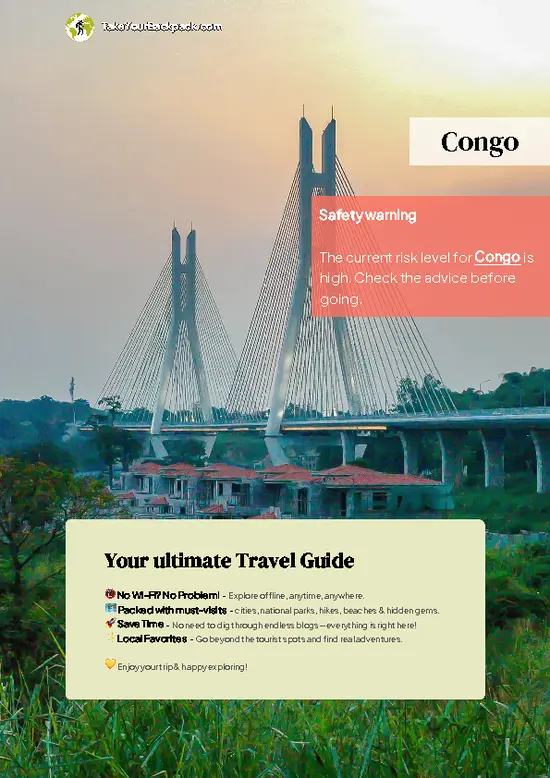
example page 0 from our offline Travel Guide for Republic of the Congo
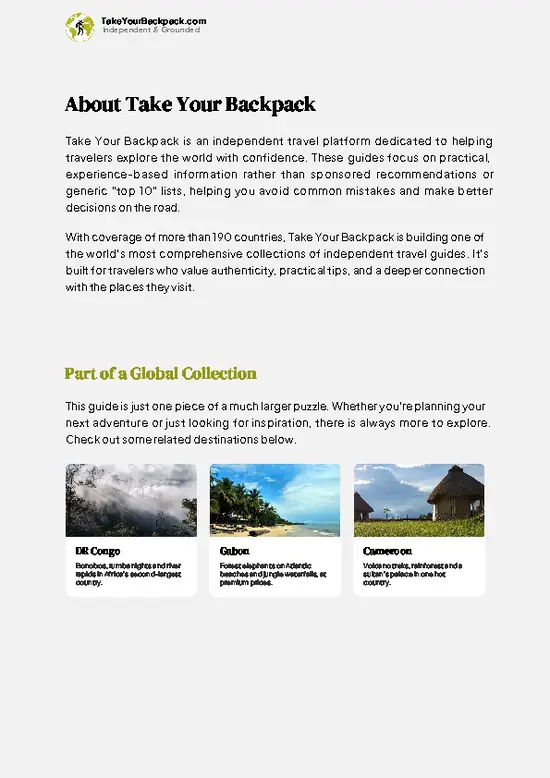
example page 1 from our offline Travel Guide for Republic of the Congo
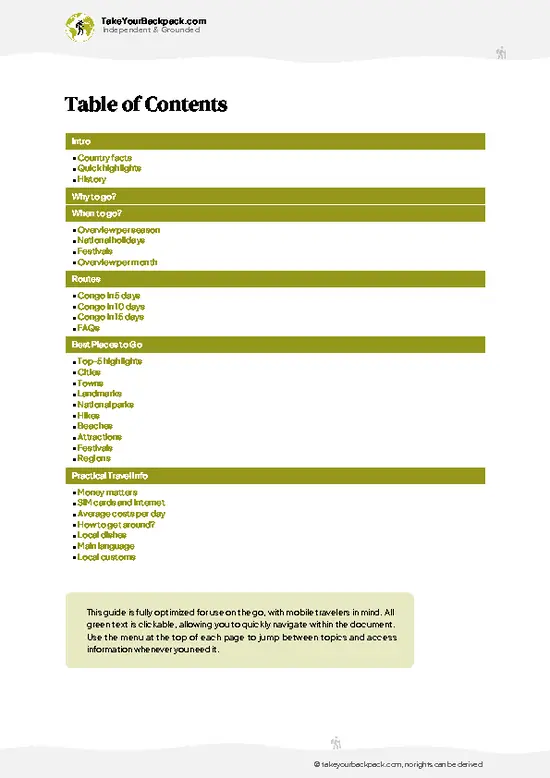
example page 2 from our offline Travel Guide for Republic of the Congo
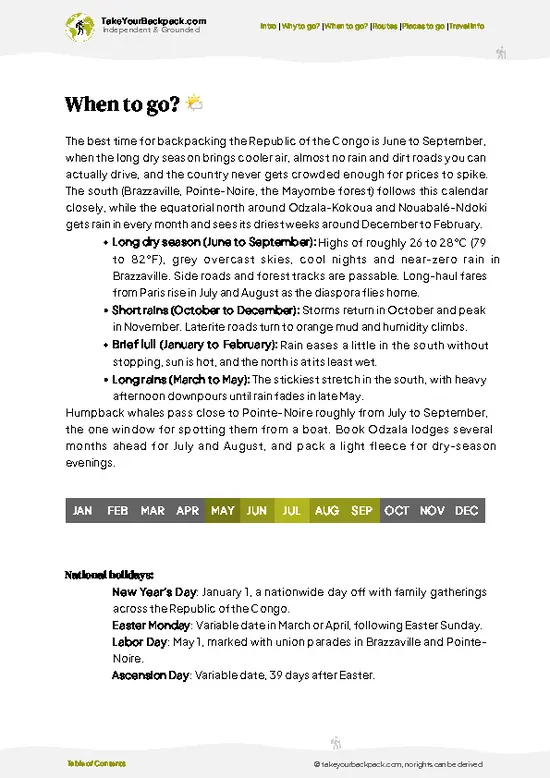
example page 3 from our offline Travel Guide for Republic of the Congo
example page 4 from our offline Travel Guide for Republic of the Congo
example page 5 from our offline Travel Guide for Republic of the Congo
example page 6 from our offline Travel Guide for Republic of the Congo
example page 7 from our offline Travel Guide for Republic of the Congo
The digital guide (218 pages) contains:
52 highlights, ranked by travel appeal
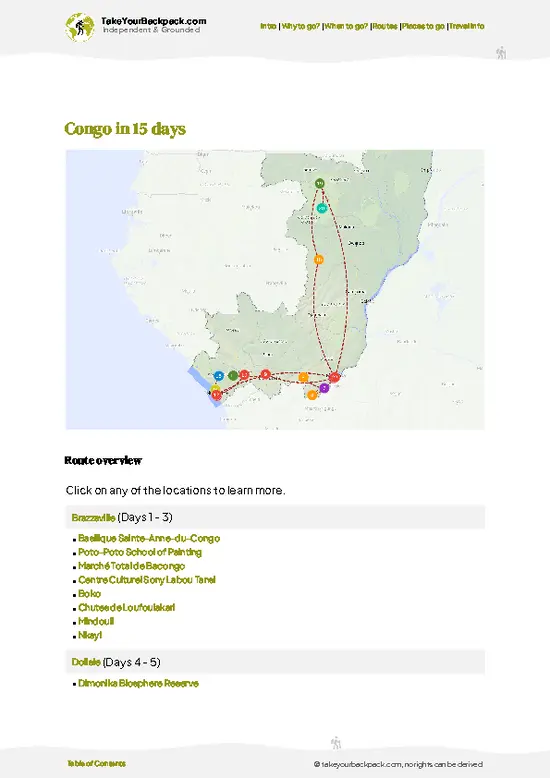
Optimized 5, 10 & 15-day travel routes
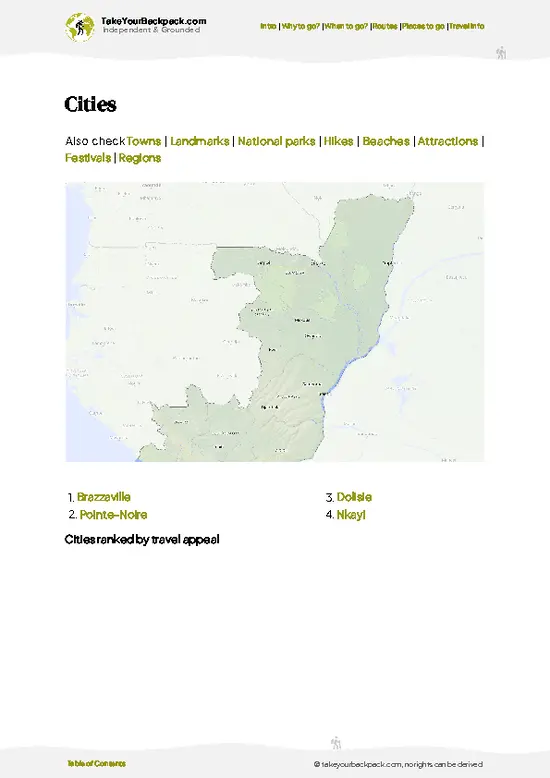
Cities, national parks, landmarks, beaches
How to get around
Offline-friendly for travel without Wi-Fi
👉 Click to see all 30+ guide features

📅 Plan smarter in minutes, not weeks
Month by month travel advice
Festivals & national holidays
Budget expectations

🗺️ Go to the right places, skip the overrated ones
Honest pros & cons of destinations
Top hikes, parks & viewpoints
Lesser-known places most travelers miss
Clear “worth it vs skip it” guidance

🛏️ Travel smoothly without rookie mistakes
Best areas to stay
Transport systems explained simply
Common scams & safety advice
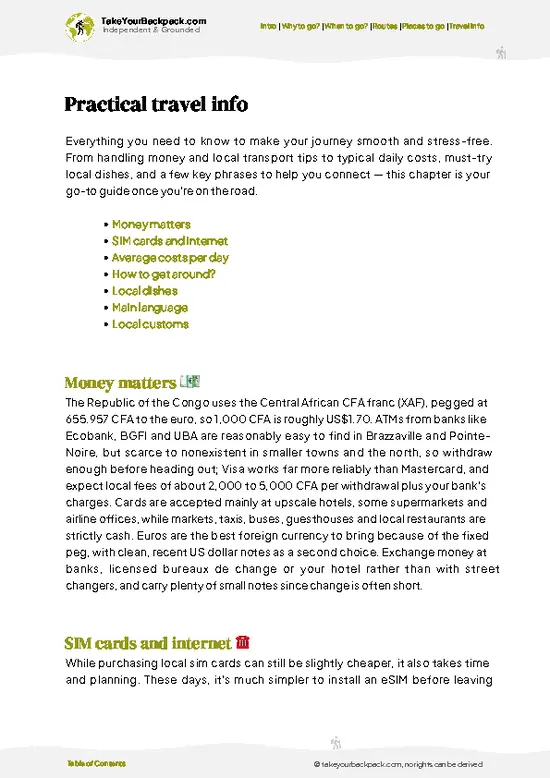
SIM cards, money & practical tips

🌍 Understand the country, not just visit it
Culture & traditions
52 Essential phrases & customs
Festivals worth planning around
Traveler-friendly historical context
Insights that make places more meaningful

📱 Built for real travel conditions
Fully downloadable PDF
Works completely offline
Optimized for phone use
Useful in remote areas & buses
Everything in one place
Save weeks of stressful planning
Get instant access to your full guide. 30‑day money-back guarantee.
+ Add another guide for just US$7.80

By proceeding you agree to our terms.
Sent to your inbox immediately after payment • 100% Secure Checkout
Best Backpacking Travel Advisor 2025 tourism awardBest Backpacking
Travel Advisor
2025
What others say about Take Your Backpack Guides:
⭐⭐⭐⭐⭐
Fantastic, amazing amount of information!
⭐⭐⭐⭐⭐
My goodness this is amazing, it's what I've been looking for hats off too you!
⭐⭐⭐⭐⭐
I think this is absolutely BRILLIANT
⭐⭐⭐⭐
Very complete and informative. It's still missing places, but I gotta to commend you
⭐⭐⭐⭐⭐
This is truly amazing, thank you, can't wait to explore it with my kids!
⭐⭐⭐⭐⭐
Awesome resource, thank you!
⭐⭐⭐⭐⭐
This is amazing! Can't wait to explore the ones I haven't seen
⭐⭐⭐⭐
I love this! Well done, great idea.
⭐⭐⭐⭐⭐
Thanks for taking the time to make this gem!
⭐⭐⭐⭐⭐
This might be the best website I've ever seen.
⭐⭐⭐⭐⭐
Congratulations, and thank you so much for your work; it's incredibly valuable.
⭐⭐⭐⭐
In all seriousness I think you did a great job pointing out the important spots
⭐⭐⭐⭐⭐
10/10 very good
⭐⭐⭐⭐⭐
As someone who's only just starting to visit regularly this is awesome, thank you.
⭐⭐⭐⭐
Thank you very much! I'm going to visit my dad, it's going to be very useful!
⭐⭐⭐⭐⭐
This is really cool! We'll be travelling for the first time and this definitely come in handy.
⭐⭐⭐⭐⭐
You are now our minister of culture, congratulations 👨‍💼
⭐⭐⭐⭐⭐
Just wanted to tell you that this is a pearl! Going to follow your recommendations.
⭐⭐⭐⭐⭐
This is so cool. I'll definitely be using the resource for my travels soon.
⭐⭐⭐⭐⭐
This is very impressive! Good work.
⭐⭐⭐⭐⭐
This is an amazing and informative site. Very well done!

🛏️ Where to stay?Best Stay Options in Congo

Yes — basic hostels and budget guesthouses exist in Congo, mainly in the two main cities of Brazzaville and Pointe‑Noire; options outside urban centres are sparse and national‑park access typically requires pricier lodges or arranged camps.
In Brazzaville the Plateau (central) and riverside Bacongo have the most choices — Plateau gives fastest access to markets, museums and nightlife but is busier and a bit costlier, while Bacongo is quieter and cheaper with fewer late‑night services and limited transport.
In Pointe‑Noire the city centre and beachfront neighbourhoods offer safer walking, better transport links and more guesthouse options, whereas outlying districts are cheaper but darker … read more 👉
Yes — basic hostels and budget guesthouses exist in Congo, mainly in the two main cities of Brazzaville and Pointe‑Noire; options outside urban centres are sparse and national‑park access typically requires pricier lodges or arranged camps.
In Brazzaville the Plateau (central) and riverside Bacongo have the most choices — Plateau gives fastest access to markets, museums and nightlife but is busier and a bit costlier, while Bacongo is quieter and cheaper with fewer late‑night services and limited transport.
In Pointe‑Noire the city centre and beachfront neighbourhoods offer safer walking, better transport links and more guesthouse options, whereas outlying districts are cheaper but darker after sundown, less tourist‑oriented and may lack reliable public transport; don’t expect a backpacker‑hostel network and plan for small hotels or guesthouses.

If you enjoy meeting fellow travelers, consider choosing hostels with high ratings for atmosphere. On the other hand, if you prefer having your own space, a hotel might be a better option.

CongoWhere to Go Next

👋 Meet the founderWho’s Behind Take Your Backpack?

Johan, backpacker and founder of TakeYourBackpackHi, I’m Johan (Netherlands 🇳🇱), the creator of TakeYourBackpack. Over the past decade, I’ve backpacked through 80+ countries across six continents, gaining extensive experience with independent travel, long-term trips, and overland routes.

This site is built on a combination of firsthand travel experience and carefully curated insights from other backpackers. Many guides are based on places I’ve personally visited, while others bring together tips, observations, and practical advice shared by trusted travelers I’ve met along the way.

The goal is to provide realistic, experience-driven guidance — not generic itineraries — so you can explore destinations with better context, clearer expectations, and more confidence.

Get full Congo guide •
Instant download • 52 highlights • Full Offline guide