×

Congo🇨🇬 | landmarksLac TéléMokele-mbembe legend, pirogue paddling, swamp forest, gorilla country | things to do and best time to go

Explore Chutes de LoufoulakariExplore Basilique Sainte-Anne-du-Congo

Backpacking in Lac Télé
👍 Recommendedunique site ranked #2
By Johan Kruseman 🇳🇱 | Updated October 22, 2026

Lac Télé comes with almost no other visitors, so the guides, the pirogue and the forest edge are yours alone. The lake sits in the north of the Republic of the Congo, in the flooded Likouala forests, a round sheet of shallow water roughly 5 kilometers across. Be realistic about the main sight. The lake itself is calm, brown-green and low-lying, with a wall of trees and a sky full of parrot calls, and it will not hit you like a waterfall. The real show is the swamp forest around it: sticky heat, mud that swallows boots, insects at dusk, and the thump and whoop of unseen animals. Skip it if you need comfort or fast logistics. Go if rough, remote and quiet appeals. Photography is best at the water’s edge in soft morning mist. A first day usually means a slow pirogue paddle through flooded channels, a wet walk to the shore, and an evening of frog noise around a village fire.

Discover everything you want to know in the 📖 Congo Travel Guide.
Safety warning

The current risk level for Congo is high. Check the advice before going.


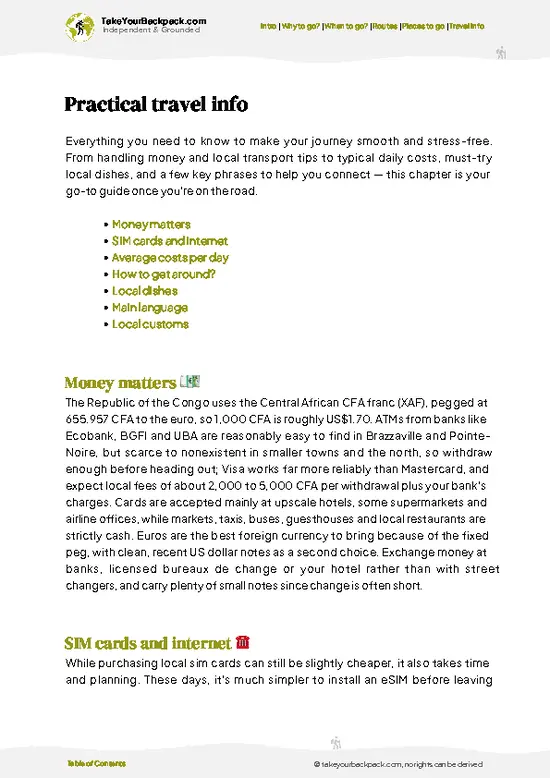
example page 0 from our offline Travel Guide for Republic of the Congo
example page 1 from our offline Travel Guide for Republic of the Congo
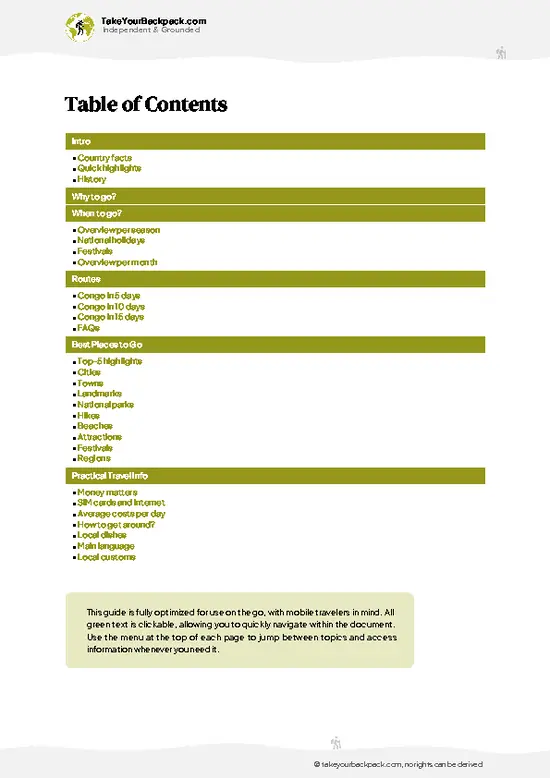
example page 2 from our offline Travel Guide for Republic of the Congo
example page 3 from our offline Travel Guide for Republic of the Congo
example page 4 from our offline Travel Guide for Republic of the Congo
example page 5 from our offline Travel Guide for Republic of the Congo
example page 6 from our offline Travel Guide for Republic of the Congo
example page 7 from our offline Travel Guide for Republic of the Congo
Loading the map 🌍
CLICK TO FILTER
cities
towns
landmarks
national parks
hikes
beaches
attractions
festivals
regions
SHOW COUNTRY’S BESTSHOW ALL

✨ Why go?
Ranked #2 unique site in Congo
What makes this unique site worth visiting

Lac Télé is worth the effort because almost nothing else in Central Africa gives you this much unbroken wilderness without a crowd. The Lac Télé Community Reserve, about 4,400 square kilometers of swamp and terra firma forest, protects western lowland gorillas, chimpanzees, forest elephants and the rare sitatunga antelope. You will not tick animals off a list here. You will hear them, find tracks, and occasionally get a flash of fur, which is a more honest kind of wildlife experience and a better story afterward.

The place also carries a legend that no other lake in the region matches: the mokele-mbembe, a river-dwelling creature that local fishers describe and Western expeditions have chased since the 1980s. Even a skeptic enjoys hearing the stories from the people who live beside the water. … read more 👉
Lac Télé is worth the effort because almost nothing else in Central Africa gives you this much unbroken wilderness without a crowd. The Lac Télé Community Reserve, about 4,400 square kilometers of swamp and terra firma forest, protects western lowland gorillas, chimpanzees, forest elephants and the rare sitatunga antelope. You will not tick animals off a list here. You will hear them, find tracks, and occasionally get a flash of fur, which is a more honest kind of wildlife experience and a better story afterward.

The place also carries a legend that no other lake in the region matches: the mokele-mbembe, a river-dwelling creature that local fishers describe and Western expeditions have chased since the 1980s. Even a skeptic enjoys hearing the stories from the people who live beside the water.

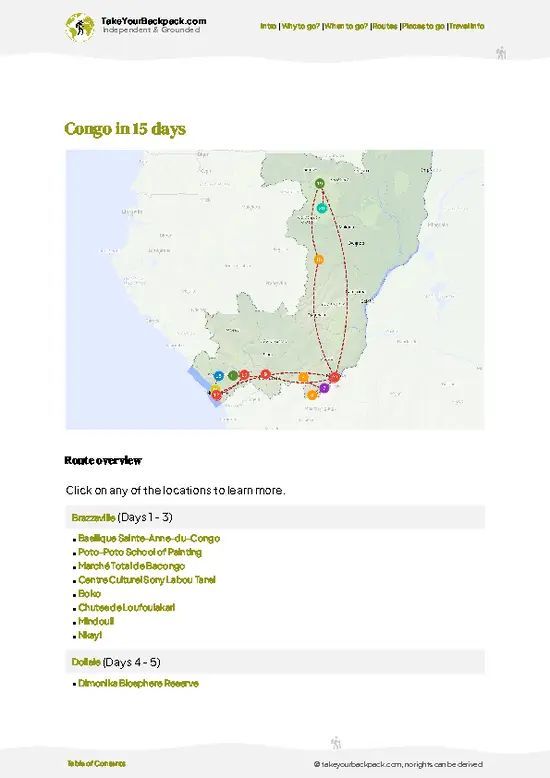
It fits best into a longer northern loop. Combine it with the river towns of the Likouala region, such as Impfondo, which is the usual gateway, and with the national parks further west. Treat it as the wild, slow chapter of a Congo trip, with the capital and the Atlantic coast as contrast.

💡 HighlightsDon't-miss highlights and experiences

  1. The Mokele-mbembe legend: This is what draws most people here. Local Bangombe and Likouala communities describe a river-dwelling creature, and expeditions since the early twentieth century have searched the lake and its swamps for it. Nobody has produced proof, but the stories told around a camp fire make the trip feel like an expedition.
  2. The lake itself: Lac Télé is a shallow, roughly circular lake about 5 kilometers across, ringed by flooded forest. Paddling out in a dugout canoe in the early morning, with mist on the water and hornbills calling, is the central experience.
  3. Lac Télé Community Reserve: Covering about 440,000 hectares of swamp forest, it is among the largest protected wetland areas in Africa. Much of it floods seasonally, so you move by pirogue more often than on foot.
  4. Western
… read more 👉
  1. The Mokele-mbembe legend: This is what draws most people here. Local Bangombe and Likouala communities describe a river-dwelling creature, and expeditions since the early twentieth century have searched the lake and its swamps for it. Nobody has produced proof, but the stories told around a camp fire make the trip feel like an expedition.
  2. The lake itself: Lac Télé is a shallow, roughly circular lake about 5 kilometers across, ringed by flooded forest. Paddling out in a dugout canoe in the early morning, with mist on the water and hornbills calling, is the central experience.
  3. Lac Télé Community Reserve: Covering about 440,000 hectares of swamp forest, it is among the largest protected wetland areas in Africa. Much of it floods seasonally, so you move by pirogue more often than on foot.
  4. Western lowland gorillas: The surrounding swamp forest holds one of the densest gorilla populations on the continent, and researchers estimate many thousands live in the region. Sightings are never guaranteed, but gorilla nests, feeding trails and the occasional glimpse of a silverback are realistic goals with a local tracker.
  5. Forest elephants and clearings: Forest elephants use the swamp edges and the mineral-rich clearings, leaving deep prints in black mud. Watching from a quiet spot, you hear them long before you see anything.
  6. Chimpanzees and monkeys: Chimpanzees live in the drier forest patches, and several monkey species move through the canopy. Dawn walks bring the loudest chorus of calls.
  7. Birdlife of the swamp forest: African grey parrots, hornbills, kingfishers and the odd shoebill-adjacent wader draw birders to the channels. Slow canoe travel lets you hear and spot far more than a hike would.
  8. Village stays on the Likouala waterways: Overnighting with the communities near the reserve brings fish smoked over fires, river travel and local guides who know the channels. Their knowledge of the swamp is the real asset on any visit.
Lac Télé is best met first by dugout canoe at dawn, because that is when the water is calm, the animals are active and the legend feels most believable.
Spotted a mistake or missing something? Contact us.

🌤️ When to go?Weather, crowds, and seasonal trade-offs

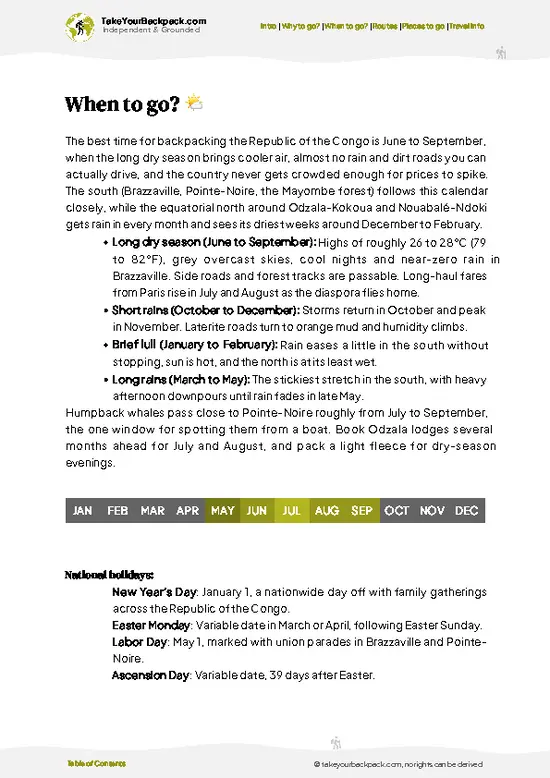
The dry months of December to February give the easiest access to Lac Télé, with the short dry spell of June to August as a second option.
  • Main Dry Season (December to February): Rain drops to a few days a month, forest trails firm up and river channels run clear. Days reach 29 to 32°C (84 to 90°F), nights sit near 21°C (70°F). Expect the highest guide and transport demand and the firmest prices.
  • Short Dry Season (June to August): Cloudier and a touch cooler at 26 to 30°C (79 to 86°F), with little rain. Swamp water is lower, so canoe routes are easier to paddle. Fewer visitors than in winter.
  • Wet Seasons (March to May, September to November): Heavy downpours, 24 to 30°C (75 to 86°F), flooded paths and muddy tracks that can stall vehicles for days. Prices soften but trips often get delayed or
… read more 👉
The dry months of December to February give the easiest access to Lac Télé, with the short dry spell of June to August as a second option.
  • Main Dry Season (December to February): Rain drops to a few days a month, forest trails firm up and river channels run clear. Days reach 29 to 32°C (84 to 90°F), nights sit near 21°C (70°F). Expect the highest guide and transport demand and the firmest prices.
  • Short Dry Season (June to August): Cloudier and a touch cooler at 26 to 30°C (79 to 86°F), with little rain. Swamp water is lower, so canoe routes are easier to paddle. Fewer visitors than in winter.
  • Wet Seasons (March to May, September to November): Heavy downpours, 24 to 30°C (75 to 86°F), flooded paths and muddy tracks that can stall vehicles for days. Prices soften but trips often get delayed or cancelled.
  • Daylight: Close to 12 hours all year, so plan treks to finish by late afternoon.
Book your guide a few weeks ahead for December and January, when the few permits and boat seats go quickly.


source: climatestotravel.comJANJanuary: fair for travelingFEBFebruary: fair for travelingMARMarch: fair for travelingAPRApril: fair for travelingMAYMay: fair for travelingJUNJune: highly recommended for travelingJULJuly: highly recommended for travelingAUGAugust: excellent for travelingSEPSeptember: excellent for travelingOCTOctober: fair for travelingNOVNovember: fair for travelingDECDecember: fair for traveling
when-to-go

✈️ The backpacker research shortcutCongo Travel Guide

An offline-friendly backpacking guide with optimized travel routes, ranked highlights, transport advice, and the best areas to stay.
example page 0 from our offline Travel Guide for Republic of the Congo
example page 1 from our offline Travel Guide for Republic of the Congo
example page 2 from our offline Travel Guide for Republic of the Congo
example page 3 from our offline Travel Guide for Republic of the Congo
example page 4 from our offline Travel Guide for Republic of the Congo
example page 5 from our offline Travel Guide for Republic of the Congo
example page 6 from our offline Travel Guide for Republic of the Congo
example page 7 from our offline Travel Guide for Republic of the Congo
The digital guide (205 pages) contains:
✅ 46 highlights, ranked by travel appeal
✅ Optimized 5, 10 & 15-day travel routes
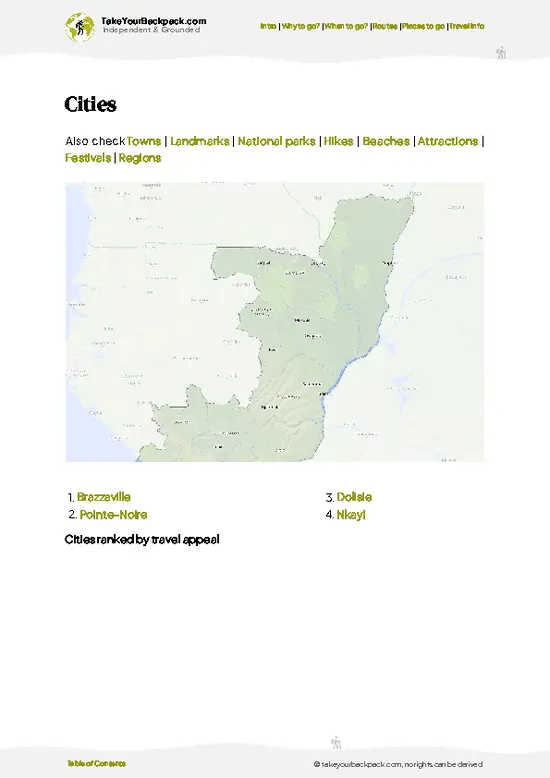
✅ Cities, national parks, landmarks, beaches
✅ How to get around
✅ Offline-friendly for travel without Wi-Fi
👉 Click to see all 30+ guide features

📅 Plan smarter in minutes, not weeks
✅ Month by month travel advice
✅ Festivals & national holidays
✅ Budget expectations

🗺️ Go to the right places, skip the overrated ones
✅ Honest pros & cons of destinations
✅ Top hikes, parks & viewpoints
✅ Lesser-known places most travelers miss
✅ Clear “worth it vs skip it” guidance

🛏️ Travel smoothly without rookie mistakes
✅ Best areas to stay
✅ Transport systems explained simply
✅ Common scams & safety advice
✅ SIM cards, money & practical tips

🌍 Understand the country, not just visit it
✅ Culture & traditions
✅ 52 Essential phrases & customs
✅ Festivals worth planning around
✅ Traveler-friendly historical context
✅ Insights that make places more meaningful

📱 Built for real travel conditions
✅ Fully downloadable PDF
✅ Works completely offline
✅ Optimized for phone use
✅ Useful in remote areas & buses
✅ Everything in one place
Stop searching, start planning
Get instant access to your full guide. 30‑day money-back guarantee.
+ Add another guide for just

By proceeding you agree to our terms.
Sent to your inbox immediately after payment • 100% Secure Checkout
Best Backpacking Travel Advisor 2025 tourism awardBest Backpacking
Travel Advisor
2025
What others say about Take Your Backpack Guides:
⭐⭐⭐⭐⭐
Fantastic, amazing amount of information!
⭐⭐⭐⭐⭐
My goodness this is amazing, it's what I've been looking for hats off too you!
⭐⭐⭐⭐⭐
I think this is absolutely BRILLIANT
⭐⭐⭐⭐
Very complete and informative. It's still missing places, but I gotta to commend you
⭐⭐⭐⭐⭐
This is truly amazing, thank you, can't wait to explore it with my kids!
⭐⭐⭐⭐⭐
Awesome resource, thank you!
⭐⭐⭐⭐⭐
This is amazing! Can't wait to explore the ones I haven't seen
⭐⭐⭐⭐
I love this! Well done, great idea.
⭐⭐⭐⭐⭐
Thanks for taking the time to make this gem!
⭐⭐⭐⭐⭐
This might be the best website I've ever seen.
⭐⭐⭐⭐⭐
Congratulations, and thank you so much for your work; it's incredibly valuable.
⭐⭐⭐⭐
In all seriousness I think you did a great job pointing out the important spots
⭐⭐⭐⭐⭐
10/10 very good
⭐⭐⭐⭐⭐
As someone who's only just starting to visit regularly this is awesome, thank you.
⭐⭐⭐⭐
Thank you very much! I'm going to visit my dad, it's going to be very useful!
⭐⭐⭐⭐⭐
This is really cool! We'll be travelling for the first time and this definitely come in handy.
⭐⭐⭐⭐⭐
You are now our minister of culture, congratulations 👨‍💼
⭐⭐⭐⭐⭐
Just wanted to tell you that this is a pearl! Going to follow your recommendations.
⭐⭐⭐⭐⭐
This is so cool. I'll definitely be using the resource for my travels soon.
⭐⭐⭐⭐⭐
This is very impressive! Good work.
⭐⭐⭐⭐⭐
This is an amazing and informative site. Very well done!

🛏️ Where to stay?Best areas to stay in Congo

Impfondo is the practical base for Lac Télé, because it has the nearest real town services, a river port and the operators who organize trips into the swamp forest.
Impfondo, on the Ubangi River in the Likouala region, is where you arrange guides, stock up on food, water and cash, and find transport onward. Budget lodging here is basic: simple guesthouses with fans, shared bathrooms and little in the way of backpacker social life. You will meet fellow travelers mainly through the small number of researchers, conservation staff and the occasional independent traveler passing through, so do not expect … read more 👉
Impfondo is the practical base for Lac Télé, because it has the nearest real town services, a river port and the operators who organize trips into the swamp forest.
Impfondo, on the Ubangi River in the Likouala region, is where you arrange guides, stock up on food, water and cash, and find transport onward. Budget lodging here is basic: simple guesthouses with fans, shared bathrooms and little in the way of backpacker social life. You will meet fellow travelers mainly through the small number of researchers, conservation staff and the occasional independent traveler passing through, so do not expect a hostel scene.
Closer to the lake, the village of Epena and the villages along the Likouala-aux-Herbes River offer the most authentic option. Accommodation there is typically a village homestay or a basic camp, and it comes with local company, fish and cassava meals, and early starts into the forest. Safety is mostly about logistics rather than crime: travel with an approved guide, carry malaria prophylaxis and bring your own bedding, a mosquito net and a water filter.
Arrive in Impfondo a day early to sort permits and supplies, then move to the lake side for the trek.

👛 Costs (as of 22 October 2026)How expensive it really is

Expect to spend about €95 a day at Lac Télé, because almost everything runs through a guide and the remote logistics keep prices high.
CategoryBudget RangeLocal Reality
Accommodation (high season)€10 to 25Basic guesthouse in Impfondo or a village homestay or camp near the lake. Low season is closer to €8 to 20.
Food€6 to 12Fish, cassava, rice and plantain at village or town eateries. Bring snacks from Impfondo.
Guide and local fees€25 to 40A guide is practically required. Travelers pay in Central African francs, and prices are negotiated per trip.
Transport€15 to 30Shared vehicles and dugout canoes or motorized boats between Impfondo, Epena and the lake. Fuel makes up most of the cost.
Permits and park fees€5 to 10Local conservation and community fees, usually organized through your guide.
Supplies
… read more 👉
Expect to spend about €95 a day at Lac Télé, because almost everything runs through a guide and the remote logistics keep prices high.
CategoryBudget RangeLocal Reality
Accommodation (high season)€10 to 25Basic guesthouse in Impfondo or a village homestay or camp near the lake. Low season is closer to €8 to 20.
Food€6 to 12Fish, cassava, rice and plantain at village or town eateries. Bring snacks from Impfondo.
Guide and local fees€25 to 40A guide is practically required. Travelers pay in Central African francs, and prices are negotiated per trip.
Transport€15 to 30Shared vehicles and dugout canoes or motorized boats between Impfondo, Epena and the lake. Fuel makes up most of the cost.
Permits and park fees€5 to 10Local conservation and community fees, usually organized through your guide.
Supplies and extras€2 to 5Water purification, insect repellent and phone credit. Cash is essential, as cards are not accepted.
Total Daily Budget€95Budget travelers can trim a little by sharing guides and boats with others.
⚠️ Prices can change and everyone travels differently, so take this as a rough guide. Hope it helps you plan your adventure!

FAQTraveler FAQ

Lac Télé is a remote lake in the swamp forests of the Likouala region in the north of the Republic of the Congo, surrounded by the Lac Télé Community Reserve. The area protects western lowland gorillas, forest elephants and a rich bird population, and local legend tells of a creature called Mokele-mbembe. Most visitors reach it through the town of Impfondo and the village of Epena.
Plan on at least 5 to 7 days for Lac Télé, counting travel from Impfondo. Reaching the lake involves river travel and a trek through flooded forest, which typically takes 1 to 2 days each way. Add a day for permits and supplies in Impfondo, and allow a buffer for delays in the wet seasons.
To reach Lac Télé, fly or travel overland to Impfondo, the main town in the Likouala region, often via Brazzaville and Ouesso or by long river routes on the Ubangi. From Impfondo you continue by road and boat to Epena, then by dugout canoe and on foot into the swamp forest with a guide. Expect two to four days of travel in total, and carry cash since there are no card facilities along the way.
⚠️ Things can change over time, so always validate details locally before you go.

Where to go next

Lac Télé isn’t the only highlight in Congo. Explore all what Congo has to offer.
Country photo of Congo

We 💚 feedbackWhat to keep in mind

Lac Télé rewards people who pay attention to the guides, because the trackers read gorilla nests, broken stems and mud prints that you would walk past. I would spend the first morning learning those signs rather than chasing the legendary creature. Bring waterproof bags for everything and a headlamp, since the forest goes dark quickly.

✍️ Help improve this page!
The information on this page is based on in-depth research, insights shared by experienced travelers, and feedback from the local travel community in Congo. While every effort is made to keep the information accurate and current, conditions can change — so if you spot anything incorrect or outdated, please get in touch.


🙋‍♂️ Give feedback

👋 Meet the founderWho’s Behind Take Your Backpack?

Johan, backpacker and founder of TakeYourBackpackHi, I’m Johan (Netherlands 🇳🇱), the creator of TakeYourBackpack. Over the past 3 decades, I’ve backpacked through 90+ countries across six continents, gaining extensive experience with independent travel, long-term trips, and overland routes.

This site is built on a combination of firsthand travel experience and carefully curated insights from other backpackers. Many guides are based on places I’ve personally visited, while others bring together tips, observations, and practical advice shared by trusted travelers I’ve met along the way.

The goal is to provide realistic, experience-driven guidance — not generic itineraries — so you can explore destinations with better context, clearer expectations, and more confidence.