×

Republic of the Congo🇨🇬 | best landmarksThe 2 Top landmarks in Congo

Landmarks in Congo (the Republic of the Congo, also known as Congo-Brazzaville) are rarely ticketed monuments with turnstiles. They are colonial-era buildings in Brazzaville, river viewpoints where the brown water churns over rapids, and forest and coast sites reached by long, dusty tracks. The capital offers the easiest access and the most traffic noise, humidity and street food smoke. Pointe-Noire adds salt wind and Atlantic haze. The north is quieter, slower and costlier, with few crowds because few visitors reach it. For independent travel, expect little signage, cash-only entry and plenty of waiting.

By Johan Kruseman 🇳🇱 | Updated October 23, 2026
Explore the best national parks in Congo

Why go?Why These unique site Stand Out

Congo suits travelers who want landmarks without crowds, and it punishes those who expect polish. The country sits on the equator, with the Congo River forming its southern border with the Democratic Republic of the Congo and dense rainforest covering much of the north. That geography shapes everything: sites cluster along the river and the rail and road corridor between Brazzaville and the coast, while the interior is reached by rough tracks that turn to red mud after rain.

History adds layers. French colonial rule, a Central African trading past, the Kongo kingdom's legacy and a Marxist-Leninist era all left marks, so the built landmarks range from mission churches and old administrative buildings to Soviet-influenced monuments, and you can read the eras in the concrete, the paint and the … read more 👉
Congo suits travelers who want landmarks without crowds, and it punishes those who expect polish. The country sits on the equator, with the Congo River forming its southern border with the Democratic Republic of the Congo and dense rainforest covering much of the north. That geography shapes everything: sites cluster along the river and the rail and road corridor between Brazzaville and the coast, while the interior is reached by rough tracks that turn to red mud after rain.

History adds layers. French colonial rule, a Central African trading past, the Kongo kingdom's legacy and a Marxist-Leninist era all left marks, so the built landmarks range from mission churches and old administrative buildings to Soviet-influenced monuments, and you can read the eras in the concrete, the paint and the peeling stucco.

Before choosing Congo, know that infrastructure is thin. Few sites have posted hours, printed maps or English-speaking staff, and French is the working language, with Lingala and Kikongo spoken widely. Photo permits are sometimes requested near government buildings, and a letter or a local contact helps a great deal. Costs run higher than in neighboring countries because fuel, food and lodging are imported or hard to move. Expect heat, humid air that fogs a camera lens, and the constant sound of generators. Patience is the entry fee.
Evaluating the Top Choices
The list of best unique sites in Congo is created based on history or culture, wow factor, atmosphere, quirks, and memorability. If you feel a unique site is missing in this list, please let us know.

When to go?Optimal Periods for Travel

Best Months: The best months for landmarks in Congo are June to August, the main dry season, when rain largely stops, skies turn hazy gray-white and roads stay passable. Daytime temperatures sit around 24 to 30°C in Brazzaville, with humidity easing and nights cooler, near 18 to 20°C. Dust hangs in the air, but you can walk between sites without being soaked.
Shoulder and Wet Seasons: December to February brings a shorter, lighter dry spell and is a workable second choice. March to May and October to November are the wettest stretches, with Brazzaville receiving roughly 1,300 to 1,500 mm a year, mostly in these months. Storms arrive in the afternoon with a hot, mineral smell before the first drops, and unpaved tracks to rural sites can become impassable for days.
Regional Differences: Pointe-Noire … read more 👉
Best Months: The best months for landmarks in Congo are June to August, the main dry season, when rain largely stops, skies turn hazy gray-white and roads stay passable. Daytime temperatures sit around 24 to 30°C in Brazzaville, with humidity easing and nights cooler, near 18 to 20°C. Dust hangs in the air, but you can walk between sites without being soaked.
Shoulder and Wet Seasons: December to February brings a shorter, lighter dry spell and is a workable second choice. March to May and October to November are the wettest stretches, with Brazzaville receiving roughly 1,300 to 1,500 mm a year, mostly in these months. Storms arrive in the afternoon with a hot, mineral smell before the first drops, and unpaved tracks to rural sites can become impassable for days.
Regional Differences: Pointe-Noire and the coast are slightly cooler and breezier in the dry season, with overcast mornings that burn off by midday. The northern forest, around Ouesso and the Sangha, stays humid all year, and its rains are less sharply seasonal, though roads and river access are best from December to February and June to August.
Crowds and Prices: Crowds are not a factor at most sites. Prices for rooms and transport rise modestly in the dry season, when business and oil-industry travel peaks in Brazzaville and Pointe-Noire, so book ahead there. Public holidays, including Independence Day on August 15, can close government-run buildings.

unique site hoppingOptimizing Your Multi-Stop Itinerary

How Many Days: A trip combining several landmarks in Congo needs 7 to 12 days, because distances are long and transport is slow. Two regions group well: Brazzaville with its surrounding Pool area, and Pointe-Noire with the Kouilou coast. The northern forest is a separate commitment and needs its own week.
Direction and Transport: Start in Brazzaville and finish on the coast. The capital is the easier place to adjust, change money and sort permits, and the coast is a calmer place to end. The two cities are linked by the Route Nationale 1 and the Congo-Océan railway, and the ride takes roughly 8 to 12 hours by road or a long day by train, depending on conditions. Domestic flights take about an hour and cost more, but save a day. Reaching the north means a flight to Ouesso or a multi-day river … read more 👉
How Many Days: A trip combining several landmarks in Congo needs 7 to 12 days, because distances are long and transport is slow. Two regions group well: Brazzaville with its surrounding Pool area, and Pointe-Noire with the Kouilou coast. The northern forest is a separate commitment and needs its own week.
Direction and Transport: Start in Brazzaville and finish on the coast. The capital is the easier place to adjust, change money and sort permits, and the coast is a calmer place to end. The two cities are linked by the Route Nationale 1 and the Congo-Océan railway, and the ride takes roughly 8 to 12 hours by road or a long day by train, depending on conditions. Domestic flights take about an hour and cost more, but save a day. Reaching the north means a flight to Ouesso or a multi-day river and road combination.
Time Per Stop: Allow a half day for a city site, a full day for anything past the urban edge, and two days when a track is involved, since delays are normal. Moves between regions should have a buffer day on either side.
Common Planning Mistakes: The biggest error is packing too much into each day, assuming that sites close on the map are close by road. A 60 km track can take four hours in the wet season. Another is skipping paperwork: carry copies of your passport and visa, and arrange any photo or access permissions in advance. Travel in daylight, because dusk comes at about 6 p.m. year-round and roads are unlit.

The ListTop landmarks of Congo

1 Chutes de Loufoulakari

Wide sandstone lip, tea-brown cascade, savanna plateau, riverside picnics

Walk to the polished rim of a broad sandstone shelf, then drop to the spray-misted pools below for a view across the full width.

2 Lac Télé

Mokele-mbembe legend, pirogue paddling, swamp forest, gorilla country

Paddle a dugout across a shallow round lake ringed by flooded forest, then track gorillas and elephants with local guides from a village base.

Loading the map 🌍

Expert viewWhat You Should Know

How Many to Visit: Aim for 4 to 6 landmarks in total. That is enough to cover two regions without spending most of your trip in the back of a shared taxi or on a bumpy, dusty track, and it leaves a buffer for the delays that are a normal part of travel here. Trying to see more usually means rushing the ones you came for.
Which Kind to Prioritize: If you are short on time or money, concentrate on the built and historic sites in Brazzaville, where distances are short and you can walk or take a cheap taxi, getting the texture of the colonial and postcolonial city: warm stucco, hot pavement, the river glinting below. If you like adventure, add one or two river or coastal sites, where the payoff is open sky, wind and the sound of water. Forest sites suit travelers with a bigger budget and flexible … read more 👉
How Many to Visit: Aim for 4 to 6 landmarks in total. That is enough to cover two regions without spending most of your trip in the back of a shared taxi or on a bumpy, dusty track, and it leaves a buffer for the delays that are a normal part of travel here. Trying to see more usually means rushing the ones you came for.
Which Kind to Prioritize: If you are short on time or money, concentrate on the built and historic sites in Brazzaville, where distances are short and you can walk or take a cheap taxi, getting the texture of the colonial and postcolonial city: warm stucco, hot pavement, the river glinting below. If you like adventure, add one or two river or coastal sites, where the payoff is open sky, wind and the sound of water. Forest sites suit travelers with a bigger budget and flexible dates, since they need guides, vehicles and good weather.
What It Costs: Budget US$60 to 110 a day for a backpacker in Congo, noticeably more than in much of Africa. A basic room runs roughly US$25 to 60, meals from street stalls or small restaurants cost US$3 to 10, and local taxis cost US$2 to 6 per hop in the capital. Entry to most urban sites is free or a few dollars, usually paid in cash in Central African francs (XAF). Guides for rural or forest visits typically cost US$20 to 50 a day, and a hired vehicle with driver for a day trip US$80 to 150, shared when you can find companions. Carry plenty of small notes, since change is scarce and cards rarely work.
Safety and Cultural Considerations: Photography is the main sensitive point. Do not photograph government buildings, soldiers, bridges or the airport, and ask before pointing a camera at people. Police checkpoints are common; stay calm, carry passport copies and greet officers politely in French, which usually gets you through faster. A yellow fever certificate is required for entry. Avoid walking after dark in cities, and avoid the Pool region without current local advice, as security there has fluctuated. Dress modestly at religious sites, and expect to be asked for a small gift or fee by whoever looks after a site. Pay it, with a smile, and you will often be shown corners that most visitors never see.

✈️ The backpacker research shortcutCongo Travel Guide

An offline-friendly backpacking guide with optimized travel routes, ranked highlights, transport advice, and the best areas to stay.
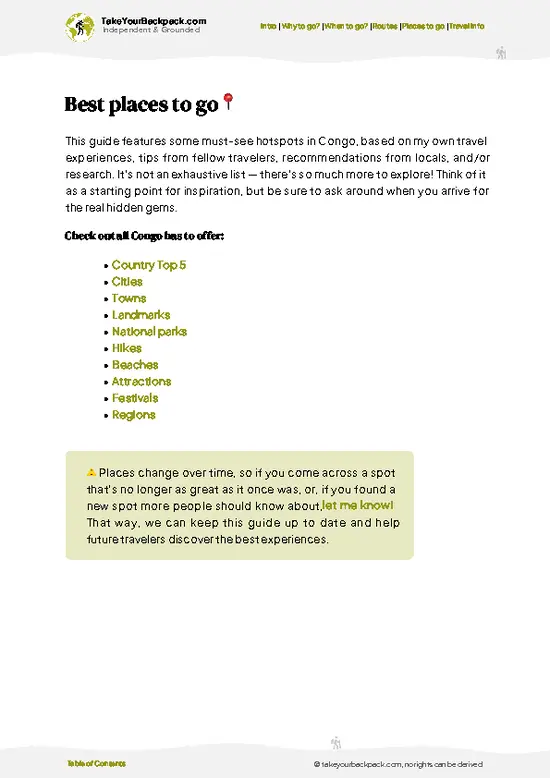
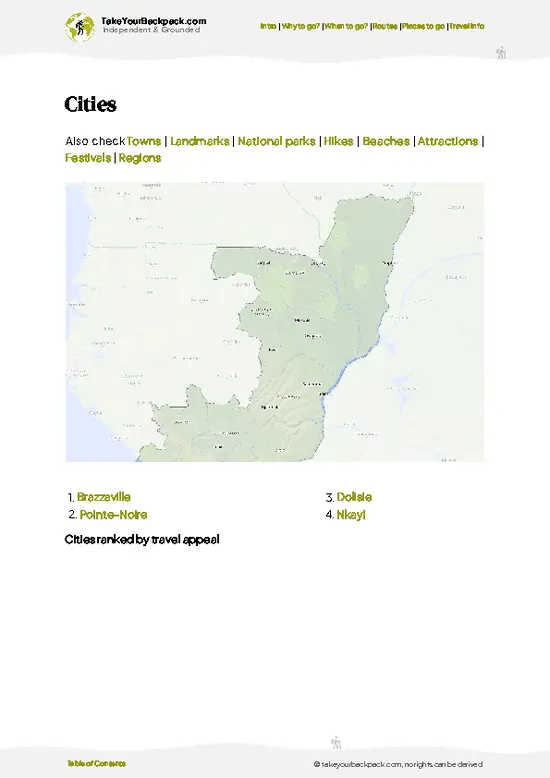
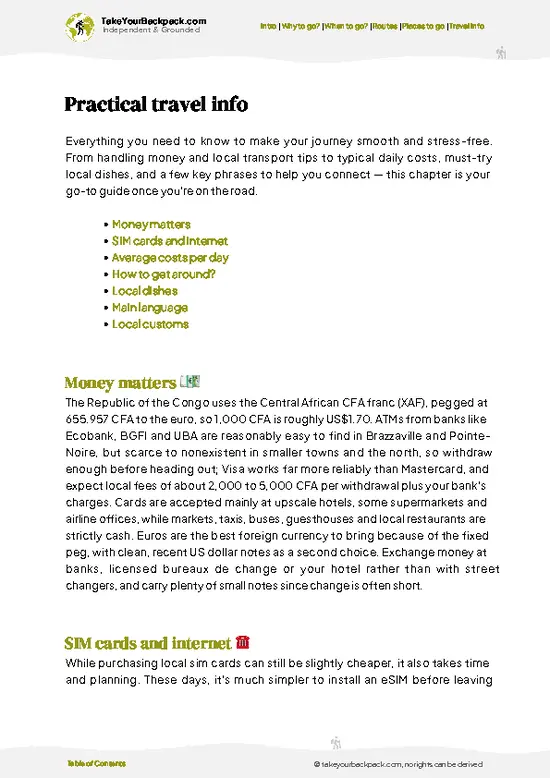
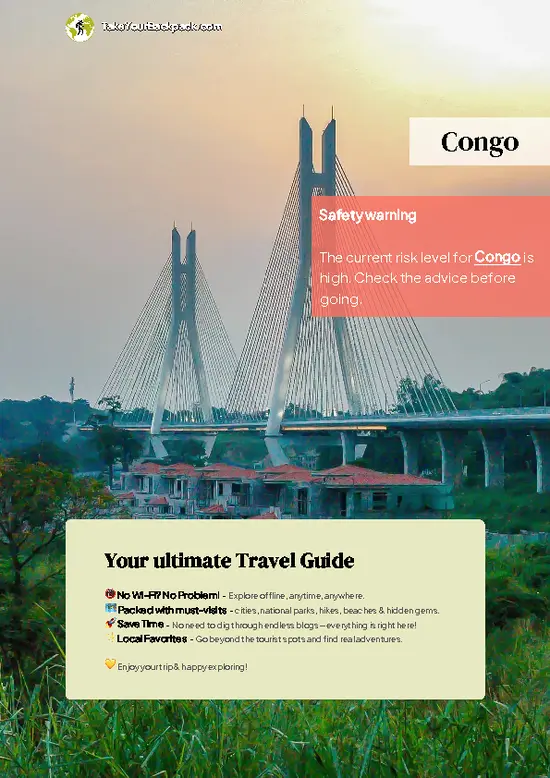
example page 0 from our offline Travel Guide for Republic of the Congo
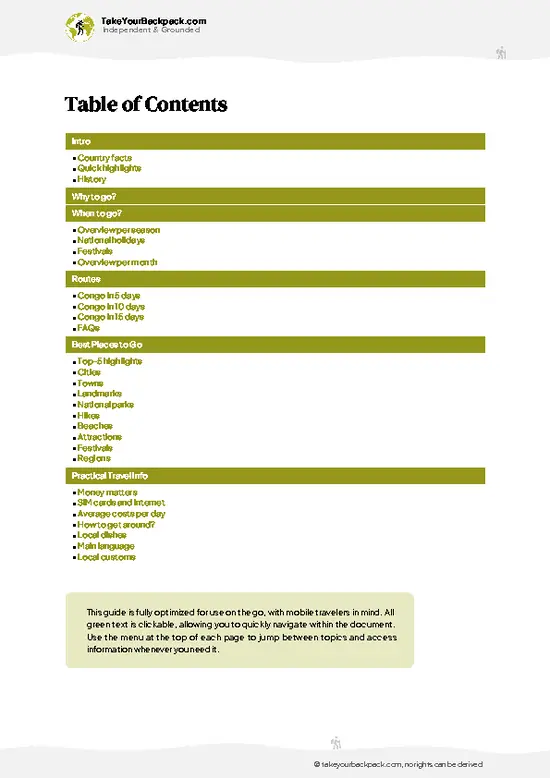
example page 1 from our offline Travel Guide for Republic of the Congo
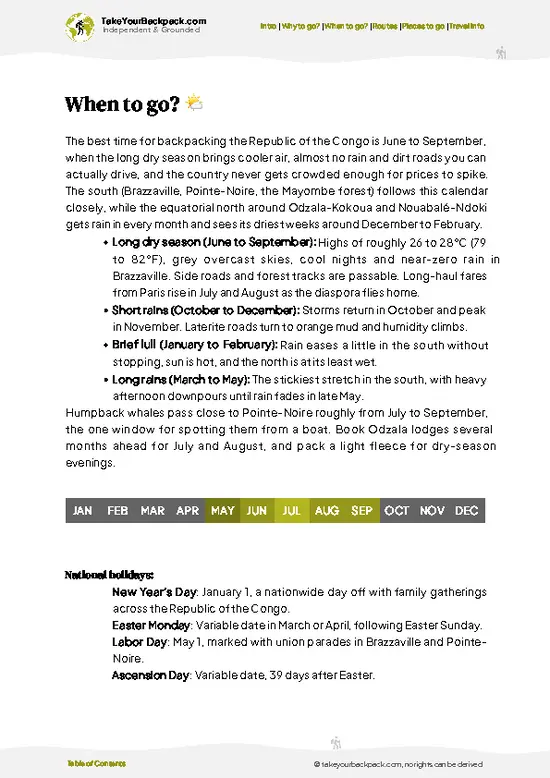
example page 2 from our offline Travel Guide for Republic of the Congo
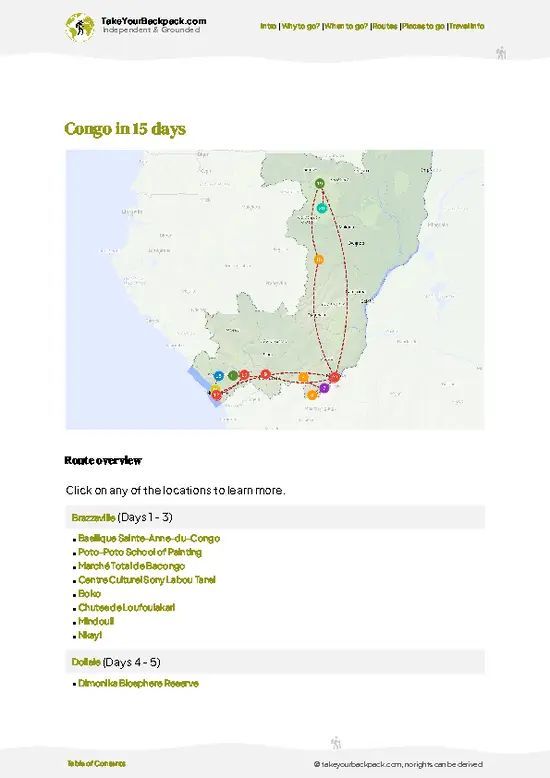
example page 3 from our offline Travel Guide for Republic of the Congo
example page 4 from our offline Travel Guide for Republic of the Congo
example page 5 from our offline Travel Guide for Republic of the Congo
example page 6 from our offline Travel Guide for Republic of the Congo
example page 7 from our offline Travel Guide for Republic of the Congo
The digital guide (205 pages) contains:
✅ 46 highlights, ranked by travel appeal
✅ Optimized 5, 10 & 15-day travel routes
✅ Cities, national parks, landmarks, beaches
✅ How to get around
✅ Offline-friendly for travel without Wi-Fi
👉 Click to see all 30+ guide features

📅 Plan smarter in minutes, not weeks
✅ Month by month travel advice
✅ Festivals & national holidays
✅ Budget expectations

🗺️ Go to the right places, skip the overrated ones
✅ Honest pros & cons of destinations
✅ Top hikes, parks & viewpoints
✅ Lesser-known places most travelers miss
✅ Clear “worth it vs skip it” guidance

🛏️ Travel smoothly without rookie mistakes
✅ Best areas to stay
✅ Transport systems explained simply
✅ Common scams & safety advice
✅ SIM cards, money & practical tips

🌍 Understand the country, not just visit it
✅ Culture & traditions
✅ 52 Essential phrases & customs
✅ Festivals worth planning around
✅ Traveler-friendly historical context
✅ Insights that make places more meaningful

📱 Built for real travel conditions
✅ Fully downloadable PDF
✅ Works completely offline
✅ Optimized for phone use
✅ Useful in remote areas & buses
✅ Everything in one place
Stop searching, start planning
Get instant access to your full guide. 30‑day money-back guarantee.
+ Add another guide for just

By proceeding you agree to our terms.
Sent to your inbox immediately after payment • 100% Secure Checkout
Best Backpacking Travel Advisor 2025 tourism awardBest Backpacking
Travel Advisor
2025
What others say about Take Your Backpack Guides:
⭐⭐⭐⭐⭐
Fantastic, amazing amount of information!
⭐⭐⭐⭐⭐
My goodness this is amazing, it's what I've been looking for hats off too you!
⭐⭐⭐⭐⭐
I think this is absolutely BRILLIANT
⭐⭐⭐⭐
Very complete and informative. It's still missing places, but I gotta to commend you
⭐⭐⭐⭐⭐
This is truly amazing, thank you, can't wait to explore it with my kids!
⭐⭐⭐⭐⭐
Awesome resource, thank you!
⭐⭐⭐⭐⭐
This is amazing! Can't wait to explore the ones I haven't seen
⭐⭐⭐⭐
I love this! Well done, great idea.
⭐⭐⭐⭐⭐
Thanks for taking the time to make this gem!
⭐⭐⭐⭐⭐
This might be the best website I've ever seen.
⭐⭐⭐⭐⭐
Congratulations, and thank you so much for your work; it's incredibly valuable.
⭐⭐⭐⭐
In all seriousness I think you did a great job pointing out the important spots
⭐⭐⭐⭐⭐
10/10 very good
⭐⭐⭐⭐⭐
As someone who's only just starting to visit regularly this is awesome, thank you.
⭐⭐⭐⭐
Thank you very much! I'm going to visit my dad, it's going to be very useful!
⭐⭐⭐⭐⭐
This is really cool! We'll be travelling for the first time and this definitely come in handy.
⭐⭐⭐⭐⭐
You are now our minister of culture, congratulations 👨‍💼
⭐⭐⭐⭐⭐
Just wanted to tell you that this is a pearl! Going to follow your recommendations.
⭐⭐⭐⭐⭐
This is so cool. I'll definitely be using the resource for my travels soon.
⭐⭐⭐⭐⭐
This is very impressive! Good work.
⭐⭐⭐⭐⭐
This is an amazing and informative site. Very well done!

🛏️ Where to stay?Best Stay Options in Congo

Backpacking the Republic of the Congo means guesthouses (“auberges”) and simple hotels rather than dorm hostels, with fan or air-con rooms typically running 15,000 to 30,000 XAF (US$25 to 50) a night. In Brazzaville, Poto-Poto has the most cheap options and puts you near markets, street food and live-music bars, at the cost of noise and pickpocket risk after dark. Centre-ville and Plateau are calmer and feel safer for walking but cost more, while Bacongo has good nightlife and cheaper rooms but quieter, poorly lit streets late at night; in Pointe-Noire, the Centre-ville near the beach and the Côte Sauvage is easiest, with cheaper rooms in Tié-Tié further from the sea.

If you enjoy meeting fellow … read more 👉
Backpacking the Republic of the Congo means guesthouses (“auberges”) and simple hotels rather than dorm hostels, with fan or air-con rooms typically running 15,000 to 30,000 XAF (US$25 to 50) a night. In Brazzaville, Poto-Poto has the most cheap options and puts you near markets, street food and live-music bars, at the cost of noise and pickpocket risk after dark. Centre-ville and Plateau are calmer and feel safer for walking but cost more, while Bacongo has good nightlife and cheaper rooms but quieter, poorly lit streets late at night; in Pointe-Noire, the Centre-ville near the beach and the Côte Sauvage is easiest, with cheaper rooms in Tié-Tié further from the sea.

If you enjoy meeting fellow travelers, consider choosing hostels with high ratings for atmosphere. On the other hand, if you prefer having your own space, a hotel might be a better option.

CongoWhere to Go Next

👋 Meet the founderWho’s Behind Take Your Backpack?

Johan, backpacker and founder of TakeYourBackpackHi, I’m Johan (Netherlands 🇳🇱), the creator of TakeYourBackpack. Over the past 3 decades, I’ve backpacked through 90+ countries across six continents, gaining extensive experience with independent travel, long-term trips, and overland routes.

This site is built on a combination of firsthand travel experience and carefully curated insights from other backpackers. Many guides are based on places I’ve personally visited, while others bring together tips, observations, and practical advice shared by trusted travelers I’ve met along the way.

The goal is to provide realistic, experience-driven guidance — not generic itineraries — so you can explore destinations with better context, clearer expectations, and more confidence.