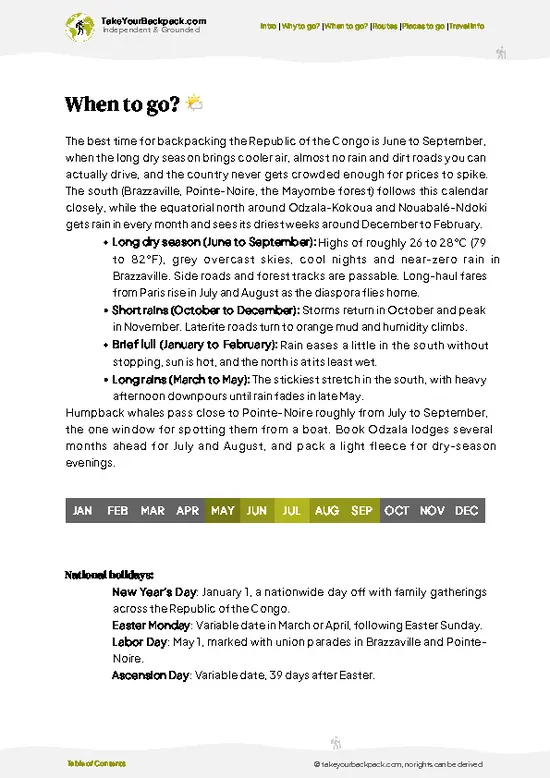
v2.webp)
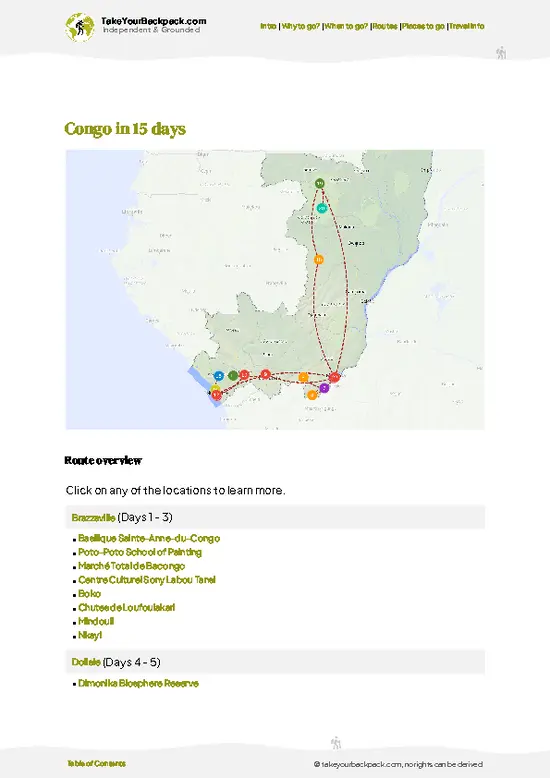
- Grand Marché: The central market is the city’s noisiest classroom, with stacked wax-print cloth, smoked fish, manioc leaves, spices and secondhand electronics under tin roofs. Go in the morning before the heat peaks. Entry is free, and you need 1 to 2 hours. Keep valuables zipped away.
- Cathédrale du Sacré-Cœur: The main Catholic church anchors the downtown skyline and is worth a look for its brick and concrete bulk and the Sunday congregations singing in Lingala and Kituba. Visit on a Sunday morning for the music, or in the early evening for calm. Free, about 30 minutes. Dress modestly.
- Gare CFCO (railway station): The station marks the end of the Congo-Océan line, built in the 1920s and 1930s at a terrible cost in forced-labor lives. Even if no train is boarding, the colonial-era platform and
- Grand Marché: The central market is the city’s noisiest classroom, with stacked wax-print cloth, smoked fish, manioc leaves, spices and secondhand electronics under tin roofs. Go in the morning before the heat peaks. Entry is free, and you need 1 to 2 hours. Keep valuables zipped away.
- Cathédrale du Sacré-Cœur: The main Catholic church anchors the downtown skyline and is worth a look for its brick and concrete bulk and the Sunday congregations singing in Lingala and Kituba. Visit on a Sunday morning for the music, or in the early evening for calm. Free, about 30 minutes. Dress modestly.
- Gare CFCO (railway station): The station marks the end of the Congo-Océan line, built in the 1920s and 1930s at a terrible cost in forced-labor lives. Even if no train is boarding, the colonial-era platform and yards tell the story of why the city exists. Late afternoon is quieter. Free to look from outside, 30 to 45 minutes. Ask before photographing.
- Côte Sauvage: The coastal road and its sandy stretches give you Atlantic rollers, fishing pirogues and beach shacks grilling fish. Currents are strong, so wade rather than swim. Best on a weekday morning or late afternoon. Expect €2 to 6 for a meal and drink, and 2 to 3 hours.
- Tié-Tié fish market and landing: Off the standard route, this working district is where boats unload and women smoke and sell the catch. Go early, when the beach is crowded with baskets and haggling. Entry is free and 1 hour is enough. Take a local with you or hire a taxi that waits.
- Institut français du Congo (Pointe-Noire): The cultural center hosts concerts, exhibitions and film nights, and it is the easiest place to meet local musicians and artists. Check the program in the evening. Events run roughly €2 to 8, and a visit takes 1 to 2 hours.
Spotted a mistake or missing something? Contact us.

 Best Backpacking
.jpg) Hi, I’m Johan (Netherlands 🇳🇱), the creator of TakeYourBackpack. Over the past 3 decades, I’ve backpacked through 90+ countries across six continents, gaining extensive experience with independent travel, long-term trips, and overland routes.
Hi, I’m Johan (Netherlands 🇳🇱), the creator of TakeYourBackpack. Over the past 3 decades, I’ve backpacked through 90+ countries across six continents, gaining extensive experience with independent travel, long-term trips, and overland routes.