×

Republic of the Congo🇨🇬 | best citiesThe 4 Top cities in Congo

Congo (the Republic of the Congo, also known as Congo-Brazzaville) has few cities, and they sit far apart. Brazzaville and Pointe-Noire hold most of the urban population, joined by a handful of smaller towns along the coast and the forest belt. The air is thick with diesel, woodsmoke and grilled fish, and mototaxis and minibuses fill the streets from dawn. Costs run high for Central Africa: a basic room often runs 25,000 to 50,000 CFA francs (about US$40 to 80). Roads and distances are hard. Independent travel here means patience, cash in hand and visa paperwork, but you will rarely share a street with another tourist.

By Johan Kruseman 🇳🇱 | Updated October 23, 2026
Explore the best towns in Congo

Why go?Why These city Stand Out

Congo’s cities exist because of water and trade. The Congo River forms the northern and eastern frontier, and the Atlantic coast gives the country its one deep-water port. The urban map follows that geography: a river capital, a coastal oil center, and a scatter of towns strung along a rail line and forest roads. Between them lie hundreds of kilometers of rainforest and savanna, so the cities feel like islands rather than a connected network.

The French colonial legacy still shapes daily life. French is the working language, with Lingala and Kituba heard in every market, and the evenings smell of charcoal, palm oil and fried plantain at open-air maquis restaurants. Live rumba and soukous spill from bars after dark, a musical tradition shared with neighboring Kinshasa.

Travelers should know … read more 👉
Congo’s cities exist because of water and trade. The Congo River forms the northern and eastern frontier, and the Atlantic coast gives the country its one deep-water port. The urban map follows that geography: a river capital, a coastal oil center, and a scatter of towns strung along a rail line and forest roads. Between them lie hundreds of kilometers of rainforest and savanna, so the cities feel like islands rather than a connected network.

The French colonial legacy still shapes daily life. French is the working language, with Lingala and Kituba heard in every market, and the evenings smell of charcoal, palm oil and fried plantain at open-air maquis restaurants. Live rumba and soukous spill from bars after dark, a musical tradition shared with neighboring Kinshasa.

Travelers should know the infrastructure is uneven. Power cuts happen, ATMs often run dry, and card payment is rare outside a few hotels, so bring euros to exchange. Prices are inflated by oil-economy wages and imported goods. A visa is required for most nationalities and should be arranged before arrival, and police checkpoints are routine, so carry a passport copy. Choose Congo for cities if you want music, food and unvarnished street life rather than polished sights.
Our Approach to Ranking
The list of best cities in Congo is created based on culture, vibe, attractions, transport ease, and local charm. If you feel a city is missing in this list, please let us know.

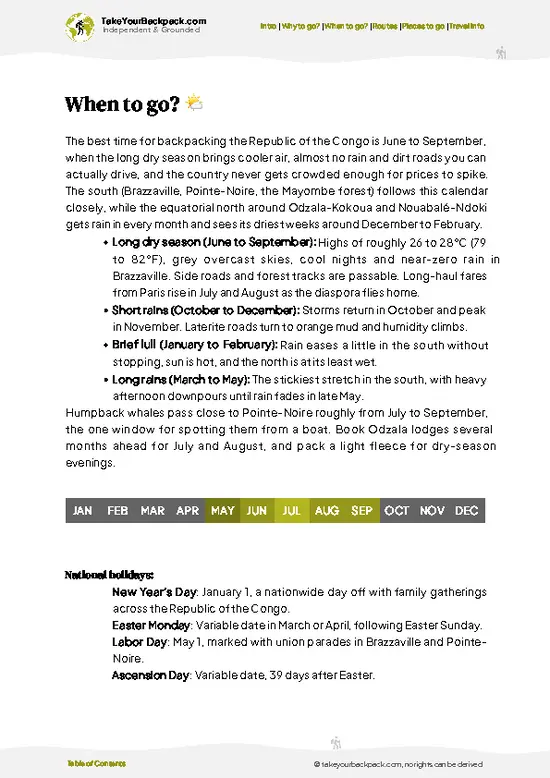
When to go?Optimal Periods for Travel

Best months for city travel: The best months are June to September, the main dry season, when rain nearly vanishes and humidity drops. Days sit around 25 to 30°C, with cooler, hazy mornings on the coast and in the south, and a pale gray sky that keeps the sun softer than you might expect. Walking streets, hopping on mototaxis and sitting at outdoor bars all become comfortable.

Shoulder and wet seasons: The shoulder months of May and October are workable but increasingly sticky. From November to April the rains come, with a short break in January and February. Downpours can turn unpaved streets into red-brown mud, flood low neighborhoods and slow traffic to a crawl. Temperatures hover around 28 to 32°C with heavy humidity, and the air smells of wet earth and rotting mango. Annual rainfall … read more 👉
Best months for city travel: The best months are June to September, the main dry season, when rain nearly vanishes and humidity drops. Days sit around 25 to 30°C, with cooler, hazy mornings on the coast and in the south, and a pale gray sky that keeps the sun softer than you might expect. Walking streets, hopping on mototaxis and sitting at outdoor bars all become comfortable.

Shoulder and wet seasons: The shoulder months of May and October are workable but increasingly sticky. From November to April the rains come, with a short break in January and February. Downpours can turn unpaved streets into red-brown mud, flood low neighborhoods and slow traffic to a crawl. Temperatures hover around 28 to 32°C with heavy humidity, and the air smells of wet earth and rotting mango. Annual rainfall in the south is roughly 1,200 to 1,500 mm, and more in the northern forest zone, where rain can fall in any month.

Prices and crowds: There is no tourist high season, so crowds do not drive prices. Rates move more with business travel and oil-sector demand than with weather. Expect hotels to cost about the same year-round, although dry-season road travel is faster and cheaper to arrange because fewer routes are cut.

city hoppingOptimizing Your Multi-Stop Itinerary

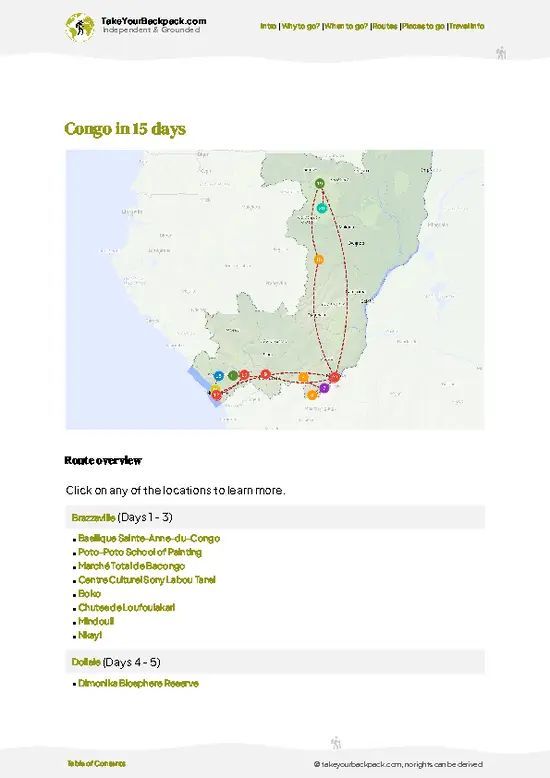
Time and direction: A trip linking several Congolese cities needs 7 to 12 days, and more if you add towns off the main axis. The country’s logic runs southwest to northeast: the Atlantic coast, the capital on the Congo River, and then the long road or river north. Most travelers start on the coast and finish at the capital, since the best-maintained link, the Route Nationale 1, runs between them.

Pacing and transfers: Allow 2 to 3 nights per stop, which is enough to handle logistics like money exchange and onward tickets. The coast to the capital is a long haul. The train service is unreliable and often suspended, so most people take a bus or shared taxi, about 8 to 12 hours depending on roadworks and checkpoints. Heading north beyond the capital means 2 to 3 days by river boat or flights, … read more 👉
Time and direction: A trip linking several Congolese cities needs 7 to 12 days, and more if you add towns off the main axis. The country’s logic runs southwest to northeast: the Atlantic coast, the capital on the Congo River, and then the long road or river north. Most travelers start on the coast and finish at the capital, since the best-maintained link, the Route Nationale 1, runs between them.

Pacing and transfers: Allow 2 to 3 nights per stop, which is enough to handle logistics like money exchange and onward tickets. The coast to the capital is a long haul. The train service is unreliable and often suspended, so most people take a bus or shared taxi, about 8 to 12 hours depending on roadworks and checkpoints. Heading north beyond the capital means 2 to 3 days by river boat or flights, and journeys can stretch with little warning.

Planning mistakes: The classic error is packing in too many stops and assuming timetables are fixed. Buses leave when full, rain can close roads, and a missed connection can cost a day. Build one buffer day for every long leg. Another mistake is arriving with only cards or too little cash; withdraw and exchange money in the larger cities before leaving them. Book long-distance trips early in the morning, when the heat is mild and the road dust has not yet thickened the air.

The ListTop cities of Congo

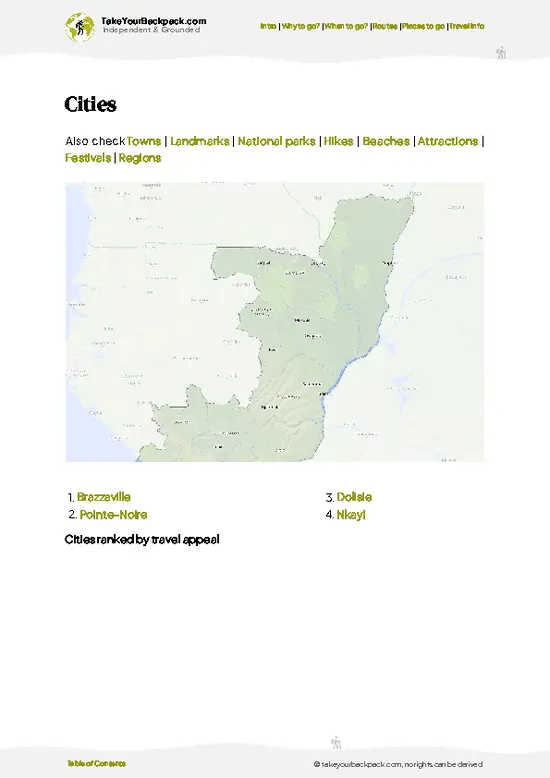
1 Brazzaville

Congo River corniche, Poto-Poto painters, rumba bars, Marché Total

Watch Kinshasa’s towers across the rapids by day, then follow live rumba through the open-air bars of Bacongo and Poto-Poto after dark.

2 Pointe-Noire

Atlantic port, Côte Sauvage, Tié-Tié landing, CFCO terminus

Watch pirogues unload at Tié-Tié at dawn, trace the Congo-Océan line to its terminus, and eat grilled fish above Atlantic breakers.

3 Dolisie

Railway junction, Niari valley, laterite dust, grilled-fish ngandas

Walk from the Congo-Ocean station platform to the crowded Grand Marché, then finish on the Niari riverbank with grilled fish and a cold beer.

4 Nkayi

Sugar cane fields, refinery town, Primus evenings, Sunday choirs

Follow moto-taxis along the cane fields at harvest, browse the central market, and spend the evening at a roadside maquis over grilled fish.

Loading the map 🌍

Expert viewWhat You Should Know

How many cities to visit: Plan on two or three cities at most. Distances are long, transport is slow, and each place deserves enough time for you to find a rhythm: a favorite street stall, a regular mototaxi driver, a bar where the band starts after 9 pm. Rushing through more means hours in cramped minibuses with little to show for it. Two bases, with a third if you have two weeks or more, give you plenty of texture.

Which kind to prioritize: If you love music, food and street life, favor the river capital, where grilled fish, cassava and live rumba carry the evenings. If you prefer sea air and a calmer pace, the Atlantic coast offers beaches, seafood and a more orderly layout, though prices are higher because of the oil industry. Smaller inland towns suit those with time and curiosity, but … read more 👉
How many cities to visit: Plan on two or three cities at most. Distances are long, transport is slow, and each place deserves enough time for you to find a rhythm: a favorite street stall, a regular mototaxi driver, a bar where the band starts after 9 pm. Rushing through more means hours in cramped minibuses with little to show for it. Two bases, with a third if you have two weeks or more, give you plenty of texture.

Which kind to prioritize: If you love music, food and street life, favor the river capital, where grilled fish, cassava and live rumba carry the evenings. If you prefer sea air and a calmer pace, the Atlantic coast offers beaches, seafood and a more orderly layout, though prices are higher because of the oil industry. Smaller inland towns suit those with time and curiosity, but they offer few services and little English, and getting there often takes a full day on rough roads.

What it costs: Budget US$60 to 110 a day (roughly 35,000 to 65,000 CFA francs) if you stay in modest hotels, eat at local restaurants and use shared taxis. A basic room runs 25,000 to 50,000 CFA francs, a plate of fish and plantain 2,500 to 5,000, and a local mototaxi ride 500 to 1,500. Intercity buses cost around 10,000 to 25,000 CFA francs a leg. Museums and cultural venues charge small entry fees, often under 5,000 CFA francs, and a local guide for a day runs 15,000 to 30,000. Carry euros in clean, recent notes, since cards rarely work and ATMs often fail.

Safety on the ground: Congolese city streets are lively but need care. Petty theft happens in crowded markets and after dark, so leave valuables at the hotel and take a taxi at night rather than walking. Police and military checkpoints are frequent; stay calm, greet politely, and have your passport copy and visa page ready. Photographing government buildings, bridges, soldiers or the river border near the capital can cause trouble, so ask first or put the camera away. Political tension flares occasionally, so check your embassy’s advice before you go.

Cultural habits that help: Greetings matter. A handshake and a “bonjour” before any request opens doors, and rushing straight to business reads as rude. Dress neatly, as Congolese people take pride in their appearance, and ask before photographing people. Tip small amounts for good service. Learning a few words of Lingala wins smiles and often a better price at the market.

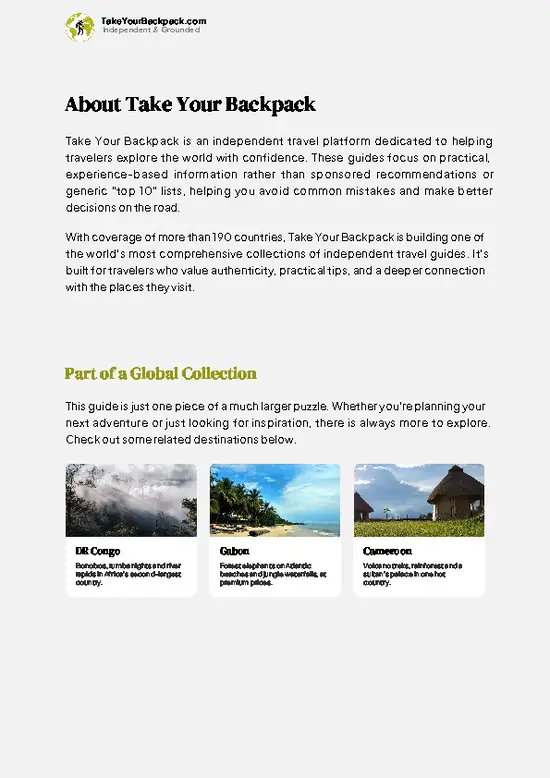
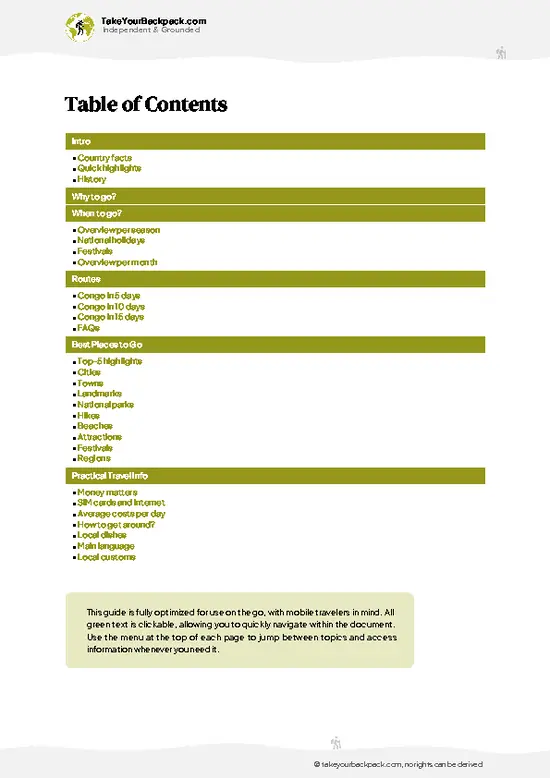
✈️ The backpacker research shortcutCongo Travel Guide

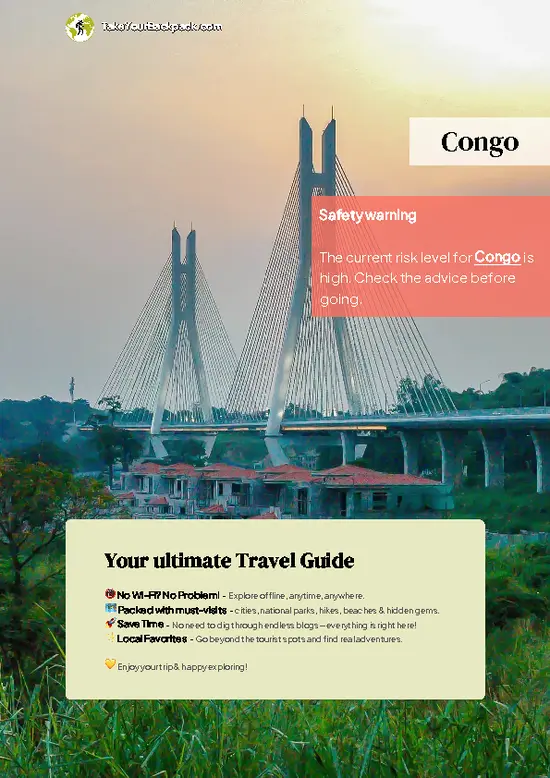
An offline-friendly backpacking guide with optimized travel routes, ranked highlights, transport advice, and the best areas to stay.
example page 0 from our offline Travel Guide for Republic of the Congo
example page 1 from our offline Travel Guide for Republic of the Congo
example page 2 from our offline Travel Guide for Republic of the Congo
example page 3 from our offline Travel Guide for Republic of the Congo
example page 4 from our offline Travel Guide for Republic of the Congo
example page 5 from our offline Travel Guide for Republic of the Congo
example page 6 from our offline Travel Guide for Republic of the Congo
example page 7 from our offline Travel Guide for Republic of the Congo
The digital guide (205 pages) contains:
✅ 46 highlights, ranked by travel appeal
✅ Optimized 5, 10 & 15-day travel routes
✅ Cities, national parks, landmarks, beaches
✅ How to get around
✅ Offline-friendly for travel without Wi-Fi
👉 Click to see all 30+ guide features

📅 Plan smarter in minutes, not weeks
✅ Month by month travel advice
✅ Festivals & national holidays
✅ Budget expectations

🗺️ Go to the right places, skip the overrated ones
✅ Honest pros & cons of destinations
✅ Top hikes, parks & viewpoints
✅ Lesser-known places most travelers miss
✅ Clear “worth it vs skip it” guidance

🛏️ Travel smoothly without rookie mistakes
✅ Best areas to stay
✅ Transport systems explained simply
✅ Common scams & safety advice
✅ SIM cards, money & practical tips

🌍 Understand the country, not just visit it
✅ Culture & traditions
✅ 52 Essential phrases & customs
✅ Festivals worth planning around
✅ Traveler-friendly historical context
✅ Insights that make places more meaningful

📱 Built for real travel conditions
✅ Fully downloadable PDF
✅ Works completely offline
✅ Optimized for phone use
✅ Useful in remote areas & buses
✅ Everything in one place
Stop searching, start planning
Get instant access to your full guide. 30‑day money-back guarantee.
+ Add another guide for just

By proceeding you agree to our terms.
Sent to your inbox immediately after payment • 100% Secure Checkout
Best Backpacking Travel Advisor 2025 tourism awardBest Backpacking
Travel Advisor
2025
What others say about Take Your Backpack Guides:
⭐⭐⭐⭐⭐
Fantastic, amazing amount of information!
⭐⭐⭐⭐⭐
My goodness this is amazing, it's what I've been looking for hats off too you!
⭐⭐⭐⭐⭐
I think this is absolutely BRILLIANT
⭐⭐⭐⭐
Very complete and informative. It's still missing places, but I gotta to commend you
⭐⭐⭐⭐⭐
This is truly amazing, thank you, can't wait to explore it with my kids!
⭐⭐⭐⭐⭐
Awesome resource, thank you!
⭐⭐⭐⭐⭐
This is amazing! Can't wait to explore the ones I haven't seen
⭐⭐⭐⭐
I love this! Well done, great idea.
⭐⭐⭐⭐⭐
Thanks for taking the time to make this gem!
⭐⭐⭐⭐⭐
This might be the best website I've ever seen.
⭐⭐⭐⭐⭐
Congratulations, and thank you so much for your work; it's incredibly valuable.
⭐⭐⭐⭐
In all seriousness I think you did a great job pointing out the important spots
⭐⭐⭐⭐⭐
10/10 very good
⭐⭐⭐⭐⭐
As someone who's only just starting to visit regularly this is awesome, thank you.
⭐⭐⭐⭐
Thank you very much! I'm going to visit my dad, it's going to be very useful!
⭐⭐⭐⭐⭐
This is really cool! We'll be travelling for the first time and this definitely come in handy.
⭐⭐⭐⭐⭐
You are now our minister of culture, congratulations 👨‍💼
⭐⭐⭐⭐⭐
Just wanted to tell you that this is a pearl! Going to follow your recommendations.
⭐⭐⭐⭐⭐
This is so cool. I'll definitely be using the resource for my travels soon.
⭐⭐⭐⭐⭐
This is very impressive! Good work.
⭐⭐⭐⭐⭐
This is an amazing and informative site. Very well done!

🛏️ Where to stay?Where to Stay in Congo

Backpacking the Republic of the Congo means guesthouses (“auberges”) and simple hotels rather than dorm hostels, with fan or air-con rooms typically running 15,000 to 30,000 XAF (US$25 to 50) a night. In Brazzaville, Poto-Poto has the most cheap options and puts you near markets, street food and live-music bars, at the cost of noise and pickpocket risk after dark. Centre-ville and Plateau are calmer and feel safer for walking but cost more, while Bacongo has good nightlife and cheaper rooms but quieter, poorly lit streets late at night; in Pointe-Noire, the Centre-ville near the beach and the Côte Sauvage is easiest, with cheaper rooms in Tié-Tié further from the sea.

If you enjoy meeting fellow … read more 👉
Backpacking the Republic of the Congo means guesthouses (“auberges”) and simple hotels rather than dorm hostels, with fan or air-con rooms typically running 15,000 to 30,000 XAF (US$25 to 50) a night. In Brazzaville, Poto-Poto has the most cheap options and puts you near markets, street food and live-music bars, at the cost of noise and pickpocket risk after dark. Centre-ville and Plateau are calmer and feel safer for walking but cost more, while Bacongo has good nightlife and cheaper rooms but quieter, poorly lit streets late at night; in Pointe-Noire, the Centre-ville near the beach and the Côte Sauvage is easiest, with cheaper rooms in Tié-Tié further from the sea.

If you enjoy meeting fellow travelers, consider choosing hostels with high ratings for atmosphere. On the other hand, if you prefer having your own space, a hotel might be a better option.

CongoMore of Congo

👋 Meet the founderWho’s Behind Take Your Backpack?

Johan, backpacker and founder of TakeYourBackpackHi, I’m Johan (Netherlands 🇳🇱), the creator of TakeYourBackpack. Over the past 3 decades, I’ve backpacked through 90+ countries across six continents, gaining extensive experience with independent travel, long-term trips, and overland routes.

This site is built on a combination of firsthand travel experience and carefully curated insights from other backpackers. Many guides are based on places I’ve personally visited, while others bring together tips, observations, and practical advice shared by trusted travelers I’ve met along the way.

The goal is to provide realistic, experience-driven guidance — not generic itineraries — so you can explore destinations with better context, clearer expectations, and more confidence.