×

Rwanda🇷🇼 | best landmarksYour Guide to the Best landmarks in Rwanda

Landmarks in Rwanda are mostly memorials, volcanic highlands and lake shores, rather than ancient ruins. The experience shifts by region: Kigali is compact, paved and easy to reach by moto or minibus, while the Northern and Western Provinces mean longer rides and higher permit-style fees. Crowds stay modest almost everywhere. For backpacking or independent travel, the south and Kigali are the cheapest and simplest to manage.

By Johan Kruseman 🇳🇱 | Updated October 23, 2026
Explore the best national parks in Rwanda

Why go?Key Factors That Shape the Experience

Rwanda is small, hilly and densely populated, which shapes what a landmark means here. Distances are short, roads are largely paved, and public minibuses reach most district towns, so access is easier than in most of East Africa. The country’s sites are tied closely to recent history and to a volcanic, forested landscape, not to centuries of monumental architecture. Travelers expecting old temples or palaces will find little; those interested in modern memory, ecology and conservation will find a lot.

Before choosing Rwanda for landmarks, know that fees vary sharply. Memorials and museums are inexpensive or free, while protected-area activities carry high, fixed government prices that are often booked ahead. Rwanda also treats its history with formal respect, so dress, photography and behavior … read more 👉
Rwanda is small, hilly and densely populated, which shapes what a landmark means here. Distances are short, roads are largely paved, and public minibuses reach most district towns, so access is easier than in most of East Africa. The country’s sites are tied closely to recent history and to a volcanic, forested landscape, not to centuries of monumental architecture. Travelers expecting old temples or palaces will find little; those interested in modern memory, ecology and conservation will find a lot.

Before choosing Rwanda for landmarks, know that fees vary sharply. Memorials and museums are inexpensive or free, while protected-area activities carry high, fixed government prices that are often booked ahead. Rwanda also treats its history with formal respect, so dress, photography and behavior rules are taken seriously. Rain affects the highlands more than the lowlands, and signage is clearer in English and French than in Kinyarwanda-only villages.
Why These Made the Cut
The list of best unique sites in Rwanda is created based on history or culture, wow factor, atmosphere, quirks, and memorability. If you feel a unique site is missing in this list, please let us know.

When to go?Timing Your Visit for the Best Experience

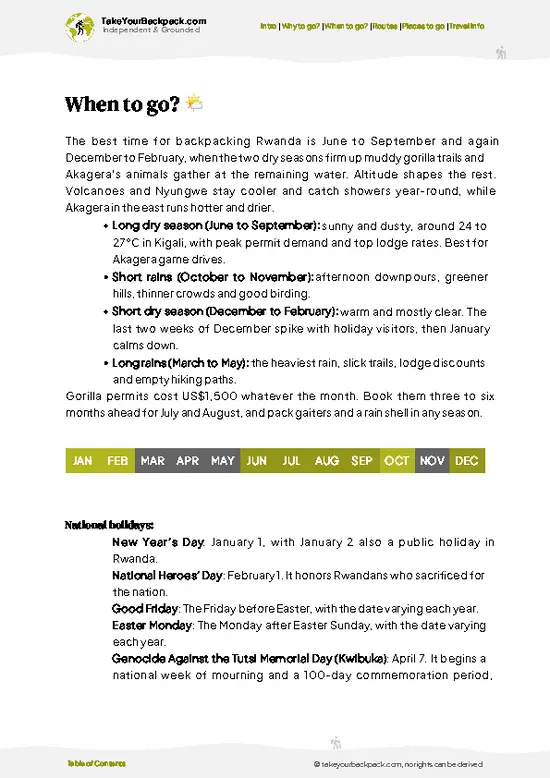
Best months and why: The best months are June to September, when the main dry season gives clearer trails, firmer roads and the best volcano and lake views. Temperatures in Kigali sit around 15 to 27°C (59 to 81°F) year-round because of the altitude, with cooler nights in the north and west, often 8 to 14°C (46 to 57°F) at higher elevations.
Shoulder seasons and rain: December to February is a shorter dry spell and also works well. The long rains from March to May bring the heaviest downpours, muddy paths and slower travel in the Northern and Western Provinces, though Kigali stays manageable. October and November have lighter, patchy rain. Annual rainfall is roughly 1,000 to 1,500 mm, higher in the northwest highlands.
Crowds and prices: July to August and the December holidays are the busiest … read more 👉
Best months and why: The best months are June to September, when the main dry season gives clearer trails, firmer roads and the best volcano and lake views. Temperatures in Kigali sit around 15 to 27°C (59 to 81°F) year-round because of the altitude, with cooler nights in the north and west, often 8 to 14°C (46 to 57°F) at higher elevations.
Shoulder seasons and rain: December to February is a shorter dry spell and also works well. The long rains from March to May bring the heaviest downpours, muddy paths and slower travel in the Northern and Western Provinces, though Kigali stays manageable. October and November have lighter, patchy rain. Annual rainfall is roughly 1,000 to 1,500 mm, higher in the northwest highlands.
Crowds and prices: July to August and the December holidays are the busiest periods, so book permits and rooms ahead. Some lodges discount 20 to 30 percent in April and May.

unique site hoppingOptimizing Your Multi-Stop Itinerary

How many days to allow: A trip combining several landmarks in Rwanda needs 7 to 10 days. The country is small, but hill roads are winding, and a 100 km journey often takes 2.5 to 3.5 hours.
Grouping and direction: Kigali works as the hub. The south (Huye and surroundings) is a half-day from the capital, about 2.5 to 3 hours by bus. The north (Musanze) is 2 to 2.5 hours away, and the west (Lake Kivu towns such as Kibuye and Rubavu) 3 to 4 hours. A sensible loop runs Kigali, south, west along the lake, north, then back to Kigali, so you avoid backtracking on the same road. Allow 1 to 2 days in Kigali and about 1 day for most single stops, with extra time where permits or early starts apply.
Common planning mistakes: Travelers underestimate hill-road times and schedule two distant stops in one … read more 👉
How many days to allow: A trip combining several landmarks in Rwanda needs 7 to 10 days. The country is small, but hill roads are winding, and a 100 km journey often takes 2.5 to 3.5 hours.
Grouping and direction: Kigali works as the hub. The south (Huye and surroundings) is a half-day from the capital, about 2.5 to 3 hours by bus. The north (Musanze) is 2 to 2.5 hours away, and the west (Lake Kivu towns such as Kibuye and Rubavu) 3 to 4 hours. A sensible loop runs Kigali, south, west along the lake, north, then back to Kigali, so you avoid backtracking on the same road. Allow 1 to 2 days in Kigali and about 1 day for most single stops, with extra time where permits or early starts apply.
Common planning mistakes: Travelers underestimate hill-road times and schedule two distant stops in one day. Instead, plan one major stop per day and travel early. Another error is booking permit-based activities last-minute, which can fail in peak months.

The ListHighly Recommended landmarks of Rwanda

1 Musanze Caves

Lava tubes, collapsed roof skylights, basalt walls, guided headlamp walk

Descend a stairway into cool basalt tunnels where daylight drops through broken ceilings, and a local guide explains how draining lava shaped the hollow and how it sheltered people in conflict.

Loading the map 🌍

Expert viewPro Tips for Exploring the Best

How many to visit: Plan on four to six landmarks in total. Rwanda’s sites are intense, especially memorials, and visiting more than one heavy site in a day tends to flatten the experience. Spacing them gives you time to absorb each, and keeps travel days from dominating.
Which kinds to prioritize: If your interest is history, put the memorials and museums first, since they are low-cost and central to understanding the country. If you like landscape and wildlife, choose one volcanic highland or lake site and treat it as the main spend. Mixed-interest travelers do best with two memorials, one natural site and one or two lighter stops. Skipping the high-priced permit activities is reasonable on a tight budget; the cheaper sites give more for the money.
What it costs: Budget backpackers can manage … read more 👉
How many to visit: Plan on four to six landmarks in total. Rwanda’s sites are intense, especially memorials, and visiting more than one heavy site in a day tends to flatten the experience. Spacing them gives you time to absorb each, and keeps travel days from dominating.
Which kinds to prioritize: If your interest is history, put the memorials and museums first, since they are low-cost and central to understanding the country. If you like landscape and wildlife, choose one volcanic highland or lake site and treat it as the main spend. Mixed-interest travelers do best with two memorials, one natural site and one or two lighter stops. Skipping the high-priced permit activities is reasonable on a tight budget; the cheaper sites give more for the money.
What it costs: Budget backpackers can manage on US$35 to 60 a day, covering a dorm or basic guesthouse, local meals, minibuses and moto rides. Memorials and museums charge roughly US$0 to 15 entry, often with an optional guide at US$10 to 25. Protected-area activities run from tens to several hundred dollars, so decide in advance whether one such permit is worth it. Local transport between towns costs about US$2 to 8 a ride. Carry Rwandan francs, since cards are not accepted everywhere outside Kigali.
Safety and conduct: Rwanda is among the safer countries in Africa, with low street crime and strict rules, such as the plastic bag ban. Dress modestly at memorials, keep your voice low, and ask before photographing; some memorial interiors prohibit photography entirely, and human remains must never be photographed. Avoid discussing ethnicity casually, because official language stresses national unity. Moto drivers must supply helmets; insist on one. Hill roads are dangerous after dark, so finish travel by late afternoon.

✈️ The backpacker research shortcutRwanda Travel Guide

An offline-friendly backpacking guide with optimized travel routes, ranked highlights, transport advice, and the best areas to stay.
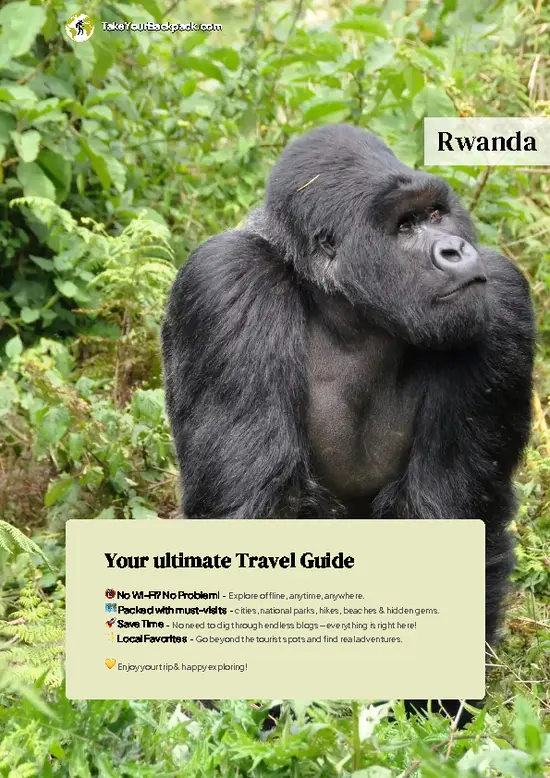
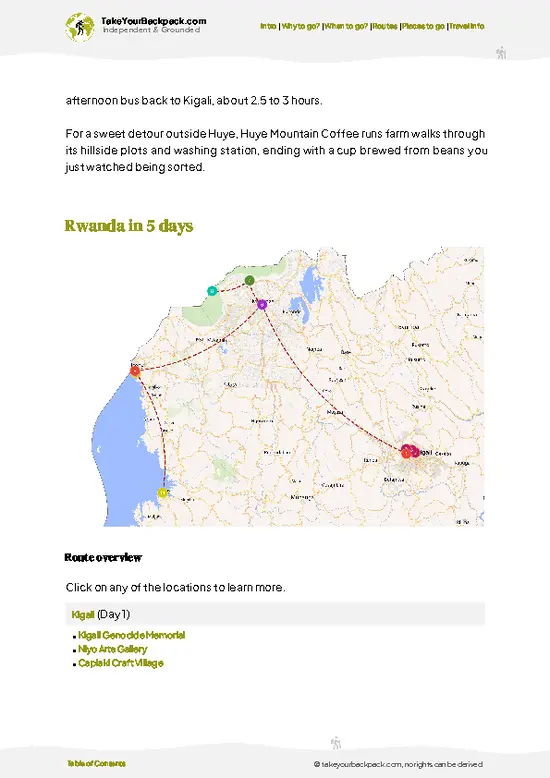
example page 0 from our offline Travel Guide for Rwanda
example page 1 from our offline Travel Guide for Rwanda
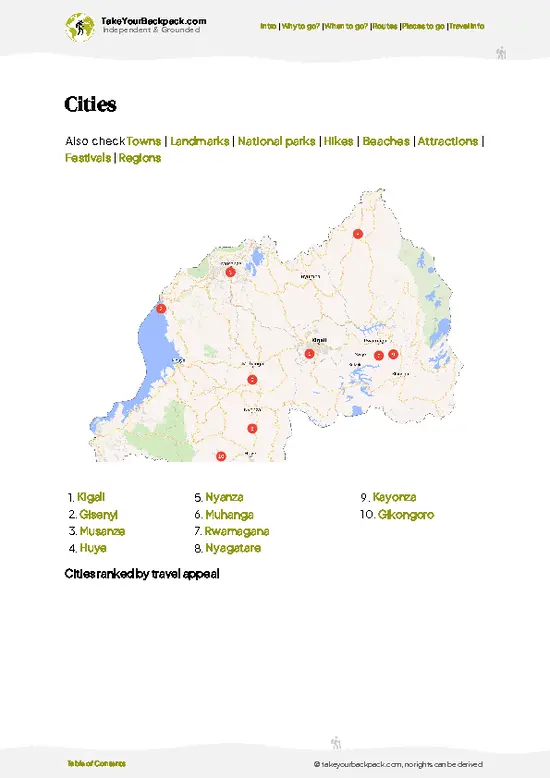
example page 2 from our offline Travel Guide for Rwanda
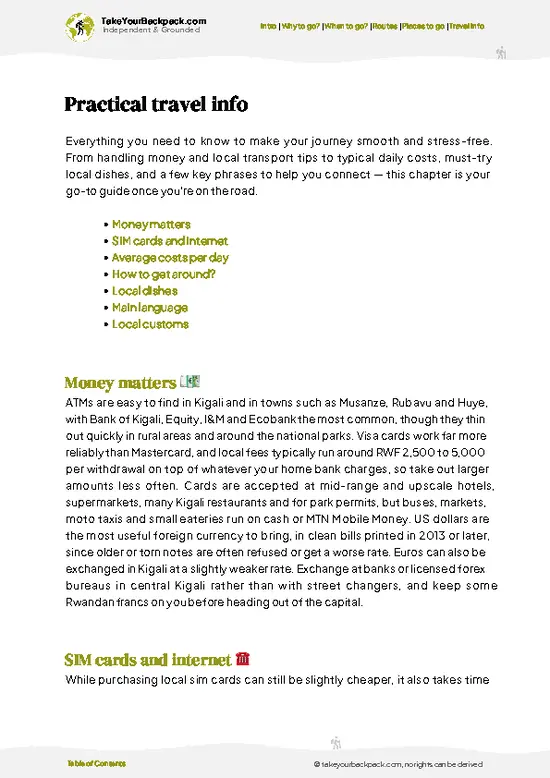
example page 3 from our offline Travel Guide for Rwanda
example page 4 from our offline Travel Guide for Rwanda
example page 5 from our offline Travel Guide for Rwanda
example page 6 from our offline Travel Guide for Rwanda
example page 7 from our offline Travel Guide for Rwanda
The digital guide (233 pages) contains:
✅ 57 highlights, ranked by travel appeal
✅ Optimized 2, 3 & 5-day travel routes
✅ Cities, national parks, landmarks, beaches
✅ How to get around
✅ Offline-friendly for travel without Wi-Fi
👉 Click to see all 30+ guide features

📅 Plan smarter in minutes, not weeks
✅ Month by month travel advice
✅ Festivals & national holidays
✅ Budget expectations

🗺️ Go to the right places, skip the overrated ones
✅ Honest pros & cons of destinations
✅ Top hikes, parks & viewpoints
✅ Lesser-known places most travelers miss
✅ Clear “worth it vs skip it” guidance

🛏️ Travel smoothly without rookie mistakes
✅ Best areas to stay
✅ Transport systems explained simply
✅ Common scams & safety advice
✅ SIM cards, money & practical tips

🌍 Understand the country, not just visit it
✅ Culture & traditions
✅ 52 Essential phrases & customs
✅ Festivals worth planning around
✅ Traveler-friendly historical context
✅ Insights that make places more meaningful

📱 Built for real travel conditions
✅ Fully downloadable PDF
✅ Works completely offline
✅ Optimized for phone use
✅ Useful in remote areas & buses
✅ Everything in one place
Stop searching, start planning
Get instant access to your full guide. 30‑day money-back guarantee.
+ Add another guide for just

By proceeding you agree to our terms.
Sent to your inbox immediately after payment • 100% Secure Checkout
Best Backpacking Travel Advisor 2025 tourism awardBest Backpacking
Travel Advisor
2025
What others say about Take Your Backpack Guides:
⭐⭐⭐⭐⭐
Fantastic, amazing amount of information!
⭐⭐⭐⭐⭐
My goodness this is amazing, it's what I've been looking for hats off too you!
⭐⭐⭐⭐⭐
I think this is absolutely BRILLIANT
⭐⭐⭐⭐
Very complete and informative. It's still missing places, but I gotta to commend you
⭐⭐⭐⭐⭐
This is truly amazing, thank you, can't wait to explore it with my kids!
⭐⭐⭐⭐⭐
Awesome resource, thank you!
⭐⭐⭐⭐⭐
This is amazing! Can't wait to explore the ones I haven't seen
⭐⭐⭐⭐
I love this! Well done, great idea.
⭐⭐⭐⭐⭐
Thanks for taking the time to make this gem!
⭐⭐⭐⭐⭐
This might be the best website I've ever seen.
⭐⭐⭐⭐⭐
Congratulations, and thank you so much for your work; it's incredibly valuable.
⭐⭐⭐⭐
In all seriousness I think you did a great job pointing out the important spots
⭐⭐⭐⭐⭐
10/10 very good
⭐⭐⭐⭐⭐
As someone who's only just starting to visit regularly this is awesome, thank you.
⭐⭐⭐⭐
Thank you very much! I'm going to visit my dad, it's going to be very useful!
⭐⭐⭐⭐⭐
This is really cool! We'll be travelling for the first time and this definitely come in handy.
⭐⭐⭐⭐⭐
You are now our minister of culture, congratulations 👨‍💼
⭐⭐⭐⭐⭐
Just wanted to tell you that this is a pearl! Going to follow your recommendations.
⭐⭐⭐⭐⭐
This is so cool. I'll definitely be using the resource for my travels soon.
⭐⭐⭐⭐⭐
This is very impressive! Good work.
⭐⭐⭐⭐⭐
This is an amazing and informative site. Very well done!

🛏️ Where to stay?Best Places to Stay in Rwanda

Rwanda has a small but growing hostel and guesthouse scene, with dorm beds from about RWF 14,000 to 28,000 (US$10 to 20) and simple private rooms from roughly RWF 28,000 to 55,000 (US$20 to 40), most of it concentrated in Kigali. In the capital, Kiyovu puts you near downtown and the main bus hubs on quiet, leafy streets. Kimihurura has the best spread of bars and restaurants but costs more, Remera is close to the airport with cheaper beds and late-night street life, and Nyamirambo offers the most local character and lowest prices, though it is louder and farther from the center, while lakeside Rubavu and Musanze (the gorilla trekking base) have a handful of budget guesthouses each.

If you enjoy … read more 👉
Rwanda has a small but growing hostel and guesthouse scene, with dorm beds from about RWF 14,000 to 28,000 (US$10 to 20) and simple private rooms from roughly RWF 28,000 to 55,000 (US$20 to 40), most of it concentrated in Kigali. In the capital, Kiyovu puts you near downtown and the main bus hubs on quiet, leafy streets. Kimihurura has the best spread of bars and restaurants but costs more, Remera is close to the airport with cheaper beds and late-night street life, and Nyamirambo offers the most local character and lowest prices, though it is louder and farther from the center, while lakeside Rubavu and Musanze (the gorilla trekking base) have a handful of budget guesthouses each.

If you enjoy meeting fellow travelers, consider choosing hostels with high ratings for atmosphere. On the other hand, if you prefer having your own space, a hotel might be a better option.

RwandaExplore Rwanda

👋 Meet the founderWho’s Behind Take Your Backpack?

Johan, backpacker and founder of TakeYourBackpackHi, I’m Johan (Netherlands 🇳🇱), the creator of TakeYourBackpack. Over the past 3 decades, I’ve backpacked through 90+ countries across six continents, gaining extensive experience with independent travel, long-term trips, and overland routes.

This site is built on a combination of firsthand travel experience and carefully curated insights from other backpackers. Many guides are based on places I’ve personally visited, while others bring together tips, observations, and practical advice shared by trusted travelers I’ve met along the way.

The goal is to provide realistic, experience-driven guidance — not generic itineraries — so you can explore destinations with better context, clearer expectations, and more confidence.