×

Rwanda🇷🇼 | best national parksYour Guide to the 5 Best national parks in Rwanda

National parks in Rwanda are few, small and tightly managed, and that shapes cost, access and crowds. The northwest has high-altitude volcanic forest and the steepest permit prices. The southwest has montane rainforest and long road journeys. The east is open savanna with the easiest game viewing and the least public transport. Backpackers can reach most gateway towns by bus, but trails are walked with a ranger.

By Johan Kruseman 🇳🇱 | Updated October 23, 2026
Explore the best hikes in Rwanda

Why go?Key Factors That Shape the Experience

Rwanda protects its wildlife through a high-value, low-volume policy, and that explains most of what a visitor meets. The country is small and densely populated, roughly 13 million people in an area about the size of Maryland, so the remaining forest and savanna are protected islands with firm boundaries. Since the 1990s the government has treated them as a national economic asset, and a share of park revenue goes to neighboring communities.

The practical result is excellent infrastructure and high prices. Roads to every park gateway are paved, distances are short and security is dependable, but permits are priced in US dollars and set by the Rwanda Development Board. Wild camping and unguided walking are not allowed. Anyone choosing Rwanda should plan around a handful of carefully chosen visits … read more 👉
Rwanda protects its wildlife through a high-value, low-volume policy, and that explains most of what a visitor meets. The country is small and densely populated, roughly 13 million people in an area about the size of Maryland, so the remaining forest and savanna are protected islands with firm boundaries. Since the 1990s the government has treated them as a national economic asset, and a share of park revenue goes to neighboring communities.

The practical result is excellent infrastructure and high prices. Roads to every park gateway are paved, distances are short and security is dependable, but permits are priced in US dollars and set by the Rwanda Development Board. Wild camping and unguided walking are not allowed. Anyone choosing Rwanda should plan around a handful of carefully chosen visits rather than a long list of cheap ones, and book permits ahead.
How the List Was Created
The list of best national parks in Rwanda is created based on landscapes, wildlife, adventure opportunities, facilities, and overall experience. If you feel a national park is missing in this list, please let us know.

When to go?Timing Your Visit for the Best Experience

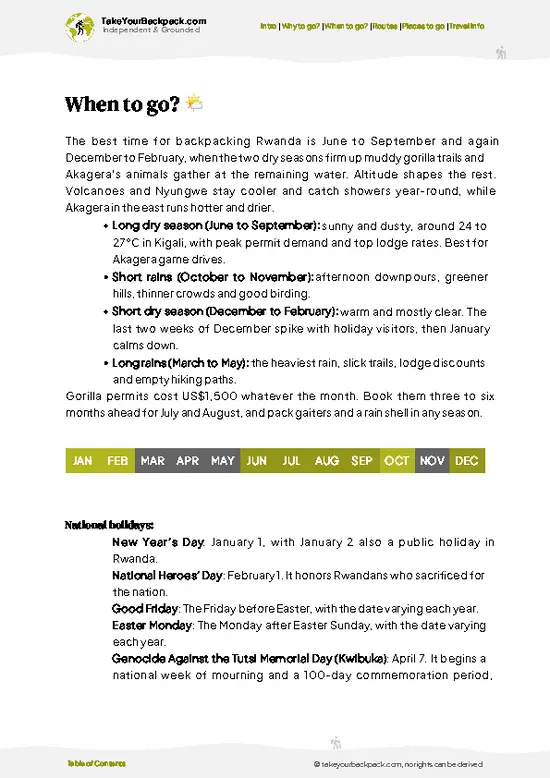
Best months and weather: The best months are June to September, with December to February as a shorter second window, because trails are driest and roads firmest. Kigali sits at about 1,500 m and stays between 16 and 27°C all year. Forest highlands at 2,500 to 3,000 m drop to 5 to 10°C at night, so a warm layer and rain jacket are needed in every month. The east is lower and hotter, often 28 to 32°C in the dry season.Shoulder and rainy seasons: The long rains from March to May bring the heaviest rainfall, often 150 to 200 mm in April, and muddy, slow forest trails. The short rains in October and November are lighter and often fall in afternoons. Permit fees stay the same all year, but lodges commonly drop rates by 20 to 30 percent outside the dry months. July to September is the busiest period, … read more 👉
Best months and weather: The best months are June to September, with December to February as a shorter second window, because trails are driest and roads firmest. Kigali sits at about 1,500 m and stays between 16 and 27°C all year. Forest highlands at 2,500 to 3,000 m drop to 5 to 10°C at night, so a warm layer and rain jacket are needed in every month. The east is lower and hotter, often 28 to 32°C in the dry season.Shoulder and rainy seasons: The long rains from March to May bring the heaviest rainfall, often 150 to 200 mm in April, and muddy, slow forest trails. The short rains in October and November are lighter and often fall in afternoons. Permit fees stay the same all year, but lodges commonly drop rates by 20 to 30 percent outside the dry months. July to September is the busiest period, so book permits and beds several weeks ahead.

national park hoppingOptimizing Your Multi-Stop Itinerary

How many days to allow: A trip linking several national parks in Rwanda needs 7 to 10 days, because every park transfer eats half a day. Grouping and direction: Kigali is the hub. The northwest and the Lake Kivu shore group well, with Kigali to Musanze at 2 to 2.5 hours and Musanze to Rubavu about 1.5 hours. From there the road runs south along the lake to the southwest forest, a long leg of 5 to 7 hours with a stop in Karongi. Finishing in the south and returning via Huye to Kigali (about 2.5 to 3 hours) avoids backtracking. The east is a separate 2.5 to 3 hour trip from Kigali, best at the start or end.Time per stop and common mistakes: Allow 2 nights for the northwest, 2 for the southwest forest and 1 to 2 for the east. Travelers often try to cover everything in 5 days, or plan a trek and … read more 👉
How many days to allow: A trip linking several national parks in Rwanda needs 7 to 10 days, because every park transfer eats half a day. Grouping and direction: Kigali is the hub. The northwest and the Lake Kivu shore group well, with Kigali to Musanze at 2 to 2.5 hours and Musanze to Rubavu about 1.5 hours. From there the road runs south along the lake to the southwest forest, a long leg of 5 to 7 hours with a stop in Karongi. Finishing in the south and returning via Huye to Kigali (about 2.5 to 3 hours) avoids backtracking. The east is a separate 2.5 to 3 hour trip from Kigali, best at the start or end.Time per stop and common mistakes: Allow 2 nights for the northwest, 2 for the southwest forest and 1 to 2 for the east. Travelers often try to cover everything in 5 days, or plan a trek and a long transfer on the same day. Buses stop running around dusk and mountain roads are slow in rain, so travel one day and trek the next.

The ListHighly Recommended national parks of Rwanda

1 Volcanoes National Park

Mountain gorillas, golden monkeys, Bisoke crater lake, Karisimbi climb

Trek through farmland and bamboo to a gorilla family, then climb Bisoke to a green crater lake or visit Dian Fossey’s grave.

Rwanda - Volcanoes National Park

2 Lake Kivu

Congo Nile Trail, Rubavu beaches, bat island, shoreline fishing boats

Move along a hilly shoreline by foot, bike or kayak, swimming off sandy beaches and paddling out to an island of roosting fruit bats.

3 Nyungwe Forest National Park

Canopy walkway, chimp tracking, colobus troops, Albertine Rift birds

Cross a suspension bridge above the treetops, then follow guides along muddy ridge trails to chimpanzees, large colobus troops and forest endemics.

4 Lake Muhazi

Kayaking, grilled tilapia, papyrus birds, Gahini church

Paddle the narrow arms of a calm lake northeast of Kigali, eat fresh tilapia on a terrace and watch fishers launch canoes at dawn.

5 Akagera National Park

Lake Ihema boat trips, savanna game drives, black rhinos, northern lion plains

Drive open acacia grassland for zebra, giraffe and lions, then switch to a boat on Lake Ihema among hippos, crocodiles and papyrus birds.

rwanda-national-park-akagera-national-park
© Google |
Loading the map 🌍

Expert viewPro Tips for Exploring the Best

How many parks to visit: Two is the number I would advise, three at most. Permit prices are high, forest treks use a full day each, and the transfers between regions add more. Two well-paced visits leave energy for the walk itself, while a third mainly adds road time. Pick one forest experience and one savanna visit if you want contrast, or stay with forest only if primates are the goal.Which kind to prioritize: Travelers with a large budget and a priority on mountain gorillas should put the northwest first, since that permit is the biggest single cost in the country. On a tighter budget, the southwest rainforest gives primate walks and a canopy walkway at a fraction of the price. Those who prefer wildlife viewing and own a vehicle or can share a rental should choose the east, where entry … read more 👉
How many parks to visit: Two is the number I would advise, three at most. Permit prices are high, forest treks use a full day each, and the transfers between regions add more. Two well-paced visits leave energy for the walk itself, while a third mainly adds road time. Pick one forest experience and one savanna visit if you want contrast, or stay with forest only if primates are the goal.Which kind to prioritize: Travelers with a large budget and a priority on mountain gorillas should put the northwest first, since that permit is the biggest single cost in the country. On a tighter budget, the southwest rainforest gives primate walks and a canopy walkway at a fraction of the price. Those who prefer wildlife viewing and own a vehicle or can share a rental should choose the east, where entry is cheaper but getting around is not.What it costs: Outside the parks, a backpacker spends roughly US$35 to 60 a day on dorm or budget rooms (US$10 to 25), local meals (RWF 3,000 to 6,000, about US$2 to 4) and buses (RWF 3,000 to 10,000, about US$2 to 7 a leg). Park costs are separate and fixed: a gorilla permit is US$1,500, golden monkey tracking about US$100, chimpanzee tracking about US$150, the canopy walk about US$70, and savanna entry roughly US$50 a day for non-resident adults. Guides are included in permits; tipping rangers and trackers US$5 to 10 each is customary. Buy permits from the Rwanda Development Board, not resellers who add a markup.Safety and etiquette: Rangers carry weapons because of buffalo and elephants, not because of crime, so follow their instructions. Anyone with a cold or stomach illness may be refused a primate trek, because animals catch human illness. Keep the required distance of about 7 m from gorillas and wear boots with good grip. The Congo border lies near the northwest and Burundi near the southwest, so check current advisories before traveling to border towns. Plastic bags are banned, and the last Saturday of each month is Umuganda, when roads in towns can slow.

Dress modestly in villages and ask before photographing people.

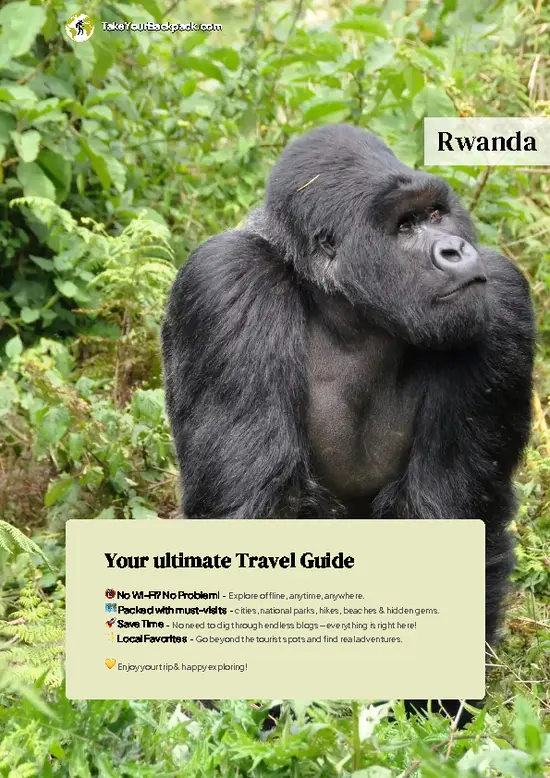
✈️ The backpacker research shortcutRwanda Travel Guide

An offline-friendly backpacking guide with optimized travel routes, ranked highlights, transport advice, and the best areas to stay.
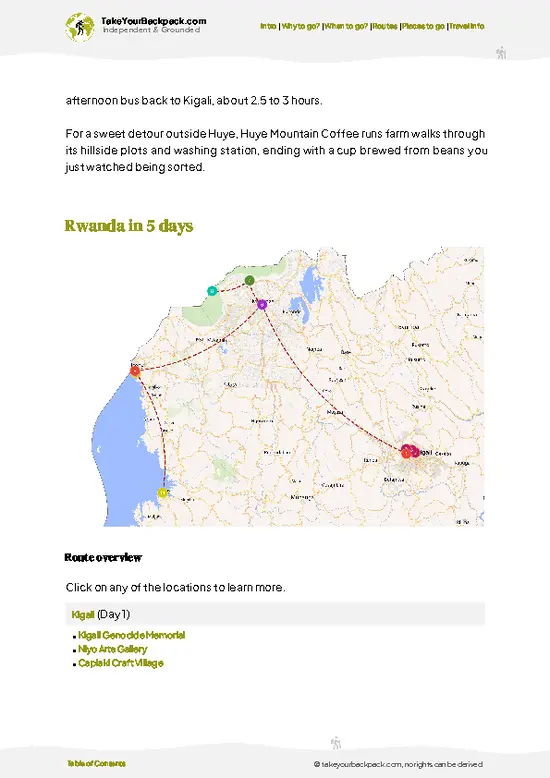
example page 0 from our offline Travel Guide for Rwanda
example page 1 from our offline Travel Guide for Rwanda
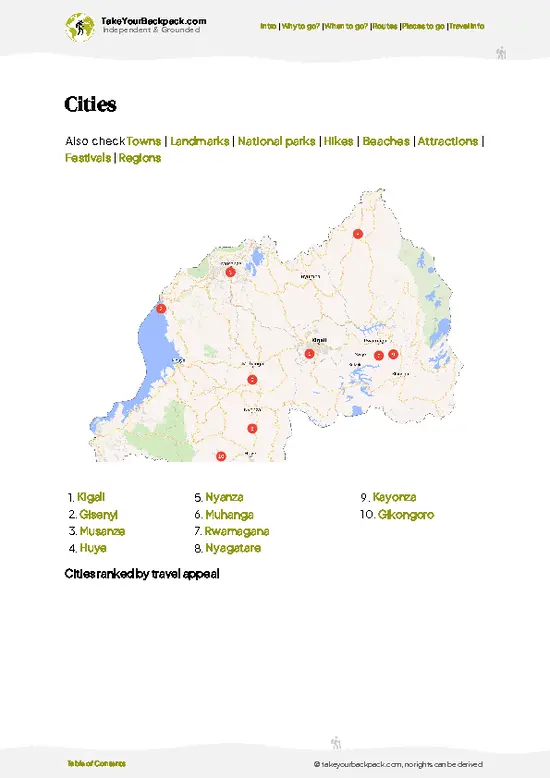
example page 2 from our offline Travel Guide for Rwanda
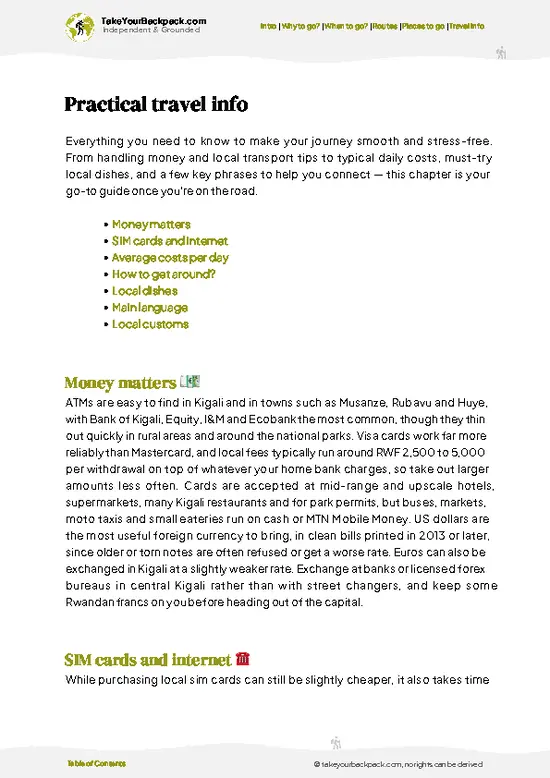
example page 3 from our offline Travel Guide for Rwanda
example page 4 from our offline Travel Guide for Rwanda
example page 5 from our offline Travel Guide for Rwanda
example page 6 from our offline Travel Guide for Rwanda
example page 7 from our offline Travel Guide for Rwanda
The digital guide (233 pages) contains:
✅ 57 highlights, ranked by travel appeal
✅ Optimized 2, 3 & 5-day travel routes
✅ Cities, national parks, landmarks, beaches
✅ How to get around
✅ Offline-friendly for travel without Wi-Fi
👉 Click to see all 30+ guide features

📅 Plan smarter in minutes, not weeks
✅ Month by month travel advice
✅ Festivals & national holidays
✅ Budget expectations

🗺️ Go to the right places, skip the overrated ones
✅ Honest pros & cons of destinations
✅ Top hikes, parks & viewpoints
✅ Lesser-known places most travelers miss
✅ Clear “worth it vs skip it” guidance

🛏️ Travel smoothly without rookie mistakes
✅ Best areas to stay
✅ Transport systems explained simply
✅ Common scams & safety advice
✅ SIM cards, money & practical tips

🌍 Understand the country, not just visit it
✅ Culture & traditions
✅ 52 Essential phrases & customs
✅ Festivals worth planning around
✅ Traveler-friendly historical context
✅ Insights that make places more meaningful

📱 Built for real travel conditions
✅ Fully downloadable PDF
✅ Works completely offline
✅ Optimized for phone use
✅ Useful in remote areas & buses
✅ Everything in one place
Stop searching, start planning
Get instant access to your full guide. 30‑day money-back guarantee.
+ Add another guide for just

By proceeding you agree to our terms.
Sent to your inbox immediately after payment • 100% Secure Checkout
Best Backpacking Travel Advisor 2025 tourism awardBest Backpacking
Travel Advisor
2025
What others say about Take Your Backpack Guides:
⭐⭐⭐⭐⭐
Fantastic, amazing amount of information!
⭐⭐⭐⭐⭐
My goodness this is amazing, it's what I've been looking for hats off too you!
⭐⭐⭐⭐⭐
I think this is absolutely BRILLIANT
⭐⭐⭐⭐
Very complete and informative. It's still missing places, but I gotta to commend you
⭐⭐⭐⭐⭐
This is truly amazing, thank you, can't wait to explore it with my kids!
⭐⭐⭐⭐⭐
Awesome resource, thank you!
⭐⭐⭐⭐⭐
This is amazing! Can't wait to explore the ones I haven't seen
⭐⭐⭐⭐
I love this! Well done, great idea.
⭐⭐⭐⭐⭐
Thanks for taking the time to make this gem!
⭐⭐⭐⭐⭐
This might be the best website I've ever seen.
⭐⭐⭐⭐⭐
Congratulations, and thank you so much for your work; it's incredibly valuable.
⭐⭐⭐⭐
In all seriousness I think you did a great job pointing out the important spots
⭐⭐⭐⭐⭐
10/10 very good
⭐⭐⭐⭐⭐
As someone who's only just starting to visit regularly this is awesome, thank you.
⭐⭐⭐⭐
Thank you very much! I'm going to visit my dad, it's going to be very useful!
⭐⭐⭐⭐⭐
This is really cool! We'll be travelling for the first time and this definitely come in handy.
⭐⭐⭐⭐⭐
You are now our minister of culture, congratulations 👨‍💼
⭐⭐⭐⭐⭐
Just wanted to tell you that this is a pearl! Going to follow your recommendations.
⭐⭐⭐⭐⭐
This is so cool. I'll definitely be using the resource for my travels soon.
⭐⭐⭐⭐⭐
This is very impressive! Good work.
⭐⭐⭐⭐⭐
This is an amazing and informative site. Very well done!

🛏️ Where to stay?Accommodation Highlights

Rwanda has a small but growing hostel and guesthouse scene, with dorm beds from about RWF 14,000 to 28,000 (US$10 to 20) and simple private rooms from roughly RWF 28,000 to 55,000 (US$20 to 40), most of it concentrated in Kigali. In the capital, Kiyovu puts you near downtown and the main bus hubs on quiet, leafy streets. Kimihurura has the best spread of bars and restaurants but costs more, Remera is close to the airport with cheaper beds and late-night street life, and Nyamirambo offers the most local character and lowest prices, though it is louder and farther from the center, while lakeside Rubavu and Musanze (the gorilla trekking base) have a handful of budget guesthouses each.

If you enjoy … read more 👉
Rwanda has a small but growing hostel and guesthouse scene, with dorm beds from about RWF 14,000 to 28,000 (US$10 to 20) and simple private rooms from roughly RWF 28,000 to 55,000 (US$20 to 40), most of it concentrated in Kigali. In the capital, Kiyovu puts you near downtown and the main bus hubs on quiet, leafy streets. Kimihurura has the best spread of bars and restaurants but costs more, Remera is close to the airport with cheaper beds and late-night street life, and Nyamirambo offers the most local character and lowest prices, though it is louder and farther from the center, while lakeside Rubavu and Musanze (the gorilla trekking base) have a handful of budget guesthouses each.

If you enjoy meeting fellow travelers, consider choosing hostels with high ratings for atmosphere. On the other hand, if you prefer having your own space, a hotel might be a better option.

RwandaSee More of Rwanda

👋 Meet the founderWho’s Behind Take Your Backpack?

Johan, backpacker and founder of TakeYourBackpackHi, I’m Johan (Netherlands 🇳🇱), the creator of TakeYourBackpack. Over the past 3 decades, I’ve backpacked through 90+ countries across six continents, gaining extensive experience with independent travel, long-term trips, and overland routes.

This site is built on a combination of firsthand travel experience and carefully curated insights from other backpackers. Many guides are based on places I’ve personally visited, while others bring together tips, observations, and practical advice shared by trusted travelers I’ve met along the way.

The goal is to provide realistic, experience-driven guidance — not generic itineraries — so you can explore destinations with better context, clearer expectations, and more confidence.