×

Rwanda🇷🇼 | best regionsYour Guide to the 9 Best regions in Rwanda

Rwanda is small enough to cross in a day, yet its regions differ sharply in feel and cost. The volcano highlands in the northwest are cool, expensive and permit-driven. The lake shore in the west is slower and cheaper, and the east is dry savanna. Kigali anchors the center. Roads are paved and buses frequent, so independent travel is straightforward, though crowds and prices vary widely.

By Johan Kruseman 🇳🇱 | Updated October 23, 2026
Explore the best cities in Rwanda

Why go?Key Factors That Shape the Experience

Rwanda suits region-hopping because of its compact size and reliable infrastructure. Most places lie within a half day of Kigali on paved roads, and minibuses and larger coaches run on fixed schedules. The terrain explains the variety: the country is nicknamed the “Land of a Thousand Hills,” and altitude, mostly 1,000 to 4,500 meters, produces cool highlands, warmer lake basins and drier lowlands within short distances.

Policy shapes travel as much as geography. The government favors high-value, low-volume tourism, so gorilla permits cost US$1,500 and park fees are set high, while the rest of the country stays modest in price. Visitors should also know that the 1994 genocide is central to national memory, and memorials are part of the landscape. Plan for respectful, unhurried visits. Plastic … read more 👉
Rwanda suits region-hopping because of its compact size and reliable infrastructure. Most places lie within a half day of Kigali on paved roads, and minibuses and larger coaches run on fixed schedules. The terrain explains the variety: the country is nicknamed the “Land of a Thousand Hills,” and altitude, mostly 1,000 to 4,500 meters, produces cool highlands, warmer lake basins and drier lowlands within short distances.

Policy shapes travel as much as geography. The government favors high-value, low-volume tourism, so gorilla permits cost US$1,500 and park fees are set high, while the rest of the country stays modest in price. Visitors should also know that the 1994 genocide is central to national memory, and memorials are part of the landscape. Plan for respectful, unhurried visits. Plastic bags are banned, and the monthly community cleanup day, Umuganda, affects transport on the last Saturday morning.
Evaluating the Top Choices
The list of best regions in Rwanda is created based on landscapes, local culture, attractions, vibes, and overall appeal. If you feel a region is missing in this list, please let us know.

When to go?Timing Your Visit for the Best Experience

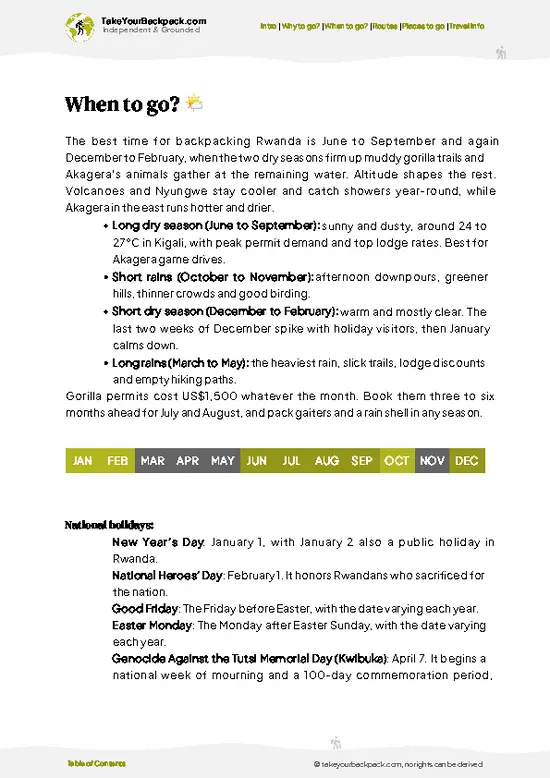
Best months and seasons: The long dry season from June to September is the best time for Rwanda’s regions, with the least rain, firmer trails and clearer views. A shorter dry spell runs from December to February. Temperatures stay moderate year-round: highs of 24 to 28°C in Kigali and the east, and 10 to 20°C in the high-altitude northwest, where nights can approach freezing.
Shoulder and wet periods: The long rains fall from March to May, with April usually the wettest, and a lighter rainy period runs from October to November. Trails turn muddy and some dirt roads slow down, but lodges often cut rates by 20 to 30 percent. Peak demand in July and August means gorilla permits and mid-range rooms should be booked well ahead. The east stays noticeably drier and hotter than the hills even in wet months.

region hoppingOptimizing Your Multi-Stop Itinerary

How many days to plan: A trip combining several regions of Rwanda needs 7 to 12 days, since distances are short but hill roads are slow. Kigali is the natural hub, and a loop works better than backtracking: start in the capital, head north or west first, then return through the south or east.
Pacing and transfers: Allow 2 to 3 nights per stop, with one night only where a single activity is the goal. Typical drives from Kigali run about 2 to 3 hours to the north, 3 to 4 hours to the lake towns, and 2 to 3 hours to the east. Moving between western and northern areas often means a bus change in Musanze or Kigali, adding an hour or more.
Common planning errors: Travelers often underestimate winding roads and schedule a transfer and an activity on the same day. Build in a buffer instead. Others book … read more 👉
How many days to plan: A trip combining several regions of Rwanda needs 7 to 12 days, since distances are short but hill roads are slow. Kigali is the natural hub, and a loop works better than backtracking: start in the capital, head north or west first, then return through the south or east.
Pacing and transfers: Allow 2 to 3 nights per stop, with one night only where a single activity is the goal. Typical drives from Kigali run about 2 to 3 hours to the north, 3 to 4 hours to the lake towns, and 2 to 3 hours to the east. Moving between western and northern areas often means a bus change in Musanze or Kigali, adding an hour or more.
Common planning errors: Travelers often underestimate winding roads and schedule a transfer and an activity on the same day. Build in a buffer instead. Others book permit-dependent activities last, when dates are already full. Fix those dates first and arrange everything else around them. Late-afternoon buses are also fewer, so travel in the morning.

The ListHighly Recommended regions of Rwanda

1 Bugesera

Church memorials, papyrus lakeshores, flat savanna, moto trips

Ride out from Nyamata to solemn church memorials, then follow dusty tracks to reedy lakes where fishing boats and waterbirds share the shore.

2 Burera

Twin lakes, dugout canoes, volcano views, lakeside dawns

Paddle a wooden dugout between small islands, then climb farm tracks above Burera and Ruhondo for views toward the Virunga volcanoes.

3 Nyamasheke

Nyungwe canopy, chimp permits, Kivu beaches, tea factory

Cross a suspended walkway about 50 meters above the forest, then wind down on a calm Kivu beach as the sun drops.

4 Gisagara

Rice marshland, coffee washing station, terraced ridges, market towns

Walk the levees of the Akanyaru paddies, taste coffee at a working cooperative, and watch ridge farms from quiet hill roads.

5 Kirehe

Rusumo cascade, Kagera banks, border trade, brochette stalls

Take a moto to the wide Kagera falls at the Tanzanian border, then end the day with charcoal-grilled goat in town.

6 Nyaruguru

Kitabi rainforest edge, tea rows, birding trail, honey cooperatives

Base yourself at a community-run eco-center for guided forest walks, Albertine Rift birding, tea estate strolls and local honey.

7 Rulindo

Mulindi tea hills, RPF headquarters, Kinihira rock, Nyabarongo wetlands

Stop between Kigali and Musanze to walk tea terraces, see the early-1990s rebel compound and look over farmland from a ritual hilltop.

8 Rutsiro

Congo Nile Trail, Kivu ridges, coffee washing station, fishing landings

Hike steep lakeside gravel past coffee terraces and fishing landings, with the lake opening below at every unmarked bend.

9 Nyabihu

Gishwati forest, potato fields, tea slopes, cool highlands

Track primates in a recovering montane forest, then walk potato lanes and tea terraces beneath the crater ridges of Bisoke and Karisimbi.

Loading the map 🌍

Expert viewPro Tips for Exploring the Best

How many regions to visit: I advise three or four regions on a first trip. Hill roads are slow, and every additional stop costs half a day in transit. Fewer stops also leave room for the unscheduled, like a market day or a memorial visit that deserves time.
Prioritizing by travel style: If your budget is tight, favor the lake shore, the south and Kigali, where costs are low and scenery comes free. If wildlife matters most, choose the parks and volcano highlands, accepting that they take most of your money. Hikers do best in the cool western and northern uplands. Add the drier east only if you want safari-style game viewing without crossing borders. Mixing one expensive region with cheaper ones keeps the average sensible.
What it costs: Backpacking in Rwanda runs about US$40 to 70 a day in towns … read more 👉
How many regions to visit: I advise three or four regions on a first trip. Hill roads are slow, and every additional stop costs half a day in transit. Fewer stops also leave room for the unscheduled, like a market day or a memorial visit that deserves time.
Prioritizing by travel style: If your budget is tight, favor the lake shore, the south and Kigali, where costs are low and scenery comes free. If wildlife matters most, choose the parks and volcano highlands, accepting that they take most of your money. Hikers do best in the cool western and northern uplands. Add the drier east only if you want safari-style game viewing without crossing borders. Mixing one expensive region with cheaper ones keeps the average sensible.
What it costs: Backpacking in Rwanda runs about US$40 to 70 a day in towns and lake areas: dorm or basic room US$10 to 25, local meals US$2 to 5, minibus rides US$1 to 6 per leg, and moto-taxis US$1 to 3. Park regions are different. The gorilla permit is US$1,500, and chimpanzee or golden monkey permits run roughly US$100 to 200. Park entry for safari areas is about US$50 to 100 per person per day, plus guides, vehicles and a night in a lodge. Budget US$150 to 400 per park visit beyond the permit. Rates are quoted in dollars but paid in Rwandan francs by many local services, so carry both.
Safety and etiquette: Rwanda is among the safest countries in Africa for independent travelers, with low petty crime and strict regulation of moto-taxi helmets. Stay out of the border zones near the Democratic Republic of the Congo, and check current advice before heading to the northwest and southwest edges. At memorials, dress modestly, ask before photographing, and keep your voice low. Never photograph officials or military sites. Rely on registered guides in parks, since they must accompany any trek.
What experienced travelers do: Book permits months ahead, since dates sell out. Carry rain layers year-round because the hills turn cold quickly. Use mobile money or ATMs in towns, as cards are unreliable outside Kigali.

✈️ The backpacker research shortcutRwanda Travel Guide

An offline-friendly backpacking guide with optimized travel routes, ranked highlights, transport advice, and the best areas to stay.
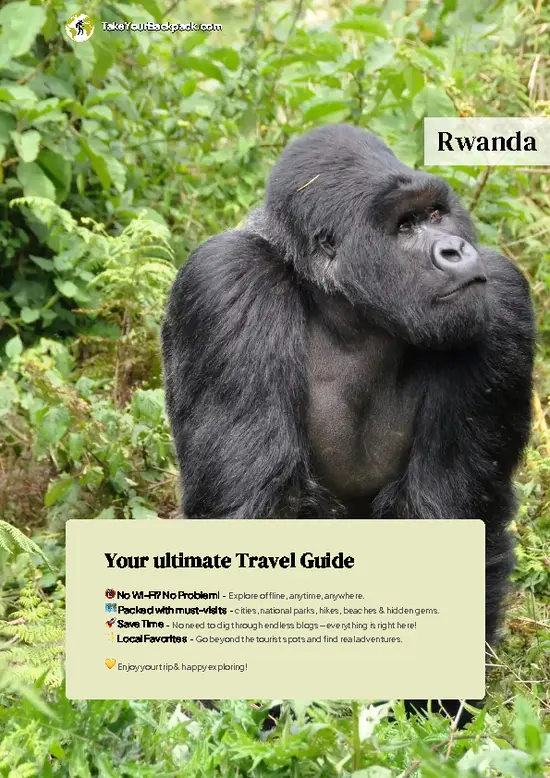
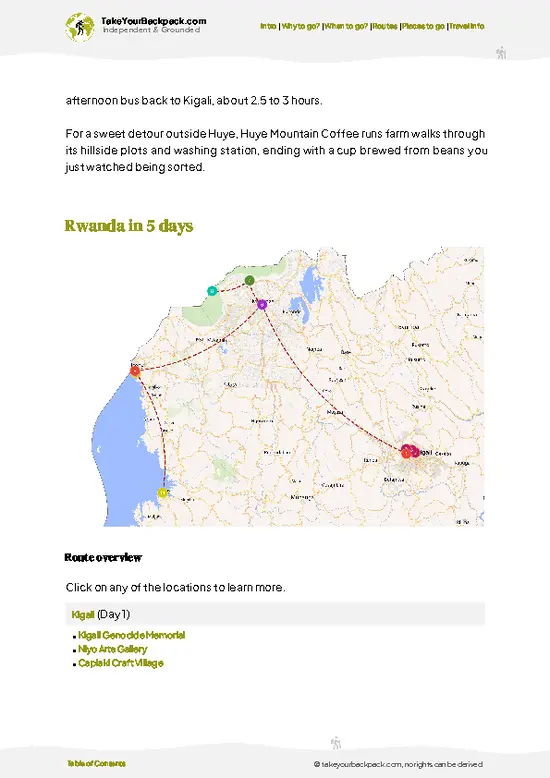
example page 0 from our offline Travel Guide for Rwanda
example page 1 from our offline Travel Guide for Rwanda
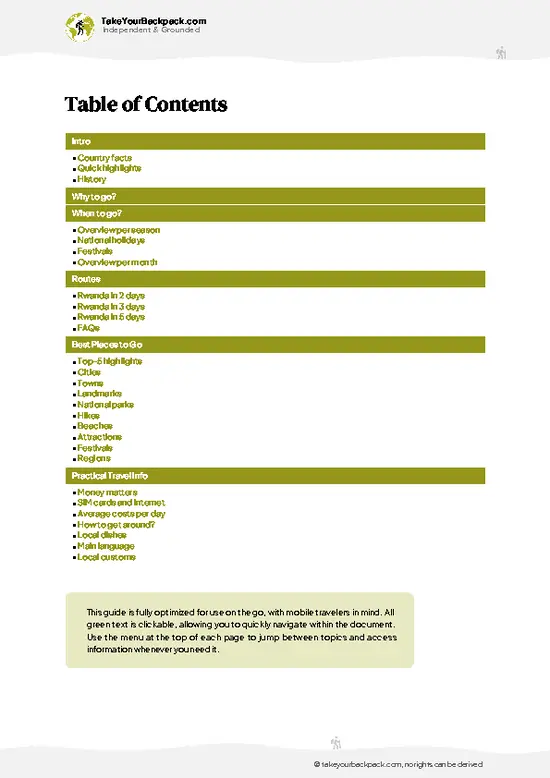
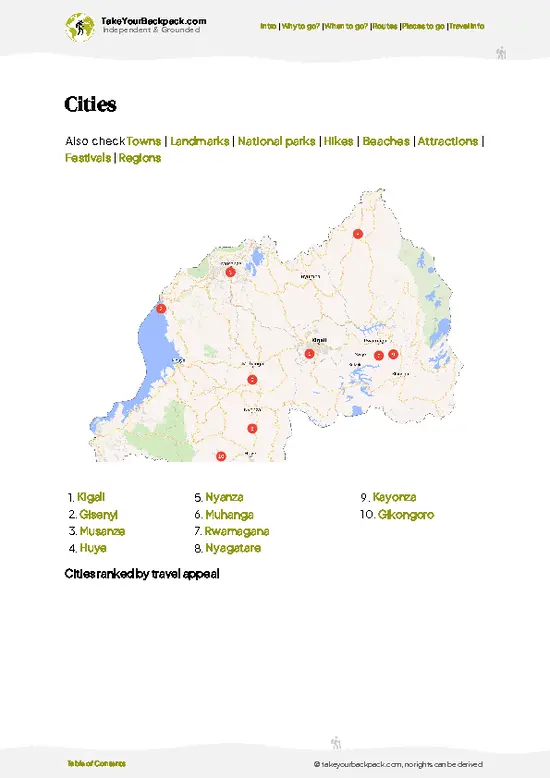
example page 2 from our offline Travel Guide for Rwanda
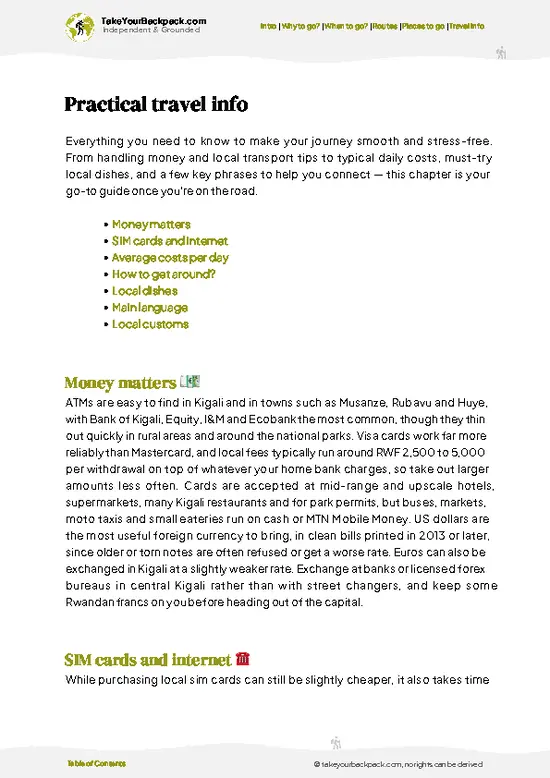
example page 3 from our offline Travel Guide for Rwanda
example page 4 from our offline Travel Guide for Rwanda
example page 5 from our offline Travel Guide for Rwanda
example page 6 from our offline Travel Guide for Rwanda
example page 7 from our offline Travel Guide for Rwanda
The digital guide (233 pages) contains:
✅ 57 highlights, ranked by travel appeal
✅ Optimized 2, 3 & 5-day travel routes
✅ Cities, national parks, landmarks, beaches
✅ How to get around
✅ Offline-friendly for travel without Wi-Fi
👉 Click to see all 30+ guide features

📅 Plan smarter in minutes, not weeks
✅ Month by month travel advice
✅ Festivals & national holidays
✅ Budget expectations

🗺️ Go to the right places, skip the overrated ones
✅ Honest pros & cons of destinations
✅ Top hikes, parks & viewpoints
✅ Lesser-known places most travelers miss
✅ Clear “worth it vs skip it” guidance

🛏️ Travel smoothly without rookie mistakes
✅ Best areas to stay
✅ Transport systems explained simply
✅ Common scams & safety advice
✅ SIM cards, money & practical tips

🌍 Understand the country, not just visit it
✅ Culture & traditions
✅ 52 Essential phrases & customs
✅ Festivals worth planning around
✅ Traveler-friendly historical context
✅ Insights that make places more meaningful

📱 Built for real travel conditions
✅ Fully downloadable PDF
✅ Works completely offline
✅ Optimized for phone use
✅ Useful in remote areas & buses
✅ Everything in one place
Stop searching, start planning
Get instant access to your full guide. 30‑day money-back guarantee.
+ Add another guide for just

By proceeding you agree to our terms.
Sent to your inbox immediately after payment • 100% Secure Checkout
Best Backpacking Travel Advisor 2025 tourism awardBest Backpacking
Travel Advisor
2025
What others say about Take Your Backpack Guides:
⭐⭐⭐⭐⭐
Fantastic, amazing amount of information!
⭐⭐⭐⭐⭐
My goodness this is amazing, it's what I've been looking for hats off too you!
⭐⭐⭐⭐⭐
I think this is absolutely BRILLIANT
⭐⭐⭐⭐
Very complete and informative. It's still missing places, but I gotta to commend you
⭐⭐⭐⭐⭐
This is truly amazing, thank you, can't wait to explore it with my kids!
⭐⭐⭐⭐⭐
Awesome resource, thank you!
⭐⭐⭐⭐⭐
This is amazing! Can't wait to explore the ones I haven't seen
⭐⭐⭐⭐
I love this! Well done, great idea.
⭐⭐⭐⭐⭐
Thanks for taking the time to make this gem!
⭐⭐⭐⭐⭐
This might be the best website I've ever seen.
⭐⭐⭐⭐⭐
Congratulations, and thank you so much for your work; it's incredibly valuable.
⭐⭐⭐⭐
In all seriousness I think you did a great job pointing out the important spots
⭐⭐⭐⭐⭐
10/10 very good
⭐⭐⭐⭐⭐
As someone who's only just starting to visit regularly this is awesome, thank you.
⭐⭐⭐⭐
Thank you very much! I'm going to visit my dad, it's going to be very useful!
⭐⭐⭐⭐⭐
This is really cool! We'll be travelling for the first time and this definitely come in handy.
⭐⭐⭐⭐⭐
You are now our minister of culture, congratulations 👨‍💼
⭐⭐⭐⭐⭐
Just wanted to tell you that this is a pearl! Going to follow your recommendations.
⭐⭐⭐⭐⭐
This is so cool. I'll definitely be using the resource for my travels soon.
⭐⭐⭐⭐⭐
This is very impressive! Good work.
⭐⭐⭐⭐⭐
This is an amazing and informative site. Very well done!

🛏️ Where to stay?Where to Stay in Rwanda

Rwanda has a small but growing hostel and guesthouse scene, with dorm beds from about RWF 14,000 to 28,000 (US$10 to 20) and simple private rooms from roughly RWF 28,000 to 55,000 (US$20 to 40), most of it concentrated in Kigali. In the capital, Kiyovu puts you near downtown and the main bus hubs on quiet, leafy streets. Kimihurura has the best spread of bars and restaurants but costs more, Remera is close to the airport with cheaper beds and late-night street life, and Nyamirambo offers the most local character and lowest prices, though it is louder and farther from the center, while lakeside Rubavu and Musanze (the gorilla trekking base) have a handful of budget guesthouses each.

If you enjoy … read more 👉
Rwanda has a small but growing hostel and guesthouse scene, with dorm beds from about RWF 14,000 to 28,000 (US$10 to 20) and simple private rooms from roughly RWF 28,000 to 55,000 (US$20 to 40), most of it concentrated in Kigali. In the capital, Kiyovu puts you near downtown and the main bus hubs on quiet, leafy streets. Kimihurura has the best spread of bars and restaurants but costs more, Remera is close to the airport with cheaper beds and late-night street life, and Nyamirambo offers the most local character and lowest prices, though it is louder and farther from the center, while lakeside Rubavu and Musanze (the gorilla trekking base) have a handful of budget guesthouses each.

If you enjoy meeting fellow travelers, consider choosing hostels with high ratings for atmosphere. On the other hand, if you prefer having your own space, a hotel might be a better option.

RwandaMore of Rwanda

👋 Meet the founderWho’s Behind Take Your Backpack?

Johan, backpacker and founder of TakeYourBackpackHi, I’m Johan (Netherlands 🇳🇱), the creator of TakeYourBackpack. Over the past 3 decades, I’ve backpacked through 90+ countries across six continents, gaining extensive experience with independent travel, long-term trips, and overland routes.

This site is built on a combination of firsthand travel experience and carefully curated insights from other backpackers. Many guides are based on places I’ve personally visited, while others bring together tips, observations, and practical advice shared by trusted travelers I’ve met along the way.

The goal is to provide realistic, experience-driven guidance — not generic itineraries — so you can explore destinations with better context, clearer expectations, and more confidence.