×

Rwanda🇷🇼 | national parksLake KivuCongo Nile Trail, Rubavu beaches, bat island, shoreline fishing boats | things to do and best time to go

Explore Rugezi Swamp TrailExplore Lake Muhazi

Backpacking in Lake Kivu
🌟 Highlightnational park ranked #2
By Johan Kruseman 🇳🇱 | Updated October 22, 2026

The decision at Lake Kivu is whether to stay in one town or move along the shore, and the slow, hilly roads usually tip it toward moving. Lake Kivu sits in the west of Rwanda, on the border with the Democratic Republic of the Congo, with Rubavu in the north and Rusizi in the south. Roads follow the ridges and wind constantly, so distances look short on a map and take much longer; a traveler plans one base per two or three days and takes shared minibuses between them. The water is free of bilharzia and hippos, so swimming is fine, though the lake holds dissolved gas and is not a place for deep diving. Hiking here means ridge paths, the Congo Nile Trail, and forest at Nyungwe's edge, with small monkeys rather than big game. Crowds are thin outside weekends. It suits walkers and cyclists who like quiet shores. It will bore anyone who wants safari-scale wildlife or nightlife.

Discover everything you want to know in the 📖 Rwanda Travel Guide.


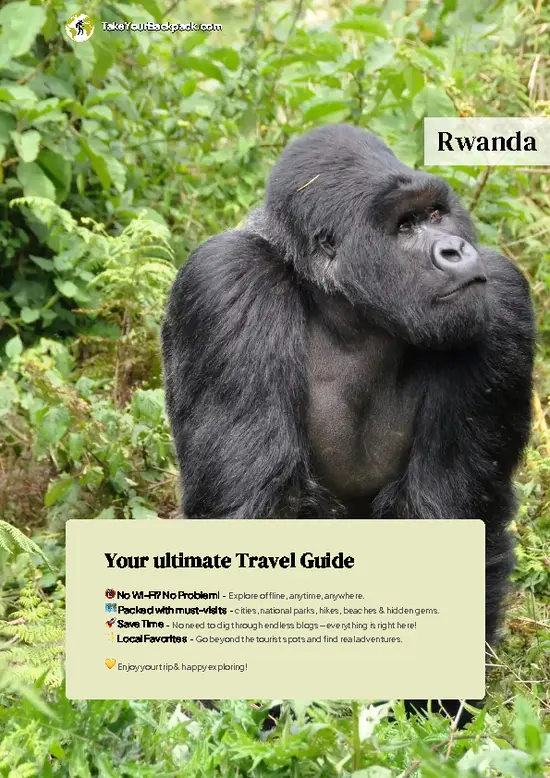
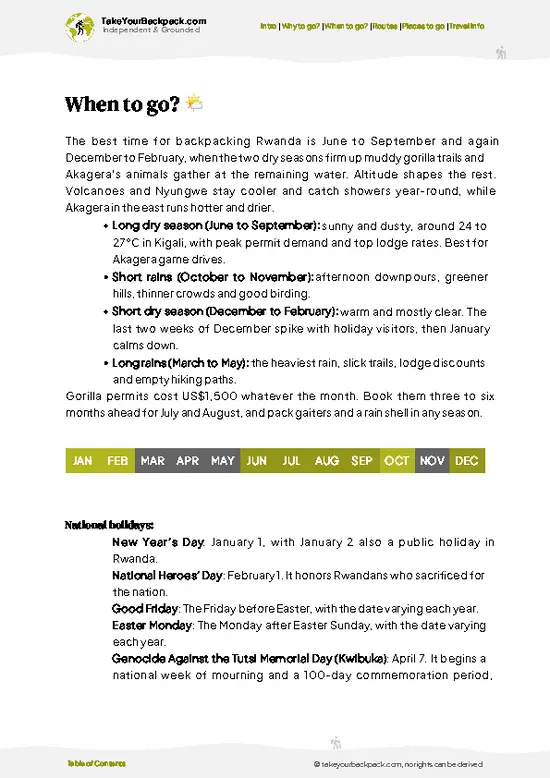
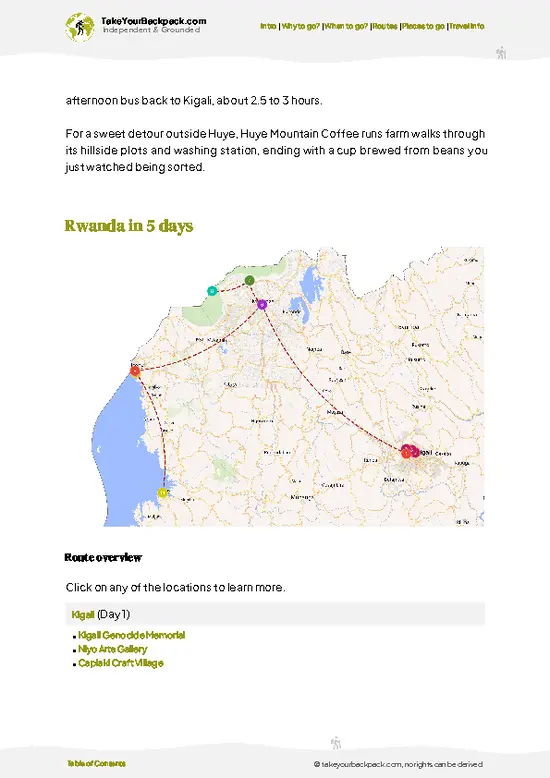
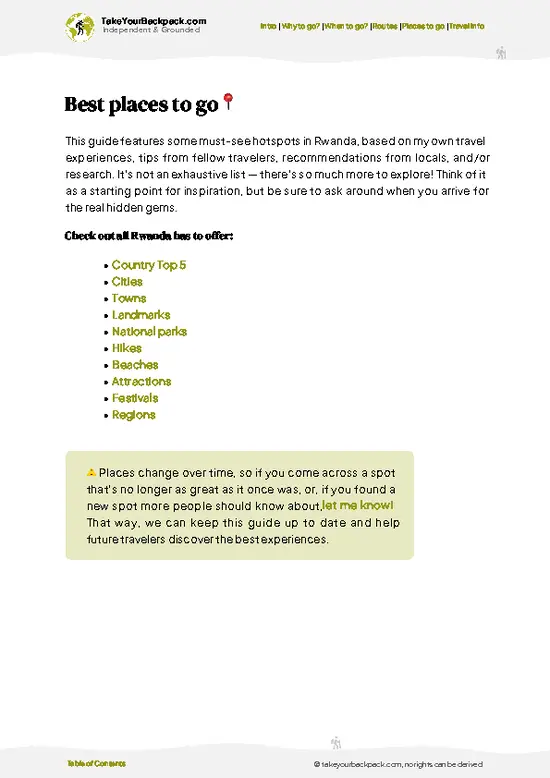
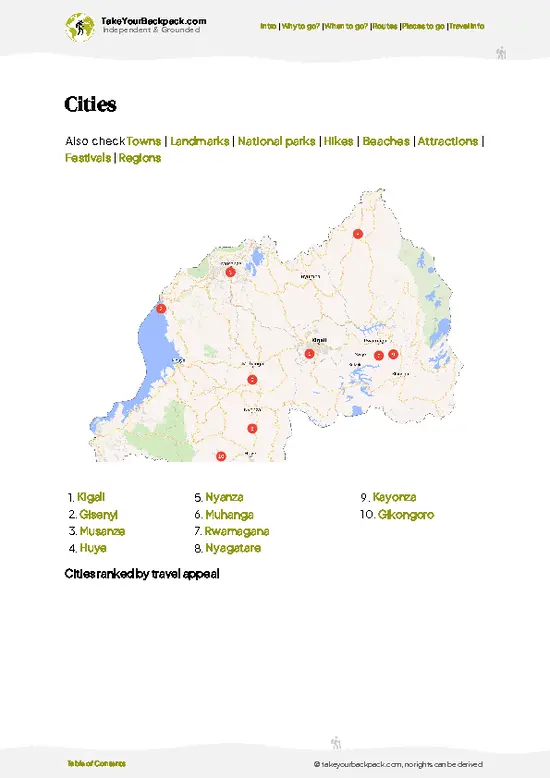
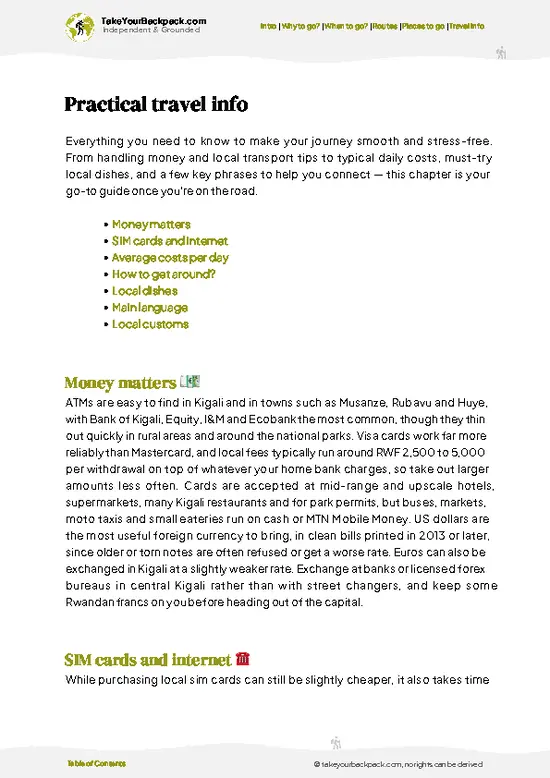
example page 0 from our offline Travel Guide for Rwanda
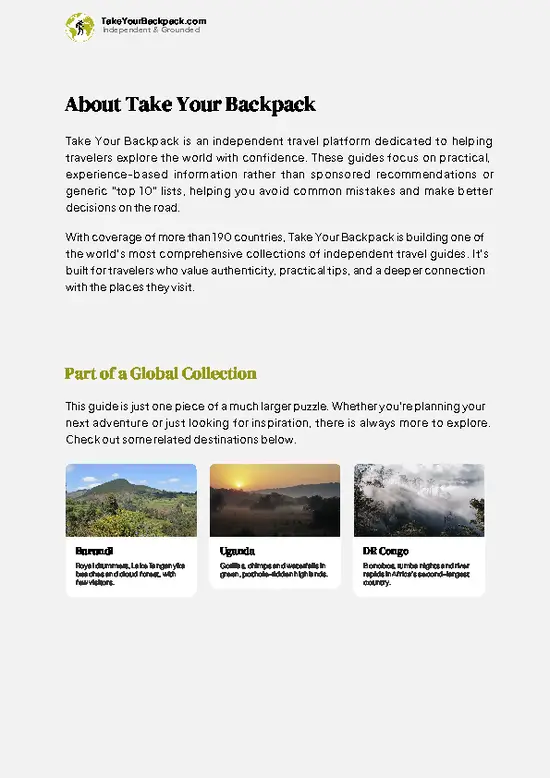
example page 1 from our offline Travel Guide for Rwanda
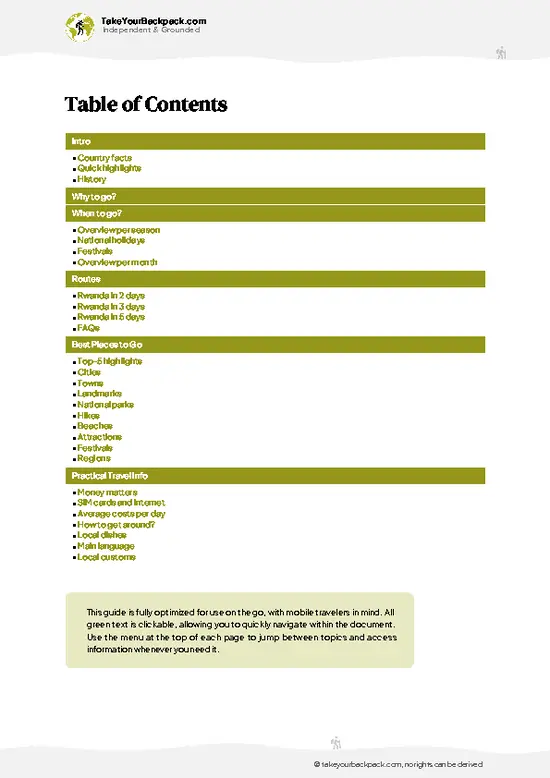
example page 2 from our offline Travel Guide for Rwanda
example page 3 from our offline Travel Guide for Rwanda
example page 4 from our offline Travel Guide for Rwanda
example page 5 from our offline Travel Guide for Rwanda
example page 6 from our offline Travel Guide for Rwanda
example page 7 from our offline Travel Guide for Rwanda
Loading the map 🌍
CLICK TO FILTER
cities
towns
landmarks
national parks
hikes
beaches
attractions
festivals
regions
SHOW COUNTRY’S BESTSHOW ALL

✨ Why go?
Ranked #2 national park in Rwanda
Why visitors keep coming back

Lake Kivu works for backpackers because the Congo Nile Trail turns it into a point-to-point route of roughly 227 kilometers that you can walk or cycle without a guide, passing from village to village along the shoreline. Small guesthouses and lakeside campsites appear every day or so, so you carry little and decide your pace as you go. Locals sell fruit, fresh tilapia and strong coffee from roadside stalls, and the hills around Gisenyi and Kibuye grow much of the country's coffee, so the walk doubles as a tour of plantations. Nobody needs a tour operator to organize this; signs and local directions are enough, and a paper map or offline app covers the rest. A second pull is the quiet water itself. Kayaks and small boats leave from the beaches at Kibuye, where you can reach forested islands … read more 👉
Lake Kivu works for backpackers because the Congo Nile Trail turns it into a point-to-point route of roughly 227 kilometers that you can walk or cycle without a guide, passing from village to village along the shoreline. Small guesthouses and lakeside campsites appear every day or so, so you carry little and decide your pace as you go. Locals sell fruit, fresh tilapia and strong coffee from roadside stalls, and the hills around Gisenyi and Kibuye grow much of the country's coffee, so the walk doubles as a tour of plantations. Nobody needs a tour operator to organize this; signs and local directions are enough, and a paper map or offline app covers the rest. A second pull is the quiet water itself. Kayaks and small boats leave from the beaches at Kibuye, where you can reach forested islands on your own schedule. Evenings are calm, lit by fishing boats called sakumbi, whose wooden hulls rig long poles.

💡 HighlightsDon't-miss highlights and experiences

  1. Congo Nile Trail: The signature route along the lake from Rubavu to Rusizi, mixing dirt tracks, coffee terraces and village markets, and best taken over several days on foot or by mountain bike.
  2. Rubavu (Gisenyi) beaches: Sandy public beaches on the northern shore, with calm water for swimming and a relaxed weekend crowd, set against the Nyiragongo volcano glow across the border on clear nights.
  3. Napoleon Island (Bat Island): A small island off Kibuye covered in trees and home to a large colony of fruit bats that hang in the branches by day. Reach it by paddle or boat.
  4. Kibuye peninsula and islands: Forested hills and islands around the town offer kayaking, short walks and sheltered coves, with a few lodges and some quiet camping.
  5. Rusizi and the southern shore: Quieter waterside land where the Rusizi
… read more 👉
  1. Congo Nile Trail: The signature route along the lake from Rubavu to Rusizi, mixing dirt tracks, coffee terraces and village markets, and best taken over several days on foot or by mountain bike.
  2. Rubavu (Gisenyi) beaches: Sandy public beaches on the northern shore, with calm water for swimming and a relaxed weekend crowd, set against the Nyiragongo volcano glow across the border on clear nights.
  3. Napoleon Island (Bat Island): A small island off Kibuye covered in trees and home to a large colony of fruit bats that hang in the branches by day. Reach it by paddle or boat.
  4. Kibuye peninsula and islands: Forested hills and islands around the town offer kayaking, short walks and sheltered coves, with a few lodges and some quiet camping.
  5. Rusizi and the southern shore: Quieter waterside land where the Rusizi River leaves the lake, with birdlife and a relaxed pace compared with the north.
  6. Nyamyumba hot springs: Geothermal pools near Rubavu where water emerges at high temperatures, used locally for bathing and a stop on the northern route.
  7. Sakumbi fishing boats at dusk: Wooden fishing boats rigged with long poles and nets go out in the evening, and watching them from a shoreline cafe is a simple, atmospheric way to end a day.
The Rubavu beaches and the Nyamyumba hot springs combine well in one day, since both lie close together on the northern shore.
Spotted a mistake or missing something? Contact us.

Things to do around Lake Kivu

Ratings based on Tripadvisor reviews. When you book through this link, you support our work at no extra cost to you.

🌤️ When to go?When to go for the best experience

  • Long Dry Season (June to early September): Lake Kivu is at its most reliable now, with sunny days of 24 to 27°C (75 to 81°F), cooler nights around 15 to 17°C (59 to 63°F) and firm roads along the Congo Nile Trail. Kayaking, cycling and beach time are at their best. Rooms in Rubavu and Kibuye fill on weekends, and prices run 10 to 20 percent higher.
  • Short Dry Spell (December to February): Similar temperatures with occasional showers. Local holiday crowds peak around Christmas and New Year, mainly at Gisenyi beach hotels.
  • Long Rains (March to May): Downpours are frequent, hillside trails turn slick, and haze hides the Congolese shore. Temperatures stay at 17 to 25°C (63 to 77°F). Guesthouses often discount rooms and the lakeshore is nearly empty.
  • Short Rains (October to November): Afternoon storms,
… read more 👉
  • Long Dry Season (June to early September): Lake Kivu is at its most reliable now, with sunny days of 24 to 27°C (75 to 81°F), cooler nights around 15 to 17°C (59 to 63°F) and firm roads along the Congo Nile Trail. Kayaking, cycling and beach time are at their best. Rooms in Rubavu and Kibuye fill on weekends, and prices run 10 to 20 percent higher.
  • Short Dry Spell (December to February): Similar temperatures with occasional showers. Local holiday crowds peak around Christmas and New Year, mainly at Gisenyi beach hotels.
  • Long Rains (March to May): Downpours are frequent, hillside trails turn slick, and haze hides the Congolese shore. Temperatures stay at 17 to 25°C (63 to 77°F). Guesthouses often discount rooms and the lakeshore is nearly empty.
  • Short Rains (October to November): Afternoon storms, green hills, and moderate prices.
Daylight stays close to 12 hours all year, so start walking by 7 am and finish before the afternoon storms.


source: climatestotravel.comJANJanuary: fair for travelingFEBFebruary: fair for travelingMARMarch: below average for travelingAPRApril: below average for travelingMAYMay: highly recommended for travelingJUNJune: excellent for travelingJULJuly: excellent for travelingAUGAugust: excellent for travelingSEPSeptember: excellent for travelingOCTOctober: highly recommended for travelingNOVNovember: fair for travelingDECDecember: fair for traveling
when-to-go

✈️ The backpacker research shortcutRwanda Travel Guide

An offline-friendly backpacking guide with optimized travel routes, ranked highlights, transport advice, and the best areas to stay.
example page 0 from our offline Travel Guide for Rwanda
example page 1 from our offline Travel Guide for Rwanda
example page 2 from our offline Travel Guide for Rwanda
example page 3 from our offline Travel Guide for Rwanda
example page 4 from our offline Travel Guide for Rwanda
example page 5 from our offline Travel Guide for Rwanda
example page 6 from our offline Travel Guide for Rwanda
example page 7 from our offline Travel Guide for Rwanda
The digital guide (233 pages) contains:
✅ 57 highlights, ranked by travel appeal
✅ Optimized 2, 3 & 5-day travel routes
✅ Cities, national parks, landmarks, beaches
✅ How to get around
✅ Offline-friendly for travel without Wi-Fi
👉 Click to see all 30+ guide features

📅 Plan smarter in minutes, not weeks
✅ Month by month travel advice
✅ Festivals & national holidays
✅ Budget expectations

🗺️ Go to the right places, skip the overrated ones
✅ Honest pros & cons of destinations
✅ Top hikes, parks & viewpoints
✅ Lesser-known places most travelers miss
✅ Clear “worth it vs skip it” guidance

🛏️ Travel smoothly without rookie mistakes
✅ Best areas to stay
✅ Transport systems explained simply
✅ Common scams & safety advice
✅ SIM cards, money & practical tips

🌍 Understand the country, not just visit it
✅ Culture & traditions
✅ 52 Essential phrases & customs
✅ Festivals worth planning around
✅ Traveler-friendly historical context
✅ Insights that make places more meaningful

📱 Built for real travel conditions
✅ Fully downloadable PDF
✅ Works completely offline
✅ Optimized for phone use
✅ Useful in remote areas & buses
✅ Everything in one place
Stop searching, start planning
Get instant access to your full guide. 30‑day money-back guarantee.
+ Add another guide for just

By proceeding you agree to our terms.
Sent to your inbox immediately after payment • 100% Secure Checkout
Best Backpacking Travel Advisor 2025 tourism awardBest Backpacking
Travel Advisor
2025
What others say about Take Your Backpack Guides:
⭐⭐⭐⭐⭐
Fantastic, amazing amount of information!
⭐⭐⭐⭐⭐
My goodness this is amazing, it's what I've been looking for hats off too you!
⭐⭐⭐⭐⭐
I think this is absolutely BRILLIANT
⭐⭐⭐⭐
Very complete and informative. It's still missing places, but I gotta to commend you
⭐⭐⭐⭐⭐
This is truly amazing, thank you, can't wait to explore it with my kids!
⭐⭐⭐⭐⭐
Awesome resource, thank you!
⭐⭐⭐⭐⭐
This is amazing! Can't wait to explore the ones I haven't seen
⭐⭐⭐⭐
I love this! Well done, great idea.
⭐⭐⭐⭐⭐
Thanks for taking the time to make this gem!
⭐⭐⭐⭐⭐
This might be the best website I've ever seen.
⭐⭐⭐⭐⭐
Congratulations, and thank you so much for your work; it's incredibly valuable.
⭐⭐⭐⭐
In all seriousness I think you did a great job pointing out the important spots
⭐⭐⭐⭐⭐
10/10 very good
⭐⭐⭐⭐⭐
As someone who's only just starting to visit regularly this is awesome, thank you.
⭐⭐⭐⭐
Thank you very much! I'm going to visit my dad, it's going to be very useful!
⭐⭐⭐⭐⭐
This is really cool! We'll be travelling for the first time and this definitely come in handy.
⭐⭐⭐⭐⭐
You are now our minister of culture, congratulations 👨‍💼
⭐⭐⭐⭐⭐
Just wanted to tell you that this is a pearl! Going to follow your recommendations.
⭐⭐⭐⭐⭐
This is so cool. I'll definitely be using the resource for my travels soon.
⭐⭐⭐⭐⭐
This is very impressive! Good work.
⭐⭐⭐⭐⭐
This is an amazing and informative site. Very well done!

🛏️ Where to stay?How to pick the right area

Rubavu (Gisenyi) in the north and Kibuye (Karongi) in the center are the best bases, and Kamembe (Rusizi) in the south works for the far end of the Congo Nile Trail. There are no national park lodgings at Lake Kivu itself, so you sleep in lakeshore towns and village guesthouses.
Rubavu has the widest choice. Hostels and simple guesthouses with dorm beds or doubles run US$10 to 30, with mid-range lakefront hotels at US$50 to 100. Beaches are a short walk, and Goma across the border is a day trip for some. Rubavu is a few hours by road from Kigali.
Kibuye is quieter and better for hikers. Small lodges … read more 👉
Rubavu (Gisenyi) in the north and Kibuye (Karongi) in the center are the best bases, and Kamembe (Rusizi) in the south works for the far end of the Congo Nile Trail. There are no national park lodgings at Lake Kivu itself, so you sleep in lakeshore towns and village guesthouses.
Rubavu has the widest choice. Hostels and simple guesthouses with dorm beds or doubles run US$10 to 30, with mid-range lakefront hotels at US$50 to 100. Beaches are a short walk, and Goma across the border is a day trip for some. Rubavu is a few hours by road from Kigali.
Kibuye is quieter and better for hikers. Small lodges and beach guesthouses charge US$15 to 60, and boats to the islands leave from the waterfront. Several places will let you pitch a tent for US$5 to 10.
Between the two, the Congo Nile Trail has basic homestays and community-run campsites at spots such as Kinunu, Musasa and Nyamunini, usually US$8 to 25 with meals extra. Book ahead on weekends and holidays, because Rwandans flock to the lake then.
Rusizi is the end of the line, with modest hotels at US$20 to 50 close to the Nyungwe road.

👛 Costs (as of 22 October 2026)Typical daily expenses

Lake Kivu costs a backpacker about US$40 to 70 a day, with a total daily budget of US$55 when staying at a guesthouse in high season.
CategoryBudget RangeLocal Reality
Entrance feesUS$0The shoreline and beaches are free to access. Some private beach resorts charge a day fee of US$2 to 5.
Accommodation (high season)US$15 to 25Dorm beds, basic guesthouses and camping in Rubavu or Kibuye. Low season rooms can run 10 to 20 percent cheaper.
Local transportUS$3 to 8Shared minibuses between towns cost US$2 to 6, and moto-taxis on short hops cost US$1 to 3.
Food and suppliesUS$8 to 15Brochettes, tilapia and buffet lunches are cheap. Lakeside restaurants cost more, and meals at homestays cost US$3 to 6.
ActivitiesUS$5 to 15Kayak rental is about US$10 to 20 for a half day, and island boat trips cost about
… read more 👉
Lake Kivu costs a backpacker about US$40 to 70 a day, with a total daily budget of US$55 when staying at a guesthouse in high season.
CategoryBudget RangeLocal Reality
Entrance feesUS$0The shoreline and beaches are free to access. Some private beach resorts charge a day fee of US$2 to 5.
Accommodation (high season)US$15 to 25Dorm beds, basic guesthouses and camping in Rubavu or Kibuye. Low season rooms can run 10 to 20 percent cheaper.
Local transportUS$3 to 8Shared minibuses between towns cost US$2 to 6, and moto-taxis on short hops cost US$1 to 3.
Food and suppliesUS$8 to 15Brochettes, tilapia and buffet lunches are cheap. Lakeside restaurants cost more, and meals at homestays cost US$3 to 6.
ActivitiesUS$5 to 15Kayak rental is about US$10 to 20 for a half day, and island boat trips cost about US$10 to 25 shared. Bike rental costs US$10 to 20 a day.
Total Daily BudgetUS$55A mix of simple lodging, local food and a bit of transport and activity spending.
All payments are made in Rwandan francs, and ATMs are found in Rubavu and Kibuye.
⚠️ Prices can change and everyone travels differently, so take this as a rough guide. Hope it helps you plan your adventure!

🥾 TrailsHiking Lake Kivu national park: highlights and difficulty

Lake Kivu offers walking that follows the shore on rolling ridges, with steep climbs, red-dirt tracks and long views over the water to the Congo side. The terrain is hilly rather than high, and most days involve repeated ups and downs through eucalyptus, banana groves and coffee terraces. Wildlife is modest: vervet monkeys, many birds, fruit bats on the islands and the odd monitor lizard along the water's edge.
  • Congo Nile Trail: About 227 km from Rubavu to Rusizi, usually done over 4 to 10 days on foot or 4 to 6 by bike. Difficulty is moderate to hard because of constant hills. Terrain is dirt
… read more 👉
Lake Kivu offers walking that follows the shore on rolling ridges, with steep climbs, red-dirt tracks and long views over the water to the Congo side. The terrain is hilly rather than high, and most days involve repeated ups and downs through eucalyptus, banana groves and coffee terraces. Wildlife is modest: vervet monkeys, many birds, fruit bats on the islands and the odd monitor lizard along the water's edge.
  • Congo Nile Trail: About 227 km from Rubavu to Rusizi, usually done over 4 to 10 days on foot or 4 to 6 by bike. Difficulty is moderate to hard because of constant hills. Terrain is dirt road and footpath, passing villages, tea and coffee plantations and quiet beaches.
  • Rubavu to Kibuye stretch: A common first section, roughly 2 to 3 days on foot. Expect steady climbs, farmland views and simple guesthouses at the stopping points.
  • Kibuye to Rusizi stretch: A longer, quieter section, usually 3 to 4 days on foot, with more forest and fewer travelers. Moderate to hard, and more remote.
  • Napoleon Island paddle: A short boat or kayak trip from Kibuye with a gentle walk on the island. Easy, around half a day.
  • Day walks around Rubavu: Short, easy loops from town through farmland and along the beach, 1 to 3 hours, good for a half-day.
Lake Kivu is reached by minibus or coach from Kigali, with direct services to Rubavu and Kibuye, and local minibuses link the towns along the shore. The lake is not a gazetted national park, so there is no entrance fee for the shoreline or the walking route. Some islands and guided activities charge small fees. Crowds are light, with the beaches busiest at weekends and the trail often empty. Carry water, sun protection and a rain layer, and start early since afternoon showers are common.
⚠️ Hiking info can sometimes be outdated or inaccurate. Before you hit the trail, check the latest conditions with locals. If you do spot anything that's off, I'd love to hear from you, so I can update it for fellow travelers.

🛡️ SafetyTraveler Safety Guide

Lake Kivu is calm and well-managed for hikers, and the main hazards are steep terrain and sudden weather rather than people or animals. The Congo Nile Trail rolls through ridges and valleys with climbs of several hundred meters, so pace yourself and start early to be off the high sections before afternoon rain. Red clay turns greasy after storms. Shoes with real tread matter more than poles.
Swimming is fine in the designated beach areas, and the lake holds no hippos or crocodiles near the popular shores. Dissolved gas sits deep in the water, which is monitored and not a concern for swimmers. Wear a life vest when kayaking and avoid paddling far from shore as winds pick up.
Carry water and sun protection, because the trail has long stretches between villages. Download an offline map and keep … read more 👉
Lake Kivu is calm and well-managed for hikers, and the main hazards are steep terrain and sudden weather rather than people or animals. The Congo Nile Trail rolls through ridges and valleys with climbs of several hundred meters, so pace yourself and start early to be off the high sections before afternoon rain. Red clay turns greasy after storms. Shoes with real tread matter more than poles.
Swimming is fine in the designated beach areas, and the lake holds no hippos or crocodiles near the popular shores. Dissolved gas sits deep in the water, which is monitored and not a concern for swimmers. Wear a life vest when kayaking and avoid paddling far from shore as winds pick up.
Carry water and sun protection, because the trail has long stretches between villages. Download an offline map and keep cash for homestays. The land border with the Democratic Republic of the Congo near Rubavu can be tense, so check current advice before crossing.

FAQTraveler FAQ

Plan for 2 to 3 days at Lake Kivu if you want to relax and kayak, and 4 to 6 days if you hike the Congo Nile Trail. The trail runs about 227 km from Rubavu to Rusizi, though most walkers do a section of it. Many travelers split the time between Rubavu and Kibuye.
Yes, Lake Kivu is easy without a car using public buses from Kigali to Rubavu (about 3 to 4 hours, US$4 to 6) and Karongi (about 3 hours, similar fare). Local minibuses and moto-taxis link the lakeshore towns for US$1 to 6. Passenger boats and kayaks can cover some stretches, and walkers on the Congo Nile Trail rely on their feet.
No entrance fee or permit is needed to visit Lake Kivu or walk its shoreline, so access is free. The Congo Nile Trail has no formal permit, although some community campsites and homestays charge US$5 to 25 a night. Private beach resorts may charge US$2 to 5 for day use, and guided hikes or boat trips are priced separately.
⚠️ Things can change over time, so always validate details locally before you go.

Other Rwandan national parks near Lake Kivu

Explore more nearby:


💡 Not sure where to go next?
Create a personalized itinerary for Rwanda including Lake Kivu and the places that fit your trip.

Generate my itinerary

👉 Discover all national parks

Or checkout all Rwanda has to offer (think cities, towns, villages, national parks, hikes, beaches, festivals)
Country photo of Rwanda

We 💚 feedbackWhat to keep in mind

Lake Kivu suits travelers who like their days slow and their plans loose: kayakers, coffee drinkers, people happy to read on a lakeside terrace after a morning paddle or a forested ridge walk. It won’t satisfy anyone chasing big wildlife or a packed itinerary. I would bring a rain layer, book at least one boat or kayak outing, and leave a spare day for the road along the shore, which is slower than the map suggests.

✍️ Help improve this page!
The information on this page is based on in-depth research, insights shared by experienced travelers, and feedback from the local travel community in Rwanda. While every effort is made to keep the information accurate and current, conditions can change — so if you spot anything incorrect or outdated, please get in touch.


🙋‍♂️ Give feedback

👋 Meet the founderWho’s Behind Take Your Backpack?

Johan, backpacker and founder of TakeYourBackpackHi, I’m Johan (Netherlands 🇳🇱), the creator of TakeYourBackpack. Over the past 3 decades, I’ve backpacked through 90+ countries across six continents, gaining extensive experience with independent travel, long-term trips, and overland routes.

This site is built on a combination of firsthand travel experience and carefully curated insights from other backpackers. Many guides are based on places I’ve personally visited, while others bring together tips, observations, and practical advice shared by trusted travelers I’ve met along the way.

The goal is to provide realistic, experience-driven guidance — not generic itineraries — so you can explore destinations with better context, clearer expectations, and more confidence.