×

Rwanda🇷🇼 | national parksLake MuhaziKayaking, grilled tilapia, papyrus birds, Gahini church | things to do and best time to go

Explore Lake KivuExplore Akagera National Park

Backpacking in Lake Muhazi
👌 Worth visitingnational park ranked #3
By Johan Kruseman 🇳🇱 | Updated October 22, 2026

Lake Muhazi is a long, narrow freshwater lake with no park authority, no gate and no ranger-run trail network, so it works as a lakeside escape rather than a protected-area trip. It lies in the east of Rwanda, northeast of Kigali, a ribbon of water with many fingerlike arms. The shoreline is a mix of eucalyptus ridges, banana groves, papyrus fringes and small fishing villages, and the water is calm enough for kayaks and slow boat rides. Walking is informal because paths are village tracks, so you follow them by asking locals and keeping the water in sight. Wildlife means waterbirds, not big game. Weekends bring Kigali day-trippers to the lodges, while weekdays are quiet. Public minibuses reach towns near the lake but rarely the shore itself, so plan to finish the trip on a moto taxi, and agree on the fare before you climb on.

Discover everything you want to know in the 📖 Rwanda Travel Guide.


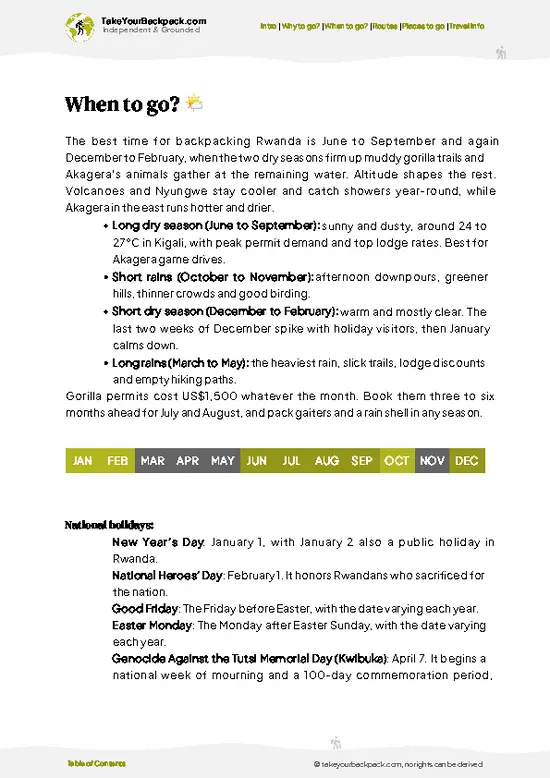
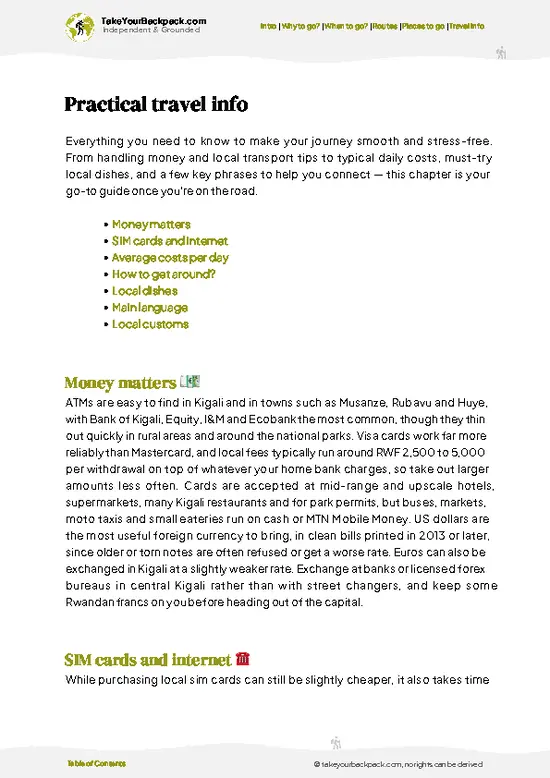
example page 0 from our offline Travel Guide for Rwanda
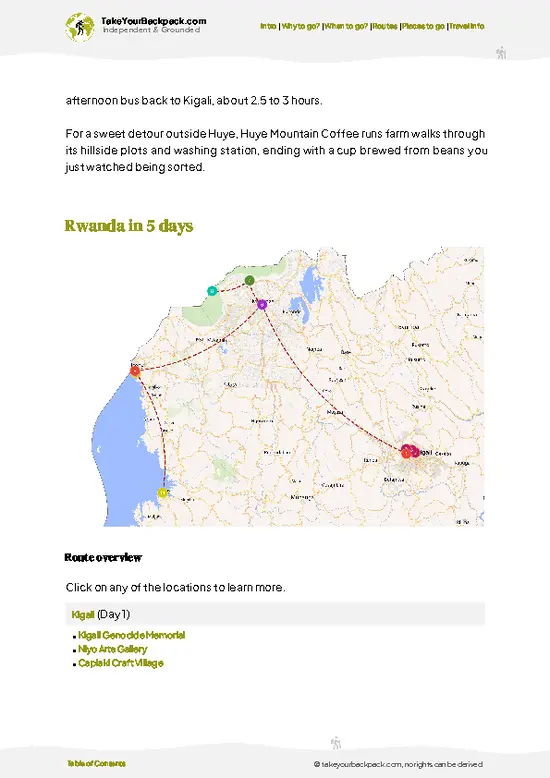
example page 1 from our offline Travel Guide for Rwanda
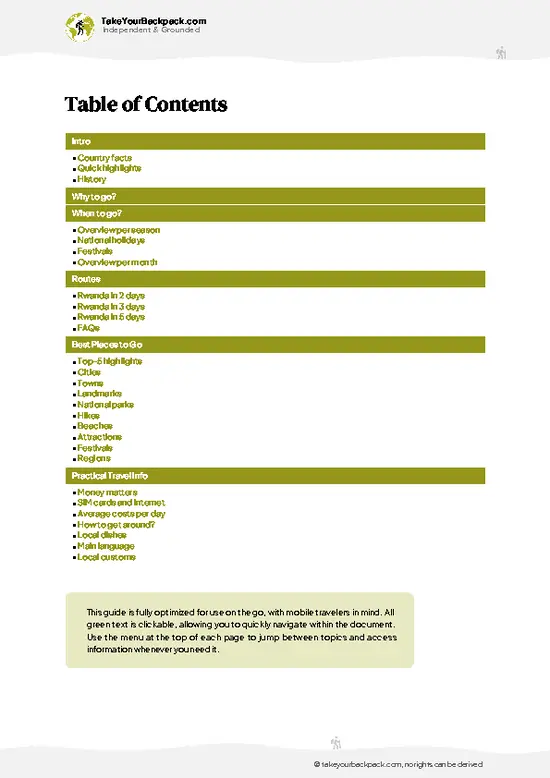
example page 2 from our offline Travel Guide for Rwanda
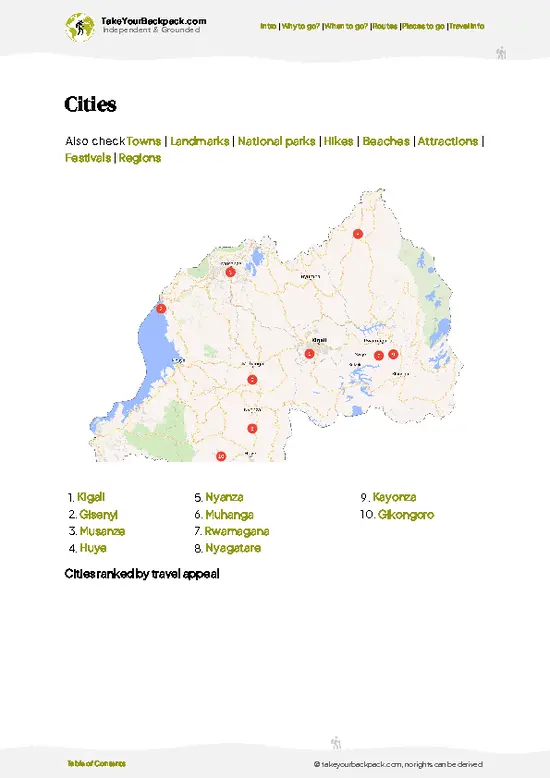
example page 3 from our offline Travel Guide for Rwanda
example page 4 from our offline Travel Guide for Rwanda
example page 5 from our offline Travel Guide for Rwanda
example page 6 from our offline Travel Guide for Rwanda
example page 7 from our offline Travel Guide for Rwanda
Loading the map 🌍
CLICK TO FILTER
cities
towns
landmarks
national parks
hikes
beaches
attractions
festivals
regions
SHOW COUNTRY’S BESTSHOW ALL

✨ Why go?
Ranked #3 national park in Rwanda
What makes it a must-see national park

Lake Muhazi suits travelers who like making their own plan, because nothing here is run by permit or guided circuit. You pick a ridge road, follow it down to the water and decide for yourself whether to walk, paddle or sit with a grilled tilapia. That freedom is the main draw, especially after Rwanda’s tightly managed gorilla and national park experiences.

The lake is also a gentle counterweight to the country’s big-ticket trips. It stretches roughly 60 kilometers in length yet is rarely wider than a couple of kilometers, so the opposite shore is always in view and the water looks like a river between green hills. The east end near Gahini adds history, with a church and hospital tied to the East African Revival.

For budget travelers, lodges and beach clubs on the shore offer simple stays … read more 👉
Lake Muhazi suits travelers who like making their own plan, because nothing here is run by permit or guided circuit. You pick a ridge road, follow it down to the water and decide for yourself whether to walk, paddle or sit with a grilled tilapia. That freedom is the main draw, especially after Rwanda’s tightly managed gorilla and national park experiences.

The lake is also a gentle counterweight to the country’s big-ticket trips. It stretches roughly 60 kilometers in length yet is rarely wider than a couple of kilometers, so the opposite shore is always in view and the water looks like a river between green hills. The east end near Gahini adds history, with a church and hospital tied to the East African Revival.

For budget travelers, lodges and beach clubs on the shore offer simple stays and camping-style options, and village food is cheap. You can do all of it without a tour operator, as long as you accept slow transport and a few conversations in Kinyarwanda or French.

💡 HighlightsEssential experiences to have while exploring Lake Muhazi

  1. Kayaking and boat rides on the main lake: The calm, sheltered water is the reason most people come. Paddling the narrow arms puts you beside papyrus beds and fishing canoes, with the hills rising straight from the water.
  2. Grilled tilapia at a lakeside restaurant: Fish comes out of the lake the same day and is served whole with fries or cooked bananas. Eating it on a terrace over the water is a standard Muhazi ritual.
  3. Birdwatching along the papyrus edges: The reed fringes and shallow inlets attract kingfishers, cormorants, herons and other waterbirds. Early morning on the water or a quiet shoreline path gives the best sightings.
  4. Gahini and its Anglican church: At the eastern end of the lake, Gahini is known for its mission hospital and church, where the East African Revival movement began in the
… read more 👉
  1. Kayaking and boat rides on the main lake: The calm, sheltered water is the reason most people come. Paddling the narrow arms puts you beside papyrus beds and fishing canoes, with the hills rising straight from the water.
  2. Grilled tilapia at a lakeside restaurant: Fish comes out of the lake the same day and is served whole with fries or cooked bananas. Eating it on a terrace over the water is a standard Muhazi ritual.
  3. Birdwatching along the papyrus edges: The reed fringes and shallow inlets attract kingfishers, cormorants, herons and other waterbirds. Early morning on the water or a quiet shoreline path gives the best sightings.
  4. Gahini and its Anglican church: At the eastern end of the lake, Gahini is known for its mission hospital and church, where the East African Revival movement began in the 1930s. It adds a cultural stop to a nature-based visit.
  5. Fishing cooperatives at work: Local fishers set out in wooden canoes at dawn and return with small catches. You can watch from the shore and chat with them if you are polite and curious.
  6. Ridge-road views over the arms of the lake: Roads that run along the hilltops show the lake’s odd shape, with fingers of water threading between eucalyptus-covered slopes. It is the best way to understand the geography.
Walking the shoreline and ridge roads around Lake Muhazi costs nothing, and watching the fishing canoes from the bank is just as free.
Spotted a mistake or missing something? Contact us.

Things to do near Lake Muhazi

Ratings based on Tripadvisor reviews. When you book through this link, you support our work at no extra cost to you.

🌤️ When to go?Seasonal considerations and timing

  • Long Dry Season (June to September): Lake Muhazi is at its most reliable, with clear mornings around 12 to 14°C (54 to 57°F) and afternoons of 25 to 28°C (77 to 82°F). Dirt roads around the shoreline stay firm, and boat trips and cycling run smoothly.
  • Short Dry Spell (December to February): Warm, bright days of 24 to 28°C (75 to 82°F) draw Kigali weekenders, so lakeside lodges fill on Saturdays and rates rise by roughly US$10 to 25.
  • Long Rains (March to May): Downpours turn side tracks to slick red clay. Highs stay near 24°C (75°F), prices dip, and the shore is nearly empty.
  • Short Rains (October to November): Afternoon storms are common but brief, and the hills turn green. Mornings are usually clear for kayaking or birdwatching.
Daylight stays close to 12 hours all year, so plan walks and boat … read more 👉
  • Long Dry Season (June to September): Lake Muhazi is at its most reliable, with clear mornings around 12 to 14°C (54 to 57°F) and afternoons of 25 to 28°C (77 to 82°F). Dirt roads around the shoreline stay firm, and boat trips and cycling run smoothly.
  • Short Dry Spell (December to February): Warm, bright days of 24 to 28°C (75 to 82°F) draw Kigali weekenders, so lakeside lodges fill on Saturdays and rates rise by roughly US$10 to 25.
  • Long Rains (March to May): Downpours turn side tracks to slick red clay. Highs stay near 24°C (75°F), prices dip, and the shore is nearly empty.
  • Short Rains (October to November): Afternoon storms are common but brief, and the hills turn green. Mornings are usually clear for kayaking or birdwatching.
Daylight stays close to 12 hours all year, so plan walks and boat rides for the morning, and book weekend rooms ahead if you travel in dry months.


source: climatestotravel.comJANJanuary: excellent for travelingFEBFebruary: excellent for travelingMARMarch: fair for travelingAPRApril: fair for travelingMAYMay: good for travelingJUNJune: excellent for travelingJULJuly: excellent for travelingAUGAugust: excellent for travelingSEPSeptember: highly recommended for travelingOCTOctober: good for travelingNOVNovember: fair for travelingDECDecember: excellent for traveling
when-to-go

✈️ The backpacker research shortcutRwanda Travel Guide

An offline-friendly backpacking guide with optimized travel routes, ranked highlights, transport advice, and the best areas to stay.
example page 0 from our offline Travel Guide for Rwanda
example page 1 from our offline Travel Guide for Rwanda
example page 2 from our offline Travel Guide for Rwanda
example page 3 from our offline Travel Guide for Rwanda
example page 4 from our offline Travel Guide for Rwanda
example page 5 from our offline Travel Guide for Rwanda
example page 6 from our offline Travel Guide for Rwanda
example page 7 from our offline Travel Guide for Rwanda
The digital guide (233 pages) contains:
✅ 57 highlights, ranked by travel appeal
✅ Optimized 2, 3 & 5-day travel routes
✅ Cities, national parks, landmarks, beaches
✅ How to get around
✅ Offline-friendly for travel without Wi-Fi
👉 Click to see all 30+ guide features

📅 Plan smarter in minutes, not weeks
✅ Month by month travel advice
✅ Festivals & national holidays
✅ Budget expectations

🗺️ Go to the right places, skip the overrated ones
✅ Honest pros & cons of destinations
✅ Top hikes, parks & viewpoints
✅ Lesser-known places most travelers miss
✅ Clear “worth it vs skip it” guidance

🛏️ Travel smoothly without rookie mistakes
✅ Best areas to stay
✅ Transport systems explained simply
✅ Common scams & safety advice
✅ SIM cards, money & practical tips

🌍 Understand the country, not just visit it
✅ Culture & traditions
✅ 52 Essential phrases & customs
✅ Festivals worth planning around
✅ Traveler-friendly historical context
✅ Insights that make places more meaningful

📱 Built for real travel conditions
✅ Fully downloadable PDF
✅ Works completely offline
✅ Optimized for phone use
✅ Useful in remote areas & buses
✅ Everything in one place
Stop searching, start planning
Get instant access to your full guide. 30‑day money-back guarantee.
+ Add another guide for just

By proceeding you agree to our terms.
Sent to your inbox immediately after payment • 100% Secure Checkout
Best Backpacking Travel Advisor 2025 tourism awardBest Backpacking
Travel Advisor
2025
What others say about Take Your Backpack Guides:
⭐⭐⭐⭐⭐
Fantastic, amazing amount of information!
⭐⭐⭐⭐⭐
My goodness this is amazing, it's what I've been looking for hats off too you!
⭐⭐⭐⭐⭐
I think this is absolutely BRILLIANT
⭐⭐⭐⭐
Very complete and informative. It's still missing places, but I gotta to commend you
⭐⭐⭐⭐⭐
This is truly amazing, thank you, can't wait to explore it with my kids!
⭐⭐⭐⭐⭐
Awesome resource, thank you!
⭐⭐⭐⭐⭐
This is amazing! Can't wait to explore the ones I haven't seen
⭐⭐⭐⭐
I love this! Well done, great idea.
⭐⭐⭐⭐⭐
Thanks for taking the time to make this gem!
⭐⭐⭐⭐⭐
This might be the best website I've ever seen.
⭐⭐⭐⭐⭐
Congratulations, and thank you so much for your work; it's incredibly valuable.
⭐⭐⭐⭐
In all seriousness I think you did a great job pointing out the important spots
⭐⭐⭐⭐⭐
10/10 very good
⭐⭐⭐⭐⭐
As someone who's only just starting to visit regularly this is awesome, thank you.
⭐⭐⭐⭐
Thank you very much! I'm going to visit my dad, it's going to be very useful!
⭐⭐⭐⭐⭐
This is really cool! We'll be travelling for the first time and this definitely come in handy.
⭐⭐⭐⭐⭐
You are now our minister of culture, congratulations 👨‍💼
⭐⭐⭐⭐⭐
Just wanted to tell you that this is a pearl! Going to follow your recommendations.
⭐⭐⭐⭐⭐
This is so cool. I'll definitely be using the resource for my travels soon.
⭐⭐⭐⭐⭐
This is very impressive! Good work.
⭐⭐⭐⭐⭐
This is an amazing and informative site. Very well done!

🛏️ Where to stay?How to pick the right area

No accommodation sits inside a park boundary here, because Lake Muhazi is an open lakeshore dotted with small lodges, so you sleep at the water’s edge or in nearby towns. Most backpackers use Kigali, about an hour’s drive west, as a cheap base. Dorm beds there run US$10 to 20, and you reach the lake on a day trip by moto-taxi or minibus.
If you want to wake up beside the water, look at the lodges and resorts along the southern and western shore, such as those near Rwamagana and Gahini. Simple rooms cost about US$25 to 60, and a few places allow camping for around US$5 to 10 with your own tent. … read more 👉
No accommodation sits inside a park boundary here, because Lake Muhazi is an open lakeshore dotted with small lodges, so you sleep at the water’s edge or in nearby towns. Most backpackers use Kigali, about an hour’s drive west, as a cheap base. Dorm beds there run US$10 to 20, and you reach the lake on a day trip by moto-taxi or minibus.
If you want to wake up beside the water, look at the lodges and resorts along the southern and western shore, such as those near Rwamagana and Gahini. Simple rooms cost about US$25 to 60, and a few places allow camping for around US$5 to 10 with your own tent. Weekends are busier, and midweek stays are quieter and often cheaper.
Rwamagana, on the main road east of Kigali, is the practical town stop. It has guesthouses at US$12 to 30 a night, markets for self-catering, and frequent minibuses to the lakeshore. Gicumbi and Rwamagana side roads are rough, so arrive before dark and arrange a moto-taxi ride in advance.

👛 Costs (as of 22 October 2026)How expensive it really is

A day at Lake Muhazi typically costs about US$42 to 70 for a backpacker, with lodging as the biggest line. There is no formal entrance fee for the lakeshore, and you pay mostly for lodging, food and boat time. Prices are paid in Rwandan francs, though some lodges quote in dollars.
CategoryBudget RangeLocal Reality
Entrance FeeUS$0The open shoreline has no gate or ticket. Some resorts charge US$3 to 10 for day access to their beach.
Accommodation (High Season)US$25 to 40Simple lakeside rooms or guesthouses in dry months and weekends. Camping is US$5 to 10 where offered.
Accommodation (Low Season)US$15 to 30Rates soften during the March to May rains, especially midweek.
Local TransportUS$4 to 8Minibus from Kigali costs roughly US$1 to 3 each way, and moto-taxis along the shore cost US$1 to 4 per
… read more 👉
A day at Lake Muhazi typically costs about US$42 to 70 for a backpacker, with lodging as the biggest line. There is no formal entrance fee for the lakeshore, and you pay mostly for lodging, food and boat time. Prices are paid in Rwandan francs, though some lodges quote in dollars.
CategoryBudget RangeLocal Reality
Entrance FeeUS$0The open shoreline has no gate or ticket. Some resorts charge US$3 to 10 for day access to their beach.
Accommodation (High Season)US$25 to 40Simple lakeside rooms or guesthouses in dry months and weekends. Camping is US$5 to 10 where offered.
Accommodation (Low Season)US$15 to 30Rates soften during the March to May rains, especially midweek.
Local TransportUS$4 to 8Minibus from Kigali costs roughly US$1 to 3 each way, and moto-taxis along the shore cost US$1 to 4 per ride.
Food and SuppliesUS$8 to 12Grilled tilapia, brochettes and buffet-style meals at local restaurants. Lodge restaurants charge more.
ActivitiesUS$5 to 10Kayak, canoe or short boat rental for an hour or two.
Total Daily BudgetUS$42 to 70Roughly US$50 for a typical backpacker day.
⚠️ Prices can change and everyone travels differently, so take this as a rough guide. Hope it helps you plan your adventure!

🥾 TrailsHiking Lake Muhazi national park: highlights and difficulty

Lake Muhazi has no named, signposted trails, so the walking is done on village paths and ridge roads that people use every day. The most popular routes start at a lakeside lodge or landing and follow the shore for a couple of hours, passing banana plots, small farms and papyrus beds. Distances are loose, because you can turn back whenever you like.
  • Shoreline stroll: Easy and mostly flat, following dirt paths from a lodge along the water. Expect one to two hours at an easy pace, with birds in the reeds and fishing canoes close to the bank.
  • Ridge-road walk: Moderate, with steady up-and-down climbs
… read more 👉
Lake Muhazi has no named, signposted trails, so the walking is done on village paths and ridge roads that people use every day. The most popular routes start at a lakeside lodge or landing and follow the shore for a couple of hours, passing banana plots, small farms and papyrus beds. Distances are loose, because you can turn back whenever you like.
  • Shoreline stroll: Easy and mostly flat, following dirt paths from a lodge along the water. Expect one to two hours at an easy pace, with birds in the reeds and fishing canoes close to the bank.
  • Ridge-road walk: Moderate, with steady up-and-down climbs on dirt roads above the water. Half a day gives wide views over the lake’s fingers, but there is little shade, so bring a hat and water.
  • Village loop: Easy to moderate, linking the shore to nearby hamlets and a market or two. Allow two to three hours, and greet people as you pass, since it is the polite way to walk through a farming area.
  • Paddle and walk combination: Moderate, mixing a short kayak or boat trip with a walk back along the shore. It suits a full day, with the water giving a different angle on the same hills.
Wildlife is mostly birds, with kingfishers, herons and cormorants around the reeds, plus the occasional monitor lizard sunning near the water. Do not expect large mammals. The terrain is red clay and loose soil that turns slick after rain, so shoes with grip matter.

Getting to Lake Muhazi by public transport is straightforward as far as the nearby towns, since minibuses leave Kigali regularly toward the east, but the last stretch to the shore usually means a moto taxi. There is no entrance fee because there is no park gate, though lodges with lake access may charge for day use or boat hire. Weekends draw crowds of Kigali visitors to the beach clubs, while weekdays are calm and the paths are nearly empty.
⚠️ Hiking info can sometimes be outdated or inaccurate. Before you hit the trail, check the latest conditions with locals. If you do spot anything that's off, I'd love to hear from you, so I can update it for fellow travelers.

🛡️ SafetyStaying Safe: What Travelers Should Know

Lake Muhazi is a low-key, easy destination where the main hazards are sun, road traffic and slippery clay paths rather than anything dramatic. Lakeside trails are gentle, but after rain the red soil gets greasy on slopes, so wear shoes with real grip and take your time on descents. The lake sits at roughly 1,400 to 1,500 meters, so the equatorial sun burns quickly. Bring a hat, sunscreen and a liter or two of water, since shoreline shops are sparse.
Moto-taxis are the main transport, and you should insist on the helmet, which is legally required in Rwanda. Boat and kayak operators supply life jackets. Wear one, and skip swimming in the lake, where bilharzia is a risk in shallow reedy edges. Hippos are not an issue here, and the wildlife you meet is mostly birds, so keep binoculars handy. Rwanda … read more 👉
Lake Muhazi is a low-key, easy destination where the main hazards are sun, road traffic and slippery clay paths rather than anything dramatic. Lakeside trails are gentle, but after rain the red soil gets greasy on slopes, so wear shoes with real grip and take your time on descents. The lake sits at roughly 1,400 to 1,500 meters, so the equatorial sun burns quickly. Bring a hat, sunscreen and a liter or two of water, since shoreline shops are sparse.
Moto-taxis are the main transport, and you should insist on the helmet, which is legally required in Rwanda. Boat and kayak operators supply life jackets. Wear one, and skip swimming in the lake, where bilharzia is a risk in shallow reedy edges. Hippos are not an issue here, and the wildlife you meet is mostly birds, so keep binoculars handy. Rwanda is calm and orderly, but keep valuables out of sight in crowded Kigali bus stations.

FAQFrequently asked questions about Lake Muhazi

One full day is enough for Lake Muhazi, and two days let you slow down. Most people reach the shoreline from Kigali in about an hour, spend a day kayaking, walking or eating grilled tilapia, and return in the evening. An overnight stay at a lakeside lodge near Rwamagana costs roughly US$25 to 60.
Yes, Lake Muhazi works well without a car. Minibuses run from Kigali’s Nyabugogo station toward Rwamagana and Gahini for about US$1 to 3, and journeys take 45 minutes to 1.5 hours depending on your stop. From the road, moto-taxis cover the last stretch to lodges for US$1 to 4 per ride.
Lake Muhazi has no park entrance fee and no permit requirement for walking along the shore. Some lodges and beach resorts charge day-use fees of about US$3 to 10, and boat or kayak hire costs around US$5 to 10 for an hour or two. Carry some cash in Rwandan francs, since small lakeside businesses rarely take cards.
⚠️ Things can change over time, so always validate details locally before you go.

Other Rwandan national parks near Lake Muhazi

Explore more nearby:

  • Akagera National Park—Lake Ihema boat trips, savanna game drives, black rhinos, northern lion plains| 37 km away
  • Volcanoes National Park—Mountain gorillas, golden monkeys, Bisoke crater lake, Karisimbi climb| 99 km away
  • Lake Kivu—Congo Nile Trail, Rubavu beaches, bat island, shoreline fishing boats| 116 km away

💡 Not sure where to go next?
Create a personalized itinerary for Rwanda including Lake Muhazi and the places that fit your trip.

Generate my itinerary

👉 Discover all national parks

Or checkout all Rwanda has to offer (think cities, towns, villages, national parks, hikes, beaches, festivals)
Country photo of Rwanda

We 💚 feedbackSumming up the experience

Lake Muhazi works best as a slow day or one-night break between Kigali and Akagera National Park, giving your legs a rest from the capital and the savanna drives. I would go on a weekday, take a morning paddle, and keep the afternoon free for fish and a ridge walk. Bring cash, since card machines are rare.

✍️ Help improve this page!
The information on this page is based on in-depth research, insights shared by experienced travelers, and feedback from the local travel community in Rwanda. While every effort is made to keep the information accurate and current, conditions can change — so if you spot anything incorrect or outdated, please get in touch.


🙋‍♂️ Give feedback

👋 Meet the founderWho’s Behind Take Your Backpack?

Johan, backpacker and founder of TakeYourBackpackHi, I’m Johan (Netherlands 🇳🇱), the creator of TakeYourBackpack. Over the past 3 decades, I’ve backpacked through 90+ countries across six continents, gaining extensive experience with independent travel, long-term trips, and overland routes.

This site is built on a combination of firsthand travel experience and carefully curated insights from other backpackers. Many guides are based on places I’ve personally visited, while others bring together tips, observations, and practical advice shared by trusted travelers I’ve met along the way.

The goal is to provide realistic, experience-driven guidance — not generic itineraries — so you can explore destinations with better context, clearer expectations, and more confidence.