×

Rwanda🇷🇼 | national parksNyungwe Forest National ParkCanopy walkway, chimp tracking, colobus troops, Albertine Rift birds | things to do and best time to go

Explore Akagera National ParkExplore Volcanoes National Park

Backpacking in Nyungwe Forest
UNESCO World Heritage site
👍 Recommendednational park ranked #2
By Johan Kruseman 🇳🇱 | Updated October 22, 2026

Nyungwe Forest National Park is one of the few places in Rwanda where you can hike for days without a crowd, and the main trails can be walked in a day or two with a guide. It lies in the southwest of Rwanda, along the Congo-Nile Divide, with montane rainforest that covers steep ridges and valleys. The scenery is dense and green, and the canopy walkway is the best-known feature. Wildlife includes chimpanzees, colobus monkeys and more than 300 bird species, though sightings are never guaranteed and tracking takes early starts and patience. Rain is frequent, trails are muddy, and fog can hide the views. Costs catch people out: permits for chimpanzee tracking and the canopy walk sell out in busy months, so book through the Rwanda Development Board or an operator ahead of time. Guides are compulsory on all trails, so do not plan a free-roaming trip. Before going, buy permits first and book lodging second.

Discover everything you want to know in the 📖 Rwanda Travel Guide.


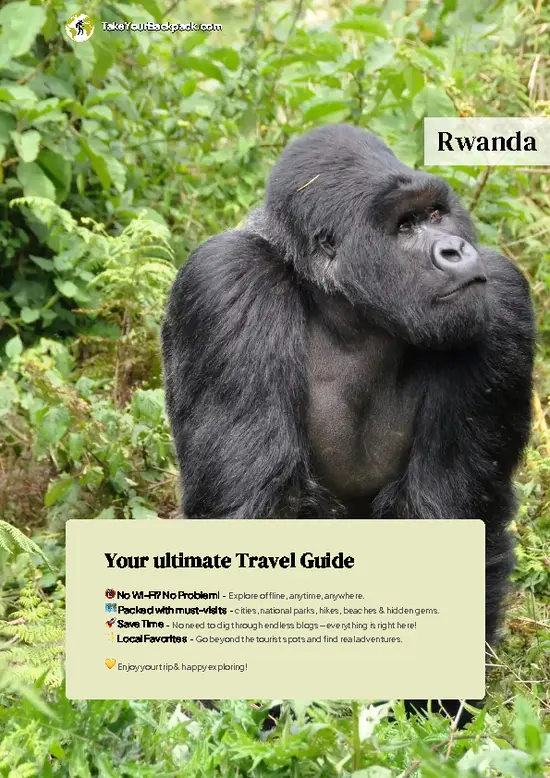
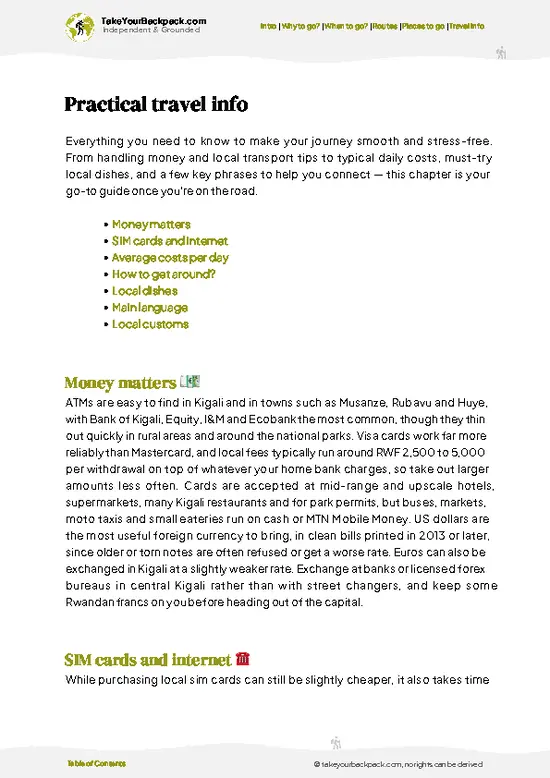
example page 0 from our offline Travel Guide for Rwanda
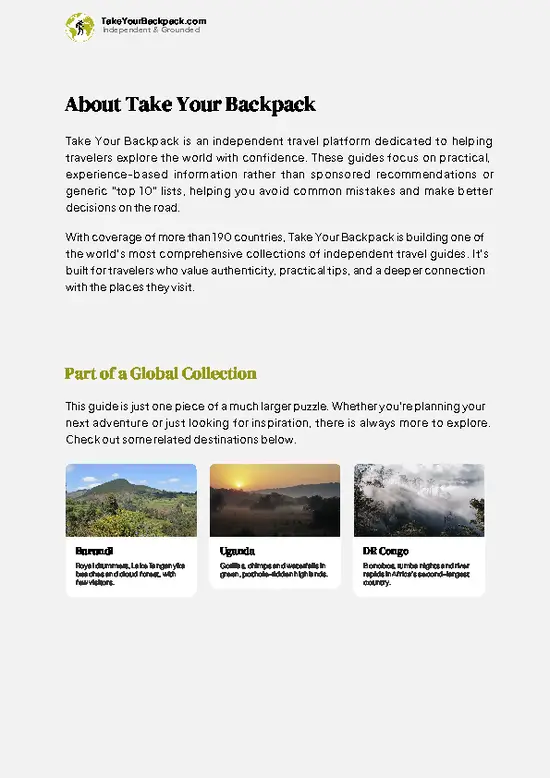
example page 1 from our offline Travel Guide for Rwanda
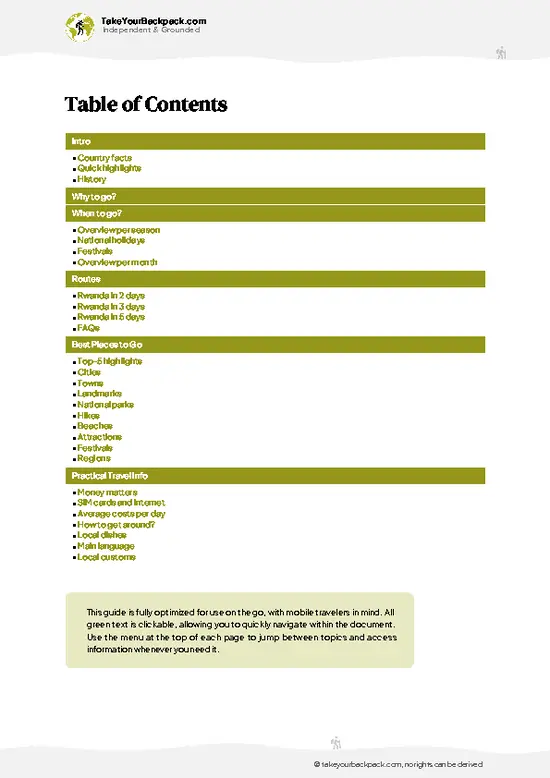
example page 2 from our offline Travel Guide for Rwanda
example page 3 from our offline Travel Guide for Rwanda
example page 4 from our offline Travel Guide for Rwanda
example page 5 from our offline Travel Guide for Rwanda
example page 6 from our offline Travel Guide for Rwanda
example page 7 from our offline Travel Guide for Rwanda
Loading the map 🌍
CLICK TO FILTER
cities
towns
landmarks
national parks
hikes
beaches
attractions
festivals
regions
SHOW COUNTRY’S BESTSHOW ALL

✨ Why go?
Ranked #2 national park in Rwanda
The unique appeal for travelers

Nyungwe Forest National Park suits backpackers who want trail variety without needing a vehicle on the trail itself. Walks start from a handful of trailheads along the road, so you can string together several short hikes over a few days rather than commit to one long expedition. The Congo-Nile Trail links the park region with Lake Kivu, and it appeals to anyone who likes to cross a landscape on foot, with villages, tea plantations and farmland along the way. Guides are required inside the forest, which keeps the experience structured, but the price is shared across a small group so it suits independent travelers. The park also has a canopy walkway about 50 meters above the forest floor, a rare chance to see the treetops without a long hike. Add chimpanzee tracking at dawn and you can fill … read more 👉
Nyungwe Forest National Park suits backpackers who want trail variety without needing a vehicle on the trail itself. Walks start from a handful of trailheads along the road, so you can string together several short hikes over a few days rather than commit to one long expedition. The Congo-Nile Trail links the park region with Lake Kivu, and it appeals to anyone who likes to cross a landscape on foot, with villages, tea plantations and farmland along the way. Guides are required inside the forest, which keeps the experience structured, but the price is shared across a small group so it suits independent travelers. The park also has a canopy walkway about 50 meters above the forest floor, a rare chance to see the treetops without a long hike. Add chimpanzee tracking at dawn and you can fill several days with very different activities. Nyungwe rewards travelers who plan permits ahead and arrive prepared for wet weather.

💡 HighlightsWhat this place is best known for

  1. Canopy Walkway: A suspension bridge of roughly 160 meters that hangs about 50 meters above the forest floor, reached by a short trail from Uwinka. You look down on treetops, birds and sometimes monkeys, and the walk takes about an hour.
  2. Chimpanzee Tracking: Trackers lead small groups to habituated chimpanzee communities. Starts are early, the terrain is steep and muddy, and the encounter can last an hour once you find them.
  3. Colobus Monkey Tracking: Large groups of Angolan colobus live here, sometimes numbering in the hundreds. They are easier to find than chimps and make a good half-day outing.
  4. Bigugu Trail: The hardest day hike, climbing toward the park’s highest point at about 2,950 meters. It is a long, steep, rewarding walk for fit hikers.
  5. Isumo Waterfall Trail: A long walk through forest,
… read more 👉
  1. Canopy Walkway: A suspension bridge of roughly 160 meters that hangs about 50 meters above the forest floor, reached by a short trail from Uwinka. You look down on treetops, birds and sometimes monkeys, and the walk takes about an hour.
  2. Chimpanzee Tracking: Trackers lead small groups to habituated chimpanzee communities. Starts are early, the terrain is steep and muddy, and the encounter can last an hour once you find them.
  3. Colobus Monkey Tracking: Large groups of Angolan colobus live here, sometimes numbering in the hundreds. They are easier to find than chimps and make a good half-day outing.
  4. Bigugu Trail: The hardest day hike, climbing toward the park’s highest point at about 2,950 meters. It is a long, steep, rewarding walk for fit hikers.
  5. Isumo Waterfall Trail: A long walk through forest, bamboo and tea plantations to a three-tiered waterfall. It suits people who want scenery and a swim-free picnic stop.
  6. Karamba Bird Trail: A gentle path suited to birders, with Albertine Rift endemics such as Rwenzori turaco and many other forest species.
  7. Irebero Trail: A moderate walk through orchid-rich forest and swampy sections, good for seeing flowers, butterflies and small primates.
The canopy walkway and the Igishigishigi Trail that leads to it pair well in one morning, leaving the afternoon free for rest.
Spotted a mistake or missing something? Contact us.

Things to do near Nyungwe Forest National Park

Ratings based on Tripadvisor reviews. When you book through this link, you support our work at no extra cost to you.

🌤️ When to go?Best time to explore Nyungwe Forest

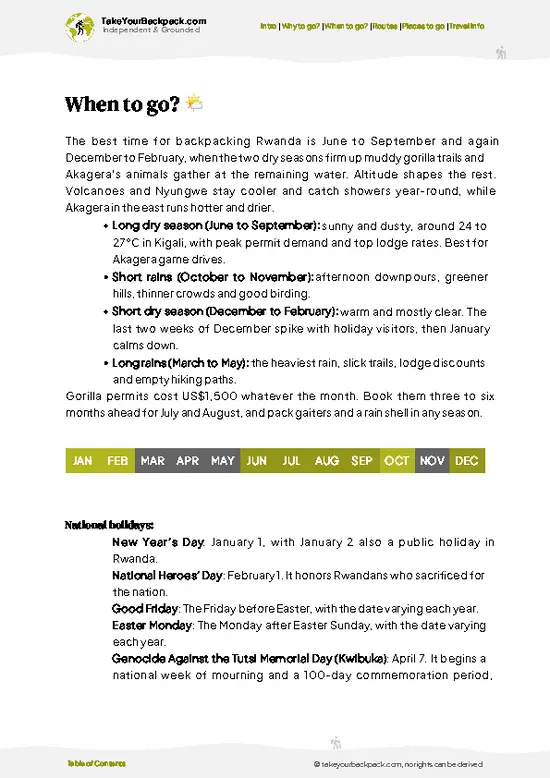
  • Long Dry Season (June to August): Nyungwe’s firmest trails and clearest skies come now, with daytime highs of 18 to 23°C (64 to 73°F) and chilly dawns near 8 to 10°C (46 to 50°F). Chimp tracking and the canopy walkway are busiest, so lodges and permits fill early and rates peak.
  • Short Dry Season (December to February): Similar sunshine with slightly warmer afternoons, up to about 24°C (75°F). Birding is excellent and the Congo Nile Trail side routes are passable.
  • Long Rains (March to May): Mist, daily downpours and slick red clay. Crowds thin out, some lodges discount rooms by 20 to 30 percent, and leeches and mud slow every trek. April is the wettest.
  • Short Rains (October to November): Showers usually arrive in the afternoon, so mornings still work for hiking. Primates are easier to find when
… read more 👉
  • Long Dry Season (June to August): Nyungwe’s firmest trails and clearest skies come now, with daytime highs of 18 to 23°C (64 to 73°F) and chilly dawns near 8 to 10°C (46 to 50°F). Chimp tracking and the canopy walkway are busiest, so lodges and permits fill early and rates peak.
  • Short Dry Season (December to February): Similar sunshine with slightly warmer afternoons, up to about 24°C (75°F). Birding is excellent and the Congo Nile Trail side routes are passable.
  • Long Rains (March to May): Mist, daily downpours and slick red clay. Crowds thin out, some lodges discount rooms by 20 to 30 percent, and leeches and mud slow every trek. April is the wettest.
  • Short Rains (October to November): Showers usually arrive in the afternoon, so mornings still work for hiking. Primates are easier to find when fruit is in season.
Daylight stays close to 12 hours all year, so start treks early. Book chimp permits at least a month ahead for June to August.


source: climatestotravel.comJANJanuary: fair for travelingFEBFebruary: fair for travelingMARMarch: fair for travelingAPRApril: fair for travelingMAYMay: highly recommended for travelingJUNJune: excellent for travelingJULJuly: highly recommended for travelingAUGAugust: highly recommended for travelingSEPSeptember: excellent for travelingOCTOctober: highly recommended for travelingNOVNovember: fair for travelingDECDecember: fair for traveling
when-to-go

✈️ The backpacker research shortcutRwanda Travel Guide

An offline-friendly backpacking guide with optimized travel routes, ranked highlights, transport advice, and the best areas to stay.
example page 0 from our offline Travel Guide for Rwanda
example page 1 from our offline Travel Guide for Rwanda
example page 2 from our offline Travel Guide for Rwanda
example page 3 from our offline Travel Guide for Rwanda
example page 4 from our offline Travel Guide for Rwanda
example page 5 from our offline Travel Guide for Rwanda
example page 6 from our offline Travel Guide for Rwanda
example page 7 from our offline Travel Guide for Rwanda
The digital guide (233 pages) contains:
✅ 57 highlights, ranked by travel appeal
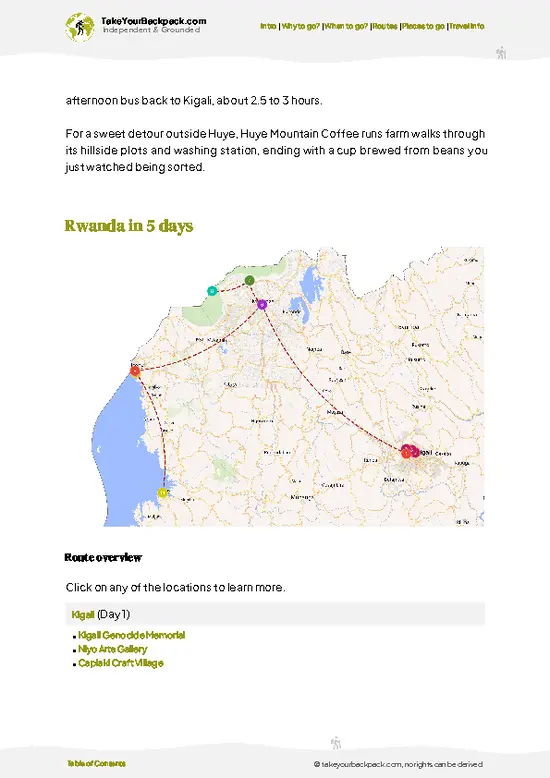
✅ Optimized 2, 3 & 5-day travel routes
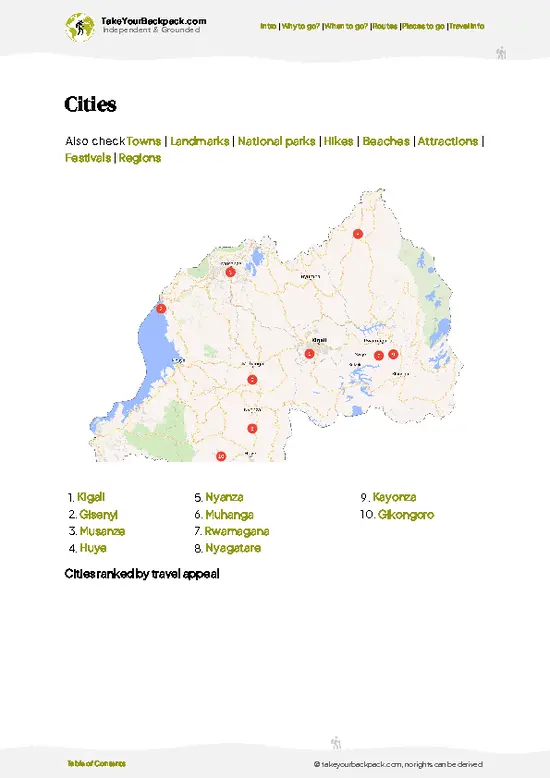
✅ Cities, national parks, landmarks, beaches
✅ How to get around
✅ Offline-friendly for travel without Wi-Fi
👉 Click to see all 30+ guide features

📅 Plan smarter in minutes, not weeks
✅ Month by month travel advice
✅ Festivals & national holidays
✅ Budget expectations

🗺️ Go to the right places, skip the overrated ones
✅ Honest pros & cons of destinations
✅ Top hikes, parks & viewpoints
✅ Lesser-known places most travelers miss
✅ Clear “worth it vs skip it” guidance

🛏️ Travel smoothly without rookie mistakes
✅ Best areas to stay
✅ Transport systems explained simply
✅ Common scams & safety advice
✅ SIM cards, money & practical tips

🌍 Understand the country, not just visit it
✅ Culture & traditions
✅ 52 Essential phrases & customs
✅ Festivals worth planning around
✅ Traveler-friendly historical context
✅ Insights that make places more meaningful

📱 Built for real travel conditions
✅ Fully downloadable PDF
✅ Works completely offline
✅ Optimized for phone use
✅ Useful in remote areas & buses
✅ Everything in one place
Stop searching, start planning
Get instant access to your full guide. 30‑day money-back guarantee.
+ Add another guide for just

By proceeding you agree to our terms.
Sent to your inbox immediately after payment • 100% Secure Checkout
Best Backpacking Travel Advisor 2025 tourism awardBest Backpacking
Travel Advisor
2025
What others say about Take Your Backpack Guides:
⭐⭐⭐⭐⭐
Fantastic, amazing amount of information!
⭐⭐⭐⭐⭐
My goodness this is amazing, it's what I've been looking for hats off too you!
⭐⭐⭐⭐⭐
I think this is absolutely BRILLIANT
⭐⭐⭐⭐
Very complete and informative. It's still missing places, but I gotta to commend you
⭐⭐⭐⭐⭐
This is truly amazing, thank you, can't wait to explore it with my kids!
⭐⭐⭐⭐⭐
Awesome resource, thank you!
⭐⭐⭐⭐⭐
This is amazing! Can't wait to explore the ones I haven't seen
⭐⭐⭐⭐
I love this! Well done, great idea.
⭐⭐⭐⭐⭐
Thanks for taking the time to make this gem!
⭐⭐⭐⭐⭐
This might be the best website I've ever seen.
⭐⭐⭐⭐⭐
Congratulations, and thank you so much for your work; it's incredibly valuable.
⭐⭐⭐⭐
In all seriousness I think you did a great job pointing out the important spots
⭐⭐⭐⭐⭐
10/10 very good
⭐⭐⭐⭐⭐
As someone who's only just starting to visit regularly this is awesome, thank you.
⭐⭐⭐⭐
Thank you very much! I'm going to visit my dad, it's going to be very useful!
⭐⭐⭐⭐⭐
This is really cool! We'll be travelling for the first time and this definitely come in handy.
⭐⭐⭐⭐⭐
You are now our minister of culture, congratulations 👨‍💼
⭐⭐⭐⭐⭐
Just wanted to tell you that this is a pearl! Going to follow your recommendations.
⭐⭐⭐⭐⭐
This is so cool. I'll definitely be using the resource for my travels soon.
⭐⭐⭐⭐⭐
This is very impressive! Good work.
⭐⭐⭐⭐⭐
This is an amazing and informative site. Very well done!

🛏️ Where to stay?Where staying makes the most sense

The best base for backpackers is the Gisakura and Kitabi area on the park’s northern edge, with Cyangugu (Rusizi) at the southern end as the other practical option. Inside the park, Nyungwe Top View Hill Hotel and the Uwinka area offer limited options, with camping near Uwinka at about US$20 to 30 per person if you carry a tent.

Gisakura is the sweet spot for budget travelers. Guesthouses and small lodges near the tea estates cost roughly US$25 to 60 a night for a simple double, and the Nyungwe Nziza Ecolodge and Gisakura Guest House are common picks. Dorm-style beds are rare, so travelers often … read more 👉
The best base for backpackers is the Gisakura and Kitabi area on the park’s northern edge, with Cyangugu (Rusizi) at the southern end as the other practical option. Inside the park, Nyungwe Top View Hill Hotel and the Uwinka area offer limited options, with camping near Uwinka at about US$20 to 30 per person if you carry a tent.

Gisakura is the sweet spot for budget travelers. Guesthouses and small lodges near the tea estates cost roughly US$25 to 60 a night for a simple double, and the Nyungwe Nziza Ecolodge and Gisakura Guest House are common picks. Dorm-style beds are rare, so travelers often pair up to split rooms. Expect basic meals at a handful of roadside restaurants.

Kitabi has a couple of mid-range lodges and a conservation center, handy for early starts toward Kamiranzovu or Uwinka. Both areas sit along the main highway, so buses between Kigali, Huye and Rusizi will drop you at the door.

Rusizi town has cheaper rooms (US$15 to 35) and lake views over Lake Kivu, but it adds about two hours to the park’s northern trailheads. Book Gisakura rooms ahead for June to August.

👛 Costs (as of 22 October 2026)Money, prices, and spending tips

A realistic daily budget for Nyungwe Forest National Park is about US$116 to 190 when you stay in a basic lodge and do one paid activity. Most costs come from permits, which are the biggest line item, so plan around them.
CategoryBudget RangeLocal Reality
Park entrance feeUS$0 to 40Paid per activity rather than as a single gate fee, so costs are folded into guided walks.
ActivitiesUS$60 to 100Canopy walkway costs about US$60 to 70 and guided day hikes US$40 to 90. Chimp tracking is about US$90 to 100 per person.
Accommodation (high season)US$25 to 60Simple guesthouse doubles at Gisakura. Rates ease by 20 to 30 percent in the long rains.
CampingUS$20 to 30Near Uwinka, if you bring your own tent and stove.
Local transportUS$3 to 10Minibuses along the highway cost a few dollars; moto-taxis to trailheads
… read more 👉
A realistic daily budget for Nyungwe Forest National Park is about US$116 to 190 when you stay in a basic lodge and do one paid activity. Most costs come from permits, which are the biggest line item, so plan around them.
CategoryBudget RangeLocal Reality
Park entrance feeUS$0 to 40Paid per activity rather than as a single gate fee, so costs are folded into guided walks.
ActivitiesUS$60 to 100Canopy walkway costs about US$60 to 70 and guided day hikes US$40 to 90. Chimp tracking is about US$90 to 100 per person.
Accommodation (high season)US$25 to 60Simple guesthouse doubles at Gisakura. Rates ease by 20 to 30 percent in the long rains.
CampingUS$20 to 30Near Uwinka, if you bring your own tent and stove.
Local transportUS$3 to 10Minibuses along the highway cost a few dollars; moto-taxis to trailheads add a little more.
Food and suppliesUS$8 to 20Roadside meals of beans, rice and brochettes are cheap. Lodge dinners cost more, and snacks are best bought before arrival.
Total Daily BudgetUS$116 to 190Based on one activity, high-season lodging and local meals.


source: visitrwanda.com
⚠️ Prices can change and everyone travels differently, so take this as a rough guide. Hope it helps you plan your adventure!

🥾 TrailsTrail guide for Nyungwe Forest national park

Nyungwe Forest National Park has more than a dozen marked trails, from short forest strolls to full-day climbs, and all are walked with a ranger guide. Terrain is steep, wet and often slippery, with red clay, tree roots and stream crossings, so sturdy boots and rain gear matter.
  • Igishigishigi Trail: About 2 km, 1.5 to 2 hours, easy to moderate. Leads to the canopy walkway through mature forest with a chance of birds and primates.
  • Isumo Waterfall Trail: About 10 to 11 km, 4 to 5 hours, moderate to hard. Passes tea fields, bamboo and valley forest to a waterfall.
  • Bigugu Trail: About 8 km one way, 5
… read more 👉
Nyungwe Forest National Park has more than a dozen marked trails, from short forest strolls to full-day climbs, and all are walked with a ranger guide. Terrain is steep, wet and often slippery, with red clay, tree roots and stream crossings, so sturdy boots and rain gear matter.
  • Igishigishigi Trail: About 2 km, 1.5 to 2 hours, easy to moderate. Leads to the canopy walkway through mature forest with a chance of birds and primates.
  • Isumo Waterfall Trail: About 10 to 11 km, 4 to 5 hours, moderate to hard. Passes tea fields, bamboo and valley forest to a waterfall.
  • Bigugu Trail: About 8 km one way, 5 to 6 hours, hard. A steep climb with wide views on clear days.
  • Karamba Bird Trail: About 4 km, 2 to 3 hours, easy. Flat, quiet and good for birdwatching.
  • Irebero Trail: About 4 km, 2 to 3 hours, moderate. Passes orchids, ferns and a small swampy section.
  • Congo-Nile Trail: A multiday route of about 227 km along Lake Kivu that reaches the park region at its southern end, mostly on rural tracks with homestay stops.
Wildlife includes chimpanzees, L’Hoest’s monkeys, colobus, blue monkeys and many birds. Fog is common, so early starts give the best visibility.
Getting to Nyungwe Forest National Park is straightforward by bus along the main road through the south, but trailheads such as Uwinka are some distance apart, so hiring a moto or a car for transfers is useful. Crowds stay light except during peak dry months, when popular permits sell out. An entrance fee applies and guide rules are strict, so arrange everything with park staff before setting out.
⚠️ Hiking info can sometimes be outdated or inaccurate. Before you hit the trail, check the latest conditions with locals. If you do spot anything that's off, I'd love to hear from you, so I can update it for fellow travelers.

🛡️ SafetyTraveler Safety Guide

Nyungwe Forest National Park is well managed and safe for hikers, and the main challenges are wet footing and cold, not danger. Guides are mandatory on all trails, which removes navigation worries, and they carry radios and know the terrain. Trails climb and drop steeply between roughly 1,600 and 2,950 meters (5,200 and 9,700 feet), so a slow, steady pace matters more than fitness. Red clay turns slick after rain, so wear boots with real grip and bring gaiters if you have them. Rain arrives in any month, and mornings are cold, so carry a waterproof shell and a warm layer. Leeches are rare but possible, and stinging nettles line some paths, so long sleeves help. Chimpanzees and colobus monkeys are habituated, and guides will enforce a distance of about 8 meters. Keep your voice low, never eat … read more 👉
Nyungwe Forest National Park is well managed and safe for hikers, and the main challenges are wet footing and cold, not danger. Guides are mandatory on all trails, which removes navigation worries, and they carry radios and know the terrain. Trails climb and drop steeply between roughly 1,600 and 2,950 meters (5,200 and 9,700 feet), so a slow, steady pace matters more than fitness. Red clay turns slick after rain, so wear boots with real grip and bring gaiters if you have them. Rain arrives in any month, and mornings are cold, so carry a waterproof shell and a warm layer. Leeches are rare but possible, and stinging nettles line some paths, so long sleeves help. Chimpanzees and colobus monkeys are habituated, and guides will enforce a distance of about 8 meters. Keep your voice low, never eat in front of them, and skip tracking if you have a cold, since primates can catch human illnesses.

FAQFrequently asked questions about Nyungwe Forest

Two to three days works well for Nyungwe Forest National Park. One day covers the canopy walkway at Uwinka and a short trail, but chimpanzee tracking usually starts before dawn and takes 3 to 6 hours. Add a day for Gisakura birding or the Isumo waterfall hike, which runs about 4 to 5 hours.
Yes, Nyungwe Forest National Park is reachable without a car. Buses run from Kigali to Huye and on to Gisakura or Rusizi, usually 5 to 6 hours total, and drivers will drop you along the highway. Moto-taxis cover the short hop to trailheads for roughly US$3 to 8, though many travelers arrange a shared transfer to reach dawn tracking starts.
Nyungwe Forest National Park charges per activity rather than a gate fee, and every guided hike needs a booking. Canopy walkway costs about US$60 to 70, guided day hikes US$40 to 90, and chimp tracking about US$90 to 100 per person. Book through the Rwanda Development Board or a local operator, ideally several weeks ahead in June to August.
⚠️ Things can change over time, so always validate details locally before you go.

Other Rwandan national parks near Nyungwe Forest

Explore more nearby:

  • Lake Kivu—Congo Nile Trail, Rubavu beaches, bat island, shoreline fishing boats| 52 km away
  • Volcanoes National Park—Mountain gorillas, golden monkeys, Bisoke crater lake, Karisimbi climb| 127 km away
  • Lake Muhazi—Kayaking, grilled tilapia, papyrus birds, Gahini church| 142 km away

💡 Not sure where to go next?
Create a personalized itinerary for Rwanda including Nyungwe Forest and the places that fit your trip.

Generate my itinerary

👉 Discover all national parks

Or checkout all Rwanda has to offer (think cities, towns, villages, national parks, hikes, beaches, festivals)
Country photo of Rwanda

We 💚 feedbackSumming up the experience

Nyungwe Forest National Park punishes the traveler who arrives without permits and tries to book on the spot. Reserve chimp tracking and the canopy walk before you leave Kigali, then add a cheaper birding or waterfall day to fill the gaps. Bring a rain shell and waterproof bag even in dry months, because the forest makes its own weather.

✍️ Help improve this page!
The information on this page is based on in-depth research, insights shared by experienced travelers, and feedback from the local travel community in Rwanda. While every effort is made to keep the information accurate and current, conditions can change — so if you spot anything incorrect or outdated, please get in touch.


🙋‍♂️ Give feedback

👋 Meet the founderWho’s Behind Take Your Backpack?

Johan, backpacker and founder of TakeYourBackpackHi, I’m Johan (Netherlands 🇳🇱), the creator of TakeYourBackpack. Over the past 3 decades, I’ve backpacked through 90+ countries across six continents, gaining extensive experience with independent travel, long-term trips, and overland routes.

This site is built on a combination of firsthand travel experience and carefully curated insights from other backpackers. Many guides are based on places I’ve personally visited, while others bring together tips, observations, and practical advice shared by trusted travelers I’ve met along the way.

The goal is to provide realistic, experience-driven guidance — not generic itineraries — so you can explore destinations with better context, clearer expectations, and more confidence.