×

Senegal🇸🇳 | festivalsDak’ArtBiennale of contemporary art, “Off” shows, vernissage nights, Dakar murals | things to do and best time to go

Explore LougaExplore World Festival of Black Arts (FESMAN)

Backpacking in Dak’Art
🏆 Top pickfestival ranked #2
By Johan Kruseman 🇳🇱 | Updated October 22, 2026

A drummer’s hands blur outside a half-built gallery in Dakar, the bass thumping through your sternum while someone sells you a cold bissap from a cooler and a curator hands you a flyer for three openings tonight. That is Dak’Art, the Biennale of Contemporary African Art, held in Senegal’s capital on the Cap-Vert peninsula. It runs for about a month, usually in the spring or early summer of even-numbered years. The official exhibition sits in central venues, while the “Off” program scatters shows across courtyards, cultural centers, shopfronts and beaches. Expect painters, filmmakers, installation artists, designers and a crowd of Dakarois, curators and wandering backpackers. Distances are real, taxis are haggled and the heat is heavy. In exchange you get free-entry openings, loud street-side debates and art hung where nobody expected it. One evening ends on the Corniche, with fishing pirogues moving past the last exhibition.

Discover everything you want to know in the 📖 Senegal Travel Guide.


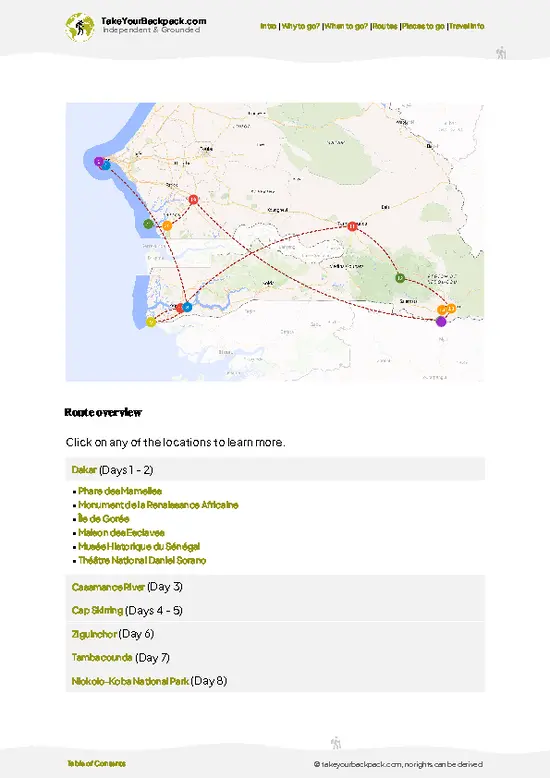
example page 0 from our offline Travel Guide for Senegal
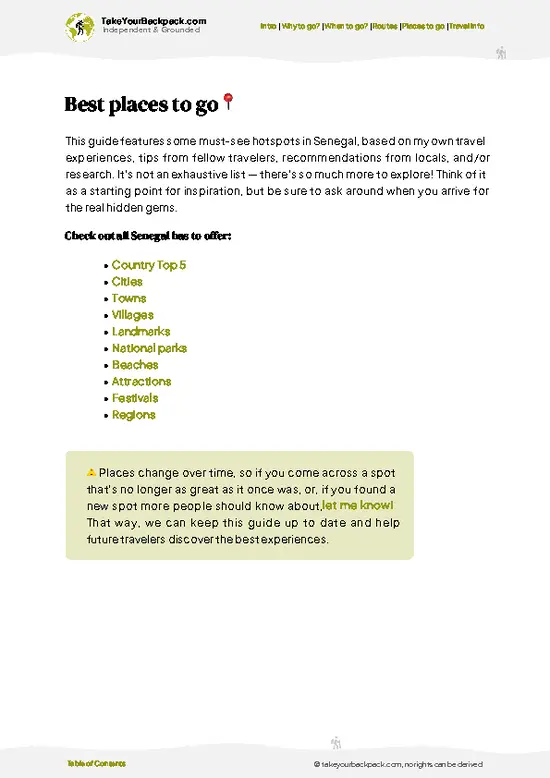
example page 1 from our offline Travel Guide for Senegal
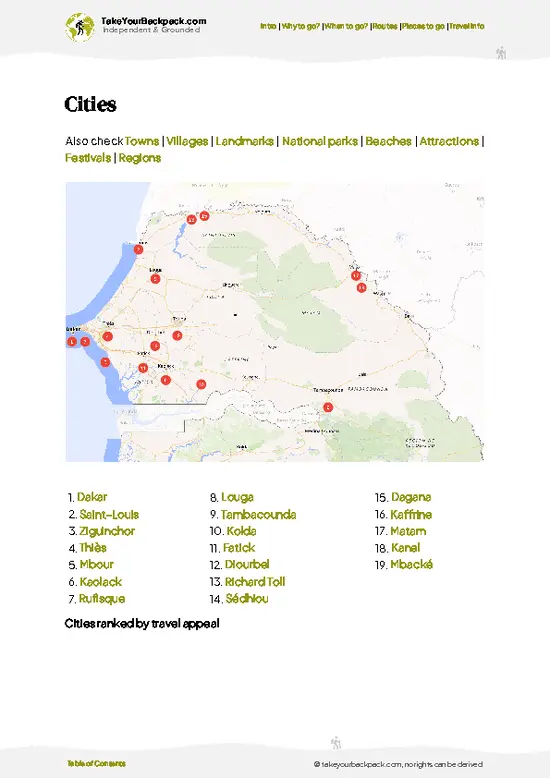
example page 2 from our offline Travel Guide for Senegal
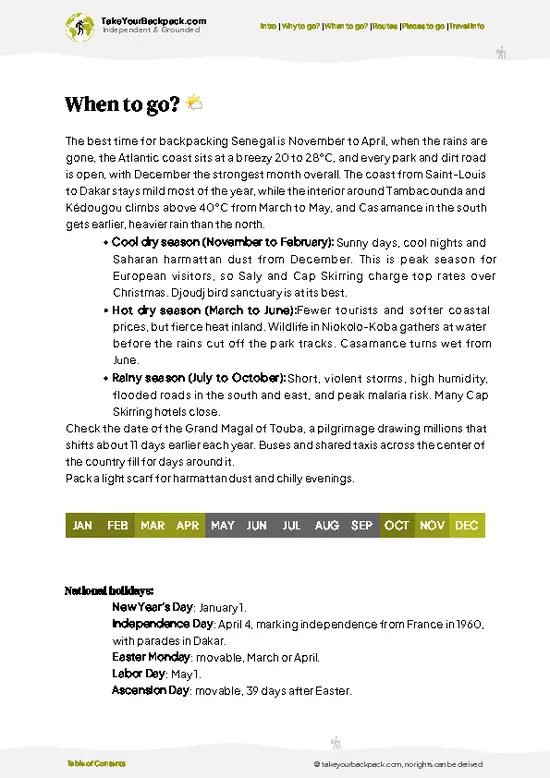
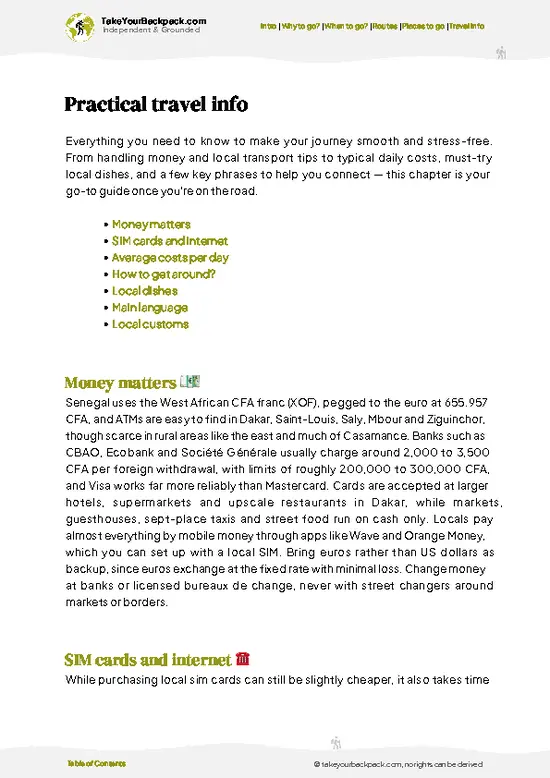
example page 3 from our offline Travel Guide for Senegal
example page 4 from our offline Travel Guide for Senegal
example page 5 from our offline Travel Guide for Senegal
example page 6 from our offline Travel Guide for Senegal
example page 7 from our offline Travel Guide for Senegal
Loading the map 🌍
CLICK TO FILTER
cities
towns
villages
landmarks
national parks
beaches
attractions
festivals
regions
SHOW COUNTRY’S BESTSHOW ALL

✨ Why go?
Ranked #2 festival in Senegal
Why Dak’Art should be on your travel list

Dak’Art pulls backpackers because it turns Dakar into one long, walkable-by-taxi gallery with an open door policy. The “Off” program is the heart of it: hundreds of independent shows in courtyards, galleries, cafés and the occasional shipping container, mostly free, which makes it far cheaper than comparable art fairs in Europe or the US. Openings are where you meet people. Artists from Lagos, Kinshasa, Abidjan and Johannesburg stand around with plastic cups, and they will happily explain a piece if you ask. That social energy is temporary but easy to join, even solo. It also fits a longer West Africa route nicely. Pair it with the ferry to Gorée Island, the neighborhoods of Medina and Ouakam, and onward overland toward Saint-Louis or The Gambia. The timing means you arrive in the hot, dry … read more 👉
Dak’Art pulls backpackers because it turns Dakar into one long, walkable-by-taxi gallery with an open door policy. The “Off” program is the heart of it: hundreds of independent shows in courtyards, galleries, cafés and the occasional shipping container, mostly free, which makes it far cheaper than comparable art fairs in Europe or the US. Openings are where you meet people. Artists from Lagos, Kinshasa, Abidjan and Johannesburg stand around with plastic cups, and they will happily explain a piece if you ask. That social energy is temporary but easy to join, even solo. It also fits a longer West Africa route nicely. Pair it with the ferry to Gorée Island, the neighborhoods of Medina and Ouakam, and onward overland toward Saint-Louis or The Gambia. The timing means you arrive in the hot, dry stretch before the rains, so plan your gallery crawls for mornings and evenings. Since the dates move each edition, check the announcement before you book flights.

💡 HighlightsThe experiences that define the visit

  1. The International Exhibition: The main curated show gathers selected artists from across Africa and its diaspora under a single theme. It is the best place to see where contemporary African painting, video and sculpture are heading. Allow half a day, and expect a modest entry fee or free access on some days.
  2. The “Off” Program: Hundreds of independent exhibitions spring up in private homes, cultural centers, restaurants and gardens across the city. Pick a neighborhood, wander between venues and you will often meet the artist at the door. Many are free.
  3. Opening Nights: Vernissages are the festival’s social engine. Expect live music, grilled snacks, cold drinks and long conversations in French, Wolof and English. Arrive late, around dusk, when the crowd thickens.
  4. Gorée Island Exhibitions: The island’s
… read more 👉
  1. The International Exhibition: The main curated show gathers selected artists from across Africa and its diaspora under a single theme. It is the best place to see where contemporary African painting, video and sculpture are heading. Allow half a day, and expect a modest entry fee or free access on some days.
  2. The “Off” Program: Hundreds of independent exhibitions spring up in private homes, cultural centers, restaurants and gardens across the city. Pick a neighborhood, wander between venues and you will often meet the artist at the door. Many are free.
  3. Opening Nights: Vernissages are the festival’s social engine. Expect live music, grilled snacks, cold drinks and long conversations in French, Wolof and English. Arrive late, around dusk, when the crowd thickens.
  4. Gorée Island Exhibitions: The island’s old colonial houses and courtyards host shows during the biennale. The ferry ride from the port is part of the experience, and the quiet sandy lanes make a calm break from the city.
  5. Street Art and Murals in Medina: Dakar’s walls carry some of its best work, and Medina’s lanes are thick with murals that spill from the festival’s energy. Walk it in the morning, with permission to photograph residents asked first.
Start with the International Exhibition, because it gives you the festival’s curatorial frame and names of artists whose work you will then spot in the “Off” venues.
Spotted a mistake or missing something? Contact us.

Things to do around Dak’Art

Ratings based on Tripadvisor reviews. When you book through this link, you support our work at no extra cost to you.

🌤️ When to go?When is the celebration of Dak’Art?

Dak’Art, the Biennale of Contemporary African Art, runs for about a month in Dakar, usually opening in May or June in even-numbered years (some editions slipped to November), with the main exhibition at the former Palais de Justice and satellite shows across the city.
  • Best days: The opening weekend has the openings, parades and artist crowds. Weekdays are quieter for slow gallery viewing, and the closing week still has the off-site shows running.
  • Weather: May and June are hot and humid, roughly 26 to 32°C (79 to 90°F), with sea breezes along the Corniche and first rains possible late in the period. Bring a hat, sunscreen, light cotton and a small umbrella. November editions are drier and a little cooler.
  • Booking: Reserve beds four to six weeks ahead for the opening week. Rates in central areas
… read more 👉
Dak’Art, the Biennale of Contemporary African Art, runs for about a month in Dakar, usually opening in May or June in even-numbered years (some editions slipped to November), with the main exhibition at the former Palais de Justice and satellite shows across the city.
  • Best days: The opening weekend has the openings, parades and artist crowds. Weekdays are quieter for slow gallery viewing, and the closing week still has the off-site shows running.
  • Weather: May and June are hot and humid, roughly 26 to 32°C (79 to 90°F), with sea breezes along the Corniche and first rains possible late in the period. Bring a hat, sunscreen, light cotton and a small umbrella. November editions are drier and a little cooler.
  • Booking: Reserve beds four to six weeks ahead for the opening week. Rates in central areas can rise by 20 to 40 percent.
  • Crowds and roads: Dakar traffic jams badly at rush hours, so allow extra time between venues and plan airport transfers outside the morning and evening peaks.
Visit the main exhibition early on a weekday, then spend the afternoon on the off-site shows.


source: climatestotravel.comJANJanuary: excellent for travelingFEBFebruary: not recommended for travelingMARMarch: not recommended for travelingAPRApril: not recommended for travelingMAYMay: not recommended for travelingJUNJune: not recommended for travelingJULJuly: not recommended for travelingAUGAugust: not recommended for travelingSEPSeptember: not recommended for travelingOCTOctober: not recommended for travelingNOVNovember: not recommended for travelingDECDecember: not recommended for traveling

✈️ The backpacker research shortcutSenegal Travel Guide

An offline-friendly backpacking guide with optimized travel routes, ranked highlights, transport advice, and the best areas to stay.
example page 0 from our offline Travel Guide for Senegal
example page 1 from our offline Travel Guide for Senegal
example page 2 from our offline Travel Guide for Senegal
example page 3 from our offline Travel Guide for Senegal
example page 4 from our offline Travel Guide for Senegal
example page 5 from our offline Travel Guide for Senegal
example page 6 from our offline Travel Guide for Senegal
example page 7 from our offline Travel Guide for Senegal
The digital guide (360 pages) contains:
✅ 85 highlights, ranked by travel appeal
✅ Optimized 5, 10 & 15-day travel routes
✅ Cities, national parks, landmarks, beaches
✅ How to get around
✅ Offline-friendly for travel without Wi-Fi
👉 Click to see all 30+ guide features

📅 Plan smarter in minutes, not weeks
✅ Month by month travel advice
✅ Festivals & national holidays
✅ Budget expectations

🗺️ Go to the right places, skip the overrated ones
✅ Honest pros & cons of destinations
✅ Top hikes, parks & viewpoints
✅ Lesser-known places most travelers miss
✅ Clear “worth it vs skip it” guidance

🛏️ Travel smoothly without rookie mistakes
✅ Best areas to stay
✅ Transport systems explained simply
✅ Common scams & safety advice
✅ SIM cards, money & practical tips

🌍 Understand the country, not just visit it
✅ Culture & traditions
✅ 52 Essential phrases & customs
✅ Festivals worth planning around
✅ Traveler-friendly historical context
✅ Insights that make places more meaningful

📱 Built for real travel conditions
✅ Fully downloadable PDF
✅ Works completely offline
✅ Optimized for phone use
✅ Useful in remote areas & buses
✅ Everything in one place
Stop searching, start planning
Get instant access to your full guide. 30‑day money-back guarantee.
+ Add another guide for just

By proceeding you agree to our terms.
Sent to your inbox immediately after payment • 100% Secure Checkout
Best Backpacking Travel Advisor 2025 tourism awardBest Backpacking
Travel Advisor
2025
What others say about Take Your Backpack Guides:
⭐⭐⭐⭐⭐
Fantastic, amazing amount of information!
⭐⭐⭐⭐⭐
My goodness this is amazing, it's what I've been looking for hats off too you!
⭐⭐⭐⭐⭐
I think this is absolutely BRILLIANT
⭐⭐⭐⭐
Very complete and informative. It's still missing places, but I gotta to commend you
⭐⭐⭐⭐⭐
This is truly amazing, thank you, can't wait to explore it with my kids!
⭐⭐⭐⭐⭐
Awesome resource, thank you!
⭐⭐⭐⭐⭐
This is amazing! Can't wait to explore the ones I haven't seen
⭐⭐⭐⭐
I love this! Well done, great idea.
⭐⭐⭐⭐⭐
Thanks for taking the time to make this gem!
⭐⭐⭐⭐⭐
This might be the best website I've ever seen.
⭐⭐⭐⭐⭐
Congratulations, and thank you so much for your work; it's incredibly valuable.
⭐⭐⭐⭐
In all seriousness I think you did a great job pointing out the important spots
⭐⭐⭐⭐⭐
10/10 very good
⭐⭐⭐⭐⭐
As someone who's only just starting to visit regularly this is awesome, thank you.
⭐⭐⭐⭐
Thank you very much! I'm going to visit my dad, it's going to be very useful!
⭐⭐⭐⭐⭐
This is really cool! We'll be travelling for the first time and this definitely come in handy.
⭐⭐⭐⭐⭐
You are now our minister of culture, congratulations 👨‍💼
⭐⭐⭐⭐⭐
Just wanted to tell you that this is a pearl! Going to follow your recommendations.
⭐⭐⭐⭐⭐
This is so cool. I'll definitely be using the resource for my travels soon.
⭐⭐⭐⭐⭐
This is very impressive! Good work.
⭐⭐⭐⭐⭐
This is an amazing and informative site. Very well done!

🛏️ Where to stay?Where staying makes the most sense

Plateau, the downtown peninsula, is the most practical area to stay for the main Dak’Art venues, since the former Palais de Justice, many galleries and the ferry port to Gorée sit within walking distance. Budget beds here run roughly €12 to 30, and the streets are busy by day and quieter after dark, so take a taxi at night.
Medina, just north of Plateau, is cheaper and more local, with market streets, small guesthouses and plenty of cheap eateries. It suits you if you like noise and neighborhood life, and it is walkable to Plateau in about 20 minutes. Stay on the main roads after dark.
Mermoz, Sacré-Coeur … read more 👉
Plateau, the downtown peninsula, is the most practical area to stay for the main Dak’Art venues, since the former Palais de Justice, many galleries and the ferry port to Gorée sit within walking distance. Budget beds here run roughly €12 to 30, and the streets are busy by day and quieter after dark, so take a taxi at night.
Medina, just north of Plateau, is cheaper and more local, with market streets, small guesthouses and plenty of cheap eateries. It suits you if you like noise and neighborhood life, and it is walkable to Plateau in about 20 minutes. Stay on the main roads after dark.
Mermoz, Sacré-Coeur and Point E form the leafy residential belt toward the west and north. They have quieter streets, many private rooms, and several of the art spaces and cultural centers that host off-site shows. Taxis to Plateau take 20 to 40 minutes depending on traffic.
Ngor and Almadies, on the northwest tip, are the surf and beach zone. They are more social, with traveler-friendly guesthouses, cafés and beach bars, but they are 30 to 50 minutes from the central venues. Pick them if you want sea and sunsets after gallery days.

👛 Costs (as of 22 October 2026)Travel costs and budget guide for Dak’Art

Dak’Art, the contemporary art biennale in Dakar, costs roughly €53 to 113 a day for an independent traveler in high season, with the total driven mostly by where you sleep. Prices are shown in euros, though you pay everything in West African CFA francs.
CategoryBudget RangeLocal Reality
Festival tickets€0 to 8Many off-site exhibitions in galleries, cultural centers and courtyards are free. Some main venues charge a modest entry, and a few evening events or special openings cost a little more.
Accommodation€12 to 30 (low season); €25 to 60 (high season)Dorm beds and simple guesthouse rooms in Plateau, Médina and Mermoz fill up and rise in price while the biennale is on. A private room with a fan runs toward the top of that range.
Local transport€3 to 10Yellow taxis are cheap but need a price agreed
… read more 👉
Dak’Art, the contemporary art biennale in Dakar, costs roughly €53 to 113 a day for an independent traveler in high season, with the total driven mostly by where you sleep. Prices are shown in euros, though you pay everything in West African CFA francs.
CategoryBudget RangeLocal Reality
Festival tickets€0 to 8Many off-site exhibitions in galleries, cultural centers and courtyards are free. Some main venues charge a modest entry, and a few evening events or special openings cost a little more.
Accommodation€12 to 30 (low season); €25 to 60 (high season)Dorm beds and simple guesthouse rooms in Plateau, Médina and Mermoz fill up and rise in price while the biennale is on. A private room with a fan runs toward the top of that range.
Local transport€3 to 10Yellow taxis are cheap but need a price agreed before you get in, usually €1.50 to 5 per ride across the city. Ride-hailing apps often come out cheaper and spare you haggling. Shared minibuses cost under €1 but are confusing for newcomers.
Food & drinks€8 to 20Street plates of thieboudienne or fish with rice cost €1.50 to 3. Sit-down restaurants in Almadies and Plateau charge €8 to 15 a meal, and a bottle of local beer is about €1.50 to 3.
Miscellaneous expenses€5 to 15Covers SIM card and data, bottled water, tips and the odd catalog or print from an artist’s studio. Allow extra if you plan to buy art.
Total Daily Budget€53 to 113A realistic daily figure of around €75 to 115 for a comfortable independent trip with a private room.
⚠️ Prices can change and everyone travels differently, so take this as a rough guide. Hope it helps you plan your adventure!

🍲 FoodEating & Drinking in Dak’Art

Dak’Art visitors eat well, because the venues sit close to Dakar’s everyday food scene. The national dish, thieboudienne, is fish with rice cooked in a tomato-rich sauce with cassava, carrots and cabbage, and a lunch plate in a small local canteen costs roughly €2 to 4. Look for yassa poulet (chicken in onion and lemon) and mafé (peanut stew) as well.
Between exhibitions, street stalls near Plateau and Medina sell fataya (fried pastries filled with fish or meat), grilled corn and sandwiches with fries tucked inside, usually around €0.50 to 2. Coffee comes as café Touba, spiced with grains of selim and sold in tiny cups from carts.
Drinks are the real refreshment in the heat. Try bissap (hibiscus), bouye (baobab fruit) and ginger juice, usually served cold in small bags or bottles for around … read more 👉
Dak’Art visitors eat well, because the venues sit close to Dakar’s everyday food scene. The national dish, thieboudienne, is fish with rice cooked in a tomato-rich sauce with cassava, carrots and cabbage, and a lunch plate in a small local canteen costs roughly €2 to 4. Look for yassa poulet (chicken in onion and lemon) and mafé (peanut stew) as well.
Between exhibitions, street stalls near Plateau and Medina sell fataya (fried pastries filled with fish or meat), grilled corn and sandwiches with fries tucked inside, usually around €0.50 to 2. Coffee comes as café Touba, spiced with grains of selim and sold in tiny cups from carts.
Drinks are the real refreshment in the heat. Try bissap (hibiscus), bouye (baobab fruit) and ginger juice, usually served cold in small bags or bottles for around €0.50 to 1.50. Gallery openings often pour wine or beer, while Gazelle is the local beer in bars.
Carry cash, since stalls and canteens rarely take cards. Meals are often shared from one big platter, so wash your hands and eat from the section in front of you. Ask for the price before ordering at stalls, and avoid ice or tap water if your stomach is sensitive.

FAQCommon questions from travelers

Dak’Art is held every two years in Dakar, usually for about a month starting in May or June, though some editions have been moved to other months such as November. The main exhibition is at the former Palais de Justice in Plateau, and satellite shows spread across the city. Check the official Biennale announcement for the exact dates a few months ahead.
Attending Dak’Art is inexpensive, since many exhibitions and off-site shows are free and the main venue charges only modest entry, roughly €0 to 8 a day. A realistic daily budget in Dakar is about €48 to 70, including a bed at €15 to 35, taxis at €1.50 to 5 a ride and street meals at €2 to 4. Beds cost the most during the opening weeks.
Dak’Art does not usually require tickets far in advance, since most exhibitions are open-entry and can be bought at the door. Opening events and special evening programs may need invitations or registration, so check announcements before you arrive. Book accommodation four to six weeks ahead for the opening week, because central beds in Plateau and Ngor fill up and prices rise 20 to 40 percent.
⚠️ Things can change over time, so always validate details locally before you go.

Other Senegalese festivals near Dak’Art

Explore more nearby:


💡 Not sure where to go next?
Create a personalized itinerary for Senegal including Dak’Art and the places that fit your trip.

Generate my itinerary

👉 Discover all festivals

Or checkout all Senegal has to offer (think cities, towns, villages, national parks, hikes, beaches, festivals)
Country photo of Senegal

We 💚 feedbackKey takeaways before you go

Dak’Art suits curious, sociable travelers who like talking to strangers over cheap drinks and do not need a strict schedule. Art students, photographers and anyone already roaming West Africa will get the most from it. Download an offline map, carry small cash for taxis and book your bed early, because the best-located rooms fill fast.

✍️ Help improve this page!
The information on this page is based on in-depth research, insights shared by experienced travelers, and feedback from the local travel community in Senegal. While every effort is made to keep the information accurate and current, conditions can change — so if you spot anything incorrect or outdated, please get in touch.


🙋‍♂️ Give feedback

👋 Meet the founderWho’s Behind Take Your Backpack?

Johan, backpacker and founder of TakeYourBackpackHi, I’m Johan (Netherlands 🇳🇱), the creator of TakeYourBackpack. Over the past 3 decades, I’ve backpacked through 90+ countries across six continents, gaining extensive experience with independent travel, long-term trips, and overland routes.

This site is built on a combination of firsthand travel experience and carefully curated insights from other backpackers. Many guides are based on places I’ve personally visited, while others bring together tips, observations, and practical advice shared by trusted travelers I’ve met along the way.

The goal is to provide realistic, experience-driven guidance — not generic itineraries — so you can explore destinations with better context, clearer expectations, and more confidence.