×

Senegal🇸🇳 | best festivalsBest 6 festivals in Senegal

Festivals in Senegal run on drums, incense and crowds more than on stages and tickets. Most are free to enter, so your money goes to food, rides and a bed. In Dakar and Saint-Louis, the sound of sabar drums and brass bands carries down sandy streets, and rooms fill early. In the Sine-Saloum and Casamance, ceremonies unfold under mango trees and along creeks, with small crowds and slower access. The big religious pilgrimages pull millions to towns like Touba, where transport jams and heat press hard. For a backpacker or any independent traveler, cities are easy, villages take planning, and each region sets a different pace.

By Johan Kruseman 🇳🇱 | Updated October 19, 2026
Explore the best regions in Senegal

Why go?Why These festival Stand Out

Senegal suits festivals because public life is built around gathering. Sufi brotherhoods (the Mouride, Tijaniyya and others) organize huge annual pilgrimages, griot traditions keep drumming and oral storytelling alive, and coastal history gives Saint-Louis and Gorée a layered music and arts culture. Hospitality, or teranga, means strangers get fed, greeted and often pulled into the circle, so a visitor rarely feels like an audience of one.

The geography shapes everything. Fishing coasts, sandy Sahel plains, mangrove deltas and southern forests each host different rituals, and the roads between them vary from smooth highways to red laterite tracks that dust everything you own. The long dry season gives reliable open-air weather, while the rainy months can wash out tracks and ceremonies in … read more 👉
Senegal suits festivals because public life is built around gathering. Sufi brotherhoods (the Mouride, Tijaniyya and others) organize huge annual pilgrimages, griot traditions keep drumming and oral storytelling alive, and coastal history gives Saint-Louis and Gorée a layered music and arts culture. Hospitality, or teranga, means strangers get fed, greeted and often pulled into the circle, so a visitor rarely feels like an audience of one.

The geography shapes everything. Fishing coasts, sandy Sahel plains, mangrove deltas and southern forests each host different rituals, and the roads between them vary from smooth highways to red laterite tracks that dust everything you own. The long dry season gives reliable open-air weather, while the rainy months can wash out tracks and ceremonies in the south.

Know before you choose Senegal: dates move. Religious events follow the Islamic lunar calendar and shift about 11 days earlier each year, so check them close to travel. Big events strain transport, water and rooms, and prices for beds can double or triple in host towns. Dress modestly, expect heat and fine dust, and carry small bills in West African francs (CFA). Arts festivals keep more fixed dates, but programs can change late.
Behind the Scenes of Selection
The list of best festivals in Senegal is created based on energy, traditions, crowd experience, activities, and overall excitement. If you feel a festival is missing in this list, please let us know.


When to go?When to Plan Your Trip

Best months for festivals: November to April is the best window for festivals in Senegal, because the dry season brings clear skies, little or no rain and outdoor events that run on schedule. Days along the coast sit around 25 to 30°C with a cool Atlantic breeze, while nights in Dakar can dip to 18 to 21°C. Inland, around Touba, Tambacounda and Kédougou, afternoons reach 35 to 40°C by March and April, and the harmattan wind carries a fine pale haze that dulls the light and dries the throat.
Shoulder and wet season: May and June are hot and sticky, especially away from the coast, with daytime highs of 33 to 40°C. The rains run roughly July to October, with the heaviest downpours in August and September, particularly in Casamance and the south, where annual rainfall can exceed 1,200 mm against … read more 👉
Best months for festivals: November to April is the best window for festivals in Senegal, because the dry season brings clear skies, little or no rain and outdoor events that run on schedule. Days along the coast sit around 25 to 30°C with a cool Atlantic breeze, while nights in Dakar can dip to 18 to 21°C. Inland, around Touba, Tambacounda and Kédougou, afternoons reach 35 to 40°C by March and April, and the harmattan wind carries a fine pale haze that dulls the light and dries the throat.
Shoulder and wet season: May and June are hot and sticky, especially away from the coast, with daytime highs of 33 to 40°C. The rains run roughly July to October, with the heaviest downpours in August and September, particularly in Casamance and the south, where annual rainfall can exceed 1,200 mm against about 300 to 500 mm in the north. Tracks turn to red mud, creeks swell and small village events become hard to reach, though the landscape goes green and rooms are cheaper.
Crowds and prices: Peak season, December to February, raises room rates in Dakar, Saint-Louis and the Petite Côte by roughly 20 to 50 percent. Religious pilgrimages shift with the lunar calendar, so they can land in any season. In those host towns, book a bed early or expect to sleep far from the action.

festival hoppingPlanning Your Route Efficiently

Trip length and direction: A trip combining several festivals in Senegal needs 10 to 16 days, because roads are slow and dates rarely line up neatly. Group stops by region: Dakar with the Petite Côte and Saint-Louis in the north, and the Sine-Saloum delta with Casamance in the south. Starting in Dakar and moving north first, then looping back, keeps you near the main airport hub, Blaise Diagne International, in case dates shift.
Time per stop: Give a city festival two to three days, and a village or pilgrimage stop at least two, since arrival, queues and heat eat the first day. Dakar to Saint-Louis takes about 4 to 5 hours by road, and Dakar to Touba around 3 to 4 hours on the toll highway. Dakar to Ziguinchor is about 10 to 12 hours overland through The Gambia, or 1 to 2 hours by flight. The … read more 👉
Trip length and direction: A trip combining several festivals in Senegal needs 10 to 16 days, because roads are slow and dates rarely line up neatly. Group stops by region: Dakar with the Petite Côte and Saint-Louis in the north, and the Sine-Saloum delta with Casamance in the south. Starting in Dakar and moving north first, then looping back, keeps you near the main airport hub, Blaise Diagne International, in case dates shift.
Time per stop: Give a city festival two to three days, and a village or pilgrimage stop at least two, since arrival, queues and heat eat the first day. Dakar to Saint-Louis takes about 4 to 5 hours by road, and Dakar to Touba around 3 to 4 hours on the toll highway. Dakar to Ziguinchor is about 10 to 12 hours overland through The Gambia, or 1 to 2 hours by flight. The Dakar to Ziguinchor ferry runs overnight and is a long, salty, engine-throbbing affair, so book a cabin if you want sleep. Sept-places (shared Peugeot taxis) leave when full, so allow slack.
Common mistakes: The classic error is stacking events on consecutive days across regions. Leave one buffer day between long hops. Another is arriving on the day of a pilgrimage, when roads clog and rooms vanish, so arrive a day or two earlier. Also avoid planning southern trips in August or September, when flooded tracks cancel plans.

The ListThe Best festivals of Senegal

1 Saint-Louis Jazz Festival

colonial architecture, riverside stages, jazz ensembles, Saint-Louis city

Absorb the rhythms of jazz in historic Saint-Louis, where musicians from around the world perform in atmospheric venues along the river.

2 Dak’Art

biennial art, pan-African exhibitions, Dakar venues, contemporary works

Navigate Dakar’s art scene as galleries and public spaces showcase innovative works from across Africa and its diaspora.

3 Gorée Diaspora Festival

Atlantic island, memory sites, diaspora gatherings, historic fort

Trace the legacy of the transatlantic slave trade through performances, dialogue, and shared remembrance on Gorée’s evocative shores.

4 Festival du Sahel

desert landscapes, nomadic traditions, open-air concerts, Sahelian cuisine

Immerse yourself in Sahelian culture with music, storytelling, and local flavors set against the region’s striking arid backdrop.

5 FESFOP

regional rhythms, open-air stages, local bands, Louga city

Hear Louga’s musical heritage come alive as diverse genres and generations gather for concerts and spontaneous street sessions.

6 World Festival of Black Arts (FESMAN)

Black arts, multidisciplinary showcases, global artists, cultural dialogue

Engage with artists and thinkers from Africa and beyond in a festival dedicated to the diversity of Black artistic expression.

Loading the map 🌍

Expert viewInsights from Locals and Experts

How many to attend: Two to three festivals in one trip is the number I advise. Travel between regions is slow, heat drains you by midday, and each event deserves a full day to settle in, eat from the street stalls and find your footing. Cram in more and you spend the trip in a sept-place with your knees against a stranger's sack of onions.
Choosing by travel style: For first-timers and anyone who wants comfort, pick an arts or music festival in a city like Dakar or Saint-Louis: paved roads, plenty of guesthouses, English-friendly guides and grilled fish on the street at dusk. For culture seekers, village ceremonies in the Sine-Saloum or Casamance bring slower days, drumming under baobabs and far fewer foreigners, but you need a local contact or guide. Religious pilgrimages suit seasoned travelers … read more 👉
How many to attend: Two to three festivals in one trip is the number I advise. Travel between regions is slow, heat drains you by midday, and each event deserves a full day to settle in, eat from the street stalls and find your footing. Cram in more and you spend the trip in a sept-place with your knees against a stranger's sack of onions.
Choosing by travel style: For first-timers and anyone who wants comfort, pick an arts or music festival in a city like Dakar or Saint-Louis: paved roads, plenty of guesthouses, English-friendly guides and grilled fish on the street at dusk. For culture seekers, village ceremonies in the Sine-Saloum or Casamance bring slower days, drumming under baobabs and far fewer foreigners, but you need a local contact or guide. Religious pilgrimages suit seasoned travelers with patience, since the scale is huge, the heat intense and the atmosphere deeply devout rather than festive.
What it costs: Budget US$25 to 45 a day (about 15,000 to 27,000 CFA) for a dorm or simple guesthouse, street meals of 1,000 to 2,500 CFA, and local transport. Most festivals charge nothing, but music events can run 3,000 to 15,000 CFA. A local guide for a village ceremony costs about 10,000 to 25,000 CFA a day. Sept-place fares between towns run roughly 2,000 to 8,000 CFA, and taxis in host towns double during big events, so agree the price first. Rooms near major events can jump from 10,000 to 30,000 CFA.
Safety and etiquette: Crowds are the main risk. Pickpockets work packed processions and ferry docks, so carry a small amount of cash, leave your passport copy in a money belt and keep your phone zipped away. Ask before photographing people, especially marabouts, women and ceremonial dancers, and expect to be asked for a small gift or tip. Dress with covered shoulders and knees at religious events, and drink only sealed or filtered water. Fasting periods change opening hours and food availability, so carry snacks. Check current government travel advice for Casamance border areas before heading south, and stay on established routes. Accept the invitation to share a bowl of thieboudienne when it comes, since it is the best meal you will get.

✈️ The backpacker research shortcutSenegal Travel Guide

An offline-friendly backpacking guide with optimized travel routes, ranked highlights, transport advice, and the best areas to stay.
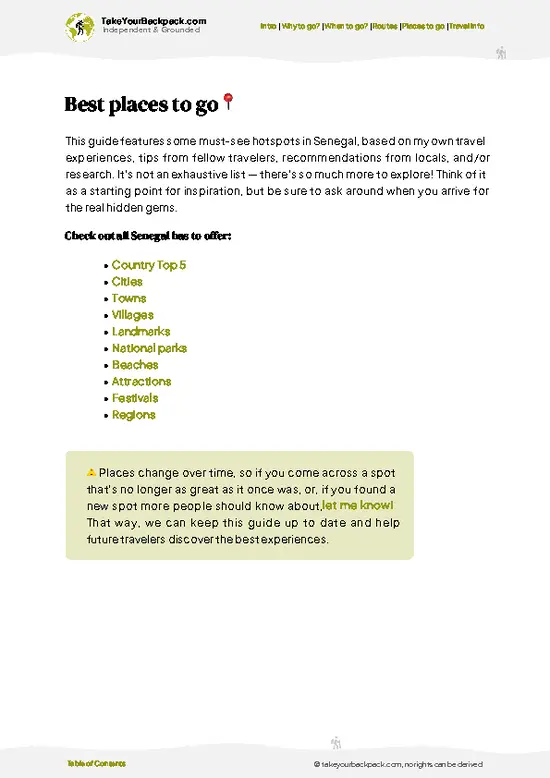
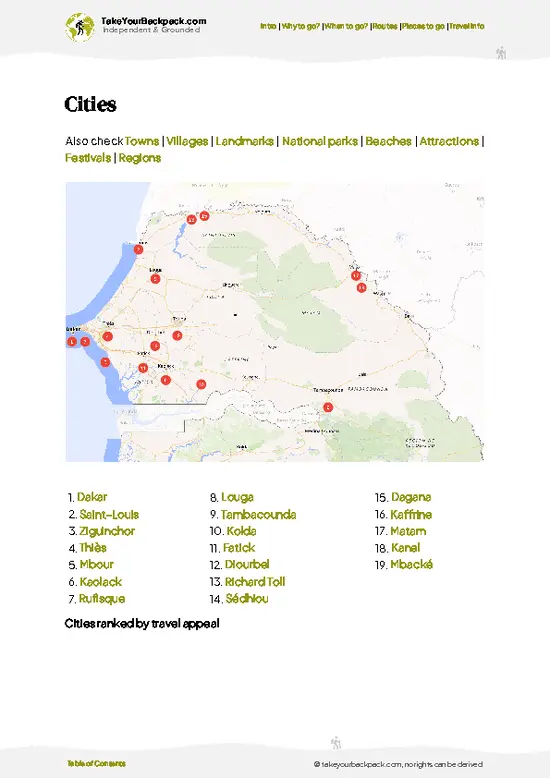
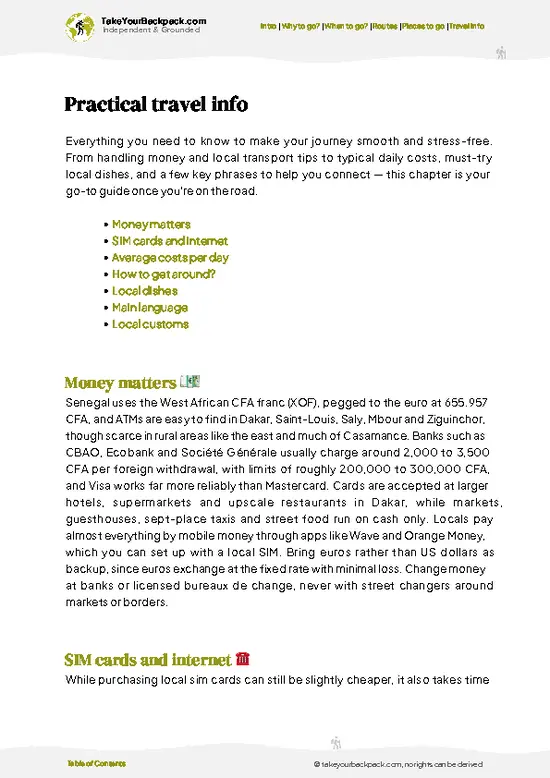
example page 0 from our offline Travel Guide for Senegal
example page 1 from our offline Travel Guide for Senegal
example page 2 from our offline Travel Guide for Senegal
example page 3 from our offline Travel Guide for Senegal
example page 4 from our offline Travel Guide for Senegal
example page 5 from our offline Travel Guide for Senegal
example page 6 from our offline Travel Guide for Senegal
example page 7 from our offline Travel Guide for Senegal
The digital guide (360 pages) contains:
✅ 85 highlights, ranked by travel appeal
✅ Optimized 5, 10 & 15-day travel routes
✅ Cities, national parks, landmarks, beaches
✅ How to get around
✅ Offline-friendly for travel without Wi-Fi
👉 Click to see all 30+ guide features

📅 Plan smarter in minutes, not weeks
✅ Month by month travel advice
✅ Festivals & national holidays
✅ Budget expectations

🗺️ Go to the right places, skip the overrated ones
✅ Honest pros & cons of destinations
✅ Top hikes, parks & viewpoints
✅ Lesser-known places most travelers miss
✅ Clear “worth it vs skip it” guidance

🛏️ Travel smoothly without rookie mistakes
✅ Best areas to stay
✅ Transport systems explained simply
✅ Common scams & safety advice
✅ SIM cards, money & practical tips

🌍 Understand the country, not just visit it
✅ Culture & traditions
✅ 52 Essential phrases & customs
✅ Festivals worth planning around
✅ Traveler-friendly historical context
✅ Insights that make places more meaningful

📱 Built for real travel conditions
✅ Fully downloadable PDF
✅ Works completely offline
✅ Optimized for phone use
✅ Useful in remote areas & buses
✅ Everything in one place
Stop searching, start planning
Get instant access to your full guide. 30‑day money-back guarantee.
+ Add another guide for just

By proceeding you agree to our terms.
Sent to your inbox immediately after payment • 100% Secure Checkout
Best Backpacking Travel Advisor 2025 tourism awardBest Backpacking
Travel Advisor
2025
What others say about Take Your Backpack Guides:
⭐⭐⭐⭐⭐
Fantastic, amazing amount of information!
⭐⭐⭐⭐⭐
My goodness this is amazing, it's what I've been looking for hats off too you!
⭐⭐⭐⭐⭐
I think this is absolutely BRILLIANT
⭐⭐⭐⭐
Very complete and informative. It's still missing places, but I gotta to commend you
⭐⭐⭐⭐⭐
This is truly amazing, thank you, can't wait to explore it with my kids!
⭐⭐⭐⭐⭐
Awesome resource, thank you!
⭐⭐⭐⭐⭐
This is amazing! Can't wait to explore the ones I haven't seen
⭐⭐⭐⭐
I love this! Well done, great idea.
⭐⭐⭐⭐⭐
Thanks for taking the time to make this gem!
⭐⭐⭐⭐⭐
This might be the best website I've ever seen.
⭐⭐⭐⭐⭐
Congratulations, and thank you so much for your work; it's incredibly valuable.
⭐⭐⭐⭐
In all seriousness I think you did a great job pointing out the important spots
⭐⭐⭐⭐⭐
10/10 very good
⭐⭐⭐⭐⭐
As someone who's only just starting to visit regularly this is awesome, thank you.
⭐⭐⭐⭐
Thank you very much! I'm going to visit my dad, it's going to be very useful!
⭐⭐⭐⭐⭐
This is really cool! We'll be travelling for the first time and this definitely come in handy.
⭐⭐⭐⭐⭐
You are now our minister of culture, congratulations 👨‍💼
⭐⭐⭐⭐⭐
Just wanted to tell you that this is a pearl! Going to follow your recommendations.
⭐⭐⭐⭐⭐
This is so cool. I'll definitely be using the resource for my travels soon.
⭐⭐⭐⭐⭐
This is very impressive! Good work.
⭐⭐⭐⭐⭐
This is an amazing and informative site. Very well done!

🛏️ Where to stay?Accommodation Highlights

Senegal has a small but growing hostel scene, with dorm beds at roughly 8,000 to 15,000 CFA (US$13 to 25) and simple guesthouses, called “auberges” or “campements”, filling most of the budget gaps. In Dakar, Ngor and Yoff hold the most backpacker-friendly beds, close to surf breaks, beach bars and Ngor Island, with quieter streets than the center but a 30 to 45 minute ride to the city’s markets. Nearby Almadies has the best nightlife and the highest prices. Plateau puts you within walking distance of Sandaga market and the ferry to Gorée, but it empties out after dark and has more petty theft. Outside the capital, the old island quarter of Saint-Louis and the villages of the Sine-Saloum delta … read more 👉
Senegal has a small but growing hostel scene, with dorm beds at roughly 8,000 to 15,000 CFA (US$13 to 25) and simple guesthouses, called “auberges” or “campements”, filling most of the budget gaps. In Dakar, Ngor and Yoff hold the most backpacker-friendly beds, close to surf breaks, beach bars and Ngor Island, with quieter streets than the center but a 30 to 45 minute ride to the city’s markets. Nearby Almadies has the best nightlife and the highest prices. Plateau puts you within walking distance of Sandaga market and the ferry to Gorée, but it empties out after dark and has more petty theft. Outside the capital, the old island quarter of Saint-Louis and the villages of the Sine-Saloum delta offer good-value guesthouses in a far calmer setting.

If you enjoy meeting fellow travelers, consider choosing hostels with high ratings for atmosphere. On the other hand, if you prefer having your own space, a hotel might be a better option.

SenegalSee More of Senegal

👋 Meet the founderWho’s Behind Take Your Backpack?

Johan, backpacker and founder of TakeYourBackpackHi, I’m Johan (Netherlands 🇳🇱), the creator of TakeYourBackpack. Over the past 3 decades, I’ve backpacked through 90+ countries across six continents, gaining extensive experience with independent travel, long-term trips, and overland routes.

This site is built on a combination of firsthand travel experience and carefully curated insights from other backpackers. Many guides are based on places I’ve personally visited, while others bring together tips, observations, and practical advice shared by trusted travelers I’ve met along the way.

The goal is to provide realistic, experience-driven guidance — not generic itineraries — so you can explore destinations with better context, clearer expectations, and more confidence.