×

Sierra Leone🇸🇱 | regionsKono DistrictDiamond diggings, red laterite roads, Koidu market, moto-taxis | things to do and best time to go

Explore Freetown PeninsulaExplore Bunce Island

Backpacking in Kono District
👌 Worth visitingregion ranked #3
By Johan Kruseman 🇳🇱 | Updated October 22, 2026

Kono District suits a backpacker with cash in small notes and a taste for places where nobody is selling you anything, because Koidu’s market and motorbike taxis cover nearly everything you need. It sits in the east of Sierra Leone, a diamond region of red laterite roads, pit-scarred valleys and rivers turned the color of milk tea by washing gravel. Mornings smell of woodsmoke and frying dough, and by afternoon the air is thick with dust, generators and the thud of picks. Nature is modest, since the draw is working landscapes and people rather than parks or beaches. Moto-taxis cost a little more than shared cars but save hours and bruises, so they give the best value for short hops. A shared car is cheaper and far less comfortable. Kono will delight curious, flexible travelers who like unpolished places. It will frustrate anyone wanting hotels, set sights or reliable schedules.

Discover everything you want to know in the 📖 Sierra Leone Travel Guide.


example page 0 from our offline Travel Guide for Sierra Leone
example page 1 from our offline Travel Guide for Sierra Leone
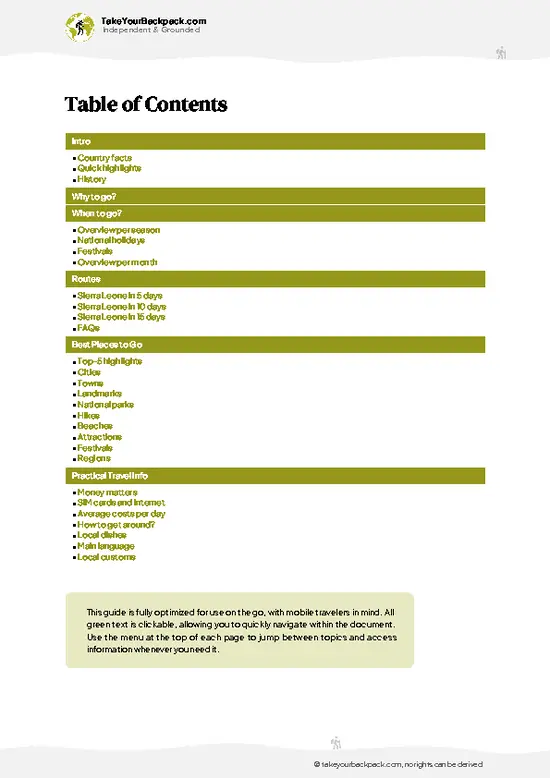
example page 2 from our offline Travel Guide for Sierra Leone
example page 3 from our offline Travel Guide for Sierra Leone
example page 4 from our offline Travel Guide for Sierra Leone
example page 5 from our offline Travel Guide for Sierra Leone
example page 6 from our offline Travel Guide for Sierra Leone
example page 7 from our offline Travel Guide for Sierra Leone
Loading the map 🌍
CLICK TO FILTER
cities
towns
landmarks
national parks
hikes
beaches
attractions
festivals
regions
SHOW COUNTRY’S BESTSHOW ALL

✨ Why go?
Ranked #3 region in Sierra Leone
Why visitors keep coming back

Kono District gives you a working diamond country you can see up close, which no other part of Sierra Leone matches. Around Koidu you can watch artisanal diggers sieve gravel in river valleys, then walk back to town for a plate of rice and cassava leaf at a roadside cookshop. That compact mix of industry, trade and village life means you rarely need long transfers. The second reason is people. Kono’s towns have a strong sense of identity, and conversation flows easily over a stool at a market stall or beside the Sewa River. Visitors are still uncommon, so greetings are curious rather than rehearsed. Third, Yengema and the smaller mining settlements show how a boom economy shapes everyday life, from tin-roofed trading posts to football pitches carved out of spoil heaps. It is slow travel by … read more 👉
Kono District gives you a working diamond country you can see up close, which no other part of Sierra Leone matches. Around Koidu you can watch artisanal diggers sieve gravel in river valleys, then walk back to town for a plate of rice and cassava leaf at a roadside cookshop. That compact mix of industry, trade and village life means you rarely need long transfers. The second reason is people. Kono’s towns have a strong sense of identity, and conversation flows easily over a stool at a market stall or beside the Sewa River. Visitors are still uncommon, so greetings are curious rather than rehearsed. Third, Yengema and the smaller mining settlements show how a boom economy shapes everyday life, from tin-roofed trading posts to football pitches carved out of spoil heaps. It is slow travel by necessity, and the places you add on come through chatting with locals, not a checklist.

💡 HighlightsThe experiences that define the visit

  1. Koidu town center and market: The district capital’s main market is a crush of fabric, spices, phone-charging stalls and dried fish. It is the best place to understand how diamond money circulates through ordinary trade.
  2. Artisanal diggings along the Sewa River: Crews wade in the water, shoveling gravel into sieves and scanning the residue for stones. Go with a local guide and ask permission before taking photos.
  3. Koidu’s kimberlite mine perimeter: The large industrial operation near town shows the scale of formal mining. You can see the scarred hillsides and heavy trucks from public roads, though the site itself is closed to casual visitors.
  4. Yengema: A historic mining town with an older layout than Koidu, quieter streets and a relaxed feel. A walk here shows what the district looked like before
… read more 👉
  1. Koidu town center and market: The district capital’s main market is a crush of fabric, spices, phone-charging stalls and dried fish. It is the best place to understand how diamond money circulates through ordinary trade.
  2. Artisanal diggings along the Sewa River: Crews wade in the water, shoveling gravel into sieves and scanning the residue for stones. Go with a local guide and ask permission before taking photos.
  3. Koidu’s kimberlite mine perimeter: The large industrial operation near town shows the scale of formal mining. You can see the scarred hillsides and heavy trucks from public roads, though the site itself is closed to casual visitors.
  4. Yengema: A historic mining town with an older layout than Koidu, quieter streets and a relaxed feel. A walk here shows what the district looked like before the current boom.
  5. Sefadu: The old district seat, with a lived-in colonial-era feel and slower trading than Koidu. A good place for a conversation with elders.
  6. Tombodu: A mining settlement popular with locals, with busy trading days and crews fresh from the pits. Few foreigners pass through, so expect curiosity.
  7. Njaiama Sewafe: A river-side community where farming and diamond digging overlap. Locals gather at the water in the evenings, and it is easy to spend time here without a plan.
  8. Village football pitches: Late-afternoon matches on dusty pitches draw whole neighborhoods, and strangers are welcome to stand on the sideline.
  9. Cookshops around Koidu: Small roadside kitchens serve cassava leaf, groundnut stew and rice from steaming pots. Eating at one is the simplest local experience in the district.
  10. Bafi River: Quiet banks away from the main diggings, where children swim and women wash clothes. It is a calm stop after a day of dust.
For a full day, pair the Sewa River diggings in the morning with the Koidu market in the afternoon, since both sit close together and show mining and trade in one sweep. Kono District rewards that kind of tight loop.
Spotted a mistake or missing something? Contact us.

⌛️ 5 days5-day itinerary for Kono District

Day 1: Koidu: Arrive by shared car and spend the afternoon on foot in the market and main streets. Roads and vehicle departures set the pace in Kono, since cars fill before they leave and motorbike taxis fill the gaps, so Koidu works best as a fixed base. Eat at a cookshop, then settle early. Dust and heat make night walking tiring.
Day 2: Sewa River: Hire a local guide and a moto-taxi to reach the artisanal diggings in the morning, when crews are working hardest. Watching the sieving takes patience, but it explains the district better than any museum could. Return to town by afternoon to rest through the hottest hours.
Day 3: Yengema: Take a shared car or bike out to Yengema, the older mining town. The streets are quieter, so conversations come easily, and you can see how the town grew around … read more 👉
Day 1: Koidu: Arrive by shared car and spend the afternoon on foot in the market and main streets. Roads and vehicle departures set the pace in Kono, since cars fill before they leave and motorbike taxis fill the gaps, so Koidu works best as a fixed base. Eat at a cookshop, then settle early. Dust and heat make night walking tiring.
Day 2: Sewa River: Hire a local guide and a moto-taxi to reach the artisanal diggings in the morning, when crews are working hardest. Watching the sieving takes patience, but it explains the district better than any museum could. Return to town by afternoon to rest through the hottest hours.
Day 3: Yengema: Take a shared car or bike out to Yengema, the older mining town. The streets are quieter, so conversations come easily, and you can see how the town grew around mining. Come back to Koidu in the evening, because staying central keeps your options open if a vehicle fails to appear.
Day 4: Tombodu: This is the detour. Tombodu lies off the main Koidu axis, but the ride out adds a busy mining settlement and a very different crowd from the capital. Go early, leave before late afternoon, and bring small bills for food and fares.
Day 5: Sefadu and the river: Use the last day for Sefadu and a slow riverside afternoon at the Bafi or Sewa, with no fixed schedule, before heading out of the district.
If you can only keep one day, keep Day 2. The Sewa diggings are what Kono District is known for, and nothing else here gets you as close to the work, the people and the landscape in one morning.

🌤️ When to go?Seasonal considerations and timing

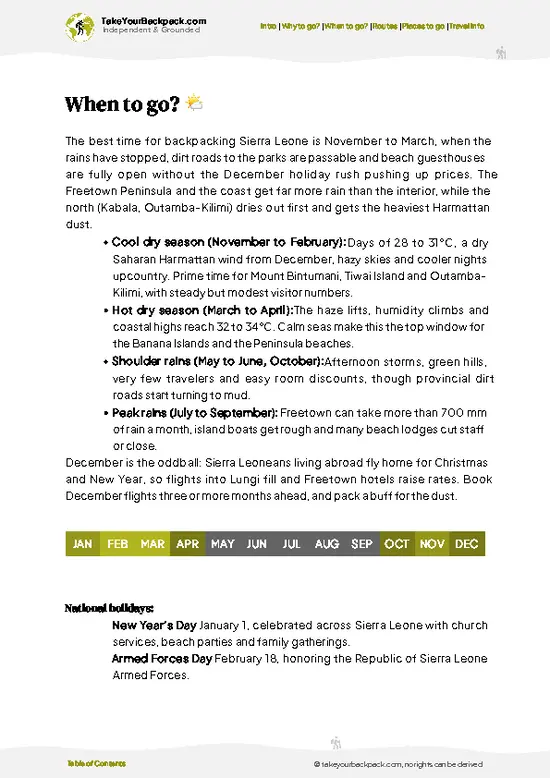
  • Dry Season (November to April): Kono District is easiest from December to February, with highs of 30 to 35°C (86 to 95°F), cooler nights around 20 to 23°C (68 to 73°F) and almost no rain. Harmattan haze can dull the sky and dust coats everything from motorbikes to your pack. Laterite roads stay firm, so this is when travel is fastest.
  • Early Rains (May to June): Showers build, humidity climbs and highs ease to 28 to 32°C (82 to 90°F). Roads begin to rut but remain passable, and prices for shared rides start creeping up.
  • Peak Rains (July to September): Rain falls most afternoons and sometimes all day, with 25 to 29°C (77 to 84°F). Mud can strand vehicles for hours, and some tracks to villages become impassable.
  • Late Rains (October): Storms taper off and the green countryside is at its lushest,
… read more 👉
  • Dry Season (November to April): Kono District is easiest from December to February, with highs of 30 to 35°C (86 to 95°F), cooler nights around 20 to 23°C (68 to 73°F) and almost no rain. Harmattan haze can dull the sky and dust coats everything from motorbikes to your pack. Laterite roads stay firm, so this is when travel is fastest.
  • Early Rains (May to June): Showers build, humidity climbs and highs ease to 28 to 32°C (82 to 90°F). Roads begin to rut but remain passable, and prices for shared rides start creeping up.
  • Peak Rains (July to September): Rain falls most afternoons and sometimes all day, with 25 to 29°C (77 to 84°F). Mud can strand vehicles for hours, and some tracks to villages become impassable.
  • Late Rains (October): Storms taper off and the green countryside is at its lushest, with roads slowly firming up.
Daylight stays close to 12 hours all year, so plan to arrive before dusk. Visit in early December, after the roads dry but before the holiday crowds and higher fares.


source: climatestotravel.comJANJanuary: excellent for travelingFEBFebruary: excellent for travelingMARMarch: excellent for travelingAPRApril: excellent for travelingMAYMay: fair for travelingJUNJune: fair for travelingJULJuly: below average for travelingAUGAugust: below average for travelingSEPSeptember: fair for travelingOCTOctober: fair for travelingNOVNovember: highly recommended for travelingDECDecember: highly recommended for traveling
when-to-go

✈️ The backpacker research shortcutSierra Leone Travel Guide

An offline-friendly backpacking guide with optimized travel routes, ranked highlights, transport advice, and the best areas to stay.
example page 0 from our offline Travel Guide for Sierra Leone
example page 1 from our offline Travel Guide for Sierra Leone
example page 2 from our offline Travel Guide for Sierra Leone
example page 3 from our offline Travel Guide for Sierra Leone
example page 4 from our offline Travel Guide for Sierra Leone
example page 5 from our offline Travel Guide for Sierra Leone
example page 6 from our offline Travel Guide for Sierra Leone
example page 7 from our offline Travel Guide for Sierra Leone
The digital guide (242 pages) contains:
✅ 50 highlights, ranked by travel appeal
✅ Optimized 5, 10 & 15-day travel routes
✅ Cities, national parks, landmarks, beaches
✅ How to get around
✅ Offline-friendly for travel without Wi-Fi
👉 Click to see all 30+ guide features

📅 Plan smarter in minutes, not weeks
✅ Month by month travel advice
✅ Festivals & national holidays
✅ Budget expectations

🗺️ Go to the right places, skip the overrated ones
✅ Honest pros & cons of destinations
✅ Top hikes, parks & viewpoints
✅ Lesser-known places most travelers miss
✅ Clear “worth it vs skip it” guidance

🛏️ Travel smoothly without rookie mistakes
✅ Best areas to stay
✅ Transport systems explained simply
✅ Common scams & safety advice
✅ SIM cards, money & practical tips

🌍 Understand the country, not just visit it
✅ Culture & traditions
✅ 52 Essential phrases & customs
✅ Festivals worth planning around
✅ Traveler-friendly historical context
✅ Insights that make places more meaningful

📱 Built for real travel conditions
✅ Fully downloadable PDF
✅ Works completely offline
✅ Optimized for phone use
✅ Useful in remote areas & buses
✅ Everything in one place
Stop searching, start planning
Get instant access to your full guide. 30‑day money-back guarantee.
+ Add another guide for just

By proceeding you agree to our terms.
Sent to your inbox immediately after payment • 100% Secure Checkout
Best Backpacking Travel Advisor 2025 tourism awardBest Backpacking
Travel Advisor
2025
What others say about Take Your Backpack Guides:
⭐⭐⭐⭐⭐
Fantastic, amazing amount of information!
⭐⭐⭐⭐⭐
My goodness this is amazing, it's what I've been looking for hats off too you!
⭐⭐⭐⭐⭐
I think this is absolutely BRILLIANT
⭐⭐⭐⭐
Very complete and informative. It's still missing places, but I gotta to commend you
⭐⭐⭐⭐⭐
This is truly amazing, thank you, can't wait to explore it with my kids!
⭐⭐⭐⭐⭐
Awesome resource, thank you!
⭐⭐⭐⭐⭐
This is amazing! Can't wait to explore the ones I haven't seen
⭐⭐⭐⭐
I love this! Well done, great idea.
⭐⭐⭐⭐⭐
Thanks for taking the time to make this gem!
⭐⭐⭐⭐⭐
This might be the best website I've ever seen.
⭐⭐⭐⭐⭐
Congratulations, and thank you so much for your work; it's incredibly valuable.
⭐⭐⭐⭐
In all seriousness I think you did a great job pointing out the important spots
⭐⭐⭐⭐⭐
10/10 very good
⭐⭐⭐⭐⭐
As someone who's only just starting to visit regularly this is awesome, thank you.
⭐⭐⭐⭐
Thank you very much! I'm going to visit my dad, it's going to be very useful!
⭐⭐⭐⭐⭐
This is really cool! We'll be travelling for the first time and this definitely come in handy.
⭐⭐⭐⭐⭐
You are now our minister of culture, congratulations 👨‍💼
⭐⭐⭐⭐⭐
Just wanted to tell you that this is a pearl! Going to follow your recommendations.
⭐⭐⭐⭐⭐
This is so cool. I'll definitely be using the resource for my travels soon.
⭐⭐⭐⭐⭐
This is very impressive! Good work.
⭐⭐⭐⭐⭐
This is an amazing and informative site. Very well done!

🛏️ Where to stay?Where staying makes the most sense

Koidu is the best base in Kono District, with the widest range of cheap guesthouses, ATMs, markets and reliable onward transport for US$15 to 40 a night. It is the district’s largest town, so you can find a bed, a meal and a motorbike driver at any hour. The streets are busy and loud, with generators humming at night, but traveler numbers are small and locals tend to be curious and friendly, which makes solo arrival easy. Ask your guesthouse host to introduce a driver they trust.
Town centers around the main roundabout and market streets are the most convenient, close to food stalls, shops and … read more 👉
Koidu is the best base in Kono District, with the widest range of cheap guesthouses, ATMs, markets and reliable onward transport for US$15 to 40 a night. It is the district’s largest town, so you can find a bed, a meal and a motorbike driver at any hour. The streets are busy and loud, with generators humming at night, but traveler numbers are small and locals tend to be curious and friendly, which makes solo arrival easy. Ask your guesthouse host to introduce a driver they trust.
Town centers around the main roundabout and market streets are the most convenient, close to food stalls, shops and transport stands. Quieter neighborhoods on the edge of town suit light sleepers and often have more breeze, though you will need a short motorbike ride to reach the center after dark.
Smaller towns such as Yengema and Njaiama Sewafe work for a night or two if you want a slower pace and a chance to meet residents, with basic rooms at US$10 to 25 and fewer services. Bring cash, as electricity and cards are unreliable. Village stays are possible through local contacts and usually involve a simple room, bucket washing and a shared meal. Reach out in advance and arrive in daylight.

🚌 Getting aroundTransportation options and practical tips

Kono District punishes anyone who waits for a shared vehicle to fill up at the wrong hour or who sets off for Koidu on a late afternoon, because the last cars leave early and you can end up sleeping in a roadside town you never planned to see. Most backpackers reach Koidu from Freetown or Bo by shared taxi or minibus, then use motorbike taxis for everything local. It works, but schedules are loose and departures happen when the seats are full.
  • Shared taxi or minibus: The Freetown to Koidu run costs about US$10 to 15 and takes 7 to 10 hours depending on the road. Seats are cramped, the cabin smells of fuel, damp cloth and fried snacks passed through windows, but it is the best balance of cost and reliability for long hauls. Leave at dawn, when the air is still cool.
  • Motorbike taxi (okada): A
… read more 👉
Kono District punishes anyone who waits for a shared vehicle to fill up at the wrong hour or who sets off for Koidu on a late afternoon, because the last cars leave early and you can end up sleeping in a roadside town you never planned to see. Most backpackers reach Koidu from Freetown or Bo by shared taxi or minibus, then use motorbike taxis for everything local. It works, but schedules are loose and departures happen when the seats are full.
  • Shared taxi or minibus: The Freetown to Koidu run costs about US$10 to 15 and takes 7 to 10 hours depending on the road. Seats are cramped, the cabin smells of fuel, damp cloth and fried snacks passed through windows, but it is the best balance of cost and reliability for long hauls. Leave at dawn, when the air is still cool.
  • Motorbike taxi (okada): A ride around Koidu costs US$0.50 to 2, and longer rides to mining towns and villages US$3 to 8. You are fast, dusty and exposed, with red laterite coating your teeth, but nothing else reaches the remote tracks. For a backpacker this gives the most for the money, so agree the fare before climbing on and wear your own helmet if you can.
  • Poda poda (minibus): These battered vans run set routes between larger towns for US$1 to 4. They are slow, loud with music and sellers shouting, and packed tight, but they are the cheapest way to cover short hops when you are not in a hurry.
  • Hired 4x4 with driver: Expect US$100 to 150 a day including fuel. It is comfortable and the only dependable option during heavy rains, and splitting it among three or four people makes it worth the spend for remote forest or river areas.
Carry small bills in the local currency for every ride, since drivers rarely have change, and book your seat the evening before for any long-distance departure.

🍲 FoodWhat to Eat & Drink

Kono District eats like the rest of inland Sierra Leone, with rice at the center of nearly every meal. Order cassava leaf stew, slow-cooked with palm oil until dark and rich, or groundnut soup with chicken and a kick of chili. Plasas is a spinach-like leaf stew that gets its depth from smoked fish. A plate costs roughly US$2 to 4.
For quick bites, head to the market stalls in Koidu, where women fry akara bean fritters, grill skewers of meat over charcoal and sell sweet fried plantain in paper cones. Roadside chop bars serve a few simple pots, and you point at what you want. Smoke, palm oil and charcoal hang in the late afternoon air. Look for cold Star beer and sugary ginger drinks at small bars, and palm wine, milky and faintly sour, at village gatherings.
Eat with your right hand if you share … read more 👉
Kono District eats like the rest of inland Sierra Leone, with rice at the center of nearly every meal. Order cassava leaf stew, slow-cooked with palm oil until dark and rich, or groundnut soup with chicken and a kick of chili. Plasas is a spinach-like leaf stew that gets its depth from smoked fish. A plate costs roughly US$2 to 4.
For quick bites, head to the market stalls in Koidu, where women fry akara bean fritters, grill skewers of meat over charcoal and sell sweet fried plantain in paper cones. Roadside chop bars serve a few simple pots, and you point at what you want. Smoke, palm oil and charcoal hang in the late afternoon air. Look for cold Star beer and sugary ginger drinks at small bars, and palm wine, milky and faintly sour, at village gatherings.
Eat with your right hand if you share a communal bowl, and wash beforehand since a bowl of water is usually passed around. Greet people before ordering, as a hurried approach reads as rude. Food is often cooked in the morning and sold until it runs out, so lunchtime beats evening for the best selection. Carry small notes, and expect vegetarian options to be limited, since stews usually include fish or meat.

FAQCommon questions from travelers

Three to five days is enough for Kono District if you base yourself in Koidu and use motorbike taxis for day trips. Allow one full day each way if you are coming from Freetown, which is 7 to 10 hours by road. Add extra days in the rainy season from July to September, when mud slows everything.
Getting around Kono District without a car is straightforward using motorbike taxis, which cost about US$0.50 to 2 for rides within Koidu and US$3 to 8 for longer trips. Shared taxis and poda poda minibuses connect Koidu with towns like Yengema and with the wider region for US$1 to 15. Negotiate fares before you set off and travel in daylight.
Kono District is known for its diamond mining, which has shaped the economy of Koidu and nearby towns for decades. You will see artisanal digging sites, gravel washing along streams and busy trading offices in town. The district also has lush forest countryside and a lively local culture, with palm wine, market life and warm village hospitality.
⚠️ Things can change over time, so always validate details locally before you go.

Other Sierra Leonean regions near Kono District

Explore more nearby:

  • Bunce Island—Fortress ruins, cannon battery, mangrove boat ride, estuary graveyard| 234 km away
  • Freetown Peninsula—Surf beaches, chimpanzee sanctuary, forested peaks, fishing villages| 250 km away

💡 Not sure where to go next?
Create a personalized itinerary for Sierra Leone including Kono District and the places that fit your trip.

Generate my itinerary

👉 Discover all regions

Or checkout all Sierra Leone has to offer (think cities, towns, villages, national parks, hikes, beaches, festivals)
Country photo of Sierra Leone

We 💚 feedbackWhat to keep in mind

Kono District needs three full days to make sense and five if you want to wander beyond Koidu. Anything shorter leaves you chasing vehicles rather than talking to people. I would spend the first day in the market, hire a local guide for the diggings, and carry plenty of small notes, since change is scarce.

✍️ Help improve this page!
The information on this page is based on in-depth research, insights shared by experienced travelers, and feedback from the local travel community in Sierra Leone. While every effort is made to keep the information accurate and current, conditions can change — so if you spot anything incorrect or outdated, please get in touch.


🙋‍♂️ Give feedback

👋 Meet the founderWho’s Behind Take Your Backpack?

Johan, backpacker and founder of TakeYourBackpackHi, I’m Johan (Netherlands 🇳🇱), the creator of TakeYourBackpack. Over the past 3 decades, I’ve backpacked through 90+ countries across six continents, gaining extensive experience with independent travel, long-term trips, and overland routes.

This site is built on a combination of firsthand travel experience and carefully curated insights from other backpackers. Many guides are based on places I’ve personally visited, while others bring together tips, observations, and practical advice shared by trusted travelers I’ve met along the way.

The goal is to provide realistic, experience-driven guidance — not generic itineraries — so you can explore destinations with better context, clearer expectations, and more confidence.