×

Sierra Leone🇸🇱 | national parksWestern Area Peninsula National ParkPeninsula ridge views, laterite paths, lowland canopy, edge-village approaches | things to do and best time to go

Explore Outamba-Kilimi National ParkExplore Kambui Hills Forest Reserve

Backpacking in Western Area Peninsula
👍 Recommendednational park ranked #4
By Johan Kruseman 🇳🇱 | Updated October 22, 2026

The park holds the last sizable block of lowland forest on the Freetown Peninsula, and chimpanzees, which are rare to glimpse, still live in it. It sits in Sierra Leone's capital region, on the hills south of Freetown running toward the Atlantic coast. Expect red laterite paths, damp air thick with leaf rot, hornbills crashing overhead and cicadas that drown out conversation by midday. Hiking here is rewarding, with ridge views to the ocean and streams to cross, but the forest is thin on signage and wildlife is shy. Hire a local guide through the community groups at the trailhead instead of wandering alone, because junctions confuse everyone and a wrong turn costs hours. Start early, since heat builds fast and rain turns clay slick. Carry cash in small notes, as there are no ATMs nearby. Roads to the edges are rough, so allow slack in your schedule. Near the end of a walk, the forest opens onto a slope where the sea glints through palm crowns.

Discover everything you want to know in the 📖 Sierra Leone Travel Guide.


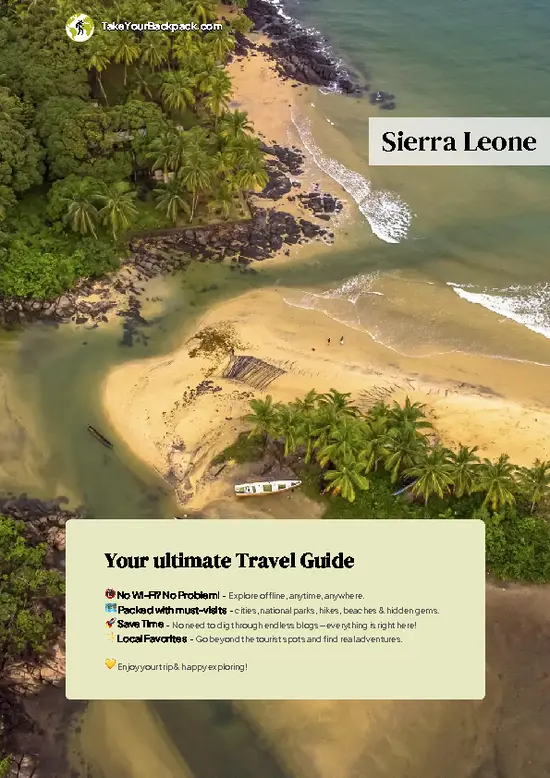
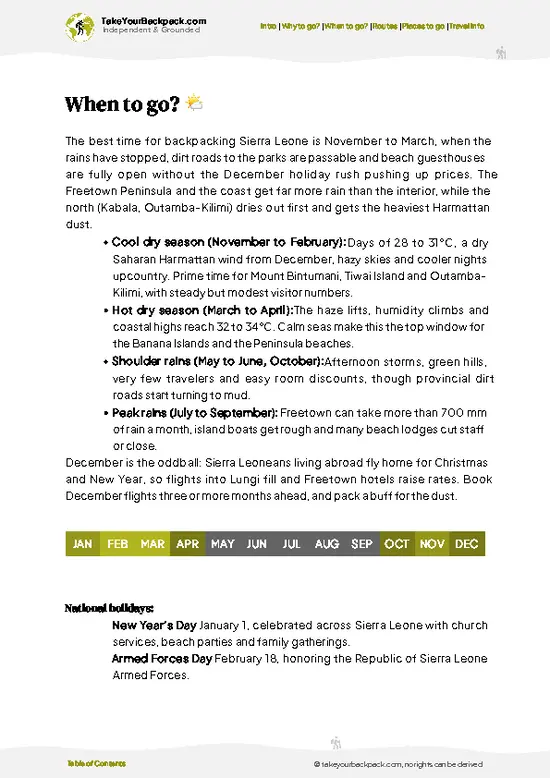
example page 0 from our offline Travel Guide for Sierra Leone
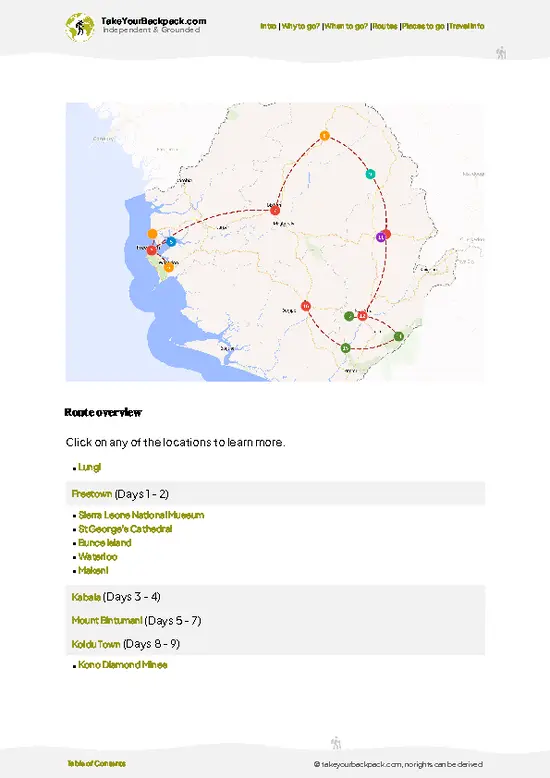
example page 1 from our offline Travel Guide for Sierra Leone
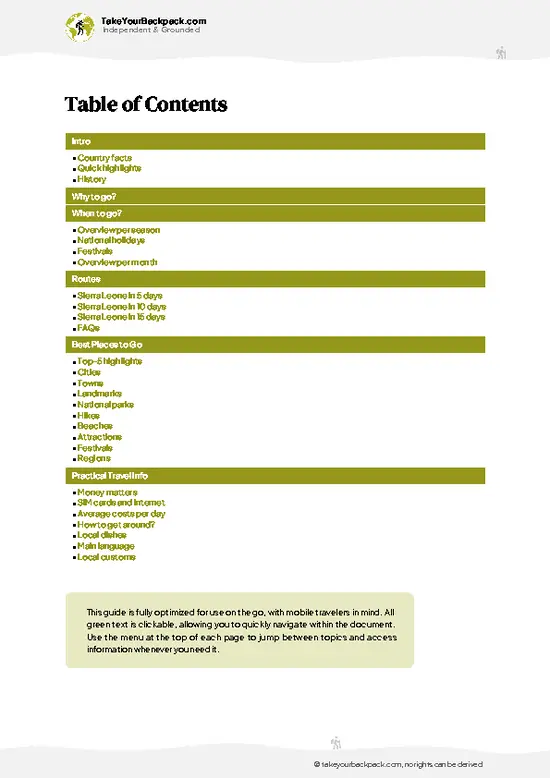
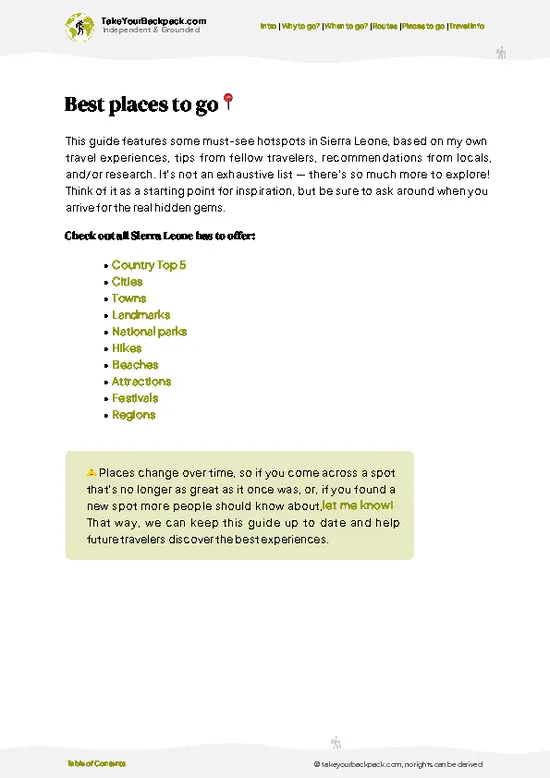
example page 2 from our offline Travel Guide for Sierra Leone
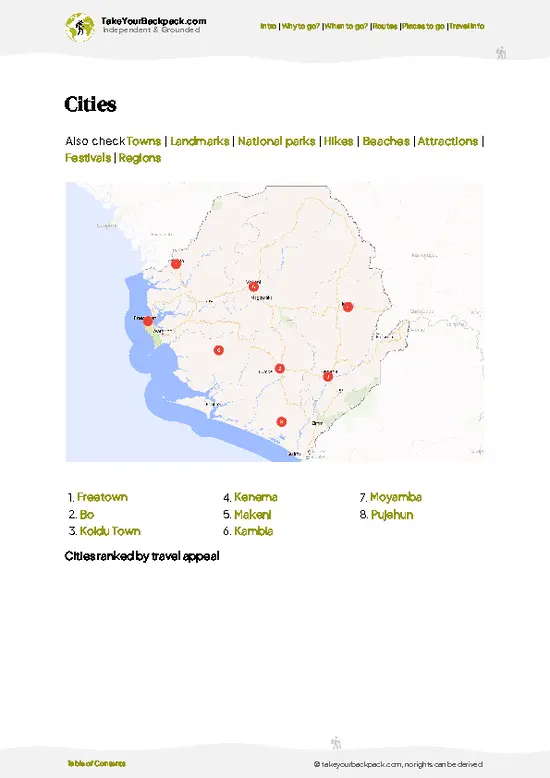
example page 3 from our offline Travel Guide for Sierra Leone
example page 4 from our offline Travel Guide for Sierra Leone
example page 5 from our offline Travel Guide for Sierra Leone
example page 6 from our offline Travel Guide for Sierra Leone
example page 7 from our offline Travel Guide for Sierra Leone
Loading the map 🌍
CLICK TO FILTER
cities
towns
landmarks
national parks
hikes
beaches
attractions
festivals
regions
SHOW COUNTRY’S BESTSHOW ALL

✨ Why go?
Ranked #4 national park in Sierra Leone
The unique appeal for travelers

Western Area Peninsula National Park suits backpackers who want real forest without a package tour. It sits within easy reach of the capital, so you can walk in with a guide from a nearby village and be back among the city's noise by evening. That saves the cost of an expedition and gives you a trail experience few other places in West Africa offer so close to a major city.
The forest itself is the draw. Walkers pass through the Guma Valley watershed forest area and the hills above it, where streams, ferns and towering cotton trees shade the ground. Birders come for hornbills and turacos, and a lucky few hear chimpanzees calling from the canopy. Community guides know the faint paths and the fruiting trees where animals gather.
It works best for self-guided travelers willing to hire a local guide … read more 👉
Western Area Peninsula National Park suits backpackers who want real forest without a package tour. It sits within easy reach of the capital, so you can walk in with a guide from a nearby village and be back among the city's noise by evening. That saves the cost of an expedition and gives you a trail experience few other places in West Africa offer so close to a major city.
The forest itself is the draw. Walkers pass through the Guma Valley watershed forest area and the hills above it, where streams, ferns and towering cotton trees shade the ground. Birders come for hornbills and turacos, and a lucky few hear chimpanzees calling from the canopy. Community guides know the faint paths and the fruiting trees where animals gather.
It works best for self-guided travelers willing to hire a local guide at the start, and it pairs naturally with beach days on the peninsula's western shore. Bring good shoes and plenty of water, and treat it as a quiet counterweight to Freetown's energy.

💡 HighlightsDon't-miss highlights and experiences

  1. Chimpanzee habitat: The park shelters a small population of wild chimpanzees. Sightings are uncommon, but their pant-hoots carry through the forest at dawn, and guides know where nests and feeding signs appear.
  2. Peninsula ridge viewpoints: Breaks in the canopy along the high ground reveal the Atlantic on one side and the Freetown estuary on the other, with haze softening the distance.
  3. Lowland rainforest canopy: Cotton trees, vines and giant buttress roots form a dim, humid world where the air smells of wet leaves and soil.
  4. Forest streams and small waterfalls: Clear water cuts through the hillsides and offers cool crossings, especially welcome after a climb in the heat.
  5. Birdlife: Hornbills, turacos and sunbirds work the treetops. Early mornings are the best time to catch them feeding while the forest
… read more 👉
  1. Chimpanzee habitat: The park shelters a small population of wild chimpanzees. Sightings are uncommon, but their pant-hoots carry through the forest at dawn, and guides know where nests and feeding signs appear.
  2. Peninsula ridge viewpoints: Breaks in the canopy along the high ground reveal the Atlantic on one side and the Freetown estuary on the other, with haze softening the distance.
  3. Lowland rainforest canopy: Cotton trees, vines and giant buttress roots form a dim, humid world where the air smells of wet leaves and soil.
  4. Forest streams and small waterfalls: Clear water cuts through the hillsides and offers cool crossings, especially welcome after a climb in the heat.
  5. Birdlife: Hornbills, turacos and sunbirds work the treetops. Early mornings are the best time to catch them feeding while the forest is still cool.
  6. Monkeys and forest mammals: Several monkey species move through the trees, and with a patient guide you may also spot duikers or signs of smaller mammals.
  7. Village approaches: Walking in from edge communities lets you see farm plots, palm groves and daily life before the trees close over the path.
Allow a full day for a guided forest walk covering most of this, or two days if you want a better chance of chimpanzee sounds and unhurried birding.
Spotted a mistake or missing something? Contact us.

🌤️ When to go?Best time to explore Western Area Peninsula

  • Peak Dry Season (December to February): Trails are firmest and views from the ridges over Freetown and the Atlantic are clearest, though Harmattan dust can haze distant peaks. Days reach 30 to 33°C (86 to 91°F), nights 23 to 25°C (73 to 77°F). Beach lodgings on the peninsula cost the most and book out around Christmas.
  • Late Dry Season (March to April): Heat and humidity build, with highs near 32°C (90°F). Crowds thin and prices ease, and early starts keep climbs comfortable.
  • Rainy Season (May to October): Rain peaks in July and August, often over 800 mm a month. Trails turn to mud, streams swell, and leeches and mosquitoes multiply. Temperatures sit at 25 to 29°C (77 to 84°F). Guesthouses discount, and forest is at its greenest.
  • Early Rains (November): Showers fade and the forest stays lush,
… read more 👉
  • Peak Dry Season (December to February): Trails are firmest and views from the ridges over Freetown and the Atlantic are clearest, though Harmattan dust can haze distant peaks. Days reach 30 to 33°C (86 to 91°F), nights 23 to 25°C (73 to 77°F). Beach lodgings on the peninsula cost the most and book out around Christmas.
  • Late Dry Season (March to April): Heat and humidity build, with highs near 32°C (90°F). Crowds thin and prices ease, and early starts keep climbs comfortable.
  • Rainy Season (May to October): Rain peaks in July and August, often over 800 mm a month. Trails turn to mud, streams swell, and leeches and mosquitoes multiply. Temperatures sit at 25 to 29°C (77 to 84°F). Guesthouses discount, and forest is at its greenest.
  • Early Rains (November): Showers fade and the forest stays lush, with fewer visitors.
Daylight stays close to 12 hours all year, so start hikes by 7 am to finish before dark and the afternoon storms.


source: climatestotravel.comJANJanuary: excellent for travelingFEBFebruary: excellent for travelingMARMarch: excellent for travelingAPRApril: highly recommended for travelingMAYMay: fair for travelingJUNJune: below average for travelingJULJuly: below average for travelingAUGAugust: below average for travelingSEPSeptember: fair for travelingOCTOctober: fair for travelingNOVNovember: highly recommended for travelingDECDecember: excellent for traveling
when-to-go

✈️ The backpacker research shortcutSierra Leone Travel Guide

An offline-friendly backpacking guide with optimized travel routes, ranked highlights, transport advice, and the best areas to stay.
example page 0 from our offline Travel Guide for Sierra Leone
example page 1 from our offline Travel Guide for Sierra Leone
example page 2 from our offline Travel Guide for Sierra Leone
example page 3 from our offline Travel Guide for Sierra Leone
example page 4 from our offline Travel Guide for Sierra Leone
example page 5 from our offline Travel Guide for Sierra Leone
example page 6 from our offline Travel Guide for Sierra Leone
example page 7 from our offline Travel Guide for Sierra Leone
The digital guide (242 pages) contains:
✅ 50 highlights, ranked by travel appeal
✅ Optimized 5, 10 & 15-day travel routes
✅ Cities, national parks, landmarks, beaches
✅ How to get around
✅ Offline-friendly for travel without Wi-Fi
👉 Click to see all 30+ guide features

📅 Plan smarter in minutes, not weeks
✅ Month by month travel advice
✅ Festivals & national holidays
✅ Budget expectations

🗺️ Go to the right places, skip the overrated ones
✅ Honest pros & cons of destinations
✅ Top hikes, parks & viewpoints
✅ Lesser-known places most travelers miss
✅ Clear “worth it vs skip it” guidance

🛏️ Travel smoothly without rookie mistakes
✅ Best areas to stay
✅ Transport systems explained simply
✅ Common scams & safety advice
✅ SIM cards, money & practical tips

🌍 Understand the country, not just visit it
✅ Culture & traditions
✅ 52 Essential phrases & customs
✅ Festivals worth planning around
✅ Traveler-friendly historical context
✅ Insights that make places more meaningful

📱 Built for real travel conditions
✅ Fully downloadable PDF
✅ Works completely offline
✅ Optimized for phone use
✅ Useful in remote areas & buses
✅ Everything in one place
Stop searching, start planning
Get instant access to your full guide. 30‑day money-back guarantee.
+ Add another guide for just

By proceeding you agree to our terms.
Sent to your inbox immediately after payment • 100% Secure Checkout
Best Backpacking Travel Advisor 2025 tourism awardBest Backpacking
Travel Advisor
2025
What others say about Take Your Backpack Guides:
⭐⭐⭐⭐⭐
Fantastic, amazing amount of information!
⭐⭐⭐⭐⭐
My goodness this is amazing, it's what I've been looking for hats off too you!
⭐⭐⭐⭐⭐
I think this is absolutely BRILLIANT
⭐⭐⭐⭐
Very complete and informative. It's still missing places, but I gotta to commend you
⭐⭐⭐⭐⭐
This is truly amazing, thank you, can't wait to explore it with my kids!
⭐⭐⭐⭐⭐
Awesome resource, thank you!
⭐⭐⭐⭐⭐
This is amazing! Can't wait to explore the ones I haven't seen
⭐⭐⭐⭐
I love this! Well done, great idea.
⭐⭐⭐⭐⭐
Thanks for taking the time to make this gem!
⭐⭐⭐⭐⭐
This might be the best website I've ever seen.
⭐⭐⭐⭐⭐
Congratulations, and thank you so much for your work; it's incredibly valuable.
⭐⭐⭐⭐
In all seriousness I think you did a great job pointing out the important spots
⭐⭐⭐⭐⭐
10/10 very good
⭐⭐⭐⭐⭐
As someone who's only just starting to visit regularly this is awesome, thank you.
⭐⭐⭐⭐
Thank you very much! I'm going to visit my dad, it's going to be very useful!
⭐⭐⭐⭐⭐
This is really cool! We'll be travelling for the first time and this definitely come in handy.
⭐⭐⭐⭐⭐
You are now our minister of culture, congratulations 👨‍💼
⭐⭐⭐⭐⭐
Just wanted to tell you that this is a pearl! Going to follow your recommendations.
⭐⭐⭐⭐⭐
This is so cool. I'll definitely be using the resource for my travels soon.
⭐⭐⭐⭐⭐
This is very impressive! Good work.
⭐⭐⭐⭐⭐
This is an amazing and informative site. Very well done!

🛏️ Where to stay?Where staying makes the most sense

Most backpackers sleep outside Western Area Peninsula National Park, and the best base is the beach strip on the peninsula’s western shore. There are no formal lodgings inside the park, so the forest is a day-hike or guided-trek destination.
River Number Two Beach and Tokeh Beach have beach guesthouses and eco-lodges, with dorm-style or simple private rooms at about US$20 to 60 a night. Bureh Beach, a surf spot, has basic bungalows from roughly US$25 to 50 and is the sociable pick for budget travelers. Both sit on the park’s fringe, so guides can collect you at trailheads.
Freetown is the practical … read more 👉
Most backpackers sleep outside Western Area Peninsula National Park, and the best base is the beach strip on the peninsula’s western shore. There are no formal lodgings inside the park, so the forest is a day-hike or guided-trek destination.
River Number Two Beach and Tokeh Beach have beach guesthouses and eco-lodges, with dorm-style or simple private rooms at about US$20 to 60 a night. Bureh Beach, a surf spot, has basic bungalows from roughly US$25 to 50 and is the sociable pick for budget travelers. Both sit on the park’s fringe, so guides can collect you at trailheads.
Freetown is the practical alternative. Hostels and mid-range guesthouses in Aberdeen, Lumley and the Hill Station area run about US$25 to 80, and you get restaurants, ATMs and transport links. From Aberdeen or Lumley, a taxi to trailheads near Regent or Leicester takes 30 to 60 minutes.
Camping is possible with a guide and permission from park rangers, but there are no facilities. Book ahead for December and January, when beach lodges fill.

👛 Costs (as of 22 October 2026)Travel costs and budget guide for Western Area Peninsula

A day in Western Area Peninsula National Park costs roughly US$10 to 25 for a backpacker including a guide, with a total daily budget of US$100 here at high-season rates.
CategoryBudget RangeLocal Reality
Entrance and guideUS$10 to 25Fees and guide are usually arranged through lodges or rangers, paid in cash.
Accommodation (high season)US$25 to 60Beach guesthouses and Freetown hostels. Rates drop in the rains.
Local transportUS$5 to 20Shared taxis and poda-podas are cheap. Private taxis to trailheads cost more.
Food and suppliesUS$8 to 20Rice dishes and grilled fish at local spots are cheap. Lodge meals cost more.
Water and extrasUS$2 to 5Bottled water and snacks. Bring supplies from Freetown.
Total Daily BudgetUS$100Comfortable budget level for one day.
⚠️ Prices can change and everyone travels differently, so take this as a rough guide. Hope it helps you plan your adventure!

🥾 TrailsExploring Western Area Peninsula: trails, terrain, and views

Western Area Peninsula National Park has no tightly signposted trail network, so most walks follow routes arranged with local community guides from villages around the forest edge. The terrain is steep in places, with red clay that becomes slippery after rain, root-tangled steps and shallow stream crossings.
  • Short forest loop: A half-day walk of roughly 2 to 4 hours through shaded lowland forest, mostly easy to moderate, with birds and monkeys the likeliest sightings.
  • Ridge climb: A harder day walk of about 4 to 6 hours that gains height to open viewpoints over the sea and the estuary. Expect sustained
… read more 👉
Western Area Peninsula National Park has no tightly signposted trail network, so most walks follow routes arranged with local community guides from villages around the forest edge. The terrain is steep in places, with red clay that becomes slippery after rain, root-tangled steps and shallow stream crossings.
  • Short forest loop: A half-day walk of roughly 2 to 4 hours through shaded lowland forest, mostly easy to moderate, with birds and monkeys the likeliest sightings.
  • Ridge climb: A harder day walk of about 4 to 6 hours that gains height to open viewpoints over the sea and the estuary. Expect sustained uphill sections and strong humidity.
  • Chimpanzee-focused trek: An early-start outing that can run most of a day, moderate to hard, where the aim is to listen for calls and find signs such as nests and chewed fruit rather than expect a close encounter.
  • Stream route: A gentler option following water courses, with cool crossings, ferns and frogs, suited to first-timers who want less climbing.
Wildlife is elusive, so quiet pacing helps more than speed. Wear boots with grip, carry at least 2 liters of water, and pack a light rain layer since showers arrive quickly in the wetter months.
Access is by road from Freetown, using shared taxis or a hired car toward the villages at the park's edge, and the final stretch can be rough. Crowds are minimal; you may meet no other walkers. Entry and guide arrangements are handled locally, usually paid in cash, so bring small notes.
⚠️ Hiking info can sometimes be outdated or inaccurate. Before you hit the trail, check the latest conditions with locals. If you do spot anything that's off, I'd love to hear from you, so I can update it for fellow travelers.

🛡️ SafetyTraveler Safety Guide

Western Area Peninsula National Park is straightforward with a local guide, and most problems come from heat, mud and navigation. Trails are lightly marked and branch often through dense forest, so hire a guide through a lodge or the park office rather than going alone. Start early, carry at least 2 to 3 liters of water, and wear shoes with real grip, since red clay becomes slick in the rains. Streams can rise quickly after storms, so wait rather than force a crossing. Chimpanzees and monkeys live in the forest, and you may hear far more than you see. Keep your distance, never feed them, and keep food sealed. Snakes are present but avoid people, so watch your footing and wear long trousers. Bring insect repellent, because mosquitoes carry malaria, and start antimalarials before arrival. Leave … read more 👉
Western Area Peninsula National Park is straightforward with a local guide, and most problems come from heat, mud and navigation. Trails are lightly marked and branch often through dense forest, so hire a guide through a lodge or the park office rather than going alone. Start early, carry at least 2 to 3 liters of water, and wear shoes with real grip, since red clay becomes slick in the rains. Streams can rise quickly after storms, so wait rather than force a crossing. Chimpanzees and monkeys live in the forest, and you may hear far more than you see. Keep your distance, never feed them, and keep food sealed. Snakes are present but avoid people, so watch your footing and wear long trousers. Bring insect repellent, because mosquitoes carry malaria, and start antimalarials before arrival. Leave valuables at your lodging and tell someone your route.

FAQTraveler FAQ

Plan on one to two days for Western Area Peninsula National Park. One full day covers a guided forest hike from a trailhead near Regent or Leicester, and a second day lets you add a beach stop at River Number Two or Tokeh.
Yes, Western Area Peninsula National Park can be reached without a car, though you will want a guide. Shared taxis and poda-podas run from Freetown toward Regent, Leicester and the peninsula beaches in about 30 to 90 minutes, costing a few dollars. Private taxis for a day cost roughly US$30 to 60.
Western Area Peninsula National Park charges a modest entrance and guide fee, generally about US$10 to 25 per person, paid in cash. Arrange it through the park office, rangers or your lodge, which often handle the paperwork. Bring small bills and ask in advance about camping permission if you plan to stay overnight.
⚠️ Things can change over time, so always validate details locally before you go.

Other Sierra Leonean national parks near Western Area Peninsula

Explore more nearby:


💡 Not sure where to go next?
Create a personalized itinerary for Sierra Leone including Western Area Peninsula and the places that fit your trip.

Generate my itinerary

👉 Discover all national parks

Or checkout all Sierra Leone has to offer (think cities, towns, villages, national parks, hikes, beaches, festivals)
Country photo of Sierra Leone

We 💚 feedbackSumming up the experience

Western Area Peninsula National Park works best as a forest morning before an afternoon on the peninsula's beaches, with a night in Freetown on either side. I would hire the guide the evening before and start at first light, because the heat and the birdsong both peak early.

✍️ Help improve this page!
The information on this page is based on in-depth research, insights shared by experienced travelers, and feedback from the local travel community in Sierra Leone. While every effort is made to keep the information accurate and current, conditions can change — so if you spot anything incorrect or outdated, please get in touch.


🙋‍♂️ Give feedback

👋 Meet the founderWho’s Behind Take Your Backpack?

Johan, backpacker and founder of TakeYourBackpackHi, I’m Johan (Netherlands 🇳🇱), the creator of TakeYourBackpack. Over the past 3 decades, I’ve backpacked through 90+ countries across six continents, gaining extensive experience with independent travel, long-term trips, and overland routes.

This site is built on a combination of firsthand travel experience and carefully curated insights from other backpackers. Many guides are based on places I’ve personally visited, while others bring together tips, observations, and practical advice shared by trusted travelers I’ve met along the way.

The goal is to provide realistic, experience-driven guidance — not generic itineraries — so you can explore destinations with better context, clearer expectations, and more confidence.