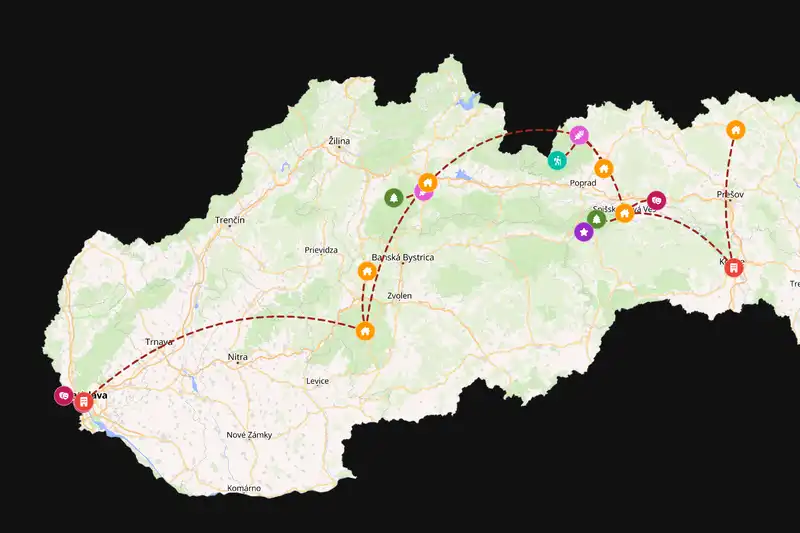
Yes, Slovakia is easy to backpack on your own: distances are short, trains and buses reach every major town, and trails are among the best marked in Europe.
The main rail line links
Bratislava, Žilina,
Poprad and
Košice, and Bratislava to Košice takes 5 to 5.5 hours for roughly €15 to 25. Hostel dorms cost about €15 to 28, and private rooms in family-run guesthouses cost about €35 to 60. Weekday lunch menus run €6 to 9, so €45 to 65 a day covers a comfortable backpacker budget. Younger people in cities speak English, while in villages a few words of Slovak and a translation app go a long way.
Ten to fourteen days is the right amount of time for Slovakia. That lets you see the capital, the central mining towns, the mountains and the Gothic east without rushing.
With only
5 days, stay in the Tatras and Spiš: two nights near the
High Tatras and two in
Levoča cover hiking,
Slovak Paradise and
Spiš Castle. With
10 days, add
Bratislava,
Banská Štiavnica and the Liptov valley. With
15 days, you can add
Bardejov,
Orava Castle and
Kremnica at an easy pace. Bratislava to Poprad is about 4 hours by train, so crossing the country costs you roughly half a day each way.
Yes, you can travel all over Slovakia without a car. Trains cover the main east-west corridor, and regional buses fill in almost everything else.
Trains run from
Bratislava to
Poprad in about 4 hours and to
Košice in 5 to 5.5 hours, with fares around €15 to 25. In the Tatras, the electric railway connects Štrbské Pleso, Starý Smokovec and
Tatranská Lomnica.
Banská Štiavnica,
Bardejov and
Bojnice are bus towns, 2 to 3 hours from their nearest hubs. Weekend and evening services thin out sharply, so check the cp.sk timetable the night before.
Vlkolínec has no regular bus, so plan on about an hour’s walk from Ružomberok’s Biely Potok.
The must-visits in Slovakia are the
High Tatras,
Spiš Castle with nearby
Levoča, and the gorges of
Slovak Paradise, all within an hour of Poprad.
Add
Banská Štiavnica, the hillside silver-mining town about 2 to 3 hours by bus from Bratislava, and
Bratislava itself for its castle and old town (one or two days is enough). If you have time,
Vlkolínec, a UNESCO-listed village of log houses, and the walled square of
Bardejov, about 2 hours north of Košice by bus, round out the list. Of the castles,
Bojnice and
Orava are the most striking after Spiš. Plan at least 10 days to see most of these comfortably.
If you are short on time in Slovakia, cut the spa and lake resorts in the west and the remote far east, and keep the Tatras, Spiš and Banská Štiavnica.
Piešťany and the
Zlaté Piesky lake in Bratislava are pleasant for locals but hard to justify on a tight schedule. The
Poloniny beech forests near the Ukrainian border take 6 to 8 hours to reach from Bratislava by public transport and need at least 2 extra days. In the capital, one full day covers the old town and castle, so skip the museum circuit. If you start to suffer from castle fatigue, choose either
Bojnice or
Orava rather than both, since each costs half a day of travel.
Yes, our itinerary-planner does exactly that. Set your trip length in days, give your interests and travel style, optionally give start- and end location and/or some mandatory stops you would like to include and the itinerary planner creates your personalized routes for Slovakia in seconds. Try it out!
Try the itinerary plannerv2.webp)
 Best Backpacking