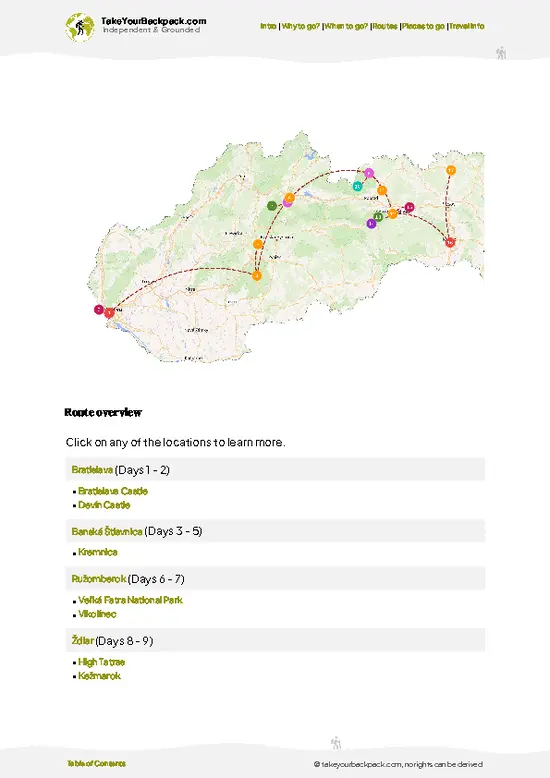
This 15-day traverse is for travelers who want the full width of Slovakia, west to east, at a pace that leaves room for slow mornings and long hikes. It mixes the capital and two medieval mining towns with three different mountain ranges and the Gothic east, and it ends near the Polish and Ukrainian borders where few visitors go. Every move runs on intercity and regional trains, regional buses and the Tatra Electric Railway, with one or two short taxi hops.
Days 1-2: Bratislava and Devín
Start in
Bratislava and give it a day of rooftops and river. Climb to
Bratislava Castle in the morning for the view over the Danube toward Austria, then walk downhill to the Art Nouveau Blue Church of St. Elizabeth, a 15-minute stroll from the Old Town that most day-trippers skip. On day 2, take city bus 29 from the Most SNP bridge, about 25 minutes, to
Devin Castle, a ruin on a rock where the Morava River meets the Danube. The Iron Curtain ran along this riverbank, and the memorial below the ruin names …
read more 👉This 15-day traverse is for travelers who want the full width of Slovakia, west to east, at a pace that leaves room for slow mornings and long hikes. It mixes the capital and two medieval mining towns with three different mountain ranges and the Gothic east, and it ends near the Polish and Ukrainian borders where few visitors go. Every move runs on intercity and regional trains, regional buses and the Tatra Electric Railway, with one or two short taxi hops.
Days 1-2: Bratislava and Devín
Start in Bratislava and give it a day of rooftops and river. Climb to Bratislava Castle in the morning for the view over the Danube toward Austria, then walk downhill to the Art Nouveau Blue Church of St. Elizabeth, a 15-minute stroll from the Old Town that most day-trippers skip. On day 2, take city bus 29 from the Most SNP bridge, about 25 minutes, to Devin Castle, a ruin on a rock where the Morava River meets the Danube. The Iron Curtain ran along this riverbank, and the memorial below the ruin names the people shot trying to cross. Back in town, dinner in a wine cellar near Michalská Street costs €12 to 18.Days 3-5: Banská Štiavnica and Kremnica
Three nights in Banska Stiavnica sounds like a lot until you’re there. The town sits in the crater of an extinct volcano, and its mining wealth paid for the hillside of stone houses you walk through every day. Spend day 3 settling in, then give day 4 to the Banská Štiavnica Old Castle and New Castle complex: the Old Castle grew out of a Romanesque church, while the white New Castle was a lookout against Ottoman raids. The open-air mining museum on the edge of town takes you underground in a hard hat. Day 5 is a day trip to Kremnica, about 1.5 hours by bus with a change in Žiar nad Hronom. Its mint has been striking coins since the Middle Ages and still runs today, and the walled Town Castle on the hill above the sloping square is small enough to see in an hour.Days 6-7: Ružomberok, Veľká Fatra and Vlkolínec
Head north by bus through Banská Bystrica to Ruzomberok, about 3 hours, a working paper-mill town that makes a cheap, unpretentious base. On day 7, ride the Malinô Brdo chairlift above town into the Velka Fatra, walk the grassy ridge, then follow the marked trail down to Vlkolinec, a UNESCO-listed hamlet of around 45 log houses painted blue and ochre. Arriving on foot from above, after the tour groups have driven away, is the best way to see it. From the village it’s about an hour’s walk down to Ružomberok.Days 8-9: Ždiar and the High Tatras
A one-hour train to Poprad and a one-hour bus via Kežmarok bring you to Zdiar, a Goral village of wooden houses with painted window frames, strung along the road below the Belianske Tatras. Sleeping here instead of in the resort towns means sheep in the morning and quiet evenings. Use day 9 for the High Tatras: take the bus a few stops to Biela voda and walk up the valley to Zelené pleso, a green tarn under sheer walls with a mountain hut serving hot soup for €5 to 7. It’s roughly 5 hours round trip.Days 10-12: Spišská Nová Ves, Slovak Paradise and Dobšinská Ice Cave
On the way south, stop in Kezmarok to see its wooden articular church, built without nails, then continue by train via Poprad to Spisska Nova Ves. Its long lens-shaped square is pleasant, but you’re here because Čingov, the gateway to Slovak Paradise, is a short bus ride away. Give day 11 to the Prielom Hornádu gorge, where chains, steel steps and footbridges carry you along the river wall, and climb out to the Tomášovský výhľad viewpoint. Day 12 belongs to Dobsinska Ice Cave on the park’s southern edge. Connections are sparse, so plan the day around the bus via Poprad or the regional train toward Červená Skala, and pack a fleece: the ice inside stays frozen year-round and the tour runs only in the warm season.Days 13-15: Spiš Castle, Košice and Bardejov
Leave Spišská Nová Ves early by bus for Spišské Podhradie and walk up to Spiš Castle, a ruin that covers roughly 4 hectares of limestone hilltop. Then continue by bus to Kosice, about 1.5 hours. The east’s main city is livelier than its reputation: Hlavná Street fills with café tables, and St. Elisabeth Cathedral is the largest church in Slovakia. On day 14, ride the bus about 2 hours north to Bardejov, whose Gothic square of tall gabled houses has barely changed in centuries, and return in the evening. Košice’s airport and night trains to Bratislava make day 15 an easy exit.
If you have one spare day in the far east, take a bus from Bardejov toward Svidník to see the wooden Greek Catholic churches of the Carpathian villages, such as the one in Ladomirová.
 Best Backpacking


