×

Somalia🇸🇴 | festivalsEid al-Fitrend of Ramadan, communal feasts, mosque gatherings | things to do and best time to go

Explore Dervish DayExplore Eid al-Adha

Backpacking in Eid al-Fitr
👌 Worth visitingfestival ranked #8
By Johan Kruseman 🇳🇱 | Updated June 6, 2026

Here’s what most travelers miss: Eid al-Fitr in Somalia isn’t just a feast—it’s a full-body reset. You’ll find yourself swept up in Mogadishu’s pulse, where the festival erupts after Ramadan’s final sunset. The city’s heart—especially the Hamar Weyne district—becomes a living, breathing celebration. Somali Eid is a collision of Sufi-inspired drumming, ululating voices, and the scent of spiced goat wafting from every corner. The crowd is everyone: families in crisp white, teenagers with Bluetooth speakers, elders trading stories. The vibe? Relentless joy, but with the edge of a place that’s earned every moment of peace. It’s short—just a day or two—but the intensity lingers. Go if you want to witness resilience and community in action. Skip it if you’re hunting for a sanitized, tourist-friendly festival.

Discover everything you want to know in the 📖 Somalia Travel Guide.
Safety warning

The current risk level for Somalia is high. Check the advice before going.


Get your Somalia guide
83 ranked highlights, routes & tips, works offline (354 pages)
Loading the map 🌍
CLICK TO FILTER
cities
towns
landmarks
national parks
hikes
beaches
attractions
festivals
regions
SHOW COUNTRY’S BESTSHOW ALL

✨ Why go?
Ranked #8 festival in Somalia
What makes this festival worth celebrating

Backpackers flock to Somalia during Eid al-Fitr for a whirlwind of social energy and cultural immersion. This festival isn’t just a date on the calendar; it’s a vibrant celebration that transforms communities. Picture bustling streets filled with laughter, shared meals, and spontaneous gatherings. You’re not just a spectator; you’re part of a temporary community that welcomes you with open arms.

Planning your route around Eid means you’ll experience the festival’s affordability compared to similar events elsewhere. Local markets overflow with delicious food at prices that won’t break the bank. Plus, the festive atmosphere amplifies the thrill of exploration, making every moment feel alive.

Integrating Eid into your longer travel plans adds depth to your journey. It’s a chance to connect … read more 👉
Backpackers flock to Somalia during Eid al-Fitr for a whirlwind of social energy and cultural immersion. This festival isn’t just a date on the calendar; it’s a vibrant celebration that transforms communities. Picture bustling streets filled with laughter, shared meals, and spontaneous gatherings. You’re not just a spectator; you’re part of a temporary community that welcomes you with open arms.

Planning your route around Eid means you’ll experience the festival’s affordability compared to similar events elsewhere. Local markets overflow with delicious food at prices that won’t break the bank. Plus, the festive atmosphere amplifies the thrill of exploration, making every moment feel alive.

Integrating Eid into your longer travel plans adds depth to your journey. It’s a chance to connect with locals, learn their stories, and witness traditions that have endured for generations. This isn’t just about the destination; it’s about the energy you carry forward, fueling your adventures beyond the festival.
Want to include Eid al-Fitr in your Somalia route?
Create a personalized Somalia itinerary that includes Eid al-Fitr and the places that fit your trip — based on your travel style, budget, and available time. Get your route in seconds.

Generate my trip

💡 HighlightsEssential experiences to have while celebrating the Eid al-Fitr

  • Eid morning prayers (Salat al-Eid) in mosques and open grounds — The communal prayer is the spine of the day: neighborhoods gather at mosques or sprawling open fields, men, women and families in traditional dress, a charged mix of solemnity and joy as people greet one another afterwards. The scale and immediacy of those gatherings—friends you haven’t seen all year bumping into each other—gives Eid a real communal punch you don’t get from photos.
  • Feasting and street food — sambusas, anjero, xalwo and more — Food is everywhere: flaky sambusas stuffed with spiced meat, thin anjero (canjeero) or muufo breads, syrupy xalwo (halwa) for sweets and endless cups of spiced tea. Vendors set up early, families open their homes, and sharing plates with neighbors is part ceremony, part competitive deliciousness.
read more 👉
  • Eid morning prayers (Salat al-Eid) in mosques and open grounds — The communal prayer is the spine of the day: neighborhoods gather at mosques or sprawling open fields, men, women and families in traditional dress, a charged mix of solemnity and joy as people greet one another afterwards. The scale and immediacy of those gatherings—friends you haven’t seen all year bumping into each other—gives Eid a real communal punch you don’t get from photos.
  • Feasting and street food — sambusas, anjero, xalwo and more — Food is everywhere: flaky sambusas stuffed with spiced meat, thin anjero (canjeero) or muufo breads, syrupy xalwo (halwa) for sweets and endless cups of spiced tea. Vendors set up early, families open their homes, and sharing plates with neighbors is part ceremony, part competitive deliciousness.
  • Henna, new clothes and market bustle — Eid starts with dressing up: women and girls get henna designs on their hands, tailors hustle to finish last-minute garments, and markets swell with fabric, jewelry and perfumes. The visual of bright diracs, patterned macawis and freshly painted henna is a vivid, everyday kind of pageantry.
  • Traditional music, dance and poetry (dhaanto, buraanbur, gabay) — Expect live, improvised moments: men and women perform dhaanto dances, women recite buraanbur poems and elders trade gabay (poetry). It’s not a staged show so much as spontaneous cultural performance—call-and-response singing, rhythmic clapping, and poetry that can be witty, pointed or heartfelt.
  • Family visits, charity and community outings (picnics, coastal gatherings) — Eid is built around visiting family, giving Zakat al-Fitr or sweets to children, and getting outside together. In coastal towns you’ll see entire families picnic on the beach; in smaller towns the day can include local fairs or markets. The generosity and social rounds—knocking on doors, sharing plates, handing out small gifts—keep the whole neighborhood buzzing.
Spotted a mistake or missing something? Contact us.
🌤️ When to go?When is the celebration of Eid al-Fitr?


  • Topic: Weather – Somalia’s Eid al-Fitr usually falls after Ramadan, which shifts yearly. The best window is during the dry season, roughly November to March, when temperatures hover between 25-30°C (77-86°F). This keeps the heat manageable and the skies clear for exploring.

  • Topic: Temperature – Expect daytime highs around 30°C (86°F) and cooler nights near 20°C (68°F). Avoid the scorching months of April to June when temps can spike past 38°C (100°F), draining your energy before the festival even starts.

  • Topic: Daylight Hours – Near the equator, daylight stays steady year-round, about 12 hours. This means you can plan your days without worrying about early sunsets cutting your adventures short.

  • Topic: Crowds – Eid draws locals in full force, but Somalia’s tourism is low-key. You’ll
read more 👉

  • Topic: Weather – Somalia’s Eid al-Fitr usually falls after Ramadan, which shifts yearly. The best window is during the dry season, roughly November to March, when temperatures hover between 25-30°C (77-86°F). This keeps the heat manageable and the skies clear for exploring.

  • Topic: Temperature – Expect daytime highs around 30°C (86°F) and cooler nights near 20°C (68°F). Avoid the scorching months of April to June when temps can spike past 38°C (100°F), draining your energy before the festival even starts.

  • Topic: Daylight Hours – Near the equator, daylight stays steady year-round, about 12 hours. This means you can plan your days without worrying about early sunsets cutting your adventures short.

  • Topic: Crowds – Eid draws locals in full force, but Somalia’s tourism is low-key. You’ll find vibrant community energy without overwhelming tourist crushes, especially if you time your visit just after the main prayers and feasts.

  • Topic: Seasonal Activities – Eid is a cultural crescendo, packed with communal meals, traditional dances, and market buzz. Visiting during Eid means diving into authentic Somali life, but outside the festival, the pace slows, offering quieter exploration.

  • Topic: Price Fluctuations – Expect a slight bump in local prices for accommodation and transport during Eid due to demand. Booking early or arriving just before the festival can save you from last-minute surges.


Pro-tip: Align your trip to land a day or two before Eid starts—this way, you catch the build-up without paying festival peak prices or battling the biggest crowds.


source: climatestotravel.comJANJanuary: highly recommended for travelingFEBFebruary: highly recommended for travelingMARMarch: highly recommended for travelingAPRApril: highly recommended for travelingMAYMay: highly recommended for travelingJUNJune: highly recommended for travelingJULJuly: highly recommended for travelingAUGAugust: highly recommended for travelingSEPSeptember: highly recommended for travelingOCTOctober: highly recommended for travelingNOVNovember: highly recommended for travelingDECDecember: highly recommended for traveling

✈️ The backpacker research shortcutSomalia Travel Guide

An offline-friendly backpacking guide with optimized travel routes, ranked highlights, transport advice, and the best areas to stay.
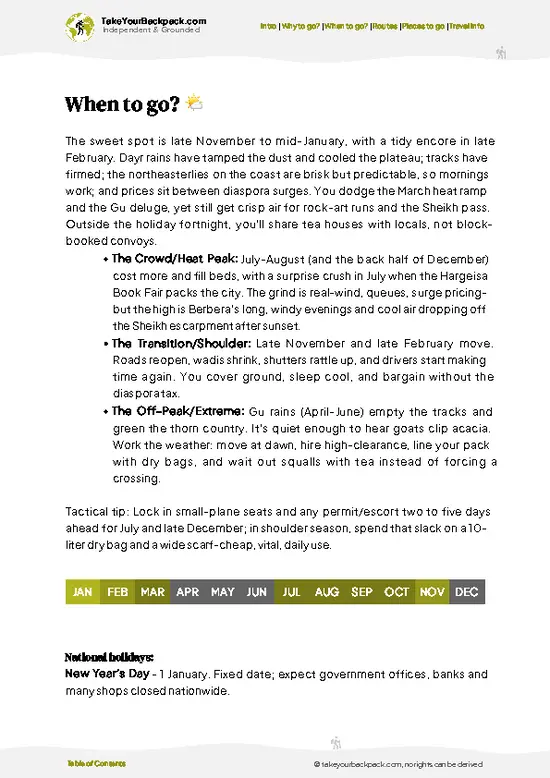
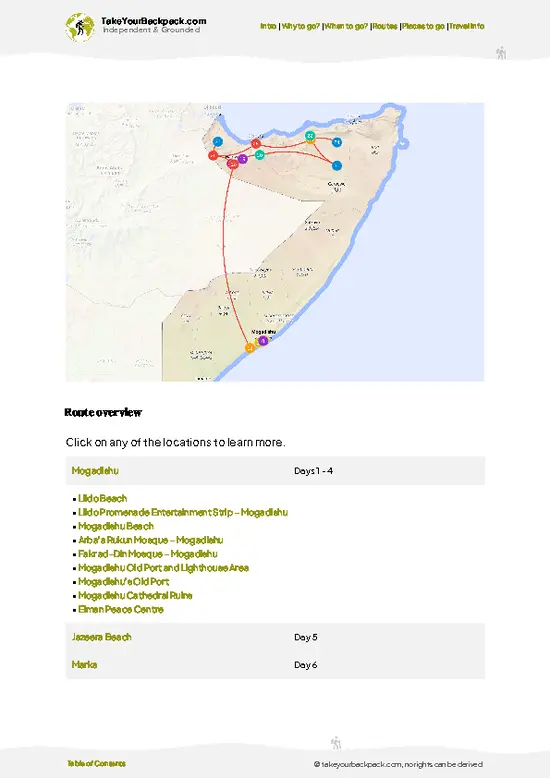
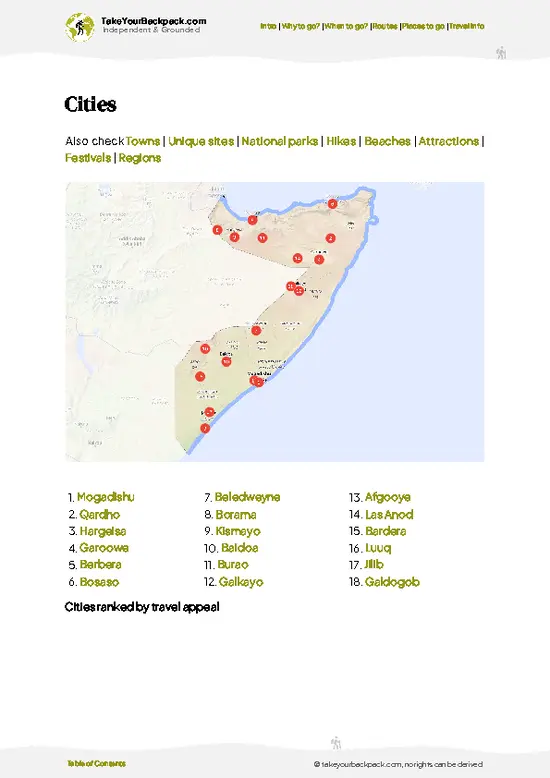
example page 0 from our offline Travel Guide for Somalia
example page 1 from our offline Travel Guide for Somalia
example page 2 from our offline Travel Guide for Somalia
example page 3 from our offline Travel Guide for Somalia
example page 4 from our offline Travel Guide for Somalia
example page 5 from our offline Travel Guide for Somalia
example page 6 from our offline Travel Guide for Somalia
example page 7 from our offline Travel Guide for Somalia
The digital guide (354 pages) contains:
83 highlights, ranked by travel appeal
Optimized 5, 10 & 15-day travel routes
Cities, national parks, landmarks, beaches
How to get around
Offline-friendly for travel without Wi-Fi
👉 Click to see all 30+ guide features

📅 Plan smarter in minutes, not weeks
Month by month travel advice
Festivals & national holidays
Budget expectations

🗺️ Go to the right places, skip the overrated ones
Honest pros & cons of destinations
Top hikes, parks & viewpoints
Lesser-known places most travelers miss
Clear “worth it vs skip it” guidance

🛏️ Travel smoothly without rookie mistakes
Best areas to stay
Transport systems explained simply
Common scams & safety advice
SIM cards, money & practical tips

🌍 Understand the country, not just visit it
Culture & traditions
52 Essential phrases & customs
Festivals worth planning around
Traveler-friendly historical context
Insights that make places more meaningful

📱 Built for real travel conditions
Fully downloadable PDF
Works completely offline
Optimized for phone use
Useful in remote areas & buses
Everything in one place
Save weeks of stressful planning
Get instant access to your full guide. 30‑day money-back guarantee.


By proceeding you agree to our terms.
Sent to your inbox immediately after payment • 100% Secure Checkout
Best Backpacking Travel Advisor 2025 tourism awardBest Backpacking
Travel Advisor
2025
What others say about Take Your Backpack Guides:
⭐⭐⭐⭐⭐
Fantastic, amazing amount of information!
⭐⭐⭐⭐⭐
My goodness this is amazing, it's what I've been looking for hats off too you!
⭐⭐⭐⭐⭐
I think this is absolutely BRILLIANT
⭐⭐⭐⭐
Very complete and informative. It's still missing places, but I gotta to commend you
⭐⭐⭐⭐⭐
This is truly amazing, thank you, can't wait to explore it with my kids!
⭐⭐⭐⭐⭐
Awesome resource, thank you!
⭐⭐⭐⭐⭐
This is amazing! Can't wait to explore the ones I haven't seen
⭐⭐⭐⭐
I love this! Well done, great idea.
⭐⭐⭐⭐⭐
Thanks for taking the time to make this gem!
⭐⭐⭐⭐⭐
This might be the best website I've ever seen.
⭐⭐⭐⭐⭐
Congratulations, and thank you so much for your work; it's incredibly valuable.
⭐⭐⭐⭐
In all seriousness I think you did a great job pointing out the important spots
⭐⭐⭐⭐⭐
10/10 very good
⭐⭐⭐⭐⭐
As someone who's only just starting to visit regularly this is awesome, thank you.
⭐⭐⭐⭐
Thank you very much! I'm going to visit my dad, it's going to be very useful!
⭐⭐⭐⭐⭐
This is really cool! We'll be travelling for the first time and this definitely come in handy.
⭐⭐⭐⭐⭐
You are now our minister of culture, congratulations 👨‍💼
⭐⭐⭐⭐⭐
Just wanted to tell you that this is a pearl! Going to follow your recommendations.
⭐⭐⭐⭐⭐
This is so cool. I'll definitely be using the resource for my travels soon.
⭐⭐⭐⭐⭐
This is very impressive! Good work.
⭐⭐⭐⭐⭐
This is an amazing and informative site. Very well done!

🛏️ Where to stay?Best areas to stay in Somalia

When you’re gearing up for Eid al-Fitr in Somalia, the right base can elevate your experience. Head to Mogadishu, the heart of the action. The city buzzes with energy, especially during the festival. Look for neighborhoods like Hamar Weyne and Bondhere. These areas are not just safe; they’re alive with local culture. You’ll find markets overflowing with sweets and traditional dishes, perfect for diving into the festive spirit.

For a more laid-back vibe, consider the coastal areas near Liido Beach. It’s a hotspot for backpackers, offering a mix of relaxation and social interaction. You’ll meet … read more 👉
When you’re gearing up for Eid al-Fitr in Somalia, the right base can elevate your experience. Head to Mogadishu, the heart of the action. The city buzzes with energy, especially during the festival. Look for neighborhoods like Hamar Weyne and Bondhere. These areas are not just safe; they’re alive with local culture. You’ll find markets overflowing with sweets and traditional dishes, perfect for diving into the festive spirit.

For a more laid-back vibe, consider the coastal areas near Liido Beach. It’s a hotspot for backpackers, offering a mix of relaxation and social interaction. You’ll meet fellow travelers and locals alike, sharing stories over fresh seafood and sunset views.

Stay alert to local customs and be mindful of your surroundings. This isn’t just about finding a place to crash; it’s about immersing yourself in a vibrant community. The connections you make here will fuel your journey, keeping your energy high and your budget intact. Embrace the challenge, and let the festival’s spirit guide you.

👛 Costs (as of 4 April 2026)Typical daily expenses

Eid al-Fitr in Somalia is a vibrant celebration, but navigating the costs can be tricky. Here’s a breakdown to keep your budget in check while you soak in the festivities.
  • Festival Tickets: Many events during Eid are free, but some special performances or gatherings might charge a small fee. Expect to pay around €5 to €15 ($5 to $15) for entry to more exclusive events.
  • Accommodation: Prices can vary widely. Budget hotels or guesthouses range from €10 to €30 ($10 to $30) per night. If you’re looking for something more comfortable, mid-range hotels can cost between €40 and €80 ($40 to $80) per night. Book early, as places fill up quickly during the festival.
  • Local Transport: Public transport is affordable. A bus ride typically costs about €0.50 to €1 ($0.50 to $1). If you opt for a taxi, expect
read more 👉
Eid al-Fitr in Somalia is a vibrant celebration, but navigating the costs can be tricky. Here’s a breakdown to keep your budget in check while you soak in the festivities.
  • Festival Tickets: Many events during Eid are free, but some special performances or gatherings might charge a small fee. Expect to pay around €5 to €15 ($5 to $15) for entry to more exclusive events.
  • Accommodation: Prices can vary widely. Budget hotels or guesthouses range from €10 to €30 ($10 to $30) per night. If you’re looking for something more comfortable, mid-range hotels can cost between €40 and €80 ($40 to $80) per night. Book early, as places fill up quickly during the festival.
  • Local Transport: Public transport is affordable. A bus ride typically costs about €0.50 to €1 ($0.50 to $1). If you opt for a taxi, expect to pay around €5 to €10 ($5 to $10) for short distances. Always negotiate fares beforehand to avoid surprises.
  • Food & Drinks: Street food is a must-try and very budget-friendly. Meals can range from €2 to €5 ($2 to $5) at local stalls. Dining in restaurants will set you back about €10 to €20 ($10 to $20) per meal. Keep an eye out for traditional dishes that are worth the splurge.
  • Miscellaneous Expenses: This includes souvenirs, tips, and any unexpected costs. Budget around €10 to €30 ($10 to $30) for extras. It’s wise to have a little cushion for spontaneous experiences that pop up during the festival.

Stay sharp and plan ahead. This way, you’ll have the energy and funds to dive into the heart of the celebration without any financial hiccups.
⚠️ Prices can change and everyone travels differently, so take this as a rough guide. Hope it helps you plan your adventure!

🍲 FoodEating & Drinking in Eid al-Fitr

At the Eid al-Fitr festival in Somalia, food and drink transform into a vibrant celebration of community and culture. You’ll find bariis iskukaris, a fragrant rice dish spiced with cardamom and cloves, often served with tender meat or fish. Don’t miss the sambusa, crispy pastries stuffed with spiced meat or lentils, perfect for snacking while mingling.

As you navigate the festival stalls, keep an eye out for halwa, a sweet, sticky treat that’s a must-try. It’s often shared among friends and family, embodying the spirit of togetherness. For drinks, shaah (tea) is a staple, served sweet and spiced, providing a warm contrast to the bustling atmosphere.

Etiquette is key here. Expect to share food; it’s a sign of hospitality. Lines can get long, so be patient and enjoy the chatter around you. … read more 👉
At the Eid al-Fitr festival in Somalia, food and drink transform into a vibrant celebration of community and culture. You’ll find bariis iskukaris, a fragrant rice dish spiced with cardamom and cloves, often served with tender meat or fish. Don’t miss the sambusa, crispy pastries stuffed with spiced meat or lentils, perfect for snacking while mingling.

As you navigate the festival stalls, keep an eye out for halwa, a sweet, sticky treat that’s a must-try. It’s often shared among friends and family, embodying the spirit of togetherness. For drinks, shaah (tea) is a staple, served sweet and spiced, providing a warm contrast to the bustling atmosphere.

Etiquette is key here. Expect to share food; it’s a sign of hospitality. Lines can get long, so be patient and enjoy the chatter around you. Cash is king, so bring enough to savor the experience without worrying about card transactions. Serving sizes are generous, so don’t hesitate to ask for smaller portions if you want to sample more dishes. Dive in and relish every bite!

Other Somali festivals near Eid al-Fitr

Explore more nearby:


💡 Not sure where to go next?
Create a personalized itinerary for Somalia including Eid al-Fitr and the places that fit your trip.

Generate my itinerary

👉 Discover all festivals

Or checkout all Somalia has to offer (think cities, towns, villages, national parks, hikes, beaches, festivals)
Country photo of Somalia

We 💚 feedbackKey takeaways before you go

Eid al-Fitr in Somalia is a whirlwind of joy and connection. You’ll feel the energy pulse through the streets as families gather, laughter echoing in the air. The best surprise? The communal feasts—food that bursts with flavor and warmth, where everyone is welcome. Just a heads-up: be ready for crowds. Embrace the chaos; it’s part of the experience. Keep your wits about you, and you’ll find that the heart of Somalia beats strongest during this celebration.

✍️ Help improve this page!
The information on this page is based on in-depth research, insights shared by experienced travelers, and feedback from the local travel community in Somalia. While every effort is made to keep the information accurate and current, conditions can change — so if you spot anything incorrect or outdated, please get in touch.


🙋‍♂️ Give feedback

👋 Meet the founderWho’s Behind Take Your Backpack?

Johan, backpacker and founder of TakeYourBackpackHi, I’m Johan (Netherlands 🇳🇱), the creator of TakeYourBackpack. Over the past decade, I’ve backpacked through 80+ countries across six continents, gaining extensive experience with independent travel, long-term trips, and overland routes.

This site is built on a combination of firsthand travel experience and carefully curated insights from other backpackers. Many guides are based on places I’ve personally visited, while others bring together tips, observations, and practical advice shared by trusted travelers I’ve met along the way.

The goal is to provide realistic, experience-driven guidance — not generic itineraries — so you can explore destinations with better context, clearer expectations, and more confidence.

Get full Somalia guide •
Instant download • 83 highlights • Full Offline guide