×

South Africa🇿🇦 | regionsKarooDolerite pillars, gravel passes, fossil farms, star-filled nights | things to do and best time to go

Explore Garden RouteExplore KwaZulu-Natal Midlands

Backpacking in Karoo
👌 Worth visitingregion ranked #8
By Johan Kruseman 🇳🇱 | Updated October 22, 2026

Karoo used to be the stretch you endured on the N1 between Cape Town and Johannesburg, a blur of flat-topped koppies and sheep fences. Today travelers stop. The Karoo covers the arid interior of South Africa, with Graaff-Reinet, Prince Albert, Nieu-Bethesda and Karoo National Park as its anchors. Distances are huge and buses thin, so renting a car costs more money but saves days and gives the most freedom. Skip the long highway towns with only a fuel stop, and spend time in the Cape Dutch villages and the Valley of Desolation. I expected silence and found the night sky so crowded with stars that I could read the shadows on a farm gate. Fill your tank in every town, because stations can be far apart.

Discover everything you want to know in the 📖 South Africa Travel Guide.


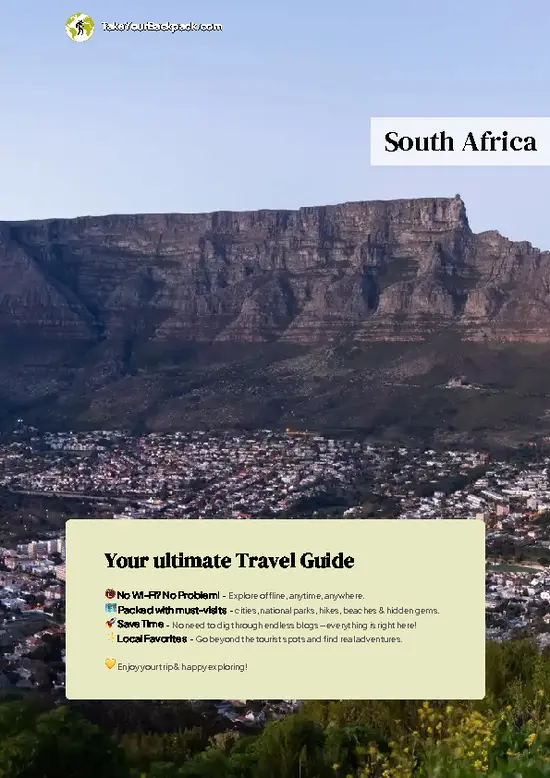
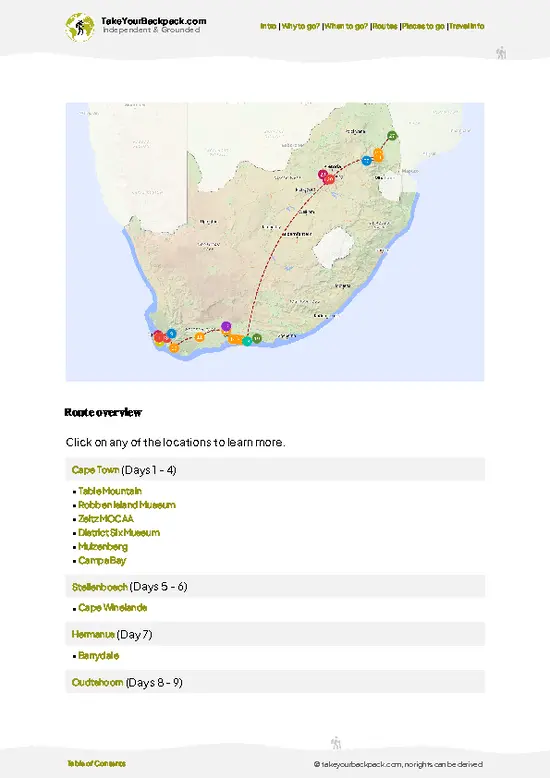
example page 0 from our offline Travel Guide for South Africa
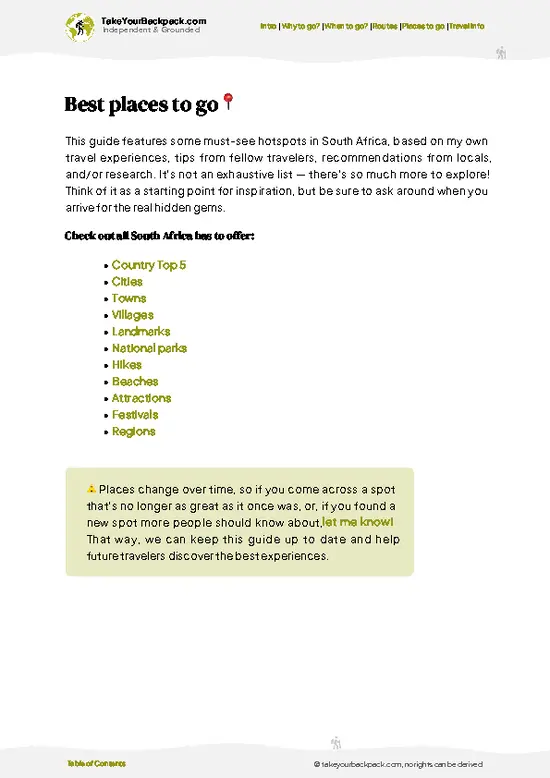
example page 1 from our offline Travel Guide for South Africa
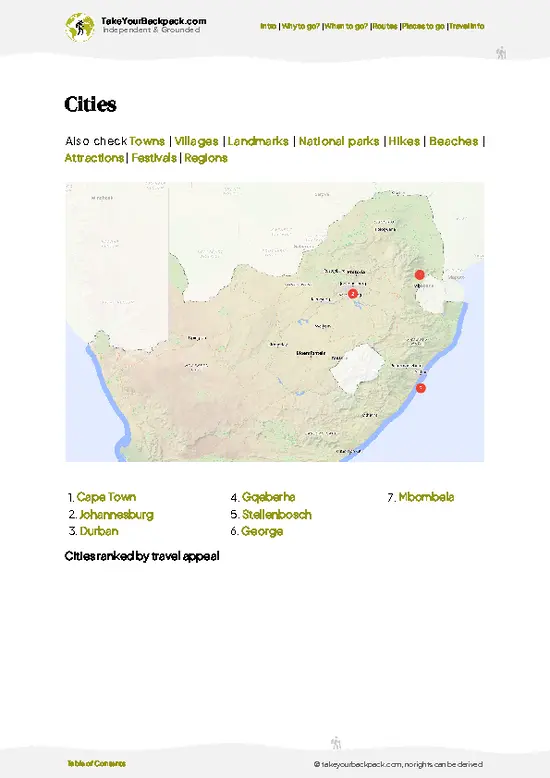
example page 2 from our offline Travel Guide for South Africa
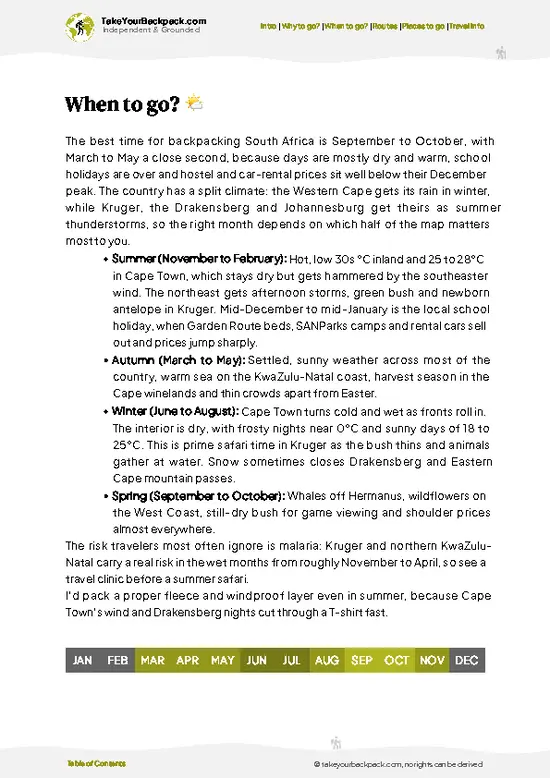
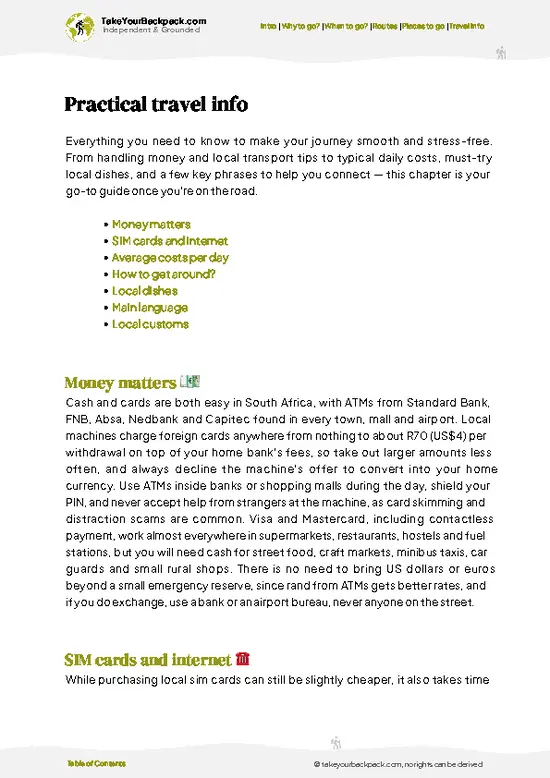
example page 3 from our offline Travel Guide for South Africa
example page 4 from our offline Travel Guide for South Africa
example page 5 from our offline Travel Guide for South Africa
example page 6 from our offline Travel Guide for South Africa
example page 7 from our offline Travel Guide for South Africa
Loading the map 🌍
CLICK TO FILTER
cities
towns
villages
landmarks
national parks
hikes
beaches
attractions
festivals
regions
SHOW COUNTRY’S BESTSHOW ALL

✨ Why go?
Ranked #8 region in South Africa
Why visitors keep coming back

Karoo rewards backpackers who want space and slow days. The landscape changes sharply without much travel: dolerite columns in the Valley of Desolation, fossil-rich plains around Nieu-Bethesda, and mountain passes near Prince Albert, such as Swartberg Pass, a gravel road cut by hand in the 1880s. That variety means you can hike, stargaze and visit museums within a short drive of each other. The second reason is the human scale. Towns are small, guesthouses are family-run, and farm stays let you eat what the neighbors grew or raised. Lamb is the local pride. The third is flexibility. With a car you can string together villages at your own pace, stopping at roadside stalls, dry riverbeds and old farmsteads that no bus passes.

💡 HighlightsDon't-miss highlights and experiences

  1. Valley of Desolation, Graaff-Reinet: dolerite pillars rising about 120 meters above the plain inside Camdeboo National Park. Walk the short rim trail for the widest view.
  2. Karoo National Park, Beaufort West: the main wildlife reserve, with Cape mountain zebra, black rhino and a fossil trail. Drive the Klipspringer Pass loop.
  3. Swartberg Pass: a winding gravel road between Prince Albert and Oudtshoorn, with hairpin turns, stone retaining walls and views of folded rock layers.
  4. Owl House, Nieu-Bethesda: Helen Martins’s home, filled with concrete sculptures of owls, camels and wise men, glittering with crushed glass.
  5. Prince Albert village: a Cape Dutch main street with a farm-produce market, olive presses and dried-fruit stalls.
  6. Hankey Pass viewpoint area, Graaff-Reinet district: a quiet corner of the
… read more 👉
  1. Valley of Desolation, Graaff-Reinet: dolerite pillars rising about 120 meters above the plain inside Camdeboo National Park. Walk the short rim trail for the widest view.
  2. Karoo National Park, Beaufort West: the main wildlife reserve, with Cape mountain zebra, black rhino and a fossil trail. Drive the Klipspringer Pass loop.
  3. Swartberg Pass: a winding gravel road between Prince Albert and Oudtshoorn, with hairpin turns, stone retaining walls and views of folded rock layers.
  4. Owl House, Nieu-Bethesda: Helen Martins’s home, filled with concrete sculptures of owls, camels and wise men, glittering with crushed glass.
  5. Prince Albert village: a Cape Dutch main street with a farm-produce market, olive presses and dried-fruit stalls.
  6. Hankey Pass viewpoint area, Graaff-Reinet district: a quiet corner of the district where local farmers drive to watch the plains turn gold. Few tourists reach it.
  7. Compassberg viewpoint, Nieu-Bethesda: the highest peak in the Sneeuberg range, reached on private farm hikes with permission.
  8. Karoo Fossil Trail, Nieu-Bethesda: the Gondwana-era fossils and dinosaur footprints on the farms around town are a rare thing to touch.
  9. Meiringspoort Waterfall: a short walk in a gorge crossed by the road, with pools beneath the falls and picnic tables.
  10. Fransie Pienaar Museum, Prince Albert: a modest local museum on the history of the village and its farms, loved by locals.
Karoo days work best when you pair the Owl House with the Compassberg viewpoint in Nieu-Bethesda.
Spotted a mistake or missing something? Contact us.

⌛️ 5 daysA smart one-week plan

Slow driving and long breaks from the midday heat set the rhythm in Karoo, since stretches between towns are long and fuel stops rare.

Day 1: Graaff-Reinet: Start in this old town with its Cape Dutch streets, then drive to the Valley of Desolation for late-day views. Staying put early lets you adjust to the dry air and the pace.

Day 2: Nieu-Bethesda: A short, scenic drive brings you to the Owl House and the village's quiet lanes. Use the afternoon for a fossil walk or a farm visit, then eat at one of the pub kitchens in the evening.

Day 3: Karoo National Park: Head west to Beaufort West and spend the day on the park roads, watching zebra and antelope. The reserve gives you a break from villages and fits well between the east and the Swartberg.

Day 4 and 5: Prince Albert: Settle in among … read more 👉
Slow driving and long breaks from the midday heat set the rhythm in Karoo, since stretches between towns are long and fuel stops rare.

Day 1: Graaff-Reinet: Start in this old town with its Cape Dutch streets, then drive to the Valley of Desolation for late-day views. Staying put early lets you adjust to the dry air and the pace.

Day 2: Nieu-Bethesda: A short, scenic drive brings you to the Owl House and the village's quiet lanes. Use the afternoon for a fossil walk or a farm visit, then eat at one of the pub kitchens in the evening.

Day 3: Karoo National Park: Head west to Beaufort West and spend the day on the park roads, watching zebra and antelope. The reserve gives you a break from villages and fits well between the east and the Swartberg.

Day 4 and 5: Prince Albert: Settle in among the olive groves, wander the main street and sample local produce. Detour on the second day into Meiringspoort to see the waterfall and walk beside the river, then return for sunset on the village stoep.

My pick for the one day that justifies the trip is Day 2: Nieu-Bethesda, where the odd Owl House, the empty lanes and the dark sky make Karoo memorable.

🌤️ When to go?Seasonal considerations and timing

Spring and autumn give the Karoo its most comfortable days, with clear skies and walkable temperatures.
  • Spring (Sep to Nov): Days run 20 to 28°C (68 to 82°F), nights cool to 5 to 10°C (41 to 50°F), and wildflowers can carpet the plains after rain.
  • Summer (Dec to Feb): Afternoons hit 35 to 40°C (95 to 104°F) and thunderstorms arrive in the late afternoon. Days are long, but hiking before noon is the only sane option. South African school holidays fill guesthouses and lift prices.
  • Autumn (Mar to May): Warm days of 22 to 30°C (72 to 86°F), crisp nights, and quiet roads.
  • Winter (Jun to Aug): Sunny days reach 15 to 20°C (59 to 68°F), but nights often fall below freezing, and snow dusts the higher peaks. Stargazing is superb and rooms are cheapest.
Book ahead for Easter and December, and pack layers … read more 👉
Spring and autumn give the Karoo its most comfortable days, with clear skies and walkable temperatures.
  • Spring (Sep to Nov): Days run 20 to 28°C (68 to 82°F), nights cool to 5 to 10°C (41 to 50°F), and wildflowers can carpet the plains after rain.
  • Summer (Dec to Feb): Afternoons hit 35 to 40°C (95 to 104°F) and thunderstorms arrive in the late afternoon. Days are long, but hiking before noon is the only sane option. South African school holidays fill guesthouses and lift prices.
  • Autumn (Mar to May): Warm days of 22 to 30°C (72 to 86°F), crisp nights, and quiet roads.
  • Winter (Jun to Aug): Sunny days reach 15 to 20°C (59 to 68°F), but nights often fall below freezing, and snow dusts the higher peaks. Stargazing is superb and rooms are cheapest.
Book ahead for Easter and December, and pack layers year-round, because the desert air swings 20°C (36°F) between afternoon and dawn.


source: climatestotravel.comJANJanuary: good for travelingFEBFebruary: good for travelingMARMarch: highly recommended for travelingAPRApril: highly recommended for travelingMAYMay: highly recommended for travelingJUNJune: good for travelingJULJuly: good for travelingAUGAugust: good for travelingSEPSeptember: excellent for travelingOCTOctober: excellent for travelingNOVNovember: excellent for travelingDECDecember: fair for traveling
when-to-go

✈️ The backpacker research shortcutSouth Africa Travel Guide

An offline-friendly backpacking guide with optimized travel routes, ranked highlights, transport advice, and the best areas to stay.
example page 0 from our offline Travel Guide for South Africa
example page 1 from our offline Travel Guide for South Africa
example page 2 from our offline Travel Guide for South Africa
example page 3 from our offline Travel Guide for South Africa
example page 4 from our offline Travel Guide for South Africa
example page 5 from our offline Travel Guide for South Africa
example page 6 from our offline Travel Guide for South Africa
example page 7 from our offline Travel Guide for South Africa
The digital guide (457 pages) contains:
✅ 125 highlights, ranked by travel appeal
✅ Optimized 7, 14 & 21-day travel routes
✅ Cities, national parks, landmarks, beaches
✅ How to get around
✅ Offline-friendly for travel without Wi-Fi
👉 Click to see all 30+ guide features

📅 Plan smarter in minutes, not weeks
✅ Month by month travel advice
✅ Festivals & national holidays
✅ Budget expectations

🗺️ Go to the right places, skip the overrated ones
✅ Honest pros & cons of destinations
✅ Top hikes, parks & viewpoints
✅ Lesser-known places most travelers miss
✅ Clear “worth it vs skip it” guidance

🛏️ Travel smoothly without rookie mistakes
✅ Best areas to stay
✅ Transport systems explained simply
✅ Common scams & safety advice
✅ SIM cards, money & practical tips

🌍 Understand the country, not just visit it
✅ Culture & traditions
✅ 52 Essential phrases & customs
✅ Festivals worth planning around
✅ Traveler-friendly historical context
✅ Insights that make places more meaningful

📱 Built for real travel conditions
✅ Fully downloadable PDF
✅ Works completely offline
✅ Optimized for phone use
✅ Useful in remote areas & buses
✅ Everything in one place
Stop searching, start planning
Get instant access to your full guide. 30‑day money-back guarantee.
+ Add another guide for just

By proceeding you agree to our terms.
Sent to your inbox immediately after payment • 100% Secure Checkout
Best Backpacking Travel Advisor 2025 tourism awardBest Backpacking
Travel Advisor
2025
What others say about Take Your Backpack Guides:
⭐⭐⭐⭐⭐
Fantastic, amazing amount of information!
⭐⭐⭐⭐⭐
My goodness this is amazing, it's what I've been looking for hats off too you!
⭐⭐⭐⭐⭐
I think this is absolutely BRILLIANT
⭐⭐⭐⭐
Very complete and informative. It's still missing places, but I gotta to commend you
⭐⭐⭐⭐⭐
This is truly amazing, thank you, can't wait to explore it with my kids!
⭐⭐⭐⭐⭐
Awesome resource, thank you!
⭐⭐⭐⭐⭐
This is amazing! Can't wait to explore the ones I haven't seen
⭐⭐⭐⭐
I love this! Well done, great idea.
⭐⭐⭐⭐⭐
Thanks for taking the time to make this gem!
⭐⭐⭐⭐⭐
This might be the best website I've ever seen.
⭐⭐⭐⭐⭐
Congratulations, and thank you so much for your work; it's incredibly valuable.
⭐⭐⭐⭐
In all seriousness I think you did a great job pointing out the important spots
⭐⭐⭐⭐⭐
10/10 very good
⭐⭐⭐⭐⭐
As someone who's only just starting to visit regularly this is awesome, thank you.
⭐⭐⭐⭐
Thank you very much! I'm going to visit my dad, it's going to be very useful!
⭐⭐⭐⭐⭐
This is really cool! We'll be travelling for the first time and this definitely come in handy.
⭐⭐⭐⭐⭐
You are now our minister of culture, congratulations 👨‍💼
⭐⭐⭐⭐⭐
Just wanted to tell you that this is a pearl! Going to follow your recommendations.
⭐⭐⭐⭐⭐
This is so cool. I'll definitely be using the resource for my travels soon.
⭐⭐⭐⭐⭐
This is very impressive! Good work.
⭐⭐⭐⭐⭐
This is an amazing and informative site. Very well done!

🛏️ Where to stay?Where staying makes the most sense

Prince Albert is the easiest base for backpackers in the Karoo, with a walkable main street, small guesthouses and a relaxed crowd of hikers and cyclists. It sits at the foot of the Swartberg Mountains, so Swartberg Pass and Meiringspoort are close, and the evenings are social around local cafés. Budget beds run about US$15 to 30 a night.
Nieu-Bethesda suits travelers who want quiet. It is a tiny village under the Sneeuberg range with a handful of cheap rooms and campsites, star-heavy skies and the famous Owl House, and it feels safe for walking at night. Expect US$12 to 25.
Graaff-Reinet is the … read more 👉
Prince Albert is the easiest base for backpackers in the Karoo, with a walkable main street, small guesthouses and a relaxed crowd of hikers and cyclists. It sits at the foot of the Swartberg Mountains, so Swartberg Pass and Meiringspoort are close, and the evenings are social around local cafés. Budget beds run about US$15 to 30 a night.
Nieu-Bethesda suits travelers who want quiet. It is a tiny village under the Sneeuberg range with a handful of cheap rooms and campsites, star-heavy skies and the famous Owl House, and it feels safe for walking at night. Expect US$12 to 25.
Graaff-Reinet is the practical hub, with the widest choice of hostels and guesthouses, shops and a good base for Camdeboo National Park. It is safe in the historic center and mixes backpackers with road-trippers.
Beaufort West works for a single overnight stop on the N1, with Karoo National Park next door, though it has little nightlife.

🚌 Getting aroundGetting around like a local

Karoo is easiest to get around by renting a car, even for one or two legs, because towns sit 100 to 250 km apart with almost nothing between them. Roads are good and traffic is light, so driving is reliable, while public options are thin and slow. Splitting a rental among three or four travelers usually costs about US$25 to 40 each per day and saves hours of waiting.
  • Long-distance coach: Intercity coaches on the N1 stop at Beaufort West, Laingsburg and Colesberg, with fares around US$20 to 45 between Cape Town and Johannesburg. They are the best value for covering big distances overnight, but they only serve the highway towns, not villages like Prince Albert or Nieu-Bethesda.
  • Shuttle and minibus: Hostel shuttles and private transfers reach off-highway towns for roughly US$30 to 60 per leg. They
… read more 👉
Karoo is easiest to get around by renting a car, even for one or two legs, because towns sit 100 to 250 km apart with almost nothing between them. Roads are good and traffic is light, so driving is reliable, while public options are thin and slow. Splitting a rental among three or four travelers usually costs about US$25 to 40 each per day and saves hours of waiting.
  • Long-distance coach: Intercity coaches on the N1 stop at Beaufort West, Laingsburg and Colesberg, with fares around US$20 to 45 between Cape Town and Johannesburg. They are the best value for covering big distances overnight, but they only serve the highway towns, not villages like Prince Albert or Nieu-Bethesda.
  • Shuttle and minibus: Hostel shuttles and private transfers reach off-highway towns for roughly US$30 to 60 per leg. They cost more than coaches but save you a full day of connections, so they are worth it for tricky spots.
  • Hitchhiking: Possible on quieter roads, but waits can stretch past two hours in 35°C heat with little shade. It is not worth the time or the risk when a shared shuttle exists.
  • Passenger train: The long-distance line through Beaufort West is slow, infrequent and unreliable. Skip it unless you want the novelty, as it gives the least for your time.
Fill the tank at every large town, because stations between them can be 150 km apart and some close early.

🍲 FoodEating & Drinking in Karoo

Karoo lamb is the headline. The animals graze on aromatic scrub, giving the meat a herby, slightly salty depth, best slow-roasted or grilled over coals at a braai. Look for potjiekos (stews cooked in cast-iron pots), boerewors rolls and biltong, the spiced air-dried meat sold in strips at nearly every roadside stop.
For sweet things, try melktert (milk tart dusted with cinnamon), koeksisters sticky with syrup, and Prince Albert’s dried fruit and olives. Drinks include rooibos tea, local craft beer, and fruity wines from the Klein Karoo.
Backpackers eat best at farm stalls, village cafés and pub grills, where a hearty plate costs about US$6 to 12. Supermarkets in larger towns suit self-catering, since hostel kitchens are common.
Be ready for early closing, as many kitchens shut by 8 or 9 pm and … read more 👉
Karoo lamb is the headline. The animals graze on aromatic scrub, giving the meat a herby, slightly salty depth, best slow-roasted or grilled over coals at a braai. Look for potjiekos (stews cooked in cast-iron pots), boerewors rolls and biltong, the spiced air-dried meat sold in strips at nearly every roadside stop.
For sweet things, try melktert (milk tart dusted with cinnamon), koeksisters sticky with syrup, and Prince Albert’s dried fruit and olives. Drinks include rooibos tea, local craft beer, and fruity wines from the Klein Karoo.
Backpackers eat best at farm stalls, village cafés and pub grills, where a hearty plate costs about US$6 to 12. Supermarkets in larger towns suit self-catering, since hostel kitchens are common.
Be ready for early closing, as many kitchens shut by 8 or 9 pm and small towns can be quiet on Sundays. Tipping 10 percent is standard, and a braai invitation is usually a friendly one worth accepting.

FAQTraveler FAQ

Three to five days is enough to cover the main Karoo highlights by car. Spend a day in Prince Albert and the Swartberg Pass, a day in Graaff-Reinet and Camdeboo National Park, and a day at Nieu-Bethesda, with roughly 2 to 3 hours of driving between them. Add a day at Karoo National Park near Beaufort West if you want wildlife.
Getting around Karoo without a car is possible but slow, and relies mainly on intercity coaches along the N1 and shuttles to smaller towns. Coaches cost about US$20 to 45 between Cape Town and Johannesburg and stop at Beaufort West, Laingsburg and Colesberg. Private shuttles to villages like Prince Albert or Nieu-Bethesda run about US$30 to 60 per leg, so book ahead.
Karoo is known for vast semi-desert plains, enormous night skies and some of the best lamb in South Africa. Travelers come for Swartberg Pass, the Owl House in Nieu-Bethesda, Camdeboo National Park’s Valley of Desolation and the fossil-rich landscapes near Beaufort West. It also has Cape Dutch architecture in Graaff-Reinet, South Africa’s fourth-oldest town.
⚠️ Things can change over time, so always validate details locally before you go.

Other South African regions near Karoo

Explore more nearby:

  • Garden Route—coastal forests, lagoons, seaside towns, scenic drives| 197 km away
  • Cape Winelands—vineyard landscapes, Cape Dutch estates, mountain backdrops, cellar tastings| 337 km away
  • Overberg—wheat fields, whale coast, fynbos reserves, mountain passes| 352 km away

💡 Not sure where to go next?
Create a personalized itinerary for South Africa including Karoo and the places that fit your trip.

Generate my itinerary

👉 Discover all regions

Or checkout all South Africa has to offer (think cities, towns, villages, national parks, hikes, beaches, festivals)
Country photo of South Africa

We 💚 feedbackKey takeaways before you go

Karoo trips go wrong when travelers cram in too many towns and spend the day on the road. I would pick two bases, stay at least two nights in each, and leave the afternoons empty. Bring a paper map, offline maps and extra water.

✈️ When did I visit South Africa?
I have visited South Africa, before and after my Zimbabwe trip in 2001.

✍️ Help improve this page!
The information on this page is based on my own backpacking experience in South Africa, supplemented with up-to-date research and feedback from other travelers. Travel details can change, so if you notice anything outdated or incomplete, feel free to let me know.


🙋‍♂️ Give feedback

👋 Meet the founderWho’s Behind Take Your Backpack?

Johan, backpacker and founder of TakeYourBackpackHi, I’m Johan (Netherlands 🇳🇱), the creator of TakeYourBackpack. Over the past 3 decades, I’ve backpacked through 90+ countries across six continents, gaining extensive experience with independent travel, long-term trips, and overland routes.

This site is built on a combination of firsthand travel experience and carefully curated insights from other backpackers. Many guides are based on places I’ve personally visited, while others bring together tips, observations, and practical advice shared by trusted travelers I’ve met along the way.

The goal is to provide realistic, experience-driven guidance — not generic itineraries — so you can explore destinations with better context, clearer expectations, and more confidence.