×

South Sudan🇸🇸 | national parksSouthern National ParkGiant eland, gallery forest, giraffe, roan antelope | things to do and best time to go

Explore Shambe National ParkExplore Lantoto National Park

Backpacking in Southern
👍 Recommendednational park ranked #4
By Johan Kruseman 🇳🇱 | Updated October 22, 2026

Dust coats your tongue as the truck lurches off the track and a herd of tiang antelope scatters through tall, bleached grass. This is Southern National Park, in the southwest of South Sudan, near Wau and the border region with the Central African Republic and DR Congo side of the country. Be plain about it: this is not a park for casual hikers. There are no marked trails, no visitor center and no reliable road network, and the rains turn tracks to soup. What it does offer is raw savanna and woodland, elephants, giraffe, buffalo and rare sightings of the northern white-footed species, with almost no other people around. Skip any plan that relies on spontaneous arrival. Arrange a local guide, an armed escort if advised and a 4x4 before you leave town, check current security first, and carry every liter of water and all your food. Spend your first day confirming permits and the route, then drive in and watch the grassland at dawn.

Discover everything you want to know in the 📖 South Sudan Travel Guide.
Safety warning

The current risk level for South Sudan is high. Check the advice before going.


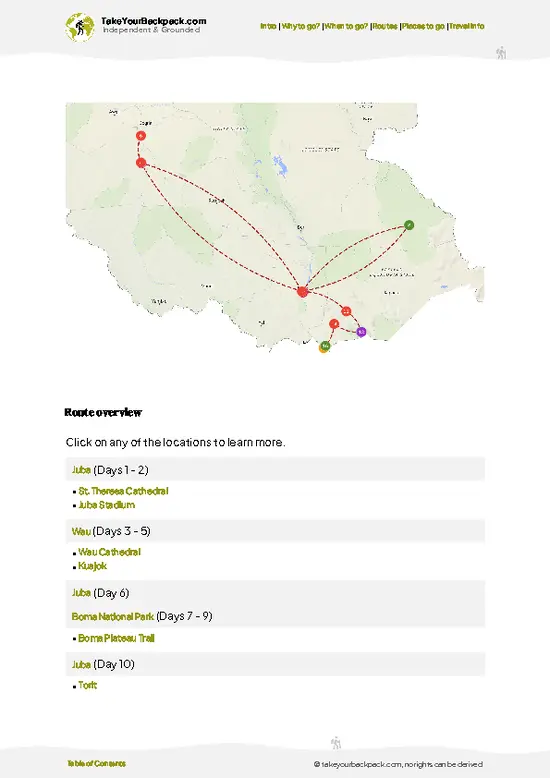
example page 0 from our offline Travel Guide for South Sudan
example page 1 from our offline Travel Guide for South Sudan
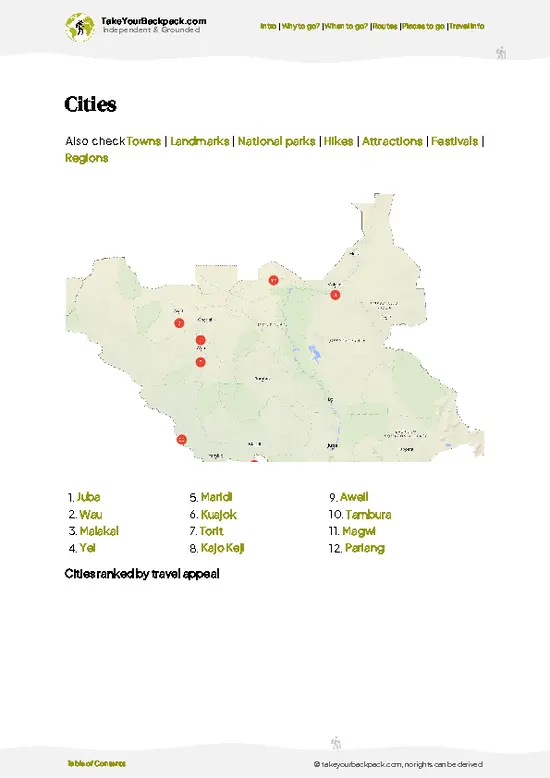
example page 2 from our offline Travel Guide for South Sudan
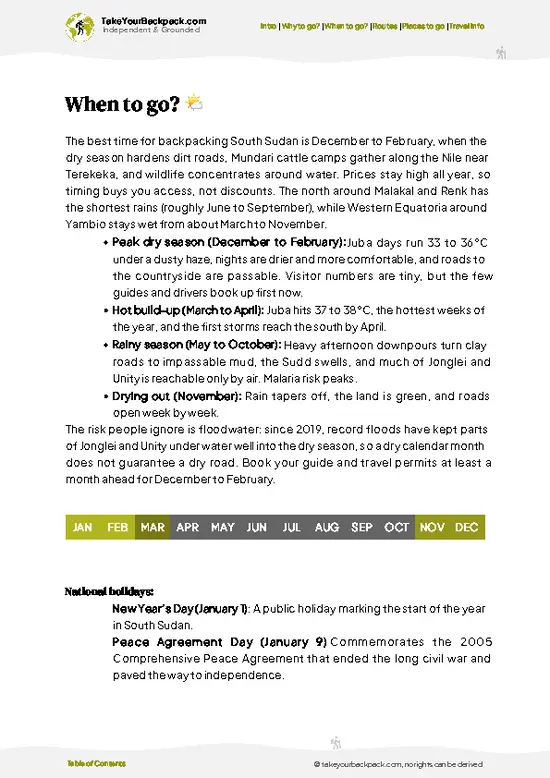
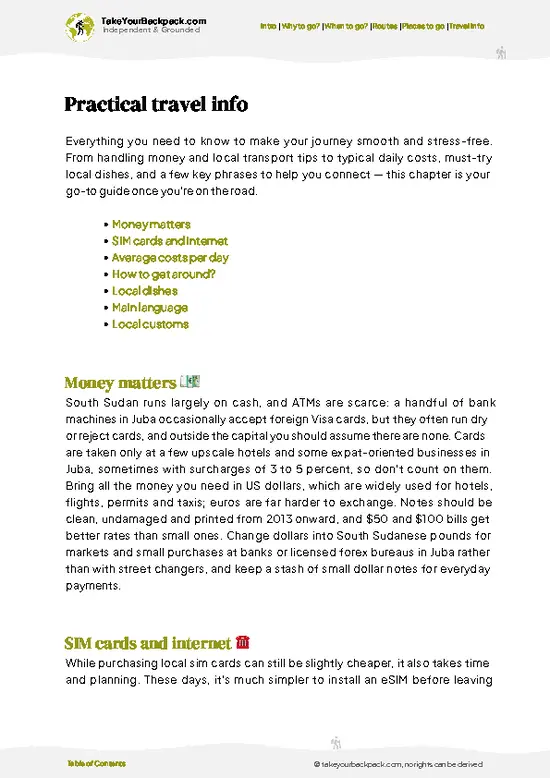
example page 3 from our offline Travel Guide for South Sudan
example page 4 from our offline Travel Guide for South Sudan
example page 5 from our offline Travel Guide for South Sudan
example page 6 from our offline Travel Guide for South Sudan
example page 7 from our offline Travel Guide for South Sudan
Loading the map 🌍
CLICK TO FILTER
cities
towns
landmarks
national parks
hikes
attractions
festivals
regions
SHOW COUNTRY’S BESTSHOW ALL

✨ Why go?
Ranked #4 national park in South Sudan
Why visitors keep coming back

Southern National Park draws backpackers who want wildlife without a single tour bus in sight. It is one of Africa’s oldest protected areas, and the giant eland, the largest antelope on the continent, is among the animals people hope to see here, along with elephants, buffalo and giraffe. Independent exploring works differently here than elsewhere. You will not follow signposted loops. You will walk with armed ranger escorts who know the ground, read tracks and decide where it is safe to go, which makes the park suit self-reliant, flexible travelers far better than anyone wanting a packaged day. The second draw is the sheer lack of other people. Rolling woodland, river forest along watercourses and open grass stretch out with no fences and no souvenir stalls. If you carry your own food, water … read more 👉
Southern National Park draws backpackers who want wildlife without a single tour bus in sight. It is one of Africa’s oldest protected areas, and the giant eland, the largest antelope on the continent, is among the animals people hope to see here, along with elephants, buffalo and giraffe. Independent exploring works differently here than elsewhere. You will not follow signposted loops. You will walk with armed ranger escorts who know the ground, read tracks and decide where it is safe to go, which makes the park suit self-reliant, flexible travelers far better than anyone wanting a packaged day. The second draw is the sheer lack of other people. Rolling woodland, river forest along watercourses and open grass stretch out with no fences and no souvenir stalls. If you carry your own food, water and camping gear and have patience for slow logistics, you get a bush experience of a kind that is rare, quiet and entirely yours. Pair it with the Western Equatoria countryside around Yambio for a longer overland trip.

💡 HighlightsKey sights and experiences for travelers

  1. Giant eland herds: The animal most associated with the park, a spiral-horned antelope that stands over 1.5 meters at the shoulder. Sightings are never guaranteed, so go with rangers who know where herds feed.
  2. Elephants in the woodland: Forest and savanna elephants move through the park, and fresh dung and broken branches tell you they are close long before you see them.
  3. Giraffe on the open grassland: Tall silhouettes above the grass make for good, quiet viewing from a respectful distance.
  4. Buffalo and roan antelope: Herds graze the floodplain edges, and a slow walk upwind gives the best chance of a clear view.
  5. River forest corridors: Dense gallery forest along streams is cooler and loud with birds, hornbills and monkeys among them.
  6. Wide savanna vistas: Rolling grass and scattered trees with no road
… read more 👉
  1. Giant eland herds: The animal most associated with the park, a spiral-horned antelope that stands over 1.5 meters at the shoulder. Sightings are never guaranteed, so go with rangers who know where herds feed.
  2. Elephants in the woodland: Forest and savanna elephants move through the park, and fresh dung and broken branches tell you they are close long before you see them.
  3. Giraffe on the open grassland: Tall silhouettes above the grass make for good, quiet viewing from a respectful distance.
  4. Buffalo and roan antelope: Herds graze the floodplain edges, and a slow walk upwind gives the best chance of a clear view.
  5. River forest corridors: Dense gallery forest along streams is cooler and loud with birds, hornbills and monkeys among them.
  6. Wide savanna vistas: Rolling grass and scattered trees with no road or building in view give a sense of scale that is hard to find elsewhere.
  7. Ranger-led bush walks: Following scouts as they read tracks and signs is the most rewarding way to learn the park.
Southern National Park charges no per-item entry for any of these sights, and the cheapest of all is simply watching birds along the river forest from a quiet spot near camp.
Spotted a mistake or missing something? Contact us.

🌤️ When to go?When to go for the best experience

  • Dry Season (December to March): Roads and tracks are firmest, grass is burnt or cut back, and wildlife is easiest to spot around rivers. Days run 32 to 38°C (90 to 100°F), nights 20 to 24°C (68 to 75°F). Daylight stays near 12 hours.
  • Early Rains (April to June): Storms arrive in the afternoon, grass shoots up and visibility drops. Temperatures sit around 28 to 33°C (82 to 91°F). Tracks start turning to mud.
  • Peak Rains (July to October): Heavy downpours cut off many routes, rivers swell and flooding is common. Highs of 27 to 31°C (81 to 88°F). Access is the hardest of the year, and charter flights and vehicle hire cost more or simply stop.
  • Late Rains (November): Ground dries out and conditions improve week by week, with highs near 32°C (90°F).
Southern National Park has almost no tourist infrastructure, … read more 👉
  • Dry Season (December to March): Roads and tracks are firmest, grass is burnt or cut back, and wildlife is easiest to spot around rivers. Days run 32 to 38°C (90 to 100°F), nights 20 to 24°C (68 to 75°F). Daylight stays near 12 hours.
  • Early Rains (April to June): Storms arrive in the afternoon, grass shoots up and visibility drops. Temperatures sit around 28 to 33°C (82 to 91°F). Tracks start turning to mud.
  • Peak Rains (July to October): Heavy downpours cut off many routes, rivers swell and flooding is common. Highs of 27 to 31°C (81 to 88°F). Access is the hardest of the year, and charter flights and vehicle hire cost more or simply stop.
  • Late Rains (November): Ground dries out and conditions improve week by week, with highs near 32°C (90°F).
Southern National Park has almost no tourist infrastructure, so prices barely shift by season; the real variable is whether the tracks are passable. Plan for the first half of the dry season.


source: climatestotravel.comJANJanuary: excellent for travelingFEBFebruary: excellent for travelingMARMarch: good for travelingAPRApril: fair for travelingMAYMay: fair for travelingJUNJune: fair for travelingJULJuly: fair for travelingAUGAugust: fair for travelingSEPSeptember: fair for travelingOCTOctober: good for travelingNOVNovember: excellent for travelingDECDecember: excellent for traveling
when-to-go

✈️ The backpacker research shortcutSouth Sudan Travel Guide

An offline-friendly backpacking guide with optimized travel routes, ranked highlights, transport advice, and the best areas to stay.
example page 0 from our offline Travel Guide for South Sudan
example page 1 from our offline Travel Guide for South Sudan
example page 2 from our offline Travel Guide for South Sudan
example page 3 from our offline Travel Guide for South Sudan
example page 4 from our offline Travel Guide for South Sudan
example page 5 from our offline Travel Guide for South Sudan
example page 6 from our offline Travel Guide for South Sudan
example page 7 from our offline Travel Guide for South Sudan
The digital guide (242 pages) contains:
✅ 57 highlights, ranked by travel appeal
✅ Optimized 5, 10 & 15-day travel routes
✅ Cities, national parks, landmarks, beaches
✅ How to get around
✅ Offline-friendly for travel without Wi-Fi
👉 Click to see all 30+ guide features

📅 Plan smarter in minutes, not weeks
✅ Month by month travel advice
✅ Festivals & national holidays
✅ Budget expectations

🗺️ Go to the right places, skip the overrated ones
✅ Honest pros & cons of destinations
✅ Top hikes, parks & viewpoints
✅ Lesser-known places most travelers miss
✅ Clear “worth it vs skip it” guidance

🛏️ Travel smoothly without rookie mistakes
✅ Best areas to stay
✅ Transport systems explained simply
✅ Common scams & safety advice
✅ SIM cards, money & practical tips

🌍 Understand the country, not just visit it
✅ Culture & traditions
✅ 52 Essential phrases & customs
✅ Festivals worth planning around
✅ Traveler-friendly historical context
✅ Insights that make places more meaningful

📱 Built for real travel conditions
✅ Fully downloadable PDF
✅ Works completely offline
✅ Optimized for phone use
✅ Useful in remote areas & buses
✅ Everything in one place
Stop searching, start planning
Get instant access to your full guide. 30‑day money-back guarantee.
+ Add another guide for just

By proceeding you agree to our terms.
Sent to your inbox immediately after payment • 100% Secure Checkout
Best Backpacking Travel Advisor 2025 tourism awardBest Backpacking
Travel Advisor
2025
What others say about Take Your Backpack Guides:
⭐⭐⭐⭐⭐
Fantastic, amazing amount of information!
⭐⭐⭐⭐⭐
My goodness this is amazing, it's what I've been looking for hats off too you!
⭐⭐⭐⭐⭐
I think this is absolutely BRILLIANT
⭐⭐⭐⭐
Very complete and informative. It's still missing places, but I gotta to commend you
⭐⭐⭐⭐⭐
This is truly amazing, thank you, can't wait to explore it with my kids!
⭐⭐⭐⭐⭐
Awesome resource, thank you!
⭐⭐⭐⭐⭐
This is amazing! Can't wait to explore the ones I haven't seen
⭐⭐⭐⭐
I love this! Well done, great idea.
⭐⭐⭐⭐⭐
Thanks for taking the time to make this gem!
⭐⭐⭐⭐⭐
This might be the best website I've ever seen.
⭐⭐⭐⭐⭐
Congratulations, and thank you so much for your work; it's incredibly valuable.
⭐⭐⭐⭐
In all seriousness I think you did a great job pointing out the important spots
⭐⭐⭐⭐⭐
10/10 very good
⭐⭐⭐⭐⭐
As someone who's only just starting to visit regularly this is awesome, thank you.
⭐⭐⭐⭐
Thank you very much! I'm going to visit my dad, it's going to be very useful!
⭐⭐⭐⭐⭐
This is really cool! We'll be travelling for the first time and this definitely come in handy.
⭐⭐⭐⭐⭐
You are now our minister of culture, congratulations 👨‍💼
⭐⭐⭐⭐⭐
Just wanted to tell you that this is a pearl! Going to follow your recommendations.
⭐⭐⭐⭐⭐
This is so cool. I'll definitely be using the resource for my travels soon.
⭐⭐⭐⭐⭐
This is very impressive! Good work.
⭐⭐⭐⭐⭐
This is an amazing and informative site. Very well done!

🛏️ Where to stay?Choosing the right base

No lodges or campgrounds operate inside Southern National Park, so most travelers sleep in Yambio or Juba and arrange everything else through local contacts. The park lies in Western Equatoria, and Yambio is the realistic gateway, with a handful of basic guesthouses and church-run rooms that offer a bed, a mosquito net and sometimes a generator-powered fan. Expect simple concrete rooms and shared bathrooms. Book ahead by phone where possible, since stock is small.

Juba is the main entry point for the country and has far more choice, from hostel-style rooms and mid-range hotels to riverside camps … read more 👉
No lodges or campgrounds operate inside Southern National Park, so most travelers sleep in Yambio or Juba and arrange everything else through local contacts. The park lies in Western Equatoria, and Yambio is the realistic gateway, with a handful of basic guesthouses and church-run rooms that offer a bed, a mosquito net and sometimes a generator-powered fan. Expect simple concrete rooms and shared bathrooms. Book ahead by phone where possible, since stock is small.

Juba is the main entry point for the country and has far more choice, from hostel-style rooms and mid-range hotels to riverside camps along the Nile. Many have secure compounds, restaurants and reliable generators, which makes it the place to restock, change money and organize permits, travel passes and a driver before heading south and west.

Inside the park, wild camping with a local ranger or guide is the only option, and it needs a self-contained setup: tent, water filter, food and a satellite communicator. Never camp without permission from local authorities or rangers. Smaller towns such as Nzara and Maridi can offer a room with a local family or mission, but nothing is guaranteed, so carry a tent as backup.

👛 Costs (as of 22 October 2026)Money, prices, and spending tips

A realistic budget for Southern National Park is about US$85 to 150 per day, driven mostly by transport and guides rather than fees or beds.
CategoryBudget RangeLocal Reality
Entrance feeUS$0 to 20No formal ticketing system is reliably in place; local authorities or wildlife officials may ask for a payment or permit fee.
Accommodation (high season)US$15 to 40Basic guesthouses in Yambio; Juba runs higher at US$50 to 120. Camping in the park costs nothing but needs your own gear.
Local transportUS$20 to 50Shared minibuses and motorbike taxis between towns; hiring a 4x4 with driver is US$150 to 250 a day, usually shared.
Guide or rangerUS$15 to 30Essential for navigation and security; negotiate a daily rate and tip afterward.
Food and suppliesUS$10 to 25Simple meals of beans, rice, fish and cassava
… read more 👉
A realistic budget for Southern National Park is about US$85 to 150 per day, driven mostly by transport and guides rather than fees or beds.
CategoryBudget RangeLocal Reality
Entrance feeUS$0 to 20No formal ticketing system is reliably in place; local authorities or wildlife officials may ask for a payment or permit fee.
Accommodation (high season)US$15 to 40Basic guesthouses in Yambio; Juba runs higher at US$50 to 120. Camping in the park costs nothing but needs your own gear.
Local transportUS$20 to 50Shared minibuses and motorbike taxis between towns; hiring a 4x4 with driver is US$150 to 250 a day, usually shared.
Guide or rangerUS$15 to 30Essential for navigation and security; negotiate a daily rate and tip afterward.
Food and suppliesUS$10 to 25Simple meals of beans, rice, fish and cassava at small restaurants; bring snacks and water purification from Juba.
Total Daily BudgetUS$85 to 150Cash in US dollars is widely preferred; cards and ATMs are unreliable outside Juba.
⚠️ Prices can change and everyone travels differently, so take this as a rough guide. Hope it helps you plan your adventure!

🥾 TrailsBest hikes in Southern national park

Southern National Park has no developed network of signposted trails, so walks follow ranger routes, animal paths and old tracks through the park. Distances and times depend on the day’s conditions and the guides’ judgment.
  • Grassland walks: Typically a few hours from camp across open savanna. Flat to gently rolling, with tall grass in the wet months that limits visibility. Easy to moderate in effort, but heat is the main challenge.
  • River forest loops: Shaded walks along streams, usually two to three hours. Ground can be muddy and uneven, and roots and fallen trunks slow you down. Good for birds
… read more 👉
Southern National Park has no developed network of signposted trails, so walks follow ranger routes, animal paths and old tracks through the park. Distances and times depend on the day’s conditions and the guides’ judgment.
  • Grassland walks: Typically a few hours from camp across open savanna. Flat to gently rolling, with tall grass in the wet months that limits visibility. Easy to moderate in effort, but heat is the main challenge.
  • River forest loops: Shaded walks along streams, usually two to three hours. Ground can be muddy and uneven, and roots and fallen trunks slow you down. Good for birds and monkeys.
  • Tracking walks for big game: Longer outings, often half a day, following elephant or buffalo sign. Moderate difficulty, with quiet movement and obeying the rangers’ instructions essential.
  • Terrain: Black clay soil, termite mounds, seasonal swamps and scattered woodland. Carry plenty of water, sun protection and sturdy boots.
  • Wildlife: Giant eland, elephant, buffalo, giraffe, roan antelope and many bird species. Keep distance from elephants and buffalo at all times.
Practical matters are the hard part. Public transport to the park is essentially absent, and travelers arrive by 4x4 or charter from Juba or Yambio over rough roads that can be impassable in the rains. Crowds are not a concern: you may be the only visitors. Access depends on security conditions and on permission from wildlife authorities, so confirm in advance and expect fees to be negotiated and paid in cash in US dollars. Bring everything you need, including food, water treatment, a first-aid kit and spare fuel.
⚠️ Hiking info can sometimes be outdated or inaccurate. Before you hit the trail, check the latest conditions with locals. If you do spot anything that's off, I'd love to hear from you, so I can update it for fellow travelers.

🛡️ SafetyScams, Hazards, and Annoyances

Southern National Park is remote, thinly managed and sits in a region where security can shift quickly, so the biggest hazards are logistical rather than animal. Check current conditions with local authorities, humanitarian agencies or your embassy before leaving Yambio, and travel with a local guide or ranger who knows the area. Some areas near the border with the Democratic Republic of the Congo and the Central African Republic have seen armed groups, so route choice matters.

Heat is constant. Start walking at first light, carry at least 4 liters of water per person and filter everything else. Malaria is a serious risk year-round, so take prophylaxis and use a net. Tracks turn to mud in the rains, and tall grass hides footing and snakes, so wear closed boots. Elephants and buffalo exist … read more 👉
Southern National Park is remote, thinly managed and sits in a region where security can shift quickly, so the biggest hazards are logistical rather than animal. Check current conditions with local authorities, humanitarian agencies or your embassy before leaving Yambio, and travel with a local guide or ranger who knows the area. Some areas near the border with the Democratic Republic of the Congo and the Central African Republic have seen armed groups, so route choice matters.

Heat is constant. Start walking at first light, carry at least 4 liters of water per person and filter everything else. Malaria is a serious risk year-round, so take prophylaxis and use a net. Tracks turn to mud in the rains, and tall grass hides footing and snakes, so wear closed boots. Elephants and buffalo exist but are wary; keep distance and never walk at night. Carry a first-aid kit, satellite communicator and printed permits, as there is no mobile coverage.

FAQCommon questions from travelers

Plan on 4 to 6 days for Southern National Park, and more if you count the overland travel. Getting from Juba to Yambio takes a day or more by road or a short domestic flight, and tracks into the park can be slow. Two or three days inside with a guide is enough for a first visit.
Visiting Southern National Park without a car is very difficult, because there is no public transport inside the park. You can reach Yambio by bus or flight from Juba, then hire a motorbike or share a 4x4 with a driver for roughly US$150 to 250 a day. Walking in with a ranger is possible for short stretches only.
Southern National Park has no reliably operating ticket office, but you should expect to arrange permission and possibly a fee of around US$0 to 20 through local wildlife authorities or county officials. Carry a South Sudan visa, a travel permit from Juba and printed copies of any letters. Always carry small US dollar notes for payments.
⚠️ Things can change over time, so always validate details locally before you go.

Other South Sudanese national parks near Southern

Explore more nearby:


💡 Not sure where to go next?
Create a personalized itinerary for South Sudan including Southern and the places that fit your trip.

Generate my itinerary

👉 Discover all national parks

Or checkout all South Sudan has to offer (think cities, towns, villages, national parks, hikes, beaches, festivals)
Country photo of South Sudan

We 💚 feedbackFinal thoughts on exploring Southern

Southern National Park rewards a stay of three to four days, enough to settle into the ranger rhythm and give the animals a fair chance to show up. One day is mostly wasted on logistics. I would bring more food and cash than seems sensible, and arrange the escort before leaving Juba.

✍️ Help improve this page!
The information on this page is based on in-depth research, insights shared by experienced travelers, and feedback from the local travel community in South Sudan. While every effort is made to keep the information accurate and current, conditions can change — so if you spot anything incorrect or outdated, please get in touch.


🙋‍♂️ Give feedback

👋 Meet the founderWho’s Behind Take Your Backpack?

Johan, backpacker and founder of TakeYourBackpackHi, I’m Johan (Netherlands 🇳🇱), the creator of TakeYourBackpack. Over the past 3 decades, I’ve backpacked through 90+ countries across six continents, gaining extensive experience with independent travel, long-term trips, and overland routes.

This site is built on a combination of firsthand travel experience and carefully curated insights from other backpackers. Many guides are based on places I’ve personally visited, while others bring together tips, observations, and practical advice shared by trusted travelers I’ve met along the way.

The goal is to provide realistic, experience-driven guidance — not generic itineraries — so you can explore destinations with better context, clearer expectations, and more confidence.