×

Sudan🇸🇩 | festivalsNuba Wrestling FestivalNuba Mountains, ash-painted wrestlers, post-harvest bouts, village rivalry | things to do and best time to go

Explore Sufi FestivalExplore Shendi Camel Race Festival

Backpacking in Nuba Wrestling
🏆 Top pickfestival ranked #2
By Johan Kruseman 🇳🇱 | Updated October 22, 2026

Nuba wrestling is a run of village tournaments timed to the post-harvest season, so there is no single ticketed festival with a fixed date. It takes place in the Nuba Mountains of South Kordofan, in southern Sudan, on dusty village grounds ringed by granite hills. Expect drums, ash-covered wrestlers and a crowd of neighbors, not a stage show. I expected brutality. What surprised me was a bout ending in seconds when one man’s back touched the ground, after which the loser laughed and embraced the winner. Plan around the real risks. Dates shift with each village, so confirm locally rather than booking around a rumor. Permits and road conditions cause the longest delays, so sort them early with a local guide. Ask before photographing wrestlers, and do not turn up uninvited. Unlike the city matches in Omdurman played for urban crowds, these contests are tied to a village’s harvest and its rivalries.

Discover everything you want to know in the 📖 Sudan Travel Guide.
Safety warning

The current risk level for Sudan is high. Check the advice before going.


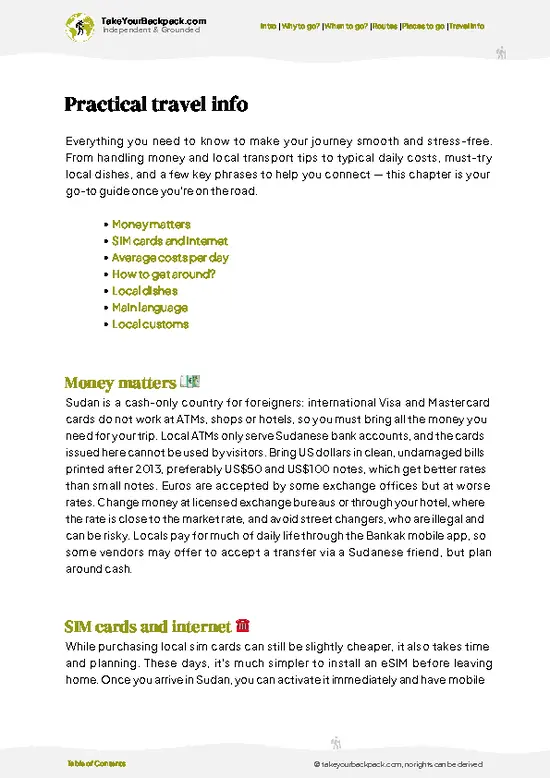
example page 0 from our offline Travel Guide for Sudan
example page 1 from our offline Travel Guide for Sudan
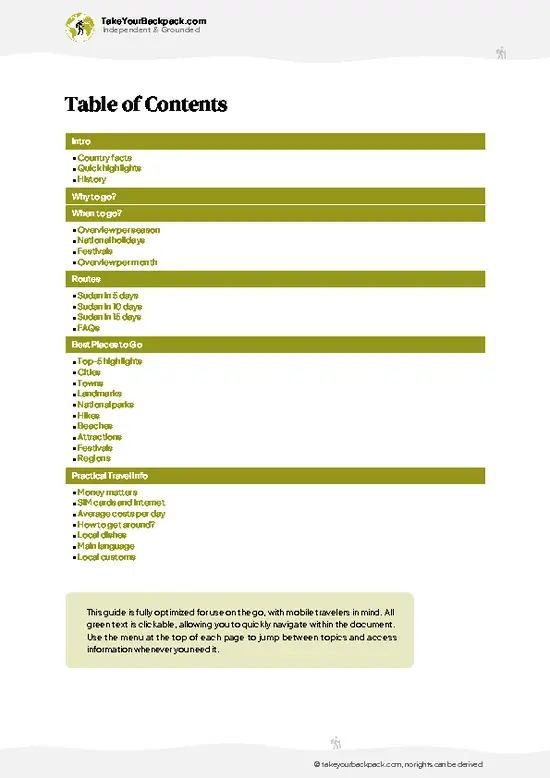
example page 2 from our offline Travel Guide for Sudan
example page 3 from our offline Travel Guide for Sudan
example page 4 from our offline Travel Guide for Sudan
example page 5 from our offline Travel Guide for Sudan
example page 6 from our offline Travel Guide for Sudan
example page 7 from our offline Travel Guide for Sudan
Loading the map 🌍
CLICK TO FILTER
cities
towns
landmarks
national parks
hikes
beaches
attractions
festivals
regions
SHOW COUNTRY’S BESTSHOW ALL

✨ Why go?
Ranked #2 festival in Sudan
What sets this place apart

Nuba Wrestling Festival draws travelers who want to watch a tradition that is still a community event, not a performance for visitors. Bouts follow the post-harvest season, when granaries are full and young men from neighboring villages challenge each other, so the crowd is mostly families, elders and drummers. You stand shoulder to shoulder with locals, and a polite introduction through a host gets you a front-row spot and a seat in the shade.

The second reason is the setting. The Nuba Mountains rise from the Kordofan plain in rocky outcrops, and getting there means passing through farming villages that most itineraries never touch. Few places in Sudan reward overland travelers with such a clear sense of arriving somewhere real.

It also fits well into a longer Sudan route. Wrestling days … read more 👉
Nuba Wrestling Festival draws travelers who want to watch a tradition that is still a community event, not a performance for visitors. Bouts follow the post-harvest season, when granaries are full and young men from neighboring villages challenge each other, so the crowd is mostly families, elders and drummers. You stand shoulder to shoulder with locals, and a polite introduction through a host gets you a front-row spot and a seat in the shade.

The second reason is the setting. The Nuba Mountains rise from the Kordofan plain in rocky outcrops, and getting there means passing through farming villages that most itineraries never touch. Few places in Sudan reward overland travelers with such a clear sense of arriving somewhere real.

It also fits well into a longer Sudan route. Wrestling days are short, so the festival works as the anchor of a trip that adds Kordofan’s markets and hill villages. Costs stay low next to organized cultural events elsewhere in Africa, because there are no entry gates, only the expense of getting there and a guide you trust.

💡 HighlightsPlaces and moments you shouldn't skip

  1. The wrestling bouts: This is what the festival is known for. Two barefoot men circle in a ring of spectators, grip and twist until one falls, and the contest is often over in moments. Bouts follow strict etiquette, and the crowd cheers winners and losers alike.
  2. Ash and oil body decoration: Wrestlers rub their skin with ash and oil before a match, and the patterns tie to village and age group. It looks striking in the open light, and it is worth asking permission before taking photographs.
  3. Drumming and song: Drummers and singers set the pace and lift the crowd. The rhythm changes as contests heat up, and spectators clap, call out and join choruses that seem to carry across the whole village.
  4. Village rivalry and arrival processions: Teams enter in groups, often trailed by supporters, and pride
… read more 👉
  1. The wrestling bouts: This is what the festival is known for. Two barefoot men circle in a ring of spectators, grip and twist until one falls, and the contest is often over in moments. Bouts follow strict etiquette, and the crowd cheers winners and losers alike.
  2. Ash and oil body decoration: Wrestlers rub their skin with ash and oil before a match, and the patterns tie to village and age group. It looks striking in the open light, and it is worth asking permission before taking photographs.
  3. Drumming and song: Drummers and singers set the pace and lift the crowd. The rhythm changes as contests heat up, and spectators clap, call out and join choruses that seem to carry across the whole village.
  4. Village rivalry and arrival processions: Teams enter in groups, often trailed by supporters, and pride in the home village runs through every match. Watching the entrances shows how much the event is about community standing.
  5. Granite hill villages of the Nuba Mountains: Rocky outcrops, farmland and clustered homes frame the matches. Walking between villages on foot or by vehicle, with a local host, shows farming life that continues around the wrestling days.
Nuba Wrestling Festival fits into one to three days, depending on how many villages you visit.
Spotted a mistake or missing something? Contact us.

🌤️ When to go?When is the celebration of Nuba Wrestling Festival?

Nuba Wrestling Festival runs through the dry season after the harvest, roughly December to February, with bouts held on afternoons across several days in the villages around Kadugli in South Kordofan, and the dates follow the harvest and local village agreements rather than a fixed calendar.
  • Best day: Choose the main inter-village bout day, when champions from rival communities arrive with drummers and singers, over the smaller warm-up matches.
  • Weather: Days reach 30 to 35°C (86 to 95°F) and nights drop to 15 to 20°C (59 to 68°F). Rain is absent, dust is common, and daylight lasts about 11 hours. Bring a scarf, sunglasses, a hat, a warm layer and 3 liters of water.
  • Booking: Arrange your guide, permits and a bed or host family at least 3 to 4 weeks ahead. Prices for rooms and rides rise 20 to
… read more 👉
Nuba Wrestling Festival runs through the dry season after the harvest, roughly December to February, with bouts held on afternoons across several days in the villages around Kadugli in South Kordofan, and the dates follow the harvest and local village agreements rather than a fixed calendar.
  • Best day: Choose the main inter-village bout day, when champions from rival communities arrive with drummers and singers, over the smaller warm-up matches.
  • Weather: Days reach 30 to 35°C (86 to 95°F) and nights drop to 15 to 20°C (59 to 68°F). Rain is absent, dust is common, and daylight lasts about 11 hours. Bring a scarf, sunglasses, a hat, a warm layer and 3 liters of water.
  • Booking: Arrange your guide, permits and a bed or host family at least 3 to 4 weeks ahead. Prices for rooms and rides rise 20 to 40 percent around match days.
  • Roads: Reach the venue a day early, since vehicles fill fast and tracks are slow. Leave the morning after the final bouts, when pickups crowd the road.
Confirm the match date with a local contact in Kadugli the week you travel, as bouts are often moved by a day.


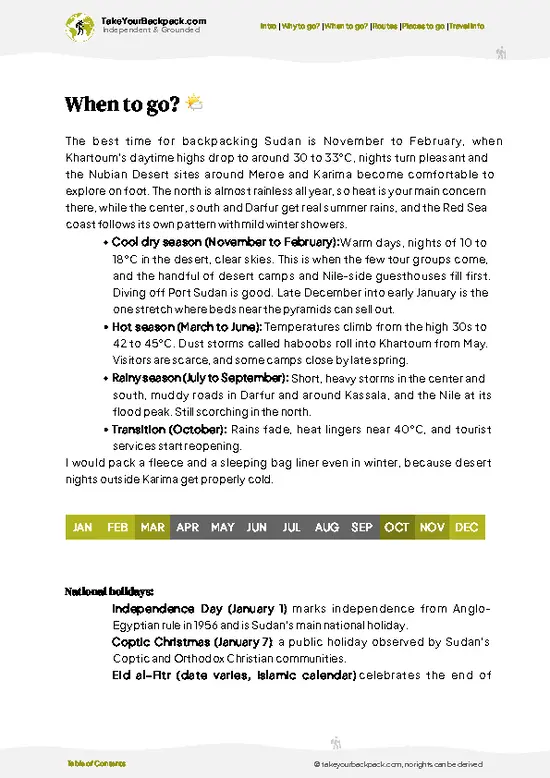
source: climatestotravel.comJANJanuary: highly recommended for travelingFEBFebruary: highly recommended for travelingMARMarch: not recommended for travelingAPRApril: not recommended for travelingMAYMay: not recommended for travelingJUNJune: not recommended for travelingJULJuly: not recommended for travelingAUGAugust: not recommended for travelingSEPSeptember: not recommended for travelingOCTOctober: not recommended for travelingNOVNovember: highly recommended for travelingDECDecember: highly recommended for traveling

✈️ The backpacker research shortcutSudan Travel Guide

An offline-friendly backpacking guide with optimized travel routes, ranked highlights, transport advice, and the best areas to stay.
example page 0 from our offline Travel Guide for Sudan
example page 1 from our offline Travel Guide for Sudan
example page 2 from our offline Travel Guide for Sudan
example page 3 from our offline Travel Guide for Sudan
example page 4 from our offline Travel Guide for Sudan
example page 5 from our offline Travel Guide for Sudan
example page 6 from our offline Travel Guide for Sudan
example page 7 from our offline Travel Guide for Sudan
The digital guide (268 pages) contains:
✅ 62 highlights, ranked by travel appeal
✅ Optimized 5, 10 & 15-day travel routes
✅ Cities, national parks, landmarks, beaches
✅ How to get around
✅ Offline-friendly for travel without Wi-Fi
👉 Click to see all 30+ guide features

📅 Plan smarter in minutes, not weeks
✅ Month by month travel advice
✅ Festivals & national holidays
✅ Budget expectations

🗺️ Go to the right places, skip the overrated ones
✅ Honest pros & cons of destinations
✅ Top hikes, parks & viewpoints
✅ Lesser-known places most travelers miss
✅ Clear “worth it vs skip it” guidance

🛏️ Travel smoothly without rookie mistakes
✅ Best areas to stay
✅ Transport systems explained simply
✅ Common scams & safety advice
✅ SIM cards, money & practical tips

🌍 Understand the country, not just visit it
✅ Culture & traditions
✅ 52 Essential phrases & customs
✅ Festivals worth planning around
✅ Traveler-friendly historical context
✅ Insights that make places more meaningful

📱 Built for real travel conditions
✅ Fully downloadable PDF
✅ Works completely offline
✅ Optimized for phone use
✅ Useful in remote areas & buses
✅ Everything in one place
Stop searching, start planning
Get instant access to your full guide. 30‑day money-back guarantee.
+ Add another guide for just

By proceeding you agree to our terms.
Sent to your inbox immediately after payment • 100% Secure Checkout
Best Backpacking Travel Advisor 2025 tourism awardBest Backpacking
Travel Advisor
2025
What others say about Take Your Backpack Guides:
⭐⭐⭐⭐⭐
Fantastic, amazing amount of information!
⭐⭐⭐⭐⭐
My goodness this is amazing, it's what I've been looking for hats off too you!
⭐⭐⭐⭐⭐
I think this is absolutely BRILLIANT
⭐⭐⭐⭐
Very complete and informative. It's still missing places, but I gotta to commend you
⭐⭐⭐⭐⭐
This is truly amazing, thank you, can't wait to explore it with my kids!
⭐⭐⭐⭐⭐
Awesome resource, thank you!
⭐⭐⭐⭐⭐
This is amazing! Can't wait to explore the ones I haven't seen
⭐⭐⭐⭐
I love this! Well done, great idea.
⭐⭐⭐⭐⭐
Thanks for taking the time to make this gem!
⭐⭐⭐⭐⭐
This might be the best website I've ever seen.
⭐⭐⭐⭐⭐
Congratulations, and thank you so much for your work; it's incredibly valuable.
⭐⭐⭐⭐
In all seriousness I think you did a great job pointing out the important spots
⭐⭐⭐⭐⭐
10/10 very good
⭐⭐⭐⭐⭐
As someone who's only just starting to visit regularly this is awesome, thank you.
⭐⭐⭐⭐
Thank you very much! I'm going to visit my dad, it's going to be very useful!
⭐⭐⭐⭐⭐
This is really cool! We'll be travelling for the first time and this definitely come in handy.
⭐⭐⭐⭐⭐
You are now our minister of culture, congratulations 👨‍💼
⭐⭐⭐⭐⭐
Just wanted to tell you that this is a pearl! Going to follow your recommendations.
⭐⭐⭐⭐⭐
This is so cool. I'll definitely be using the resource for my travels soon.
⭐⭐⭐⭐⭐
This is very impressive! Good work.
⭐⭐⭐⭐⭐
This is an amazing and informative site. Very well done!

🛏️ Where to stay?How to pick the right area

Kadugli is the best base for Nuba Wrestling Festival, because it is the main town of the Nuba Mountains, has the most beds and sits within a short pickup ride of the villages where matches happen.
Staying in town gives you a social setup. Simple guesthouses and rooms around the central market area put you near shared pickups, tea sellers and the people who arrange guides and travel permits. Solo travelers can split vehicle costs here, which matters because transport out to the wrestling grounds is the biggest expense. The market streets are busy by day and quiet after dark, so walking back at night … read more 👉
Kadugli is the best base for Nuba Wrestling Festival, because it is the main town of the Nuba Mountains, has the most beds and sits within a short pickup ride of the villages where matches happen.
Staying in town gives you a social setup. Simple guesthouses and rooms around the central market area put you near shared pickups, tea sellers and the people who arrange guides and travel permits. Solo travelers can split vehicle costs here, which matters because transport out to the wrestling grounds is the biggest expense. The market streets are busy by day and quiet after dark, so walking back at night is usually fine, but a local host or guide who knows the neighborhood is still a good idea.
For a deeper experience, ask your guide about a homestay in a village close to the matches. You sleep in a family compound, often on a rope bed in the open air, and eat what the household cooks. It is basic, with no hot water and limited power, but you wake up already at the venue and get to know the wrestlers’ families.
Talodi and Dilling are alternatives if bouts are held in their areas, though lodging there is thinner. El Obeid works as a gateway city with more choice, but it adds a long road leg before the festival.

👛 Costs (as of 22 October 2026)Typical daily expenses

Nuba Wrestling Festival costs roughly US$38 to 90 per person per day for an independent traveler, with most of the money going to transport, a guide and permits rather than entry.
CategoryBudget RangeLocal Reality
Festival ticketsUS$0 to 5Matches are open village events with no ticket. Visitors sometimes give a small contribution to the host community.
Accommodation (high season)US$12 to 25A basic room in Kadugli or a village homestay with a rope bed. Prices climb on match days.
Local transportUS$6 to 15Shared pickups and motorbike taxis to the wrestling grounds. Hiring a whole vehicle costs far more.
Food & drinksUS$5 to 10Porridge and stew meals, grilled meat and sweet tea. Cash only, usually in the local currency.
Miscellaneous expensesUS$15 to 35Local guide or translator, travel permit fees
… read more 👉
Nuba Wrestling Festival costs roughly US$38 to 90 per person per day for an independent traveler, with most of the money going to transport, a guide and permits rather than entry.
CategoryBudget RangeLocal Reality
Festival ticketsUS$0 to 5Matches are open village events with no ticket. Visitors sometimes give a small contribution to the host community.
Accommodation (high season)US$12 to 25A basic room in Kadugli or a village homestay with a rope bed. Prices climb on match days.
Local transportUS$6 to 15Shared pickups and motorbike taxis to the wrestling grounds. Hiring a whole vehicle costs far more.
Food & drinksUS$5 to 10Porridge and stew meals, grilled meat and sweet tea. Cash only, usually in the local currency.
Miscellaneous expensesUS$15 to 35Local guide or translator, travel permit fees and camera permission. Bring water and a power bank.
Total Daily BudgetUS$38 to 90Splitting a guide and vehicle with other travelers lowers the cost.


source: sudan.gov.sd
⚠️ Prices can change and everyone travels differently, so take this as a rough guide. Hope it helps you plan your adventure!

🍲 FoodLocal Cuisine & Drinks

Food at Nuba Wrestling Festival is village cooking and roadside tea rather than a stall circuit, so expect to eat what the host community serves.
The staple is asida, a thick sorghum porridge, eaten with a scoop of mullah, a stew of dried okra, meat or tomato. You tear off a piece with your right hand and dip it in the shared bowl. Grilled goat and kebab appear on bigger match days, and you may be offered kisra, a thin fermented flatbread.
Tea and coffee are the main drinks. Women running small charcoal setups under trees pour sweet shai, often spiced with ginger, and jebena coffee in tiny cups. Hibiscus karkade and a cold sorghum drink are sold in bottles and jugs when available. Alcohol is not part of the scene in most areas, and the traditional sorghum brew is a household matter, so accept … read more 👉
Food at Nuba Wrestling Festival is village cooking and roadside tea rather than a stall circuit, so expect to eat what the host community serves.
The staple is asida, a thick sorghum porridge, eaten with a scoop of mullah, a stew of dried okra, meat or tomato. You tear off a piece with your right hand and dip it in the shared bowl. Grilled goat and kebab appear on bigger match days, and you may be offered kisra, a thin fermented flatbread.
Tea and coffee are the main drinks. Women running small charcoal setups under trees pour sweet shai, often spiced with ginger, and jebena coffee in tiny cups. Hibiscus karkade and a cold sorghum drink are sold in bottles and jugs when available. Alcohol is not part of the scene in most areas, and the traditional sorghum brew is a household matter, so accept it only if a host offers it.
Etiquette matters. Wait to be invited to a shared bowl, take from the section in front of you, and thank the cook. Say yes to the first tea, since refusing can look rude. Pay in cash only, in small notes, and carry snacks and bottled water from Kadugli because supplies at the grounds run out by midday.

FAQTraveler FAQ

Nuba Wrestling Festival takes place in the dry season after the harvest, roughly December to February, in villages around Kadugli in the Nuba Mountains of South Kordofan. There is no fixed calendar, so match days are set by local communities and can shift by a day. Bouts usually run across several afternoons, and the main inter-village day is the best one to catch.
Attending Nuba Wrestling Festival is mostly free, since matches are open village events, though a small contribution of US$0 to 5 to the host community is common. The real costs are a basic room at US$12 to 25 a night, shared pickup transport at US$6 to 15 a day, and a guide with permits at US$15 to 35. Expect a total of about US$38 to 90 per day.
Nuba Wrestling Festival does not sell tickets, so you only need to arrange your trip in advance, not an entry pass. Book a local guide, travel permits and a bed in Kadugli or a village homestay at least 3 to 4 weeks ahead, since beds and vehicles fill on match days. Bring cash in small notes, as there are no card payments at the grounds.
⚠️ Things can change over time, so always validate details locally before you go.

Other Sudanese festivals near Nuba Wrestling

Explore more nearby:


💡 Not sure where to go next?
Create a personalized itinerary for Sudan including Nuba Wrestling and the places that fit your trip.

Generate my itinerary

👉 Discover all festivals

Or checkout all Sudan has to offer (think cities, towns, villages, national parks, hikes, beaches, festivals)
Country photo of Sudan

We 💚 feedbackParting advice and final tips

Nuba Wrestling Festival suits patient travelers who enjoy local culture watched up close, not scheduled shows, and who are happy to rely on a local host. If you need fixed times and comfortable logistics, skip it. I would go with a trusted guide, confirm dates close to departure, and carry small gifts for your hosts.

✈️ When did I visit Sudan?
Sudan I visited back in October 2017. I combined the trip with a visit to Ethiopia.

✍️ Help improve this page!
The information on this page is based on my own backpacking experience in Sudan, supplemented with up-to-date research and feedback from other travelers. Travel details can change, so if you notice anything outdated or incomplete, feel free to let me know.


🙋‍♂️ Give feedback

👋 Meet the founderWho’s Behind Take Your Backpack?

Johan, backpacker and founder of TakeYourBackpackHi, I’m Johan (Netherlands 🇳🇱), the creator of TakeYourBackpack. Over the past 3 decades, I’ve backpacked through 90+ countries across six continents, gaining extensive experience with independent travel, long-term trips, and overland routes.

This site is built on a combination of firsthand travel experience and carefully curated insights from other backpackers. Many guides are based on places I’ve personally visited, while others bring together tips, observations, and practical advice shared by trusted travelers I’ve met along the way.

The goal is to provide realistic, experience-driven guidance — not generic itineraries — so you can explore destinations with better context, clearer expectations, and more confidence.