×

Syria🇸🇾 | best national parksDiscover the 4 Best national parks Across Syria

Syria has very few formally managed national parks, so expect protected areas rather than polished park systems. The coastal mountains around Latakia offer forest, cooler air and the easiest access by minibus. The central steppe and desert reserves are open, empty and hard to reach without a driver. The southern and interior highlands sit in between. None of them has the visitor centers, marked trails or booking systems of Jordan or Turkey. Independent travel and backpacking work only if you accept improvised logistics, local hosts and paying cash. Skip these places if you want ranger-led infrastructure. Go if you want quiet landscapes and little company.

By Johan Kruseman 🇳🇱 | Updated October 19, 2026
Explore the best hikes in Syria

Why go?Key Factors That Shape the Experience

Syria is a poor match for the conventional national park trip, and it is better to know that before booking. The country’s protected areas are few, and the state of management varies. Most have no signage, no ticket office, and little published information. Years of conflict and weak funding left the conservation system thin, and some rural areas still carry unexploded ordnance. Staying on established roads and tracks is a firm rule.

What Syria does offer is geographic range in a small area. Within one country you get Mediterranean forested ridges, semi-arid steppe, river valleys and true desert, and they are separated by only a few hours of driving. Human history is layered over almost all of it. Shepherds, farmers and village communities use the land, so you are rarely in empty wilderness … read more 👉
Syria is a poor match for the conventional national park trip, and it is better to know that before booking. The country’s protected areas are few, and the state of management varies. Most have no signage, no ticket office, and little published information. Years of conflict and weak funding left the conservation system thin, and some rural areas still carry unexploded ordnance. Staying on established roads and tracks is a firm rule.

What Syria does offer is geographic range in a small area. Within one country you get Mediterranean forested ridges, semi-arid steppe, river valleys and true desert, and they are separated by only a few hours of driving. Human history is layered over almost all of it. Shepherds, farmers and village communities use the land, so you are rarely in empty wilderness and you will often meet people who know the terrain.

The practical conclusion is that Syria suits travelers who treat nature as an add-on to a wider cultural trip, not as the reason to come. Hire local guides and drivers, carry cash in US dollars and check your government’s travel advisory and current road conditions before committing. If your priority is long-distance trekking with reliable maps and huts, Turkey, Lebanon or Jordan will serve you far better.
How the List Was Created
The list of best national parks in Syria is created based on landscapes, wildlife, adventure opportunities, facilities, and overall experience. If you feel a national park is missing in this list, please let us know.

When to go?Seasonal Guide to Visiting

Best months: April to May and October to early November are the best months, because daytime temperatures sit at roughly 18 to 28°C across most regions and the rains have either finished or not yet arrived. Spring brings green hillsides and the strongest flowering in the steppe. Autumn is drier and clearer, with better visibility on the coast and in the mountains.Summer and winter: June to August is not worth the effort inland. Damascus and the central plains regularly reach 35 to 40°C, and the desert interior can pass 40°C with almost no shade, which makes walking miserable and unsafe. The coast is cooler at 28 to 33°C but humid, and the coastal mountains give the only real relief at higher elevations. Winter, from December to February, is cold and wet in the west. The coast gets roughly … read more 👉
Best months: April to May and October to early November are the best months, because daytime temperatures sit at roughly 18 to 28°C across most regions and the rains have either finished or not yet arrived. Spring brings green hillsides and the strongest flowering in the steppe. Autumn is drier and clearer, with better visibility on the coast and in the mountains.Summer and winter: June to August is not worth the effort inland. Damascus and the central plains regularly reach 35 to 40°C, and the desert interior can pass 40°C with almost no shade, which makes walking miserable and unsafe. The coast is cooler at 28 to 33°C but humid, and the coastal mountains give the only real relief at higher elevations. Winter, from December to February, is cold and wet in the west. The coast gets roughly 600 to 1,000 mm of rain a year, most of it in these months, and higher ridges can see snow and closed roads. Inland areas get far less, around 100 to 250 mm, but nights drop close to freezing.Crowds and prices: Crowds are minimal in every season, so timing is a weather decision, not a queue decision. The one exception is the Eid holidays and summer weekends, when Syrian families fill the coastal hills and minibus seats and cheap rooms disappear. Midweek travel in spring avoids this. Prices for guides and drivers rise modestly at those peaks, usually by 10 to 25 percent.

national park hoppingSuggested Travel Strategies

Trip length: A trip combining several protected areas in Syria needs 7 to 10 days, because road conditions and checkpoints make every transfer slower than the map suggests. Three regions cluster logically: the coastal mountains near Latakia, the central corridor around Homs and Hama, and the desert interior reached through Palmyra. Damascus works as the arrival and departure hub.Direction and timing: Start in Damascus, go north to Homs, and then decide between desert and coast. Doing the desert first while you are fresh is sensible, since it needs the most preparation. Allow 1 to 2 days per stop, and 2 to 3 in the coastal hills if you want to hike rather than just look. Damascus to Homs takes around 2 to 2.5 hours by road. Homs to Palmyra takes 2.5 to 3 hours. Damascus to Latakia takes 4 to … read more 👉
Trip length: A trip combining several protected areas in Syria needs 7 to 10 days, because road conditions and checkpoints make every transfer slower than the map suggests. Three regions cluster logically: the coastal mountains near Latakia, the central corridor around Homs and Hama, and the desert interior reached through Palmyra. Damascus works as the arrival and departure hub.Direction and timing: Start in Damascus, go north to Homs, and then decide between desert and coast. Doing the desert first while you are fresh is sensible, since it needs the most preparation. Allow 1 to 2 days per stop, and 2 to 3 in the coastal hills if you want to hike rather than just look. Damascus to Homs takes around 2 to 2.5 hours by road. Homs to Palmyra takes 2.5 to 3 hours. Damascus to Latakia takes 4 to 5 hours, and Homs to Latakia roughly 2 to 2.5.Mistakes to avoid: The most common mistake is squeezing desert and coast into one day each. Syrian road conditions, fuel supply and checkpoint waits eat hours, so leave a buffer day in a 7-day plan. Another is trying to rely on public transport to reach the reserves themselves. Minibuses stop in towns, not at trailheads, so arrange a driver or a local guide for the last stretch. Do not drive after dark outside cities. Finally, do not plan more than two regions in under a week. Fewer regions seen properly beats a long list seen from a car window.

The ListHighly Recommended national parks of Syria

1 Jabal al-Sheikh Reserve

snow-capped peak, alpine flora, border views

Ascend toward a snow-topped summit with alpine plants underfoot and panoramic views stretching across several countries.

syria-national-park-jabal-al-sheikh-reserve
© Google |

2 Al-Lajat Nature Reserve

basalt fields, volcanic terrain, scattered villages

Navigate a stark volcanic plateau where ancient lava flows shape the land, dotted with isolated communities and resilient desert flora.

syria-national-park-al-lajat-nature-reserve
© Google |

3 Jabal Abdul Aziz Nature Reserve

limestone ridge, semi-arid steppe, rare gazelles

Walk along a rugged limestone ridge and scan open steppe for elusive wildlife, with distant horizons and few signs of modern life.

4 Jabal al-Bilas Reserve

arid hills, open steppe, wild sheep habitat

Traverse dry hills and wide-open steppe, keeping an eye out for native sheep and the subtle changes in desert vegetation.

Loading the map 🌍

Expert viewInsights from Locals and Experts

How many to visit: Visit two protected areas, three at most. Syria’s transfers are slow, services are thin, and each stop needs arranged transport and a local contact. A third stop only makes sense if it shares a region with one of the first two, because adding a new region costs a full day of driving for very little extra time on foot.Choosing between kinds: Pick the coastal forest areas if you want hiking, cooler air and the easiest logistics. Go for the desert and steppe reserves if you want solitude and open landscape and you are comfortable with a hired driver and a guide. Skip any interior site that cannot be confirmed as open and cleared by a local guide in the days before you arrive. It is not worth a long drive to find a closed track. Travelers on a tight timeline should choose the … read more 👉
How many to visit: Visit two protected areas, three at most. Syria’s transfers are slow, services are thin, and each stop needs arranged transport and a local contact. A third stop only makes sense if it shares a region with one of the first two, because adding a new region costs a full day of driving for very little extra time on foot.Choosing between kinds: Pick the coastal forest areas if you want hiking, cooler air and the easiest logistics. Go for the desert and steppe reserves if you want solitude and open landscape and you are comfortable with a hired driver and a guide. Skip any interior site that cannot be confirmed as open and cleared by a local guide in the days before you arrive. It is not worth a long drive to find a closed track. Travelers on a tight timeline should choose the coast. Those with more time and a taste for emptiness should add the desert.Costs that catch people out: Budget US$35 to 70 a day for a backpacker who shares transport and eats locally, including a basic room at US$10 to 25. Entry fees where they exist are small, usually US$1 to 5, and many areas charge nothing. The real expense is access. A local guide costs around US$20 to 50 a day, and a driver with a car runs US$60 to 120 a day depending on distance and fuel. Split these with other travelers. Do not rely on cards or ATMs, which are unreliable. Carry enough clean US dollar notes for the whole trip and a smaller amount of Syrian pounds for small purchases. Torn or old notes are often refused, so bring crisp ones. Also carry your own water, food and offline maps, because shops near reserves are scarce.Delays and mistakes: Checkpoints can add 30 minutes to several hours to a transfer, so never schedule a flight or border crossing on the same day as a long drive. Arrange the guide in advance through your hotel in Damascus or a reputable local agency, not on arrival at a site. Hiring someone on the spot is how travelers overpay by half or end up with a guide who does not know the area. Do not leave marked roads or tracks. Unexploded ordnance remains a risk in some rural and former front-line areas, and a local guide’s knowledge is the only reliable protection. Check your government’s advisory and recent local conditions before every leg.Cultural considerations: Dress modestly, with long trousers and covered shoulders for everyone, and more conservative clothing for women in rural areas. Ask before photographing people, military sites and checkpoints. Accepting tea from shepherds and villagers is normal and polite, and a small payment for a meal or a night in a village home is appreciated. Do not fly a drone. It will draw immediate attention from security forces.

✈️ The backpacker research shortcutSyria Travel Guide

An offline-friendly backpacking guide with optimized travel routes, ranked highlights, transport advice, and the best areas to stay.
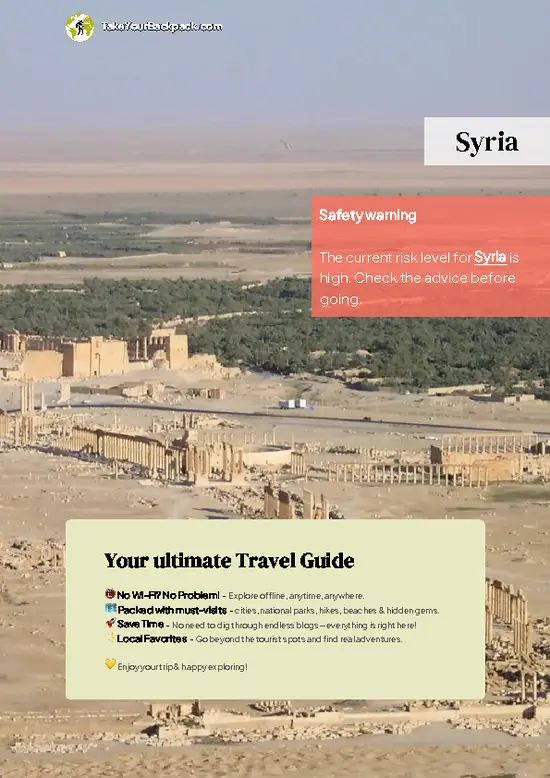
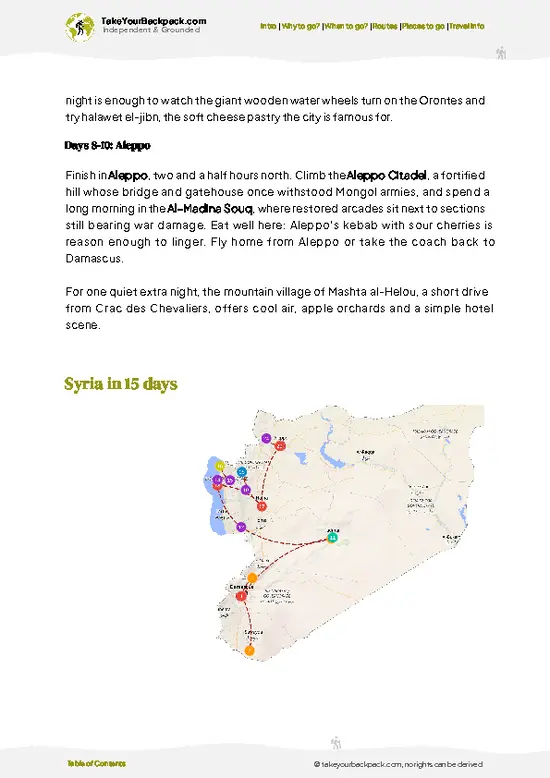
example page 0 from our offline Travel Guide for Syria
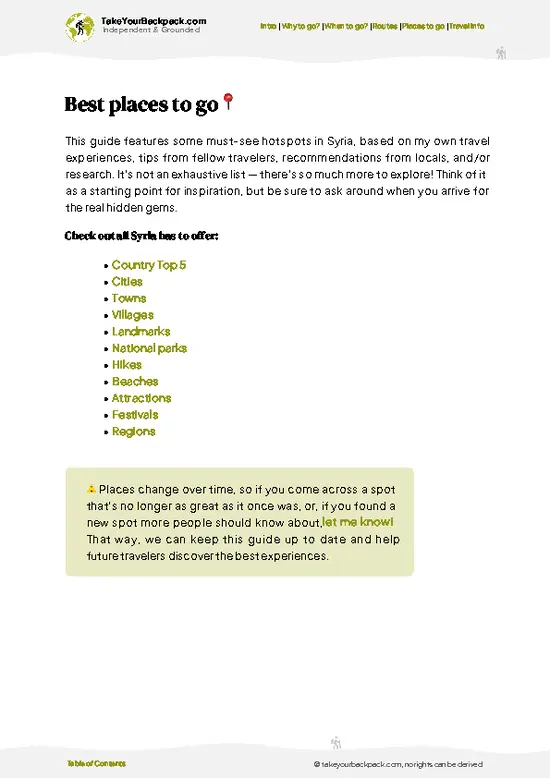
example page 1 from our offline Travel Guide for Syria
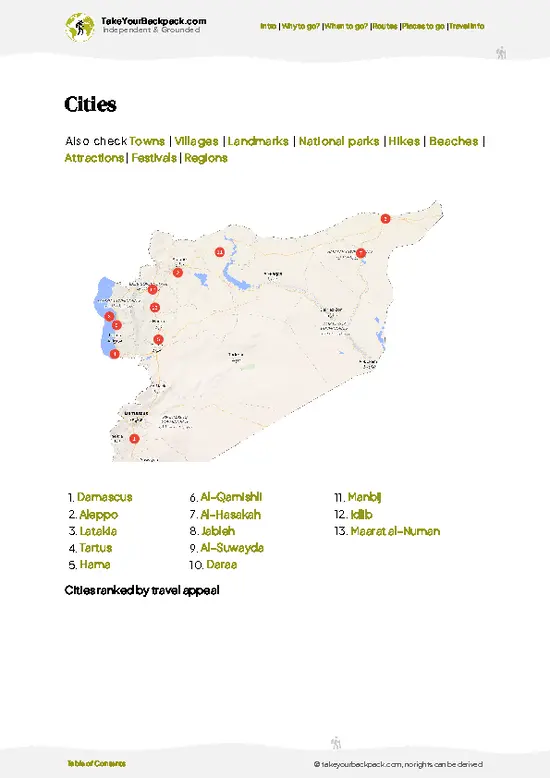
example page 2 from our offline Travel Guide for Syria
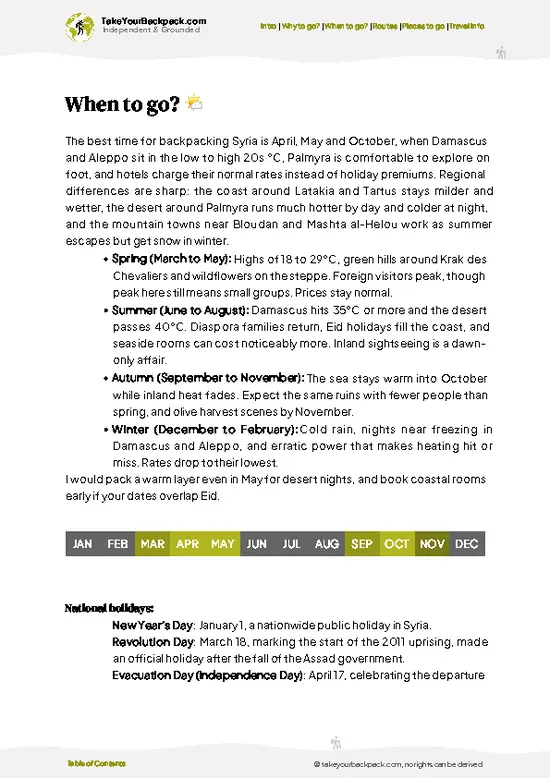
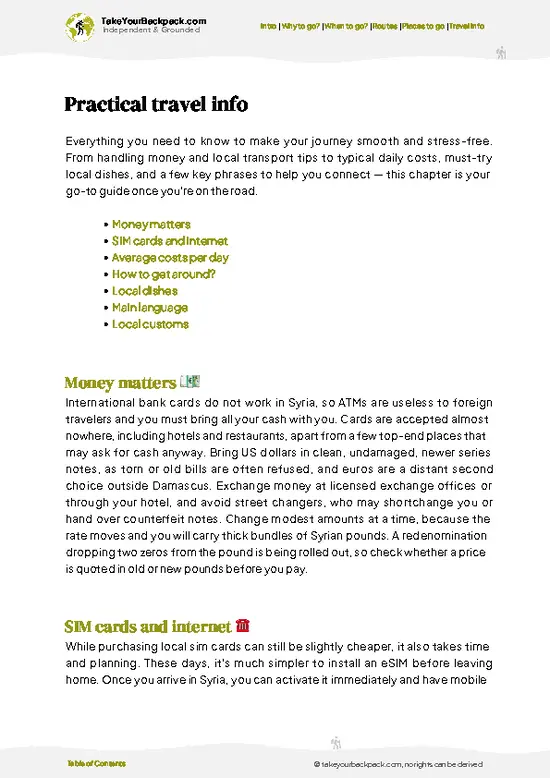
example page 3 from our offline Travel Guide for Syria
example page 4 from our offline Travel Guide for Syria
example page 5 from our offline Travel Guide for Syria
example page 6 from our offline Travel Guide for Syria
example page 7 from our offline Travel Guide for Syria
The digital guide (288 pages) contains:
✅ 70 highlights, ranked by travel appeal
✅ Optimized 5, 10 & 15-day travel routes
✅ Cities, national parks, landmarks, beaches
✅ How to get around
✅ Offline-friendly for travel without Wi-Fi
👉 Click to see all 30+ guide features

📅 Plan smarter in minutes, not weeks
✅ Month by month travel advice
✅ Festivals & national holidays
✅ Budget expectations

🗺️ Go to the right places, skip the overrated ones
✅ Honest pros & cons of destinations
✅ Top hikes, parks & viewpoints
✅ Lesser-known places most travelers miss
✅ Clear “worth it vs skip it” guidance

🛏️ Travel smoothly without rookie mistakes
✅ Best areas to stay
✅ Transport systems explained simply
✅ Common scams & safety advice
✅ SIM cards, money & practical tips

🌍 Understand the country, not just visit it
✅ Culture & traditions
✅ 52 Essential phrases & customs
✅ Festivals worth planning around
✅ Traveler-friendly historical context
✅ Insights that make places more meaningful

📱 Built for real travel conditions
✅ Fully downloadable PDF
✅ Works completely offline
✅ Optimized for phone use
✅ Useful in remote areas & buses
✅ Everything in one place
Stop searching, start planning
Get instant access to your full guide. 30‑day money-back guarantee.
+ Add another guide for just

By proceeding you agree to our terms.
Sent to your inbox immediately after payment • 100% Secure Checkout
Best Backpacking Travel Advisor 2025 tourism awardBest Backpacking
Travel Advisor
2025
What others say about Take Your Backpack Guides:
⭐⭐⭐⭐⭐
Fantastic, amazing amount of information!
⭐⭐⭐⭐⭐
My goodness this is amazing, it's what I've been looking for hats off too you!
⭐⭐⭐⭐⭐
I think this is absolutely BRILLIANT
⭐⭐⭐⭐
Very complete and informative. It's still missing places, but I gotta to commend you
⭐⭐⭐⭐⭐
This is truly amazing, thank you, can't wait to explore it with my kids!
⭐⭐⭐⭐⭐
Awesome resource, thank you!
⭐⭐⭐⭐⭐
This is amazing! Can't wait to explore the ones I haven't seen
⭐⭐⭐⭐
I love this! Well done, great idea.
⭐⭐⭐⭐⭐
Thanks for taking the time to make this gem!
⭐⭐⭐⭐⭐
This might be the best website I've ever seen.
⭐⭐⭐⭐⭐
Congratulations, and thank you so much for your work; it's incredibly valuable.
⭐⭐⭐⭐
In all seriousness I think you did a great job pointing out the important spots
⭐⭐⭐⭐⭐
10/10 very good
⭐⭐⭐⭐⭐
As someone who's only just starting to visit regularly this is awesome, thank you.
⭐⭐⭐⭐
Thank you very much! I'm going to visit my dad, it's going to be very useful!
⭐⭐⭐⭐⭐
This is really cool! We'll be travelling for the first time and this definitely come in handy.
⭐⭐⭐⭐⭐
You are now our minister of culture, congratulations 👨‍💼
⭐⭐⭐⭐⭐
Just wanted to tell you that this is a pearl! Going to follow your recommendations.
⭐⭐⭐⭐⭐
This is so cool. I'll definitely be using the resource for my travels soon.
⭐⭐⭐⭐⭐
This is very impressive! Good work.
⭐⭐⭐⭐⭐
This is an amazing and informative site. Very well done!

🛏️ Where to stay?Where to Base Yourself

True dorm-style hostels are rare in Syria, but budget guesthouses and small family-run hotels are easy to find, with private rooms typically running US$15 to 35 a night. In Damascus, the Old City around Bab Touma and Bab Sharqi has the most character, with courtyard houses and lively cafes and bars within walking distance of the main sights, though street noise carries late into the evening. Marjeh, near Martyrs’ Square, has the cheapest rooms close to transport and souqs but feels grittier after dark, while in Aleppo the area around Bab al-Faraj keeps you near the citadel and old souqs with fewer evening options.

If you enjoy meeting fellow travelers, consider choosing hostels with high ratings … read more 👉
True dorm-style hostels are rare in Syria, but budget guesthouses and small family-run hotels are easy to find, with private rooms typically running US$15 to 35 a night. In Damascus, the Old City around Bab Touma and Bab Sharqi has the most character, with courtyard houses and lively cafes and bars within walking distance of the main sights, though street noise carries late into the evening. Marjeh, near Martyrs’ Square, has the cheapest rooms close to transport and souqs but feels grittier after dark, while in Aleppo the area around Bab al-Faraj keeps you near the citadel and old souqs with fewer evening options.

If you enjoy meeting fellow travelers, consider choosing hostels with high ratings for atmosphere. On the other hand, if you prefer having your own space, a hotel might be a better option.

SyriaExpand Your Journey

👋 Meet the founderWho’s Behind Take Your Backpack?

Johan, backpacker and founder of TakeYourBackpackHi, I’m Johan (Netherlands 🇳🇱), the creator of TakeYourBackpack. Over the past 3 decades, I’ve backpacked through 90+ countries across six continents, gaining extensive experience with independent travel, long-term trips, and overland routes.

This site is built on a combination of firsthand travel experience and carefully curated insights from other backpackers. Many guides are based on places I’ve personally visited, while others bring together tips, observations, and practical advice shared by trusted travelers I’ve met along the way.

The goal is to provide realistic, experience-driven guidance — not generic itineraries — so you can explore destinations with better context, clearer expectations, and more confidence.